Serra do Mar, Southern Brazil
1Maurício Bergamini Scheer2,4 and Alan Yukio Mocochinski3
Received: 11.01.2016; accepted: 8.07.2016
ABSTRACT - (Upper montane grassland structure within six subranges of Serra do Mar, Southern Brazil). The phytosociological structure of upper montane grasslands (high altitude grasslands) was studied in six subranges of Serra do Mar. Throughout 324 (1 m2) plot samples, we identified 195 taxa out of 280 taxa previously found in a floristic survey. Besides the general analysis of these communities, five physiognomies (synusiae) of these grasslands were previously determined based upon the species with greater cover. Cryptangium triquetrum and Croton mullerianus had the highest phytosociological importance value among the upper montane grasslands sampled in the present study. The first species was the most important of the grassy physiognomy of all sampled subranges and the second one of the shrubby physiognomy within three subranges. Chusquea pinifolia, Machaerina austrobrasiliensis, Deschampsia caespitosa, Gleichenella pectitata, Tibouchina dubia, Xyris stenophylla, Eryngium koehnearum and Eriochrysis holcoides were also structurally important. Although considerable species richness has been observed, the dominance of one or few species in the community was common in all subranges and physiognomies. In a brief comparison with upper montane vegetation studies (mainly on rocky outcrops) carried out in Southeastern Brazil, a low sharing of species was verified. Furthermore, the scarcity of studies in the literature regarding floristic and sociological structure of upper montane grasslands hampers a deeper analysis at level of species.
Keywords: high altitude grassland, phytosociology, Sea Mountain Range
RESUMO - (Estrutura de campos altomontanos de seis serras no sul do Brasil). A estrutura fitossociológica de Campos Altomontanos foi avaliada em montanhas pertencentes a seis blocos da Serra do Mar, no Estado do Paraná: Serra Gigante, Serra do Ibitiraquire, Serra da Farinha Seca, Serra da Igreja, Serra da Prata e Serra da Pedra Branca do Araraquara. Em 324 parcelas de 1 m², foram amostrados 195 taxa, dos 280 encontrados em estudo florístico prévio. Além da análise geral dessas comunidades, foram pré-definidas cinco fisionomias vegetacionais (sinúsias) com base nas espécies com provável maior destaque na cobertura. Cryptangium triquetrum e Croton mullerianus apresentaram-se como as principais espécies dos campos altomontanos amostrados na Serra do Mar paranaense. A primeira foi a espécie mais importante em todos os trechos de fisionomia campestre, enquanto a segunda destacou-se na fisionomia subarbustiva em três serras amostradas. Chusquea pinifolia, Machaerina austrobrasiliensis, Deschampsia caespitosa, Gleichenella pectitata, Tibouchina dubia, Xyris stenophylla, Eryngium koehnearum e Eriochrysis holcoides também se destacaram em diversos trechos e fisionomias. Apesar de considerável riqueza, a dominância de uma ou poucas espécies nas comunidades avaliadas foi uma constante em todas as serras e fitofisionomias. Em uma breve comparação com estudos realizados em vegetações altomontanas, principalmente sobre afloramentos de rocha no Sudeste do Brasil, foi verificado um baixo compartilhamento de espécies com os campos altomontanos do presente estudo. A escassez de trabalhos publicados sobre a florística e a estrutura fitossociológica desses campos, dificulta análises mais aprofundadas em nível de espécie.
Palavras-chave: Campos de altitude, Campos de “alta”altitude, fitossociologia, Serra do Mar
1. Parte deste artigo é parte atualizada da Dissertação de Mestrado do segundo Autor
2. SANEPAR - Companhia de Saneamento do Paraná (APD/CETS/DMA), Rua Engenheiro Antônio Batista Ribas, 151, Tarumã, 82800-130 Curitiba, PR, Brasil
3. ICMBio - Instituto Chico Mendes de Conservação da Biodiversidade ICMBio, Área de Proteção Ambiental de Guaraqueçaba, Praça Carlos Cavalcanti, 48, Estação Ferroviária, 83370-000 Antonina, PR, Brasil
4. Corresponding author: [email protected]
Introduction
Standing out in a context of montane and upper montane forests, the natural landscape at the top of
several mountain ranges is largely occupied by grassland vegetation. The highland regions of both Serra do Mar and Serra da Mantiqueira present about 350 km2 of high
Many descriptions for the various grassland formations of plateau surfaces and mountain ranges of Brazil have been reported in the literature by several authors. However, these descriptions often result in confusion, redundant and inaccurate categorization of such environments, especially for those higher level mountain ranges (e.g. alpine, mountaintop and steppe-like grasslands, upper montane or high elevation refuges, ecological refuges, upper montane herbaceous plant refuges, rocky grasslands (rocky outocrop vegetation), high-altitude rupestrian grasslands, the Atlantic Forest biome grasslands, altitude grasslands (campos de altitude, a generic term), upper montane grasslands (campos de “alta” altitude or “campos altomontanos”, etc.) (e.g. Rizzini 1979, Ferri 1980, Veloso et al. 1991, IBGE 1992, Martinelli 1996, Safford 1999a, b, Tramujas 2000, Roderjan et al. 2002, Caiafa & Silva 2005, 2007, Garcia & Pirani, 2005, Ribeiro et al. 2007, Mocochinski & Scheer 2008, IBGE 2012, Vasconcelos 2011, Scheer et al. 2011a, 2013a, b, 2014, Meireles et al. 2014, Alves et al. 2014, Tinti et al. 2015).
The Brazilian CONAMA Resolution 10/1993 had already ascribed “campos de altitude” to the montane and upper montane levels occurring in litholic ridges from high-altitude mountains. CONAMA Resolution 423/2010, in order to link Federal Law no. 11.428/2006, regarded the term “campos de altitude” not only to upper montane environments, but also to the montane Atlantic Forest biome.
Quite often, the term “campos rupestres” (rocky outcrop vegetation or rupestrian grasslands) is used by some authors to the vegetation which predominantly occurs on very shallow soils on quartzite and sandstone rocks (among others), usually at montane and upper montane levels (Ferri 1980, Vasconcelos 2011, among others). Despite having similar physiognomy and sharing some taxa, the rock fields and “high-altitude graslands” should be treated as distinct based upon differences in geological substrates, plant species composition, climatic and phytogeographic domains (Vasconcelos 2011, Alves et al. 2014). However, regarding the term “montane and upper montane rupicolous/rupestrian vegetation” could also be attributed to the transitional sites with incipient substrates and/or the primary succession colonizing rock outcrops close to the upper montane grasslands of Serra do Mar (Coastal Mountain Range). As a matter of fact, both of them can be considered as upper montane vegetation refuges (Veloso et al. 1991),
granitic and gneissic/migmatitic rocks, and therefore not necessarily over quartzite or sandstone rocks by leaving the physiognomy of such upper montane grasslands or even the rock grasslands uncovered. Furthermore, the term “altitude”, although widely used (sometimes even by law) to determine montane and upper montane levels, is quite inaccurate since every location has a specific altitude which needs to be specified so that confusion and generalizations are avoided. Also, the terms “rupestrian” or “rupicolous” denote the neighboring or interspersed rock outcrops over topsoils or incipient substrates, which may occur on several lithologies, and for this reason the vegetation type should be added. The term “fields”, adopted by IBGE (Brazilian Institute of Geography and Statistics), is more comprehensive: herbaceous and shrubby vegetation, consisting primarily of graminoids and scattered bushes. Therefore, the above terminology requires better specification. We aimed at differentiating the grasslands (CONAMA Resolution 423/2010) occurring in montane levels (commonly found in hinterland uplands) from the “high” altitude grasslands, which are predominantly Haplic and Folic Histosols that also feature “rupestrian areas” with transitional rock outcrops. To this end, we adopted in the present study the term “Upper Montane Grasslands”, abiding by the parameters set for forests according to IBGE Vegetation Classification System. They can also be considered as upper montane vegetation refuges based on the concept that they dominated larger areas in the last glacial periods. Currently, along with the transition from rupestrian flora to rocky outcrops, they are different from the dominant context of forests. On the other hand, we have to point out that these ecosystems are current patterns of where they are located, arising from morphogenesis and pedogenesis processes which resulted from climate change and geomorphology up to date.
damage the physiognomic characteristics of some upper montane grasslands, even though many authors considered these environments as anthropic fields such as “Pampas” in Southern Brazil (Overbeck et al. 2007, Behling et al. 2009) and Campos Gerais (Safford 2001) as well as high-altitude grasslands in Southeastern Brazil. Some upper montane grasslands in the Southern and Southeastern Brazil have endured wildfires resulted from illegal agro-pasture activities of neighboring properties. As a matter of fact, only 0.5% of wildfires in the Southeastern mountains appear to be natural (Aximoff 2001), which has severely altered their floristic and pedological composition. In many upper montane grasslands of Serra do Mar, the occurrence of some specialized underground organs with the function to support grazing and fires can be only an acquired inheritance during drier past climates. It does not mean that these current mature (old growth) grasslands need fire for its maintenance.
Many areas of montane and upper montane forests have also been devastated by man-made fires, losing their ecological resilience and beginning a colonization process along with countryside-like physiognomy, which causes a disruption and distortion regarding natural grasslands.
The building processes for the formation of upper montane grasslands are complex and date back to an ancient landscape by the end of the Pleistocene-epoch, when dry-cold severe weather dominated the Southeastern region of the South American continent (Safford 1999b). According to Safford (1999a), the high number of endemic species in this formation indicates that these environments are relatively ancient and not only the result of recent anthropogenic disturbances. There is Palaeobotanical evidence that suggests that the mountain ridges of Southeastern Brazil have been uninterruptedly covered by upper montane grasslands since the end of the Pleistocene (Behling 1997a, b). A similar situation must have occurred to the regions immediately to the South, although back then some exposed mountain ridges may have been largely bare or covered only by precursor rupestrian vegetation, being colonized (or recolonized) throughout the Holocene (Scheer et al. 2012, 2014).
Unlike the countryside-like montane grasslands (such as “Pampas”), the difficulty of access and the adversity of environmental conditions may have safeguarded upper montane grasslands from anthropogenic degradation processes. Thus, they are rare well-preserved areas of nature in the South and
been constantly threatened by anthropogenic processes such as wildfires, biological contamination as well as disorderly tourism development (Mocochinski & Scheer 2008). While considering the high levels of endemism, the uniqueness of their ecological processes (high carbon stocks in the soil per unit area, soil retention and regulation of water flows, slope protection, etc., Scheer et al. 2011, 2013) as well as their restricted occurrence within a few tens of square kilometers in the State of Paraná, it is clear the importance of action plans for the conservation of such vegetation. Hence, improved basic knowledge is crucial, such as structural and floristic composition which are still scarce. By acknowledging this gap in knowledge about the biological diversity in the Southern region of Brazil, besides complementing and updating the floristic study reported by Mocochinski & Scheer (2008), we aimed at presenting the phytosociological structure of upper montane grasslands from several mountains belonging to six subranges of Serra do Mar in Paraná and their similarity. Additionally, we conducted a brief search for studies which might include similar sites in other regions of Brazil. Gathering information and knowledge about the most dominant and frequent species in these formations as well as their different vegetation types in Paraná play a key role for further research on such important environments.
Material and methods
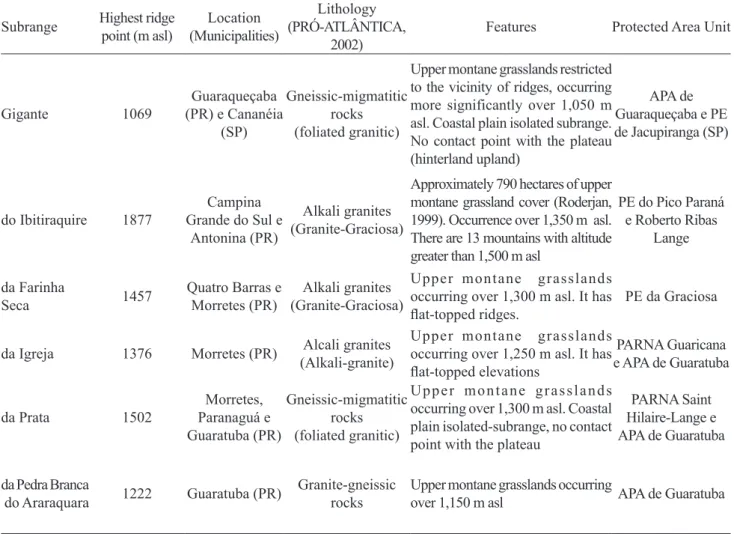
Study areas - The six sampled subranges belong to Serra do Mar in the State of Paraná, Southern Brazil. The geographic coordinates are between latitudes 25º56'S and 25º08'S and longitudes 48º52'W and 48º30'W. The subranges are regionally known as: Serra do Ibitiraquire, Serra da Igreja, Serra da Prata, Serra Gigante, Serra da Farinha Seca (Graciosa) and Serra da Pedra Branca do Araraquara (figure 1). Such study areas were chosen based on the representativeness of this formation occurrence in Paraná and a number of outstanding differences: for instance, altitude (between 950 and 1870 m asl), extension and altitudinal ranges of the formation, geographical position, continentality, etc. (table 1).
annual average of 13.4 °C and absolute maximum of 30 °C to upper montane levels, in forest environment, in Morro Anhangava in the municipality of Quatro Barras, Paraná. The rate of precipitation in Serra do Mar is well distributed throughout the year and show wide variation depending on the topography. Measurements in the coastal region surpass 2,000 mm annual precipitation and on the slopes of the subranges the values reach 3,500 mm. As for hinterland uplands, surpassing mountain ranges, annual precipitation may reach 1,500 mm (Maack 1968).
As previously mentioned, the current occurrence of upper montane grasslands over the Upper Montane Atlantic Dense Rain (Cloud) Forest is regulated by the substrate thickness relationships between (histic) organic and mineral horizons, which resulted from both climate and geomorphology. The upper montane grasslands are in predominantly Haplic and Folic Histosols as well as Histic Litholic Entisols, which either have no mineral horizons or their occurrence typically starts at a depth below 40 cm or even in places where histic horizons have a lithic contact within the depth between 20 and 40 cm. The sites where histic horizons have less thickening there are better conditions for the upper montane forest to be established (Scheer et al. 2013a, b), then taking place in Litholic Entisols (typically dystrophic and typically humic) (Roderjan 1994, Rocha 1999, Vaschenko et al. 2007) and Gleysols (Wisniewski et al. 2005, Scheer et al. 2013a), Regosols (Scheer et al. 2013b) as well as Cambisols (Roderjan 1994, Rocha 1999). These extremely acid soils have high organic matter content,
low base saturation and high exchangeable aluminum content. In lower altitude or even isolated mountains in southern Brazil (e.g. Serra Gigante), the typical upper montane grasslands may occur more significantly close to the ridges, just over 1000 m asl, which does not occur in higher mountains (e.g. above 1300 m asl). As a matter of fact, such occurrences at lower altitudes are due to geomorphological and soil characteristics, as well as mass-elevation effect (e.g. lower temperatures in comparison with higher and more extensive subranges) also known as the Massenerhebung effect (Grubb 1971, Flenley 1995, Han et al. 2012).
As for higher subranges such as Serra do Ibitiraquire, the upper montane grasslands have a more extensive range, being proportionally higher (above 1,400 m asl), is interweaving with the occurrence of upper montane forests and rocky outcrops, by evidencing the important role of other environmental factors (table 1).
Phytosociological study - In order to study the sociological structure of the plant communities, we sampled 324 plots (1 × 1 m) in the six subranges. A different number of sample plots were set up on each subrange based upon the field area length, the number of ridges per subrange, accessibility on each subrange as well as the phytophysiognomy in the field.
Subrange Highest ridge point (m asl)
Location (Municipalities)
Lithology (PRÓ-ATLÂNTICA,
2002)
Features Protected Area Unit
Gigante 1069
Guaraqueçaba (PR) e Cananéia
(SP)
Gneissic-migmatitic rocks (foliated granitic)
Upper montane grasslands restricted to the vicinity of ridges, occurring more significantly over 1,050 m asl. Coastal plain isolated subrange. No contact point with the plateau (hinterland upland)
APA de Guaraqueçaba e PE de Jacupiranga (SP)
do Ibitiraquire 1877
Campina Grande do Sul e
Antonina (PR)
Alkali granites (Granite-Graciosa)
Approximately 790 hectares of upper montane grassland cover (Roderjan, 1999). Occurrence over 1,350 m asl. There are 13 mountains with altitude greater than 1,500 m asl
PE do Pico Paraná e Roberto Ribas
Lange
da Farinha
Seca 1457
Quatro Barras e Morretes (PR)
Alkali granites (Granite-Graciosa)
Upper montane grasslands occurring over 1,300 m asl. It has
flat-topped ridges. PE da Graciosa da Igreja 1376 Morretes (PR) Alcali granites
(Alkali-granite)
Upper montane grasslands occurring over 1,250 m asl. It has flat-topped elevations
PARNA Guaricana e APA de Guaratuba
da Prata 1502
Morretes, Paranaguá e Guaratuba (PR) Gneissic-migmatitic rocks (foliated granitic)
U p p e r m o n t a n e g r a s s l a n d s occurring over 1,300 m asl. Coastal plain isolated-subrange, no contact point with the plateau
PARNA Saint Hilaire-Lange e APA de Guaratuba
da Pedra Branca
do Araraquara 1222 Guaratuba (PR)
Granite-gneissic rocks
Upper montane grasslands occurring
over 1,150 m asl APA de Guaratuba Table 1. Features of the sampled subranges of Serra do Mar (Sea Mountain Range) in Southern Brazil
APA - Environmental Protection Area PE – State Park
PARNA – National Park 1 – PRÓ-ATLÂNTICA 2002 ² – Roderjan 1999,
and recognized in the field, which enabled more accurate estimates of phytosociological descriptors. The characterization was based upon the most common species with greater cover or similar habitats, thereby visually defining the synusiae.
Five physiognomies were determined: 1. Shrubby, when the species with greater cover were visibly shrubs; 2. Grassy, when the species with greater cover were visibly graminoids; 3. Chusquea mimosa; 4. Chusquea pinifolia; 5. Machaerina austrobrasiliensis; when these species were visibly and clearly the most dominant ones.
All plant taxa found in the plots were registered in field records. We also recorded the maximum height and the predominant height of each species per sample plot
(adaptation of the method reported by Braun-Blanquet 1979), based on the estimated vertical projection of the aerial parts of the plants sampled on the ground. To determine the predominant height, we took into consideration the most photosynthetically active portion of the species found within the plots sampled. To aid measurement of species cover, the plots were assembled with metric graduation measuring tapes. No attempt was made to record species density due to the difficulty to determine the number of different specimens found in the field, especially graminoids. Plant material samples were collected from each plot in order to compose the floristic list (published by Mocochinski & Scheer 2008) and also to identify the ones yet unknown by the authors. However, for some of those as yet unknown we used morpho-species
identification, since the specific determination was not possible due to the lack of suitable source material for this purpose. The reference material was deposited in the collection of Museu Botânico Municipal in Curitiba (MBM) and duplicates were donated to the Herbarium of Universidade Federal do Paraná (UFPR-UPCB) as well as to Escola de Florestas de Curitiba (EFC). Taxa of our phytosociological survey were reviewed according to the List of Species of the Brazilian Flora 2020 (Flora of Brazil under construction 2016) as well as the Brazilian Catalogue of Plants and Fungi (Forzza et al. 2010).
The final graphical presentation relating to the phytosociological importance of the species in each physiognomy within the six sampled subranges was developed by AMADO 1:01 CISIA-program. The cluster analysis was performed in STATIGRAPHICS PLUS-program.
Results and Discussion
Structure of upper montane grasslands in Serra do Ibitiraquire
Serra do Ibitiraquire - Physiognomy: shrubby - We found 94 species within the 61 sampled plots and the community had an absolute plant cover of 124.7 m².100 -1m² (considered here the sum of the cover of all sampled species), especially Croton mullerianus with the highest importance percentage (table 2). Such emphasis was mainly due to the cover percentage (36.5%), more than double if compared to the second species, Cryptangium triquetrum. The main six species accounted for almost half the percentage of the community. Furthermore, C. mullerianus and C. triquetrum alone accounted for more than half the community relative cover.
Chusquea pinifolia stood out in the upper strata of the community with predominant height (average of 87.8 cm) and relative cover of 5.9%. Chusquea mimosa also stood out in the upper strata with prevailing height (average of 85 cm), however, it was found in only 20% of the sampled plots.
The species with predominant height lower than 30 cm accounted for less than 5% the community relative cover. Whereas, the species with predominant height between 30 and 60 cm accounted for 84% the relative cover, of which four out of the five most important species of such community were found in this stratum. The species with prevailing height above 60 cm accounted for 11% the relative cover, especially C. pinifolia, C. mimosa and Machaerina
Serra do Ibitiraquire - Physiognomy: grassy - 99 species (mainly graminoids) were found within the 64 sampled plots (table 3). The community had an absolute plant cover of 109 m². 100-1 m².
C. triquetrum showed the highest percentage (16,4%) and relative cover of 26.5%, which represents over a quarter of the community. The difference for the other species was not as great as in the shrubby physiognomy, however, we observed that only seven species accounted for more than 50% the highest importance percentage of the community. The three main species accounted for almost 50% the community relative cover.
Cryptangium triquetrum, dominating nearly a third of the community showed a predominant height of 54.6 cm, which is higher than the other nine most important species. Thus, it characterized the physiognomy of the vegetation by creating a typical “graminoid” carpet (although Cyperaceae).
On this physiognomy, the species’ prevailing height between 0 and 30 cm comprised 5% of the relative cover. The species with average hight between 30 and 60 cm comprised 47% of the relative cover. As for the species with average height greater than 60 cm comprised 48% of the relative cover.
Serra do Ibitiraquire - Physiognomy: Chusquea pinifolia - We found 85 species and an absolute cover of 125 m².100-1m² within the 56 sampled plots with dominance of Chusquea pinifolia (caratuva). This species comprised more than a quarter of the importance percentage and almost half of the community relative cover (table 4). Once again C. mullerianus and Cryptangium triquetrum were among the four most important species in the sampled plot. Those, along with Machaerina austrobrasiliensis and Alstroemeria amabilis accounted for more than half the importance percentage.
This physiognomy has higher size due to the dominance of C. pinifolia, which showed height average of 78 cm. The gradual increase in height of such physiognomy is likely a result of the relative thickness of subsurface mineral horizons, below histosol horizons (histic) (Scheer et al. 2014). Another strata was observed some 50 cm afar, in which Croton mullerianus, Rhynchospora exaltata and C. triquetrum were dominant. We also observed the occurrence of important “graminoid” species such as C. triquetrum, Deschampsia caespitosa, Xyris stenophylla and Eriochrysis holcoides within the community.
Species FA Co FR CoR PI Hpre Hmax 1 Croton mullerianus 93.4 45.46 9.39 36.47 22.93 45.5 54.5 2 Cryptangium triquetrum 82.0 19.61 8.24 15.73 11.98 58.0 74.8 3 Chusquea pinifolia 36.1 7.36 3.62 5.90 4.76 87.8 116.2 4 Mimosa congestifolia 34.4 5.25 3.46 4.21 3.83 54.0 59.8
5 Hesperozygis nitida 31.1 4.05 3.13 3.25 3.19 36.7 45.7 6 Machaerina austrobrasiliensis 31.1 2.64 3.13 2.12 2.62 61.4 77.1 7 Rhynchospora exaltata 27.9 3.05 2.80 2.45 2.62 52.5 66.1
8 Chusquea mimosa 19.7 2.95 1.98 2.37 2.17 85.1 114.5
9 Deschampsia caespitosa 21.3 2.25 2.14 1.80 1.97 54.5 60.6 10 Utricularia reniformis 26.2 1.48 2.64 1.18 1.91 19.1 21.7 11 Eryngium koehneanum 19.7 2.13 1.98 1.71 1.84 45.1 56.3 12 Gaylussacia brasiliensis var brasiliensis 26.2 1.25 2.64 1.00 1.82 41.0 47.2 13 Vernonanthura montevidensis 27.9 1.02 2.80 0.82 1.81 49.2 54.2 14 Symphyopappus cuneatus 23.0 1.59 2.31 1.28 1.79 50.7 57.4
15 Xyris stenophylla 21.3 1.25 2.14 1.00 1.57 36.3 44.8 16 Mimosa prionopus 13.1 1.95 1.32 1.56 1.44 36.6 45.6 17 Baccharis crispa 21.3 0.87 2.14 0.70 1.42 48.0 54.0
18 Poaceae5 21.3 0.72 2.14 0.58 1.36 14.6 17.6
19 Sticherus sp. 11.5 1.67 1.15 1.34 1.25 50.0 54.3
20 Leandra sulfurea 19.7 0.57 1.98 0.46 1.22 37.6 41.5 21 Myrsine altomontana 16.4 0.97 1.65 0.78 1.21 59.9 62.8 22 Siphoneugena reitzii 14.8 1.02 1.48 0.82 1.15 57.7 61.3
23 Poaceae15 16.4 0.69 1.65 0.55 1.10 47.1 56.0
24 Leandra sp. 18.0 0.26 1.81 0.21 1.01 34.4 36.9
25 Eriochrysis holcoides 13.1 0.80 1.32 0.64 0.98 34.0 43.3 26 Lycopodium clavatum 11.5 0.95 1.15 0.76 0.96 28.0 35.4 27 Gaultheria serrata var. organensis 14.8 0.48 1.48 0.38 0.93 41.9 45.0 28 Galianthe gertii 13.1 0.66 1.32 0.53 0.92 36.5 39.3
29 Alstroemeria amabilis 9.8 0.69 0.99 0.55 0.77 51.5 57.7 30 Blechnum cordatum 9.8 0.54 0.99 0.43 0.71 43.5 47.2
31 Dyckia reitzii 9.8 0.52 0.99 0.42 0.70 25.8 29.8
32 Mimosa eurystegia 8.2 0.72 0.82 0.58 0.70 36.0 42.0 33 Rhynchospora sp. 1 6.6 0.84 0.66 0.67 0.66 44.8 50.3 34 Eriocaulon ligulatum 9.8 0.41 0.99 0.33 0.66 20.3 24.8
35 Tibouchina hospital 9.8 0.30 0.99 0.24 0.61 45.0 47.3 36 Galium hypocarpium ssp. Indecorum 9.8 0.28 0.99 0.22 0.61 29.7 31.7
37 Lycopodium sp. 8.2 0.46 0.82 0.37 0.60 27.6 35.2
38 Myrcia hartwegiana 8.2 0.39 0.82 0.32 0.57 54.4 60.8
39 Tibouchina dúbia 8.2 0.39 0.82 0.32 0.57 34.0 38.0
40 Cyperaceae 1 9.8 0.18 0.99 0.14 0.57 45.8 53.7
(Mountain Range), n = 61. FA: absolute frequency (%); Co: absolute cover (%); FR: relative frequency (%); CoR: relative cover (%); PI: importance percentage (%); Hpre: predominant height (cm); Hmax: maximum height (cm).
Species FA Co FR CoR PI Hpre Hmax 41 Achyrocline satureioides 8.2 0.23 0.82 0.18 0.50 36.2 43.2
42 Poaceae 14 8.2 0.18 0.82 0.14 0.48 39.8 40.8
43 Dichanthelium sabulorum 8.2 0.15 0.82 0.12 0.47 50.2 43.2 44 Phalocallis geniculata 8.2 0.13 0.82 0.11 0.46 62.4 68.8
45 Baccharis angusticeps 4.9 0.46 0.49 0.37 0.43 46.0 51.3 46 Sticherus pruinosus 4.9 0.33 0.49 0.26 0.38 48.7 49.3 47 Lycopodium thyoides 4.9 0.30 0.49 0.24 0.37 32.0 36.3 48 Gaylussacia arassatubensis 4.9 0.23 0.49 0.18 0.34 34.3 35.7
49 Axonopus sp. 4.9 0.16 0.49 0.13 0.31 15.7 21.3
50 Ericaceae 1 4.9 0.16 0.49 0.13 0.31 28.7 38.0
51 Gaultheria serrata 4.9 0.15 0.49 0.12 0.31 37.7 48.7
52 Miconia sp. 4.9 0.15 0.49 0.12 0.31 29.3 31.3
53 Doryopteris crenulans 4.9 0.10 0.49 0.08 0.29 22.7 23.3
54 Trixis lessingii 4.9 0.10 0.49 0.08 0.29 15.3 16.0
55 Mimosa tucumensis 3.3 0.25 0.33 0.20 0.26 40.5 49.0
56 Ilex microdonta 1.6 0.43 0.16 0.34 0.25 100.0 110.0
57 Poaceae16 3.3 0.15 0.33 0.12 0.22 58.5 62.0
59 Chascolytrum calotheca 3.3 0.13 0.33 0.11 0.22 70.5 78.0
58 Ericaceae 2 3.3 0.13 0.33 0.11 0.22 48.0 49.5
60 Sisyrinchium vaginatum 3.3 0.10 0.33 0.08 0.20 45.0 45.0
61 Melastomataceae 1 3.3 0.07 0.33 0.05 0.19 32.5 35.0
62 Sisyrinchium sp. 3.3 0.05 0.33 0.04 0.18 41.0 45.5
63 Poaceae13 3.3 0.03 0.33 0.03 0.18 24.0 24.0
64 Escallonia laevis 1.6 0.23 0.16 0.18 0.17 65.0 67.0
65 Danthonia secundiflora 1.6 0.16 0.16 0.13 0.15 59.0 92.0 66 Rhynchospora sp. 2 1.6 0.16 0.16 0.13 0.15 15.0 24.0 67 Quesnelia imbricata 1.6 0.13 0.16 0.11 0.13 35.0 37.0 68 Vriesea hoehneana 1.6 0.10 0.16 0.08 0.12 36.0 38.0
69 Zygopetalum maculatum 1.6 0.10 0.16 0.08 0.12 22.0 22.0 70 Symphyopappus sp. 1 1.6 0.08 0.16 0.07 0.12 67.0 75.0 71 Lycopodium sp. 2 1.6 0.07 0.16 0.05 0.11 22.0 47.0 72 Myrciaria tenella 1.6 0.07 0.16 0.05 0.11 83.0 83.0 73 Stevia claussenii 1.6 0.07 0.16 0.05 0.11 15.0 20.0
74 Gesneriaceae indet. 1.6 0.05 0.16 0.04 0.10 47.0 47.0
75 Poaceae10 1.6 0.05 0.16 0.04 0.10 24.0 34.0
76 Poaceae11 1.6 0.05 0.16 0.04 0.10 66.0 73.0
77 Smilax campestris 1.6 0.05 0.16 0.04 0.10 43.0 43.0 78 Symphyopappus sp. 2 1.6 0.05 0.16 0.04 0.10 60.0 60.0
79 Symplocos corymboclados 1.6 0.05 0.16 0.04 0.10 42.0 42.0 80 Coccocypselum condalia 1.6 0.03 0.16 0.03 0.10 22.0 27.0 81 Esterhazya splendida 1.6 0.03 0.16 0.03 0.10 50.0 61.0 82 Gaultheria sp. 1 1.6 0.03 0.16 0.03 0.10 68.0 68.0
Species FA Co FR CoR PI Hpre Hmax 83 Graphistylis serrana 1.6 0.03 0.16 0.03 0.10 41.0 41.0 84 Leandra quinquedentata 1.6 0.03 0.16 0.03 0.10 45.0 49.0
85 Myrceugenia alpigea 1.6 0.03 0.16 0.03 0.10 59.0 59.0
86 Oxypetalum sp. 1.6 0.03 0.16 0.03 0.10 72.0 76.0
87 Tibouchina sp. 1 1.6 0.03 0.16 0.03 0.10 38.0 38.0 88 Weinmannia humilis 1.6 0.03 0.16 0.03 0.10 58.0 67.0
89 Xyris piraquarae 1.6 0.03 0.16 0.03 0.10 74.0 74.0
90 Baccharis nebularis 1.6 0.02 0.16 0.01 0.09 70.0 70.0
91 Leandra cordigera 1.6 0.02 0.16 0.01 0.09 18.0 21.0
92 Melastomataceae indet. 2 1.6 0.02 0.16 0.01 0.09 15.0 15.0
93 Pleopeltis hirsutissima 1.6 0.02 0.16 0.01 0.09 34.0 34.0
94 Tibouchina sp. 2 1.6 0.02 0.16 0.01 0.09 17.0 17.0
Total 995.1 124.66 100 100 100
plots within an absolute cover of 136 m².100-1m²
(table 5). Chusquea mimosa comprised 25.7% of importance percentage. Shrubs and nanofanerophytes such as Croton mullerianus, Siphoneugena reitzii and Vernonanthura montevidensis showed significant importance in this physiognomy with the stratum right below the the main species.
A l t o g e t h e r, C h u s q u e a m i m o s a, C ro t o n mullerianus, Cryptangium triquetrum, Siphoneugena reitzii and Vernonanthura montevidensis accounted for more than half the importance percentage and also comprised more than 70% of the cover percentage. Serra do Ibitiraquire - Physiognomy: Machaerina austrobrasiliensis - We found 36 species in the 10 sampled plots (table 6) and a vegetation cover of 102 m².100-1m². Machaerina austrobrasiliensis accounted for more than a quarter the community dominance percentage as well as more than 40% of relative cover. Croton mullerianus showed high frequence. Even though Chusquea pinifolia was not very frequently found, it had a higher cover percentage in comparison with Xyris stenophylla, which had the same frequency. Cryptangium triquetrum, although very frequent, did not show high cover percentages. The five main species in this physiognomy comprised more than 80% of the relative cover and more than 60% of the importance percentage.
This physiognomy was observed more commonly at poor drainage sites with Xyris stenophylla, Xyris piraquarae and Baccharis angusticeps showing greater importance than in other vegetation physiognomy types.
Structure of upper montane grasslands in Serra da Igreja
Serra da Igreja - Physiognomy: shrubby - We found 50 species in the 27 sampled plots and a vegetation cover of 149 m².100-1m² (table 7). Croton mullerianus was the most important species occurring in all plots with nearly 40% of the relative cover. Cryptangium triquetrum was also important in almost all plots of this physiognomy. The four main species accounted for more than half the dominance percentage of the community. Despite having low cover in the physiognomy, Chusquea mimosa stood out as it showed the highest portions of the vertical strata with average height of 106.4 cm in comparison to plants higher than 2 m in height.
Other shrubby species such as Tibouchina dubia and Myrsine altomontana stood out by showing the same frequency, but the first species presented vegetation cover three times greater than the second one. Furthermore, Weinmannia humilis, Myrsine altomontana and Siphoneugena reitzii, also dominant in this community, can grow as trees over 6 m tall in adjacent upper montane rainforests. However, in upper montane grasslands they grow as nanophanerophytes to about 1 m in height.
Species FA Co FR CoR PI Hpre Hmax 1 Cryptangium triquetrum 51.6 29.00 6.31 26.54 16.42 54.6 67.3 2 Deschampsia caespitosa 50.0 13.17 6.12 12.05 9.09 49.6 63.2 3 Eriochrysis holcoides 40.6 11.19 4.97 10.24 7.60 41.5 53.0 4 Croton mullerianus 34.4 5.92 4.21 5.42 4.81 40.0 48.6
5 Eryngium koehneanum 31.3 5.77 3.82 5.28 4.55 42.3 50.3 6 Xyris stenophylla 34.4 4.59 4.21 4.20 4.21 32.6 41.0 7 Chusquea pinifolia 25.0 5.58 3.06 5.10 4.08 46.4 57.3 8 Vernonanthura montevidensis 42.2 1.03 5.16 0.94 3.05 41.8 46.6
9 Eryngium scirpinum 15.6 1.89 1.91 1.73 1.82 32.7 40.7 10 Hesperozygis nitida 17.2 1.28 2.10 1.17 1.64 37.1 41.2 11 Machaerina austrobrasiliensis 10.9 2.11 1.34 1.93 1.63 68.7 75.9 12 Nassella sellowiana 10.9 1.78 1.34 1.63 1.48 56.0 80.9 13 Mimosa congestifolia 15.6 1.13 1.91 1.03 1.47 52.9 58.2 14 Symphyopappus cuneatus 14.1 1.30 1.72 1.19 1.45 50.8 58.3
15 Rhynchospora exaltata 9.4 1.89 1.15 1.73 1.44 41.5 49.0 16 Chascolytrum calotheca 14.1 1.25 1.72 1.14 1.43 65.3 74.3 17 Lobelia camporum 18.8 0.45 2.29 0.41 1.35 25.0 27.3 18 Bacchariscrispa 18.8 0.42 2.29 0.39 1.34 39.0 42.3
19 Mimosa prionopus 6.3 2.05 0.76 1.87 1.32 34.5 46.0 20 Achyrocline satureioides 10.9 1.38 1.34 1.26 1.30 36.7 46.3 21 Lycopodium sp. 14.1 0.92 1.72 0.84 1.28 21.9 26.9 22 Sisyrinchium vaginatum 17.2 0.36 2.10 0.33 1.22 22.5 23.2 23 Rhynchospora sp. 1 12.5 0.98 1.53 0.90 1.22 37.1 53.6
24 Poaceae 13 15.6 0.48 1.91 0.44 1.18 20.5 22.7
25 Galianthe gertii 10.9 0.52 1.34 0.47 0.91 30.1 33.3 26 Dichanthelium sabulorum 10.9 0.48 1.34 0.44 0.89 33.3 58.0 27 Eriocaulon ligulatum 10.9 0.47 1.34 0.43 0.88 19.4 31.6 28 Lycopodium thyoides 6.3 0.94 0.76 0.86 0.81 28.5 38.5
29 Rhynchospora sp. 2 9.4 0.48 1.15 0.44 0.80 20.8 25.7 30 Chusquea mimosa 7.8 0.69 0.96 0.63 0.79 58.0 72.0 31 Galium hypocarpium ssp. indecorum 9.4 0.45 1.15 0.41 0.78 34.5 39.2 32 Leandra sp. 9.4 0.22 1.15 0.20 0.67 18.5 19.8 33 Trixis lessingii 7.8 0.34 0.96 0.31 0.64 17.2 18.8 34 Xyris piraquarae 4.7 0.72 0.57 0.66 0.62 38.7 47.0
35 Lycopodium clavatum 6.3 0.33 0.76 0.30 0.53 25.3 36.0 36 Dyckia reitzii 6.3 0.31 0.76 0.29 0.53 20.8 22.5
38 Poaceae 11 6.3 0.19 0.76 0.17 0.47 46.3 60.8
37 Leguminosae indet. 6.3 0.19 0.76 0.17 0.47 21.8 26.5
40 Tibouchina hospita 6.3 0.14 0.76 0.13 0.45 29.3 29.5
39 Miconia sp. 6.3 0.14 0.76 0.13 0.45 25.8 26.8 41 Lycopodium sp. 1 4.7 0.33 0.57 0.30 0.44 28.3 34.3
Species FA Co FR CoR PI Hpre Hmax 42 Utricularia reniformis 4.7 0.33 0.57 0.30 0.44 22.3 28.0
43 Gaylussacia brasiliensis var
brasiliensis 6.3 0.11 0.76 0.10 0.43 27.0 30.8
44 Hypochaeris catharinensis 6.3 0.11 0.76 0.10 0.43 20.5 31.5
45 Blechnumcordatum 4.7 0.31 0.57 0.29 0.43 49.3 43.7 46 Baccharis angusticeps 4.7 0.25 0.57 0.23 0.40 36.3 41.0 47 Sticherus sp. 3.1 0.42 0.38 0.39 0.38 52.0 58.5 48 Campovassouria cruciata 4.7 0.20 0.57 0.19 0.38 37.7 40.0
49 Alstroemeria amabilis 4.7 0.14 0.57 0.13 0.35 32.3 37.7
50 Esterhazya splendida 4.7 0.11 0.57 0.10 0.34 56.0 58.7
52 Symphyopappus sp. 1 4.7 0.09 0.57 0.09 0.33 45.0 49.7
51 Gaylussacia arassatubensis 4.7 0.09 0.57 0.09 0.33 12.3 13.0
53 Vriesea hoehneana 1.6 0.47 0.19 0.43 0.31 30.0 41.0
55 Stevia claussenii 4.7 0.05 0.57 0.04 0.31 25.7 25.7
54 Andropogon macrothrix 4.7 0.05 0.57 0.04 0.31 16.3 16.3
56 Escallonia laevis 3.1 0.23 0.38 0.21 0.30 58.0 65.5
57 Cyperaceae indet. 2 3.1 0.19 0.38 0.17 0.28 20.5 23.0
58 Cyperaceae indet. 1 3.1 0.16 0.38 0.14 0.26 16.0 16.0
59 Tibouchina dubia 1.6 0.33 0.19 0.30 0.25 51.0 57.0 60 Leandra quinquedentata 3.1 0.11 0.38 0.10 0.24 35.5 36.5
61 Galium sp. 3.1 0.09 0.38 0.09 0.23 27.0 30.5
62 Gaultheria serrata var. organensis 3.1 0.08 0.38 0.07 0.23 37.5 41.5
63 Poaceae 10 3.1 0.08 0.38 0.07 0.23 32.5 34.0
64 Poaceae 14 3.1 0.08 0.38 0.07 0.23 18.0 29.0
65 Tibouchina reitzii 3.1 0.08 0.38 0.07 0.23 49.5 64.5 66 Phalocallis geniculata 3.1 0.06 0.38 0.06 0.22 67.0 68.0
67 Ericaceae 02 3.1 0.06 0.38 0.06 0.22 40.5 43.5
68 Polygala campestris 3.1 0.06 0.38 0.06 0.22 21.5 22.0
69 Axonopus sp. 3.1 0.03 0.38 0.03 0.21 24.0 24.0 70 Drosera montana 3.1 0.03 0.38 0.03 0.21 2.5 4.5 71 Fuchsia regia subsp. serrae 3.1 0.03 0.38 0.03 0.21 22.5 22.5
72 Cyperaceae 6 1.6 0.22 0.19 0.20 0.20 47.0 71.0
73 Poaceae 15 1.6 0.20 0.19 0.19 0.19 59.0 64.0
74 Mimosa tucumensis 1.6 0.17 0.19 0.16 0.17 23.0 31.0
75 Myrsine altomontana 1.6 0.17 0.19 0.16 0.17 70.0 75.0 76 Handroanthus catarinesis 1.6 0.14 0.19 0.13 0.16 65.0 65.0 77 Polygala subverticillata 1.6 0.13 0.19 0.11 0.15 26.0 30.0 78 Oxypetalum sublanatum 1.6 0.11 0.19 0.10 0.15 41.0 53.0
79 Myrcia hartwegiana 1.6 0.09 0.19 0.09 0.14 45.0 47.0 80 Quesnelia imbricata 1.6 0.09 0.19 0.09 0.14 38.0 38.0 81 Weinmannia humilis 1.6 0.08 0.19 0.07 0.13 30.0 45.0
82 Cyperaceae 2 1.6 0.06 0.19 0.06 0.12 45.0 47.0
83 Danthonia secundiflora 1.6 0.06 0.19 0.06 0.12 55.0 68.0
Species FA Co FR CoR PI Hpre Hmax
84 Lycopodiaceae indet. 1.6 0.05 0.19 0.04 0.12 1.0 1.0
85 Melastomataceae indet. 1 1.6 0.05 0.19 0.04 0.12 14.0 29.0
86 Piptocarpha densifolia 1.6 0.05 0.19 0.04 0.12 47.0 47.0 88 Berberis laurina 1.6 0.03 0.19 0.03 0.11 38.0 38.0 87 Viola cerasifolia 1.6 0.05 0.19 0.04 0.12 14.0 17.0
89 Hesperozygis rhododon 1.6 0.03 0.19 0.03 0.11 22.0 33.0
90 Leandra sulfurea 1.6 0.03 0.19 0.03 0.11 18.0 50.0
91 NI 4 1.6 0.03 0.19 0.03 0.11 14.0 17.0
92 Poaceae 5 1.6 0.03 0.19 0.03 0.11 38.0 71.0
93 Apocynaceae 1 1.6 0.02 0.19 0.01 0.10 43.0 43.0
94 Baccharis nebularis 1.6 0.02 0.19 0.01 0.10 73.0 73.0
95 Doryopteris crenulans 1.6 0.02 0.19 0.01 0.10 28.0 28.0
96 Melastomataceae 2 1.6 0.02 0.19 0.01 0.10 13.0 13.0
97 NI 2 1.6 0.02 0.19 0.01 0.10 26.0 26.0
98 Scleria balansae 1.6 0.02 0.19 0.01 0.10 13.0 18.0
99 Holocheilus brasiliensis 1.6 0.02 0.19 0.01 0.10 30.0 30.0
Total 817.2 109.28 100 100 100
Table 3 (continuation)
Species FA Co FR CoR PI Hpre Hmax
1 Chusquea pinifolia 100.0 54.07 9.62 43.26 26.44 78.4 99.4 2 Croton mullerianus 87.5 16.95 8.42 13.56 10.99 48.0 57.6 3 Rhynchospora exaltata 35.7 6.41 3.44 5.13 4.28 50.9 63.7 4 Cryptangium triquetrum 48.2 3.95 4.64 3.16 3.90 55.0 64.3
5 Machaerina austrobrasiliensis 35.7 4.82 3.44 3.86 3.65 67.2 80.1 6 Alstroemeria amabilis 39.3 1.71 3.78 1.37 2.58 42.6 49.6 7 Deschampsia caespitosa 33.9 1.30 3.26 1.04 2.15 53.6 65.9 8 Gaylussacia brasiliensis var. brasiliensis 30.4 1.55 2.92 1.24 2.08 47.7 58.0
9 Xyris stenophylla 26.8 1.75 2.58 1.40 1.99 35.1 42.3 10 Baccharis crispa 33.9 0.80 3.26 0.64 1.95 48.2 53.0 11 Eriochrysis holcoides 26.8 1.25 2.58 1.00 1.79 37.0 43.6 12 Xyris piraquarae 21.4 1.86 2.06 1.49 1.77 50.9 61.8 13 Mimosa congestifolia 19.6 1.66 1.89 1.33 1.61 64.0 68.6 14 Leandra quinquedentata 19.6 1.14 1.89 0.91 1.40 46.7 50.7
15 Utricularia reniformis 19.6 1.04 1.89 0.83 1.36 19.2 22.7 16 Gaultheria serrata 23.2 0.59 2.23 0.47 1.35 53.0 55.7 17 Gaylussacia arassatubensis 21.4 0.63 2.06 0.50 1.28 37.5 40.7 18 Galium hypocarpium ssp. indecorum 21.4 0.54 2.06 0.43 1.25 36.1 37.3
19 Leandra sulfurea 14.3 1.25 1.37 1.00 1.19 41.0 46.9 20 Baccharis angusticeps 12.5 1.34 1.20 1.07 1.14 58.0 59.1
Species FA Co FR CoR PI Hpre Hmax 21 Hesperozygis nitida 17.9 0.64 1.72 0.51 1.12 56.4 62.7 22 Lycopodium thyoides 16.1 0.86 1.55 0.69 1.12 28.2 38.2 23 Myrsine altomontana 16.1 0.73 1.55 0.59 1.07 76.7 82.9 24 Sticherus sp. 5.4 1.73 0.52 1.39 0.95 49.0 54.7
25 Symphyopappus cuneatus 12.5 0.80 1.20 0.64 0.92 62.1 69.0 26 Tibouchina hospita 14.3 0.48 1.37 0.39 0.88 42.9 47.3 27 Rhynchospora sp. 1 7.1 1.25 0.69 1.00 0.84 41.8 50.8 28 Eryngium koehneanum 10.7 0.73 1.03 0.59 0.81 39.7 53.3
29 Scleria balansae 12.5 0.48 1.20 0.39 0.79 34.7 43.9 30 Vernonanthura montevidensis 12.5 0.34 1.20 0.27 0.74 55.9 60.0
31 Melastomataceaeindet. 1 12.5 0.30 1.20 0.24 0.72 23.6 24.7
32 Mimosa tucumensis 8.9 0.70 0.86 0.56 0.71 21.8 28.8 33 Dyckia reitzii 7.1 0.91 0.69 0.73 0.71 32.8 40.8 34 Chascolytrum calotheca 10.7 0.36 1.03 0.29 0.66 57.3 68.0
35 Lycopodium sp. 7.1 0.70 0.69 0.56 0.62 42.8 46.3 36 Symplocos corymboclados 7.1 0.63 0.69 0.50 0.59 56.0 56.8 37 Trixis lessingii 8.9 0.39 0.86 0.31 0.59 19.8 25.8 38 Drimys angustifolia 7.1 0.59 0.69 0.47 0.58 90.3 98.5
39 Siphoneugena reitzii 8.9 0.34 0.86 0.27 0.57 55.8 57.4 40 Leptostelma catharinensis 8.9 0.32 0.86 0.26 0.56 35.0 38.0 41 Galianthe gertii 7.1 0.46 0.69 0.37 0.53 36.8 43.3 42 Eriocaulon ligulatum 8.9 0.23 0.86 0.19 0.52 21.4 22.6 43 Graphistylis serrana 8.9 0.21 0.86 0.17 0.52 77.4 81.8 44 Gaylussacia caratuvensis 3.6 0.73 0.34 0.59 0.46 87.0 88.0
45 Blechnum cordatum 7.1 0.27 0.69 0.21 0.45 37.0 41.5 46 Sisyrinchium vaginatum 7.1 0.13 0.69 0.10 0.39 31.8 32.8 47 Hypochaeris catharinensis 5.4 0.27 0.52 0.21 0.36 18.7 39.0 48 Dichanthelium sabulorum 5.4 0.20 0.52 0.16 0.34 46.0 52.3
49 Baccharis platypoda 5.4 0.18 0.52 0.14 0.33 48.7 51.7
50 Poaceae 5 5.4 0.18 0.52 0.14 0.33 15.3 15.3
51 Baccharis nebularis 5.4 0.14 0.52 0.11 0.31 62.0 66.3
52 Miconia ramboi 5.4 0.07 0.52 0.06 0.29 34.7 35.7
53 Weinmannia humilis 1.8 0.50 0.17 0.40 0.29 98.0 108.0
54 Ilex chamaedryfolia 3.6 0.25 0.34 0.20 0.27 86.5 99.0
55 Mimosa prionopus 3.6 0.21 0.34 0.17 0.26 47.0 50.0
56 Doryopteris crenulans 3.6 0.20 0.34 0.16 0.25 31.0 44.0
57 Achyrocline satureioides 3.6 0.18 0.34 0.14 0.24 59.5 66.5
58 Mimosa eurystegia 3.6 0.18 0.34 0.14 0.24 40.5 43.0
59 Escallonia laevis 1.8 0.38 0.17 0.30 0.24 100.0 108.0 60 Tibouchina dubia 3.6 0.13 0.34 0.10 0.22 33.5 36.5 61 Lycopodium sp. 1 1.8 0.32 0.17 0.26 0.21 20.0 26.0 62 Gaultheria sp. 1 3.6 0.09 0.34 0.07 0.21 49.5 49.5
Species FA Co FR CoR PI Hpre Hmax
63 Ericaceae indet. 1 3.6 0.09 0.34 0.07 0.21 36.5 40.5
64 Leandra sp. 3.6 0.07 0.34 0.06 0.20 37.5 41.5
65 Piptocarpha densifolia 1.8 0.29 0.17 0.23 0.20 37.0 82.0 66 Gaultheria serrata var. organensis 3.6 0.05 0.34 0.04 0.19 63.5 63.5 67 Phalocallis geniculata 3.6 0.05 0.34 0.04 0.19 55.0 62.0
68 Melastomataceae indet 2 3.6 0.05 0.34 0.04 0.19 14.0 14.0
69 Dicranopteris nervosa 1.8 0.20 0.17 0.16 0.16 32.0 32.0 70 Sticherus pruinosus 1.8 0.11 0.17 0.09 0.13 34.0 37.0 71 Polygala campestris 1.8 0.11 0.17 0.09 0.13 29.0 29.0 72 Lycopodium sp. 2 1.8 0.09 0.17 0.07 0.12 40.0 58.0
73 Ericaceae indet. 2 1.8 0.07 0.17 0.06 0.11 52.0 54.0
74 Fabaceae 1.8 0.07 0.17 0.06 0.11 24.0 28.0
75 Leandra cordigera 1.8 0.07 0.17 0.06 0.11 15.0 22.0 76 Andropogon macrothrix 1.8 0.05 0.17 0.04 0.11 25.0 41.0 77 Smilax campestris 1.8 0.04 0.17 0.03 0.10 53.0 53.0 78 Campovassouria cruciata 1.8 0.04 0.17 0.03 0.10 29.0 29.0
79 Galium sellowianum 1.8 0.04 0.17 0.03 0.10 15.0 17.0 80 Drosera montana 1.8 0.04 0.17 0.03 0.10 3.0 3.0 81 Salvia sp. 1.8 0.02 0.17 0.01 0.09 47.0 47.0 82 Paspalum polyphyllum 1.8 0.02 0.17 0.01 0.09 37.0 67.0 83 Ilex microdonta 1.8 0.02 0.17 0.01 0.09 27.0 27.0 84 Lobelia camporum 1.8 0.02 0.17 0.01 0.09 22.0 22.0
85 Galium sp. 1.8 0.02 0.17 0.01 0.09 14.0 14.0
Total 1039.3 125.00 100 100 100
Table 4 (continuation)
Species FA Co FR CoR PI Hpre Hmax
1 Chusquea mimosa 100.0 56.67 9.89 41.56 25.73 122.8 166.9
2 Croton mullerianus 66.7 23.56 6.59 17.28 11.94 58.0 72.5
3 Cryptangium triquetrum 44.4 9.22 4.40 6.76 5.58 64.3 76.0
4 Siphoneugena reitzii 44.4 5.33 4.40 3.91 4.15 76.3 88.8 5 Vernonanthura montevidensis 55.6 1.78 5.49 1.30 3.40 67.2 77.0
6 Sticherus sp. 33.3 3.56 3.30 2.61 2.95 47.0 56.0
7 Eryngium koehneanum 33.3 2.89 3.30 2.12 2.71 34.3 37.0
8 Baccharis crispa 44.4 1.33 4.40 0.98 2.69 51.8 57.5
9 Xyris stenophylla 22.2 3.00 2.20 2.20 2.20 35.0 46.0 10 Pentacalia desiderabilis 11.1 4.33 1.10 3.18 2.14 65.0 85.0
11 Smilax campestris 33.3 0.78 3.30 0.57 1.93 39.7 61.7
Species FA Co FR CoR PI Hpre Hmax
14 Leandra sulfurea 22.2 1.11 2.20 0.81 1.51 38.0 42.5 15 Vriesea hoehneana 11.1 2.56 1.10 1.87 1.49 75.0 82.0
16 Galium hypocarpium ssp. indecorum 22.2 1.00 2.20 0.73 1.47 38.5 46.5
17 Lycopodium sp. 22.2 1.00 2.20 0.73 1.47 36.0 40.5
18 Mimosa prionopus 11.1 2.22 1.10 1.63 1.36 13.0 29.0
19 Hydrocotyle quinqueloba 22.2 0.67 2.20 0.49 1.34 37.5 39.5 20 Phalocallis geniculata 22.2 0.56 2.20 0.41 1.30 52.0 57.5
21 Alstroemeria amabilis 22.2 0.56 2.20 0.41 1.30 49.0 52.5
22 Myrsine altomontana 22.2 0.56 2.20 0.41 1.30 49.0 52.5
23 Leandra sp. 22.2 0.33 2.20 0.24 1.22 29.0 30.0
24 Esterhazya splendida 11.1 1.78 1.10 1.30 1.20 78.0 85.0 25 Deschampsia caespitosa 22.2 0.22 2.20 0.16 1.18 73.5 77.5
26 Hesperozygis nitida 22.2 0.22 2.20 0.16 1.18 78.5 78.5
27 Sticherus pruinosus 11.1 1.11 1.10 0.81 0.96 46.0 67.0
28 Poaceae 16 11.1 0.89 1.10 0.65 0.88 53.0 61.0
29 Rhynchospora sp. 2 11.1 0.89 1.10 0.65 0.88 28.0 28.0 30 Symphyopappus cuneatus 11.1 0.78 1.10 0.57 0.83 67.0 71.0
31 Gaylussacia brasiliensis var brasiliensis 11.1 0.44 1.10 0.33 0.71 40.0 45.0
32 Machaerina austrobrasiliensis 11.1 0.44 1.10 0.33 0.71 45.0 65.0
33 Poaceae 5 11.1 0.44 1.10 0.33 0.71 16.0 16.0
34 Rhynchospora exaltata 11.1 0.44 1.10 0.33 0.71 90.0 110.0 35 Baccharis nebularis 11.1 0.33 1.10 0.24 0.67 52.0 57.0
36 Xyris piraquarae 11.1 0.33 1.10 0.24 0.67 75.0 76.0
37 Gaultheria serrata 11.1 0.22 1.10 0.16 0.63 31.0 31.0
38 Gaultheria sp. 1 11.1 0.22 1.10 0.16 0.63 35.0 42.0 39 Lycopodium clavatum 11.1 0.22 1.10 0.16 0.63 35.0 35.0 40 Lycopodium thyoides 11.1 0.22 1.10 0.16 0.63 20.0 21.0
41 Poaceae 14 11.1 0.22 1.10 0.16 0.63 56.0 56.0
42 Fuchsia regia subsp. serrae 11.1 0.11 1.10 0.08 0.59 103.0 103.0 43 Galianthe gertii 11.1 0.11 1.10 0.08 0.59 44.0 44.0
44 Melastomataceae 1 11.1 0.11 1.10 0.08 0.59 25.0 25.0
45 Myrciaria tenella 11.1 0.11 1.10 0.08 0.59 44.0 44.0
46 Tibouchina hospita 11.1 0.11 1.10 0.08 0.59 33.0 33.0
Total 1011.1 136.33 100 100 100
was also found in all the plots, but showed lower cover. Only these two species along with Tibouchina dubia (shrubby), accounted for 50% of the importance percentage and more than 70% of the community relative cover.
The seven main species, which comprised more than 80% of the relative cover (125 m².100-1m²),
showed average height between 45 and 65 cm, clearly indicating the large overlap in this portion of the community vertical stratification.
Structure of upper montane grasslands in Serra da Prata
Species FA Co FR CoR PI Hpre Hmax
1 Machaerina austrobrasiliensis 100 41.20 10.87 40.39 25.63 60.9 76.1
2 Croton mullerianus 90 16.50 9.78 16.18 12.98 36.8 44.8
3 Chusquea pinifolia 60 11.00 6.52 10.78 8.65 46.8 56.8
4 Xyris stenophylla 60 7.80 6.52 7.65 7.08 28.7 35.8
5 Cryptangium triquetrum 80 5.50 8.70 5.39 7.04 52.0 66.3
6 Eriochrysis holcoides 40 2.60 4.35 2.55 3.45 34.0 42.0
7 Deschampsia caespitosa 50 0.80 5.43 0.78 3.11 48.0 52.4
8 Baccharis angusticeps 30 1.50 3.26 1.47 2.37 38.0 41.0
9 Xyris piraquarae 30 0.80 3.26 0.78 2.02 57.0 62.7
10 Rhynchospora exaltata 20 1.90 2.17 1.86 2.02 36.5 51.5
11 Galianthe gertii 20 0.90 2.17 0.88 1.53 26.0 30.0
12 Chusquea mimosa 10 2.00 1.09 1.96 1.52 85.0 117.0
13 Leandra sp. 20 0.80 2.17 0.78 1.48 28.0 31.5
14 Dyckia reitzii 20 0.50 2.17 0.49 1.33 19.0 20.5
15 Eriocaulon ligulatum 20 0.50 2.17 0.49 1.33 26.5 28.5
16 Gaylussacia brasiliensis var brasiliensis 20 0.50 2.17 0.49 1.33 26.5 29.0
17 Utricularia reniformis 20 0.50 2.17 0.49 1.33 31.0 43.0
18 Melastomataceae indet.1 20 0.40 2.17 0.39 1.28 14.0 15.5
19 Rhynchospora sp. 1 20 0.40 2.17 0.39 1.28 39.0 42.5
20 Baccharis crispa 20 0.30 2.17 0.29 1.23 39.5 39.5
21 Leandra cordigera 20 0.20 2.17 0.20 1.18 18.5 18.5
22 Leandra sulfurea 10 1.00 1.09 0.98 1.03 49.0 58.0
23 Symphyopappus cuneatus 10 0.80 1.09 0.78 0.94 42.0 57.0
24 Poaceae 05 10 0.50 1.09 0.49 0.79 9.0 9.0
25 Quesnelia imbricata 10 0.50 1.09 0.49 0.79 40.0 44.0
26 Gaylussacia arassatubensis 10 0.40 1.09 0.39 0.74 20.0 23.0
27 Mimosa congestifolia 10 0.40 1.09 0.39 0.74 53.0 59.0
28 Mimosa tucumensis 10 0.40 1.09 0.39 0.74 23.0 30.0
29 Eryngium koehneanum 10 0.30 1.09 0.29 0.69 37.0 39.0
30 Sticherus sp. 10 0.30 1.09 0.29 0.69 44.0 44.0
31 Scleria balansae 10 0.20 1.09 0.20 0.64 10.0 12.0
32 Tibouchina hospita 10 0.20 1.09 0.20 0.64 17.0 23.0
33 Galium hypocarpium ssp. indecorum 10 0.10 1.09 0.10 0.59 15.0 15.0
34 Chascolytrum calotheca 10 0.10 1.09 0.10 0.59 55.0 55.0
35 Sisyrinchium vaginatum 10 0.10 1.09 0.10 0.59 40.0 40.0
36 Trixis lessingii 10 0.10 1.09 0.10 0.59 20.0 20.0
Table 6. Phytosociological parameters of the Machaerina austrobrasiliensis physiognomy of the upper montane grasslands in Serra do Ibitiraquire, n = 10. FA: absolute frequency (%); Co: absolute cover (%); FR: relative frequency (%); CoR: relative cover (%); PI: importance percentual (%); Hpre: predominant height (cm); Hmax: maximum height (cm).
dominance in this physiognomy. These four species accounted for almost half the dominance percentage and more than 60% of the cover percentage.
Solely six species were found in at least two thirds of the plots. Half of the detected species occurred in
species in this physiognomy. However, Croton mullerianus also stood out, being present in all plots and reaching the second highest percentage of importance. We highlight the importance of species frequently found in poor drainage environments such as Machaerina austrobrasiliensis, Xyris stenophylla and Xyris piraquarae.
In the above strata we found shrubs and nanophanerophytes such as Clethra uleana, Siphoneugena reitzii, Myrcia hartwegiana and Hesperozygis rhododon , whereas graminoids formed a dense vegetative layer of nearly 50 cm from the ground. From the most important species, only Machaerina austrobrasiliensis showed predominant height (frequently above 60 cm).
Nearly two thirds of the species (19) were detected in only one or two sampled plots.
Structure of upper montane grasslands in Serra da Farinha Seca
Serra da Farinha Seca - Physiognomy: shrubby - 42 species were found in the 10 sampled plots within a vegetation cover of 134.7 m².100-1m² (table 11). Mimosa congestifolia comprised the highest percentage of importance, and stood out based on its cover percentage. It accounted for nearly a quarter of the community relative cover. Cryptangium triquetrum, Sticherus sp., Chusquea pinifolia along with a non-identified Poaceae showed importance as well. Other shrubby species ranked only in the sixth and seventh position, namely: Siphoneugena reitzii and Myrcia hartwegiana. The seven species mentioned above comprised 54% of the importance percentage and almost 70% of the relative cover.
Chusquea pinifolia is quite important in this physiognomy based upon its frequency in the above strata and also for having all prevailing and maximum heights among the main species.
Serra da Farinha Seca - Physiognomy: grassy - 53 species were found in the 22 sampled plots within an absolute cover of 148 m².100-1m² (2).
Cryptangium triquetrum showed great importance in this physiognomy as it was found in all the plots, comprising 49% of the relative cover by dominating the upper strata of the community. Its average height was higher than the other eight important species, by creating a typical “graminoid”carpet.
Siphoneugena reitzii and Tibouchina dubia also stood out as shrubby species. However, despite their
each species accounted for solely 4% of the relative cover.
As a matter of fact, only these three species were detected in more than a third of the sampled plots. We also observed that 36, or more than two thirds of the species, showed relative cover values lower than 1%, which represents only 11% of the overall community cover.
Serra da Farinha Seca - Physiognomy: Chusquea pinifolia - Twenty-nine species were found in five sampled plots within an absolute cover of 134.6 m².100-1m² (table 13). Chusquea pinifolia
showed 30.7% of importance percentage, which represents more than half the relative cover. It was also the dominant species in the upper strata, reaching prevailing heights greater than the other species, with the exception of a non-identified Poaceae.
In the stretches where C. pinifolia was the most dominant, several other important shrubs were also often found occupying spaces under Chusquea pinifolia in the vertical strata, especially Mimosa congestifolia, Siphoneugena reitzii, Baccharis nebularis, Symplocos corymboclados and Clethra scabra. The latter was exclusively found in Serra da Farinha Seca. The occurrence of Clethra uleana is common in upper montane grasslands, while Clethra scabra is more common in montane forests at altitudes < 1200 m asl. However, in Serra da Farinha Seca both species share the same environment, but C. scabra seems to occur only in physiognomies dominated by Chusquea pinifolia. Falkenberg (2003) had already reported the overlapping area of occurrence of these two species in upper montane cloud forest and rupicolous vegetation in the region of Aparados da Serra Geral.
Structure of upper montane grasslands in Serra Gigante
Species FA Co FR CoR PI Hpre Hmax
1 Croton mullerianus 100.0 59.19 9.57 39.63 24.60 67.6 78.1 2 Cryptangium triquetrum 96.3 27.78 9.22 18.60 13.91 69.7 86.1 3 Sticherus sp. 66.7 13.11 6.38 8.78 7.58 56.3 62.6 4 Tibouchina dubia 74.1 8.70 7.09 5.83 6.46 50.0 60.7
5 Myrsine altomontana 74.1 2.74 7.09 1.84 4.46 53.4 61.3 6 Alstroemeria amabilis 55.6 1.93 5.32 1.29 3.30 48.2 59.3 7 Xyris stenophylla 33.3 4.70 3.19 3.15 3.17 40.0 48.6 8 Leandra cordigera 40.7 1.93 3.90 1.29 2.60 53.1 59.5
9 Poaceae2 33.3 2.37 3.19 1.59 2.39 58.3 68.0
10 Blechnum cordatum 37.0 1.26 3.55 0.84 2.19 38.0 47.7 11 Siphoneugena reitzii 37.0 1.15 3.55 0.77 2.16 60.2 62.6 12 Weinmannia humilis 22.2 2.44 2.13 1.64 1.88 82.8 85.3 13 Galium hypocarpium ssp. indecorum 25.9 1.70 2.48 1.14 1.81 38.4 44.9 14 Chusquea mimosa 18.5 2.48 1.77 1.66 1.72 106.4 140.2
15 Gaylussacia brasiliensis var brasiliensis 29.6 0.48 2.84 0.32 1.58 29.0 33.0 16 Hesperozygis rhododon 14.8 2.00 1.42 1.34 1.38 60.3 66.0 17 Handroanthus catarinesis 22.2 0.85 2.13 0.57 1.35 71.3 78.5 18 Dichanthelium sabulorum 18.5 1.22 1.77 0.82 1.30 46.0 44.8
19 Poaceae 3 22.2 0.48 2.13 0.32 1.23 42.2 47.5
20 Vriesea platynema var. variegata 7.4 2.52 0.71 1.69 1.20 61.0 63.0 21 Eriocaulon ligulatum 14.8 1.33 1.42 0.89 1.16 27.0 40.8 22 Gaultheria serrata var. organensis 18.5 0.74 1.77 0.50 1.13 48.4 51.8 23 Baccharis crispa 18.5 0.70 1.77 0.47 1.12 56.6 63.4 24 Clethra uleana 14.8 0.67 1.42 0.45 0.93 42.8 63.0
25 Myrcia pulchra 7.4 1.56 0.71 1.04 0.88 58.0 64.0 26 Vernonanthura montevidensis 11.1 0.59 1.06 0.40 0.73 61.3 66.7 27 Baccharis angusticeps 11.1 0.37 1.06 0.25 0.66 50.0 61.0 28 Utricularia reniformis 11.1 0.33 1.06 0.22 0.64 23.0 30.0
29 Sticherus pruinosus 7.4 0.56 0.71 0.37 0.54 52.5 56.0
30 Graphistylis serrana 7.4 0.26 0.71 0.17 0.44 47.5 53.0 31 Smilax campestris 7.4 0.26 0.71 0.17 0.44 52.5 55.0 32 Myrciaria tenella 7.4 0.19 0.71 0.12 0.42 39.5 42.0
33 Apocynaceae 1 7.4 0.15 0.71 0.10 0.40 45.0 49.0
34 Myrcia hartwegiana 7.4 0.11 0.71 0.07 0.39 61.0 61.0
35 Holocheilus brasiliensis 7.4 0.11 0.71 0.07 0.39 19.5 19.5 36 Vriesea hoehneana 3.7 0.56 0.35 0.37 0.36 42.0 50.0 37 Coccocypselum condalia 3.7 0.52 0.35 0.35 0.35 8.0 14.0 38 Blechnum sp. 2 3.7 0.41 0.35 0.27 0.31 73.0 85.0
39 Drimys angustifolia 3.7 0.11 0.35 0.07 0.21 63.0 71.0
40 Ericaceae 4 3.7 0.11 0.35 0.07 0.21 47.0 53.0
Species FA Co FR CoR PI Hpre Hmax
41 Ocotea tristis 3.7 0.11 0.35 0.07 0.21 30.0 54.0 42 Symplocos corymboclados 3.7 0.11 0.35 0.07 0.21 33.0 41.0 43 Danthonia sp. 3.7 0.07 0.35 0.05 0.20 17.0 17.0 44 Mikania clematidifolia 3.7 0.07 0.35 0.05 0.20 66.0 66.0
45 Symplocos corymboclados 3.7 0.07 0.35 0.05 0.20 41.0 60.0 46 Ternstroemia brasiliensis 3.7 0.07 0.35 0.05 0.20 69.0 69.0 47 Ilex microdonta 3.7 0.04 0.35 0.02 0.19 41.0 41.0 48 Orthosia dusenii 3.7 0.04 0.35 0.02 0.19 62.0 62.0
49 NI 5 3.7 0.04 0.35 0.02 0.19 30.0 30.0
50 Verbesina glabrata 3.7 0.04 0.35 0.02 0.19 40.0 40.0
Total 1044.4 149.33 100 100 100
Species FA Co FR CoR PI Hpre Hmax
1 Cryptangium triquetrum 100.0 62.14 10.07 41.29 25.68 64.4 75.2 2 Croton mullerianus 100.0 39.29 10.07 26.10 18.09 50.4 61.1 3 Tibouchina dubia 71.4 8.00 7.19 5.32 6.25 46.2 52.6 4 Myrsine altomontana 85.7 3.43 8.63 2.28 5.46 50.2 54.9 5 Alstroemeria amabilis 78.6 2.79 7.91 1.85 4.88 52.4 58.2 6 Handroanthus catarinesis 50.0 5.29 5.04 3.51 4.27 57.9 61.4 7 Xyris stenophylla 42.9 4.79 4.32 3.18 3.75 53.3 64.2 8 Galium hypocarpium ssp. indecorum 50.0 1.79 5.04 1.19 3.11 38.3 40.3
9 Sticherus sp. 35.7 3.21 3.60 2.14 2.87 55.6 58.0 10 Leandra cordigera 35.7 2.14 3.60 1.42 2.51 48.2 50.6 11 Utricularia reniformis 35.7 0.86 3.60 0.57 2.08 17.8 19.6 12 Sticherus pruinosus 28.6 1.14 2.88 0.76 1.82 35.3 42.0 13 Blechnum sp. 1 28.6 0.71 2.88 0.47 1.68 47.3 48.3 14 Siphoneugena reitzii 28.6 0.57 2.88 0.38 1.63 56.8 58.0
15 Gaylussacia brasiliensis var. brasiliensis 28.6 0.36 2.88 0.24 1.56 26.0 26.5 16 Eriocaulon ligulatum 7.1 3.57 0.72 2.37 1.55 22.0 30.0 17 Dichanthelium sabulorum 21.4 1.36 2.16 0.90 1.53 43.7 49.7 18 Symplocos corymboclados 21.4 0.43 2.16 0.28 1.22 57.7 59.7
19 Hesperozygis rhododon 14.3 1.43 1.44 0.95 1.19 47.5 57.5 20 Vernonanthura montevidensis 14.3 1.29 1.44 0.85 1.15 64.5 78.5
21 Weinmannia humilis 14.3 0.71 1.44 0.47 0.96 61.5 61.5 22 Agarista niederleinii var. niederleinii 14.3 0.57 1.44 0.38 0.91 73.0 78.5
23 Poaceae 2 7.1 1.43 0.72 0.95 0.83 59.0 75.0
24 Baccharis angusticeps 14.3 0.21 1.44 0.14 0.79 23.5 23.5 25 Verbesina glabrata 7.1 0.86 0.72 0.57 0.64 60.0 62.0
26 Myrtaceae indet. 1 7.1 0.71 0.72 0.47 0.60 15.0 27.0
Table 8. Phytosociological parameters of the grassy physiognomy of the upper montane grasslands in Serra da Igreja, n = 14. FA: absolute frequency (%); Co: absolute cover (%); FR: relative frequency (%); CoR: relative cover (%); PI: importance percentual (%); Hpre: predominant height (cm); Hmax: maximum height (cm).
Species FA Co FR CoR PI Hpre Hmax
27 Myrcia pulchra 7.1 0.50 0.72 0.33 0.53 76.0 79.0 28 Chusquea mimosa 7.1 0.29 0.72 0.19 0.45 215.0 215.0
29 Graphistylis serrana 7.1 0.21 0.72 0.14 0.43 39.0 54.0 30 Baccharis crispa 7.1 0.14 0.72 0.09 0.41 49.0 49.0 31 Ilex microdonta 7.1 0.14 0.72 0.09 0.41 56.0 56.0 32 Danthonia sp. 1 7.1 0.07 0.72 0.05 0.38 41.0 41.0 33 Ocotea porosa 7.1 0.07 0.72 0.05 0.38 38.0 38.0
Total 992.9 150.50 100 100 100
Table 8 (continuation)
Species FA Co FR CoR PI Hpre Hmax
1 Croton mullerianus 100.0 36.60 9.37 30.23 19.80 53.9 62.3 2 Cryptangium triquetrum 93.3 13.87 8.75 11.45 10.10 56.6 68.9 3 Machaerina austrobrasiliensis 80.0 13.87 7.50 11.45 9.48 61.8 81.8 4 Tibouchina dubia 80.0 13.40 7.50 11.07 9.28 59.5 61.9 5 Sticherus sp. 66.7 7.53 6.25 6.22 6.24 44.7 52.0 6 Chusquea mimosa 66.7 5.60 6.25 4.63 5.44 68.9 96.5
7 Poaceae 1 53.3 2.87 5.00 2.37 3.68 42.3 53.0
8 Myrcia pulchra 40.0 4.27 3.75 3.52 3.64 70.3 79.7
9 Gaylussacia brasiliensis var. brasiliensis 53.3 1.67 5.00 1.38 3.19 38.3 40.6 10 Myrsine altomontana 46.7 2.20 4.38 1.82 3.10 63.7 68.0 11 Gaultheria serrata var. organensis 53.3 0.93 5.00 0.77 2.89 46.9 48.1 12 Vriesea platynema var. variegata 20.0 3.80 1.88 3.14 2.51 57.0 68.3 13 Alstroemeria amabilis 40.0 1.40 3.75 1.16 2.45 38.2 42.7 14 Xyris piraquarae 26.7 2.47 2.50 2.04 2.27 54.5 62.5 15 Hesperozygis rhododon 26.7 1.80 2.50 1.49 1.99 69.0 83.8 16 Chusquea pinifolia 20.0 1.73 1.88 1.43 1.65 58.3 75.0 17 Vernonanthura montevidensis 20.0 0.73 1.88 0.61 1.24 69.3 72.3 18 Utricularia reniformis 20.0 0.40 1.88 0.33 1.10 24.7 24.7
19 Graphistylis serrana 13.3 0.80 1.25 0.66 0.96 41.0 47.0 20 Leandra quinquedentata 13.3 0.73 1.25 0.61 0.93 56.0 61.5 21 Blechnum cordatum 13.3 0.47 1.25 0.39 0.82 41.0 44.0 22 Leandra cordigera 13.3 0.47 1.25 0.39 0.82 41.5 44.5
23 Smilax campestris 13.3 0.47 1.25 0.39 0.82 69.5 75.0 24 Galium hypocarpium ssp. indecorum 13.3 0.33 1.25 0.28 0.76 57.0 60.0
25 Orthosia dusenii 6.7 1.07 0.63 0.88 0.75 80.0 102.0 26 Ternstroemia brasiliensis 6.7 0.33 0.63 0.28 0.45 58.0 63.0 27 Siphoneugena reitzii 6.7 0.27 0.63 0.22 0.42 39.0 46.0 28 Baccharis angusticeps 6.7 0.20 0.63 0.17 0.40 52.0 52.0
29 Baccharis crispa 6.7 0.20 0.63 0.17 0.40 67.0 76.0
Species FA Co FR CoR PI Hpre Hmax
30 Coccocypselum sp. 6.7 0.13 0.63 0.11 0.37 47.0 47.0 31 Handroanthus catarinesis 6.7 0.13 0.63 0.11 0.37 111.0 111.0 32 Dendrophorbium limosum 6.7 0.07 0.63 0.06 0.34 69.0 69.0 33 Doryopteris crenulans 6.7 0.07 0.63 0.06 0.34 15.0 15.0 34 Oxypetalum sp. 6.7 0.07 0.63 0.06 0.34 38.0 38.0
35 Rhynchospora sp. 4 6.7 0.07 0.63 0.06 0.34 58.0 58.0 36 Symplocos corymboclados 6.7 0.07 0.63 0.06 0.34 31.0 33.0
Total 1066.7 121.07 100 100 100
Species FA Co FR CoR PI Hpre Hmax
1 Cryptangium triquetrum 85.7 26.71 7.89 21.42 14.66 52.5 74.8 2 Croton mullerianus 100.0 20.14 9.21 16.15 12.68 50.0 57.6 3 Machaerina austrobrasiliensis 85.7 13.86 7.89 11.11 9.50 64.0 80.8 4 Gaylussacia brasiliensis var brasiliensis 85.7 8.71 7.89 6.99 7.44 33.3 36.8
5 Xyris stenophylla 57.1 10.71 5.26 8.59 6.93 24.8 32.3 6 Xyris piraquarae 42.9 12.29 3.95 9.85 6.90 52.7 77.7 7 Sticherus sp. 85.7 4.57 7.89 3.67 5.78 36.8 41.2 8 Tibouchina dubia 71.4 5.71 6.58 4.58 5.58 40.4 44.2
9 Chusquea mimosa 42.9 2.86 3.95 2.29 3.12 62.3 70.3
11 Poaceae 1 42.9 0.86 3.95 0.69 2.32 52.7 56.7
10 Phalocallis geniculata 42.9 0.86 3.95 0.69 2.32 45.7 50.7 12 Vriesea platynema var. variegata 14.3 4.00 1.32 3.21 2.26 59.0 72.0 13 Sticherus pruinosus 28.6 1.43 2.63 1.15 1.89 60.0 68.5 14 Myrcia hartwegiana 28.6 1.29 2.63 1.03 1.83 85.5 239.0
15 Chusquea pinifolia 28.6 1.14 2.63 0.92 1.77 52.0 57.0 16 Alstroemeria amabilis 28.6 0.57 2.63 0.46 1.54 60.5 61.5 17 Clethra uleana 14.3 2.14 1.32 1.72 1.52 95.0 102.0 18 Myrsine altomontana 28.6 0.43 2.63 0.34 1.49 61.0 67.0
19 Hesperozygis rhododon 14.3 1.57 1.32 1.26 1.29 84.0 92.0 20 Symplocos corymboclados 14.3 1.29 1.32 1.03 1.17 60.0 66.0 21 Eriocaulon ligulatum 14.3 1.14 1.32 0.92 1.12 24.0 43.0 23 Myrcia pulchra 14.3 0.43 1.32 0.34 0.83 60.0 64.0 22 Gaultheria serrata var. organensis 14.3 0.43 1.32 0.34 0.83 53.0 67.0
25 Siphoneugena reitzii 14.3 0.29 1.32 0.23 0.77 95.0 95.0 24 Galium hypocarpium ssp. indecorum 14.3 0.29 1.32 0.23 0.77 64.0 64.0 26 Tibouchina hospita 14.3 0.29 1.32 0.23 0.77 35.0 35.0 27 Utricularia reniformis 14.3 0.29 1.32 0.23 0.77 25.0 25.0 28 Baccharis angusticeps 14.3 0.14 1.32 0.11 0.72 55.0 55.0
29 Dendrophorbium limosum 14.3 0.14 1.32 0.11 0.72 35.0 35.0 30 Leandra cordigera 14.3 0.14 1.32 0.11 0.72 17.0 17.0
Total 1085.7 124.71 100 100 100