Comparison of breeding value prediction for two traits in a Nellore-Angus
crossbred population using different Bayesian modeling methodologies
Lauren L. Hulsman Hanna
1,*, Dorian J. Garrick
2, Clare A. Gill
1, Andy D. Herring
1,
James O. Sanders
1and David G. Riley
11
Department of Animal Science, Texas A&M University, College Station, Texas, USA.
2Department of Animal Science, Iowa State University, Ames, Iowa, USA.
Abstract
The objectives of this study were to 1) compare four models for breeding value prediction using genomic or pedigree information and 2) evaluate the impact of fixed effects that account for family structure. Comparisons were made in a Nellore-Angus population comprising F2, F3and half-siblings to embryo transfer F2calves with records for overall
temperament at weaning (TEMP;n = 769) and Warner-Bratzler shear force (WBSF; n = 387). After quality control,
there were 34,913 whole genome SNP markers remaining. Bayesian methods employed were BayesB (~p= 0.995 or
0.997 for WBSF or TEMP, respectively) and BayesC (p= 0 and ~p), where ~pis the ideal proportion of markers not in-cluded. Direct genomic values (DGV) from single trait Bayesian analyses were compared to conventional pedi-gree-based animal model breeding values. Numerically, BayesC procedures (using ~p) had the highest accuracy of all models for WBSF and TEMP (r$gg$= 0.843 and 0.923, respectively), but BayesB had the least bias (regression of
per-formance on prediction closest to 1,b$y,x= 2.886 and 1.755, respectively). Accounting for family structure decreased
accuracy and increased bias in prediction of DGV indicating a detrimental impact when used in these prediction methods that simultaneously fit many markers.
Keywords: Bayesian inference, crossbred cattle, genomic prediction, model comparison.
Received: March 27, 2014; Accepted: July 23, 2014.
Introduction
Expected progeny differences (EPD) are widely used for selection in the US beef cattle industry. Current interna-tional research efforts are focused on incorporating genomic prediction methods into national evaluations that produce EPD (Hayeset al., 2009b; VanRaden and Sullivan, 2010; Saatchiet al., 2011, 2012, 2013; Rius-Vilarrasa et al., 2012). The landmark paper by Meuwissenet al.(2001) described genomic predictions using Bayesian inference that they believed capitalized on linkage disequilibrium (LD) between observed markers and unobserved quantita-tive trait loci (QTL).
For these methods, prediction procedures can be a two-part process using the Bayesian framework of 1) train-ing to calculate substitution effects of markers in historical data using both phenotypes and genotypes; and 2) using markers genotyped in individuals outside the training data to calculate direct genomic values (DGV) based on substi-tution effects estimated in training. The size of the
refer-ence (i.e., training) population and its relationship to the prediction population are important considerations to achieve higher precision (accuracy) of genomic breeding values in animals with only genomic information available (de Rooset al., 2009; Ibáñez-Escricheet al., 2009; Habier et al., 2010, 2013; Kizilkaya et al., 2010; Saatchi et al., 2010; Toosiet al., 2010).
Relatedness among animals and between breeds (in crossbred or composite populations) can directly impact prediction accuracy (de Rooset al., 2009; Ibáñez-Escriche et al., 2009), at least in part due to inconsistent LD patterns among cattle breeds (Gautieret al., 2007; Bovine HapMap Consortium, 2009). Few studies have investigated the use of genomic prediction models using field or research data from crossbred populations (Hayeset al., 2009a; Snelling et al., 2012). The objectives of this study were to 1) evalu-ate and compare four models (three Bayesian using genomic information and a pedigree-based animal model) in predicting genetic merit using all animals in the training population; and 2) evaluate the effects on genetic merit pre-diction of including or excluding fixed effects to account for family structure. These objectives were investigated us-ing sus-ingle trait analyses of two traits measured in a Nel-lore-Angus crossbred population.
www.sbg.org.br
Send correspondence to David G. Riley. Department of Animal Sci-ence, Texas A&M University, College Station, Texas 77843, USA. E-mail: [email protected].
*Present address: Department of Animal Sciences, North Dakota State University, Fargo, North Dakota 58108, USA.
Cattle, genotypes, and traits
The cattle population, genotypes, and traits used in this study were previously described in Hulsman Hannaet al.(2014). Briefly, the cattle population consisted of Nel-lore-Angus F2(embryo transfer and natural service recipro-cal crosses), F3and natural service half-siblings to embryo transfer F2animals. The population was characterized by 3 distinct cycles (designated as Cycle 1, 2, and 3), where Cy-cle 1 included embryo transfer Nellore-Angus F2and natu-ral service half-sibling calves, Cycle 2 included natunatu-ral service F2calves, and Cycle 3 included natural service F3 calves. All procedures involving animals were approved by the Texas A&M Institutional Care and Use Committee. An-imals were genotyped on the Bovine SNP50 Version 1 & 2 assays (Illumina Inc., San Diego, CA) and, after quality ed-its, had 34,913 SNP available for genomic prediction anal-yses.
Overall temperament at weaning (TEMP), a subjec-tive measurement on a 1 to 9 scale, where 1 is docile and 9 is wild or unruly (n= 772) was used in this study. Four eval-uators scored each animal in this study for TEMP, but aver-age TEMP score across all evaluators was used in subse-quent analyses. Warner-Bratzler shear force (WBSF), a quantitative measurement using a United Testing machine (United 5STM-500, Huntington Beach, CA) with a 11.3 kg load cell and a v-notch WBSF attachment, was used to mea-sure the peak force required to shear each core and reflect meat tenderness. Only electrically-stimulated data was available for all steers in Cycles 1, 2, and 3 and were there-fore used. The average shear value of the electrically stimu-lated side of each steer, averaged across all shears per steak, for 14-d aged steaks (n= 390) were used for analyses in this study.
Statistical analysis
In a previous study with these animals, Hulsman Hannaet al.(2014) fitted a model for TEMP that included fixed effects of sex (n = 2), family nested within sire (n= 31), birth year-season combinations (n= 10), and tem-perament scoring pen nested within birth year-season com-binations (n = 42). The corresponding model for WBSF included fixed effects of type of cross (an effect based upon the combination of sire and dam breeds,n= 12) and date of shear (n= 16).
Fixed effects that accounted for family structure such as family nested within sire or type of cross may comple-ment or be confounded with genomic information in asso-ciation analyses; the effect of inclusion of such effects on accuracy of prediction of breeding values is unknown. Ge-notype frequency differences between families could result in false associations while training markers for prediction of breeding values using Bayesian methods (Lander and Schork, 1994; Marchiniet al., 2004; Jansset al., 2012).
et al., 2009). In addition, studies with the current cattle pop-ulation (Rileyet al., 2013; Hulsman Hannaet al., 2014) uti-lized fixed effects to account for family structure in associ-ation analyses, but as the effect on genomic predictions of including those effects is unknown, analyses in this study were evaluated with or without significant family structure fixed effects. A traditional animal model that accounted for family in the conventional manner using pedigree was also fitted as a control.
For both traits, only those animals with phenotypes, genotypes and all relevant fixed effects required in the model were used in the study (n= 769 or 387 for TEMP or WBSF, respectively). Correlations between TEMP and WBSF phenotype records were previously calculated using either Pearson’s or Spearman’s Rank correlation coeffi-cients in Hulsman Hanna et al. (2014), and TEMP and WBSF were not found to be correlated in either analysis (p > 0.05).
Bayesian methods employed
BayesB (Meuwissenet al., 2001) and BayesC (Kizil-kayaet al., 2010; Habieret al., 2011) methods were utilized in this study as in Hulsman Hannaet al.(2014). Both meth-ods require thatp, a proportion of markers not contributing to the trait of interest, is known. The best fittingp (desig-nated as ~p) was determined in Hulsman Hannaet al.(2014) as the value that accounted for the majority of genetic varia-tion with the fewest number of markers. For TEMP and WBSF, ~pwas determined to be 0.997 and 0.995, respec-tively. An additional analysis was run using BayesC proce-dures with p = 0 (i.e., all markers were included in the model). Analyses were performed using GenSel software (see Internet References section) to generate DGV for ani-mals included in the training group by summing across pos-terior means of random marker effects multiplied by the centered number of copies of the B allele for each individ-ual. All animals with data available were used in the train-ing population for comparison purposes, where cross-vali-dation procedures were conducted following this study and will be reported separately. For each trait, comparisons were made between DGV and estimated breeding values (EBV) produced using a traditional animal model (i.e., tra-ditional pedigree-based Best Linear Unbiased Predictions). Estimated breeding values from an animal model were gen-erated using ASReml software (see Internet References section), fitting the same fixed effects as used in genomic analyses, but with random animal effects with variance-covariance determined from pedigree information, and ran-dom uncorrelated residuals.
Comparison criteria for breeding value prediction
i.e., BV based on genomic prediction) can be used in simu-lations to assess accuracy (Meuwissenet al., 2001). Simple correlation coefficients between de-regressed EBV and DGV can be used to assess accuracy with field data, but that correlation underestimates true accuracy (Saatchi et al., 2012). Accuracy of EBV (or DGV) predicted in this study was calculated following the standardization method pro-posed by Saatchiet al.(2011) to adjust for underestimation, and takes the form of:
Accuracy gg p,EBV
g g
=$ $ = ,
$
r s
s s
wheresp,EBV is the covariance of phenotype or trait with ei-ther EBV or DGV,sg$ is the standard deviation of the addi-tive genetic effects estimated from the training population reported as the posterior mean or variance estimate (i.e., the mean estimate over the iterations or chains run) of the anal-ysis conducted, andsg is the standard deviation of the ad-ditive genetic effects from the population (i.e., animals with phenotypic and genotypic information), which is the ex-pected additive genetic effects of that population for the given trait and is calculated as:
sg = sg = p
2 2 2
h s
whereh2is the heritability of the trait calculated during the analyses (e.g., the genomic heritability for Bayesian meth-ods and based on variance components for the animal model), andsp
2
is the phenotypic variance calculated from animals with genotypic data. The simple linear regression coefficient (b$y,x), which can be used to give an indication of
biasedness (Saatchiet al., 2013) was calculated. The simple linear regression coefficient (b$y,x) is the regression of
phe-notype on EBV (or DGV) and takes the form of:
$
b s
s
EBV,p
EBV,p
EBV 2
=
wheresEBV,p is the covariance of EBV (or DGV) and phe-notype andsEBV
2
is the variance of the EBV (or DGV) cal-culated from the DGV or EBV produced in that respective analysis using the sample variance function in Microsoft Excel 2013. This regression parameter should be 1 if unbi-ased (Saatchiet al., 2011, 2013).
The relative ranking of EBV (or DGV) is critical in determining candidates that will be selected and this was assessed in two ways: 1) using Spearman Rank correlation coefficients and 2) coarser assessments of rank changes calculated as the percentage and number of individuals whose EBV (or DGV) were in different quartiles from dis-tinct analyses.
Results
Breeding value prediction
The estimates of heritability for WBSF and TEMP using an animal model (single trait analysis, additive ge-netic component only) were 0.055 ± 0.091 and 0.35 ±
0.115, respectively. Originally, the type of cross effect was fitted for WBSF analyses using the animal model. This re-sulted in a heritability estimate of zero, however, and was subsequently excluded from runs using the animal model. Posterior means of genomic heritability estimated through Bayesian methods were higher for WSBF, but lower for TEMP (Table 1).
EBV from animal models for WBSF and TEMP were compared to DGV from three Bayesian methods with and without inclusion of fixed effects to account for significant family structure (Tables 2-4). Numerically, BayesC models with ~p had the highest accuracy for either trait, regardless whether fixed effects for family structure were included or not (Table 1). The simple linear regression coefficient (b$y,x) of DGV on phenotype was closest to 1 for BayesB for
both traits and either statistical model, indicating less bias for that method. All analyses had significant Spearman rank correlation coefficients (Table 4) for trait breeding values predicted from the fitted models. Inclusion of fixed effects to account for family structure resulted in lower Spearman Rank correlation coefficients for DGV from any Bayesian model compared with EBV from a traditional ani-mal model excluding such fixed effects. Spearman Rank correlation coefficients for EBV with DGV were always lower than those among DGV from the fitted Bayesian models. In general, correlation coefficients for DGV esti-mated from models that included fixed effects for family structure were lower, indicating substantial influence of that effect on the relative ranking of animals.
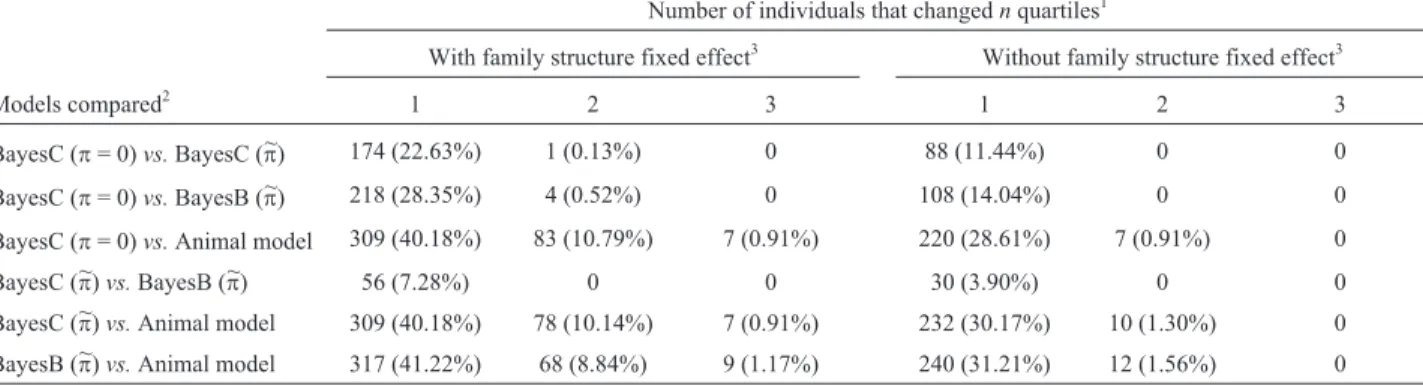
No more than 2% of individuals had EBV in different analyses that were more than 2 quartiles apart for WBSF or TEMP (Tables 2 and 3). When fixed effects accounting for family structure were included in the model, WBSF and TEMP were similar in the percentage of animals that changedn quartiles, although that percentage for WBSF was typically numerically lower than TEMP. When the sta-tistical model did not include fixed effects for family struc-ture, TEMP had a larger reduction in the number of animals (and, therefore, lower percentage) that changednquartiles.
quar-tile with the Bayesian analyses, and approximately 71% for any Bayesian estimation with those from animal models (Tables 2 and 3).
Discussion
The heritability estimate for WBSF is low in compar-ison to most values reported forBos tauruscattle with elec-trically-stimulated carcasses, which have ranged from 0.11 to 0.53 depending on breed or cross and number of mea-sured animals (Shackelford et al., 1994; reviewed by Minicket al., 2004). Although the estimate of heritability for WBSF did not differ from zero in the present study, oth-ers have reported low values usingBos indicuscattle due to an apparently low additive genetic component for this trait in these types of cattle (Rileyet al., 2003; Smith et al., 2007). The effect of electrical stimulation on these car-casses could be reducing variation in WBSF resulting in lower estimates of heritability. Reported estimates of heritability for temperament measured as flight speed have been reported as high as 0.40 (Burrow, 2001) and the esti-mate of 0.35 using an animal model from the present study is consistent with those estimates.
Traditional animal models account for family struc-ture using pedigree information (Henderson, 1973, 1975), but with the inclusion of genomic information, differences in genotype frequency due to family structure could lead to false associations, and therefore impact the accuracy of DGV. Results from the present study indicated that inclu-sion of fixed effects to account for differences between families decreased accuracy and increased bias associated with prediction of DGV in this crossbred population. When fixed effects for family structure were not included, Bayesian methods were more accurate, had less bias, and had less re-ranking between analyses compared to an ani-mal model.
As all animals with data available were included in the training population, accuracy was expected to be mod-erately high, even though the sample sizes were lower than 1,000 individuals (the typical standard minimum for run-ning genetic evaluations) because the information used to estimate effects were from those animals. Without includ-ing family structure fixed effects, accuracy for Bayesian and animal model analyses were higher than may typically be expected given the sample sizes, but training population accuracies are not typically reported and, therefore, com-parisons are not available. Although all analyses showed
Family structure fixed effect included2 Family structure fixed effect excluded2
BayesC (p= 0) BayesC (~p) BayesB (~p) BayesC (p= 0) BayesC (p~) BayesB (p~) Animal model
Warner-Bratzler shear force
$
h2 0.155 0.136 0.234 0.138 0.148 0.236 0.055
sg 2
0.064 0.056 0.097 0.057 0.061 0.097 0.023
sg$
2
0.054 0.047 0.084 0.049 0.052 0.085 0.020
sEBV 2
0.011 0.009 0.023 0.010 0.012 0.026 0.002
$ $
rgg 0.787 0.795 0.775 0.841 0.843 0.823 0.717
$
by,x 4.157 4.610 3.030 4.359 4.115 2.886 9.326
Overall temperament at weaning
$
h2 0.210 0.206 0.227 0.278 0.274 0.271 0.350
sg 2
0.893 0.876 0.965 1.181 1.164 1.154 1.487
sg$
2
0.740 0.721 0.802 1.025 1.010 1.004 1.313
sEBV 2
0.182 0.193 0.232 0.558 0.562 0.563 0.629
$ $
rgg 0.671 0.702 0.698 0.918 0.923 0.918 0.862
$
by,x 2.996 2.885 2.646 1.810 1.782 1.755 1.916
1$
h2
is the estimate of heritability, whereh$2
for the Bayesian models is the posterior mean of the genomic heritability,sg 2
is the additive genetic variance
calculated ash$2 p ´ s2
, which provides an estimate of what the additive genetic variance is expected to be in that population for the given trait.sp 2
= 0.413 or
4.253 for Warner-Bratzler shear force or overall temperament at weaning, respectively, and is the estimate of phenotypic variance from the data.s$g 2
is the posterior mean or variance estimate of additive genetic variance from the training potulation calculated in that respective analysis.sEBV
2
is the variance of the estimated breeding values estimated using either Bayesian or animal model procedures, wherep~= 0.995 or 0.997 for Warner-Bratzler shear force or overall temperament at weaning, respectively, using genomic information in Bayesian models.
2Family structure fixed effect refers to family nested within sire or type of cross (an effect based upon the combination of sire and dam breeds,n= 12) for
bias in the estimates, it was reduced when the sample size increased (e.g., TEMPvs.WBSF), which was expected.
Habieret al.(2013) investigated genomic BLUP and its ability to capture relationships, model LD and exploit cosegregation (the deviation from independent segregation of alleles if loci are linked). They found that genomic BLUP can exploit LD, cosegregation, and additive-genetic relationships captured by SNP, but suggest that Bayesian methods witht-distributed priors (e.g., BayesB or BayesC in this study) may be more beneficial to account for rapid decay in LD. This would explain why the Bayesian meth-ods utilized in this study did not need fixed effects to ac-count for family structure and further suggested that inclusion of those fixed effects detrimentally impacted the ability of Bayesian methods to utilize genomic information from the current population.
Simulation studies have reported superior accuracy values from Bayesian methods relative to traditional ani-mal models (e.g., Meuwissenet al., 2001; Piyasatianet al., 2006). Habier et al. (2011) concluded that the optimal Bayesian modeling method to use was trait dependent when they compared six Bayesian models. In the case of TEMP and WBSF, there was little difference between Bayesian models, although BayesC procedures usingp$had numerically higher accuracies, but larger bias than BayesB for both traits.
As accuracy and the regression coefficient were cal-culated using genetic parameter estimates from the respec-tive analyses (see Table 1), it is interesting to note the differences seen when comparing the variance of the breed-ing values estimated (sEBV
2
; either DGV or EBV, which are technically estimates of additive genetic effects and should
Table 2- Comparison of the number and percentage of individuals with estimated breeding values for Warner-Bratzler shear force that changedn
quartiles between any two analyses.
Number of individuals that changednquartiles1
With family structure fixed effect3 Without family structure fixed effect3
Models compared2 1 2 3 1 2 3
BayesC (p= 0)vs.BayesC (~p) 28 (7.24%) 0 0 28 (7.24%) 0 0
BayesC (p= 0)vs.BayesB (~p) 46 (11.89%) 0 0 66 (17.05%) 0 0
BayesC (p= 0)vs.Animal model 140 (36.18%) 40 (10.34%) 4 (1.03%) 136 (35.14%) 22 (5.68%) 2 (0.52%)
BayesC (~p)vs.BayesB (p~) 36 (9.30%) 0 0 44 (11.37%) 0 0
BayesC (~p)vs.Animal model 141 (36.43%) 36 (9.30%) 5 (1.29%) 141 (36.43%) 22 (5.68%) 3 (0.78%)
BayesB (~p)vs.Animal model 144 (37.21%) 38 (9.82%) 2 (0.52%) 139 (35.92%) 22 (5.68%) 3 (0.78%)
1The number of quartiles changed was calculated by first assigning an animal’s quartile for any given analysis, then finding the difference of each ani-mal’s quartile between the two analyses compared. Percentage was calculated by dividing the number of individuals within that category by the total number of animals (n= 387).
2p~= 0.995 3
Family structure fixed effect refers to type of cross (an effect based upon the combination of sire and dam breeds,n= 12) for Warner-Bratzler shear force.
Table 3- Comparison of the number and percentage of individuals with estimated breeding values for overall temperament at weaning that changedn
quartiles between any two analyses.
Number of individuals that changednquartiles1
With family structure fixed effect3 Without family structure fixed effect3
Models compared2 1 2 3 1 2 3
BayesC (p= 0)vs.BayesC (~p) 174 (22.63%) 1 (0.13%) 0 88 (11.44%) 0 0
BayesC (p= 0)vs.BayesB (~p) 218 (28.35%) 4 (0.52%) 0 108 (14.04%) 0 0
BayesC (p= 0)vs.Animal model 309 (40.18%) 83 (10.79%) 7 (0.91%) 220 (28.61%) 7 (0.91%) 0
BayesC (~p)vs.BayesB (p~) 56 (7.28%) 0 0 30 (3.90%) 0 0
BayesC (~p)vs.Animal model 309 (40.18%) 78 (10.14%) 7 (0.91%) 232 (30.17%) 10 (1.30%) 0
BayesB (~p)vs.Animal model 317 (41.22%) 68 (8.84%) 9 (1.17%) 240 (31.21%) 12 (1.56%) 0
1The number of quartiles changed was calculated by first assigning an animal’s quartile for any given analysis then finding the difference of each animal’s
quartile between the two analyses compared. Percentage was calculated by dividing the number of individuals within that category by the total number of animals (n= 769).
2p~= 0.997 3
be equivalent tosg$2
) to the additive genetic variance calcu-lated through the analysis (sg$2
). When family structure fixed effects were included in Bayesian analyses, the ratio ofsEBV2
tosg2$
ranged from 0.246 to 0.289, which was much lower than when excluded (0.544 to 0.561 for Bayesian models and 0.479 for the animal model) of TEMP. This dif-ference was not observed for WBSF, most likely due to sample size.
Furthermore, the estimate (either the posterior mean or variance component) of additive genetic variance (sg$2
) was always lower than what was expected (sg2
). Ultimately, the differences found between the three variance parame-ters ofsEBV2
,sg$2 ,sg2
and provide an assessment of the esti-mation procedure, as sg2
is the value sEBV2
and sg$2 are expected to be. This is not surprising or novel, as these models do not take into account interactions between or within causative loci for a given trait, thereby creating missing variance (e.g., see Zuket al.(2012) discussion on phantom heritability). Differences may have been strongly influenced by sample size available for this study. The re-sults from this study show, however, that the variance esti-mated from the analysis (sg$2
) compared to the expected variance (sg2
) are relatively similar, the difference is consis-tent across the models within a trait, and the use of family structure fixed effects in the model should not be included for prediction of genetic merit.
Acknowledgments
This project was partially supported by National Re-search Initiative competitive grant no. 2008-35205-18767 from the USDA National Institute of Food and Agriculture Animal Genome Program, by Texas AgriLife Research, and the Beef Checkoff. The authors wish to express their appreciation for this support. The authors also appreciate the contributions of J.E. Sawyer, B.D. Johnson, D.A. Gann,
Jr., J. Miller, and all personnel at the Texas A&M AgriLife McGregor Research Center. This study was included in the dissertation submitted in partial fulfillment of the doctoral degree requirements of the first author.
References
Alexander LJ, Kuehn LA, Smith TPL, Matukumalli LK, Mote B, Koltes JE, Reecy J, Geary TW, Rule DC and MacNeil MD (2009) A Limousin specific myostatin allele affects longis-simus muscle area and fatty acid profiles in a Wagyu-Li-mousin F2population. J Anim Sci 87:1576-1581.
Bovine HapMap Consortium (2009) Genome-wide survey of SNP variation uncovers the genetic structure of cattle breeds. Science 324:528-532.
Burrow HM (2001) Variances and covariances between produc-tive and adapproduc-tive traits and temperament in a composite breed of tropical beef cattle. Liv Prod Sci 70:213-233. de Roos APW, Hayes BJ and Goddard ME (2009) Reliability of
genomic predictions across multiple populations. Genetics 183:1545-1553.
Gautier M, Faraut T, Moazami-Gaudarzi K, Navratil V, Foglio M, Grohs C, Boland A, Garnier J-G, Biochard D, Lathrop GM
et al.(2007) Genetic and haplotypic structure in 14 Euro-pean and African cattle breeds. Genetics 177:1059-1070. Habier D, Tetens J, Seefried FR, Lichtner P and Thaller G (2010)
The impact of genetic relationship information on genomic breeding values in German Holstein cattle. Genet Sel Evol 42:5.
Habier D, Fernando R, Kizilkaya K and Garrick D (2011) Exten-sion of the Bayesian alphabet for genomic selection. BMC Bioinf 12:e186.
Habier D, Fernando RL and Garrick DJ (2013) Genomic BLUP decoded: A look into the blackbox of genomic prediction. Genetics 194:597-607.
Hayes BJ, Bowman PJ, Chamberlain AC, Verbyla K and Goddard ME (2009a) Accuracy of genomic breeding values in multi-breed dairy cattle populations. Genet Sel Evol 41:51.
BayesC (p= 0) BayesC (~p) BayesB (p~) Animal model
With family structure fixed effect2
BayesC (p= 0) 0.964 0.942 0.449
BayesC (~p) 0.996 0.996 0.460
BayesB (~p) 0.984 0.991 0.475
Animal model 0.652 0.655 0.658
Without family structure fixed effect2
BayesC (p= 0) 0.988 0.982 0.911
BayesC (~p) 0.995 0.999 0.899
BayesB (~p) 0.982 0.993 0.895
Animal model 0.810 0.805 0.796
1
Analyses listed are the Bayesian or traditional mixed model procedure used to estimate breeding values, wherep~= 0.995 or 0.997 for Warner-Bratzler shear force (bottom diagonal) or overall temperament at weaning (top diagonal), respectively.
2
Hayes BJ, Bowman PJ, Chamberlain AJ and Goddard ME (2009b) Invited review: Genomic selection in dairy cattle: Progress and challenges. J Dairy Sci 92:433-443.
Henderson CR (1973) Sire evaluation and genetic trends. J Anim Sci 1973:10-41.
Henderson CR (1975) Use of relationships among sires to in-crease accuracy of sire evaluation. J Dairy Sci 58:1731-1738.
Hulsman Hanna LL, Garrick DJ, Gill CA, Herring AD, Riggs PK, Miller RK, Sanders JO and Riley DG (2014) Genome-wide association study of temperament and tenderness using dif-ferent Bayesian approaches in a Nellore-Angus crossbred population. Livest Sci 161:17-27.
Ibáñez-Escriche N, Fernando RL, Toosi A and Dekkers JCM (2009) Genomic selection of purebreds for crossbred perfor-mance. Genet Sel Evol 41:12-22.
Janss L, de los Campos G, Sheehan N and Sorensen D (2012) In-ferences from genomic models in stratified populations. Ge-netics 192:693-704.
Kizilkaya K, Fernando RL and Garrick DJ (2010) Genomic pre-diction of simulated multibreed and purebred performance using observed fifty thousand single nucleotide polymor-phism genotypes. J Anim Sci 88:544-551.
Lander ES and Schork NJ (1994) Genetic dissection of complex traits. Science 265:2037-2048.
Marchini J, Cardon LR, Phillips MS and Donnelly P (2004) The effects of human population structure on large genetic asso-ciation studies. Nat Genet 36:512-517.
Meuwissen THE, Hayes BJ and Goddard ME (2001) Prediction of total genetic value using genome-wide dense marker maps. Genetics 157:1819-1829.
Michal JJ, Zhang ZW, Gaskins CT and Zhang Z (2006) The bo-vinefatty acid binding protein 4gene is significantly associ-ated with marbling and subcutaneous fat depth in Wagyu x Limousin F2crosses. Anim Genet 37:400-402.
Minick JA, Dikeman ME, Pollak EJ and Wilson DE (2004) Heritability and correlation estimates of Warner-Bratzler shear force and carcass traits from Angus-, Charolais-, Here-ford-, and Simmental-sired cattle. Can J Anim Sci 84:599-609.
Piyasatian N, Fernando RL and Dekkers JCM (2006) Genomic se-lection for composite line development using low density marker maps. In: Proceedings from 8thWorld Congress on Genetics Applied to Livestock Production, Belo Horizonte, MG, Brazil, pp. 22-65.
Riley DG, Chase CC, Hammond AC, West RL, Johnson DD, Olson TA and Coleman SW (2003) Estimated genetic pa-rameters for palatability traits of steaks from Brahman cat-tle. J Anim Sci 81:54-60.
Riley DG, Welsh Jr TH, Gill CA, Hulsman LL, Herring AD, Riggs PK, Sawyer JE, and Sanders JO (2013) Whole ge-nome association of SNP with newborn calf cannon bone length. Livest Sci 155:186-196.
Rius-Vilarrasa E, Brøndum RF, Strandén I, Guldbrandtsen B, Strandberg E, Lund MS and Fikse WF (2012) Influence of model specifications on the reliabilities of genomic
predic-tion in a Swedish-Finnish red breed cattle populapredic-tion. J Anim Breed Genet 2012:1-11.
Saatchi M, Miraei-Ashtiani SR, Nejati Javaremi A, Moradi-Shahrebabak M and Mehrabani-Yeghaneh H (2010) The im-pact of information quantity and strength of relationship be-tween training set and validation set on accuracy of genomic estimated breeding values. Afr J Biotech 9:438-442. Saatchi M, McClure MC, McKay SD, Rolf MM, Kim J, Decker
JE, Taxis RM, Chapple RH, Romey HR, Northcutt SLet al.
(2011) Accuracies of genomic breeding values in American Angus beef cattle using K-means clustering for cross-vali-dation. Genet Sel Evol 43:40.
Saatchi M, Schnabel RD, Rolf MM, Taylor JF and Garrick DJ (2012) Accuracy of direct genomic breeding values for na-tionally evaluated traits in US Limousin and Simmental beef cattle. Genet Sel Evol 44:1-10.
Saatchi M, Ward J and Garrick DJ (2013) Accuracies of direct genomic breeding values in Hereford beef cattle using na-tional or internana-tional training populations. J Anim Sci 91:1538-1551.
Shackelford SD, Koohmaraie M, Cundiff LV, Gregory KE, Rohrer GA and Savell JW (1994) Heritabilities and phe-notypic and genetic correlations for bovine postrigor cal-pastatin activity, intramuscular fat content, Warner-Bratzler shear force, retail product yield, and growth rate. J Anim Sci 72:857-863.
Smith T, Domingue JD, Paschal JC, Franke DE, Bidner TD and Whipple G (2007) Genetic parameters for growth and car-cass traits of Brahman steers. J Anim Sci 85:1377-1384. Snelling WM, Cushman RA, Fortes MRS, Reverter A, Bennett
GL, Keele JW, Keuhn LA, McDaneld TG, Thallman RM and Thomas MG (2012) Physiology and Endocrinology Symposium: How single nucleotide polymorphism chips will advance our knowledge of factors controlling puberty and aid in selecting replacement beef females. J Anim Sci 90:1152-1165.
Toosi A, Fernando RL and Dekkers JCM (2010) Genomic selec-tion in admixed and crossbred populaselec-tions. J Anim Sci 88:32-46.
VanRaden PM and Sullivan PG (2010) International genomic evaluation methods for dairy cattle. Genet Sel Evol 42:7. Zuk O, Hechter E, Sunyaev SR and Lander ES (2012) The
mys-tery of missing heritability: Genetic interactions create phantom heritability. Proc Natl Acad Sci USA 109:1193-1198.
Internet Resources
Bos taurus 6.1 on NCBI, http://www.ncbi.nlm.nih.gov/ pro-jects/mapview/map_search.cgi?taxid = 9913 (April 8, 2013).
GenSel software, http://taurus.ansci.iastate.edu/gensel (April 8, 2013).
ASReml software, www.vsni.co.uk (April 8, 2013).
Associate Editor: Bertram Brenig