O
RIGINALA
RTICLE Revista Brasileira de FisioterapiaAnalysis of partial body weight support during
treadmill and overground walking of children
with cerebral palsy
Análise do uso de suporte parcial de peso corporal em esteira e em piso fixo
durante o andar de crianças com paralisia cerebral
Vânia M. Matsuno1,, Muriel R. Camargo1, Gabriel C. Palma1, Diego Alveno1, Ana Maria F. Barela1,2
Abstract
Objective: To analyze the spatial-temporal characteristics and joint angles during overground walking without body weight support (BWS) and with 0% and 30% BWS, and during treadmill walking with the same BWS in children with cerebral palsy. Methods: Six children with hemiplegic and spastic cerebral palsy (7.70 ± 1.04 years old) were videotaped during overground walking at a comfortable speed with no BWS, with 0% and 30% BWS, and during treadmill walking with 0% and 30% BWS. Reflective markers were placed over main bony landmarks in both body sides to register the coordinates “x”, “y”, “z”. Results: During overground walking, children walked faster and presented longer and faster strides, longer duration of single-stance and swing periods, and shorter duration of double-stance period, than treadmill walking, regardless of BWS use. The hip was the only joint that presented a difference between body sides and experimental conditions; i.e. range of motion (ROM) was reduced in the plegic side when compared to the nonplegic side, and during overground walking without BWS when compared to 30% BWS. Conclusion: Children with hemiplegic and spastic cerebral palsy were able to walk overground and on a treadmill with different percentages of BWS, and their performance was superior during overground walking, regardless of BWS use.
Key words: joint angles; spatial-temporal parameters; hemiplegia; children.
Resumo
Objetivo: Analisar características espaço-temporais e ângulos articulares de crianças com paralisia cerebral andando sem o uso de suporte parcial de peso corporal (SPPC) em piso fixo e com 0% e 30% de SPPC em piso fixo e em esteira. Métodos: Seis crianças com paralisia cerebral hemiplégica espástica (7,70±1,04 anos) foram filmadas andando com velocidade confortável sem o uso de SPPC, com 0% e 30% de SPPC em piso fixo e com 0% e 30% de SPPC em esteira. Marcadores refletivos foram afixados nos principais pontos anatômicos dos dois hemicorpos para registro das coordenadas “x”, “y”, “z”. Resultados: As crianças andaram mais rapidamente e com passadas mais longas e mais rápidas, com duração dos períodos de apoio simples e balanço maiores e apoio duplo menor no piso fixo do que na esteira, independentemente do uso do SPPC. O quadril foi a única articulação que apresentou diferenças entre os hemicorpos e entre as condições, sendo que o hemicorpo plégico apresentou menor amplitude de movimento (ADM) que o hemicorpo não plégico, e a ADM foi maior na condição sem o uso de SPPC do que com 30% de SPPC em piso fixo. Conclusão: Crianças com paralisia cerebral hemiplégica espástica são capazes de andar em piso fixo e esteira com diferentes porcentagens de SPPC, sendo que seus desempenhos foram melhores no piso fixo, independentemente do uso de SPPC, do que na esteira.
Palavras-chave: ângulos articulares; parâmetros espaço-temporais; hemiplegia; crianças.
Received: 26/05/2009 – Revised: 10/11/2009 – Accepted: 26/01/2010
1 Movement Analysis Laboratory, Institute of Physical Activity and Sport Science, Universidade Cruzeiro do Sul, São Paulo (SP), Brasil 2 Post-Graduate Program in Human Movement Sciences, São Paulo (SP), Brasil
Correspondence to: Ana Maria Forti Barela, Instituto de Ciências da Atividade Física e Esporte (ICAFE), Universidade Cruzeiro do Sul, Rua Galvão Bueno, 868 – 13o. Andar, Bloco B,
Liberdade, CEP 01506-000, São Paulo (SP), Brasil, e-mail: [email protected]
Introduction
Systems involving the use of a suspension vest and par-tial body weight support (BWS) have been used as a form of walking training1. In this type of training, subjects practice
treadmill walking while their weight is partially supported by a suspension vest. he BWS can be used in diferent ways that allow various degrees of body motion. he height of the vest and the subject’s body weight can be adjusted by the calibra-tion of load cells, counterweights, pneumatic lift, springs, etc. hus, the system may support a percentage of the subject’s body weight (partial BWS) or the total body weight, according to the examiner’s wish.
Among the diferent percentages of BWS that can be used, the majority of studies evaluating treadmill walking adopted a 30% BWS due to its efectiveness in improving walking perfor-mance2-5. In addition to selecting the appropriate percentage of
BWS during training sessions, another aspect to be considered is the type of walking surface, as it should preferably replicate situations encountered during daily life activities in order to facilitate the transfer of skills to that context6,7.
he diferences between overground and treadmill walking without BWS have been investigated in healthy individuals8-11 and in hemiparetic stroke patients12,13. he
characteristics of locomotion, such as joint angles or spatial-temporal parameters8,14,15, foot contact with the surface11, and
muscle activation13, are inluenced by the type of walking
surface. hus, it may be that walking training on a treadmill may interfere with the proper transfer of skills to overground walking7,10,16, which is the walking surface used by individuals
on a daily basis.
Among those individuals with locomotor impairment, one group that can beneit from walking training with BWS is children with cerebral palsy, since the development of an independent and eicient walking is one of the major targets for this group. Cerebral palsy (CP) describes a group of perma-nent disorders of the development of movement and posture, causing activity limitation17. hese disorders are attributed
to nonprogressive disturbances that occurred in the deve-loping fetal or infant brain17. To date, there are few studies
using BWS for walking training in children with CP18,19, and
these are mostly case studies20-23. In previous studies, the
im-provement in walking performance was generally evaluated by motor tests, such as the Gross Motor Function Measure24,
and their results suggest that BWS can improve walking in children with CP.
Few studies have investigated the use of BWS during over-ground walking3,25-27, and none of them had samples consisting
of children. Additionally, little information is available regarding the impact of surface type (e.g. treadmill or overground) on walking performance with BWS. hus, before recommending walking training with BWS to children with CP, it would be important to evaluate their walking performance in diferent types of surface.
he aim of this study was to analyze the spatial-temporal characteristics and joint angles during overground walking without BWS and with 0% and 30% BWS, and during treadmill walking with the same BWS in children with cerebral palsy.
Methods
Sample
Six children with hemiplegic and spastic CP, aged be-tween 6 and 9 years, participated in this study. To be included in the study, they had to present spastic hemiplegia without any cognitive, verbal or visual impairments that could inter-fere with the performance of tasks, and had to be classified as level I to III of the Gross Motor Function Classification System (GMFCS)28. Children who were currently attending
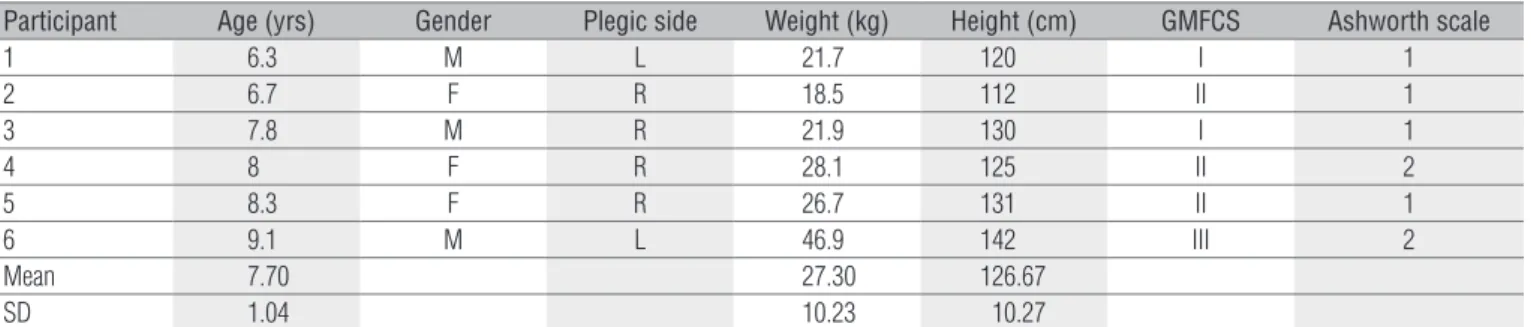
an intervention program offered by the Universidade Fede-ral de São Carlos (UFSCar), São Carlos (SP), Brazil, or who had previously participated in that program, were contac-ted through telephone. The characteristics of children are shown in Table 1.
Participant Age (yrs) Gender Plegic side Weight (kg) Height (cm) GMFCS Ashworth scale
1 6.3 M L 21.7 120 I 1
2 6.7 F R 18.5 112 II 1
3 7.8 M R 21.9 130 I 1
4 8 F R 28.1 125 II 2
5 8.3 F R 26.7 131 II 1
6 9.1 M L 46.9 142 III 2
Mean 7.70 27.30 126.67
SD 1.04 10.23 10.27
Table 1. Characterization of children with hemiplegic and spastic cerebral palsy in terms of age, gender, plegic side, weight, height, Gross Motor Function Classification System (GMFCS), and Ashworth scale30.
Procedures
Children accompanied by their parents or guardians at-tended the Learning, Biomechanics, Assessment and Training Laboratory (LABAT) of the UFSCar, where the data were acquired. Initially, the objectives and procedures of the study were explained, and each parent or guardian signed a consent form approved by the Ethics Committee of the Cruzeiro do Sul University, São Paulo, Brazil (No. 100/2007). While the parent or guardian was requested to complete the Pediatric Evalualion of Disability Inventory (PEDI)29, which covers issues related to
mobility, self care and social function, study investigators me-asured children’s weight and height, and a physical therapist used the Ashworth scale to assess the degree of spasticity30.
hen, relective markers were placed bilaterally over the ifth metatarsal, lateral malleolus, lateral femoral condyle, greater trochanter, and greater tubercle of the humerus for the iden-tiication of foot, leg, thigh and trunk segments, respectively, and to calculate joint angles. hus, the foot and leg segments deined the angle of the ankle, the leg and thigh segments de-ined the angle of the knee, and the thigh and trunk segments deined the angle of the hip.
Children were videotaped at 60 Hz by four digital ca-meras (Panasonic, model AG-DVC7P) bilaterally arranged, while walking in ive experimental conditions: (1) overground walking without BWS; (2) overground walking with 0% BWS; (3) overground walking with 30% BWS; (4) treadmill walking with 0% BWS; and (5) treadmill walking with 30% BWS.
For overground walking, children walked at a self-selected and comfortable speed over a 10-meter course. Before vide-otaping, the children were given the chance to practice each experimental condition to familiarize themselves with the pro-cedures. For treadmill walking, the treadmill was positioned at the center of the 10-meter course and children were requested to walk at a comfortable speed, while one investigator progres-sively increased the speed and checked if the child could ac-complish the task. After reaching the speed that was adequate for each child, the practice of the ive experimental conditions commenced. he children wore shoes and did not use any kind of orthoses during all experimental conditions.
Four repetitions of each experimental condition were videotaped, and the procedure always started with children walking overground without BWS (control condition). To re-duce the time spent in the laboratory, experimental conditions involving BWS were irst performed overground and then on the treadmill. he sequence for the percentage of BWS (0% or 30%) was chosen at random by the child. All children were allo-wed to rest between tasks, when needed.
he BWS system used in this study consists of a vest with adjustable belts and coated handles in the pelvis and thigh,
which is suspended by a steel cable attached to a motor that slides on a rail of approximately 10 meters ixed to the ceiling. A load cell, positioned between the vest and the steel cable, was used to determine the approximate percentage of BWS. To adjust the percentage of BWS, the motor was used to reduce or increase the length of the steel cable according to the desired percentage.
Data treatment
Videotaped data were transferred to a computer through a capture card (ieee1394). One stride of both the plegic and non-plegic limbs were selected from two trials under each experi-mental condition using the Ariel Performance Analysis System Program (APAS). hese data were digitized using the same pro-gram to obtain the coordinates x, y and z, which corresponded to the markers placed over children’s anatomical landmarks. he procedure for processing the real coordinates of the ac-quired data was the direct linear transformation (DLT). hese coordinates were iltered with a fourth-order Butterworth low-pass ilter (10 Hz), and the following variables were calculated using the Matlab program (MathWorks, Inc.): walking speed; stride length; speed and cadence; duration of the single-stance, double-stance and swing periods; range of motion (ROM) of the hip, knee and ankle joints during the walking cycle. he data corresponding to the coordinate x of the marker placed over the greater trochanter (referring to the plane of progression) were used to calculate mean walking speed, and the markers placed over the right and left lateral malleolus were used to calculate stride length. Stride speed was calculated by the ratio between stride length and duration. ROM was calculated by the diference between the maximum and minimum angles of each joint.
Statistical analysis
To compare the walking performance among the ive experimental conditions in children with hemiplegic and spastic CP, univariate (ANOVA) and multivariate (MANOVA) repeated-measures analyses of variance were employed. For the irst ANOVA, the factor was the experimental condition and the dependent variable was the mean walking speed; for the second ANOVA, the factors were the experimental condi-tion and body side (plegic or nonplegic), and the dependent variable was cadence. For all the MANOVAs, the factors were the experimental condition and body side; the dependent variables were stride length and speed for the irst MANOVA, duration of single-stance, double-stance and swing periods for the second MANOVA, and ROM of the hip, knee and ankle joints for the third MANOVA. When necessary, Tukey’s post
hoc tests were employed. he signiicance level (α) was set at 0.05 for all statistical tests, which were performed with the software Statistical Package for Social Sciences (SPSS version 10.0, SPSS Inc.).
Results
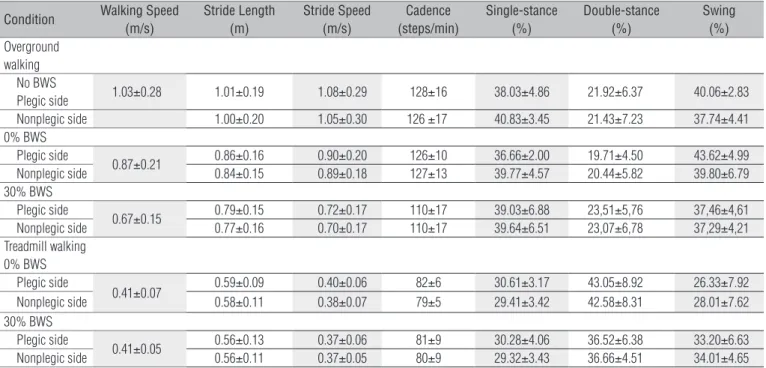
Table 2 shows the values for all variables, except for ROM, which is shown in Figure 1. he ANOVAs indicated that the experimental condition was signiicantly associated with diferent walking speeds (F4,20 = 19.33, p<0.001) and cadence (F4,20 = 29.21, p<0.001). here was no indication of diferences in cadence between body sides (F1,5 = 1.84, p>0.05), and no as-sociation between the experimental condition and body side (F4,20 = 0.48, p>0.05). Post hoc analyses indicated that children walked faster and with a higher cadence overground without BWS and with 0% BWS than on the treadmill with 0% or 30% BWS. When BWS was set at 30%, the children also showed hi-gher cadence walking overground than on the treadmill.
he irst MANOVA indicated that the experimental con-dition was signiicantly associated with diferent stride length and speed (Wilk’s Lambda = 0.15, F8,38 = 7.57, p<0.001). here was no indication of diferences in stride length and speed be-tween body sides (Wilk’s Lambda = 0.37, F2,4 = 3.34, p>0.05), and no association between the experimental condition and body side (Wilk’s Lambda = 0.87, F8,38 = 0.33, p>0.05). he univariate analyses of the experimental condition showed signiicant
diferences in stride length (F4,20 = 21.19, p<0.001) and speed (F4,20 = 22.99, p<0.001). Post hoc analyses indicated that children walked with longer and faster strides overground without BWS and with 0% BWS, than on the treadmill with 0% or 30% BWS.
he second MANOVA indicated that the experimental condi-tion was signiicantly associated with diferent duracondi-tions of stance and swing periods (Wilk’s Lambda = 0.11, F12,47 = 5.31, p<0.001). here was no indication of diferences between body sides (Wilk’s Lambda = 0.75, F3,3 = 0,80, p>0.05), and no associa-tion between the experimental condiassocia-tion and the body side (Wilk’s ambda = 0.63, F12,47 = 0.76, p>0.05). he univariate analyses of the experimental condition showed signiicant di-ferences in the duration of single-stance (F4,20 = 12.84, p<0.001), double-stance F4,20 = 25.57, p<0.001) and swing periods (F4,20 = 9.33, p<0.001). Post hoc analyses indicated that the single-stanceperiod (without BWS and with 0% BWS) was longer when children walked overground than on the treadmill. he duration of the double-stance period was shorter when children walked overground without BWS and with 0% BWS than on the tread-mill, and shorter when they walked overground with 30% BWS than on the treadmill with 0% BWS. he duration of the swing period was longer during overground walking without BWS and with 0% BWS than on treadmill walking with 0% BWS.
he third MANOVA indicated that the experimen-tal condition was signiicantly associated with ROM (Wilk’s Lambda = 0.15, F12,47 = 4.25, p<0.001). here was an indication of diferences between body sides (Wilk’s Lambda = 0.05, F3,3 = 18.66, p<0.05), but no association
Condition Walking Speed (m/s)
Stride Length (m)
Stride Speed (m/s)
Cadence (steps/min)
Single-stance (%)
Double-stance (%)
Swing (%)
Overground walking
No BWS
Plegic side 1.03±0.28 1.01±0.19 1.08±0.29 128±16 38.03±4.86 21.92±6.37 40.06±2.83 Nonplegic side 1.00±0.20 1.05±0.30 126 ±17 40.83±3.45 21.43±7.23 37.74±4.41 0% BWS
Plegic side
0.87±0.21 0.86±0.16 0.90±0.20 126±10 36.66±2.00 19.71±4.50 43.62±4.99
Nonplegic side 0.84±0.15 0.89±0.18 127±13 39.77±4.57 20.44±5.82 39.80±6.79
30% BWS Plegic side
0.67±0.15 0.79±0.15 0.72±0.17 110±17 39.03±6.88 23,51±5,76 37,46±4,61
Nonplegic side 0.77±0.16 0.70±0.17 110±17 39.64±6.51 23,07±6,78 37,29±4,21
Treadmill walking 0% BWS
Plegic side
0.41±0.07 0.59±0.09 0.40±0.06 82±6 30.61±3.17 43.05±8.92 26.33±7.92
Nonplegic side 0.58±0.11 0.38±0.07 79±5 29.41±3.42 42.58±8.31 28.01±7.62
30% BWS Plegic side
0.41±0.05 0.56±0.13 0.37±0.06 81±9 30.28±4.06 36.52±6.38 33.20±6.63
Nonplegic side 0.56±0.11 0.37±0.05 80±9 29.32±3.43 36.66±4.51 34.01±4.65
Table 2. Walking speed, stride length and speed, cadence, and duration of single-stance, double-stance, and swing periods during five experimental conditions in children with hemiplegic and spastic cerebral palsy (n=6).
was found between the experimental condition and the body side (Wilk’s Lambda = 0.38, F12,47 = 1.77, p>0.05). he univariate analyses of the experimental condition showed signiicant diferences in the ROM of the hip (F4,20 = 5.91, p <0.005), knee (F4,20 = 3.75, p<0.05), and ankle joints (F4,20 = 3,87, p<0.05). he univariate analysis of body sides also indicated a signiicant diference in the ROM of the hip joint (F1,5 = 32.64, p<0.005); i.e. the plegic side showed a more limited ROM than the nonple-gic side. Post hoc analyses indicated that the ROM of the hip was greater during overground walking without BWS than with 30% BWS. here was no indication of such diferences in the ROM of the knee and ankle joints.
Discussion
his study analyzed the spatial-temporal characteristics and the joint angles of children with CP during overground and treadmill walking and under diferent contexts of BWS. Few studies have investigated the use of BWS during over-ground walking3,25,27, and their focus was on patients who had
sufered a stroke. he present study was the irst to analyze overground walking performance of children with CP using a BWS system, and to compare it to walking without BWS and with treadmill walking with BWS. According to our indings, the children walked faster and had longer and faster strides when walking overground than on the treadmill, regardless of BWS use. In terms of joint angles, the hip was the only joint showing diferences between the body sides and among the experimental conditions, with the plegic side showing a more limited ROM than the nonplegic side, and overground walking without BWS showing a greater ROM than walking with 30% BWS.
Regarding the type of walking surface, most of the dife-rences found in spatial-temporal variables may have been due to the characteristics of the treadmill and the speed at which children walked. For example, the length of the treadmill may interfere with the length of the stride31. Additionally, due to
the fact that the treadmill is a moving surface, walking on that surface is more unstable than walking overground, and this may also decrease the length and speed of the stride32.
Because the mean walking speed interferes with spatial-tem-poral characteristics of walking33, the stride length and speed
could have been similar between the two types of surfaces if the treadmill speed had been set closely to the speed at which children walked overground. However, because children with CP are not used to walk on the treadmill, this may have pre-vented them to feel comfortable walking at a faster speed.
he diferences found in the duration of the stance and swing periods between overground and treadmill walking may also be a relection of a greater degree of instability as-sociated with the latter. It is well established that a longer single-stance period indicates the ability to sustain the limb34,
and in the same way, a shorter double-stance period indicates stability to walk. Because the treadmill is a moving surface, the children needed to spend more time with both feet on the surface during the walking cycle than when they walked overground. Consequently, they spent less time with only one foot on the surface during treadmill walking than during overground walking. One factor that contributes to improved stability and balance is the increase in the base of support35.
In the case of this study, the children spent more time with
Figure 1. Range of motion of the hip (A), knee (B), and ankle (C) joints during five experimental conditions in children with hemiplegic and spastic cerebral palsy (n=6).
Hip ROM (º)
Plegic side 80
70
60
50
40
30
20
10
80
70
60
50
40
30
20
10
80
70
60
50
40
30
20
10
No BWS 0% BWS OG 30% BWS OG 0% BWS T 30% BWS T
Nonplegic side
Knee ROM (º)
Ankle ROM (º)
A)
B)
C)
ROM=range of motion; BWS=body weight support; OG=overground walking; T=treadmill walking.
both feet on the treadmill to ensure greater stability while walking on that surface.
he use of the treadmill for walking training in children with CP has advantages and disadvantages. In terms of the ad-vantages, the treadmill can be used in a limited space, it favors the practice of complete walking cycles with symmetrical and consistent steps36, the number of walking cycles per training
sessions can be high given that the child cannot stop walking while the treadmill is in motion, and the speed of locomotion can be precisely controlled.
In terms of the disadvantages, treadmill walking requi-res a higher control of propulsion and balance compared to overground walking37. In terms of propulsion, while walking
overground requires the application of enough force to al-ternately move the right and left limbs forward, walking on a treadmill using some type of external support (e.g. BWS, side bars) generates a force that is not necessarily propor-tional to the speed38. It is also possible that in this situation
the limbs might be passively moved by the treadmill without any change in muscular activation13, with the child simply
raising and lowering the limbs while the treadmill belt is moving. In terms of balance control, because the treadmill is a moving surface, the walking strategy to keep stability can be different from that used for overground walking. This aspect was observed in this study through the variables du-ration of single-stance and double-stance periods, which were previously discussed. The disadvantages of using a treadmill may limit the transfer of skills to overground walking37, since the strategies required for treadmill walking
are not necessarily the same for overground walking, which is the type of surface that we normally walk.
In the case of walking training in children with CP, one should be concerned with the conditions imposed to these children and should work for enabling a more efective learning from this form of locomotion. And perhaps most importantly, one should understand whether the diferent types of training facilitate or hinder the transfer of learning to the child’s daily context. hus, studies like the present one are important be-cause they compare the walking training in diferent types of surfaces to verify the impact of each procedure on the ability of locomotion, and consequently on the activities of daily living in children with CP.
Regarding the joint ROM, the absence of diferences ob-served for the knee and ankle joints may be due to the small sample size and the variability among the children, as relec-ted by the standard deviation values (Figure 1B and 1C). On the other hand, there was less variability for the hip ROM, possibly because it is a more proximal joint than the knee and ankle joints. he hip ROM showed diferences between
the plegic and nonplegic sides, and the diferences found be-tween the experimental conditions may be attributed to the use of the suspension vest, which can restrict the movement of this joint26,37.
Finally, for most of the parameters examined, no diferences were found between the two selected percentages of BWS for tre-admill and overground walking. his result contradicts a previous study investigating the use of BWS during overground walking in hemiplegic subjects26. Again, this result can be attributed to the
small sample size and the wide variability among the children. To our knowledge, there are currently no published studies to investigate walking parameters under diferent percenta-ges of BWS in children with CP. For future studies, it is impor-tant to include a larger number of children with CP, especially because there is great variability in the type of brain injury in these children. his study demonstrated that it is possible to use BWS systems for walking training overground and on the treadmill in children with hemiplegic and spastic CP, and that diferences in walking parameters can be observed between these types of surfaces.
his study has some limitations that need to be acknowled-ged, such as the nonrandomized sequence of surface types, the limited time to familiarize with the experimental conditions, the diferences between the speed of treadmill and overground walking, and the small sample size. In this study, only children who were able to walk independently were selected to partici-pate, but they showed great variability in task execution in the diferent experimental conditions.
Future studies should be performed with larger sample sizes and with children presenting diferent types of CP and greater impairment in locomotion. hese studies should also include other walking parameters in their analyses. Finally, studies that investigate the efects of walking training in diferent types of surfaces must be conducted to clarify whether BWS systems are efective per se or whether it is the combination of the sys-tem and the type of surface that favors walking performance in children with CP.
Acknowledgments
1. Therlkeld AJ, Cooper LD, Monger BP, Craven AN, Haupt HG. Temporospatial and kinematic gait alterations during treadmill walking with body weight suspension. Gait Posture. 2003;17(3):235-45.
2. Lindquist AR, Prado CL, Barros RM, Mattioli R, da Costa PH, Salvini TF. Gait training combining partial body-weight support, a treadmill, and functional electrical stimulation: effects on poststroke gait. Phys Ther. 2007;87(9):1144-54.
3. Lamontagne A, Fung J. Faster is better: implications for speed-intensive gait training after stroke. Stroke. 2004;35(11):2543-8.
4. McNevin NH, Coraci L, Schafer J. Gait in adolescent cerebral palsy: the effect of partial unweighting. Arch Phys Med Rehabil. 2000;81(4):525-8.
5. Provost B, Dieruf K, Burtner PA, Phillips JP, Bernitsky-Beddingfield A, Sullivan KJ, et al. Endurance and gait in children with cerebral palsy after intensive body weight-supported treadmill training. Pediatr Phys Ther. 2007;19(1):2-10.
6. Richards CL, Malouin F, Wood-Dauphinee S, Williams JI, Bouchard JP, Brunet D. Task-specific physical therapy for optimization of gait recovery in acute stroke patients. Arch Phys Med Rehabil. 1993;74(3):612-20.
7. Carr JH, Shepherd RB. Neurological rehabilitation: optimizing motor performance. Oxford: Butterworth-Heinemann; 1998.
8. Alton F, Baldey L, Caplan S, Morrisey MC. A kinematic comparison of overground and treadmill walking. Clin Biomech (Bristol, Avon). 1998;13(6):434-40.
9. Stolze H, Kuhtz-Buschbeck JP, Mondwurf C, Boczek-Funcke A, Johnk K, Deuschl G, et al. Gait analysis during treadmill and overground locomotion in children and adults. Electroencephalogr Clin Neurophysiol. 1997;105(6):490-7.
10. Lee SJ, Hidler J. Biomechanics of overground vs. treadmill walking in healthy individuals. J Appl Physiol. 2008;104(3):747-55.
11. Warabi T, Kato M, Kiriyama K, Yoshida T, Kobayashi N. Treadmill walking and overground walking of human subjects compared by recording sole-floor reaction force. Neurosci Res. 2005;53(3):343-8.
12. Bayat R, Barbeau H, Lamontagne A. Speed and temporal-distance adaptations during treadmill and overground walking following stroke. Neurorehabil Neural Repair. 2005;19(2):115-24.
13. Harris-Love ML, Macko RF, Whitall J, Forrester LW. Improved hemiparetic muscle activation in treadmill versus overground walking. Neurorehabil Neural Repair. 2004;18(3):154-60.
14. Wass E, Taylor N, Matsas A. Familiarisation to treadmill walking in unimpaired older people. Gait Posture. 2005;21(1):72-9.
15. Matsas A, Taylor N, McBurney H. Knee joint kinematics from familiarised treadmill walking can be generalised to overground walking in young unimpaired subjects. Gait Posture. 2000;11(1):46-53.
16. Shepherd R, Carr J. Treadmill walking in neurorehabilitation. Neurorehabil Neural Repair. 1999;13:171-3.
17. Rosenbaum P, Paneth N, Leviton A, Goldstein M, Bax M, Damiano D, et al. A report: the definition and classification of cerebral palsy April 2006. Dev Med Child Neurol Suppl. 2007;109:8-14.
18. Shindl MR, Forstner C, Kern H, Hesse S. Treadmill training with partial body weight support in nonambulatory patients with cerebral palsy. Arch Phys Med Rehabil. 2000;81(3):301-6.
19. Dodd KJ, Foley S. Partial body-weight-supported treadmill training can improve walking in children with cerebral palsy: a clinical controlled trial. Dev Med Child Neurol. 2007;49(2):101-5.
20. Beard L, Harrow C, Bothner K. The effect of body weight support treadmill training on gait function in cerebral palsy: two case studies. Pediatr Phys Ther. 2005;17(1):72.
21. Begnoche D, Sanders E, Pitetti KH. Effect of an intensive physical therapy program with partial body weight treadmill trainning on a 2 year-old child with spastic quadriplegic cerebral palsy. Pediatr Phys Ther. 2005;17(1):73.
22. Sanders E, Begnoche D, Pitetti KH. Effect of an intensive physical therapy program with partial body weight treadmill training on a 9 year-old child with spastic diplegic cerebral palsy. Pediatr Phys Ther. 2005;17(1):82.
23. Dannemiller L, Heriza C, Burtner P, Gutierrez T. Partial weight bearing treadmill training in the home with young children with cerebral palsy: a study of feasibility and motor outcomes. Pediatr Phys Ther. 2005;17(1):77-8.
24. Russell DJ, Rosenbaum P, Cadman DT, Gowland C, Hardy S, Jarvis S. The gross motor function measure: a means to evaluate the effects of physical therapy. Dev Med Child Neurol. 1989;31(3):341-52.
25. Barbeau H, Lamontagne A, Ladouceur M, Mercier I, Fung J. Optimizing locomotor function with body weight support training and functional electrical stimulation. In: Latash ML, Levin MF, editors. Progress in motor control. Champaign: Human Kinetics; 2004. p. 237-51.
26. Sousa CO, Barela JA, Prado-Medeiros CL, Salvini TF, Barela AM. The use of body weight support on ground level: an alternative strategy for gait training of individuals with stroke. 2009;6:43.
27. Sousa CO. Estudo da marcha com suporte parcial de peso corporal em piso fixo em pacientes hemiparéticos [dissertação]. São Carlos (SP): Universidade Federal de São Carlos; 2009.
28. Palisano R, Rosenbaum P, Walter S, Russell D, Wood E, Galuppi B. Developmental and reability of a system to classity gross motor function in children with cerebral palsy. Dev Med Child Neurol. 1997;39(4):214-23.
29. Mancini MC. Inventário de avaliação pediátrica de incapacidade (PEDI): manual da versão brasileira adaptada. Belo Horizonte: UFMG; 2005.
30. Ashworth B. Preliminary trial of carisoprodol in multiple sclerosis. Practitioner. 1964;192:540-2.
31. Murray MP, Spurr GB, Sepic SB, Gardner GM, Mollinger LA. Treadmill vs. floor walking: kinematics, electromyogram, and heart rate. J Appl Physiol. 1985;59(1):87-91.
32. Bunterngchit Y, Lockhart T, Woldstad JC, Smith JL. Age related effects of transitional floor surfaces and obstruction of view on gait characteristics related to slips and falls. Int J Ind Ergon. 2000;25(3):223-32.
33. Winter DA. The biomechanics and motor control of human gait: normal, elderly, and pathological. 2ª Ed. Waterloo: University of Waterloo Press; 1991.
34. Perry J. Gait analysis: normal and pathological function. Throfare: Slack Incorporated; 1992.
35. McGinnis PM. Biomecânica do esporte e do exercício. Porto Alegre: Artmed; 2002.
36. Harris-Love ML, Forrester LW, Macko RF, Silver KH, Smith GV. Hemiparetic gait parameters in overground versus treadmill walking. Neurorehabil Neural Repair. 2001;15(2):105-12.
37. Norman KE, Pepin A, Ladouceur M, Barbeau H. A treadmill apparatus and harness support for evaluation and rehabilitation of gait. Arch Phys Med Rehabil. 1995;76(8):772-8.
38. Goldberg EJ, Kautz SA, Neptune RR. Can treadmill walking be used to assess propulsion generation? J Biomech. 2008;41(8):1805-8.
410