1 Rehabilitation Sciences Master’s Program, Centro Universitário Augusto Motta (UNISUAM), Rio de Janeiro, RJ, Brazil 2 School of Physical Therapy, Universidade Federal do Rio de Janeiro (UFRJ), Rio de Janeiro, RJ, Brazil
3 Laboratory of Pulmonary Function, Pedro Ernesto University Hospital, Universidade do Estado do Rio de Janeiro (UERJ), Rio de Janeiro, RJ, Brazil
Received: 08/16/2012 Revised: 02/21/2013 Accepted: 04/08/2013 a r t i c l e
Relationship between body balance, lung function,
nutritional status and functional capacity in
adults with cystic fibrosis
Jennifer T. S. Penafortes1, Fernando S. Guimarães1,2, Vanessa J. Ribeiro Moço1, Vívian P. Almeida1, Sara L. S. Menezes1,2, Agnaldo J. Lopes1,3
ABSTRACT | Background: Cystic ibrosis (CF) is a hereditary condition in which lung disease affects all patients.
In addition to pulmonary involvement, the multisystemic components of CF cause signiicant physical limitations. However, the impact of lung function on balance control in CF has not been studied. Objective: To assess body balance
in adults with CF and to test its possible associations with lung function, nutritional status, and functional capacity.
Method: This was a cross-sectional study in which 14 adults with CF underwent pulmonary function testing (spirometry,
body plethysmography, and carbon monoxide diffusing capacity (DLco), respiratory muscle strength, 6-min walking distance (6MWD), Berg balance scale (BBS), nutritional analysis (body mass index and bioelectrical impedance), and stabilometry. Body balance was quantiied using stabilometry; all participants performed the following two trials: opened base, eyes open (OBEO); closed base, eyes closed (CBEC). Results:In stabilometry, the median for the lateral range and anterior-posterior range in the CBEC trial was 0.10 (0.08-0.11) and 0.13 (0.11-0.22), respectively (p<0.05). The maximal inspiratory pressure (MIP) correlated inversely with the lateral standard deviation (ρ=–0.61; p<0.05) as the DLco correlated positively with the anterior-posterior range (ρ=0.54; p<0.05). There were signiicant relationships between body composition indexes and almost all stabilometric variables measured. There were no relationships of the BBS and 6MWD with the stabilometric variables. Conclusions:In adults with CF, imbalance occurs mainly in the anterior-posterior direction and is especially associated with body composition.
Keywords: cystic ibrosis; rehabilitation; respiratory function tests; postural balance; psychomotor performance;
nutrition assessment.
HOW TO CITE THIS ARTICLE
Penafortes JTS, Guimarães FS, Ribeiro Moço VJ, Almeida VP, Menezes SLS, Lopes AJ. Relationship between body balance, lung function, nutritional status and functional capacity in adults with cystic ibrosis. Braz J Phys Ther. 2013 Sept-Oct; 17(5):450-457. http://dx.doi.org/10.1590/S1413-35552012005000111
Introduction
Cystic fibrosis (CF) is a severe autosomal recessive hereditary disease, with variability in symptom onset and presentation1. Although CF is
a progressively debilitating disease, in recent years the improvements in its understanding and treatment have been increasing the patients’ life expectancy. The median predicted survival of only 16 years in 1970 has currently reached approximately 40 years, and infants born with CF in the beginning of this new millennium are expected to live beyond 50 years of age. The number of middle-aged or older individuals with CF is also increasing1.
CF is a disorder that affects many systems and can cause various problems. Lung disease is recognized as the factor with the greatest impact on the morbidity
and mortality in older people with CF1,2. In CF,
pulmonary function impairment results in excessive recruitment of the expiratory and accessory inspiratory muscles, which contributes to adaptive hypertrophy. Under high tension, these muscles shorten and lose lexibility, decreasing muscle length and strength. As the involvement of the lungs by CF increases, the hyperinlation and increased work of breathing may cause muscle imbalance due to the altered respiratory mechanics2,3. In addition to pulmonary involvement,
an important predictor of survival in CF4. Adults with
CF also have more bone and joint disease, including low bone mineral density and postural deformities2.
Body balance has been studied increasingly in the literature over the last decades3,5,6. The maintenance of
balance control is important for the correct execution of all daily living activities. One of the most dangerous aspects of changes in body stability is the increased risk of falls. Deterioration in balance function clearly starts at a relatively young age and further accelerates around the age of sixty7. Recent studies have noted
reduced balance and coordination in individuals with chronic obstructive pulmonary disease (COPD)3,8.
The postural attitude of a hyperinlated thorax can lead to shoulder, spinal column, and pelvic girdle compensations, including spinal column deformities as increased thoracic kyphosis and lumbar lordosis, which are fairly common in adults with CF9.However
the information regarding balance in CF is limited, and the relationship between lung function and balance has not been analyzed in CF.
The accumulation of fat can also cause a reduction in body balance and contribute to falls, particularly when combined with low muscle mass, which, in turn, can impair the biomechanical responses and reduce the stability mechanisms. It is believed that obesity might affect the selection of motor strategies
employed to maintain body balance6. However, to
our knowledge, no study has previously attempted to investigate the correlation between body mass and balance in the adult population with CF.
The changes in thoracic biomechanics inluence the overall body mechanics10. Thus, any respiratory
imbalance might result in altered total body balance. It is therefore possible to assume that all of these changes may culminate in a reduction in functional capacity. Such knowledge can be an important tool for planning the most appropriate mode of therapeutic exercise in adults with CF. Therefore, we sought to assess body balance in adults with CF, as well as to verify the relationship between body balance, lung function, nutritional status, and functional capacity in these patients.
Method
Participants
This was a cross-sectional study that included patients treated at Centro de Referência para Adultos com Fibrose Cística da Policlínica Piquet Carneiro, Rio de Janeiro, RJ, Brazil. A convenience sample of adults with CF was recruited between September
2011 and February 2012. The diagnosis of CF was based on at least two of the following criteria: sweat chloride concentration >60 mEq/mL; two clinical features consistent with CF; or genetic testing demonstrating two mutations associated with CF11.
Inclusion criteria were: a) age ≥18 years, diagnosed with CF, b) clinically stable, c) no injuries or previous surgery on the lower limbs; and d) absence of knee or ankle clinical instability. Exclusion criteria were: a) hospitalized patients, b) acute intercurrent respiratory infection during the 3 weeks preceding enrollment; c) unable to perform pulmonary function evaluation or 6-min walking test (6MWT); d) neurological, cardiovascular, metabolic, rheumatic or vestibular diseases; e) abnormal accumulation of luid (edema), mainly in the limbs, as assessed by physical examination, f) any implanted electronic or metallic device. Home medication (antibiotics, bronchodilators, pancreatic enzyme supplements, and vitamins) was maintained over the course of the study.
The present study was approved by the Research Ethics Committee of Centro Universitário Augusto Motta (UNISUAM), Rio de Janeiro, RJ, Brazil (approval no. 012/2011). All participants signed an informed consent form.
Measurements
The body mass index (BMI) was calculated on the basis of weight and height [weight (Kg) / height (m2)] using an analog balance scale which includes
a stadiometer (R110, Welmy, Santa Bárbara d’Oeste, São Paulo, Brazil), and the results were classiied according to the World Health Organization12. Body
composition was analyzed using a bioelectrical impedance device (BIA 310e, Biodynamics, Seattle, WA, USA). The participants were instructed to rest for 5 minutes before the test. During the test, they were barefoot, away from metallic objects, and stood with their feet 15 to 30 cm apart13. Two
electrodes were placed on the dorsum of the right hand, and two were placed on the dorsum of the right foot. Resistance and reactance were calculated and used to estimate fat-free mass (FFM). The selected equation has been previously validated for Brazilian individuals13.
Pulmonary function testing consisted of spirometry, body plethysmography, carbon monoxide diffusing capacity (DLco), and respiratory muscle strength. Measurements were conducted using the Collins Plus Pulmonary Function Testing Systems (Warren E. Collins, Inc., Braintree, MA, USA), following the standards for the procedure and interpretation14.
taken during shallow panting at a rate of one to two breaths/second with an open glottis. Airway resistance (Rwa) was also measured simultaneously during the open-shutter panting; reported thoracic gas volume was the calculated average of three to five acceptable panting maneuvers. Carbon monoxide diffusing capacity (DLco) maneuvers were performed after the participant had been seated for at least 5 minutes. Because exercise increases DLco, the participant was asked to refrain from exertion immediately before the test; the participant was also instructed about the requirements of the maneuver. Respiratory muscle strength was measured using a pressure transducer. Maximal inspiratory pressure (MIP) and maximal expiratory pressure (MEP) were measured from residual volume (RV) and total lung capacity (TLC), respectively. The participants had to maintain maximal effort against the occluded airway for one to three seconds. At least three MIP and three MEP maneuvers were recorded. The pulmonary function testing results were expressed as percentage of the predicted values for the Brazilian population15-17. The participants also completed two
encouraged 6MWT in a 30-m hospital corridor, following recommendations17. The maximal distance
covered was recorded for further analysis. Results were expressed as a percentage of the predicted values according to the reference equations18.
Functional balance was measured using the Berg Balance Scale (BBS), which has been previously validated for the Brazilian population19. The BBS
examines balance by using different standardized positions and actions related to 14 daily life items. The items are scored according to the time that the body position can be maintained and the distance at which the arm is capable of reaching forward19,20.
Each item has an ordinal scale of ive alternatives, ranging from 0 to 4 points. The maximum score that can be reached is 56. A cutoff score of 46 or lower has been used to identify patients at risk of falling21.
Body balance was quantified using a force platform system (AccuSway Plus, AMTI, Watertown, Massachusetts, USA), and center-of-foot pressure signals were recorded using EBG Software version 1.0 (PGSM, France). This measurement system contains 2,288 force sensors arranged in rows and columns of the platform and connected to a data acquisition system controlled by software. All participants performed the following two trials: opened base, eyes open (OBEO); closed base, eyes closed (CBEC) (feet parallel and <1 cm apart). The participants were asked to maintain a static position with their eyes focused on a target on the wall located
1.5 m for 30 seconds. A randomized block design (four possible sequences of the described trials) was used to minimize fatigue and learning effects. The calculated stabilometric variables included the lateral standard deviation (X SD), anterior-posterior standard deviation (Y SD), lateral range (X range), and anterior-posterior range (Y range)6.
Anthropometry, BBS, bioelectrical impedance, and stabilometry were evaluated at the same location. Pulmonary function tests and 6MWT were performed elsewhere with a maximum interval of one week between tests.
Data analysis
To check the homogeneity of the sample, a Shapiro-Wilk test was used; if a meaningful number of variables did not have a normal distribution, nonparametric tests were selected. The results were expressed as the median and interquartile range values or frequencies (percentage). Numerical variables were compared using the Mann-Whitney test. Spearman’s rank correlations were calculated to investigate associations. Data analysis was performed using SAS 6.11 software (SAS Institute, Inc., Cary, NC, USA). The statistical signiicance level was set at p<0.05.
Results
Thirty-eight individuals were initially eligible for assessment; however, 5 did not meet inclusion criteria because they were under the age of 18. Among the 33 individuals recruited for the investigation, 19 were excluded. Of the excluded individuals, 8 did not agree to participate, 6 had limited mobility, 4 were not able to perform the pulmonary function tests, and 1 had vestibular disease. Thus, 14 adults with CF completed the study.
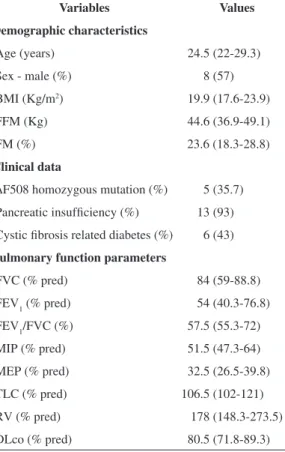
Anthropometric and clinical characteristics, pulmonary function, and respiratory muscle strength are summarized in Table 1. Pancreatic insuficiency and CF-related diabetes were common indings in the sample studied (Table 1). Overall, 8 participants (57%) were male, and the median age was 24.5 years (range, 20-34 years). Six participants had a BMI <18.5 Kg/m2; 4 had a BMI between 18.5 and
25 Kg/m2; 2 had a BMI between 25 and 30 Kg/m2;
and 2 had a BMI ≥30 Kg/m2. Ten participants (71.4%)
The 6-min walking distance (6MWD) was abnormally low in 6 participants (42.8%). The median 6MWD was 636.5 m (range, 450-750 m), and the median 6MWD% was 83.3 (67.6-92.3). Of the 14 participants, 11 had a score at the 56-point, 2 at the 55-point, and 1 at the 54-point on the BBS. The data obtained by stabilometry are presented in Table 2. There was a greater displacement in the anterior-posterior direction, especially when participants were tested with eyes and base closed (p<0.05 for all).
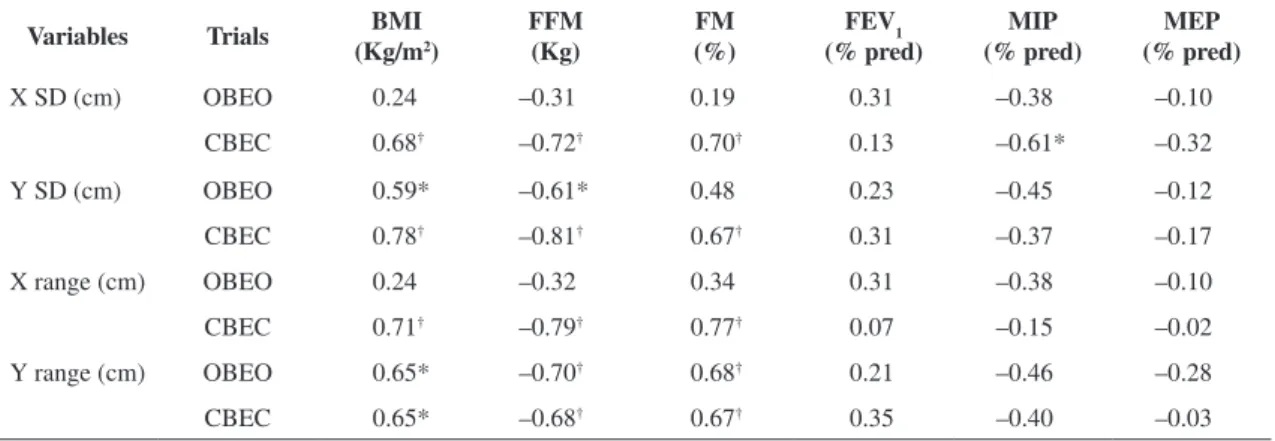
There were no relationships between the BBS, 6MWD, and stabilometric variables. However, we found associations between stabilometric variables and body composition indexes, pulmonary function parameters and respiratory muscle strength (Tables 3 and 4).
Discussion
Our study demonstrated that, in adults with CF, the changes in st abilometry are primarily in
the anterior-posterior direction. The nutritional status, inspiratory muscle strength, and pulmonary diffusion capacity are signiicantly correlated with postural balance in these subjects. In addition, there is no relationship between BBS or 6MWD and stabilometry. To date, there seem to be no studies that have focused on this issue.
Stabilometry assesses body balance through the quantiication of postural oscillations in the standing position on a force platform, involving the recording of the center of pressure displacement in the anterior-posterior and lateral directions6,21. Many investigators
have attempted to understand which factors affect body balance and, consequently, tend to increase the incidence of falls3,4. Despite different underlying
etiologies and time of onset, both CF and COPD lead to parallel pathological changes in a way that can be compared in stabilometric measurements. Similarly to the current study, some authors demonstrated greater displacement in the anterior-posterior direction in COPD patients3; however, Rocco et al.22
observed increased lateral center of pressure displacement (but no increased anterior-posterior center of pressure displacement) compared to healthy controls. Interestingly, balance in the lateral direction is primarily maintained by torques at the trunk muscles and movement, whereas anterior-posterior direction is primarily maintained by torques at the ankle23. Despite not having a control group, our study
suggests that lateral imbalance in adults with CF may also be due to a marked impairment in respiratory muscle strength. As expected, we observed changes in all stabilometric variables when the trial was modiied3,6. The CBEC trial was the condition with
Table 1. Anthropometric and clinical characteristics, pulmonary function testing, and respiratory muscle strength.
Variables Values
Demographic characteristics
Age (years) 24.5 (22-29.3) Sex - male (%) 8 (57) BMI (Kg/m2) 19.9 (17.6-23.9) FFM (Kg) 44.6 (36.9-49.1)
FM (%) 23.6 (18.3-28.8)
Clinical data
∆F508 homozygous mutation (%) 5 (35.7) Pancreatic insuficiency (%) 13 (93) Cystic ibrosis related diabetes (%) 6 (43)
Pulmonary function parameters
FVC (% pred) 84 (59-88.8) FEV1 (% pred) 54 (40.3-76.8) FEV1/FVC (%) 57.5 (55.3-72) MIP (% pred) 51.5 (47.3-64) MEP (% pred) 32.5 (26.5-39.8) TLC (% pred) 106.5 (102-121) RV (% pred) 178 (148.3-273.5) DLco (% pred) 80.5 (71.8-89.3)
Results are medians (interquartile range) or number (%) of 14 adults with cystic ibrosis. BMI = body mass index; FFM = fat-free mass; FM = fat mass; FVC = forced vital capacity; % pred = % predicted; FEV1 = forced expiratory volume in one second; MIP = maximal inspiratory pressure; MEP = maximal expiratory pressure; TLC = total lung capacity; RV = residual volume; DLco = diffusing capacity for carbon monoxide.
Table 2. Stabilometric variables.
Variables Trials Values
X SD (cm) OBEO 0.01 (0.01-0.01) CBEC 0.09 (0.07-0.10) Y SD (cm) OBEO 0.02 (0.01-0.02) CBEC 0.12 (0.08-0.13) X range (cm) OBEO 0.01 (0.01-0.01) CBEC 0.10 (0.08-0.11) Y range (cm) OBEO 0.03 (0.02-0.04) CBEC 0.13 (0.11-0.22)
the highest demand for somatosensory and vestibular systems, since the visual feedback is eliminated6.
The evaluation of the relationship between balance and nutritional status is important for providing information about the factors that can predispose to falls. The current study showed significant relationships between body composition indexes and almost all stabilometric variables measured. Some authors also showed a positive correlation between body adiposity and body balance control6,24.
Interestingly, almost one third of our participants had a BMI consistent with overweight or obesity; it is possible that fat accumulation and body mass increases can causes a center of pressure displacement, which can generate loss of stability mechanisms6. In
contrast, it is worth noting that 43% of our sample
had BMI compatible with malnutrition. In adults with CF, it is assumed that nutritional depletion is caused by negative energy balance resulting not only from pancreatic insuficiency (causing poor nutrient absorption) but also by the CF-related diabetes and chronic respiratory disease25. All of these conditions
were common in our sample. Thus, it is possible that malnutrition may have inluenced our results, changing the body balance.
Our study showed a signiicant correlation between maximal inspiratory pressure (MIP) (% predicted) and mean (SD) (cm) measured with eyes and base closed, and all participants had signiicant air trapping. As a result of the changes occurring in the trunk muscles due to air trapping, respiratory effort increases signiicantly. This can result in an impaired ability of
Table 4. Spearman’s correlation coeficients between plethysmographic measurements, diffusing capacity and stabilometric variables in adults with cystic ibrosis (n=14).
Variables Trials TLC
(% pred)
RV (% pred)
RV/TLC (%)
DLco (% pred)
X SD (cm) OBEO –0.10 –0.38 –0.27 0.24
CBEC 0.25 –0.13 –0.24 0.35
Y SD (cm) OBEO 0.12 –0.30 –0.36 0.53*
CBEC 0.04 –0.27 –0.39 0.50
X range (cm) OBEO –0.10 –0.38 –0.28 0.24
CBEC –0.16 –0.46 –0.33 0.39
Y range (cm) OBEO 0.19 –0.15 –0.26 0.44
CBEC 0.45 –0.07 –0.34 0.54*
X SD = lateral standard deviation; Y SD = anterior-posterior standard deviation; X range = lateral range; Y range = anterior-posterior range; OBEO = opened base, eyes open; CBEC = closed base, eyes closed; TLC = total lung capacity; % pred = % predicted; RV = residual volume; DLco = diffusing capacity for carbon monoxide. *p<0.05; †p<0.01.
Table 3. Spearman’s correlation coeficients between body composition, spirometry, respiratory muscle strength and stabilometric variables in adults with cystic ibrosis (n=14).
Variables Trials BMI (Kg/m2)
FFM (Kg)
FM (%)
FEV1 (% pred)
MIP (% pred)
MEP (% pred)
X SD (cm) OBEO 0.24 –0.31 0.19 0.31 –0.38 –0.10
CBEC 0.68† –0.72† 0.70† 0.13 –0.61* –0.32
Y SD (cm) OBEO 0.59* –0.61* 0.48 0.23 –0.45 –0.12
CBEC 0.78† –0.81† 0.67† 0.31 –0.37 –0.17
X range (cm) OBEO 0.24 –0.32 0.34 0.31 –0.38 –0.10
CBEC 0.71† –0.79† 0.77† 0.07 –0.15 –0.02
Y range (cm) OBEO 0.65* –0.70† 0.68† 0.21 –0.46 –0.28
CBEC 0.65* –0.68† 0.67† 0.35 –0.40 –0.03
X SD = lateral standard deviation; Y SD = anterior-posterior standard deviation; X range = lateral range; Y range = anterior-posterior range; OBEO = opened base, eyes open; CBEC = closed base, eyes closed; BMI = body mass index; FFM = fat-free mass; FM = fat mass;
FEV1 = forced expiratory volume in one second; % pred = % predicted; MIP = maximal inspiratory pressure; MEP = maximal expiratory
the trunk to contribute to body balance. Moreover, the limbs and trunk muscles might be atrophied and weak because of the inadequate nutritional status resulting from pancreatic insuficiency (observed in 93% of our participants) and an ongoing catabolic state26. In
addition, increased lumbar lordosis is often noted in these patients; this change may cause an associated imbalance of the muscular system that will inhibit normal movement. Interestingly, some investigators demonstrated that postural reeducation improves respiratory muscle strength and the ability to expand the rib cage in sedentary subjects27.
The role of DLco in pulmonary function testing is to provide information on the transport of gas from alveolar air to hemoglobin28. In our study, it is
not surprising to observe a signiicant relationship (positive correlation) between DLco (% predicted) and stabilometric variables. During the single-breath DLco maneuver in adults with CF, the maximal inspiration against obstructed airways requires abnormally negative intrathoracic pressures; this increases the pulmonary capillary blood volume and, thereby, increases the DLco. Furthermore, patients with higher BMIs and greater body surface areas tend to have higher DLco values due to increased pulmonary capillary blood volume; this causes a center of pressure displacement28.
In this study, we chose BBS over other evaluation methods not only because it is inexpensive, easy to administer, and secure, but also because it is widely used in clinical practice and research. The usefulness of the BBS score for the assessment of functional balance has been conirmed in research studies and in clinical practice based on the extensive analysis of its measurement properties, which were found to be reliable19,20. In COPD patients, Beauchamp et al.29
demonstrated differences in the BBS score between fallers and non-fallers (45.2±5.40 vs. 48.8±5; p=0.042). However, our investigation did not ind changes in the BBS score among CF individuals, suggesting a low discriminative power of this scale when compared to more reined tests such as stabilometry. Our results are in accordance with Gil et al.30, who also found no correlation between the
force platform parameters and two functional tests to evaluate body balance.
Another focus was the relationship between functional capacity and body balance. Simpler and cheaper tests such as the 6MWT have been used to assess tolerance to exercise in adult patients with CF, and the distance achieved in the walking test allows an estimation of individual response to
incremental maximal exercise. Several conditions have been linked to the limited exercise capacity in adults with CF, including the deterioration of pulmonary function, peripheral muscle weakness, and malnutrition31. Moreover, the role of body balance
as one of the main domains of functional capacity is recognized. Despite these considerations, the association between body balance and the 6MWT has not been previously investigated in patients with chronic lung diseases. In the present investigation, no relationship was noted between stabilometric variables and the 6MWD, suggesting that exercise tolerance is not compromised by imbalance in people living with CF.
The main limitations of our study were the small sample size and the lack of comparisons between the CF results with a paired sample of normal subjects. Despite these limitations, this is the irst study to evaluate the relationship between stabilometry results and lung function parameters in adults with CF. Since there are no published studies on body balance in CF, we believe that our results represent an important contribution to the field. Further investigations including a larger sample and a healthy control group are necessary to conirm the body balance impairment in adults with CF, which may bring a new rehabilitative treatment perspective for this group of patients.
In conclusion, the present study showed greater displacement in the anterior-posterior direction in adults with CF. Additionally, body balance is associated with several factors in these subjects, especially with body composition variables (FFM, FM, and BMI). Our results suggest that balance should be considered in the assessment and rehabilitation strategies directed toward adults with CF.
References
1. Garattini E, Bilton D, Cremona G, Hodson M. Adult cystic ibrosis care in the 21st century. Monaldi Arch Chest Dis. 2011;75(3):178-84. PMid:22428221.
2. Yankaskas JR, Marshall BC, Suian B, Simon RH, Rodman D. Cystic fibrosis adult care: Consensus Conference Report. Chest. 2004;125(Suppl 1):1S-39. PMid:14734689. http://dx.doi.org/10.1378/chest.125.1_suppl.1S
4. Elborn JS, Bell SC. Nutrition and survival in cystic fibrosis. Thorax. 1996;51(10):971-2. http://dx.doi. org/10.1136/thx.51.10.971
5. Schmid M, Conforto S, Bibbo D, D’Alessio T. Respiration and posture sway: detection of phase synchronizations and interactions. Hum Mov Sci. 2004;23:105-19. PMid:15474172. http://dx.doi.org/10.1016/j. humov.2004.06.001
6. Mainenti MRM, Rodrigues EC, Oliveira JF, Ferreira AS, Dias CM, Silva ALS. Adiposity and postural balance control: Correlations between bioelectrical impedance and stabilometric signals in elderly Brazilian women. Clinics. 2011;66(9):1513-18. PMid:22179151 PMCid:PMC3164396.
7. Era P, Sainio P, Koskinen S, Haavisto P, Vaara M, Aromaa A. Postural balance in a random sample of 7,979 subjects aged 30 years and over. Gerontology. 2006;52(4):204-13. PMid:16849863. http://dx.doi.org/10.1159/000093652 8. Chang AT, Seale H, Walsh J, Brauer SG. Static balance
is affected following an exercise task in chronic obstructive pulmonary disease. J Cardiopulm Rehabil Prev. 2008;28(2):142-56. PMid:18360191.
9. Boulay C, Tardieu C, Hecquet J, Benaim C, Mouilleseaux B, Marty C, et al. Sagittal alignment of spine and pelvis regulated by pelvic incidence: standard values and prediction of lordosis. Eur Spine J. 2006;15(4):415-22. PMid:16179995 PMCid:PMC3489325. http://dx.doi. org/10.1007/s00586-005-0984-5
10. Butcher SJ, Meshke JM, Sheppard MS. Reductions in functional balance, coordination, and mobility measures among patients with stable chronic obstructive pulmonary disease. J Cardiopulm Rehabil. 2004;24(4):274-80. PMid:15286536. http:// dx.doi.org/10.1097/00008483-200407000-00013 11. Farrel PM, Rosenstein BJ, White TB, Accurso FJ,
Castellani C, Cutting GR, et al. Guidelines for diagnosis of cystic ibrosis in newborns through older adults: Cystic Fibrosis Consensus Report. J Pediatr. 2008;153(2):S4-14. PMid:18639722 PMCid:PMC2810958. http://dx.doi. org/10.1016/j.jpeds.2008.05.005
12. World Health Organization. Obesity: preventing and managing the global epidemic. Report of a WHO consultation. World Health Organ Rep Ser. 2000;894(i-xii):1-253.
13. Kyle UG, Bosaeus I, De Lorenzo AD, Deurenberg P, Elia M. Bioelectrical impedance analysis–part I: review of principles and methods. Clin Nutr. 2004;23(5):1226-43. PMid:15380917. http://dx.doi.org/10.1016/j. clnu.2004.06.004
14. Miller MR, Hankinson J, Brusasco V. ATS/ERS Task Force. Standardization of spirometry. Eur Respir J. 2005;26(2):319-38. PMid:16055882. http://dx.doi.org/ 10.1183/09031936.05.00034805
15. Pereira CAC, Sato T, Rodrigues SC. New reference values for forced spirometry in white adults in Brazil. J Bras Pneumol. 2007;33(4):397-406. PMid:17982531. http:// dx.doi.org/10.1590/S1806-37132007000400008 16. Neder JA, Andreoni S, Castelo-Filho A, Nery LE.
Reference values for lung function tests. I. Static volumes. Braz J Med Biol Res. 1999;32(6):703-17. PMid:10412549.
17. Pereira FM, Ribeiro MÂ, Ribeiro AF, Toro AA, Hessel G, Ribeiro JD. Functional performance on the six-minute walk test in patients with cystic ibrosis. J Bras Pneumol. 2011;37(6):735-44. PMid:22241030. 18. Gibbons WJ, Fruchter N, Sloan S, Levy RD.
Reference values for a multiple repetition 6-minute walk test in healthy adults older than 20 years. J Cardiopulm Rehabil. 2011;21(2):87-93. http://dx.doi. org/10.1097/00008483-200103000-00005
19. Miyamoto ST, Lombardi I Jr, Berg KO, Ramos LR, Natour J. Brazilian Version of Berg Balance scale. Braz J Med Biol Res 2004;37(9):1411-21. PMid:15334208. http://dx.doi. org/10.1590/S0100-879X2004000900017
20. Karuka AH, Silva JAMG, Navega MT. Analysis of agreement of assessment tools of body balance in the elderly. Rev Bras Fisioter. 2011;15(6):460-6. PMid:22218711. http://dx.doi.org/10.1590/S1413-35552011000600006 21. Duarte M, Freitas SMSF. Revision of posturography
based on force plate for balance evaluation. Rev Bras Fisioter. 2010;14(3):183-92. http://dx.doi.org/10.1590/ S1413-35552010000300003
22. R o c c o C C M , S a m p a i o L M M , S t i r b u l o v R . Neurophysiological aspects and their relationship to clinical and functional impairment in patients with chronic obstructive pulmonary disease. Clinics. 2011;66(1):125-9. PMid:21437448 PMCid:PMC3044581. http://dx.doi. org/10.1590/S1807-59322011000100022
23. Winter DA, Prince F, Frank JS, Powell C, Zabjek KF. Unified theory regarding A/P and M/L balance in quiet stance. J Neurophysiol. 1996;75(6):2334-43. PMid:8793746.
24. Greve J, Alonso A, Bordini ACPG, Camacho GL. Correlation between body mass index and postural balance. Clinics. 2007;62(6):717-20. PMid:18209913. http://dx.doi.org/10.1590/S1807-59322007000600010 25. Lopes AJ, Mafort TT, De Sá Ferreira A, Santos de Castro
MC, De Cássia Firmida M, De Andrade Marques E. Is the type of chronic pulmonary infection a determinant of lung function outcomes in adult patients with cystic ibrosis? Monaldi Arch Chest Dis. 2012;77(3-4):122-8. PMid:23461248.
26. Reid WD, Geddes EL, O’Brien K, Brooks D, Crowe J. Effects of inspiratory muscle training in cystic fibrosis: a systematic review. Clin Rehabil. 2008;22(10-11):1003-13. PMid:18955432. http://dx.doi.org/10.1177/0269215508090619
27. Moreno MA, Catai AM, Teodori RM, Borges BLA, Cesar MC, Silva E. Effect of a muscle stretching program using the Global Postural Reeducation method on respiratory muscle strength and thoracoabdominal mobility of sedentary young males. J Bras Pneumol. 2007;33(6):679-86. PMid:18200368. http://dx.doi.org/10.1590/ S1806-37132007000600011
28. Saydain G, Beck KC, Decker PA, Cowl CT, Scanlon PD. Clinical signiicance of elevated diffusing capacity. Chest. 2004;125(2):446-52. PMid:14769723. http:// dx.doi.org/10.1378/chest.125.2.446
Med. 2009;103(12);1885-91. PMid:19592229. http:// dx.doi.org/10.1016/j.rmed.2009.06.008
30. Gil AWO, Oliveira MR, Coelho VA, Carvalho CE, Teixeira DC, Silva RA Jr. Relationship between force platform and two functional tests for measuring balance in the elderly. Rev Bras Fisioter. 2011;15(6):429-35. PMid:22002192. http://dx.doi.org/10.1590/S1413-35552011005000024 31. McKone EF, Barry SC, Fitzgerald MX, Gallagher CG.
Role of arterial hypoxemia and pulmonary mechanics in exercise limitation in adults with cystic ibrosis. J Appl
Physiol. 2005;99(3):1012-8. PMid:15860682. http:// dx.doi.org/10.1152/japplphysiol.00475.2004
Correspondence
Agnaldo José Lopes
Rua Araguaia, 1266, bloco 1/405, Freguesia, Jacarepaguá CEP 22745-271, Rio de Janeiro, RJ, Brasil