630 Brazilian Journal of Physics, vol. 37, no. 2B, June, 2007
On New Gauge Boson Signals According to the Littlest Higgs Model in Future
e
+e
−Colliders
F. M. L. de Almeida Jr., Y. A. Coutinho, J. A. Martins Sim˜oes, A. J. Ramalho, S. Wulck,
Instituto de F´ısica,
Universidade Federal do Rio de Janeiro, 21941-972, Rio de Janeiro, RJ, Brazil
and M. A. B. do Vale
Departamento de Ciˆencias Naturais, Universidade Federal de S˜ao Jo˜ao Del Rei,
36301-160, S˜ao Jo˜ao del Rei, MG, Brazil
Received on 19 January, 2007
There is a recent proposal of identifying the Higgs particle of the Standard Model as a pseudo Nambu-Goldstone boson. This new broken symmetry introduces new particles and new interactions. Among these new interactions a central role to get an experimental signal of a new physics is played by the new neutral gauge bosons,AHandZH. We study the associated production of general new neutral gauge bosonZ′and a
hard photon in the processe++e−−→µ++µ−+γ. ForMAH <√swe show that the hard photon energy distribution ine++e−−→γ+f+f¯can present a model dependence and establish the theoretical origin of a new possible heavy neutral gauge boson.
Keywords: Littlest Higgs; New Gauge Bosons
I. THE LITTLEST HIGGS MODEL
Recently, new models have been proposed as possible so-lutions to the hierarchy problem of the Standard Model (SM). The Little Higgs models [1] implement the idea that the Higgs boson is a pseudo-Goldstone boson. They are constructed by embedding the Standard Model inside a larger group with an enlarged symmetry. The minimal model was called the Lit-tlest Higgs Model (LHM). The LHM consists of an SU(5)
non-linear sigma model which is spontaneously broken to its subgroupSO(5)by vacuum expectation value (VEV) of order f. The gauged group(SU(2)⊗U(1))2is broken at the same time to its diagonal electroweak SM subgroupSU(2)⊗U(1). The new heavy states in this model consists of heavy gauge bosons (WH,ZH,AH), a triplet HiggsΦand a vector like top
quark which cancels the quadratic divergences coming from the SM top quark. By construction, all of the new states ac-quire masses of order f and typically in the TeV range. The approximate mass relations for the heavy gauge bosons can be written as [2]:
MW2 H ≃M
2
ZH ≥ MW24f2
v2 M
2
AH ≥M 2
wtan2θw
4f2 5v2 (1) whereθwis the Weinberg angle,vis the electroweak scale and
the mass parameterMW ≡gv/2 approaches the SMW-boson
mass when f →∞. The neutral gauge bosonAH is typically
light and should be the first signal of the LHM. A first prop-erty of this model is the presence of a second, heavier, new neutral gauge boson, named ZH (MZH ≈4MAH). The total
decay widthΓZH is mainly dependent of the free parameters MZH andc(cosθ), while the total decay widthΓAH is
sensi-tive to the free parametersMAH andc′(cosθ′). The parameter
space for the two mixing angles,candc′, is 0≤c≤0.5 and 0.62≤c′≤0.73, consistent with the precision electroweak constraints.
II. THE HARD PHOTON
The most direct channel to study theAH,ZH properties is
e++e−−→ f+f¯, at the ressonant energy√s=MZH,MAH.
As these masses are unknown, the new high-energy accelera-tors will have to vary√s. As this procedure is a very complex operation it is important to have physical alternatives at fixed
√
s.
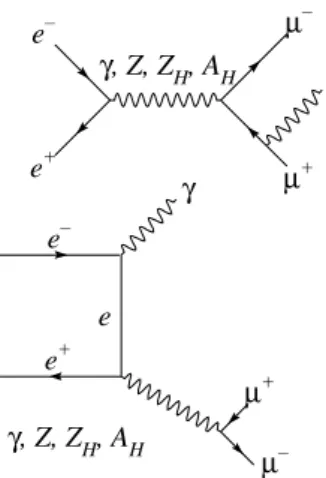
In this work we explore the interesting properties of the fun-damental interaction mechanism of the associated production of new neutral gauge bosons and a hard photon in the process
e++e−−→µ++µ−+γ. (For more details see [3]). The
Feynman diagrams for this channel are shown in Fig. 1. A
e+
e– µ–
µ+
γ γ, Z, ZH, AH
e
γ
e–
e+
µ+
γ, Z, ZH, AH
µ–
FIG. 1: Feynman diagrams for the processe++e−−→µ++µ−+γ.
F. M. L. de Almeida Jr. et al. 631
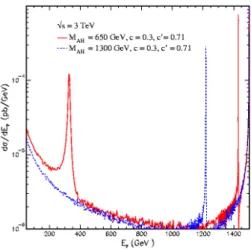
FIG. 2: Photon energy distribution ine++e−−→γ+µ−+µ+ show-ing the two peaks associated toZHandAHwith√s=3 TeV for LHM (c=0.3 andc′=0.71).
FIG. 3: Photon energy distribution ine++e−−→γ+µ−+µ+ show-ing the two peaks associated toZHandAHwith√s=3 TeV for LHM (c=0.3 andc′=0.65).
energy given by [4].
Eγ∓∆γ=
s−(MZ′±∆Z′)2
2√s (2)
where∆γand∆Z′ are the uncertainties in the photon energy
and inMZ′.
The study of the hard photon energy distribution will give most information as the direct new bosons decays, but in a simple and direct way. Since the new boson masses are not known, colliders are considered at the highest energy and so we are considering√s=3 TeV. If indications of new bosons are found with masses lower than√s, a new run with a c.m.
energy near the mass value is not necessary in order to study the new bosons properties in details.
FIG. 4: Dalitz Plot.
χ ψ η
LH c = 0.3 c’= 0.71
√s = 3 TeV , MZ’ = 1500 GeV
FIG. 5: Photon energy distribution ine++e−−→γ+µ−+µ+with
√
s=3 TeV forχ,η,ψand for LHM (c=0.3 andc′=0.71).
III. RESULTS
In order to obtain the hard photon energy distribution, we imposed a set of realistic cuts: all final states particles were required to emerge with a polar cosθ, measured with respect to the direction of the electron beam, in the range|cosθ| ≤
0.995. The hard photon energy was required to be greater than 5 GeV. The resulting photon energy distributions are shown in Figs. 2 and 3 in the channelµ+µ−γfor two differentc′values (c′=0.65 andc′=0.71). ForMAH=650 GeV, we can see two
peaks, the first one associated toZH, and the second toAH. For
MAH=1300 GeV, only the peak associated toAHappears. We
632 Brazilian Journal of Physics, vol. 37, no. 2B, June, 2007
of the photon peak. We show in Fig. 4 the invariant mass Dalitz plot. The three horizontal lines correspond to the three different neutral gauge boson (Z,AH,ZH) masses. Depending
on the heavy boson masses one can see two horizontal lines (Z andAH) or even only the SMZ mass. In Fig. 5 we can
see the hard-photon energy distribution associated with theAH
compared to the canonical η, χ, ψ super-string inspiredE6 models. Theη,χ,ψmodels have a much larger value for the total neutral gauge boson width and this fact makes the hard photon energy much broader.
IV. CONCLUSIONS
We have shown that the hard photon energy distribution can establish the theoretical origin of a new possible heavy
neutral gauge boson independent of how all new boson de-cays. This alternative signature forZ′ production at the new electron-positron colliders could allow us to study its prop-erties, at a fixed collider energy√s>MZ′. Moreover, if the
neutral gauge boson is identified, due to the width of the hard photon energy distribution, as theAHof the LHM, this would
imply the existence of another neutral gauge boson, theZH,
with mass approximately four times theAHmass.
Acknowledgments:CNPq, FAPERJ and FAPEMIG.
[1] N. Arkani-Hamed, A. G. Cohen, and H. Georgi, Phys. Lett. B
513, 232 (2001) [arXiv:hep-ph/0105239].
[2] T. Han, H. E. Logan, B. McElrath, and L. T. Wang, Phys. Rev. D
67, 095004 (2003) [ar-Xiv:hep-ph/0301040].
[3] F. M. L. Almeida Jr., Y. A. Coutinho, J. A. Martins Sim ˜oes, A. J. Ramalho, S. Wulck, and M. A. B. do Vale,
[arXiv:hep-ph/0601102].