Constraints on the Environment Depence of the Neutrino Mass
from Solar and Reactor Neutrino Data
Pedro Cunha de Holanda
Instituto de F´ısica, Universidade de S˜ao Paulo, Cidade Universit´aria, 05508-900, S˜ao Paulo, SP, Brazil
Received on 18 July, 2006
We investigate what can be the role of Mass Varying Neutrinos in several different neutrino oscillation exper-iments, in particular focusing on the relation between KamLAND data and solar neutrino experiment results. Assuming that the adiabaticity of solar neutrinos evolution in LMA-MSW scenario is not broken by the inclu-sion of this new mechanism, we can establish new limits on MaVaN’s parameters by fitting together KamLAND and solar neutrinos data. We also investigate the role of how non-adiabatic effects in the Sun can change this scenario, allowing a larger value of these parameters.
Keywords: Neutrino oscillations; Solar neutrino puzzle
I. INTRODUCTION
In this article we investigate the characteristic effects of the dependence of the neutrino mass on the visible matter envi-ronment for solar and reactor neutrinos. We find that, although the inclusion of the environment dependent terms can lead to certain improvement of the quality of the fit in the most favour LMA region for well determined values of the new parame-ters, (in agreement with the result of Ref. [1]), this improve-ment does not hold much statistical significance. However, the inclusion of these effects, can substantially improve the quality of the fit in the high-∆m2(LMA-II) region which can be allowed at 98.9% CL. Still, if we assume that the presence of this new effect is not strong enough to break adiabaticity of solar neutrino evolution, the combined analysis of the so-lar [2–7] and KamLAND data [8] in these scenarios results into a constraint on the possible dependence of the neutrino mass on the ordinary matter density. Consequently, we derive an upper bound on the product of the effective neutrino-scalar
(λν) and matter-scalar (λf) Yukawa couplings, which depends on the mass of the scalar field.
We investigate also the possibility that this new mechanism plays a leading role in reactor and solar neutrinos instead of the usual conversion mechanism through mass and mixing. In this context, reactor neutrino data are fully explained by a mass-varying neutrino mechanism, and strong non-adiabatic effects in solar neutrino evolution produces the correct energy dependence in solar neutrino conversion to reproduce experi-mental data.
II. FORMALISM
The formalism adopted here follow the one in [9], where an effective low energy model containing the Standard Model particles plus a light scalar (φ) of mass mS couples very weakly both to neutrinos (νi) and the matter fields f =e,n,p.
The Lagrangian takes the form
L
=∑
i¯ νi¡
i/∂ −m0i¢νi+
∑
f¯
f¡i/∂ −m0f¢f+1 2 £
φ¡
∂2−m2S¢φ¤ +
∑
i j
λνi jνiν¯ jφ+
∑
fλff f¯ φ, (1)
wherem0i are thevacuum massneutrinos would have in the presence of the cosmic neutrino background,λν
i j andλf are, respectively, the effective neutrino-scalar and matter-scalar couplings. We have written a Lagrangian for Dirac neutrinos but equivalently it could be written for Majorana neutrinos.
In a medium with some additional neutrino background (ei-ther relativistic or non-relativistic) as well as non-relativistic matter (electrons, protons and neutrons), neutrinos acquire masses which obey the following set of integral equations
mi j(r) = m0iδi j−Mi j(r),
Mi j(r) = λ
ν
i j m2 S
Ã
∑
f λfn
f(r) +
∑
aλνaa
Z d3k
(2π)3 Maa p
k2+M2 aa
fa(r,k) !
where nf(r) is the number density for the fermion f, and fa(r,k)is the sum of neutrino and antineutrino “a” occupa-tion numbers for momentumkin addition to the cosmic back-ground neutrinos.
We neglect the contribution to the neutrino mass from the background neutrino density and we concentrate on the matter density dependence:
Mi j(r) =λ
ν
i j m2
S
∑
f λfnf(r). (3)
This is very similar to the scenario considered in Ref.[1].
III. EFFECTS IN SOLAR NEUTRINO OSCILLATIONS
The minimum joint description of atmospheric [10], K2K [11], solar [2–7] and reactor [8, 12] data requires that all the three known neutrinos take part in the oscillations. The mixing parameters are encoded in the 3×3 lepton mixing ma-trix which can be conveniently parametrized in the standard form
U=
1 0 0
0 c23 s23 0 −s23 c23
c13 0 s13eiδ
0 1 0
−s13e−iδ 0 c13
c21 s12 0
−s12 c12 0
0 0 1
(4) whereci j≡cosθi jandsi j≡sinθi j.
According to the current data, the neutrino mass squared differences can be chosen so that
∆m2⊙=∆m221≪ |∆m312 | ≃ |∆m232|=∆m2atm. (5)
As a consequence of the fact that∆m21/|∆m31| ≈0.03, for solar and KamLAND neutrinos, the oscillations with the at-mospheric oscillation length are completely averaged and the interpretation of these data in the neutrino oscillation frame-work depends mostly on∆m221,θ12andθ13, while atmospheric and K2K neutrinos oscillations are controlled by∆m231, θ23 andθ13. Furthermore, the negative results from the CHOOZ reactor experiment [12] imply that the mixing angle connect-ing the solar and atmospheric oscillation channels, θ13, is severely constrained (sin2θ13≤0.041 at 3σ[13]). Altogether, it is found that the 3-νoscillations effectively factorizing into 2-νoscillations of the two different subsystems: solar and at-mospheric.
With the inclusion of the environment dependence terms (Eq. (3)) it is not warranted that such factorization holds. We will assume that this is still the case and study their effect on solar and KamLAND oscillations under the hypothesis of one mass-scale dominance. Under this assumption, we work in two different parametrization of the evolution equation, de-pending of what is the main conversion mechanism, as ex-plained in next sessions.
IV. MSW-LMA + MAVAN’S AS A SUBLEADING EFFECT
Assuming MaVaN’s is a subleading effect in solar and reac-tor neutrino’s conversion, we use the following parametriza-tion, as in [1]:
id dr
µ νe νµ
¶ =
· 1 2Eν
Uθ12 µ
M21(r) M23(r) M23(r) (m02−M2(r))2
¶
U†θ 12+
µ
VCC(r) 0
0 0
¶¸ µ νe νµ
¶
, (6)
where we have assumed the m01 = 0. Here VCC(r) =
√
2GFne(r) is the MSW potential proportional to the elec-tron number densityne(r)in the medium. Uθ12 is the 2×2 mixing matrix in vacuum parameterized by the angleθ12, and Mi(r)are the environment dependent kinetic contributions to the neutrino masses.
In general, for given matter density profiles, Eq. (6) has to be solved numerically. As discussed in Ref.[1] in most of pa-rameter space allowed by KamLAND and solar data, for all
practical purposes, the transition is adiabatic and the evolu-tion equaevolu-tion can be solved analytically to give the survival probability
Pee= 1 2+
1 2cos 2θ
m
0,12cos 2θ12, (7) whereθm
0,12is the effective neutrino mixing angle at the neu-trino production pointr0in the medium, explicitly given by
cos 2θm0,12=
(∆M˜2
21(r0)cos 2 ˜θ0,12−2EνVCC(r0)) q
(∆M˜212(r0)cos 2 ˜θ0,12−2EνVCC(r0))2+ (∆M˜221(r0)sin 2 ˜θ0,12)2
with
∆M˜221(r0) =2 s
M34(r0) + µ∆M2
21(r0) 2
¶2
(9)
cos 2 ˜θ0,12= ∆M2
21(r0)
2 cos 2θ21−M 2
3(r0)sin 2θ12 s
M34(r0) + µ∆M2
21(r0) 2
¶2
(10)
and where
∆M212(r0) = (m02−M2(r0))2−M12(r0). (11)
In general,Mi(r)can be an arbitrary function of the back-ground matter density. For the sake of concreteness we will assume a dependence in accordance with the results obtained in the linear approximation given in Eq.(3). So we will para-metrize these terms as:
Mi(r) =αi
· ρ(r) (gr/cm3)
¸
, (12)
whereρ is the matter density, and from Eq.(3) we find the characteristic value of theαcoefficients to be
α∼4.8×10²³λνλN µ
10−7eV mS
¶2
eV. (13)
Most precisely, in its simplest realization, Eq. (3) implies thatM32(r)would not only depend onρ2(r)but it would also adquire a contribution proportional toρ(r). In what follows we have neglected this linear contribution but we have verified that its presence would not modify our conclusions.
One must notice, however, that, as long as the transition is adiabatic, the survival probability only depends on the value of Mi(r)at the neutrino production point. Therefore it only depends on the exact functional form ofMi(r)via the averag-ing over the neutrino production point distributions.
The survival probability for anti-neutrinos,Pe¯e, which is rel-¯ evant for KamLAND, takes the form
Pe¯e¯=1−sin22 ˜θm0,12sin2 µ∆m2
KLL 2Eν
¶
, (14)
where cos 2 ˜θm
0,12is defined as in Eq. (8) and∆m2KLis the de-nominator of this equation but replacingVCC by −VCC and assuming a constant matter densityρ∼3 gr/cm3, typical of the Earth’s crust.
A. Constraints from Solar and Reactor Neutrino Data
We present in this section the results of the global analy-sis of solar and KamLAND data with environment dependent neutrinos masses for the specific realization discussed in the previous section. Furthermore, for simplicity, we will restrict ourselves to the caseM1(r) =m1=0.
Details of our solar neutrino analysis have been described in previous papers [14, 15]. We use the solar fluxes from Bahcall and Serenelli (2005) [16]. The solar neutrino data includes a total of 119 data points: the Gallium [3, 4] and Chlorine [2] (1 data point) radiochemical rates, the Super-Kamiokande [5] zenith spectrum (44 bins), and SNO data reported for phase 1 and phase 2. The SNO data used consists of the total day-night spectrum measured in the pure D2O (SNO-I) phase (34 data points) [6], plus the full data set corresponding to the Salt Phase (SNO-II) [7]. This last one includes the NC and ES event rates during the day and during the night (4 data points), and the CC day-night spectral data (34 data points). In combining with the SNO-I data, only the theoretical uncer-tainties are assumed to be correlated between the two phases. The experimental systematics errors are considered to be un-correlated between both phases.
For KamLAND we directly adapt theχ2map as given by the KamLAND collaboration for their unbinned rate+shape analysis [17] which uses 258 observed neutrino candidate events and gives, for the standard oscillation analysis, a χ2
min=701.35. The corresponding Baker-Cousins χ2 for the 13 energy bin analysis isχ2
min=13.1/11 dof. The effect of MaVaN’s parameters in KamLAND result was calculated as-suming a constant Earth density of 3 g/cm3, and assuming that KamLAND are sensitive to the vacuum value of∆m20,21 and θ12through an effective mass and mixing in a constant Earth density, given by Eqs. (9) and (10) as described in Eq. (14).
In presence of the environment dependence contribution to the masses, the analysis of solar and KamLAND data depends on four parameters: the two standard oscillation parame-ters∆m20,21= (m02)2, and tan2θ
12, and the two environment-dependence coefficients,α2, andα3. In this case, in order to cover the full CP conserving parameter space we allow theα parameters to vary in the range
−∞≤α2≤∞ −∞≤α23≤∞ (15) We find the best fit point
envi-ronment dependence of the neutrino massα2=α3=0 tan2θ12=0.44 ∆m20,21=7.9×10⁻⁵eV2.
∆χ2=2.5 (17)
where∆χ2is given with respect to the minimum in Eq.(16). Thus we find that although the inclusion of the environment dependent terms can lead to a small improvement of the qual-ity of the fit (in agreement with the result of Ref. [1]), this improvement is not statistically very significant leading only to a decrease of∆χ2=2.5 even at the cost of introducing two new parameters.
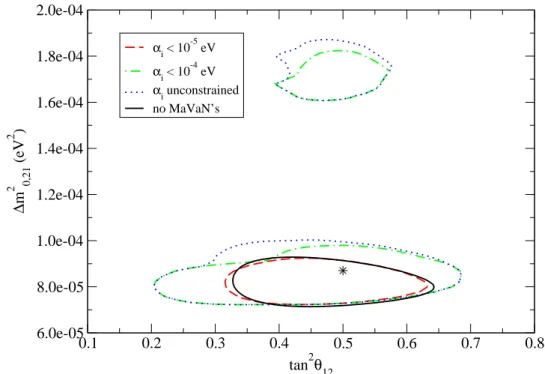
We show in Fig. 1 the result of the global analysis of solar data plus KamLAND data in the form of the allowed two-dimensional regions at 3σCL in the(∆m2
21,0,tan2θ12)plane after marginalization overα2andα3. The standard MSW al-lowed region is also showed for reference. As seen in the figure, allowing for environment dependence of the neutrino masses enlarges only slightly the allowed range of∆m221,0and tan2θ12. In contrast to the standard MSW analysis, where the limits on the mixing angle come basically from solar neutri-nos, here it is KamLAND data that control the lower limits for the mixing angle.
Most interestingly, we also find that the description of the solar data in the high-∆m2 (LMA-II) region can be signif-icantly improved so there is a new allowed solution at the 98.9% CL. The best fit point in this region is obtained for
tan2θ12=0.5 ∆m20,21=1.75×10⁻⁴eV2 α2=1.3×10⁻⁴eV α3=i2.0×10−5eV
∆χ2=8.9 (18)
While this region is excluded at more than 4σ for stan-dard MSW oscillations, it can appear at less 3σin the pres-ence of environmental effects with |α3| ≤3.2×10⁻⁵ and 2.8×10⁻⁵≤α2≤2.0×10⁻⁴. Basically this region appears at the CL which is presently allowed by KamLAND data [8] because the fit to the solar data, once the possibility of envi-ronment dependence is included, cannot discriminate between the LMA-I and LMA-II regions. Clearly this implies that this solution will be further tested by a more precise determination of the antineutrino spectrum in KamLAND.
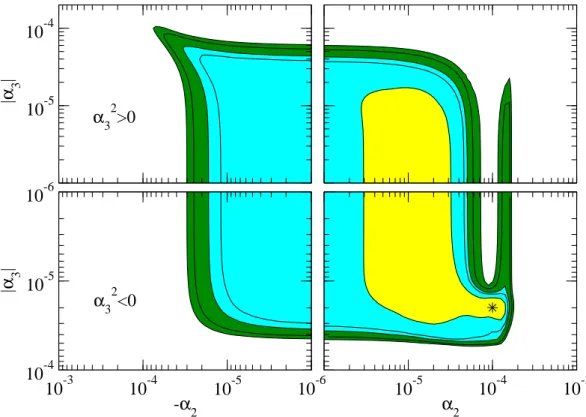
Conversely the global analysis of solar and KamLAND data results into the constraint of the possible size of the environ-ment dependent contribution to the neutrino mass. This is illustrated in Fig.2 where we show the result of the global analysis in the form of the allowed two-dimensional regions in the (α2,α3) parameter space after marginalization over ∆m20,21,tan2θ12. The full regions correspond to 1σ, 95% and 3σCL while the curves correspond to 90 and 99% CL. As seen in the figure, for CL>1.1σthe regions are connected to theα2=α3=0 case and they are always bounded. In other words, the analysis show no evidence of any environ-ment dependence contribution to the neutrino mass and there is an upper bound on the absolute values of the corresponding coefficients.
In order to quantify the bound on MaVaN’s parameters, we proceed a marginalization over the parameters∆m20,21, tan2θ12 andα3 (α2), obtaining the following 90% CL (3σ), bounds (with 1dof).
−2.2×10⁻⁵≤α2/eV≤1.4×10−4 (−5.6×10⁻⁵≤α2/eV≤1.7×10−4) (19)
|α3|/eV≤2.3×10−5 (|α3|/eV≤8.4×10−5) for α23>0 (20)
|α3|/eV≤3.4×10−5 (|α3|/eV≤5.2×10−5) for α23<0 (21)
These bounds can be converted into a bound on the prod-uct of the characteristic effective neutrino-scalar and matter-scalar couplings which must be accounted for when building specific models of MaVaNs. For example, at 90% CL,
|λνλN| µ
10−7eV mS
¶2
≤3.0×10⁻²⁸. (22)
V. MAVANS AS THE LEADING CONVERSION MECHANISM
More generically non-adiabatic effects occur for suffi-ciently large values of theαparameters so that one can dis-regard the standard MSW potentialVCCand the vacuum mass m0
2with respect to the matter density mass dependent terms.
In this case, as seen from Eq. (8), the mixing angle inside the Sun is constant and controlled by theα′s. At the border of the
Sun, as the density goes to zero, the mixing angle is driven to its vacuum value in a strongly non-adiabatic transition. In this context the MaVaN’s effects will be crucial also to interpretate the reactor neutrinos data, not anymore as a subleading effect, but as the main leading flavor conversion mechanism.
We parametrize the new MaVaN’s term slightly different from last section, having for the evolution matrix:
H= 1
2EHMV N+ 1 2EUθ12
µ 0 0 0 m22
¶ OU†θ
12+ µ
VCC 0
0 0
0.1 0.2 0.3 0.4 0.5 0.6 0.7 0.8 tan2θ
12 6.0e-05
8.0e-05 1.0e-04 1.2e-04 1.4e-04 1.6e-04 1.8e-04 2.0e-04
∆
m
2 0,21
(eV
2 )
αi < 10-5 eV αi < 10-4 eV αi unconstrained no MaVaN’s
FIG. 1: Allowed regions from the global analysis of solar plus KamLAND data in the(∆m2
0,21,tan2θ12)parameter space at 3σCL (2dof). The
best fit point at tan2θ12=0.5 and∆m20,21=8.7×10⁻⁵eV2is represented by the star. The standard MSW allowed region is also shown for
reference.
We will work in a context where reactor neutrino oscil-lations are caused exclusively by MaVaN’s effects, and vac-uum oscillation is effective only in vacvac-uum, soαi,jρ2mantle>> VCC>>Hvac.i,j
For neutrinos who crosses the Earth mantle, the MaVaN’s term dominates over both vacuum terms and standard matter interactions. We can determine each one of its entries using data from neutrino oscillation experiments who crosses the Earth:
∆m˜221=8×10⁻⁵eV2 ; tan2θ˜12=0.5 (24) so we can write:
HMV N= 1 2EUMV N
µ
0 0
0 ∆m˜221 ¶
O†MV N× µ ρ
ρmantle ¶2
(25) where
UMV N= µ
˜ c12 s˜12
−s˜12 c˜12 ¶
(26) As said before, at the center of the Sun the MaVaN’s term dominates over both vacuum and standard matter interaction terms, so the evolution hamiltonian is given by eq. (25), with mixing angles given by eq. (24). When neutrino aproaches the Sun surface, the density decreases asρ2, and at some point the matter termVCCstarts to be important.
There is a point whereVCC= ∆2mE˜cos 2 ˜θ12and a resonance between two first families is produced, withθ12=π/4.From this point this mixing angle continues to grow, achieving the value ofθ12=π/2 when theVCC becomes predominant over
the MaVaN’s terms. At the border of the Sun (but still inside it) the neutrino flux will be an energy dependent admixture of ν1andν2, with no production ofν3, and with mixing angles θ12=π/2 andθ23=π/4. Preliminar calculations show that an intersting spectral distortion on electron neutrino survival probability can be produced by such mechanism.
One important point of this mechanism is that it natu-rally produces a strong day-night asymmetry in solar neutrino fluxes, due to the strong interaction with Earth’s baryonic mat-ter. This can be avoided by some tuning in usual neutrino’s mass and mixings in a three generation scenario. A detailed analysis of the possibility to produce a general fit to solar neu-trino data will be presented elsewhere [18].
VI. DISCUSSION
We have investigated the phenomenological consequences of a scalar induced environment dependence of the effective neutrino mass in the interpretation of solar and reactor neu-trino data.
For the sake of concreteness, we consider an effective low energy model containing the Standard Model particles plus a light scalar (φ) of massmSwhich couples very weakly both to neutrinos (νi) and the matter fields f =e,n,p which can induce a dependence of the neutrino mass on the density of the medium. This is described in Sec. II and its consequences to neutrino oscillations in the Sun is discussed in Sec. III.
10
-510
-4|
α
3|
10
-610
-510
-410
-3-
α
210
-610
-510
-4|
α
3|
10
-510
-410
-3α
2α
32<0
α
32>0
FIG. 2: Allowed regions from the global analysis of solar and solar plus KamLAND data in the (α2,α3)parameter space. The curves
correspond to 1σ, 90%, 95%, 99% and 3σCL (2dof). The best fit point atα2=10−4eV andα3=i2.0×10−5eV, represented by a star, is
also shown.
in the context of this effective model. Our analysis, which is described in Sec. IV A, depends on 4 parameters: the two standardoscillation parameters∆m20,21= (m02)2, and tan2θ
12, and the two environment-dependence coefficients,α2, andα3. We found the best fit point at: tan2θ
12 =0.49, ∆m20,21 = 8.4×10⁻⁵eV2,α
2=10−4eV andα3=i2.0×10−5eV. This point corresponds to a decrease of∆χ2
min=−2.5 in compari-son to the minimum in the case where no environment depen-dence is considered. We conclude that in spite of the inclusion the two extra parameters, there is no a very statistically signifi-cant improvement of the quality of the fit in the most favoured LMA-I MSW region.
We find that the description of the solar data in the high-∆m2(LMA-II) region can be significantly improved so there is a new allowed solution at the 98.9% CL. The best fit point in this region is obtained for tan2θ
12=0.5,∆m20,21=1.75× 10⁻⁴eV2,α
2=1.3×10⁻⁴eV andα3=i2.0×10−5eV. This solution will be further tested by a more precise determination of the antineutrino spectrum in KamLAND.
In any case, our data analysis permit us to considerably limit the size of theαcoefficients (see Eq. (21)) and from that derive a limit on the product of the effective neutrino-scalar and matter-scalar Yukawa couplings depending on the mass of the scalar field (Eq. (22)). These constrains have to be taken into account when constructing specific models of MaVaNs. These scenarios will be further tested by the precise determi-nation of the energy dependence of the survival probability of solar neutrinos, in particular for low energies [19].
We also are investigating the possible role of MaVaN’s ef-fect as a leading mechanism in neutrino flavor conversion. This work is in progress, and will be further detailed in next communications.
Acknowledgments
This work was supported by Fundac¸˜ao de Amparo `a Pesquisa do Estado de S˜ao Paulo (FAPESP).
[1] V. Barger, P. Huber and D. Marfatia, [arXiv:hep-ph/0502196.] [2] B.T. Cleveland et al., Astrophys. J.496(1998) 505.
[3] C. Cattadori, Results from radiochemical solar neutrino ex-periments, talk at XXIst International Conference on Neutrino Physics and Astrophysics (NU2004), Paris, June 14–19, 2004. [4] GALLEX collaboration, Phys. Lett.B 447(1999) 127.
[5] Super-Kamiokande Collaboration, S. Fukuda et al., Phys. Rev. Lett.86(2001) 5651.
[7] SNO Collaboration, S B. Aharmim et al., nucl-ex/0502021. [8] KamLAND collaboration, K. Eguchi et al., Phys. Rev. Lett.94
(2005) 081801; Phys. Rev. Lett.90(2003) 021802.
[9] M. C. Gonzalez-Garcia, P. C. de Holanda, and R. Zukanovich Funchal, Phys. Rev. D73, 033008 (2006).
[10] Y. Ashieet al.[Super-Kamiokande Collaboration], Phys. Rev. D71, 112005 (2005).
[11] E. Aliuet al.[K2K Collaboration], Phys. Rev. Lett.94, 081802 (2005).
[12] CHOOZ Collaboration, M. Apollonioet al., Phys. Lett. B420, 397 (1998); Eur. Phys. J. C27, 331 (2003).
[13] M. C. Gonzalez-Garcia, arXiv:hep-ph/0410030.
[14] J.N. Bahcall, M.C. Gonzalez-Garcia, and C. Pe ˜na-Garay, JHEP 02 (2003) 009 [hep-ph/0212147]; J.N. Bahcall and C. Pe
˜na-Garay, JHEP.11(2003) 004.
[15] P. C. de Holanda and A. Y. Smirnov, Astropart. Phys.21, 287 (2004).
[16] J. N. Bahcall and A. M. Serenelli, Astrophys. J. 626, 530 (2005).
[17] KamLAND data andχ2results are available at
http://www.awa.tohoku.ac.jp/KamLAND/datarelease/2ndresult.html [18] M. C. Gonzalez-Garcia, P. C. de Holanda, M. Maltoni, and R.
Zukanovich Funchal, in preparation.