Cosmologial Impliations of Old
Galaxies at High Redshifts
J. A. S.Lima
and J.S. Alaniz y
Departamento deFsia,UniversidadeFederaldoRio GrandedoNorte,
C.P.1641,59072-970, Natal,RN,Brazil
Reeivedon21April,2001
Old high-z galaxies are important tools for understanding the struture formation problem and
may beome the key to determine the ultimate fateof the Universe. In this paper, the inferred
ages ofthe threeoldest galaxiesat highredshifts reportedinthe literatureare usedto onstrain
therstepohofgalaxy formationand toreanalysethehigh-ztimesalerisis. Thelowerlimits
on the formation redshift zf depends on the quantity of old dark matter in the Universe. In
partiular,if
m
0:37 thesegalaxies are notformed inFRW osmologieswithnodark energy.
This resultis inline with the Supernovaetype Iameasurementswhih suggest that the bulkof
energyintheUniverseis repulsiveandappearslikeanunknownformofdark energyomponent.
Inaomplementaranalysis,unlikereent laimsfavoringtheendoftheageproblem,it isshown
thattheEinstein-deSittermodelisexludedathigh-zby3.
I Introdution
The existene of old high-redshift galaxies (OHRGs)
providesone of thebest methods for onstraining the
age of theUniverse [1, 2℄, and, in asimilar vein, may
be an important key for determining the rst epoh
of galaxy formation. Reently, dierent groups [3-7℄
announed the disoveries of three extremely red
ra-dio galaxies at z =1:175 (3C 65),z =1:55(53W091)
and z =1:43 (53W069)with a minimal stellar ageof
4.0 Gyr,3.0Gyrand4.0 Gyr,respetively. These
dis-overiesaentuated evenfurther the alreadylassial
\agerisis"andgaverisetoanewvariantofthis
prob-lem,whihouldbenamedthehigh-ztimesalerisis:
theunderestimatedagesofthesegalaxiesontraditthe
preditionsofthestandardEinstein-deSittermodelfor
valuesofh>0:45[1℄. Foromparison,ifoneonsiders
h = H
o
=100Kms 1
Mp 1
= 0:6, the age of the
Uni-verse predited bythe Einstein-de SitterCDM model
atredshiftsz=1:175andz=1:55ist
z
=3:35Gyrand
t
z
=2:5 Gyr,respetively. Suh disrepaniesbeome
even largerif onetakes into aount the radio galaxy
at z =1:43with aminimal stellar ageof 4.0 Gyr. In
this ase, the predited age is t
z
= 2:85 Gyr, whih
yields anagedierene greatherthan1Gyr. Itisstill
worth notiing that suh estimates do not inlude an
inubationtimeofatleast0.5-1Gyr,whihwouldbe
more in aordaneto thehemo-dynamial evolution
models for suh objets[8℄. As it appears, the
prob-lemraisedbytheagesofthesegalaxiestothestandard
CDM model is a strong indiation that OHRGs may
alsoonstrainappreiably theformationredshift(z
f ),
i.e., theepoh where therststrutures were atually
formed. Inbrief,thisistheaimofthispaper. Inwhat
follows, robustlowerlimitson z
f
arederivedfor open
olddarkmatter(OCDM)andatCDMmodelsfrom
the estimated ages of the quoted old high-z galaxies.
For ompleteness, we also present a new quantitative
approahforanalysingthehigh-z timesalerisis.
Many attempts for determining the rst epoh of
galaxyformationhavebeendonein the past,and the
overall onlusion is that the major period of galaxy
formationlies in the redshiftinterval 1z 3,that
is, at relatively low redshifts [9, 10℄. Suh results are
onsistent with the simplest old darkmatter (CDM)
senarioforstrutureformation,although itsmodied
version (CDM) gave amore natural explanation for
the exess of power observed in the galaxy
distribu-tion[11, 12℄. Inspiteofthat, reentndingsofgalaxy
andidatesatz>4:0[13-15℄suggestthatourUniverse
ontainsmoreollapsedobjetsthanbelievedsomefew
years ago, and all this ativity at high redshifts
an-notbeeasilyaommodatedintheCDMsenarios[16℄.
Sine suh studies do notexlude the possibility that
Eletroniaddress: limajasdfte.ufrn.br
rare events of galaxy formation took plae at higher
redshifts,theverybeginningofthestrutureformation
proess remains as one of the most hallenging
prob-lemsinmodernosmology.
Letusrstreallthatforthelassofpassively
evolv-ing ellipti radio galaxies,almost allamountof gas is
believed to be proessed into stars in a singleepisode
of star formation, in suh a waythat the assumption
ofaninstantaneousburstisonsideredagood
approxi-mationformodelingtheirevolution. Forlookbaktime
alulations, an instantaneous burst of star formation
meansthat the ageof these OHRGsanbeexpressed
as being almost exatly the time taken by the
Uni-versetoevolvefromz
f
totheobservedredshiftz
obs . In
theframeworkofFriedmann-Robertson-Walker(FRW)
models with osmologialonstantsuhondition an
betranslatedas
t(z
obs ) t(z
f )=H
o 1
Z
(1+zobs) 1
(1+z
f )
1
dx
p
1
m +
m x
1
+
(x
2
1) t
g
; (1)
where
m and
standforthepresent-daymatterand
vauumdensityparameters,respetively. The
inequal-itysignal onthe r.h.s. of the aboveexpression omes
fromthefatthattheUniverseisolderthanoratleast
hasthesameageofanyobservedstruture. Sinethis
naturalargumentalsoholdsforanytimeinterval,a
-nitevaluefortheredshiftz
f
providesthelowerbound
forthegalaxyformationallowedbytheagedobjet
lo-ated at z
obs
. Models for whih z
f
! 1 are learly
inompatiblewith the existeneof thespei galaxy,
beingruledoutin anaturalway.
Beforedisussingtheresultingdiagrams,an
impor-tantpointofprinipleshouldbestressed. Toassurethe
robustnessofthelimitsonz
f
, weaddopt(1)the
min-imal value for theHubble parameter, and (2) the
un-derestimated agefor all OHRGs. Both onditionsare
almostself-explanatory. First,asweknow,thesmaller
the value of H
o
, the larger the age predited by the
model and, seond,objetswith smallerages are
the-oretially moreeasilyaommodated,thereby
guaran-teeingthatthemodelsarealwaysfavoredinthepresent
estimates. Forthe Hubble parameterweonsider the
value obtained by the HST Key projet whih is in
agreement with other independent estimates[17℄, i.e.,
theroundnumbervalueH
o
=60km=se=Mp[18,19℄.
Indeed,wearebeingratheronservativesinethislower
limit wasreently updatedto nearly10%of auray
(h =0:700:07,1) byFriedman [19℄, and thedata
from SNe also point onsistently to h > 0:6 or even
higher[20,21℄.
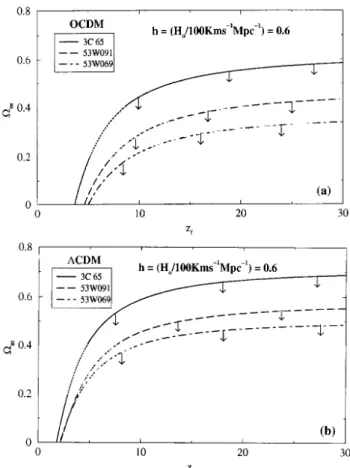
InFig. 1aweshowthe
m z
f
planeallowedby
theexisteneoftheseOHRG'sforOCDMmodels. The
shadowedhorizontalregionorrespondstotheobserved
range =0:2 0:4[22℄,whihisusedtoxthelower
limits onz
f
. As should bephysially expeted, if the
matter ontribution inreases, a larger value of z
f is
required in orderto aountfor theexisteneof these
OHRGswithin thesemodels. Conversely,for eah
ob-jet,theabsoluteminimalvalueofz
f
isobtainedforan
emptyuniverse(
m
!0). Intheobservedrangeof
m
theallowedvaluesfortheformationredshiftare
unex-petedlyhigh. Forexample,by onsidering
m =0:3,
as indiated from dynami estimates on sales up to
about 2h 1
Mp[23℄,theages of3C 65, 53W091and
53W069provide,respetively, z
f
6:3,z
f
10:5and
z
f
18. Suh valuessuggestthat these galaxies were
formedabout12.5Gyrago,orbyonsideringthemost
reentlowerlimitsfortheageoftheUniverse[24℄,that
suhobjetswereformedwhentheUniversewas1.0
Gyrold. However,sinealmostalltheageofthe
Uni-verseisatlowredshifts (z=0 2),thesegalaxiesmay
havebeenformednearlyatthesameepoh,regardless
oftheironstraintsontheredshiftspae.
Figure 1. The
m z
f
plane allowed by the existene of
OHRG'sintheframeworkofOCDM(Panela)andCDM
(Panelb). Theshadowedhorizontal regionorrespondsto
theobservedrangeof
m
. Thearrowsdelimittheavailable
parameterspae. Theurvesarealsodenedbythe
under-estimatedvaluesoft
g
andtheindiated lowerlimit ofH
o .
For a givenvalue of m, we see that the most restritive
limitisprovidedbytheradiogalaxy53W069.
Fig. 1bshowssimilarplotsforatCDM models.
In this ase, the eet of the equation of state
Figure 2. Hotz asa funtionof m. Dotted linesindiate
the 2 limits of the age-parameter for h = 0:550:05
[27 ℄ whereasdashedlines indiatethe 2 limits for h =
0:70:1, thevalue obtainedbythe HSTKeyProjet[18 ℄
andbyotherindependentestimates[17 ,20 ℄. Notethatfor
h =0:70:1 the Einstein-deSitterase (indiated inthe
panels) is oby 3 for the analysis of OHRGs. For sake
ofompleteness,Panelbshowssimilaranalysisforglobular
lusters-seealso[19 ℄.
aelerate the osmi expansion. In partiular, this
means that the lookbaktime between z
obs and z
f is
largerthaninthestandardsenarioand,therefore,the
galaxy formation proess may start relatively late in
omparison to the orresponding OCDM model. For
example, if the density parameter is around the
en-tral value,
m
=0:3, the agesof 3C 65, 53W091and
53W069 restrit the formation redshift by z
f
3:6,
z
f
5:2 and z
f
5:8, respetively. The value of z
f
isalsoproportionaltothequantityofdarkmatter. As
one mayhek,inthelimitingaseofauniverse
domi-natedonlybydarkenergy,thelowerlimitisz
f 2. It
isworthnotiingthatfor
m
0:37,thelowerlimit
in-ferredfromtheageof59W069isz
f
!1. Thisresultis
onsistentwithreentstudiesbasedontheage-redshift
relation[2,25℄,andmeansthatthestandard
osmolog-ial model with
m
0:37 and h 0:6 is (beyond
doubt) inompatible withthe existeneofthis galaxy.
We alsostress that thepresentonstraintsonthe
for-mationredshift are indeed rather onservative sine
the lower limit on H has been onsidered in all
Limitstoz
f
: OCDMandCDMmodels
Galaxy
m
OCDM
zf
CDM
zf
3C65:... 0.2 5:0 3:0
0.3 6:3 3:6
0.4 8:6 4:8
53W091:... 0.2 7:4 3:8
0.3 10:5 5:2
0.4 20:7 7:4
53W069:... 0.2 9:3 3:9
0.3 18:0 5:8
0.37 !1 10
theestimates. Finally,westressthattheselowerlimits
onz
f
provideanewtheoretialevidene that galaxies
arenotunommumobjetsatverylargeredshifts,say,
at z >5,and also reinfore theinterest onthe
obser-vationalsearhforgalaxiesandotherollapsedobjets
within the redshift interval 5 z 10 (For a
dis-ussionabouttheinueneofanarbitraryequationof
statep
x =!
x
(! 1)ontheredshiftformation,see
[26℄).
Another important impliation of age dating of
high-zobjetsisontheexpandingageoftheUniverse.
Asbefore, aruialpointisonernedtothe
measure-mentstheHubbleparameter. Reently,Sandageet al.
[27℄ argued for the end of the age risis by
onlud-ing that there is no time sale risis in osmology if
H
o
= 555kms 1
Mp 1
as inferred by the Hubble
diagram of 52 duial SNe Ia. For h = 0:550:05
and by taking t
o
= 121 (1) as the median value
fortheestimatedagesofglobularlusters [19℄,wend
H
o t
o
=0:670:09whihislearlyompatiblewiththe
preditionoftheEinstein-deSittermodel(t
o =
2
3 H
1
o ).
Moreover,evenbyadding1Gyrasinubationtime[28℄
wendH
o t
o
=0:730:1whihisalsoompatiblewith
thestandardatCDM model. However,what anbe
saidaboutasimilaranalysisathighredshift?
InFig. 2aweassume0.5Gyrasinubationtimefor
the LBDS53W069 and show the dimensionless
prod-utH
o t
z
as afuntion of
m
. Twodierent asesare
illustrated: the standard CDM and the at CDM
models. Dotted lines indiate the 2 limits of the
age-parameterbyonsidering h=0:550:05whereas
dashedlinesindiate the2 limitsforh=0:70:1,
thevalueobtainedbytheHSTKeyProjet[18℄andby
other independent estimates [17, 20℄. At this redshift
(z=1:43),thepreditionoftheatmatter-dominated
model isH
o t
z
0:17whereasforh=0:550:05 this
galaxyyields H
o t
z
=0:220:03, whih rulesout the
Einstein-deSitteraseby2standarddeviations. In
thease ofthe LBDS53W091 (at z =1:55),the
pre-ditionoftheEinstein-de Sittermodelis H
o t
z
0:16,
and similar analysis provides H
o t
z
= 0:200:03. As
onsiders h = 0:70:1. In this ase, we nd for the
LBDS53W091and LBDS53W069H
o t
z
=0:290:04
andH
o t
z
=0:250:05,whihexludestheEinstein-de
Sittermodelby 2 and 3, respetively. Therefore,if
theestimatedageofthese objetsareorret, wemay
onlude,at lightoftheaboveanalysis that thereis a
high-ztimesalerisisinthestandardosmology,even
by onsidering low values for the Hubble parameter.
Naturally,suharesultisinagreementwiththelatest
measurementsfromSupernovaetypeIawhihpointto
theexisteneofarepulsiveenergyomponent
dominat-ingthebulkofmatter-energyin theUniverse,thereby
implyingthattheUniverseisneessarelyolderthanthe
agepreditedbytheEinstein-deSittermodel.
Aknowledgements
This researh waspartially supported by the
Con-selho Naional de Desenvolvimento Ciento e
Te-nologio (CNPq), Pronex/FINEP. (no. 41.96.0908.00)
andFAPESP(no. 00/06695-0)
Referenes
[1℄ L.M.Krauss,Astrophys.J.480,466(1997)
[2℄ J.S.AlanizandJ.A.S.Lima,Astrophys.J.521,
L87(1999)
[3℄ S.J.Lilly&M.S.Longair,Mon.Not.R.Astr.So.
211,833(1984)
[4℄ A.Stokton,M.Kellogg andS.E.Ridgway,
Astro-phys.J.443.L69(1995)
[5℄ J.S.Dunlopetal.,Nature,381,581(1996)
[6℄ H.Spinrard, A. Dey,D. Stern, J.S.Dunlop, J.A.
Peaok,R.Jimenez,andR.Windhorst,Astrophys.
J.484,581(1997)
[7℄ J.S.Dunlop, inTheMost Distant RadioGalaxies,
ed.H. J.A.Rottgering, P.Best, &M. D.Lehnert,
Dordreht: Kluwer,71(1999)
[8℄ R.Jimenez,A.C.S.Friaa,J.S.Dunlop,R.J.
Ter-levih, J. A. Peaok, L. A. Nolan, Mon. Not. R.
[9℄ L.L. Cowie,E. M.Hu&A.Songaila, Nature377,
603(1995)
[10℄ S.E.Zepf,Nature390,377(1997)
[11℄ S.J.Maddox,G.Efstathiou,W.J.Sutherland&J.
Loveday,Mon.Not.R.Astr.So.,242,43P(1990)
[12℄ EfsthatiouG.,SutherlandW.&Maddox,S.J.,
Na-ture348,705(1990)
[13℄ E.M.Hu&R.G.MMahon,Nature382,231(1996)
[14℄ A.Dey,H.Spinrad,D.Stern,J.R.Graham&F.H.
Chaee,Astrophys.J498,L93(1998)
[15℄ H.-W.Chen,K.M. Lanzetta&S.A.S.Pasarelle,
Nature,398,586(1999)
[16℄ A.Kashlinsky&R.Jimenez,Astrophys.J.474,L81
(1997)
[17℄ R.Giovanellietal.,Astrophys.J.477,L1(1997)
[18℄ W.L. Freedman, inProeedingsof the18th Texas
SymposiumonRelativisti Astrophysis,edited by
A.Olinto,J.Frieman,andD.Shramm,World
Si-enti,(1998)
[19℄ W.L. Freedman,Phys.Rept.333,13(2000)
[20℄ S. Perlmutter, G. Aldering, G. Goldhaber, et al.,
Astrophys.J.517,565
[21℄ A.G.Riessetal.,Astron.J116,1009 (1998)
[22℄ A.Dekel,D.BursteinandS.White,InCritial
Dia-loguesinCosmology,editedbyN.TurokWorld
Si-enti,Singapore(1997)
[23℄ R.G.Calberg etal.,Astrophys.J.462,32(1996)
[24℄ E.Carrettaetal.,Astrophys.J.533,215(2000);L.
M.Krauss,Phys.Rep.,333,33(2000)
[25℄ J.A. S.Lima &J.S.Alaniz, Mon.Not. R. Astr.
So.317,893(2000)
[26℄ J. S.Alaniz & J.A. S.Lima, Astrophys. J. 550,
L133
[27℄ A. Sandage, G. A. Tammannand A. Saha, Phys.
Rept.307,1(1998)
[28℄ J. P.E. Peebles, Publ. Astron. So.Pa. 111, 274