Sympleti Integrators Revisited
T.J. Stuhi
InstitutodeFsia,UniversidadeFederaldoRiode Janeiro,
CaixaPostal6528,21945-970, RiodeJaneiro,RJ,Brazil
Reeivedon10Otober,2001. Revisedversionreeivedon10April,2002.
ThispaperisasurveyonSympletiIntegratorAlgorithms(SIA):numerialintegratorsdesigned
for Hamiltonian systems. As it is well known, n degrees of freedom Hamiltonian systems have
animportant property: their ows preservenot onlythe total volumeof the phasespae, whih
is only one of the Poinare invariants, but also the volume of sub-spaes less then 2n. These
invariantsare inherited from the onservationof the sympletiarea. It is usuallydemanded of
integrators that they should preserve energy. In this survey the main point is to onvine the
readersthatthe preservationof thesympletiarea oranoniity oftheHamiltonianowanbe
equallyimportant,mainlywhentheonernisnotonepartiulartrajetorybutthebehaviorofthe
phasespaeasawholeforlongintervalsoftime. TheKAMtheoremassertsthatforanyintegrable
HamiltonianperturbedbyasmallHamiltonianterm,suhasthatausedbytheonstrutionofthe
SIA,theperturbeddynamispreservesmostoftheinommensurate,nondegenerate,invarianttori.
Unstableobjetsandtheir invariantmanifoldsarestruturallystableandwill bewellrepresented
bysympletiintegrators.
I Introdution
Agreatnumberofphenomenaaremodelledby
ordi-narydierentialequations. Whensolved, analytially
ornumerially,theydesribethetimeevolutionofthe
quantitiesusedtomodelthephenomena. Amongthese
systemstherearethosealledonservativeor
Hamilto-nian; therealsoexists systemsthataredissipativebut
have a Hamiltonian ore, for example, the movement
ofan eletronin aneletronring. The appliationsof
theselattersystemsovermanyareassuhas
engineer-ing,plasmas,elestialmehanis,partileaelerators,
and many problems originating from hydrodynamis,
elastiity,relativityandquantum mehanis.
Analytial solutions for Hamilton's equations are
exeptionratherthan therule. Thismeansthat there
are very few integrableHamiltonian systems, and we
havetousenumerialodestosolvetheequations.
Nu-merialodesreduethedierentialequationstonite
diereneequationsthroughalgorithmswhiharenow
standard, for instane the Runge-Kutta family, linear
multistep odes, extrapolationmethods, Taylorseries,
tomentionsomeofthemainmethods. Mostofthese
al-gorithmsarewell known, notonly pratiallybut also
theoretially. Their stability is a researh area on its
own, inluding tehniquesoriginatedfrom the well
es-tablishedtheoryofDynamialSystems(Grithsetal.,
Sanz-SernaandVadillo,1987). However,whenwehave
tondnumerialsolutionsofaHamiltoniansetof
dif-howwellestablished, donot haveanyinformation
re-garding the naturalgeometry of the Hamiltonian
sys-tem. Usually,onlytheonservationof energyis
moni-tored, and there aretehniques to forethe numerial
solutiontoremainonaseletedenergysurfae.
At the end of the eighties, the rst ideas on
sym-pleti integratorswere launhed, based on the work
of DeVogleare, whopioneered thesubjetin 1953. A
pioneeringSympletiIntegratorAlgorithm(SIA),due
to J. Wisdom, appeared in the early eighties, and it
wasapplied to CelestialMehanis with good results.
He obtained thesympleti sheme by means of
peri-odiDirafuntions. Theperiodideltaswereusedby
Wisdomto replaethehigh frequenytimedependent
perturbation,butasamatteroffatheobtainedarst
orderSIA.Theboomoftheseshemesreahedits
max-imumatthebeginningofthenineties,andulminated
withameetingheldattheFieldsInstitute,Canada,at
theend of 1993. TheSIA's anbeobtainedby
\sym-pletiation" of some existing algorithms, generating
funtions ofanonialtransformations(a natural
sym-pletiintegrator),andsomeresearhersstartedevenat
amorebasi level, thevariationalprinipleitself (Wu
1990,MalahanandSovel1993).
The results showed that the SIA's have generally
a better performane in qualitative long term
investi-gations, although the energy is preserved only on an
average. There areinterestingexamplesthat point
be disussed later. The main weakness is their poor
performane with adaptativestep shemes.
Neverthe-less, their performane on preservingadiabati
invari-ants hasnot been exelled by any other kind of
algo-rithm[Benettinetal,l994,ShimadaandYoshida,l996℄.
Benetin studying models oflassialgasesuses
expli-itlytheinterpretation thatwhenonenumerially
inte-gratesthesystemofHamilton'sequation,usinga
sym-pleti algorithm,onereplaesthe"true"Hamiltonian
HbyadierentHamiltonianK
,{losetoit,andthen
iterates"exatly"(withintheround-oerrorofthe
ma-hine) thetime-one mappingof K
. Some buildersof
aelerators(ForestandRuth, 1990)hadusedSIA'sas
a tool long before the subjet beame more popular.
Theeletronringisanieexampleofasystemthat,in
spiteoflossesbyradiation,hasaHamiltonianore,as
alreadymentioned.
I do not mean to over all the rihness of
numer-ial integrators,their auray and stability, but only
mentionthemain aspetsbearingonthedisussionof
the SIA's. I givesomeexampleson themain features
usingaYoshida{RuthSIAof4thorderanda
symple-timidpoint RK2. Inludedis afairlyomplete setof
refereneswithsomeomments. Tomakethetext
self-ontained,Istartwith anote onHamiltoniansystems
andtheirinvariants. Thegroupaspetofthedynamis
will also be briey disussed sineit is used to derive
higherorderSIA'sfromlowerorder ones.
There is an alternative to sympleti integrators,
whiharetheexatenergy-momentumonserving
algo-rithms,designedtopreservetheseonstantsofmotion.
There is a theorem by ZhongGe and Marsden (l988)
whihsaysthat,unfortunately,thereannotexist
inte-grationshemeswhih arebothsympletiandenergy
onservingfornon-integrablesystems: theonlyoneto
preserve both is the ow of the systemitself.
There-fore, wealwayshave to pay aprie fornon-integrable
systems: akindofnumerialunertaintypriniple.
II Hamiltonian Systems: inv
ari-ants and anonial
transfor-mations
A Hamiltoniansystemisasetof2nequationsgiven
by:
_
q= H
p ;
_
p= H
q
(1)
whereH(p;q)istheHamiltonianfuntionand(p;q)=
(q
i
1 ;;q
i
n ;p
i
1 ;;p
i
n
)denotesthenanonially
on-jugatedpairofgeneralizedpositionsandmomenta. The
owofaHamiltoniansystempreservesvolume
aord-ingto Liouville'stheorem. However,therearesystems
that preservephase spae volume and are not
Hamil-tonian. This is due to thefat that volume
preserva-anbe derived from the onservation of the
symple-ti area whih gives to the Hamiltonian phase spae
its typial geometri struture. More preisely, the
ow of a Hamiltonian system with n degrees of
free-dom preserves the sum of the projeted areas on the
n (p
i ;q
i
); i = 1n, planes. This struture, alled
sympleti struture, dened by the non-degenerate
losed2-form:
w 2
=dp^dq=d(pdq)=dS ; (2)
alsoknownasthewedgeprodut. Notethatthe2-form
isthedierentialofthereduedationdS=pdq. The
wedgeprodutoftwoarbitraryvetorsu,vofthephase
spaeis denedbytheoperation:
u^v=(uJ;v ); (3)
where
J=
0 I
I 0
; (4)
0and the unity matrix I are nn bloks. J denes
thestandard anonial struture and is known as the
standardsympletimatrix.
If one integrates the k 0
th order invariant w 2k
,
over an arbitrary 2k-dimensional region of the
2n-dimensional phasespae, 1i
k
n, oneobtainsthe
invariant
Z
Z
X
i1i2ik dp
i1 dp
i
k dq
i1 dq
i
k ; (5)
on the 2k-dimensional subspae of the phase spae.
Making k = n this beomes Liouville's Theorem on
the preservation of phase spae volume. The various
powersofw 2
areknownasthePoinareinvariants. An
evenmorevaluableinvariantanbewritteniftimeand
minustheHamiltonianitselfaretakenasthe(n+1)th
pair, (q
n+1 ;p
n+1
); taking k = 1and applying Stoke's
theorem:
Z Z
n
X
i=1 dp
i dq
i =
Z
n
X
1=1 p
i dq
i Hdt
!
=onst; (6)
this equality for all iruits taken on a tube of
tra-jetoriesis known as thePoinare-Cartantheorem. If
dt=0,theiruitsare atonstantt andthelefthand
side reprodues (5) in the partiular ase of k = 1.
The form pdq Hdt is known asthe integral
invari-ant of Poinare-Cartan. From therighthand side of
equation(6)oneanderiveallthegeneratingfuntions
S(p;q;t)andrulesforobtainingallanonial
transfor-mations,andinpartiulartheonesfoundinmost
text-books. The interestedreader annd moredetails in
Intermsofthestandardsympletimatrix,a
anon-ialtransformation of variables T : (p;q) ! (P;Q) is
suhthat (r (p;q) T) T Jr (p;q)
T =J; (7)
(r
(p;q)
T)beingtheJaobianmatrixofT andT stands
forthetransposingoperation.
InHamilton-Jaobitheory itis neessaryto nd a
anonialtime-dependenttransformationwhihtakesa
set ofvariables(p
o ;q
o
) att=0,toanother set(p;q)
at time t. Infat, this is oneofthe ways ofgetting a
sympletiintegrator: weango forwardfrom t
o to t,
and,more,wedosoanonially. Thismapatingfora
time intervalh=t t
0
, thepath ofthe integrator,is
usually alled \the step"of the integrator(sympleti
ornot) whihwill bedenoted M(t),then:
p q =M(t) p o q o : (8)
TheintegratingstepM(t)isthennaturallya
symple-timapping,that is
(r (p;q) M) T Jr (p;q)
M=J; (9)
inaordanewith(7). Theabovesympletiondition
shouldbeveriedtothesameorderasthepreisionof
the sympleti operator M(t). Inthis way, it an be
guaranteed that the numerial solution given after k
stepsofM(t),i.e.,fort
k
=kt,hasthesamequalitative
behaviorof theexatsolution: theyshould agreewith
eah other on the Poinareinvariants upto the same
orderoftheintegrator.
Reall that for any pair of funtions on the phase
spae,oneandeneabilinearoperationf;g,the
Pois-sonbraket,by
ff;gg= n X i f q i g p i f p i g q i (10)
Thendenez=(p;q)sothattheHamiltoniansystem
anbewrittenin theompatform
dz
dt
=fz;Hg: (11)
It is easy to solve the above equation up to rst
or-der,taking therighthand sideevaluatedat theinitial
ondition z 1 =z o +fz o
;Hgt: (12)
This rst order approximation is known as the Euler
step for arst order numerialintegrator,and if it is
substitutedbakintheoriginalequationandintegrated
again,oneobtains
z 2 =z o +fz o
;Hgt+ffz
o
;Hg;Hg t
2
2
: (13)
Continuingthisproedure,theformalsolutionis
z(t)=exptf 0
;Hgz ; (14)
alled the Hamiltonian ow g t
H
whih, for an
arbi-trary H, is a one parameter Abelian Lie group, or
g t1 H g t2 H =g t1+t2 H
. Inamoreonvenientnotation (Dragt
(l993, 1996),Forestand Ruth (l990)) to be usedlater
in this surveywe writez=exp : tH : z
o
, and the
Hamilton'sequationsread
dz
dt
=: tH: z (15)
where: H : z=f H(z);zg:
I reall also that any funtion of the phase spae
that isinvariantunderthe ationofthis ow isalled
arstintegraloraonstantofmovement,i.e.,
f(p;q)=f(g t
H p;g
t
H
q); (16)
whihisequivalenttoff;Hg=0. Ontheotherhand,
anyfuntion f(z)whihis notonstantobeysthe
dif-ferentialequation:
df(z(t))
dt
=ff;Hg=: H :f(z(t)): (17)
Supposenowthat thereisasympletimappingM(t)
suhthatf(z(t))=Mf(z
o
),thenwehavethefollowing
sequeneofequalities:
d
dt
M(t)f(z
o
) = fM(t)f(z
o
);H(M(z
o );t)g
= fM(t)f(z
o
);MH(z
o ;t)g
zo
= M(t): H(z
o
;t): f(z
o ):
(18)
This last equation is the invariane of the Poisson
braket under sympleti transformation. However,
sine nothing is supposed about f(z
o
), the equation
istrueforanyarbitraryfuntionofz
o :
d
dt
M(t)=M(t): H(z
o
;t): (19)
whih means that M(t) ats on funtions of z
o and
transforms their funtional form in aordane with
equation(15). Thislastequationintegratedinthease
ofanautonomousHamiltonianfuntionis:
M(t)=exp(: tH(z
0
):) (20)
whih is the required relation between the sympleti
mappingandtheHamiltonianow. So,sympleti
in-tegrationmeansexpressingM(t)byaprodutof
map-pingswhihapproximatesituptoagivenorder,andin
suhawaythateahfatoranbeexpliitlyevaluated
onfuntionsofz
0 :
TheBaker-Campbell-Hausdorformula(BCH)isa
rulewhihisusefultoexpressthisprodutin termsof
the fators. This formula(Dragt l993,l996)organizes
theexponentsoftwoelementsoftheLiegroupgivenin
theforme A
ande B
wheretheexponentsaresome
lin-earoperator. Theprodute C
isgivenbye C =e A e B ,
C=A+B+ 1
2
2
[A;B℄+ 1
12
3
([[B;A℄;A℄+[B;[B;A℄) 1
24
4
( [B;[B;A℄;A℄+:::) (21)
d
[A;B℄ =ArB BrA,the ommutatorof twovetor
elds whihanbeproventobefH
A ;H
B
gifAandB
stemfromHamiltoniansH
A andH
B :
Theaboveformulasdonotdepend onthe
symple-ti struture and are valid for any Lie Group. More
preisely, the BCH formula depends on the struture
of theLie groupof the sympleti group, that is, the
possibility of writing mappings near the identity as
the exponent of some Poisson braket operator. For
example, if we are given two sympleti mappings,
M
1
(t) =exp( :tH
1
:) and M
2
(t)=exp( :tH
2 :),
then
M(t)=M
1 (t)M
2
(t)=exp(: tH
1
:)exp( :tH
2 :)
=exp( :t(H
1 +H
2 )+
1
2 t
2
fH
1
;H2g+::::);
i.e., g t
H+1+H2
=exp( :tH:)=exp( :t(H
1 +H
2 ):)
uptorstorderonly.
Toendthis briefreview ofHamiltoniansystems,it
isimportanttoaddthatthelassofintegratorsrelated
to the onservation laws given by equations (16) are
knownasredued algorithmsand themain onernis
topreserveahosenrstintegral. Usually,thelassial
integration algorithmshave somebuilt-inroutine
on-struted to take are of the redution H = onstant
at most. Otherwise,themostpopularnumerial
algo-rithms to solve ordinary dierential equations do not
\know" thattheyhavetopreserveeitherthePoinare
invariantsorrstintegralsotherthantheenergy.
Mars-den andGe (1990)havereportedaninteresting
exam-pleperformedbyJ.Simo(1990). InthisexampleSimo
made simulations of the free vibrations and rotations
ofarodusinganenergypreservingalgorithm. The
nu-merial experiment shows that rotationsease after a
few periods, violating the angular momentum
onser-vation. So, energy onservation is not always the
in-variant thatmustbepreservedatanyost. Simoand
Wong(1989)haveareduedSIAthatalsopreservesthe
angular moment rst integral. For these I give some
referenesbutdonotdisusstheminthissurvey.
How-ever,itwasprovedbyMarsdenandGe(1988)thatthe
only \integrator" whih preservesall invariants is the
truesolutionitself. ThereviewofGe(l996)inthebook
NumerialMethodsinMehanishasmanyinteresting
referenesandisanieshort introdution.
Note again that the lass of invariants to be
pre-served in a partiular situation remains a matter of
III SIA's from generating
fun-tions
I follow here Channel and Sovel (1990) and
re-fer to the works of Feng(1986), Feng and Meng-zhao
(l988,l991),Feng et al. (1989),Fengand Wang(1994)
andZhongGe (1996)foramoregeneralpresentation,
whihinludesgeneralizationsofthestandard
symple-tiform.
A time dependentgenerating funtion of any type
(seeArnold (1978), Goldstein (1980)),forexample, of
therstkind, F(q
o
;q;t), generatesaanonial
trans-formationfromthe initialonditions(p
o ;q
o
) att =0
to (p;q) at any given time t, the ow g t
H
for some
H(q;p). The orresponding transformation equations
are
p
o =
F(q
o ;q;t)
q
p=
F(q
o ;q;t)
q
o
: (22)
TheHamiltonianowandF(q
o
;q;t)must satisfythe
Hamilton-Jaobiequation
H
F
q ;q
F
t
=0: (23)
Theinterestingaspetto benotiedhereisthat
equa-tions (22) are a natural integrator, and, better than
this,itisanonialorsympleti. Thisisone instane
ofthe stepM(t) dened above. Of ourse, it is
semi-impliit,sineonehastosolvetherstsetofequations
forq
o
, andthentheother halfisexpliit. Thismeans
that it is impliit for the q 0
s and expliit for the p 0
s.
However, impliit odes are not unusual. The most
well known arethe impliitRunge-Kuttas whih were
developedforstisystemsofordinaryequations.
Ingeneral,anymappingderivedfrom agenerating
funtion is sympleti. It remains to be found away
of writing the generating funtion from the
Hamilto-nian or Hamiltonian's equations so that F(q
o
;q;t) is
aomputableformulaaswehaveseenin theprevious
setion.
Theformalseriesapproahsupposesthegenerating
funtion expressed as aseries on the small parameter
Æt=t t
0 :
G(p
o ;q)=
X
m Æt
m
m! G
m (p
o
;q); (24)
whereG
o
= p
o
trans-for G is not mandatory. They are omfortable
be-ausetheidentitytransformationisthelimitof(q;p)!
(q
o ;p
o
)ast!t
0
. Althoughgeneratingfuntionsofthe
rst kind do not have this property, they have good
symmetrial properties whih are useful to onstrut
sympleti integrators that also preserve angular
mo-mentum.
In any ase,there aremany tehniquesto nd out
theunknownG
m
: forexample,withtheaid of
Hamil-ton'sequationandtheformalexpansionfor(22)upto
anarbitrary orderm. I quote afew termstakenfrom
ChannelandSovel(1990):
G
1 =H(p
o
;q); G
2 = n X i=1 G 1 q i H p o ; G 3 = n X i=1 G 1 q H p o + n X i;j=1 G 1 q i G 1 q j 2 H p 0i p oj : (25)
Notethatateahorderkonehastoalulateuptothe
(k 1)thorderderivativeoftheHamiltonian. Channel
gives a routine that an be easily adapted to Maple.
OneanalsobuildaspeialistodetoevaluateGwith
numerialoeÆients. Theyanbeimplementedinany
languageand arefasterthenanysoftwarewhihis
de-signedforseveraltasks. SeeforexampleStuhi(2002).
Itisworthnotingthat thelatestMaple-64hasthe
ad-vantageof not being limited byits memory. The
im-plementation of thistype of SIAis ostly anyway: an
impliit systemhas to be solved by Newton's method
(onemorederivativeoftheHamiltonian,totallingkper
stepofakthorder SIA)whih requirestheevaluation
ofmatrixinverses. InthenextsetionIdisussexpliit
rst ordermethods whih are easily implementedand
more elegant. Moreover, they are the basi mapping,
orstep,from whihhigher orderexpliitSIA's anbe
built.
IV First order SIA's
I start disussing the easiest ase and will use just
onevariableto avoidumbersome expressions,sothat
themainideaanbegraspedbeforemoreinvolved
dis-ussions. ArstorderexpliitSIAanbegeneratedif
theHamiltonian isofthe typeH(p;q)=T(p)+V(q).
ThefollowingrstorderSIA
p 1+i =p i tV q (q i ) q 1+i =q i +tT p (p i+1 ); (26) where V q = H q and T p = H p
, has as its generating
funtion:
G(p
i+1 ;q
i ;t)=G
o +tG 1 =p i+1 q i
+t(T(p
i+1 )+V(q
i )):
whih is the rst term in the expansion of Channel
and Sovel (1990) given by equation (27) of the
pre-vioussetion. Dueto thespeialform imposedon the
Hamiltonian,theaboveSIA1isexpliitinboth
anoni-alvariables. NotethatifonetakestheratiosÆp=tand
Æq=t, at eah step, and let t go to zero, one reovers
Hamilton's equations. It isimportantto maintain the
orderinwhihthestepforq
i+1 andp
i+1
areperformed,
i.e., rst the Æp inrement during time t is alulated
at onstant q
i
, followed by the position hange Æq at
onstantveloity,forthesametimeintervalt,asifthe
potentialwere turned on onlyat the position q
i . If a
thirdkindofgeneratingfuntionishosen,G(p
i ;q
i+1 ),
theorderofthestepsisinverted.
Reall that the Euler integrator for Hamilton's
equationderivedfromH(p,q)=T(p)+V(q),givenby
p 1+i =p i tV q (q i ) q 1+i =q i +tT p (p i ) (28)
diersfrom(26)beauseq isevaluatedatp
i+1 given
bytherststageoftheintegrator. Inthissense itisa
leapfrogtypemethod. TheJaobianoftheEuler
trans-formation(q
i ;p
i )!(q
i+1 ;p
i+1
)appliedforexampleto
the Hamiltonianequations of thesimple harmoni
os-illator,q_=pandp_= qis
1 t
t 1
; (29)
whihshowslearlythat themappingis notarea
pre-serving,andthevalueoftheHamiltonianhasaseular
growth. On the other hand the SIA1 applied to the
sameequationsgive:
p i+1 q i+1 = 1 t
t 1 t 2 p i q i (30)
whih is obviously area preserving and a substitution
intheHamiltonianfuntionshowsthattheenergyhas
noseulargrowth.
From theabove, it is perhaps worthwhile to reall
that anyintegration algorithmis derived bymathing
theTaylorseriesdevelopmentofthetruesolution. The
order k of any integrator means that it agrees with
the Taylor series up to order k. There are
integra-tionswhihareperformeddiretly with theTaylor
se-rieswrittenasderivativesoftherighthand sideof the
system, usually alled fore funtion in the literature
of integrators. This proedure,although expliit,is in
generalexpensivebeauseliketheChannelandSovel
(1990)impliitSIA'sonehastoalulatealarge
num-berofderivatives.
Asapreliminaryillustration,theexpliitrstorder
SIA (SIA1)givenbyequations (26)will beapplied to
the simplependulum andto theHenon-Heiles
IV.1 Somepreliminary numerialexamples
Therstexampleisthependulum Hamiltonian
H(q;p)= p
2
2
os(q):
Sinetheregionneartheoriginisverywell
approx-imated bytherst order approximation,near thetwo
equilibrium points q
e
= 2k and q
i
= (2k+1),
it anbeused tohekthebehaviornear these points
whihareintegrablestableandunstableequilibria,
re-spetively.
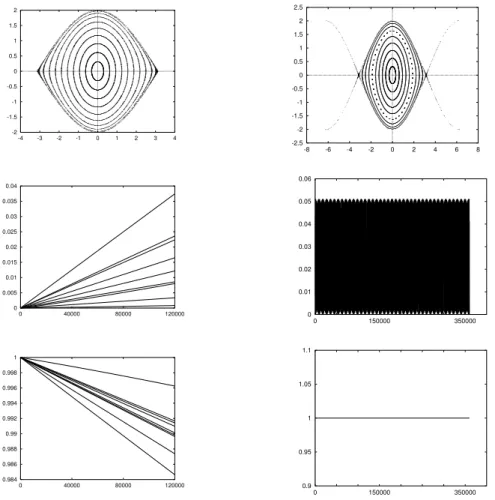
Theleft olumn of Fig. 1shows, from topto
bot-tom, the phasespae, E=E and the sympletiarea
evolution. Theyhavebeengeneratedwithaforthorder
Runge-Kutta (RK4)with xed path h=0:1, running
120000steps.Therightolumnshowsthesameitemsof
theleftone,obtainedwithasymmetriSIA2,aseond
ordersympletiintegratoromposed withthreeSIA1
stepstobedisussedlater. Ithasbeenrun350000steps
withpathh=0:3. Inspiteofthelargerpathand
num-berofsteps,notethattheSIA2representstheunstable
xed point and its invariantmanifolds aurately,
while the RK4 produes a stohasti layer typial of
non{integrablesystems. Note also the seulargrowth
oftheenergyrelativeerrorandthedereaseofthe
sym-pletiareagivenbytheRK4. Inontrast,theseond
gure of the left olumn shows an osillation for the
energyrelativeerror. This osillation is atypial
fea-tureofsympletiintegrators: nomatter howlongthe
integrationis run,theenergyevolutionhas noseular
omponent. Thethirdgureofeaholumnshowsthe
evolutionofthe sympletiarea. Theareadissipation
andtheenergyinreaseofthetrajetoriesgeneratedby
theRK4dependontheinitialondition.
-2
-1.5
-1
-0.5
0
0.5
1
1.5
2
-4
-3
-2
-1
0
1
2
3
4
-2.5
-2
-1.5
-1
-0.5
0
0.5
1
1.5
2
2.5
-8
-6
-4
-2
0
2
4
6
8
0
0.005
0.01
0.015
0.02
0.025
0.03
0.035
0.04
0
40000
80000
120000
0
0.01
0.02
0.03
0.04
0.05
0.06
0
150000
350000
0.984
0.986
0.988
0.99
0.992
0.994
0.996
0.998
1
0
40000
80000
120000
0.9
0.95
1
1.05
1.1
0
150000
350000
Figure1. (a)Theleftolumnshows thephasespae,relativeenergyerrorand sympletiareaevolutionforthe pendulum
HamiltonianusingaRK4withpathh=0:1and120000steps;(b)thesameas(a)withSIA2withpathh=0:3 and350000
steps.
Figure 2(a) shows theevolution ofthe sympleti
area for theRK4 with four dierent integrating steps
whenrunin singlepreision. Notethatasmallerpath
does not improve the sympleti area onservation of
the RK4, although the seular growth of the energy
errorissomewhatimproved.
the pendulum Hamiltonian has been runwith a RK4
withpathh=0:2,whileFig. 3(b)showsthesamewith
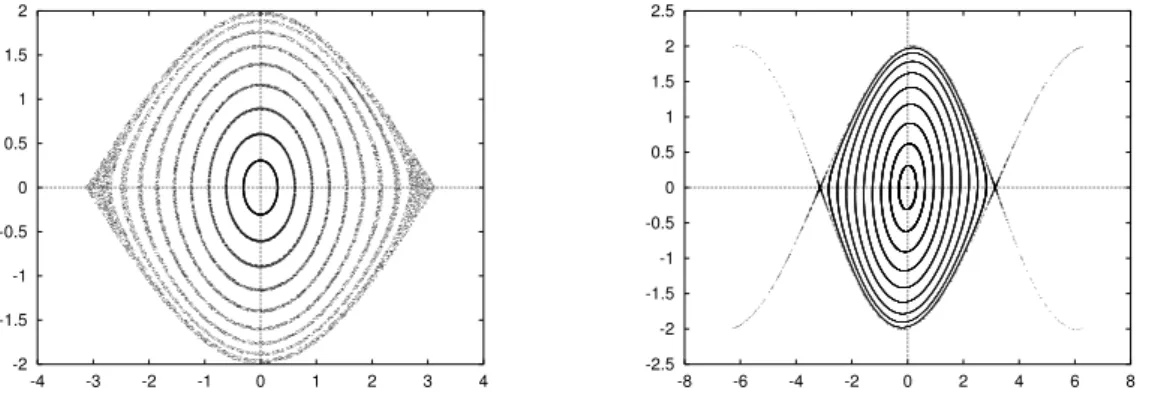
aSIA1. Asbefore, theRK4 spreadsthephase
traje-tories as if a dissipation were added, while the SIA1
preserves all the invariant manifolds. Note the
inter-esting break of the symmetry: the trajetoriesof Fig.
3 (b) aredistorted lokwise;this distortion inreases
with path of integration and appears from a ertain
pathonwards.
0.3
0.4
0.5
0.6
0.7
0.8
0.9
1
1.1
1.2
0
10000
20000
30000
40000
50000
60000
h=0.2
h=0.1
h=0.01
h=.002
-0.0001
0
0.0001
0.0002
0.0003
0.0004
0.0005
0.0006
0.0007
0
2000
4000
6000
8000
10000
12000
h=0.1
h=0.01
h=0.001
Figure2.(a)Thebehaviorofthesympletiareafor thependulumHamiltonianintegratedwithaRK4atsinglepreision,
andthepathsshowninthegure;(b)theorrespondingrelativeerrorfor theenergy.
-2
-1.5
-1
-0.5
0
0.5
1
1.5
2
-4
-3
-2
-1
0
1
2
3
4
-2.5
-2
-1.5
-1
-0.5
0
0.5
1
1.5
2
2.5
-8
-6
-4
-2
0
2
4
6
8
Figure3. (a)Thephasespae for tentrajetories of thependulumHamiltonianintegrated 100000stepswitha RK4with
pathh=0:2;(b)thesameinitialonditionsandpathof(a)integratedwithaSIA1usedtoomposetheSIA2ofFig. 1.
TheHenon-HeilesHamiltonian(Henon andHeiles,
l964)
H = 1
2 p
2
1 +p
2
2
+ 1
2 q
2
1 +q
2
2
+q 2
1 q
2 q
3
2
3
(31)
is awell known systemmotivated by its astronomial
appliations. Thepotentialrepresentsthegravitational
attration seen by a star in a galaxy with ylindrial
symmetry. Sine it has two degrees of freedom the
omplete three dimensional onstant energy
trajeto-ries annot be seen as in the ase of the pendulum.
Therefore, itis onvenient tomakeaPoinaresetion
( Henon and Heiles(l964), Ozorio de Almeida (l987))
through q
1
= 0, q_
1
> 0, and projet into the (q
2 ;p
2 )
plane. Asitiswellknown,thissetiontakesan
invari-antsurfaewiththetopologyofa2-torusofintegrable
invariantlosedurveswheretheiteratesofthesetion
lies.
Figure 4(a)showsthis setionfor E =0:08333333
and path h = 0:1 alulated a with a RK4 running
100000steps. Fig. 4(b) showsthesamesetionwitha
SIA1. Notethat the SIA1 anompetewith theRK4
algorithmforqualitativestudies. Itandoevenbetter
sine theSIA1 athes atrajetory with ison atorus
veryneartheseparatrix,whiletheRK4provokesa
sep-aratrixrossingduetoitsdissipationofarea. Compare
thesewiththeeetoftheRK4integrationinthe
pen-dulumase. Fig. 5(a)and(b)showtheenergylossand
osillationstypialoftheRK4and SIA's,respetively.
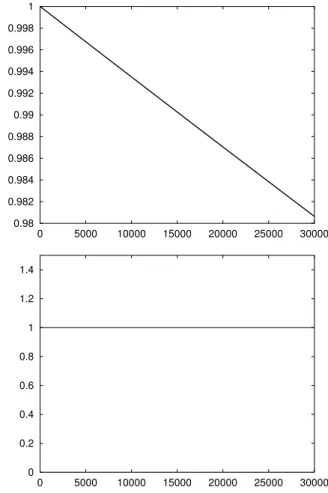
In Fig. 6 (a) and 6(b) thebehaviorof the sympleti
areaisshown,respetively,fortheRK4andtheSIA1.
tainingarstorderonewhihwasdevisedbyChirikov
(1979).
-0.4
-0.3
-0.2
-0.1
0
0.1
0.2
0.3
0.4
-0.4
-0.3
-0.2
-0.1
0
0.1
0.2
0.3
0.4
0.5
-0.4
-0.3
-0.2
-0.1
0
0.1
0.2
0.3
0.4
-0.4
-0.3
-0.2
-0.1
0
0.1
0.2
0.3
0.4
0.5
Figure4. Poinaresetionq
1
=0,E=0:08333333
integrat-ing100000stepswithpathh=0:1;(a)theRK4result;(b)
thesameonditionsasin(a)usingaSIA1integratorofthe
typedevelopedinsetionIV.
-0.0007
-0.0006
-0.0005
-0.0004
-0.0003
-0.0002
-1e-04
0
0
5000
10000
15000
20000
25000
30000
-0.005
-0.004
-0.003
-0.002
-0.001
0
0.001
0.002
0.003
0.004
0.005
0
5000
10000
15000
20000
25000
30000
Figure5. A Henon-HeilestrajetorywithE =0:08333333
ofFig. 5,300000 stepswithpathh=0:1;(a)the RK4ÆE
timeevolution;(b)thesameas(a)usingtheSIA1.
0.98
0.982
0.984
0.986
0.988
0.99
0.992
0.994
0.996
0.998
1
0
5000
10000
15000
20000
25000
30000
0
0.2
0.4
0.6
0.8
1
1.2
1.4
0
5000
10000
15000
20000
25000
30000
Figure6. ThesametrajetorywithE=0:08333333 ofFig.
5,(300000 steps, h =0:1); (a)the RK4time evolution of
thesympletiarea;(b)thesameas(a)withtheSIA1.
IV.2Wisdom-ChirikovDeltafuntiontehnique
Chirikov(l979)proposedawaytosolvetheproblem
of a perturbed pendulum Hamiltonian to study what
an beseenin the Poinaresetionsof twodegreesof
freedomsystems.
Anon-perturbedsystemination-anglevariablesis:
_
= H
0
I
=!(I); _
I =0; (32)
whose solution is: = !t +
0
, I = onstant and
H(I;)=H
0
(I). If aperturbingpotentialV(I;; t)
is introdued, where is an external orinternal
per-turbingfrequeny,thesystemtakestheform:
_
=!(I)+
V(I;;t)
I
_
I =
V(I;;t)
(33)
T = 2
istheperiodoftheperturbation, jj<1;sine
V isperiodiin and t theperturbingpotentialan
beexpanded,forexample,inaosineFourierseries:
V(I;;t)= X
m;n v
m;n
(I)os(mt+n): (34)
If m+n!(I)= 0,for anypair of integers(m;n)we
havearesonane,orasoalled longperiod term.
Ap-plying perturbation theory, for example Von Zeipel's
method, wekeeptheresonanttermsin the"averaged"
Hamiltonianandthenon-resonantonesgoestothe
gen-erating funtion of innitesimal transformations
(Bo-alletatiandPuao,1999;Chirikov,1979). The
aver-agedorresonantHamiltonianisthentheoldone
with-outthenon-resonant(shortperiod)terms:
H
R (I; ;I
r )=n!
0 J
2
2
+nv
mn (I
r
)os ; (35)
where J = I I
r
, =
mn
= mt+n (the
reso-nantargument), I
r
isthe valueofI atthe exat
res-onane and! 0 = ! I I=Ir
. Thus, we notethat
hamil-tonian(35)representsa pendulum with mass (n! 0
) 1
and g= n v
mn (I
r
). Thefollowingfurther simplied
versionofH
R
multipliedby aDelta periodi funtion
isthemappingHamiltonian:
H
M
(I; )= J 2 4 + K M 2
os Æ 2
M
(t) (36)
andtheperiodiDeltafuntionmeanstheadditionofa
ompleteseriesofhighfrequenyterms. Inthisway,the
followingtime dependentHamiltonian isobtained,
us-ingPoissontransformation(OzoriodeAlmeida(l987)):
H(J; ;t;I
r )= J 2 4 + K m 2
os (1+ 1 X n6=0 os(n M t)): (37)
This perturbation is in fat asequene of Delta
fun-tionsasfollows:
M 2 1 X os( M t)= 1 X Æ(t 2 j M
)=Æ2
M (t);
i.e., an expansion in Fourier series of a sequene of
deltapulses,whihisaperiodideltafuntionofperiod
T
M
=2=
M
. TheequationsforH
M
(t)areeasyto
in-tegratesinethehangeÆJ ourswhent=nT
M only,
else thesystemrotatesasafreerotorwithoutgravity.
Theresultisthewellknownstandardmapping:
J
n+1 =J
n
+K sin
n+1 = n +J n+1 : (38)
Notethatthismappingissimilartotherstorderone
wehavedisussedinthelasttwosetions. itiseasyto
seethat thedeterminantofitsJaobianmatrixisone,
therefore,area-preserving.
Usually the Hamiltonians of resonant problems in
CelestialMehanisareobtainedfrom thelassial
ex-pansion, whih isaFourierseries. Thisexpansionan
beseparatedbythetimesaleoftheargumentsofthe
sinesandosines,
H =H
Kepler +H seular +H orbital +H resonant (39) where H orbital
is in general averagedout sineit does
notaetthelongtermbehavior. Wisdom'smethodis
towrite themappingHamiltonianasfollows:
H map =H Kepler +H se +2Æ 2 ( M t)H res (40) whereÆ 2
isasequeneofdelta funtionsofperiod2
whose FourierSeries is as before with
M
= n being
the frequeny of the delta's (in the asteroidal ase, n
isthemeanfrequenyofJupiter). Ingeneral,thetime
dependene in Hamiltonians (39) is not expliit as in
thepotential(34).
Some results of this tehnique applied to the
as-teroidal resonanes 2/1, 3/2 and 4/3, the so alled
(p+1)/p, an be seen in Murray (l986), Stuhi and
Sessin (l989). Stuhi (l991) showsthat amapping
de-rivedwiththis tehniqueand arstorderone derived
from agenerating funtion givethe same resultwhen
applied to a sample of real asteroids from the above
mentioned resonanes. In 1990 Wisdom developed a
higherorderSIAforthen-bodyproblemandompared
withdiretintegrationsperformedinhisdigitalorrery:
aspeiallydesignedparallelomputingdevieto
simu-latetheSolarsystem(SussmanandWisdom,l992).For
appliationsinCelestialMehanisseealsoYoshidaand
Kinoshita(1991).
V The various higher order
om-positions
Having disussed the Channel and Sovel (l990)
in-tegratorup to rstorder,I nowdisuss how theyan
higher order SIA's obtained diretly with this
proe-dureareveryompliated,anddemand hardalgebrai
manipulationsthatgeneratequiteumbersome
expres-sions fortheintegrator. Fortunately, Forest andRuth
(1983,1990)andYoshida(1990)foundthathigher
or-derSIA'souldbegeneratedbyperformingseveral
in-termediate steps during the fundamental step t, in a
fashion similar to the oneused in generating high
or-der Runge-Kuttaintegrators. Thework ofCandyand
Rozmus(1991)ontainsveryinterestingexamples.
Un-less stritly neessary,only onedegreeof freedomwill
be used to keep the notation simple and outline the
reasoning.
TaketherstorderSIAasthemapM
1
(t)givenby
p i+1 =p i i (hV q (q i )) q i+1 =q i +d i (hT p (p i+1
)); (41)
i = 0N, where N is the number of intermediate
stagesneessarytoompleteonesteph. The
i andd
i
aretobedetermined(lessthenonebydenition). This
stepanbeseenasasequeneofanonial
transforma-tions,andthroughitsinversesequene:
(p
o ;q
o
) ( (p
1 ;q
1
) ( ( (p
n ;q n ) S 1 S 2 S N (42)
thenalHamiltonianfuntionH
o (q o ;p o ; 1 N ;d 1 d N
) = 0, up to some order k+1, beause the
equa-tions of motion are dp
0
dt
= 0 and dq
0
dt
= 0: This allow
usto determinethevaluesofthe
i andd
i
. Infat,we
areproeedingasin theresolutionofHamilton{Jaobi
equation. For the simple type of Hamiltonian we are
onsidering,H=T(p)+V(q), aseond order SIAis
ob-tainedforthefollowingsetofvalues:
1 =0; d
1
=1=2;
2
=1andd
2
=1=2: (43)
The idea is simple, but again the omplexity of
the system of equations for the N oeÆients
i and
d
i
grows dramatially with the order, and the aid of
algebrai manipulator is neessarily already at order
four. Fortunately,thereisawayoutthroughtheuseof
the Liegroupviewof deHamiltoniandynamis whih
alsoonveyssomeeleganetothebasiidea. Therst
researher who used Lie groups was Neri (1987) and
wasshortlyfollowedbyForest(1987),ForestandRuth
(1990)andYoshida(1990),whonotiedthattheSIA4
previously developed by Forest was a omposition of
twoSIA2.
We have seen how to ompose a rst order maps
for simpleHamiltoniansofthetypeH =T+V. This
analsobeextendedtoamoregeneralHamiltonianof
the form H = H
1 +H
2
. However, in both ases the
rst ordermaps, omposedof twostages,oneforeah
pareloftheHamiltonian,donottakeintoaountthe
Laskar and Robutel (2001) have developed a SIA for
thistypeofHamitoniansbutwith aparameter,that
is,H =H
1 +H
2
. TheirSIAisatuallybeingusedfor
sophistiatedinvestigationsofthesolarsystem.
Reall that the Hamiltonian ow, g t
, is a one
pa-rametergroupofoperatorsatingonphasespae. For
aspeit,letusallM(t)=g t
theoneparameter
op-eratorexp(t : H :)andthat"sympletiintegration
is the substitution of M(t) by a omposition of maps
whihapproximatesM(t)uptoagivenarbitraryorder,
andthisompositionmaybeappliedtoz
o
in anexat
andexpliitway".
Note that M(t) = exp : T + V : is M(t) =
N
1 (t)N
2
(t) = exp t : T : exp t : V : up to rst
or-deronlyand that itanbeorreted tohigher orders
bymeansoftheBCHformulagivenbyequation(21)in
thesetionII.TheSIA,N(t),denedbytheoeÆients
(43)
N(t)=N
1 t 2 N 2 (t)N 1 t 2 (44)
isasymmetrialompositionofN
1 ,N
2
givenby
equa-tions(41). Applyingthe BCHformula to (44),it an
beshownthat
N(t)=expt: H+O(t 3
):=M
2
(t); (45)
whih means that a seond order SIA (SIA2) is
gen-erated. It an be shown that suh symmetri
ompo-sitionsgenerate SIA's withoutoddpowersof thestep
t,andthese integratorsarealwaysofeven order. The
importantonsequeneisthattheyaretimereversible,
i.e.,
S(t)S( t)=I ; (46)
Iistheidentitymatrix.
UsingthisfatYoshida(1990)developedthetheory
ofSIA'soforder2m+2byomposingmapsoforder2m
symmetrially. More preisely, given the map N
2m (t)
itssymmetriomposition yieldsN
2m+2 (t),i.e.,
N
2m+2 (t)=N
2m (z o t)N 2m (z 1 t)N 2m (z o
t): (47)
SupposingN
2m
known,Yoshidashowedwiththe
BCH-formulathat:
N
2m+2
(t)=exp[:t(2z
o +z 1 )H: +(2z 2m+1 o +z 2m+1 1
)R (t=0)℄ (48)
Forthis tohaveorder2m+2itisimposedthat
2z
o +z
1
=1 and 2z
2m+1
o
+z 2m+1
1
=0; (49)
whihwhensolvedforz
o andz 1 gives: z o = 2 1 2m+1 2 2 1 2m+1 ; z 1 = 1 2 2 1 2m+1 : (50)
beingthat we arenotlimited to thelass of
Hamilto-niansof theformH=T(p)+V(q),ormoregenerally,
H =H
1 +H
2
,asdealtwithinForestandRuth(l990).
Therefore,seondorderstandardintegratorswhihare
provensympletianbeused asaseedforhigher
or-dersymmetriompositions,forexampletheEulerstep
evaluatedatthemidpointinphase-spae
q=q
o +hr
p H
q
o +q
2 ;
p
o +p
2
p=p
o +hr
q H
q
o +q
2 ;
p
o +p
2
; (51)
whihisaseondorderreversibleSIAasitwillbeseen
inSetion6. Infat,thisapproximationwasknown
al-ready toPoinare,and aordingtoFengitgoesbak
to Von Zeipel. It has been redisovered reently in
manystudiesonsympletiintegrators. Beforelosing
thissetion,IagainreommendtheworkofFenget al
(1991)foranotherviewofthemidpointandsympleti
algorithms.
V.1 Examples with a symmetriSIA4
First, an example studied by Candy and Rozmus
(l991),
mq= eE[sin(kq ! t)+sin(kq+! t)
whih desribes the motion of a partile of mass m,
harge e, in the eld of a standing wave. In units
suhthat ! =k=m=1;the rstorderHamiltonian
equations ofmotionanbederived fromthe
Hamilto-nianfuntion:
H(q;p)= p
2
2
os(t)os(q); (52)
where is the strength of thetime dependent
pertur-bation.
Inthisasethetimeanbeonsideredastheseond
oordinate, q
2
; and the work is done in the extended
phase spae so that the potential beomes a funtion
of the q
i
's alone. Then, one an make aseond order
midpointRK2togeneratethesymmetriseondorder
\seed"ofthe higherorder SIA's. Figs. 7(a)and 7(b),
=0:73=2,showthePoinaresetionq=2k,whih
anbeobtainedeasilybytakingthestepash=2=N
andintegratingN steps. Forh=2=25theSIA4 Fig.
7(b) shows the Poinaresetion without any
dissipa-tion, while the RK4 with the same step shows haos
and separatrix rossing. Fig. 7() shows the energy
evolutiontypialof xedpathRK4odesasdisussed
in the exampleofthe pendulum. Fig. 7(d) shows the
usual energy behavior, that is, it osillates around a
kindofaveragevaluewithoutseular growth, no
mat-ter howlongthesystemisintegrated.
-0.2
-0.15
-0.1
-0.05
0
0.05
0.1
0.15
0.2
0.35
0.4
0.45
0.5
0.55
0.6
0.65
-0.2
-0.15
-0.1
-0.05
0
0.05
0.1
0.15
0.2
0.35
0.4
0.45
0.5
0.55
0.6
0.65
-0.01
-0.009
-0.008
-0.007
-0.006
-0.005
-0.004
-0.003
-0.002
-0.001
0
0
50000
100000
150000
200000
-1e-07
-5e-08
0
5e-08
1e-07
1.5e-07
2e-07
2.5e-07
3e-07
0
40000
80000
120000
160000
200000
Figure7. Setioninq
2
=2N forHamiltonian(52) withpathh=2=25;=0:73= a)usingaRK4;b)usingaSIA4;)
theenergyforase(a); (d)theenergyevolutionforase(b): notetheosillatingbehavior.
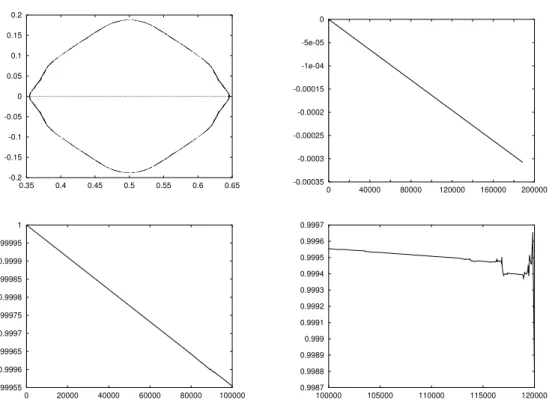
The Poinaresetion shown in Fig. 8(a) was
al-ulated with the RK4, with pathh ==25. We
dou-bled the pathused in Fig. 7and this seemssuÆient
to keep the trajetory in a invariant torus as in Fig.
7(b)(obtained withthe SIA4). However, ifwelook at
evolution of the sympletiarea, Figs. 8(b) and 8(),
weseeaseulardereaseandasuddenseriesof
intervalwhere thisdivergeneours. Theenergy
evo-lution is shown in Figure 8(b) and it shows the usual
seularbehavior.
In Fig. 9(a) the Poinaremap obtained with the
SIA4 reveals an invariant KAM torus whih persists
for the30000 Poinareiterations. This is anevidene
of the good stability properties of the sympleti
al-gorithm. The same initial onditions were run with
theRK4andthenumerialdissipationduetothe
non-onservation ofthe sympletiareamakestheiterates
migrate to aneighboring invarianturve. The initial
onditions are q
1
= 0:0, p = 0:3125, q
2
= t = 0:0,
=1=2 andthepathh=2=30. InFigs. 10(a) and
10(b)ahaotitrajetoryneartheseparatrixisshown,
andin thisasetheviolation ofthesympletiareais
notsoeasily identied sinetheorbitisin aregion of
widespreadhaosduetothemigrationofiteratesfrom
theneighborhoodofonesetofislandstoanother,that
is,duetotheoverlapofresonanes.
-0.2
-0.15
-0.1
-0.05
0
0.05
0.1
0.15
0.2
0.35
0.4
0.45
0.5
0.55
0.6
0.65
-0.00035
-0.0003
-0.00025
-0.0002
-0.00015
-1e-04
-5e-05
0
0
40000
80000
120000
160000
200000
0.99955
0.9996
0.99965
0.9997
0.99975
0.9998
0.99985
0.9999
0.99995
1
0
20000
40000
60000
80000
100000
0.9987
0.9988
0.9989
0.999
0.9991
0.9992
0.9993
0.9994
0.9995
0.9996
0.9997
100000
105000
110000
115000
120000
Figure 8. Thesame aspreviousgureusingaRK4withh=
25
;fromleft toright,toptobottom,a)thesetion; b)time
evolutionoftheenergy;)andd)timeevolutionofthesympletiareawithasuddenosillation leadingtodivergene.
0.25
0.3
0.35
0.4
0
0.1
0.2
0.3
0.4
0.5
0.6
0.7
0.8
0.9
1
0.24
0.26
0.28
0.3
0.32
0.34
0.36
0.38
0.4
0.42
0.44
0
0.1
0.2
0.3
0.4
0.5
0.6
0.7
0.8
0.9
1
Figure9. (a)AninvarianturveofthePoinaresetionH=p 2
=2 ostosqintegratedwithSIA4,h=2=30,=1=2,
-0.3
-0.2
-0.1
0
0.1
0.2
0.3
0.4
0
0.1
0.2
0.3
0.4
0.5
0.6
0.7
0.8
0.9
1
-0.4
-0.3
-0.2
-0.1
0
0.1
0.2
0.3
0.4
0
0.1
0.2
0.3
0.4
0.5
0.6
0.7
0.8
0.9
1
Figure 10. (a)A haoti trajetory of thesystem of the previous gures integrated withRK4 , h= 2=30, = 0:73=,
(qo;po;to)=(0:0;0:252;0:0)with30000iterates; (b)thesameas(a)usingSIA4. Theeetsoftheviolation oftopologial
invariantsarenotsoeasilyidentied.
-0.5
-0.4
-0.3
-0.2
-0.1
0
0.1
0.2
0.3
0.4
0.5
-0.6
-0.4
-0.2
0
0.2
0.4
0.6
0.8
-0.5
-0.4
-0.3
-0.2
-0.1
0
0.1
0.2
0.3
0.4
0.5
-0.6
-0.4
-0.2
0
0.2
0.4
0.6
0.8
-0.6
-0.4
-0.2
0
0.2
0.4
0.6
-0.6
-0.4
-0.2
0
0.2
0.4
0.6
0.8
1
-0.0015
-0.001
-0.0005
0
0.0005
0.001
0.0015
0.002
0
40000
80000
120000
160000
-0.5
-0.4
-0.3
-0.2
-0.1
0
0.1
0.2
0.3
0.4
0.5
-0.6
-0.4
-0.2
0
0.2
0.4
0.6
0.8
Figure 11. Henon-Heiles Hamiltonian integrated with the SIA4 for 100000 steps, h = 0:2, (0;0;p
1
;0); (a)setions with
E=0:159;(b)setionsforE=0:1597;()thesameas(b)for 500000steps;(d)theEevolutionfor(b): notethealways
The next example is the lassial Henon-Heiles
Hamiltonian(24),andthesetionusedisagainthe
las-sial one, viz., fx =0;x_ > 0g. (I haveused Henon's
trikto makethe setion: when theowutsthe
se-tiontheintegrationvariableishangedfromttoxand
asinglepathisintegratedtaking h= xeither before
or after the setion.) Fig. 11(a) shows a regular
se-tion obtained with a path h = 0:2, initial onditions
(0;0;p
1
;0) for E =0:159 and 100000stepsintegrated
with the SIA4. The invariant tori are not destroyed
evenwithsuhlargeapath. Whentheenergyisslightly
inreasedtoE=0:1597,andthesameinitialondition
(0;0;p
1
;0),forthesamenumberofsteps,afuzzyregion
starts as it an be see in Fig. 11(b). However, when
the numberofstepsis inreasedto 500000,the region
ofremanentinvarianttoriisnotinvadedbythehaoti
iterates as seen in Fig. 11(). Fig. 11(e) shows the
poor,in fatinaeptable,performaneoftheRK4for
the same onditionsof Fig. 11(a). In anothertrial, I
haverun1200000stepswithh=1=6and theseparate
regions of haos and integrability are still preserved.
Fig. 11-d shows the evolutionwith time of E; note
thetypialosillationsofsympletiintegrators.
Figure 12(a) shows the Poinare setion obtained
during1200000stepsofh=1=6forE=0:029952and
theinitial ondition (0;0;p
1
;0) using aRK4. As now
expetedweseethespreadofareadissipation. InFig.
12(b) the poor energy performane an be seen one
more. Fig. 12(d) shows the preservation of the
sym-pleti area in the ase 12() where asharp Poinare
setionanbeseenforthesameonditionsandenergy
oftheRK4run.
Figure 13 shows two initial onditions near
(0;0;p
1
;0) for E = 0:159, h = 0:05 for 200000 steps
integrated with the SIA4. Note that the tiny
is-lands shown in Fig. 13(a) are nally depited in Fig.
13(b)and weanseefoursatellites,in theregionnear
(:001;0;p
1
;0),madeofevenmoreminuteislands. The
RK4runofthesameonditionsshowsthattheminute
islandsarenotso sharplyaptured.
-0.25
-0.2
-0.15
-0.1
-0.05
0
0.05
0.1
0.15
0.2
0.25
-0.25 -0.2 -0.15 -0.1 -0.05
0
0.05 0.1 0.15 0.2 0.25 0.3
0
0.05
0.1
0.15
0.2
0.25
0.3
0.35
0
40000
80000
120000
160000
200000
-0.25
-0.2
-0.15
-0.1
-0.05
0
0.05
0.1
0.15
0.2
0.25
-0.25 -0.2 -0.15 -0.1 -0.05
0
0.05 0.1 0.15 0.2 0.25 0.3
0.9
0.95
1
1.05
1.1
0
40000
80000
120000
160000
200000
-0.06
-0.04
-0.02
0
0.02
0.04
0.06
0
0.1
0.2
0.3
0.4
0.5
0.6
0.052
0.0525
0.053
0.0535
0.054
0.0545
0.055
0.24
0.26
0.28
0.3
0.32
0.34
0.052
0.0525
0.053
0.0535
0.054
0.0545
0.055
0.24
0.26
0.28
0.3
0.32
0.34
Figure13. Henon-HeilesHamiltonianintegratedwithSIA4for200000steps,h=0:05: (a)PoinaresetionswithE=0:159,
showingahainof16islands(0;0;p
1
;0)amongneighboringhaotiondition;(b)detailsoftheislandsshowingaseondary
hainofminuteislandsat(:001;0;p
1
;0);()theRK4runwhereweanseelittleislandssomewhatblurred.
VI Sympletiation of standard
integrators
An alternativeapproah to the two main lines
pre-sentedsofar,istheonewhihtriestoimposethe
preser-vation of the sympleti area on existing integrators.
Inthiswaytheextensivesetofresultsandexperiments
gainedontheseintegratorsanbeinorporatedintheir
sympletiversion,questionslikestability,stiness,et.
Asitiswellknowntheintegratingalgorithmsfor
or-dinarydierentialequationsaredividedinto twomain
groups:singlepathandlinearmultipath. Idonotknow
ofanyattemptmadetoadapt sympletiationto
ex-trapolationmethods.
VI.1 Sympletisinglepath integrators
Themostusedlassofsinglepathintegratorsisthe
Runge-Kutta family. The leading group in the
sym-pletiationofthese integratorsisthat ofSanz-Serna
(1988, 1991). There are also the works of Lasagni
(1988) and Suris (1989). The three authors
indepen-dently found a neessary and suÆient ondition to
makea Runge-Kutta integrator be sympleti.
Sanz-SernaandValdilloalreadyin1987startedbytryingto
studythestabilityofstandardintegratorsusing KAM
theory. Toahievethis,theydupliatedthephasespae
ofanon-anonialsetofordinarydierentialequations
and observed that the iterates in this doubled phase
spae behavelike a Hamiltonian system. This
proe-dure leads naturally to the sympletiation of
stan-dard algorithms. As it is well known, a Runge-Kutta
ofmstages isgivenby:
K
i =f(t
n +
i h;y
n +
m
X
j=1 A
ij K
j )
y
n+1 =y
n +h
m
X
i=1 b
m K
m
(53)
where
i
isthepartitionofthesteph,Aisasquare
ma-trixofdimensionmandb
m
aretheweightofthe
vari-ousintermediatesolutionsin thenalsolution. Thisis
representedshematiallyby:
1
.
.
.
m
A
11
A
1m
.
.
.
.
.
.
A
m1
A
mm
b
1
b
m
(54)
These parameters should satisfy the onsisteny
on-dition
i =
P
m
j=1 A
ij and
P
m
j=1 b
i
= 1. If A is left
triangular,thealgorithmisexpliit,otherwiseitis
im-pliit. Thelatterisostlyanditisusedforstisystems
only.
The neessary and suÆient ondition for a
sym-pletiRunge-KuttafoundbySanz-Serna,Lazagniand
Suris is that the m-dimensional matrix M whose
ele-mentsare
bezero. Infat,this matrixwasestablishedin studies
onerning algebrai stability of Runge-Kuttas'
algo-rithms. It anbeprovedthat allRKwhih areof the
type Gauss-Legendre (Deker and Verver, 1984)
sat-isfy ondition (55). However, no expliit RK satisfy
this ondition, while the simply-impliit methods an
bemadetoobeyondition(55)(Cooper,1987).
Sanz-Serna(1991)isentirelydediatedtothisquestion,using
treetheory.
The simplest RK whih is sympleti is the
mid-point,onestage,simplyimpliitRunge-Kutta:
K
1
= f(t
n + h 2 ;y n + h 2 K 1 ) y n+1 = y n +hK
1 (56) where 1 = 1 2 ; A 11 = h 2 andb 1 =1:
Figure 14 shows the performane of the midpoint
RK2omparedtoaRK4usedsofarinallexperiments
inthisreview. ThesameonditionsofFig. 9andsome
nearbytrajetorieswere integrated with the midpoint
RK2andareshowninFig. 14(a). Theneatnessofthe
midpointomparedwith theRK4,Fig,14(b) isquite
impressive.Notethatthethinstohastilayernearthe
separatrixof the big island does not invade invariant
urvesasitdoeswiththeRK4.
Lazagnifoundageneratingfuntionforthe
anoni-altransformationdenedbythesympletiRK's,and
itis givenbythefollowingexpression:
S(p
n ;q
n+1
;h)=p T n q n+1 h X i b i H(Y i ) h X i b i a ij H p (Y i )H q (Y j ) T (57) d whereY i (P T i ;Q T i ) T
arethestagesoftheRK,whileH
p ,
H
q
areolumnvetorswiththepartialderivativesofH
andshould beseenasfuntionsof (p
n ;q
n+1
)andh.
0.22
0.24
0.26
0.28
0.3
0.32
0.34
0.36
0.38
0.4
0.42
0.44
0
0.1
0.2
0.3
0.4
0.5
0.6
0.7
0.8
0.9
1
0.22
0.24
0.26
0.28
0.3
0.32
0.34
0.36
0.38
0.4
0.42
0.44
0
0.1
0.2
0.3
0.4
0.5
0.6
0.7
0.8
0.9
1
Figure 14. (a) Some initial onditions near the invariant
urveofthe Poinaresetion ofH=p 2
=2 ostosq
in-tegrated with a sympletiRK2 , h = 2=30, = 1=2,
qo;po;to) = (0:0;0:3125;0:0) with 30000 iterates; (b) the
sameas(a)usingRK4.
Sanz-Serna (1988) found that RK's preserve
quadratirstintegrals,ormoregenerallythatbilinear
invariantsarepreservedforanysystemofordinary
dif-ferentialequations. Hisinterestingresultisthat
impos-ingenergy onservation for generalHamiltonian
fun-tions leads to degradation of the performane of the
algorithm. However,sympletionservation doesnot
doanyharmtothealgorithm. Thisresultisonemore
in aordane to the theorem by Marsden and Zhong
Ge(1988),statingthatfornon-integrableHamiltonians
onlythetrue solutionisable to preserveall rst
inte-grals besides the sympleti form. As it an be seen
fromthederivationoftheYoshida-Ruthalgorithm,the
energyispreservedonlyuptotheorderofthedisrete
sympletimapS(t). Therefore,oneannotin
prini-pletakeareofallinvariantsatthesametime,andfor
numerialintegrationonehasalwaystopayaprie.
Suris(1989)hasresultsthatareanalogousto these
ofSanz-SernaandLazagni. Hendssympleti
ondi-tionsforRK-Nystronwhiharealgorithmswhihwork
diretlywithseondorder dierentialequations. They
are onvenient for ases where obtaining Hamilton's
equations is noteasy. These integratorshave the
fol-lowingform: i =x n +h i v n +h 2 X a ij f( j ) x n+1 =x n +hv n +h 2 X j f( j ) v n+1 =v n +h X i f( j ) (58)
andtheyapplyto systemsoftheform
_
x=v; v_=f(x) and f(x)=
U(x)
Note that this RK diers from the usual ones by
the term in h 2
in the evaluation of the intermediate
stages,but thenal formula isof thesametype. The
sympletionditionisverysimilartoondition(55):
i = i (1 i
) 1im
i a ij j a ij + i j i j
=0 ii;jm(60)
(61)
VI.2 Multi-steplinear algorithms
The multi-step algorithms are the least developed
aseofsympletiintegration. Alinearmulti-step
for-mula requires the k previouspaths for the evaluation
ofy
n+k
anditsgeneralformis:
k X i=0 i y n+1 =h k X i=0 i f n+1 (62) wheref r =f(t
r ;y
r
). IfthelastoeÆient
k
=0then
theformulaisexpliitsinethelefthandsidedoesnot
involvethevalueofthepointy
n+k
whihistobe
eval-uated;otherwisethe multi-stepis alledimpliit. The
methodhastwoharateristipolynomials
(s)= k X i=0 i s i
; (s)= k X i=0 i s i (63)
andtheondition(t)=1isusedtonormalize(61).
Thesimplestexampleofthislassofformulasisthe
trapezoidalmethodgivenby
y n+1 =y n +h( f n+1 +f n 2 ) (64)
whihisanimpliitmulti-stepalgorithmwhihdepends
ontwopoints;thevaluesofitsparametersaordingto
equation (61) are:
o =
1
= 1=2and j
i
j = 1. The
trapezoidalmethodinvolvestwoevaluationsofthefore
funtion f(y;t)at thebeginningandat theendofthe
timesteph.
There is a lass of multi-step algorithm whih are
knownasbakwarddierentiation(BD)andtheyhave
i
=0fori6=k. Thesemethods need onlyoneev
alu-ation ofthe forefuntion. There are alsothe one-leg
multi-pathalgorithmwhiharesimilartotheBD's
be-ause they also use only one evaluation of the fore
funtion,butintheformofanaverageofallsteps,i.e.,
k X i=0 i y n+1 =hf n+1 k X i=0 i y n+1 ! : (65)
Theeasiestexampleis the\entermidpoint", or
mid-point,aone-legounterpartofthetrapezoidalmethod
whihhasthefollowingform
y n+1 =y n +hf y n+1 +y n : (66)
Infat, thismethodanalso beseenastheone stage
impliitRunge-Kuttagivenbyequation(56).
Thismidpoint formulahasbeenshownto be
sym-pleti by many authors . For example, Aziu (1985)
started withthe generaldenition of amulti-step
for-mulaandusingtheonditionsforonsistenyand
sta-bility onluded that they an only be of two steps
in order to be sympleti. Again the midpoint
al-gorithm! However, Suris in his paper on sympleti
Runge-Kuttasommentsthat theAizu resultis
appli-abletoformulaswhihanbereduedtoasinglestep
formula,i.e., y n+1 y n =h(f n
+(1 )f
n+1
) (67)
whihisinfat atwostagesRKgivenbythematrix
0 0 1 (68)
andsatisesondition(55).
EirolaandSanz-Serna(1992)showthatlinear
one-leg multi-step formulas, when symmetrial and
irre-duible,preservenotonly anyquadrati invariantbut
also thesympleti struture. Alinear multi-step
for-mula issymmetriif itsatises thefollowing relations
foritsparameters
j = k j ; j = k j ; (69)
andissaidtobeirreduibleifthepolynomials(s)and
(s), whih are harateristi of the method, do not
have any ommon root. One more the omnipresent
midpointsatisestheseonditions.
Therefore,thelinearmulti-pathformulasarenotin
general sympleti. Unfortunately, the only instane
where they an be shown to be sympleti, the
sym-metrial ases, have a very poor performane as
re-gardsstabilityformorethanoneleg. Thisis theissue
whihanimpaireÆientimplementationofmulti-step
sympleti formulas sine a one-stage formula is too
poor. Moreover,iftheHamiltoniansystemissti,
lin-earmulti-stepsareheaperthanimpliitRunge-Kuttas.
VII Final omments, stability
and variable step size
Theideaofsympletiintegratorsistheoretially
at-trative and the rst results were most enouraging.
Theonesshowninthissurveywereolletedinthe
lit-erature and veried. However, one would like to see
them implemented in variable step size like the
stan-dard odesthat are largelyused, but theresults were
quitedisappointing: theyperformexatlyasthe
stan-dard odes as far the preservation of the sympleti
ofthesympletistrutureseemstogowithxedstep
only.
Gear (1992), a traditional researher in numerial
analysis, onstruted an argument to justify the bad
performanewith variablestepsize. Hendsthat the
steph
n
dependsonthepreviousstep,h
n 1
,anditerate
y
n
,andnotonthederivativesoftheHamiltonian
fun-tion. Infat,hisresultsareinaordanewiththeones
by Calvo and Sanz-Serna(1992). However,aording
to Gear, their results proveonly that a SIA designed
foraxedstepperformsbadlywhenoperatingat
vari-ablestep. Therefore,thereisstillhopethat aSIAan
bespeially designedto operateat variable step. The
onlyworksofarinthisdiretionisduetoW. MEvoy
(1992), adapting a SIA to operate in stages like the
Runge-Kuttas.
Stabilityisaoneptwhihshouldnotbemixedup
with preision. Sometimes, tryingtoget abetter
pre-ision, oneanbe working outsidethestability region
of a given method. This word of aution is due not
only forsympletialgorithms but for any integrating
algorithm as well. The general referenes at the end
ansupplythe readerwithsomenieexamples. Sine
wehavementionedpreision,MLahlaneAtlea(l992)
madeaveryextensiveworkonpreisionofSIA's
inlud-ing ahighly preise fourth order method for aspeial
lassofHamiltonians.
Toonludethesenotes, it shouldbesaidthat the
subjet is still alive due to its good performane in
problemswhereadiabatiinvariantsareofinterest(see
Yoshida,l998).Yoshidaarriedsomenumerial
experi-mentswithaone-dimensionalharmoniosillatorwith
a slowly varying frequeny and a one-partile system
with a slowly varying isohroni potential. He found
that the adiabatiinvariantof thesesystems when
in-tegratedwithSIA's,donotshowseulargrowthofthe
error,unliketheRunge-Kutas. Healsofoundthat the
bestorder dependsontheerrortolerane required.
Sine the midpoint sheme is useful to ompose
higherordersympletiintegratorsthepaperbyAher
and Reih (l999) presents a study on advantages and
pitfallsofthisSIA2. AreentpaperbyM.Guzzo(2001)
improvesthemidpointsheme andappliesit ina
per-turbedKeplerproblem. Althoughthepaperisfoused
on CelestialMehanis, themain ideasan be usedin
other problems. He takes into aount the
perturba-tionintroduedbythesympletiintegratorandisable
to express itin the originalHamiltonian in aseparate
form. Thereisanotherreentdevelopmentof
symple-tiintegratorsbyLaskarandRobutel(2001,2002)and
itisatuallybeingusedintheirurrentresearhonthe
Solar system.
Arevivalofthe"kik"tehniqueofChirikovistaken
by Abdullaev (l998) treating it in the framework of
anonialtransformationstoobtainrigoroussymmetri
mappings,thusimprovingthestandardmappingasan
doneby Wisdomet al. (1993)and it is instrutive to
omparethetwoimprovementsofChirikov'strik.
InDattolietal. (1997)sympletiintegrators
meth-ods are arried to unitary operators in quantum
me-haniswithmanyinterestingexamplesinoptis. Also,
theideaofpreservingthesympletigeometryinspired
people working in non-holonomimehanis(Barthet
al (1999) and Cortez et al. (2001)). In this ontext
perhapsitshouldbeworthwhiletomentionMLahlan
andSovel(1993)foranintrodutorypaper.
To lose, I nd appropriate a quote taken from
Channeland Neri(l996) due to Hamming(l986):" an
algorithm whih transforms properly with respet to
alassof transformationsis morebasithanone that
doesnot. Inasensetheinvariantalgorithmattaksthe
problemandnotthepartiularrepresentationused".
Aknowledgments: I thank Dr. Jair Koiller for
alling this subjet to my attention and Dr.
Carlos Eduardo Aguiar for suggesting the numerial
alulation of the sympleti area. I also thank Dr.
A.M.Ozoriode Almeida forhis arefulreading of the
manusript and several suggestions that greatly
im-proved this review. Funda~ao Jose Bonifaio is
a-knowledgedforprovidingomputationalsupport.
VIII Bibliography
VIII.1Numerial integrators
Baker,D.T.H.,PhillipsC.,eds.,(1981)The
numer-ialsolutionofnon-stiproblems,OxfordSiene
Publiations,ClarendonPress,Oxford.
Gear,D.W., (1971) Initialvalue problems in
ordi-narydierentialequations, AademiPress.
GradwellI.,Sayers,D.K.,eds.,(1981)Solving
ordi-nary dierential equations I, Nonsti Problems,
Spring-Verlag. (it has a setion with systems
whih havestrangeattrators).
Hamming,R.W.,Numerial Methodsfor Sientists
andEngineers, Seondedition,p.73,Dover,New
York.
VIII.2HamiltonianSystems
Arnold, V.I. : (1978) Mathematial Methods of
Classial Mehanis,Springer-Verlag,NewYork,
l978.