Sho
rt
R
ep
or
t
J. Braz. Chem. Soc., Vol. 20, No. 10, 1939-1943, 2009. Printed in Brazil - ©2009 Sociedade Brasileira de Química 0103 - 5053 $6.00+0.00
*e-mail: [email protected]
Synthesis 12-Aryl or 12-Alkyl-8,9,10,12-tetrahydrobenzo[
a
]xanthen-11-one
Derivatives Catalyzed by Dodecatungstophosphoric Acid
Hong-Juan Wang, Xiao-Qian Ren, Yan-Yan Zhang and Zhan-Hui Zhang*
The College of Chemistry & Material Science, Hebei Normal University, Shijiazhuang 050016, P. R. China
Um protocolo eiciente para a síntese de derivados de 12-aril ou 12-alquil-8,9,10,12-tetrahidro-benzo[a]xanten-11-one foi desenvolvido via reação de três componentes de aldeído, 2-naftol e 1,3-ciclohexadiona ou 5,5-dimetil-1,3-ciclohexadiona na presença de ácido 12-tungstofosfórico (H3PW12O40) sem o uso de solvente. A presente metodologia oferece muitas vantagens como altos
rendimentos, procedimento simples, baixo custo, curto tempo de reação e condições brandas.
An eficient protocol for the synthesis of 12-aryl or 12-alkyl-8,9,10,12-tetrahydro-benzo[a] xanthen-11-one derivatives has been developed via three-component reaction of aldehyde, 2-naphthol and 1,3-cyclohexadione or 5,5-dimethyl-1,3-cyclohexadione in the presence of 12-tungstophosphoric acid (H3PW12O40) under solvent-free conditions. The present methodology offers several advantages such as high yields, simple procedure, low cost, short reaction times, and mild conditions.
Keywords: xanthene, multi-component reaction, 2-naphthol, aldehydes, 12- tungstophosphoric acid, heteropoly acid, solvent-free conditions
Introduction
Xanthenes and their derivatives have been received special attention due to their diverse array of biological activities such as anti-inlammatory, antibacterial and antiviral activities.1-3 In addition to this, they can be
employed as dyes,4 intracellular pH indicators,5 molecular
probes in chemical biology,6 and luorescent materials for
visualization of biomolecules.7 In particular, the xanthone
moiety is a core structure of a series of natural products with interesting biological and pharmacological activities.8-12
Tetrahydroxanthenones are among the most important classes in the family of xanthones due to their distinctive structure and great potential for further transformations.13,14
Consequently, the development of novel methods for the synthesis of these heterocyclic compounds has been received considerable interest in both organic and medicinal ields.15-18 The three-component reaction of aryl aldehydes,
2-naphthol and cyclic 1,3-dicarbonyl compounds has appeared as a novel alternative method for preparation of tetrahydroxanthenones.19 In this regard, NaHSO
4•SiO2
was utilized to catalyze this reaction to afford 12-aryl or
12-alkyl-8,9,10,12-tetrahydro-benzo[a]xanthen-11-one derivatives. However, this method needs to be further improved because some disadvantages such as relatively long reaction times and the use of harmful volatile organic solvent. Therefore, the development of eficient, mild and environmentally benign practical synthetic methods for accessing this type of heterocyclic compounds still remains a great need.
In recent years, the application of solid acids in organic synthesis is becoming an area of growing interest. Heteropoly acids (HPAs) are strong solid acids, harmless to the environment and highly stable toward humidity and have lexibility in modifying the acid strength.20 In particular, the
Keggin-type HPAs such as H3PW12O40 (PWA), H3PMo12O40 (PMoA) or H4SiW12O40 (SiWA) are the most efficient catalysts for a variety of catalytic processes and has been used in various organic transformations.21 On the other
hand, multi-component reactions (MCRs) offer signiicant advantages over conventional linear step synthesis, in terms of simple work-up and puriication, and less time, energy and raw-material consuming. Thus, MCRs provide beneits in both economic and environment.22 In continuation
Synthesis 12-Aryl or 12-Alkyl-8,9,10,12-tetrahydrobenzo[a]xanthen-11-one Derivatives J. Braz. Chem. Soc. 1940
synthetic methodology,23 we herein describe a novel one-pot
three-component synthesis of 12-aryl or 12-alkyl-8,9,10,12-tetrahydrobenzo[a]xanthen-11-one derivatives by using PWA as a catalyst under solvent-free conditions (Scheme 1).
Results and Discussion
Initially, we investigated the activity of PWA in the condensation of 4-chlorobenzaldehyde (1f), 2-naphthol (2) and 5,5-dimethyl-1,3-cyclohexanedione. To our delight, the expected product 12-(4-chlorophenyl)-9,9-dimethyl-8,9,10,12-tetrahydrobenzo[a] xanthen-11-one (4f) was obtained in 92% isolated yield in 1 h in the presence of a catalytic amount of PWA (5 mol%) at 60 oC under
solvent-free condition. Interestingly, under those conditions, the reaction could be scaled-up to a gram scale. No desired product was formed in the absence of PWA. The effect of other Keggin-type HPAs such as H3PMo12O40 (PMoA) and H4SiW12O40 (SiWA) for this transformation, was also studied and the results showed that PWA was the most effective catalyst. The desired product 4f was obtained in 89% and 82% yields respectively in the presence of 5 mol% of PMoA and 5 mol% of SiWA.
To explore the scope and limitation of this reaction, we have extended the reaction of 2-naphthol and 5,5-dimethyl-1,3-cyclohexanedione with a variety of aromatic aldehydes under the optimized conditions. Gratifyingly, the corresponding 12-aryl-8,9,10,12-tetrahydrobenzo[a]xanthen-11-one
derivatives could be obtained in high yields. It is worth noting that the electron property of the group on aromatic ring of aldehydes have a delicate effect on the yield of the product and reaction time. As shown in Table 1, aromatic aldehydes containing electron-withdrawing groups showed higher reactivity than those containing electron-donating groups. In addition, the use of 1,3-cyclohexanedione in place of 5,5-dimethyl-1,3-cyclohexanedione also gave similar results. Remarkably, aliphatic aldehydes also reacted with 2-naphthol and cyclic 1,3-dicarbonyl compounds under identical conditions and furnished the expected products in good yields. We have also tried to make benzoxanthen-11-ones using 1-naphthol or other phenol rather than 2-naphthol. Unfortunately, those substrates resulted only in traces of the corresponding products under the same conditions.
The catalyst could be recovered and reused without loss of catalytic activity. During the work-up of the reaction, PWA was recovered from the aqueous solution by evaporating to dryness, regenerated by heating at 150 oC. The recovered
catalyst was applied to the preparation of 4f and the yield was kept at 90-92% through three cycles of catalyst recycling.
According to the mechanism suggested by Das et al.19
we think that the reaction may proceed through ortho -quinone methides (o-QMs)formation from 2-naphthol with aldehydes. Subsequent addition of dimedone to the o-QMs forms intermediate 5, followed by cyclization to give the corresponding products 4, companied by loss of one H2O (Scheme 2). During the reaction process, the hydrogen
Scheme 1
RCHO
OH R1
R1 O
O
+ +
PWA (5 mol%)
solvent-free, 60 oC
O R O
R1
R1
1 2 3 4
Scheme 2 RCHO OH + H + O R o-QMS O R O
OH OH O
R O
4
O
Wang et al. 1941 Vol. 20, No. 10, 2009
ion is donated by the heteropoly acid. The hydrogen ion not only helps the dehydration but also beneits the enolization of dimedone to form the enolate intermediate. Only intermediate 5 was formed in the absence of a catalyst or in the presence of PWA at room temperature. These results lead us to assume that the step of cyclization is the rate-limiting step.
Conclusions
In conclusion, we have developed a simple, eficient and green process for the synthesis of 12-aryl or 12-alkyl-8,9,10,12-tetrahydro-benzo[a]xanthen-11-one derivatives via three-component reaction catalyzed by 12-tungstophosphoric acid under solvent-free conditions. The simple experimental procedure, short reaction times, solvent-free conditions, and good yields are the advantage of the present method.
Experimental
General remarks
IR spectra were obtained by using a Shimadzu FTIR-8900 spectrometer. 1H NMR spectra were determined on a
Varian 400 or a Bruker 400 spectrometer by using CDCl3 as solvent and tetramethylsilane as internal standard. Elemental analyses were performed on a Vario EL III CHNOS elemental analyzer.
General procedure for synthesis of 12-aryl or 12-alkyl-8,9,10,12-tetrahydro-benzo[a]xanthen-11-one derivatives
A mixture of 2-naphthol (1 mmol), aldehyde (1.0 mmol), cyclic 1,3-dicarbonyl compounds (1.2 mmol), PWA (0.05 mmol) was heated at 60 oC. The reaction was monitored
by TLC. After completion of the reaction, the mixture was diluted with water (10 mL) and extracted with ethyl acetate (2 × 10 mL). The combined organic layer was dried over anhydrous Na2SO4 and the solvent was removed under reduced pressure. The crude product was puriied by lash column chromatography using ethyl acetate-hexane (1:10) as eluent. The physical and spectral data of the known compounds were in agreement with those reported in literature. The spectral and analytical data for the new compounds were given below.
12-(4-Fluorophenyl)-9,9-dimethyl-8,9,10,12-tetrahydro-benzo[a]xanthen-11-one (4e)
White solid, mp 185-186 oC; IR (KBr) ν max/cm
-1: 2935,
2881, 1651, 11618, 1595, 1508, 1465, 1398, 1375, 1226,
Table 1. Synthesis of 12-aryl or 12-alkyl-8,9,10,12-tetrahydro-benzo[a]xanthen-11-one derivatives catalyzed by PWAa
Entry Aldehydes R1 time / min Yield / (%)b mp / (oC)
a Benzaldehyde Me 70 86 149-15024
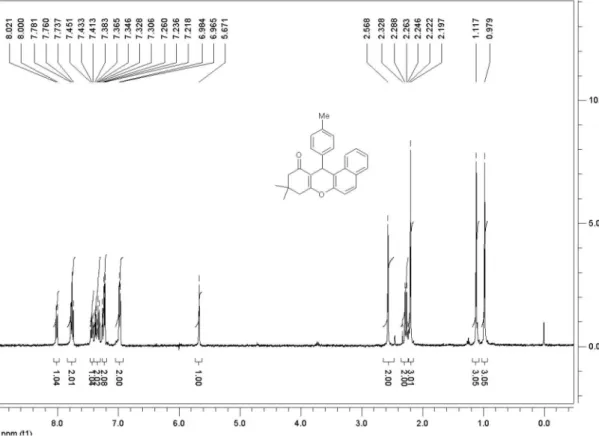
b 4-Methylbenzaldehyde Me 90 85 175-17624
c 4-Methoxybenzaldehyde Me 90 86 208-20924
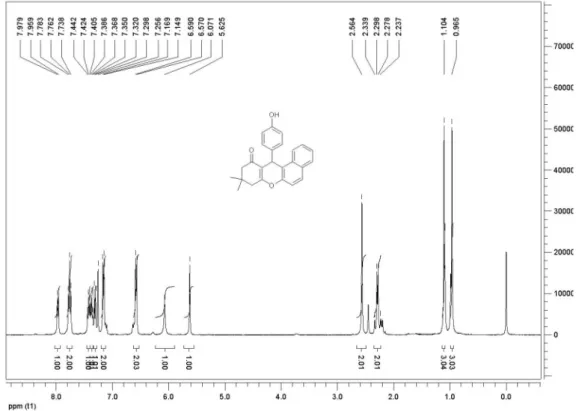
d 4-Hydroxybenzaldehyde Me 90 81 150-15124
e 4-Fluorobenzaldehyde Me 65 94 185-186
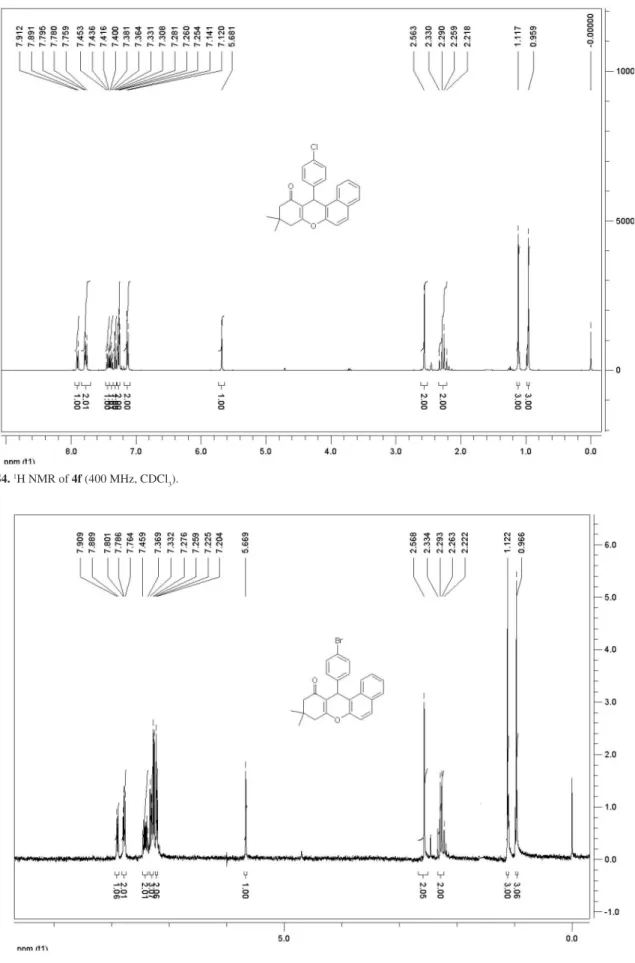
f 4-Chlorobenzaldehyde Me 60 92 187-18824
g 4-Bromobenzaldehyde Me 60 93 186-18724
h 3,4-Dichlorobenzaldehyde Me 60 92 181-182
i 4-Nitrobenzaldehyde Me 50 90 174-17524
j 2-Methyl-propionaldehyde Me 40 82 oil19
k Butyraldehyde Me 40 83 oil
l Benzaldehyde H 70 85 188-18924
m 4-Methylbenzaldehyde H 90 83 205-20624
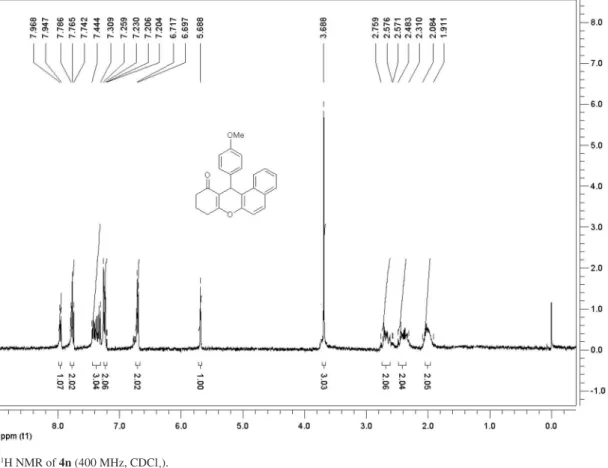
n 4-Methoxybenzaldehyde H 90 81 181-18224
o 4-Hydroxy-3-methoxybenzaldehyde H 95 83 193-19425
p 2-Chlorobenzaldehyde H 75 90 245-24625
q 3-Chlorobenzaldehyde H 60 90 209-21025
r 4-Chlorobenzaldehyde H 60 91 205-20624
s 4-Bromobenzaldehyde H 60 92 208-209
t 4-Nitrobenzaldehyde H 55 92 234-23524
u Butyraldehyde H 45 81
v Cyclohexanecarbaldehyde H 40 86
Synthesis 12-Aryl or 12-Alkyl-8,9,10,12-tetrahydrobenzo[a]xanthen-11-one Derivatives J. Braz. Chem. Soc. 1942
1184, 1014, 839; 1H NMR (400 MHz, CDCl
3): d(ppm)
0.93 (s, 3H), 1.09 (s, 3H), 2.22 and 2.29 (AB system, J 16.4 Hz, 2H), 2.53 (s, 2H), 5.69 (s, 1H), 6.84 (t, J 8.4 Hz, 2H), 7.27-7.43 (m, 5H), 7.75 (t, J 8.0 Hz, 2H), 7.92 (d, J 8.4 Hz, 1H); 13C NMR (100 MHz, CDCl
3): d(ppm) 27.0, 29.5,
32.1, 34.1, 41.5, 51.0, 114.0, 115.0, 115.2, 117.2, 117.5, 123.7, 125.0, 127.2, 128.5, 129.2, 130.0, 131.4, 131.5, 140.6, 147.8, 164.0, 197.0; Anal. Calc. for C25H21FO2: C, 80.62; H, 5.68. Found: C, 80.45; H, 5.82.
12-(3,4-Dichlorophenyl)-9,9-dimethyl-8,9,10,12-tetrahydro-benzo[a]xanthen-11-one (4h)
White solid, mp 182-184 oC; IR (KBr) ν max/cm
-1: 2962,
2891, 1649, 1637, 1618, 1597, 1398, 1385, 1373, 1234,
1002, 819; 1H NMR (400 MHz, CDCl
3): d(ppm) 0.94 (s,
3H), 1.09 (s, 3H), 2.22 and 2.28 (AB system, J 16.0 Hz, 2H), 2.53 (s, 2H), 5.66 (s, 1H), 7.18-7.22 (m, 2H), 7.29-7.43 (m, 4H), 7.73-7.77 (m, 2H), 7.88 (d, J 8.4 Hz, 1H);
13C NMR (100 MHz, CDCl
3): d(ppm) 27.2, 29.2, 32.4,
34.4, 41.4, 50.8, 113.4, 116.4, 117.2, 123.2, 125.2, 127.4, 128.0, 129.5, 130.1, 130.3, 131.0, 131.5, 132.2, 145.0, 147.8, 164.4, 196.8; Anal. Calc. for C25H20Cl2O2: C, 70.93; H, 4.76. Found: C, 71.18; H, 4.90.
9,9-Dimethyl-12-propyl-8,9,10,12-tetrahydrobenzo[a] xanthen-11-one (4k)
Colorless liquid; IR (neat) ν
max/cm
-1: 3068, 2956, 2931,
2869, 1651, 1618, 1596, 1515, 1464, 1394, 1280, 1222, 1178, 1146, 1028, 813; 1H NMR (400 MHz, CDCl
3): d
(ppm) 0.73 (t, J 7.2 Hz, 3H), 0.86-0.97 (m, 2H), 1.13 (s, 3H), 1.19 (s, 3H), 1.75-1.80 (m, 2H), 2.36 and 2.38 (AB system, J 16.4 Hz, 2H), 2.51 and 2.53 (AB system, J 176 Hz, 2H), 4.74 (t, J 4.4 Hz, 1H), 7.20 (d, J 8.8 Hz, 1H), 7.43 (d, J 7.6 Hz, 1H), 7.53 (d, J 7.6 Hz, 1H), 7.69 (d, J 8.8 Hz, 1H), 7.81 (d, J 8.8 Hz, 1H), 8.10 (d, J 8.8 Hz, 1H); 13C NMR
(100 MHz, CDCl3): d(ppm) 14.2, 18.4, 27.3, 28.0, 29.7, 32.1, 37.5, 41.4, 51.0, 112.9, 116.8, 118.4, 123.3, 124.8, 128.0 128.6, 131.2, 131.5, 148.5, 166.2, 197.7; Anal. Calc. for C22H24O2: C, 82.46; H, 7.55. Found: C, 82.62; H, 7.38.
12-(4-Bromophenyl)-8,9,10,12-tetrahydrobenzo[a] xanthen-11-one (4s)
White solid, mp 209-210 oC; IR (KBr) ν max/cm
-1: 2941,
1651, 1616, 1596, 1485, 1400, 1229, 1190, 1172, 1130, 1010, 833; 1H NMR (400 MHz, CDCl
3): d(ppm) 1.90-2.05
(m, 2H), 2.28-2.41 (m, 2H), 2.53-2.73 (m, 2H), 5.69 (s, 1H), 7.18-7.24 (m, 2H), 7.28-7.37 (m, 4H), 7.40 (t, J 8.0 Hz, 1H), 7.74-7.77 (m, 2H), 7.86 (d, J 8.4 Hz, 1H); 13C NMR
(100 MHz, CDCl3): d(ppm) 20.4, 27.2, 34.2, 37.0, 115.0, 116.8, 117.0, 120.2, 123.5, 125.0, 127.1, 128.5, 129.0, 130.4, 131.2, 131.5, 144.0, 147.8, 164.2, 165.8, 197.0;
Anal. Calc. for C23H17BrO2: C, 68.16; H, 4.23. Found: C, 68.31; H, 4.05.
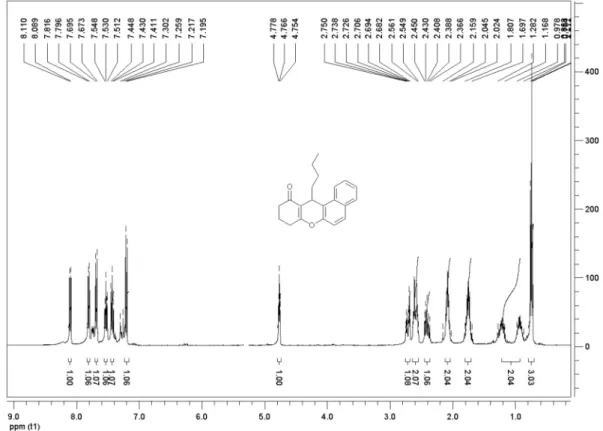
12-Propyl-8,9,10,12-tetrahydrobenzo[a]xanthen-11-one (4u)
White solid, mp 85-86 oC; IR (KBr) ν max/cm
-1: 3068,
2956, 2929, 2869, 1635, 1622, 1591, 1515, 1458, 1434, 1400, 1244, 1076, 960, 814; 1H NMR (400 MHz, CDCl
3): d(ppm) 0.75 (t, J 7.2 Hz, 3H), 0.87-0.98 (m, 2H), 1.17-1.28 (m, 2H), 1.70-1.81 (m, 2H), 2.02-2.16 (m 2H), 2.37-2.75 (m, 2H), 4.77 (t, J 4.8 Hz, 1H), 7.21 (d, J 8.8 Hz, 1H), 7.43 (d, J 7.6 Hz, 1H), 7.53 (d, J 7.6 Hz, 1H), 7.68 (d, J 8.8 Hz, 1H), 7.81 (d, J 8.8 Hz, 1H), 8.10 (d, J 8.8 Hz, 1H); 13C
NMR (100 MHz, CDCl3): d(ppm) 14.2, 18.4, 29.8, 31.2, 38.2, 41.6, 50.8, 112.1, 116.7, 117.6, 122.5, 124.1, 128.2, 131.0, 131.4, 145.0, 165.8, 197.5; Anal. Calc. for C20H20O2: C, 82.16; H, 6.89. Found: C, 81.98; H, 7.02.
12-Cyclohexyl-9,9-dimethyl-8,9,10,12-tetrahydrobenzo[a]-xanthen-11-one (4v)
White solid, mp 186-187 oC; IR (KBr) ν max/cm
-1: 2931,
1643, 1595, 1448, 1361, 1234, 1188, 1134, 993, 948, 833;
1H NMR (400 MHz, CDCl
3): d(ppm) 0.96-1.11 (m, 6H),
1.26-1.80 (m, 5H), 2.09-2.15 (m, 2H), 2.31-2.40 (m, 2H), 2.56-2.77 (m, 2H), 4.68 (d, J 3.6 Hz, 1H), 7.24 (d, J 8.8 Hz, 1H), 7.44 (d, J 7.6 Hz, 1H), 7.55 (d, J 7.6 Hz, 1H), 7.71 (d, J 8.8 Hz, 1H), 7.83 (d, J 8.0 Hz, 1H), 8.11 (d, J 8.0 Hz, 1H); 13C NMR (100 MHz, CDCl
3): d(ppm) 20.3,
26.3, 27.9, 28.5, 31.1, 32.6, 37.2, 45.5, 113.3, 116.7, 118.9, 123.7, 124.7, 126.6, 127.8, 128.5, 131.5, 131.6, 149.1, 168.5, 197.7; Anal. Calc. for C25H28O2: C, 83.29; H, 7.83. Found: C, 83.51; H, 7.65.
Acknowledgments
We are grateful for inancial support from National Natural Science Foundation of China (20872025), Nature Science Foundation of Hebei Province (B2008000149) and Natural Science Foundation of Hebei Education Department (2006318).
Supplementary Information
Supplementary data are available free of charge at http://jbcs.sbq.org.br, as PDF ile.
References
Wang et al. 1943 Vol. 20, No. 10, 2009
2. Vieira, E.; Huwyler, J.; Jolidon, S.; Knofach, F.; Mutel, V.; Wichmann, J.; Bioorg. Med. Chem. Lett. 2005, 15, 4628. 3. Hafez, H. N.; Hegab, M. I.; Ahmed-Farag, I. S.; El-Gazzar, A.
B. A.; Bioorg. Med. Chem. Lett. 2008, 18, 4538. 4. Sekar, N.; Colourage1999, 46, 43.
5. Liu, J.; Diwu, Z.; Leung, W.-Y.; Bioorg. Med. Chem. Lett. 2001, 11, 2903.
6. Kikuchi, K.; Komatsu, K.; Nagano, T.; Curr. Opin. Chem. Biol.
2004, 8, 182.
7. Sarma, R. J.; Baruah, J. B.; Dyes Pigm.2005, 64, 91. 8. Itoh, T.; Ohguchi, K.; Iinuma, M.; Nozawa, Y.; Akao, Y.; Bioorg.
Med. Chem. 2008, 16, 4500.
9. Isakovic, A.; Jankovic, T.; Harhaji, L.; Kostic-Rajacic, S.; Nikolic, Z.; Vajs, V.; Trajkovic, V.; Bioorg. Med. Chem. 2008, 16, 5683.
10. Seo, E. J.; Curtis-Long, M. J.; Lee, B. W.; Kim, H. Y.; Ryu, Y. B.; Jeong, T.-S.; Lee, W. S.; Park, K. H.; Bioorg. Med. Chem. Lett. 2007, 17, 6421.
11. Masullo, M.; Bassarello, C.; Suzuki, H.; Pizza, C.; Piacente, S.; J. Agric. Food Chem. 2008, 56, 5205.
12. Urbain, A.; Marston, A.; Grilo, L. S.; Bravo, J.; Purev, O.; Purevsuren, B.; Batsuren, D.; Reist, M.; Carrupt, P.-A.; Hostettmann, K.; J. Nat. Prod. 2008, 71, 895.
13. Lesch, B.; Bräse, S.; Angew. Chem., Int. Ed. 2004, 43, 115. 14. Shi, Y.-L.; Shi, M.; Synlett2005, 262.
15. Zhang, Z.-H.; Tao, X.-Y.; Aust. J. Chem. 2008, 61, 77. 16. Dabiri, M.; Baghbanzadeh, M.; Nikcheh, M. S.; Arzroomchilar,
E.; Bioorg. Med. Chem. Lett. 2008, 18, 436.
17. Kamino, S.; Ichikawa, H.; Wada, S.-I.; Horio, Y.; Usami, Y.; Yamaguchi, T.; Koda, T.; Harada, A.; Shimanuki, K.; Arimoto, M.; Doi, M.; Fujita, Y.; Bioorg. Med. Chem. Lett. 2008, 18, 4380.
18. Shaterian, H. R.; Ghashang, M.; J. Braz. Chem. Soc. 2008, 19, 1053.
19. Das, B.; Laxminarayana, K.; Krishnaiah, M.; Srinivas, Y.; Synlett 2007, 3107.
20. Misono, M.; Ono, I.; Koyano, G.; Aoshima, A.; Pure Appl. Chem. 2000, 72, 1305; Kozhevnikov, I. V.; Chem. Rev. 1998, 98, 171.
21. Heydari, A.; Khaksar, S.; Sheykhan, M.; Tajbakhsh, M.; J. Mol. Catal. A: Chem. 2008, 287, 5; Yadav, J. S.; Reddy,
B.V. S.; Reddy, A. S.; J. Mol. Catal. A: Chem. 2008, 280, 219; Yadav, J. S.; Reddy, B. V. S.; Aravind, S.; Kumar, G. G. K. S. N.; Madhavi, C.; Kunwar, A. C.; Tetrahedron2008, 64, 3025; Yadav, J. S.; Reddy, B. V. S.; Pandurangam, T.; Rao, K. V. R.; Praneeth, K.; Kumar, G. G. K. S. N.; Madhavi, C.; Kunwar, A. C.; Tetrahedron Lett. 2008, 49, 4296; Wang, G.-W.; Shen, Y.-B.; Wu, X.-L.; Wang, L.; Tetrahedron Lett. 2008, 49, 5090; Heydaria, A.; Khaksar, S.; Sheykhan, M.; Tajbakhsh, M.; J. Mol. Catal. A: Chem. 2008, 287, 5; Wang, G.-W.; Shen, Y.-B; Wu, X.-L.; Eur. J. Org. Chem. 2008, 4367; Wang, R.; Huang, T.; Shi, L.; Li, B.; Lu, X.; Synlett2007, 2197; Kadam, S. T.; Kim S. S.; Synthesis2008, 267; Yadav, J. S.; Reddy, B. V. S.; Kumar, G. G. K. S. N.; Aravind, S.; Synthesis2008, 395; Chen, X.; She, J.; Shang, Z.; Wu, J.; Wu, H.; Zhang, P.; Synthesis2008, 3478; Chen, X.; She, J.; Shang, Z.; Wu, J.; Zhang, P.; Synthesis2008, 3931; da Silva Rocha, K. A.; Hoehne, J. L.; Gusevskaya, E. V.; Chem. Eur. J. 2008, 14, 6166.
22. Russowsky, D.; Lopes, F. A.; da Silva, V. S. S.; Canto, K. F. S.; D’Oca, M. G. M.; Godoi, M. N.; J. Braz. Chem. Soc. 2004, 15, 165; Vieira, Y. W.; Nakamura, J.; Finelli, F. G.; Brocksom, U.; J. Braz. Chem. Soc. 2007, 18, 448; Kazemizadeh, A. R.; Ramazani, A.; J. Braz. Chem. Soc. 2009, 20, 309.
23. Zhang, Z.-H.; Hu, J.-Y.; J. Braz. Chem. Soc. 2006, 17, 1447; Mo, L.-P.; Ma, Z.-C.; Zhang, Z.-H.; Synth. Commun. 2005, 35, 1997; Zhang, Z.-H.; Lin, J.; Synth. Commun. 2007, 37, 209; Zhang, Z.-H.; Li, J.-J.; Gao, Y.-Z.; Liu, Y.-H.; J. Heterocycl. Chem.
2007, 44, 1509; Zhang, Z.-H ; Li, T.-S. ; Li, J.-J.; Monatsh. Chem. 2007, 138, 89; Liu, Y.-H.; Liu, Q.-S.; Zhang, Z.-H.; J. Mol. Catal. A: Chem. 2008, 296, 42; Liu, Y.-H.; Zhang, Z.-H.; Li, T.-S.; Synthesis2008, 3314; Lü, H.-Y. ; Li, J.-J.; Zhang, Z.-H.; Appl. Organomet. Chem. 2009, 23, 165; Liu, Y.-H.; Liu, Q.-S.; Zhang, Z.-H.; Tetrahedron Lett. 2009, 50, 916. 24. Wang, R.-Z.; Zhang, L.-F.; Cui, Z.-S.; Synth. Commun. 2009,
39, 2101.
25. von Heinrich, H.; Manfred, S.; Liebigs Ann. Chem. 1941, 641, 78.
Received: January 8, 2009
Su
pp
le
m
enta
ry
Inf
or
m
ati
on
J. Braz. Chem. Soc., Vol. 20, No. 10, S1-S7, 2009. Printed in Brazil - ©2009 Sociedade Brasileira de Química 0103 - 5053 $6.00+0.00
*e-mail: [email protected]
Synthesis 12-Aryl or 12-Alkyl-8,9,10,12-tetrahydrobenzo[
a
]xanthen-11-one
Derivatives Catalyzed by Dodecatungstophosphoric Acid
Hong-Juan Wang, Xiao-Qian Ren, Yan-Yan Zhang and Zhan-Hui Zhang*
The College of Chemistry & Material Science, Hebei Normal University, Shijiazhuang 050016, P. R. China
Synthesis 12-Aryl or 12-Alkyl-8,9,10,12-tetrahydrobenzo[a]xanthen-11-one Derivatives J. Braz. Chem. Soc.
S2
Figure S2.1H NMR of 4d (400 MHz, CDCl 3).
Wang et al. S3 Vol. 20, No. 10, 2009
Figure S5.1H NMR of 4g (400 MHz, CDCl 3). Figure S4. 1H NMR of 4f (400 MHz, CDCl
Synthesis 12-Aryl or 12-Alkyl-8,9,10,12-tetrahydrobenzo[a]xanthen-11-one Derivatives J. Braz. Chem. Soc.
S4
Figure S7.1H NMR of 4l (400 MHz, CDCl 3). Figure S6.1H NMR of 4k (400 MHz, CDCl
Wang et al. S5 Vol. 20, No. 10, 2009
Figure S8.1H NMR of 4n (400 MHz, CDCl 3).
Synthesis 12-Aryl or 12-Alkyl-8,9,10,12-tetrahydrobenzo[a]xanthen-11-one Derivatives J. Braz. Chem. Soc.
S6
Figure S11.1H NMR of 4v (400 MHz, CDCl 3). Figure S10.1H NMR of 4u (400 MHz, CDCl
Wang et al. S7 Vol. 20, No. 10, 2009
Figure S13.13C NMR of 4v (100 MHz, CDCl 3). Figure S12.13C NMR of 4u (100 MHz, CDCl
![Table 1. Synthesis of 12-aryl or 12-alkyl-8,9,10,12-tetrahydro-benzo[a]xanthen-11-one derivatives catalyzed by PWA a](https://thumb-eu.123doks.com/thumbv2/123dok_br/18993080.461337/3.892.95.826.140.555/table-synthesis-alkyl-tetrahydro-benzo-xanthen-derivatives-catalyzed.webp)