Review
Self-Assembly in Self-Organized Inorganic Systems: A View of
Programmed Metallosupramolecular Architectures
Vanderlei G. Machadoa, Paul N. W. Baxterb and Jean-Marie Lehnb
a
Departamento de Química, Centro Politécnico, Universidade Federal do Paraná, UFPR, CP 19081, Jardim das Américas, 81531-970, Curitiba-PR, Brazil
b
Institut Le Bel, Université Louis Pasteur, 4, rue Blaise Pascal, F-67000, Strasbourg, France
Os avanços recentes das pesquisas na área de sistemas inorgânicos automontados são resumidos neste artigo de revisão, em especial aqueles envolvendo os helicatos, os metalo-exorreceptores e as arquiteturas inorgânicas formadas a partir de componentes múltiplos. As aplicações, assim como as perspectivas vislumbradas para estes sistemas, são também discutidas.
This review summarizes the recent advances that have been performed on self-assembled inorganic systems, especially on helical systems, metallo-exoreceptors and on architectures formed from multiple components. In addition, applications as well as the perspectives for these designed systems are also discussed.
Keywords: supramolecular chemistry, self-assembly, self-organization, metallosupramolecular
chemistry, helicates, metallo-exoreceptors
1. Introduction
Supramolecular chemistry is currently defined as the chemistry beyond the molecule, comprising the design and studies of intermolecularly bonded chemical species, exactly as molecular chemistry is that of the covalent bond1-4. This
emergent and highly interdisciplinary field of science has seen a very rapid growth5 in recent years, as attested by the fertility
of the research made and the offered perspectives3-8.
A research area in supramolecular chemistry that has received increasing interest involves the spontaneous formation of a well-defined supramolecular structure from simple molecular building blocks. This concept, denominated self-organization4,7, represents a primordial
role in biological systems. In these systems, each complementary block contains precise information to generate, via self-assembly (each step of the self-organized process)9, the correct final structure within all possible
structures. The concepts of self-assembly were originated from studies on the tobacco mosaic virus (TMV). Raenkel-Conrat and Williams demonstrated that the TMV, after dissociation into its components, can be reconstituted in vitro
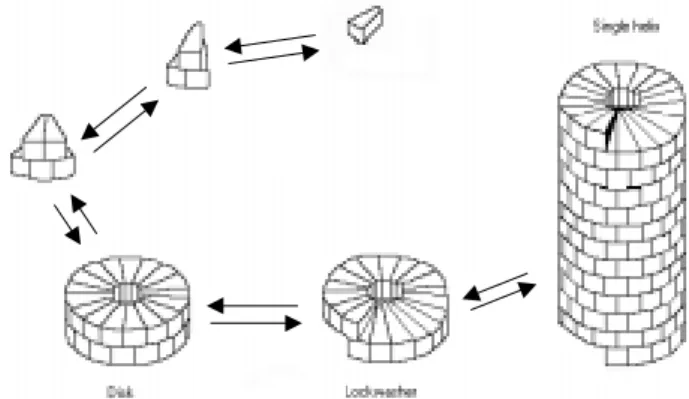
leading to the reconstruction of the intact virus (Figure 1)10.
The experiment of reconstitution showed that all necessary information for the unequivocal process of assembly of the virus is contained in its complementary components11.
e-mails: [email protected], [email protected] and [email protected]
Figure 1. Representation of the reconstitution in vitro of TMV (adapted
from ref. 11a).
Another very interesting example of self-assembly in natural systems is provided by the enzyme ATP synthase or F0F1 -ATPase, responsible for the formation and hydrolysis of adenosine triphosphate (ATP), the currency of energy in living beings12,13. The enzyme corresponds to an assembly of
embedded in a membrane, F0, which works as a proton channel. F0 is composed of three subunits (a, b and c), with the b subunit traversing F1. F1 contains 5 subunits (α, β, γ, δ and ε disposed in the following stoichiometry: α3β3γε) and
the catalytic sites, mainly located in the β subunits. The disconnection of F1 transforms itself in active ATPase, resulting in the catalytic sites being unable to synthesize ATP. If F1 is added back to F0 containing particles, the ability to make ATP is restored13. Still, the making of ATP is related to
an impressive rotational mechanism involving the catalytic sites, and the inner asymmetrical assembly of subunits, triggered by a flow of protons across the F0 domain12. All the
presented features for this splendid molecular machine14, in
the words of Boyer15, illustrate very well the fundamental
importance of self-assembled systems in Nature16.
Supramolecular self-assembled species can be constructed by means of different kinds of noncovalent binding interactions, such as electrostatic, hydrophobic, and van der Waals effects, hydrogen bonding, and donor-acceptor interactions, constituting different classes of new organic systems5,7,9,17. Another approach is obtained by
use of metal ions to assemble carefully designed parts of a desired structure. This aspect of supramolecular chemistry, known now as metallosupramolecular chemistry, defined as the extension of the coordination chemistry to the inorganic self-assembled species18, is currently growing
enormously14,17c,d,19-22. Here, we present important
advances obtained in the last years in this field, particularly in the domains of metallohelicates, self-assembled systems containing multiple components and of metallo-exoreceptors. Firstly, we will focus on some aspects of the importance of the information which lead to the formation of supramolecular structures.
2. Principles of Programming Language
Related to Supramolecular Architectures
Werner, at the end of the XIX century23, carried out
the first studies involving the coordinative bonding between metal ions and ligands. This bonding can possess different binding energies and can be as strong as the covalent bonding. This criterion would be responsible for the exclusion of many complexes from supramolecular chemistry, but as this area is founded on the selective fixation between two species, this concept can be in principle applied to all selective coordinations concerning a metal and a ligand18. It is also important to consider that
the geometry and properties of metallosupramolecular species are guided by the sum of all interactions between the molecular counterparts, such as van der Waals and π-π stacking interactions, and the question of the kinetic
lability of the formed complexes18. This last aspect is
crucial in classing these systems as self-assembled because the kinetic reversibility leads to an efficiency in forming the large structures required, thermodynamically controlled, by error-checking16a,c.
In the same manner that self-assembly requires binding, self-organization needs information in order for the determined process to take place. This information and also the algorithm that the process follows must be stored in the components, and the reading leading to the formation of a given system is made by means of precise molecular interactions4,7. Thus, designed systems possessing these
characteristics may be named programmed molecular and supramolecular systems. In the construction of programmed metallosupramolecular architectures, the important information leading to an expected supramolecular structure may be ‘sculptured’ in the ligand, and the reading is carried out by a metal ion containing a suitable coordination algorithm. These features will be illustrated in more detail in the following sections.
3. Helical structures
3.1. Introduction
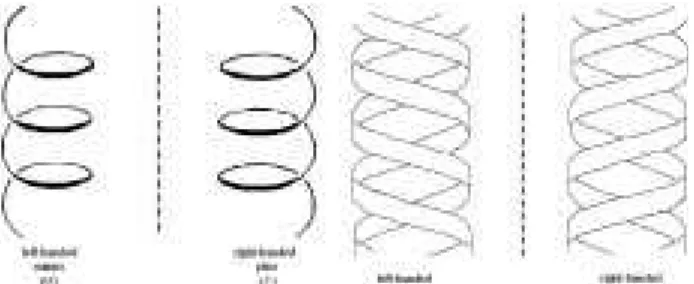
Helical architectures have, in the definition of Cahn, Ingold and Prelog, an axis, a screw sense (chirality) and a pitch (i.e. the ratio of axially linear to angular properties), being special cases of chirality24. A positive (P, plus) and
a negative (M, minus) helicity occur when the rotation is clockwise or counterclockwise, respectively, using the right-hand convention (Figure 2).
Figure 2. Schematic representation of molecular and double helices.
Many natural molecules possess ahelical structure25
and this fact has been of major interest since the disclosure of the double helix in the structure of nucleic acids26, whose
structure, formation and dissociation have been the subject of very extensive studies27. Mimics of these architectures
covalent bonds in the step by step formation of helical structures, are very difficult to accomplish28, because of
the difficulties in attaining the intricate required geometry. By means of carefully designed components, geometric constraints can be more easily overcome by the clever use of metal coordination, giving rise to a family of compounds known as helicates, in high yields. These complexes are homochiral structures, i.e., the ligands describe the same helicity sense around the metal centers (e.g., PPP in Figure 3). Other structures not having a uniform helix may be defined as heterochiral structures (PMP in Figure 3).
quaterpyridine chain35. The ligands in complex 2 possess
a twisted, chiral conformation and are wrapped around the two metal ions (Figure 4).
PPP PMP
Figure 3. Two configurations of a trinuclear complex with two ligands.
These representations show all metal ions possessing the same helicity (PPP) and a possible structure having the helicity in the central metal
different from the extremities (PMP).
Systematic studies on artificial helicates were first explored in the 1980s, being the theme of many recent reviews and parts of books4,5,7,19,20,29,30. Although until
this period no double helicates with more than two metal ions were described, many simple31 and double32 helical
systems wrapped around two metal ions were reported. In the next sections we will summarizethe various studies involving double and triple artificial helicates synthesized with transition metal ions33,34 and the applications of
these systems.
3.2. Double-stranded helicates
Of special interest inthe systematic study of double-stranded helicates was the research concerning the quaterpyridine 1, which was carefully designed sothat the bipyridine moieties are perpendicular, due to the steric hindrance imposed by the methyl groups in the 5’ and 3” positions35. In this dimeric species, two molecules of 1
bind two Cu+ ions in distorted tetrahedral coordination
geometry by use of the bipyridine unit from each
N
N N
N
1
Figure 4. Quaterpyridine (1) and the representation of its complex with Cu+.
Electrochemical studies were performed on the dinuclear helicate 2 in solution and showed that this complex undergoes two-step oxidation to yield an unstable dinuclear intermediate. A rapid dissociation in solution then occurred, with generation of the product 3 (Figure 5)36. Interestingly, the previously formed helicate 2 was easily restored by reduction of the monometallic complex 336. This process, comprised by an electronswitching between a double helix and a complex containing a single strand, represents a sort of ligand respiration and a mechanical electronswitching device.
Figure 5. Interconversion between a Cu+ double-helicate and a Cu2+
single-stranded complex through an electrochemical-chemical sequential process.
Structural modification of ligand 1 and extension of its structural features led to a general class of ligands able to form double helical complexes. This occurred with ligands 4-11, which have two to five bipyridine units in their structures (Chart 1)37.
These ligands spontaneously assemble in the presence of Cu+ ion, generating the corresponding double-stranded
helicates 12-15 (Figure 6), in which the ligand strands are wrapped around the metal ions in a double helical pattern38,39. As reinforced in the preceding section, these
structures are attained with the help of the tetrahedral-like coordination imposed by each Cu(bipyridine)2+ unit and
from the design of the ligands, which prevents metal binding to only a single strand. The determination of the crystal structures of 12 and 13 and the spectroscopic data obtained for compounds 12-15 confirmed the double helix structure38,40. Dihelicate 12 exhibits characteristics of the
two-homochiral units observed in the Coupe du Roi41. Ag+
ions, which possess adequate coordination with bipyridine units to yield double helical structures, also guide the formation of the corresponding helicates with ligands 4-1142.
Interestingly, the assembly leading to the formation of the helicates displays analogous features with biological processes, such as positive cooperativity38,43. Thus,
complexation with the first metal makes the second complexation easier, and so on. Self-recognition is another important characteristic for these architectures44. In a
mixture of ligands, each formed helicate is preferentially constituted by identical ligands, without thepresence of polymeric structures (Figure 7).
n R
H COOR or CONR2
0 4 8
1 5 9
2 6 10
3 7 11
n R R R R R
R N N
N N O O N N Chart 1. Cu+ Cu+ R R R N N O R R N N N N R O N N R R Cu+ R O N N R R R N N O Cu+ Cu+ R R R N N O R R N N N N R O N N R R Cu+ Cu+ R R R N N O R R N N N N R O N N R R O O O O N N R O N N R R R R N N O R R N N R Cu+ Cu+ N N R O N N R R R R N N O R R N N R Cu+ Cu+ Cu+ Cu+ R R R N N O R R N N N N R O N N R R R R N N N N R R Cu+ O O 12 13 14 15
Figure 6. Schematic representation of metallohelicates obtained from reaction of oligobipyridines 4-11 with Cu+ ion.
Another feature of interest was the possibility to connect nucleosides to the bipyridine units45. Double-helical
compounds were obtained by treating the ligands with Cu+
and were named deoxyribonucleohelicates (DNH)45
analogous to the double-stranded nucleic acids27.One of
the fields of science in which chemists have achieved important developments concerns the design and synthesis of nucleic acid cleavage agents for use in therapeutic treatments and as structural probes46. Thus, important
studies involving copper complexes have been carried out because of their DNA-binding interactions47. Helicates are
positively charged in their core and therefore may be able to perform selective binding to DNA. Nucleosides appended to these systems may interact with nucleic acids
by means of hydrogen bonding39,45. Studies have
demonstrated that helicates 12-15 are able to bind to double-helical DNA48. Single-strand cleavage was
provoked by visible-light irradiation in solutions of pBR322 plasmid containing a helicate48. This is a very interesting
and promising application because specially designed helicates may perform thermal or light-induced strand cleavage multiple binding to DNA.
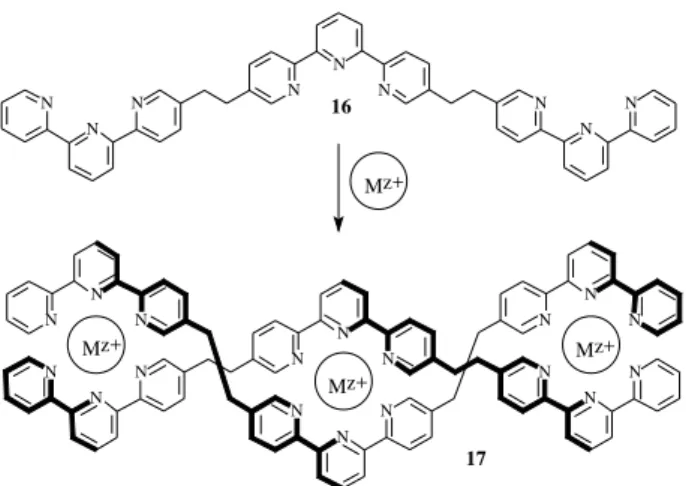
Not only 2,2’-bipyridine based ligands are capable of attaining helical structures in the presence of metal ions, but many similar polytopic heterocyclic ligands can form double helical complexes. Ligand 16, comprised by three 2,2’:6’,2” terpyridine units, forms trinuclear double helicates (17) with Fe2+ and Ni2+ (Figure 8)49.
Cu+ Cu+ R R R N N O R R N N N N R O N N R R Cu+ R R R N N O Cu+ Cu+ R R R N N O R R N N N N R O N N R R Cu+ Cu+ R N N R O N N R R O N N R R O N N R R O O R R N N O R R N N O R R N N R Cu+ Cu+ N N R O N N R R O R R N N O R R N N R Cu+ Cu+ Cu+ Cu+ R R R N N O R R N N N N R O N N R R N N R R Cu+ N N R
O N N
R R
R
N N R
O N N
R R
R
O N N
R R
N N R
O N N
R R
R
O N N
R R N N R R N N R R O N N R R
O N N R
O N N
R R
R
O N N
R R O O R R N N O R N N Cu+ R N N O
In the same manner that Cu+ ions are able to read the
tetrahedral molecular information stored in ligands 4-7 to form the corresponding helicates, Fe2+ and Ni2+ make the
octahedral reading encoded in strand 16. It is known that theCu2+ ion yields five-coordinated complexes, which
would allow, in principle, this ion to perform a ‘pyramidal’ reading encoded in two different ligands. Thus, a mixture of equimolar amounts of ligands 4 and 16 in the presence of Cu2+ led to the formation of adouble-heterostranded
helicate 18 (Figure 9)50, in which the central coordination geometry is trigonal bipyramidal and the two lateral Cu2+
ions are in a square pyramidal environment.
heteronuclear double helicate [FeCu2(19)2][BF4]4. The unsymmetrical ligand 20 is able to form two homoduplex heterotrinuclear complexes as a result of theparallel or antiparallel alignment of the ligands. However, the mixture between 20 (two equivalents), Cu+ (two equivalents) and Fe2+ (one equivalent) leads only to the formation of the parallel complex [FeCu2(20)2]4+. The mixture of the same ligand with two equivalents of Cu2+ and one equivalent of Cu+ led to the
formation of the antiparallel complex [Cu3(20)2]5+, in agreement with the preference of Cu2+ for pentacoordination.
This preference was used again to promote the formation of the heterostranded homotrinuclear double helicate [Cu3(19)(21)]6+, obtained by mixing one equivalent of each of 19 and 21 with three equivalents of Cu2+ (51). These results are of interest because the pairing determined by the metal ions between the bipyridine and terpyridine units offers the possibility of coding by means of the design of specific coding sequences, metal-ion mediated translation and finally replication by generation of the complementary strand from the constituent subunits, analogous to nucleic acid replication.
N N N
N N
N N
N N
N N
N
N
N N
N N
N Mz+
Mz+
Mz+ N
N N
N N
N N
N N
Mz+
17 16
Figure 8. Formation of a trinuclear double helicate from a ligand
comprised by three terpyridine units (Mz+ = Fe2+ or Ni2+).
N N
O
N
N N
O N N
N N O
N
N N
N N
O
N
N N
O
N N O
N
N N
19
20
21
+
N N N N
N N N
N N
Cu Cu Cu
N N N N
O O
N N N N
O O
N N
N N
N N N
N N
N N
N N
Cu(II)
6+
4
16
18
Figure 9. Formation of a double-heterostranded helicate with Cu2+ ions.
Complexation studies were also performed with ligands 19-21 (Chart 2), which contain a sequence of bipyridine and terpyridine units51. Complexation of ligand 19 (two
equivalents) with Fe2+ and Cu+ (one and two equivalents,
respectively) in acetonitrile yields the homostranded
Chart 2.
Other different ligands have been employed in order to explore different levels of molecular programming leading to the formation of double helical structures (Chart 3)32,52.
It has been shown that the multisite ligand 22 reacts with Cu+ to give a double-stranded helicate while Co2+, able to
perform an octahedral reading, yields a triple-stranded helicate53. Compound 23 is a versatile ligand that has been
used to give different double-stranded helicates in the presence of Pd2+(54) or Cu2+ (55). The same quinquepyridine forms
a double-stranded heteronuclear helicate with the tetrahedral Ag+ and the octahedral Co2+ (56). In addition,
on the nature of the copper ion and the experimental conditions57. In the same manner, double-helical ruthenium
complexes were synthesized58. This versatility to different
metal readings occurs because this ligand can be seen as having two linked groups, one bidentate bipyridine and one tridentate terpyridine54-56. The same idea was explored
with otheroligopyridines, such as the sexipyridine 2459 and the septipyridine 2560. Recently, the syntheses of double-stranded helical complexes derived from hexa(n-propylthio)novipyridine were reported61. In the
complexation of these ligands, the selection of a fraction of all donor groups in a determined ligand by a metal ion is performed according to its preferred geometry30e.
and that between catechol ligands able to form triple helicates66-68. Some researchers have revealed that
1,3-phenylene can be used with success as a rigid bridge for constructing dinuclear double-stranded helicates69,70.
Sauvage and co-workers utilized this idea to improve enormously the yield of the synthesis of a molecular knot from the double helicate [Cu2(26)2]2+ (Chart 4)71,72. In this interesting example, the replacement of a flexible –(CH2)4– spacer for the more rigid 1,3-phenylene group increased the overall yield of the synthesis of the knot from 3%71 to 30%72,
respectively. This result is due to the fact that the rigid spacer favored formation of the double helical precursor in relation to the heterochiral complex.
N N N
N N
N
N N
N N N
N
N N N N N
R
R
R = H; SCH3; SC3H7
N
N N N N N
S
S S
S
N
22 23
24
25
Chart 3.
Another important aspect in the study of the helicates is the nature of the bridge between the bipyridine units. The junction elements may show, not only enough flexibility to allow the ligand the description of a helical shape around the metals, but also the rigidity to communicate the helicity from the metal to its neighbor(s) and to avoid the binding of the metal bonded to the first site with the other binding site in the same ligand. Thus, oligobipyridine analogs, in which the CH2OCH2 bridge was substituted by CH2CH262 and
CH=CH 63 groups between the two or three bipyridine units,
were synthesized. These ligands gave as expected the corresponding helicates of Cu+ 62,63. In addition,
oligobipyridine ligands containing one or two imine bridges were found to form double helicates by complexation with Cu+ or Ag+, similar to the previously studied
oligo-bipyridines64. Many other studies have demonstrated the
crucial function of the bridge between bipyridine units65
N N
OH
N N
HO
SPACER
(CH2)4
26
Chart 4.
The work presented until now shows that three essential aspects are crucial in the formation of a metallohelicate: the nature of the binding site in the ligand, the junction between the binding sites and the configuration of the coordination metal. The combination of these three features may be employed in the construction of more complex inorganic architectures. In the same manner, the design of ligands possessing combined binding components, i.e., with several codes implemented in the same overall program, may lead to novel self-assembled structures, thus opening the possibility to perform multiprogramming. One example was recently given by ligand 27, which has oligo-bipyridine units connected by means of a pyridazine unit. It is well known that bispyridyl-pyridazine yields square-shaped species in the presence of Cu+ (73), in contrast with the double-helicates generated
by mixing oligobipyridines with the same metal ion. Ligand 27 reacts with Cu+ to give spontaneously the nanocyclic dodecanuclear complex 28, made up of four ligand molecules and twelve metal ions (Figure 10)74.
This macrocycle has external and central cavity diameters of 28 and 11 Å, respectively. Its central cavity contains four PF6- anions, as well as solvent molecules. Since the
as well as the combination of different units75 and the
design of otherprogramming systems76, may throw light
on the multisubroutine self-assembled processes and yield a variety of architectures with increasing complexity.
3.3. Triple-stranded helicates
Although inorganic triple helical structures have been known since the end of the fifties77, systematic studies
involving triple-stranded metallohelicates started only in the
last fifteen years, with the intensive work concerning the design of ligands possessing catecholate or 1-hydroxy-2-pyridonate as binding units for ferric ion sequestering78-80.
Raymond and co-workers have demonstrated that compound 29 (Chart 5) forms a 2:3 complex [Fe2(29)3] in basic medium78. The X-ray crystal structure of this complex shows
a triple-helical structure with two pseudo-octahedrally coordinated Fe3+ ions. In another pioneering work on the
design of triple-stranded helicates, Shanzer and co-workers
N
O N N O
N N
N N
O N N N O
N N
N N
O N
O
N
N N O N
N N
O
N N
O
N N
N N
O
N O
N
N N N
O N
N O
N N N
N N N
N N
O
N N O
N N
O
N N
N N N N
O O
N N
N N
O O
N N
N N
Cu+
27
28
synthesized compounds 30 and 31. These podands react with Fe3+ to form a dinuclear complex having a triple-stranded
helical structure, as determined by NMR measurements and circular dichroism spectroscopy81,82.
It was shown in the last section that ligand 22 (Chart 3) reacts with Co2+ to give a triple-stranded helicate53. Ligand
32 also yielded triple helix Co2+ complexes83. Interestingly, a subtle structural change between these ligands allowed the electrochemical oxidation of Co2+ in the complex to
Co3+, which was not possible to achieve in the complex
formed with 2253,83. The resultant complex [Co2(32)3]6+ also has a triple helical structure. Many segmental ligands have been designed in order to yield triple-stranded helical structures upon complexation with lanthanide ions84.
Recently, the structure of 32 was used by Bünzli and co-workers as a basis for the synthesis of ligands able to yield, through complexation with lanthanide ions, the first lanthanide triple-stranded helicates self-assembled in water85. Many ligands have been synthesized with the
purpose of generating triple helical architectures through complexation with appropriate metal ions86.
The steric information stored in the oligobipyridines 4-11 (Chart 1) was found to yield double-helicates by complexation with metal ions having tetrahedral coordination. Steric effects due to the disubstitution at 6,6’-positions prevent the fixation of metal ions with octahedral coordination, which would lead to the formation of triple-helicates. However, formation of these helicates is made
possible through changes in the steric instruction. By addressing this question, Elliott and co-workers have synthesized the bis(bipyridines) 33-38 (Chart 5), where the bipyridine units are connected by the 4,4’-positions87. The
ligands, upon complexation with Fe2+, gave structures with
a stoichiometry corresponding to the formation of [Fe2(ligand)3]4+. In addition, the crystal analysis of
[Fe2(33)3]4+ shows that the two Fe2+ ions are pseudo-octahedrally coordinated by one bipyridine in each ligand, leading to a triple-stranded helical structure87.
The connection of bipyridine units via the 5,5’-positions was shown to be another approach to achieve triple helical structures. Thus, the complexation of bis(bipyridine) 39 with Fe2+ was studied and NMR spectra revealed that the
complex formed, [Fe2(39)3]4+, corresponds to a triple helical structure88. The same studies were carried out with
ligand 4089. In this case, the [Fe2(40)3]4+complex formed exhibits a heterochiral structure, i.e., a meso-helicate was obtained. These results also illustrate very well the importance of the information stored in the ligand to give the correct structure. The bis(bipyridine) 41 was prepared and its complexation with Fe2+ was performed90. The
structure of the homonuclear triple-stranded helicate [Fe2(41)3]4+ was suggested. The tris(bipyridine) 42 was synthesized and its reaction with Ni2+ yielded the trinuclear
triple-stranded helicate 43 (Figure 11)91. Its structure was determined by X-ray crystallography and showed that the three strands of ligand 42 are wrapped around each other
N HN
HN O N O
OH O
OH
O Y N
O O
N O HN O NH
O HO
HO O
HO O
HO O N NH
O HN
O N
O O
Y N
HO
HO
O NH
O NH
O N
O Y
O
O N
29
30: Y=NH 31: Y=O
41
N N N N
32
N N N N
34: Y=CH2 35: Y=(CH2)2 36: Y=(CH2)3 N N Y
N N N
N N
N N
N
33 37: Y=S
38: Y=O N N
NH
NH O
N N O
N N
N
N
39 40
and held together by three metal ions, forming the triple helicate. The helical pitch (length per turn) in this helicate is about 41 Å, which is greater than that of the double helix of nucleic acids (30-35 Å)27 and even greater than that of
the double-stranded helicates 12-15 (12 Å)38.
Circular helicates have received increasing interest, due to their specific features. In these circular architectures, each ligand extends over adjacent metal centers and the strands wrap around each other, in order to yield the helical structure. In addition, these structures can be considered metallohelicate analogs of the circular DNA established in some viruses.
Although the triple-stranded helicate 43 is spontaneously formed by mixing ligand 42 with Ni2+, the complexation of the same ligand with Fe2+, a metal ion able to make an
octahedral reading, does not lead to the triple helicate. The reaction of the ligand with FeCl2 produces compound 45, a circular double-stranded helicate (Figure 13)93.
This pentanuclear complex, a torus having an outer diameter between two opposed carbon atoms of ca. 22 Å, consists of five Fe2+ ions, five ligands and a chloride ion.
All metal ions have a distorted octahedral coordination sphere occupied by three bipyridine groups, two terminal and one central, each from adifferent ligand strand. The results suggest the tight inclusion of a chloride ion into the cavity containing ten positive charges, transforming the [Fe5L5]10+ torus into a specific receptor for chloride.
Interestingly, the change in the counterion for the Fe2+ used
in the process lead to other oligomeric circular species.
N N
N N N N
N
N N
N N
N
N N N
N N N
Ni2+ Ni2+
Ni2+
N N
N N
N N
Ni2+
42
43
Figure 11. Formation of a triple-stranded helicate from oligobipyridine 42 and Ni2+.
Another interesting feature, the self-recognition, originates from the steric information needed for the assembly of double-and triple-helicates. The reaction of ligdouble-ands 5 (two equivalents) and 42 (three equivalents) with a stoichiometric mixture of Cu+ and Ni2+ lead to the exclusive formation of the
double-stranded helicate 13 and the triple-stranded helicate 43 (Figure 12)44. Thus, the mixture of two programmed molecular
systems provokes a very clean assembly of two well-defined helical complexes from a mixture containing four species, in a process involving 11 different elements.
3.4. Circular helicates
The reaction of an oligo-tridentate or a tris(bipyridine) ligand with metal ions able to perform an octahedral reading doesnot necessarily yield the corresponding double- or triple-stranded helicates. The bis-tridentate ligand 44 (Chart 6) reacts with Fe2+, Co2+ and Ni2+ to yield a circular single-stranded helicate
[M3(44)3]6+, instead of the corresponding double-helicate92.
+
Cu+ Cu+
Cu+
N N
O N N N N
O
N N O
N N N N
O
Ni2+ Ni2+ Ni2+N
N N
N N
N
N N
N N
N N
N N N N
N N
Cu+
Ni2+
Cu+ Ni2+
Cu+ Ni2+
N N
N N O N N O
N
N N N N N
N
N N N N N
N N
N N O N N O
N
N N N N N
13
43
Figure 12. Self-recognition in self-assembly of the double-stranded
helicate 13 and the triple-stranded helicate 43 from a mixture of ligands with Cu+ and Ni2+ ions.
N
N N
N
N N
N N N N
O O
44
O O
Thus, the use of anions suchas SO42-, SiF
62- and BF4- led
to the formation of the hexanuclear circular helicate94. The
use of bromide, a counteranion of intermediate size, resulted in a mixture of pentanuclear and hexanuclear circular helicates. These differences in the resultant productsare due to the template effect of the anion during the formation of the helicate, and the process can be seen as a self-assembly of a receptor as a function of its substrate. In addition, it was demonstrated that the hexanuclear circular helicate can be quantitatively transformed into the pentanuclear structure by exchanging the anion (SO42- by Cl-)94. Thus, the
self-assembly process resulting in one or other structure formed from the same components is determined by the anion acting as a template. It represents a procedure of selection from a virtual combinatorial library (VCL)95, consisting of all the
possible complexes that can be generated from the available components. Thus, each member of the VCL represents the whole library, since it can be disassembled and reassembled into every other member in a dynamic combinatorial chemistry process (DCC)95. Recently, libraries of circular
and double-stranded helicates have been provided in order to develop this subject96.
Interestingly, it was shown that the Fe2+ metallohelicate
similar in structure to complex 43 could be easily obtained by adjusting the experimental conditions97. In the same
manner, complex 43 could be transformed into the corresponding circular helicate through heating in an acid medium97. These results are due to different thermodynamic
and kinetic parameters of formation of the complexes from the metal ions and the bipyridine units. In addition, formation of these circular structures can be considered sequential self-assembled processes, since the corresponding triple-stranded helicate is formed as anintermediate.
Structural changes in the tris(bipyridine) 42 may produce different self-assembled circular structures. Thus, the modification of the CH2CH2 bridges into CH2OCH2 bridgesyields a ligand able to form a tetranuclear circular helicate, under the same conditions described above, independent of the counteranion94. The features displayed
by this self-assembled architecture can be related to the increased length of the ligand and its greater flexibility.
Many interesting circular architectures can be constructed with the use of a well-designed ligand and a suitable metal ion98. For example, Jones et al. have described a circular
supramolecular complex containing eight Co2+ (or Ni2+)
ions and twelve bridging ligands99. The crystal structure of
the complex revealed an anion encapsulated in its central cavity, as observed in complex 45.
3.5. Chirality in helical structures
The self-assembly of helical systems from achiral ligands and metal ions yield racemates containing the right-handed (P) and the left-right-handed (M) helicates (Figure 14). Since these complexes display special features, the isolation of helical architectures having high optical purity is of considerable interest. One strategy for yielding chiral helicates involves their spontaneous resolution, which has been observed in the process of crystallization of the triple-stranded helicate 4391. This result represents a successful application of molecular programming to the spontaneous but directed formation of a given supramolecular structure. Resolution techniques have also been developed in order to achieve optically pure helicates. Thus, a dinuclear double-stranded helicate was resolved with a substantial enantiomeric excess utilizing preparative column chromatography, by eluting the racemic mixture with aqueous sodium (–)-di-O,O’-4-toluoyl-L-tartrate100. The
recent advances in resolution techniques of helical structures have been revised101.
The enantiospecific synthesis of helicates is an interesting approach that has been used to achieve asymmetric induction. One method involves the synthesis of enantiomerically pure ligands with chiral links between the bipyridine units. In this way, the optically pure chiral ligand 46 with (S,S)-configuration was synthesized102. Its complexation with Cu+ and Ag+ yielded the substituted N N
N N N
N
Fe
Fe
Fe
N N
N N
N N
Fe
N N N N N N
Fe
N N
N N
N N
N N
N N N
N
Cl
-N N N N N N
5
+ 5 FeCl2
Ethylene Glycol, 170oC
9+
45
42
trinuclear helicate 47 (Figure 15), and experimental data indicated that the product is formed with a very high induction of helicity. Space-filling models and molecular-mechanics calculations suggested that steric effects may be responsible for the preferential formation of the right-handed (P) double helicate, from the two possible helical diastereomers for helicate 47102.The induced sense of helicity by the presence of chiral centers in the ligand strands has been previously reported66,103 and this
highlights the importance of the ligand design in the organization of the binding centers during the self-assembly process aimed towards the formation of supramolecular species.
spontaneous formation of the circular single-stranded helicate 49 (Figure 16). Its structure was confirmed by X-ray crystallography and NMR and circular dichroism data demonstrated that the self-assembled structure is maintained in solution107. This may illustrate the countless
possibilities in this area attainable through the suitable design of chiral ligands responsible for predetermining the chirality in self-assembled architectures108.
N N O O
N N
N N
left (M) right (P)
Figure 14. Formation of double-stranded enantiomeric helicates from
two tris(2,2’-bipyridine) strands and three metallic ions presenting tetrahedral coordination (the circle represents a metal ion Cu+ or Ag+).
N N O O
N N
N N
H3C CH3
46
47
Figure 15. Self-assembly of a right-handed double-stranded helicate (P)
from a chiral tris(bipyridine) ligand.
Other approaches have been studied in order to accomplish asymmetric induction utilizing an auxiliary template81,104,105 and the incorporation of a chiral
substituent at the extremity of the ligand67,106.
A very interesting example of the complete stereospecific self-assembly of a circular helicate has been recently reported107. The reaction of α,α
’-bis(pinene-2,2’-bipyridyl)-p-xylene chiral ligand 48 with AgPF6 in a mixture of acetonitrile and chloroform led to the
Ag
Ag
Ag
Ag Ag
Ag
N N
N N
a) AgPF6
b) NH4PF6 6 PF6
-6+
49 48
Figure 16. A stereospecific self-assembly of the circular helicate 49 from
tetrahedral reading of ligand 48 with Ag+. The representation was adapted
from ref. 22g.
3.6. Applications of helical systems
As shown in the preceding sections, considerable work has been done in the area concerning metallohelicates, and their applications have also been recently reviewed33. The
first visible possibility offered by this class of self-assembled structure is that specially designed ligands can be created in order to generate helical systems possessing endoreceptor properties. The proper choice of a bridge connecting the binding elements in the ligand may lead to an informed system capable of yielding a cavity after the metal reading, which can act as an endoreceptor. Although this approach has been used independently by Beer109, Harding65a,b, and
Nabeshima and co-workers110, considerable effort has to
be made to achieve expressive interactions between the receptor and anionic, cationic and neutral species. More recently, a bis(8-hydroxyquinoline) ligand was synthesized in order to form a metallohelicate in thepresence of Ga3+
by means of the use of cationic templates111. These
template-directed self-assembled architectures (see Section 5.2) yielded the first cryptate-like metallohelicates, having good solubility in apolar solvents. Furthermore, the design of metallohelicates with exoreceptor properties has been explored45 and the potential of this field will be discussed
later (see Section 5).
employed this strategy in the synthesis of interlocked catenanes and trefoil knots112, which cannot be obtained
in another way.
Electron-microscopy studies were performed on supramolecular liquid-crystalline polymers with right-handed helicity113. These supramolecular aggregates
resulted from the design of metallohelicates formed by the complexation of Cu+ with 6,6’-functionallized
2,2’-bipyridines114. The use of different strategies to generate
inorganic polymers and the study of their interesting properties have been successfully employed115.
The design of helical architectures can be explored in the development of various supramolecular devices. Shanzer and co-workers have prepared ligands 50 and 51, containing in their structure one 2,2’-bipyridine and one hydroxamate (Chart 7)116. The triple-stranded structure formed between
the podands and iron metal ions could act as a redox molecular switch, since Fe2+ ion has an affinity towards the
bipyridine unity by virtue of its soft nature and the hard nature of the hydroxamate prefers hard Fe3+ ions. Recently,
lipid-like ligands 52 and 53 were used in the assembly of metallohelicates in order to promote the occurrence of a liquid crystalline phase at room temperature117.
The development of fluorescent sensors and switches represents a very important challenge in the comprehension of many chemical, biochemical and material science events6,7,118. In this aspect, photophysical data involving
some metallohelicates with Cu+ in their structure showed
that the metal ions could be shielded from the surrounding medium with the adequate design of the ligand119. This
rationalization was used by Piguet and co-workers in the conception of light-converting devices based on triple-stranded helicates with lanthanide metal ions84, 85,120.
Along with the fact that the helical structures are very beautiful molecular sculptures aesthetically created by means of self-assembly, these complexes may be able to perform innumerable functions. In addition, the design of self-assembled programmed chemical systems, demonstrating multiprocessing capacity, in a one code/ several output scheme, is potentially important for the development of molecular computation processes and possibly even with respect to information processing in biology74,75.
4. Metal Ion-Directed Multicomponent
Self-Assembly: The Design and Generation of
Nanosized Molecular Receptors
4.1. Introduction
Closed three-dimensional molecular cage-type structures that have the capability for encapsulating guest species have provided the chemical community with a continual source of fascination and study over the past three decades. A large variety of such molecules have currently been prepared, and which now encompass several classes of compounds. For example, cryptates which were developed for alkali metal ion and anion binding121, multi-walled cyclophanes122 and
carceplexes123 that imprison neutral molecular guests,
sepulchrates and sarcophagines, into which are captured
HN O O
N O HN
O NH
HO HO
N
NH O
HN O
N O
O HN
N N
N N
NH
HO O
HN O
N O
O HN
N
N HO
O
HN O
N O
O HN
N
N NH
HN O O
N O HN
O NH
HO HO
N
NH O
HN O
N O
O HN
N N
N N
N
N N
N R
R
50 51
OC16H33
OC16H33
OC16H33 O
O 53: R = 52: R = C12H25
transition metal ions124 and inorganic clusters which enclose
various cations and anions125. The importance of these
compounds is mirrored by the diverse range of applications for which they have been used in materials science, medicine and chemical technology. Additionally, the unusual properties of these systems provide interesting and challenging opportunities for the study of theoretical physicochemical issues126. However, the limited availability
of many of these substances has in part posed a serious obstacle to their technological development and originated from the lengthy multistep reaction sequences and low overall yields often encountered during their synthesis121.
Early investigations showed that it was possible to use metal ion-ligand interactions as a driving force for the generation of structural complexity at a molecular level. This approach allowed direct access to topographically unusual metal ion containing entities such as helicates(see preceding section), catenates127, racks7,128, grids7,129 and
metallomacrocyclic receptors130.
It was therefore decided to explore the possibility of using metal ion-mediated self-assembly as a design principle for the generation of molecular cages and cage-type receptors of controllable size and shape. In addition, inorganic cage architectures which incorporate metal ions as integral structure generating units would be expected to exhibit novel and interesting physicochemical properties such as optical, magnetic, electrochemical and catalytic functions.
As a first step we envisioned the self-assembly of the C3 symmetric cage complex 54 (Figure 17). The concept for its design was based on the following reasoning: a) it is constructed from bipyridine subunits and metal ions of
tetrahedral coordination geometry, a combination which had already been demonstrated to participate in self assembly reactions7,30h,127; b) structure 54 is the only entity in the
reaction mixture in which all the ligand binding sites are occupied by metal ions and all metal ions are fully coordinated by ligands; complex 54 therefore represents the situation of maximum site occupancy and must be the most stable species produced in the reaction; c) the ligand components of 54 are rigidly preorganized; this feature would be expected to reduce entropic penalties associated with loss in degrees of rotational freedom upon self-assembly; d) ligand 55 in cage 54 bears groups of sufficient steric requirements to destabilize polymer formation in the presence of metal ions; this would be expected to generate a reservoir of energetically less stable monomers and oligomers comprising 55 and metal ions with incompletely occupied sites; initial investigations showed that phenyl rings would be sufficient for this purpose; and e) the presence of phenyl substituents on 55 was also expected to stabilize the cage 54 superstructure by maximizing intramolecular aromatic π-π interactions between the electron deficient pyridine rings of 56 and the phenyl rings of 55.
Most significantly, the resultant architecture would comprise two different ligand species and a single metal ion type and would therefore express a higher degree of structural informational complexity compared to the majority of preexisting self-assembled entities, which consist of a single ligand and metal ion species. Such multi-ligand type architectures must be generated via a multicomponent self-assembly pathway in which the recognition, growth and termination events involve selective discrimination of hetero-ligand containing species along the reaction coordinate.
Figure 17. Multicomponent self-assembly of an inorganic cage receptor (phenyl rings of 55 in 54 omitted for clarity). N
N N N
N N
N N
N
N
N
N N N
N N
N N
N
N
N N N N
N N N
Me N
Me
N
N
N N
N N
Me Me
Me
Me
Me 6+
3
Me
6 M
+
+
55
2
56
54a; M = Cu+ 54b; M = Ag+
4.2. Multicomponent self-assembly of cylindrical coordination architectures from five ligand units and six metal ions
When six equivalents of [Cu(MeCN)4]X (X = BF4-, PF 6-,
ClO4-), 55 (two equivalents) and 56 (three equivalents) were
combined in MeNO2 under argon and stirred at ambient temperature, the deep purple cage complex 54a formedin quantitative yield (Figure 17). 1H NMR measurements of
the solution 24 hours after mixing showed a simple spectrum comprising ten bands, two triplets and a doublet due to 55 and seven bands from 56, corresponding to the presence of a single highly symmetric species in solution. The 13C NMR spectrum also showed the expected
seventeen bands. Addition of a small quantity of 55 or 56 to a nitromethane solution of the product complex resulted in complication of the 1H NMR spectrum with sharp peaks
due to 54a still present as a major component. Thus 54a is undergoing slow exchange on the NMR timescale in nitromethane solution. UV/Vis and electrospray (ES) mass spectral results also supported the formulation of the reaction product as the cage 54a131.
The nature of cation 54a was confirmed by determination of its crystal structure131a. It is indeed an
inorganic cage-like species resulting from the self-assembly of two flat circular hexaphenylhexaazatriphenylene (HAT) units 55 forming the top and bottom, bridged by three quaterpyridine (qpy) groups 56, the five species being cemented together by six Cu+ ions.
The structure possesses a C2 axis passing through the middle of the central C-C bond of one of the qpy units; this distortion from ternary symmetry may be due to crystal packing. The top and bottom HAT units are not eclipsed as in the schematic representation of 54a (Figure 17) but rotated with respect to each other by about 27°. The 56 ligands are inclined by an angle of 66° with respect to the axis passing through the center of the two HAT units. The overall twist of the whole structure results in a triple helical shape of the complex. Bond lengths and angles do not show any peculiarity.
Complex 54a presents an internal cavity of cylindrical shape with a height of 7.4 Å (mean distance between the HAT planes) and a radius of about 5.5 Å (based on the nitrogens of the three 56 ligands). Taking the van der Waals radii into account gives an approximately cylindrical void of about 4 Å height and 4 Å radius. Thus 54a represents a self-assembled molecular receptor for appropriately sized substrate species.
The Ag+ containing analogue 54b also formed in
quantitative yield upon stirring a 1.5 : 1 : 3 stoichiometric ratio of 56, 55 and AgCF3SO3 in MeNO2. Complex 54b was characterised by 1H and 13C NMR, elemental analysis and
X-ray crystallography132. The crystal structure revealed that
the cation, unlike the helically twisted Cu+ containing analogue
54a, was shaped into an almost perfect trigonal prism. The overall dimensions of the complex are 20.2 (height) × 19.4 (diameter) Å, which make it 1.2 Å longer and 0.6 Å narrower than 54a, due to the almost eclipsed conformation of 54b. The cation 54b possesses an internal cavity of 4.7 (height) × 9.2 (diameter) Å (taking van der Waals radii into account) inside which are captured two triflate anions and a single MeNO2 solvent molecule. The guests are positioned in the same plane in such a way that almost all available space within the cavity is filled. Each guest species also partly protrudes through each of the three cavity portals into the antechambers defined by the 56 ligand surfaces and the 55 phenyl rings.
Interestingly, the 1H NMR spectra of complexes 54a-b
show the bands assignable to the ortho-phenyl ring protons of the 55 ligands to be considerably line broadened. This phenomenon appears to linked to the presence of anions in the cage cavity.
The formation of structures 54a-b represents a remarkable example of the spontaneous formation of a closed inorganic architecture through a process of multicomponent self-assembly from eleven particles belonging to two types of ligands and one type of metal ion. These results therefore successfully demonstrated the use of metal ion-mediated multicomponent self-assembly as a method of access to structurally complex molecular architecture, and represent a further step in the control of the self-organization of large and complex supramolecular structures through molecular programming.
4.3. The design and generation of elongated inorganic cylindrical cage architectures via metal ion-directed multicomponent self-assembly
Having established the success of the above design principle in constructing inorganic cages, an important further question concerned the possibility to engineer the size and shape of the internal void within cations such as 54a-b in a predictable and controllable way. Such species would have the potential capacity for shape selective and multiple guest inclusion. Towards this goal, vertical elongation of the cage 54a was attempted by utilizing ligands structurally similar to 56 but incorporating bridging groups between the bipyridine subunits, and repeating the reaction conditions which were successful for the self-assembly of 54a-b.
4.3.1. Attempted self-assembly of cylindrical cages with conformationally flexible ligand bridges
as CH2-O-CH2 and (CH2)n (n = 6-14) were used in place of 56. In all cases, no evidence for cage formation was observed even after prolonged reaction times and elevated temperatures.
Interestingly, the cage complex 57 was isolated from the reaction of a 1.5 : 1 : 3 ratio of 58, 55, and [Cu(MeCN)4]PF6 in MeNO2 (Figure 18). 1H NMR
investigations showed that 57 was partially dissociated in MeNO2-d3 and CD2Cl2 solution. It could however be isolated pure in the solid state by slow diffusion of an excess of diisopropyl ether into the reaction mixture.
The identity of 57 was confirmed by X-ray crystallography132. The cation is shaped into a highly
twisted helical cage in which two 55 ligands form respectively the top and bottom and three 58 ligands, the walls of the complex. The ligand components are held together by six Cu+ ions, which are each separated by an
average of 6.87 Å within the 55 planes and 7.65 Å between the 55 planes. The overall dimensions of the complex are 19.0 (height) × 20.0 (diameter) Å, which make it identical in size to 54a. Complex 57 is helically twisted to a greater degree than 54a. This could be due to the summed effects of the distorted tetrahedral coordination polyhedra of the six Cu+ ions and the twisted conformation of the three 58
ligands. Inside the cage is a small cavity of dimensions 4.5 (height) × 5.5 (diameter) Å (taking van der Waals radii into account), which is occupied by a single PF6- anion
with an almost perfect fit. The contracted diameter of the cavity of 57 relative to 54a results directly from the steric volume imposed by the internally facing bridging ethylene groups of the three 58 ligands.
4.3.2. Self-assembly of elongated cylindrical cage architectures with rigid ligand bridges
Cages possessing cylindrical cavities (59-63) were however successfully prepared by using ligands with rigidly preorganized bridges between the bipyridine subunits132.
Thus, reaction of the appropriate ligand components with [Cu(MeCN)4]PF6 under the same experimental conditions as that used to prepare 54a yielded the cylindrical complexes 59-63 in 50-100% yield (Figure 19). The latter complexes were characterized on the basis of elemental analysis, 1H and 13C NMR, UV/Vis and ES mass
spectroscopy. The 1H and 13C NMR spectra of 59-63
indicated the presence of a highly symmetrical species in solution with all ligands in a single magnetic and chemical environment. In the complexes elongated by means of acetylene containing bridges (59, 62-63), the band corresponding to the ortho phenyl ring protons of 55 appeared as a sharp doublet. This is consistent with an unrestricted movement of anions through the larger portals in the walls of these complexes. The ES mass spectra showed bands assignable to the cylindrical complexes with successive loss of 2-6 PF6- counterions.
Thus, rigid preorganization of both reacting ligand species proved to be a successful design modification for generating cylindrical cages with a range of cavity sizes. Molecular modeling of 63 showed the external dimensions of the complex to be 33 (height) × 20 (diameter) Å in the extended non-helical conformation. Complex 63 is therefore a truly nanoscopic cylinder which has been designed and generated through a multicomponent self-assembly strategy.
N
N N N
N N
N N
N
N
N
N N N
N N
N N
N
N
N N N N
N N N
Me N
Me
N
N
N N
N N
Me Me
Me
Me
Me 6+
57
3
Me
6 Cu+
+
+
55
2
58
4.3.3. Ligand selection in the self-assembly of hexacopper inorganic cages
In order to explore the degree to which recognition can operate within a complex mixture, an experiment was performed in which the correct stoichiometric combination of the ligand and metal ion components required to generate 54a, 60 and 61,were allowed to stir in nitromethane for 72 hours. Analysis of the resulting solution by 1H NMR and
ES mass spectroscopy showed that only three species were present in solution, i.e. the cage complexes 54a, 60 and 61. This result represents a remarkable example of correct recognition fidelity within a combinatorial library of self-assembling entities, based on four different ligands and involving a total of 33 particles (15 ligand molecules and 18 Cu2+ ions), which associate with correct recognition to
yield three structurally complex supermolecules. Previous
N N N N N N N N N N N N N N N N N N N N N N N N N N N N N N N N N N N N N N N N N N N N N N N N N N N N N N N N N N N N N N N N N N N N N N N N N N N N N N N N N N N N N N N N N N N N N N N N N N N N N N N N N N N N N N N N N N N N N N N N N N N N N N N N N N N N N N N N N N N N N N N N Me
+
Me Me Me Me6
24Å
Me Me6
+
Me 60 Me Me Me Me6
Me+
Me Me Me Me Me Me Me Me33Å
62 616
Me Me 636
Me+
Me Me Me Me28Å
29Å
+
Me Me Me
6
Me Me+
Me 54 59 Me Me22Å
20Å
studies with helicate mixtures44,63 showed that only
products comprising identical ligand strands were formed through a process of self-recognition. In the above example many more particles are initially present within the reaction mixture and the products form only by recognition between ligands of different identity. This situation which is of a higher information content, may be termed as nonself-recognition, and bears analogy to biological phenomena as found for instance in the immune system.
4.4. The designed self-assembly of multicomponent and multicompartmental cylindrical nanoarchitectures
The successful generation of the hexanuclear cage complexes described above raised the question as to whether this process could give access to multicellular inorganic architectures that would present several internal cavities and might in addition incorporate selected substrates in the course of the assembly.
The formation of supermolecular entities of this type would represent abiological analogues of numerous biological processes mediated by collective interactions and recognition events between large molecules. In particular, it would amount to a self-compartmentalization process presenting analogies with that displayed by multicompartmental proteases133.
Potential applications may also exist for example in materials science and nanotechnology, where the establishment of pathways for the controlled access to nano-sized chemical entities is of paramount interest.
Further experimental investigations successfully demonstrated that the generation of multicellular inorganic architectures was indeed possible. Thus, the bicompartmental 64 and tricompartmental 65 complex cations were generated in a single operation by self-assembly from the corresponding stoichiometric mixtures of ligand components of two different types and metal ions (Figure 20). In addition, X-ray structural determinations and 1H NMR solution studies revealed that the multicellular
architectures encapsulated anions in their cavities134.
4.4.1. Self-assembly of multicompartmental nanoarchitectures
Mixing the linear tritopic 66, and 55 with [Cu(CH3CN)4]X (X=PF6-, CF
3SO3-) in (2:1) nitromethane/
acetonitrile solution in a 1:1:3 stoichiometric ratio resulted in slow dissolution of the sparingly soluble 66 and a concomitant color change from brown to deep purple. After workup, the dark-purple organic solvent soluble PF6- and
CF3SO3- salts of 64a were isolated in 88% and 93% yields
respectively. The AgCF3SO3 analogue 64b was similarly
N
N N
N N
N
N N
N
N
N
N N
N N
N
N N
N
N
N N N N
N
N N
N N
N
N N
N
N
N N
N
N N
N N
N
N N
N
N
N
N N
N N
N
N N
N
N
N N N N
N
N N
N N
N
N N
N
N
N N
N
N N
N N
N
N N
N
N
N N
12
Me
Me Me
N N N N N
Me N
Me
N
N
N N
N N
Me
Me
Me Me Me
Me
9
Me
Me Me
+
+
64a; n = 1, y = 3, z = 9, M = Cu+
+
3
z M
n
+
67; n=2
y
66; n=1 55
64b; n = 1, y = 3, z = 9, M = Ag+
65a; n = 2, y = 4, z = 12, M = Cu+ 65b; n = 2, y = 4, z = 12, M = Ag+
generated quantitatively in nitromethane solution. The PF6
-salt of 65a and the CF3SO3- salt of 65b were also successfully prepared from the tetratopic tetrakisbipyridine 67, 55 and the suitable metal ion by procedures similar to those used for 64a-b above and were isolated in 61% and 95% yields respectively (Figure 20). In the case of 65a, the reaction had to be conducted in pure acetonitrile at 60°C in order to drive the self-assembly to completion.
Evidence that the products from the above reactions possessed multicellular cage-type structures in solution came from inspection of their 1H NMR spectra. In all cases, the
spectra were particularly simple and indicative of the presence of a highly symmetrical species in nitromethane solution. For example, in 64a-b the peaks due to the ortho- and meta-protons of the phenyl rings of 55 were divided into two groups in a ratio of 2:1 corresponding to the two outer and single inner ligands 55 in 64a-b. In 65a-b, the above mentioned protons were divided into two groups in a 1:1 ratio corresponding to the two outer and two inner ligands 55. The H6' and H6" protons of ligand 66 in 64a-b were found to be shielded relative to the remaining protons (H3', H4', H4", H3") of the four central pyridine rings of 66. This shielding effect is exactly what would be expected for protons pointing towards the interior of the cage cavity. One also observes that the signals of the ortho- protons of the phenyl rings on the inner and outer HAT ligands are broadened for both 64a and 65a. This indicates that a slow kinetic process is taking place, possibly linked to the presence of anions inside the cavities.
The ES mass spectra of the reaction products were also supportive of structures 64a and 65a. The only bands observable in each spectrum corresponded to the successive counterion loss from {[Cu9(66)3(55)3](X)8}+, and {[Cu12(67)3(55)4](PF6)10}2+ respectively. All spectra were recorded at a concentration of 10-4 mol L-1 in nitromethane
and no other peaks were seen, showing that 64a and 65a were the only species present in solution and were stable to dissociation down to at least 10-4 mol L-1.
4.4.2. Crystal structures of the multicompartmental nanoarchitectures
Confirmation that the reaction products were indeed of multicellular type was obtained by determination of the X-ray crystal structures of 64a and 65a. The cation 64a is constructed from nine Cu+ ions, three 66 and three 55
ligands, and 65a from twelve Cu+ ions, three 67 and four 55 ligands. Both complexes are shaped into beautiful expanded triple helical cylindrical cages. The overall dimensions of 64a of 26.4 (height) × 20.2 (diameter) Å, and 65a of 35.3 (height) × 20.3 (diameter) Å places them within the nanostructural domain.
In 64a the 55 ligands are not eclipsed as shown in Figure 20 but sequentially rotated with respect to each other by 30.0° (outer’-inner) and 40.5° (inner-outer”), (70.6° outer’-outer”). The helical screw sense of the complex arises mainly from a combination of the distorted tetrahedral coordination polyhedron about the Cu+ ions and the dihedral twist angles
between the bipyridine chelating subunits in the three 66 ligands, and to a lesser extent upon the dihedral twisting within the bipyridine units themselves. The complex 64a possesses two internal cavities of radius 5.4 Å (based on the N atoms of the three 66 ligands), which are each of slightly different size and provide a space of 6.5 × 4.5 Å and 6.5 × 4.0 Å taking van der Waals radii into account. One PF6- anion with full
occupancy and one PF6- anion and a nitromethane molecule
with 50% occupancy are present inside the smaller compartment. The larger compartment contains two PF6
-anions and a water molecule with full occupancy such that almost all available internal space is filled.
Cation 65a is also triple-helical and comprises four 55 ligands, two outer ones defining the ends of the cylinder, and two inner ones dividing the cylindrical cage into three compartments. The 55 ligands are also close to planarity and sequentially rotated with respect to each other by 22° (each outer-inner) and 33° (inner-inner) and 77° (outer-outer). The average distances between the mean planes through the 55 ligands are 7.97 Å (both outer-inner), 7.87 Å (inner-inner), and 23.81 Å (outer-outer), and define three cavities of dimensions 4.5 × 8.0 Å (outer two cavities), and 5.0 × 7.5 Å (inner cavity). As in 64a, the cavities are occupied by guests i.e. two PF6- anions and one MeNO
2
molecule in the outer two, and two PF6- ions and a MeOH
molecule in the inner compartment. In both 64a and 65a extensive π-π contacts (within 3.4 Å) exist between the phenyl rings of 55 and the pyridine rings of 66 and 67, which presumably also help to stabilize the resulting superstructures. The unprecedented structures of the complexes 64a and 65a might be described as molecular skyscrapers with occupants residing on each level!
The slight difference in cavity size apparent in the crystal structure of 64a and 65a is not observed in their 1H NMR spectra, which instead show single highly symmetric species with both halves of the molecule in a chemically and magnetically equivalent environment. The complexes must therefore be undergoing intramolecular motions in solution, which are rapid on the NMR timescale and confer an average cylindrical symmetry to the species.
4.4.3. Anion inclusion and anion exchange