Short Report
Printed in Brazil - ©2017 Sociedade Brasileira de Química0103 - 5053 $6.00+0.00*e-mail: [email protected]
Eco-Friendly, Catalyst and Solvent-Free, Synthesis of Acetanilides and
N
-Benzothiazole-2-yl-acetamides
Silvio Cunha*,a,b and Lourenço L. B. de Santanaa,b
aInstituto de Química and bInstituto Nacional de Ciência e Tecnologia (INCT) em Energia e Ambiente,
Universidade Federal da Bahia, Campus de Ondina, 40170-115 Salvador-BA, Brazil
An expeditious and green synthesis of acetamides in a solvent-free simple way is described, without catalyst or additives, and in good yield by an instantaneous reaction of anilines or 2-aminothiazoles and acetic anhydride without external heating, and with simple purification. Sixteen substituted acetanilides and four N-benzothiazole-2-yl-acetamides were formed, but aliphatic amines of low molecular weight were not as effective as aromatic ones, and only cyclohexylamine and the enaminone ethyl 3-amino-2-butenoate afforded the corresponding acetamides in good yield.
Keywords: acetylation, acetamides, amides, solvente-free reaction, green chemistry
Introduction
In the modern synthetic chemistry the development of greener approaches to the functional group transformations is of continuous interest.1 There are several ongoing efforts
to develop methods which do not need solvent, additives, and without tedious purification. Even reactions carried out without heating and magnetic stirring are relevant contributions, due to the energy economy aspects.2
The acetamide/acetanilide are functional groups whose importance is beyond of a simple protecting group. For instance, in medicinal chemistry they play a pivotal role affording chemically stable compounds as prodrugs with improved pharmacological profile, and many N-acylated derivatives are in clinical use.3 On the
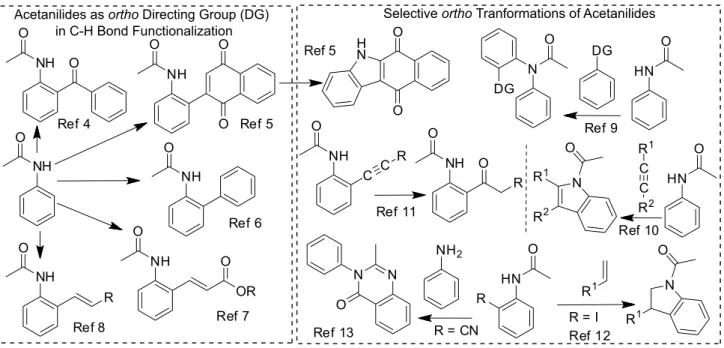
other hand, acetanilides have natural aptitude to act as ortho directing group in C−H transformations to C−C bond formation, wherein functionalized benzophenone,4
quinone,5 bisphenyl,6 or styrene7,8 derivatives can be
obtained by Pd or Rh catalysis, Figure 1. Besides, the reactivity of some ortho functional group of acetanilides is modulated by the presence of the N-acetyl moiety, which is thus selectively converted to more complex compound, constituting this kind of acetanilide into important synthetic intermediates.5,9-13
Due to the abovementioned applications, new developments in the acetylation procedure are still
desirables, and representative contributions are described, Figure 2.14-24 Furthermore, in undergraduate courses, the
parent acetanilide is extensively synthesized as classical preparation of aromatic amide.25 Therefore, we recently
developed a practical solvent-free green synthesis of such compound to experimental courses.26 However, a search in
the literature revealed that when other substituted acetanilides are needed as starting material in the context of a research project, the preparation used is very similar to that of parent acentanilide, which is almost the same of one century ago, which uses large amounts of solvents and additives such as acetic acid and sodium acetate, for instance.5-15,19-24
It should be pointed out that, although there are a few syntheses of acetanilides in the absence of solvent, it is always necessary the use of grinding or microwave heating in these previously described syntheses or, more recurrent, the use of catalyst such as morpholinium bisulfate, zirconyl triflate, tris(pentaflurophenyl)borate, anatase phase TiO2
nanoparticles, or even the unconventional rice husk ash, Figure 2.24 Despite that solvent-free catalyst’s dependent
approaches represent important contribution, more environmentally friendly procedures which reduce the use of chemicals and energy is still needed.
steps, being a green practical alternative to the current preparations. Thus, the search for an environmental benign protocol to acetamides synthesis prompted us to try the reaction of several aromatic amines using only acetic anhydride, without any solvent or additive. The method was intentionally tested to synthesize a representative set of known acetamides, allowing direct comparison to the current alternatives that employ catalyst.
Results and Discussion
The search for environmental benign protocol to acetamides synthesis prompted us to try the reaction of
several aromatic amines using only acetic anhydride, without any solvent or additive, Scheme 1.
As already mentioned, aniline 1a afforded acetanilide 3a
in almost quantitative yield.26 More importantly, several
solid and liquid substituted aromatic amines were reactive under this catalyst and solvent-free condition, and afforded the corresponding known acetanilides27 in an instantaneous
reaction (for practical reason, the reaction time of 10 s was established), and some trends emerged from the results, Scheme 1. Thus, anilines ortho, meta and para substituted were tolerated (see acetanilides 3a-h), but the presence of a strong electron-withdrawing group at ortho position precludes amide formation even under conventional
Figure 1. Representative synthetic applications of acetanilides.
(90 °C, 24 h) or microwave heating (90 °C, 10 min), and the starting amine was recovered, as indicated for 1q in the “Limitations” of Scheme 1. Probably, the association of the strong electron-withdrawing character of nitro group, and the steric hindered environment in the ortho position should preclude acetylation. However, the presence of such group was tolerated in anilines with at least one electron-releasing group at the aromatic ring (compare 3i and 1r). Chemioselective N-acetylation in the presence of OH group was observed to anilines 1c and 1l, albeit in modest yield to this latter. The low yield of 3l in relation to 3c should
be due to the 1,4-relationship between hydroxyl and nitro substituents, which may increase the intensity of the intramolecular hydrogen bonding between ortho positioned groups H2N···HO, and thus decrease the nucleophilicity
of the amino group. However, amine 1s did not afford the corresponding acetanilide, being recovered. This fact is in contrast with the work of Pahari and co-workers,17 which
successfully synthesized the corresponding acetanilide of 3-hydroxy-aniline using acetonitrile as acylating reagent.
The presence of two moderated electron-withdrawing groups in the aromatic ring was possible, but yield was
decreased when one such group is ortho positioned (compare 3j and 3k), and acetanilide was not formed with
1t. Furthermore, naphthylamine and bisamines were very effective in this transformation, once that acetanilides 3m-p
were isolated in excellent yields, Scheme 1.
To expand the potential of developed catalyst-free and solventless acetamide synthesis, a representative set of heterocyclic amines were evaluated, Scheme 2. In this way, when 2-aminothiazole was reacted with acetic anhydride, N-thiazole-2-yl-acetamide 5a had formed in same modest yield described in the literature.14 To our delight, under
the solvent-free condition, known N-benzothiazole-2-yl-acetamides 5b-c were obtained in excellent yields.14,28
However, with other heterocyclic amines indicated in Scheme 2, no amide formation was detected, and the amines were recovered. For 2-aminopyridine 4e, microwave heating (90 °C, 1 min) was also inefficient.
Contrary to aromatic amines indicated in the present study, the catalyst-free and solventless condition was not effective to butylamina 6a and ethylamine 6b. Considering
the low boiling points of amines 6a (78 °C) and 6b (16.6 °C) as compared to cyclohexylamine 6c (134 °C), and the observed exothermic dissolution in acetic anhydride, amines 6a-b should be volatilized under open flask reaction condition. Therefore only with 6c the acetylation afforded
7 in 77% yield, Scheme 3.29
In a complementary way, due to our interest in the synthetic applications of enaminones as building block to heterocycles,30 representative compounds 8a-c were
tentatively acetylated, but no reaction was observed at room temperature. Hence, microwave heating was applied, which allowed exclusive formation of N-acylated enaminone 9
from ethyl 3-amino-2-butenoate 8a in yield improved when compared to that previously obtained with acid chloride.31 However, here again, no reaction was observed
to enaminones 8b-c, Scheme 3.
Conclusions
We developed a fast, practical solvent-free, and
eco-Scheme 2. Heterocyclic acetamides.
friendly alternative protocol to access synthetically and biological important acetanilides in good yields, whereby substitution at aromatic ring was tolerated, including bisamines, and the substrate scope could be extended to N-benzothiazole-2-yl-acetamides in a simple way. In contrast of current methods, no additive or catalyst was necessary, being the greener approach of the investigated N-acetylation.
Experimental
Melting points were determined on a Microquímica MQAPF 301 hot plate apparatus and are uncorrected. Infrared spectra were recorded as KBr discs on Shimadzu IR Affinity-1 instrument. Nuclear magnetic resonance (NMR) spectra were obtained for 1H at 500 MHz and
for 13C at 125 MHz using a Bruker Avance III 500
spectrometer. Chemical shifts are reported in ppm units downfield from reference (internal TMS or residual deuterated solvent). Microwave heating reactions were performed in a CEM Discover SP using the 10 mL Pyrex pressure vial for closed vessel reactions, under the indicated power automatically to reach and maintain the set temperature, specified in each case, with infrared (IR) temperature control and medium stirring speed using cylindrical stir bars (10 × 3 mm), default ramp time of 10 minutes. When the reaction was done in under microwave heating, this is indicated.
General procedure for the synthesis of acetamides 3a-p,
5a-d, and 7
To a 10 mL round bottom flask was added 0.5 mmol of the amine and 0.1 mL of acetic anhydride. The reaction is instantaneous and exothermic, and after 10 s the solid product formed was filtered and washed with cold water. When no solid was immediately formed, 4 mL of cold water was added, and the mixture allowed standing in a refrigerator for 24 h, leading to precipitation. To all synthesized acetamides, measured physical data were in agreement to the reported values.17-19,27,31,32
N-(o-Tolyl)acetamide (3b)
White solid, 51.5 mg, 71% yield; m.p. 108.4-109.0 °C (Lit.27 108-109 °C); IR (KBr) n / cm-1 3291, 1647, 1587,
1527, 1458, 1369, 1271, 1116, 1039, 933, 854, 756, 698, 651, 607; 1H NMR (500 MHz, CDCl
3) d 2.19 (s, 3H, CH3),
2.30 (s, 3H, CH3), 7.10 (t, 1H, J 7.5 Hz, CH), 7.21 (t,
1H, J 8.0 Hz, CH), 7.71 (d, 1H, J 8.0 Hz, CH); 13C NMR
(125 MHz, CDCl3) d17.8, 24.2, 123.7, 125.4, 126.7, 129.7,
130.5, 135.6, 168.6.
N-(2-Hydroxyphenyl)acetamide (3c)
Brown solid, 98.6 mg, 95% yield; m.p. 206.5-207.4 °C (Lit.27 207 °C); IR (KBr) n / cm-1 3402, 3084, 1658, 1595,
1544, 1456, 1369, 1330, 1284, 1242, 1201, 1107, 1039, 842, 765, 667; 1H NMR (500 MHz, DMSO-d
6) d 2.28 (s,
3H, CH3), 6.73 (td, 1H, J 8.0, 1.5 Hz, CH), 6.83 (dd, 1H,
J 8.0, 1.5 Hz, CH), 6.93 (td, 1H, J 8.0, 1.5 Hz, CH), 7.44 (dd, 1H, J 8.0, 1.0 Hz, CH), 9.27 (brs, 1H, NH), 9.7 (brs, 1H, OH); 13C NMR (125 MHz, DMSO-d
6) d 24.1, 116.4,
119.4, 122.8, 125.1, 126.9, 148.3, 169.5.
N-(2-Chlorophenyl)acetamide (3d)
White solid, 60.3 mg, 72% yield; m.p. 87.9-88.1 °C (Lit.27 87.9-88.5 °C); IR (KBr) n / cm-1 3244, 3043, 1662,
1589, 1533, 1473, 1438, 1367, 1301, 1126, 1060, 1033, 966, 941, 848, 754, 725, 696, 648; 1H NMR (500 MHz,
CDCl3) d 2.24 (s, 3H, CH3), 7.04 (tl, 1H, J 8.0 Hz, CH),
7.26 (td, 1H, J 8.5, 1.0 Hz, CH), 7.35 (dd, 1H, J 8.0, 1.0 Hz, CH), 7.71 (brs, 1H, NH), 8.32 (dl, 1H, J 8.0 Hz, CH);
13C NMR (125 MHz, CDCl
3) d 24.8, 121.8, 122.7, 124.7,
127.7, 129.0, 130.5, 134.6, 168.4.
N-(3-Nitrophenyl)acetamide (3e)
Yellow solid, 67.5 mg, 76% yield; m.p. 150.8-151.4 °C (Lit.27 152-153 °C); IR (KBr) n / cm-1 3304, 3261, 3194,
3130, 3095, 1674, 1645, 1598, 1550, 1529, 1477, 1425, 1369, 1350, 1325, 1294, 1261, 1163, 1078, 1016, 983, 887, 823, 808, 742, 711, 603; 1H NMR (500 MHz, CDCl
3)
d 2.26 (s, 3H, CH3), 7.52 (t, 1H, J 8.5 Hz, CH), 7.56 (brs,
1H, CH), 7.99-7.97 (m, 2H, CH), 8.37 (brs, 1H, NH);
13C NMR (125 MHz, CDCl
3) d 24.6, 114.4, 118.9, 125.4,
129.9, 138.9, 168.6.
N-(4-Nitrophenyl)acetamide (3f)
Yellow solid, 76.5 mg, 86% yield; m.p. 212.9-213.9 °C (Lit.27 212-213 °C); IR (KBr) n / cm-1 3302, 3277, 1683,
1618, 1597, 1568, 1504, 1404, 1348, 1332, 1303, 1269, 1178, 1112, 1006, 848, 750, 686, 601; 1H NMR (500 MHz,
CDCl3) d 2.24 (s, 3H, CH3), 7.44 (brs, 1H, NH), 7.69 (d,
2H, J 9.0 Hz, CH), 8.21 (d, 2H, J 9.0 Hz, CH); 13C NMR
(125 MHz, CDCl3) d 24.8, 118.9, 125.1, 143.6. 168.7.
N-(4-Chlorophenyl)acetamide (3g)
Gray solid, 62.4 mg, 75% yield; m.p. 177.3-177.8 °C (Lit.27 177-178.5 °C); IR (KBr) n / cm-1 3304, 3263, 3192,
1670, 1608, 1541, 1489, 137, 1315, 1236, 1170, 1089, 1008, 821, 750, 707; 1H NMR (500 MHz, CDCl
3) d 2.20 (s,
3H, CH3), 7.22 (brs, 1H, NH), 7.30 (d, 2H, J 8.5 Hz, CH),
7.47 (d, 2H, J 8.5 Hz, CH); 13C NMR (125 MHz, CDCl 3)
N-(4-Methoxyphenyl)acetamide (3h)
Gray solid, 61.6 mg, 76% yield; m.p. 126.2-127.3 °C (Lit.27 126-128 °C); IR (KBr) n / cm-1 3444, 1651, 1604,
1562, 1512, 1465, 1411, 1369, 1319; 1H NMR (500 MHz,
CDCl3) d 2.1 (s, 3H, CH3), 3.80 (s, 3H, OCH3), 6.86 (d,
2H, J 8.5 Hz, CH), 7.40 (d, 2H, J 8.5 Hz, CH), 7.49 (brs, 1H, NH); 13C NMR (125 MHz, CDCl
3) d 24.3, 55.5, 114.1,
122.0, 131.0, 156.4, 168.4.
N-(4-Methoxy-2-nitrophenyl)acetamide (3i)
Yellow solid, 80.4 mg, 78% yield; m.p. 117.8-118.9 °C (Lit.27 118 °C); IR (KBr) n / cm-1 3475, 1705, 1627, 1581,
1512, 1458, 1365, 1319, 1288, 1249, 1149, 1072, 1033, 921, 871, 844, 790, 759, 632; 1H NMR (500 MHz, CDCl
3)
d 2.26 (s, 3H, CH3), 3.85 (s, 3H, OCH3), 7.64 (s, 1H, CH),
7.22 (d, 1H, J 8.5 Hz, CH), 8.62 (d, 1H, J 8.5 Hz, CH), 10.02 (brs, 1H, NH); 13C NMR (125 MHz, CDCl
3) d 25.4,
55.9, 108.5, 123.4, 123.9, 128.5, 154.9, 168.8.
N-(2,4-Dichlorophenyl)acetamide (3j)
Gray solid, 40.1 mg, 40% yield; m.p. 143.6-144.7 °C (Lit.27 144-145 °C); IR (KBr) n / cm-1 3456, 1666, 1585,
1523, 1473, 1384, 1300, 1253, 1145, 1099, 1056, 1010, 964, 945, 860, 817, 767, 690, 663; 1H NMR (500 MHz,
CDCl3) d 2.2 (s, 3H, CH3 ), 7.22 (dd, 1H, J 8.5, 2.0 Hz,
CH), 7.36 (d, 1H, J 2.0 Hz, CH), 7.56 (brs, 1H, NH), 8.31 (d, 1H, J 7.5 Hz, CH); 13C NMR (125 MHz, CDCl
3) d 24.8,
122.4, 127.9, 128.7, 133.4, 168.2.
N-(3,4-Dichlorophenyl)acetamide (3k)
Brown solid, 98.4 mg, 98% yield; m.p. 122.4-123.4 °C (Lit.27 121.9-123.3 °C); IR (KBr) n / cm-1 3417, 1666, 1589,
1531, 1473, 1388, 1365, 1307, 1257, 1126, 1014, 871, 813, 721, 678, 609; 1H NMR (500 MHz, CDCl
3) d 2.17 (s, 3H,
CH3 ), 7.29-7.35 (m, 2H, CH), 7.66 (brs, 1H, CH), 7.72
(brs, 1H, NH); 13C NMR (125 MHz, CDCl
3) d 24.5, 119.1,
121.6, 127.5, 130.5, 132.8, 137.4, 168.7.
N-(2-Hydroxy-5-nitrophenyl)acetamide (3l)
Brown solid, 54.9 mg, 56% yield; m.p. 270.2-271.3 °C (Lit.27 271-272 °C); IR (KBr) n / cm-1 3417, 1658, 1589,
1539, 1500, 1423, 1334, 1292, 1080, 1026, 945, 894, 821, 748, 682, 640; 1H NMR (500 MHz, DMSO-d
6) d 2.12 (s,
3H, CH3), 6.99 (d, 1H, J 9.0 Hz, CH), 7.86 (dd, 1H, J 9.0,
2.5 Hz, CH), 8.90 (d, 1H, J 2.5 Hz, CH), 9.41 (brs, 1H, NH), 11.50 (brs, 1H, OH); 13C NMR (125 MHz, DMSO-d
6)
d 24.3, 108.7, 113.5, 113.6, 115.1, 116.9, 120.9, 127.3, 139.6, 134.2, 169.8.
N-(Naphthalen-1-yl)acetamide (3m)
Purple solid, 80.1 mg, 87% yield; m.p. 158.8-159.5 °C
(Lit.27 159-160 °C); IR (KBr) n / cm-1 3429, 1654, 1546,
1504, 1427, 1342, 1280, 1018, 960, 775, 721, 605; 1H NMR
(500 MHz, CDCl3) d 2.24 (s, 3H, CH3), 7.39-7.48 (m, 3H,
CH), 7.67 (dl, 1H, J 8.0 Hz, CH), 7.77-7.8 (m, 4H, CH);
13C NMR (125 MHz, CDCl
3) d 24.1, 121.0, 121.6, 125.6,
125.9, 126.0, 128.6, 134.1, 169.2.
N,N’-(1,2-Phenylene)diacetamide (3n)
Brown solid, 75.2 mg, 80% yield; m.p. 188.3-189.1 °C (Lit.27 188.2-188.7 °C); IR (KBr) n / cm-1 3232, 3024, 1666,
1610, 1535, 1462, 1367, 1313, 1111, 1035, 972, 765, 713, 680, 605; 1H NMR (500 MHz, CDCl
3) d 2.08 (s, 6H, CH3),
7.14-7.17 (m, 2H, CH), 7.27-7.29 (m, 2H, CH ), 8.44 (brs, 2H, NH); 13C NMR (125 MHz, CDCl
3) d 23.7, 125.5,
126.1, 130.6, 169.9.
N,N’-([1,1’-Biphenyl]-4,4’-diyl)diacetamide (3o)
Gray solid, 131.1 mg, 98% yield; m.p. 326.2-326.7 °C (Lit.27 325 °C); IR (KBr) n / cm-1 3290, 1658, 1597, 1577,
1519, 1396, 1365, 1319, 1284, 1176, 1111, 1006, 817, 752, 663; 1H NMR (500 MHz, CDCl
3) d 2.30 (s, 6H, CH3), 7.42
(d, 4H, J 8.5 Hz, CH), 7.50 (d, 4H, J 8.5 Hz, CH), 9.28 (brs, 1H, NH); 13C NMR (125 MHz, CDCl
3) d 29.7, 115.4,
115.5, 120.2, 126.8, 127.3, 127.7.
N,N’-(3,3’-Dimethyl-[1,1’-biphenyl]-4,4’-diyl)diacetamide
(3p)
Gray solid, 143.6 mg, 97% yield; m.p. 313.1-314.3 °C (Lit.27 312 °C); IR (KBr) n / cm-1 3278, 1654, 1649,
1583, 1516, 1490, 1431, 1365, 1317, 1284, 1128, 1039, 1018, 950, 867, 819, 709, 659, 613; 1H NMR (500 MHz,
DMSO-d6) d 2.06 (s, 3H, CH3), 2.24 (s, 3H, CH3), 7.40 (dl,
1H, J 8.0 Hz, CH), 7.47 (m, 2H, CH), 9.29 (s, 1H, NH);
13C NMR (125 MHz, DMSO-d
6) d 18.5, 23.8, 124.3, 125.6,
128.7, 132.1, 136.2, 136.7, 168.7.
N-(Thiazol-2-yl)acetamide (5a)
Yellow solid, 61.0 mg, 43% yield; m.p. 201.7-202.1 °C (Lit.28 202-203 °C), IR (KBr) n / cm-1 3448, 1689,1566,
1427, 1369, 1296, 1230, 1168, 1068, 1041, 995, 972, 875, 821, 779, 709, 659, 628; 1H NMR (500 MHz, CDCl
3) d2.34
(s, 3H, CH3), 6.99 (d, 1H, J 3.5 Hz, CH), 7.44 (d, 1H,
J 3.5 Hz, CH), 12.58 (brs, 1H, NH); 13C NMR (125 MHz,
CDCl3) d 23.1, 135.0, 136.1, 160.3, 168.1.
N-(Benzothiazol-2-yl)acetamide (5b)
White solid, 90.2 mg, 94% yield; m.p. 182.3-183.2 °C (Lit.28 182-183 °C), IR (KBr) n / cm-1 3448, 1693, 1604,
1546, 1446, 1369, 1269, 1076, 1049, 999, 860, 759, 725, 675, 628; 1H NMR (500 MHz, CDCl
3) d 2.28 (s, 3H, CH3),
(d, 1H, J 8.0 Hz, CH), 7.85 (d, 1H, J 8.0 Hz, CH), 11.44 (brs, 1H, NH); 13C NMR (125 MHz, CDCl
3) d23.5, 120.4,
121.6, 124.1, 126.4, 131.9, 147.8, 159.7, 168.8.
N-(6-Methylbenzothiazol-2-yl)acetamide (5c)
White solid, 94.8 mg, 92% yield; m.p. 224.3-224.7 °C (Lit.28 225 °C); IR (KBr) n / cm-1 3196, 1691, 1606, 1541,
1460, 1365, 1288, 1267, 1247, 1224, 1041, 993, 873, 812, 723, 657; 1H NMR (500 MHz, CDCl
3) d 2.26 (s, 3H, CH3),
2.48 (s, 3H, CH3), 7.25 (d, 1H, J 8.5 Hz, CH), 7.63 (s, 1H,
CH), 7.64 (d, 1H, J 8.5 Hz, CH), 11.90 (brs, 1H, NH);
13C NMR (125 MHz, CDCl
3) d 21.4, 23.5, 119.9, 121.5,
127.9, 132.0, 134.1, 145.6, 159.3, 168.8.
N-(6-Methoxybenzothiazol-2-yl)acetamide (5d)
Brown solid, 93.2 mg, 84% yield; m.p. 229.1-229.7 °C (Lit.28 228-229 °C); IR (KBr) n / cm-1 3406, 1689, 1604,
1550, 1477, 1438, 1369, 1284, 1265, 1215, 1060, 1029, 898, 848, 813, 725, 702, 624; 1H NMR (500 MHz, CDCl
3)
d 2.28 (s, 3H, CH3), 3.87(s, 3H, OCH3), 7.04 (d, 1H,
J 8.0 Hz, CH), 7.30 (s, 1H, CH), 7.64 (d, 1H, J 8.0 Hz, CH), 10.21 (brs, 1H, NH); 13C NMR (125 MHz, CDCl
3) d 23.4,
55.9, 104.4, 115.3, 121.1, 133.3, 142.2, 156.9, 168.1.
N-Cyclohexylacetamide (7)
White solid, 54.4 mg, 77% yield; m.p. 101.5-102.3 °C (Lit.32 101-103 °C); IR (KBr) n / cm-1 3288, 3088, 2931,
2852, 1714, 1643, 1633, 1556, 1446, 1373, 1315, 1255, 1153, 1129, 981, 891, 736, 607, 551; 1H NMR (500 MHz,
CDCl3) d 1.05-1.15 (m, 3H, CH2), 1.26-1.35 (m, 2H, CH2),
1.56-1.60 (m, 1H, CH2), 1.65-1.69 (m, 2H, CH2), 1.85-1.90
(m, 2H, CH2), 1.92 (s, 3H, CH3), 3.67-3.73 (m, 1H, CH2),
5.89 (brs, 1H, NH); 13C NMR (125 MHz, CDCl
3) d 23.5,
24.9, 25.5, 33.1, 48.2, 169.2.
Synthesis of ethyl (Z)-3-acetamidobut-2-enoate(9)
To a 10 mL Pyrex pressure vial for closed vessel for microwave heating reaction, was added 0.5 mmol of the enaminone 6a and 0.1 mL of acetic anhydride. The mixture was subjected to heating in a CEM Discover SP reactor at 90 °C and 200 W for 1 minute, with IR temperature control and medium stirring speed using cylindrical stir bars (10 × 3 mm), default ramp time of 10 min. After this time, the mixture was cooled to room temperature and then 4 mL of distilled water was added. After cooling in the refrigerator the solid product was filtered and washed with cold water, resulting in 56.6 mg of white crystals of 9, 66% yield; m.p. 61.8-62.2 °C (Lit31 63-65 °C); IR (KBr) n / cm-1
3224, 3074, 2978, 2929, 1712, 1639, 1500, 1475, 1440, 1385, 1274, 1288, 1176, 1064, 1029, 983, 839, 783, 663,
605; 1H NMR (500 MHz, CDCl
3) d 4.87 (d, J 1.0 Hz, NH),
4.14 (q, 2H, J 7.0 Hz, CH2), 2.36 (d, 3H, J 1.0 Hz, CH3),
2.12 (s, 3H, CH3), 1.26 (t, J 7.0 Hz, 3H, CH3); 13C NMR
(125 MHz, CDCl3) d 14.2, 21.8, 25.2, 59.8, 96.4, 155.0,
168.9, 169.2.
Supplementary Information
Supplementary information (IR, 1H NMR and 13C NMR
spectra for 3a-q, 5a-d, and 9) is available free of charge at http://jbcs.sbq.org.br as PDF file.
Acknowledgments
The authors gratefully acknowledge the financial support of Conselho Nacional de Desenvolvimento Científico e Tecnológico (CNPq) and Fundação de Amparo à Pesquisa do Estado da Bahia (FAPESB). We also thank CAPES for a Postdoctoral fellowship to L. L. B. S., and a research fellowship to S. C.
References
1. Candeias, N. R.; Branco, L. C.; Gois, P. M. P.; Afonso, C. A. M.; Trindade, A. F.; Chem. Rev. 2009, 109, 2703.
2. Brahmachari, G.; Banerjee, B.; Curr. Green Chem. 2015, 2, 274.
3. Simplicio, A. L.; Clancy, J. M.; Gilmer, J. F.; Molecules2008,
13, 519.
4. Luo, F.; Yang, J.; Li, Z.; Xiang, H.; Zhou, X.; Eur. J. Org. Chem.
2015, 11, 2463 and references herein cited.
5. Moon, Y.; Jeong, Y.; Kook, D.; Hong, S.; Org. Biomol. Chem.
2015, 13, 3918.
6. Hubric, J.; Himmler, T.; Rodefeld, L.; Ackermann, L.; Adv. Synth. Catal. 2015, 357, 474.
7. Ackermann, L.; Wang, L.; Wolfram, R.; Lygin, A.; Org. Lett.
2012, 14, 728; Herman, G.; Becker, P.; Bolm, C.; Angew. Chem. Int. Ed. 2015, 54, 7414.
8. Takahama, Y.; Shibata, Y.; Tanaka, K.; Chem. Eur. J. 2015, 21, 9053; Wen, J.; Wu, A.; Chen, P.; Zhu, J.; Tetrahedron Lett. 2015,
56, 5282.
9. Li, G.; Jia, C.; Chen, Q.; Sun, K.; Zhao, F.; Wu, H.; Wang, Z.; Lv, Y.; Chen, X.; Adv. Synth. Catal. 2015, 357, 1311. 10. Stuart, D.; Bertrand-Laperle, M.; Burgess, K.; Fagnou, K.;
J. Am. Chem. Soc. 2008, 130, 16474.
11. Zhang, Z.; Wu, L.; Liao, J.; Wu, W.; Jiang, H.; Li, J.; Li, J.;
J. Org. Chem. 2015, 80, 7594.
12. Tasker, S.; Jamison, T.; J. Am. Chem. Soc. 2015, 137, 9531. 13. Marinho, E.; Proença, M.; Synthesis 2015, 47, 1623.
14. Wang, X.; Yang, Q.; Liu, F.; You, Q.; Synth. Commun. 2008,
15. Dulla, B.; Vijayavardhini, S.; Rambau, D.; Anuradha, V.; Rao, M.; Pal, M.; Curr. Green Chem. 2014, 1, 73; Yadav, J.; Narsaiah, A.; Basak, A.; Goud, P.; Sreenu, D.; Nagaiah, K.; J. Mol. Catal.
2006, 255, 78; Alleti, R.; Perambuduru, M.; Samantha, S.; Reddy, P.; J. Mol. Catal. 2005, 226, 57.
16. Chikkukapalli, A.; Aavula, K. S.; Mona, N. P. R.; Karthikeyan, C.; Kumar, C. H. V.; Sulur, M. G.; Sumathi, S.; Tetrahedron Lett. 2015, 56, 3799.
17. Saikia, U. P.; Hussain, F. L.; Suri, M; Pahari, P.; Tetrahedron Lett. 2016, 57, 1158.
18. Xie, S.; Fukumoto, R.; Ramstrom, O.; Yan, M.; J. Org. Chem.
2015, 80, 4392.
19. Jeyakumar, K.; Chand, D.; J. Mol. Catal. A 2006, 255, 275. 20. Moghadam, M.; Tangestaninejad, S.; Mirkhani, V.;
Mohammadpoor-Baltork, I.; Babaghanbari, M.; Zarea, M.; Shariati, L.; Taghavi, S. A.; J. Iran. Chem. Soc. 2009, 6, 523. 21. Balaskar, R. S.; Gavade, S. N.; Mane, M. S.; Shingare, M. S.;
Mane, D. V.; Green Chem. Lett. Rev. 2011, 4, 91.
22. Tajbakhsh, M.; Hosseinzadeh, R.; Alinezhad, H.; Rezaee, P.; Tajbakhsh, M.; Lett. Org. Chem. 2013, 10, 657.
23. Prajapti, S. K.; Nagarsenkar, A.; Babu, B. N.; Tetrahedron Lett.
2014, 55, 1784.
24. Shirini, F.; Akbari-Dadamahaleh, S.; Mohammad-Khah, A.;
Phosphorus Sulfur Silicon Relat. Elem. 2014, 189, 577. 25. Reeve, W.; Lowe, V. C.; J. Chem. Educ.1979, 56, 488; Cardinal,
P.; Greer, B.; Luong, H.; Tyagunova, Y.; J. Chem. Educ. 2012,
89, 1061; Merat, L. M. O. C.; Gil, R. A. S.; Quim. Nova 2003,
26, 779; Saba, S.; Ciaccio, J. A.; J. Chem. Educ. 2016, 93, 945. 26. Cunha, S.; Costa, O. B. S.; Santana, L. L. B.; Lopes, W. A.;
Quim. Nova 2015, 38, 874.
27. Fors, B. P.; Dooleweerdt, K.; Zeng, Q.; Buchwald, S. L.;
Tetrahedron 2009, 65, 6576; Epishina, M. A.; Kulikov, A. S.; Ignatâ, N. V.; Schulte, M.; Makhova, N. N.; Mendeleev Commun. 2010, 20, 335; Bedford, R. B.; Haddow, M. F.; Mitchell, C. J.; Webster, L. R.; Angew. Chem. Int. Ed. 2011,
50, 5524; Wan, X.; Ma, Z.; Li, B.; Zhang, K.; Cao, S.; Zhang, S.; Shi, Z.; J. Am. Chem. Soc. 2006, 128, 7416; Fors, B. P.; Krattiger, P.; Strieter, E.; Buchwald, S.; Org. Lett. 2008, 10, 3505; Owsley, D. C.; Bloomfield, J.; Synthesis 1977, 2, 118;
Eshghi, H.; Hassankhani, A.; Mossadegh, E.; J. Chem. Res.
2006, 2006, 218; Kalyani, D.; Dick, A.; Anani, Q.; Sanford, M.; Tetrahedron 2006, 62, 11483; Roeder, C. H.; Day, A. R.; J. Org. Chem. 1941, 6, 25; Marcinkiewicz, S.; Green, J.; Mamalis, P.; Tetrahedron 1961, 14, 208; Fierz-David, H. E.; Kuster, W.;
Helv. Chim. Acta 1930, 22, 82; Schmidt, B.; Berger, R.; Holter, F.; Org. Biomol. Chem. 2010, 8, 1406; Ingold, C. K.; Ingold, E. H.; J. Chem. Soc. 1926, 1310; Yang, Y.-H.; Cheng, M.-S; Wang, Q.-H; Nie, H.; Liao, N.; Wang, J.; Chen, H.; Eur. J. Med. Chem.
2009, 44, 1808; Willstaedt, H.; Justus Liebigs Ann. Chem. 1932,
500, 61.
28. Nayak, P. S.; Narayana, B.; Jasinski, J. P.; Yathirajan, H. S.; Kaur, M.; Acta Crystallogr. E 2013, 69, 1622; Takahashi, T.;
Yakugaku Zasshi 1949, 69, 398; Pandeya, S. N.; Yadav, M.; Mishra, V.; Asian J. Chem. 2011, 23, 3003; Wang, X.; Yang, Q.; Liu, F.; You, Q.; Synth. Commun. 2008, 38, 1028. 29. Rosen, T.; Lico, I.; Chu, D.; J. Org. Chem. 1988, 53, 1580. 30. Cunha, S.; Santana, L. L. B.; J. Braz. Chem. Soc. 2014, 25,
1311; Cunha, S.; Santos, A. O.; Correia, J. T. M.; Sabino, J. R.; Tetrahedron 2014, 70, 3284; Cunha, S.; Santos Filho, R. F.; Saraiva, K. H.; Azevedo-Santos, A. V.; Menezes, D.;
Tetrahedron Lett. 2013, 54, 3366; Cunha, S.; Gomes, A. T.;
Tetrahedron Lett.2012, 53, 6710; Cunha, S.; Oliveira, C. C.; Sabino, J. R.; J. Braz. Chem. Soc. 2011, 22, 598; Cunha, S.; Damasceno, F.; Ferrari, J.; Tetrahedron Lett. 2007, 48, 5795; Cunha, S.; Bastos, R. M.; Silva, P. O.; Costa, G. A. N.; Vencato, I.; Lariucci, C.; Napolitano, H. B.; Oliveira, C. M. A.; Kato, L.; Silva, C. C.; Menezes, D.; Vannier-Santos, M. A.; Monatsh. Chem. 2007, 138, 111; Cunha, S.; Silva, V. C.; Napolitano, H. B.; Lariucci, C.; Vencato, I.; J. Braz. Chem. Soc. 2003, 14, 2007; Cunha, S.; Rodovalho, W.; Azevedo, N.; Mendonça, M. O.; Lariucci, C.; Vencato, I.; J Braz. Chem. Soc. 2002, 13, 629; Cunha, S.; Kascheres, A.; J. Braz. Chem. Soc. 2001, 12, 481. 31. Shabana, R.; Rasmussen, J.; Lawesson, S.; Bull. Soc. Chim.
Belg. 1981, 90, 75.
32. Barluenga, J.; Jimenz, C.; Yus, M.; J. Chem. Soc. 1981, 14, 670.