Short Report
S
J. Braz. Chem. Soc., Vol. 22, No. 2, 359-363, 2011.Printed in Brazil - ©2011 Sociedade Brasileira de Química 0103 - 5053 $6.00+0.00
*e-mail: [email protected]
Acetalization of Hexanal with 2-Ethyl Hexanol Catalyzed by Solid Acids
Alessandro O. Barros, Aline T. Faísca, Elizabeth R. Lachter,* Regina S. V. Nascimento and Rosane A. S. San Gil
Instituto de Química, Universidade Federal do Rio de Janeiro, Av. Athos da Silveira Ramos 149, CT, Bloco-A, 617, Cidade Universitária, 21949-900 Rio de Janeiro-RJ, Brazil
A atividade catalítica de sólidos ácidos como o fosfato de nióbio e a Amberlyst 35, uma resina trocadora de íons, foi avaliada na acetalização do hexanal com 2-etil-hexanol. Foram avaliadas a concentração do catalisador e a temperatura de reação na conversão do hexanal. A possibilidade de re-utilização do fosfato de nióbio também foi estudada e evidenciou ser possível re-utilizar este catalisador sem perda da atividade. O rendimento em acetal foi acima de 90% em condições brandas de reação.
The catalyst activity of solid acids such as niobium phosphate and Amberlyst 35, an ion exchange resin, was evaluated in the acetalization of hexanal with 2-ethyl-hexanol. The catalyst loading and the reaction temperature were evaluated in the hexanal conversions. The possibility of recycling niobium phosphate was also studied, showing that it was possible to reuse this catalyst without signiicant loss in its catalytic activity. The yield in acetal was above 90% under mild conditions.
Keywords: acetalization, acetals, niobium phosphate, acid solids, Amberlyst 35
Introduction
The acetalization reaction is a process intensely used in organic synthesis to protect the carbonyl group of ketones and aldehydes and it is of great synthetic utility.1-3 Acetals
are prepared by the reaction of aldehydes (or ketones) with alcohols (or orthoformates) in the presence of an acid catalyst.1-4 Most of the acetalization process is the reaction
of carbonyl compounds with ethylene glycol in the presence of an appropriate catalyst.1,5
Acetal derived compounds have been used as a solvent in fragrance industries, cosmetics, food and beverage additives, pharmaceuticals, in the synthesis of enantiomerically pure compounds, and in polymer chemistry.6,7 Acetals have been also used in motor
oils, lubricating oils and hydraulic luids. Hille et al.,8
have evaluated various acetals as more biodegradable continuous phase in an invert-emulsion for off-shore drilling petroleum operations. Good results were achieved when the acetals of the 2-ethyl-hexanol were used. Recently our research group has evaluated alkyl acetals as invert-emulsions drilling luids.9 The alkyl acetals were
synthesized through acid catalysis using p-toluenesulfonic acid as catalyst.9
Acid catalysts include corrosive protic acids such as hydrochloric acid (HCl), sulfuric acid (H2SO4) and p-toluenesulfonic acid. These homogeneous catalysts present limitations because of their toxicity, corrosiveness and non-reusability, the dificulty of the work-up procedure, and the resulting environmental pollution. Heterogeneous catalysts, on the other hand, presents easy work-up, high product purity, and the possibility of recycling catalysts and does not involve the use of dangerous substances.10
Various heterogeneous catalysts have been employed in acetalization reactions, such as zeolite,11,12 clays,7 sulfonic
resins,13,14 mesoporous aluminosilicate,15 Al(HSO 4)3,
5
SBA-15,16 and CeCl 3.
17
Considering solid catalysts with Brønsted acid sites, niobium based systems are potentially interesting. Niobium phosphate has a texture, acidic sites (Brønsted and Lewis) and catalytic properties similar to niobium oxide, but it has the advantage of conserving these properties at higher pretreatment temperatures.18 Our group has been evaluating
niobium catalysts19 in benzylation and alkylation reactions
best of our knowledge, the use of niobium phosphate as catalysts for acetalization reactions has not been reported until now. Therefore the objective of this work is to report the performance of niobium phosphate and a comparison with Amberlyst 35 and p-toluenesulfonic acid in the acetalization reaction of hexanal with 2-ethyl-hexanol to prepare alkyl acetal to be used in drilling luid research.
Experimental
Materials
Niobium phosphate (NbP), supplied by CBMM (Companhia Brasileira de Metalurgia e Mineração, Araxá, Brazil), was dried and activated at 300 oC for
2 h. Ion exchange resin, Amberlyst 35 (conceded by Rohm and Haas) was dried at 105 oC on vacuum for 12 h
before use. Hexanal (Acros), 2-ethyl-hexanol (VETEC), p-toluenesulfonic acid (VETEC) and chloroform (VETEC) were used without further puriication.
Surface area
The BET surface areas and pore volumes of the niobium catalysts were determined from nitrogen adsorption isotherms at the normal boiling temperature of liquid nitrogen. The adsorption isotherms were obtained in a micromeritics ASAP (accelerated surface area and porosimetry), model 2010.
XRD
The niobium phosphate was characterized by X-ray powder diffraction (XRD) collected on a Minilex Rigaku using CuKα radiation. The samples were scanned over the angular range 8-38o (2θ), with a step size of 0.04o and a
scan rate of 1 s per step.
FTIR
Infrared (FTIR) spectra of niobium phosphate and the acetalization product were recorded by a FTIR spectrometer (Nicolet Protegé) in the spectral range 4000-400 cm-1 using
potassium bromide (KBr) pressed disks.
General acetalization procedure
The reaction was carried out in a 25 mL round-bottom two necked lask outitted with a condenser and a septum for sample removal. In a typical run, hexanal (8 mmol, 0.8 g) and 2-ethyl-hexanol (64 mmol, 8.32 g) were added
to the activated catalyst (0.05 g) previously transferred to the reaction lask. The reaction mixture was magnetically stirred at atmospheric pressure and heated by means of a constant temperature bath (60 oC) and at room temperature
(25 oC). All the reactions were performed without solvent.
The degree of hexanal conversion was analyzed periodically by gas chromatography (GC) (VARIAN, 3800). The products were also identified by GC MS (HP5890 series II/HP5972 series, respectively), Fourier transform infrared (FTIR) and proton nuclear magnetic resonance (1H NMR).
Analytical procedure
The variations of the substrate, hexanal and product contents (hexylaldehyde di-2-ethyl-hexyl acetal) were carried using a VARIAN model 3800 gas chromatograph equipped with a hydrogen lame ionization detector system and a capillary column (VA-5, 30 m, 0.32 mm i.d. 1 µm d.f). The temperature was programmed from 40 to 280 oC with
hydrogen (H2) as the carrier gas at a rate of 2 mL min-1.
Aldehyde conversion was calculated taking into account the response factor which was determined experimentally.
The identification of the products obtained in the acetalization reaction was carried out by gas chromatography mass spectrometry analysis (GC MS) on a HP 6890, utilizing a DB-5 (30 m) fused silica column at the same temperature conditions with helium (He) as the carrier gas.
FTIR spectra of reaction products were determined on a Magna-IR 760, NICOLET. Nuclear magnetic resonance spectra were recorded on a BRUKER DRX-200 (200 MHz for 1H). 1H chemical shifts (d) in CDCl
3 are given from
internal tetramethylsilane (TMS).
Typical procedure for preparation of hexylaldehyde di-2-ethyl-hexyl acetal catalysed by p-toluenesulfonic acid under relux conditions
The reaction was carried out in a 25 mL round-bottom two necked lask outitted with a condenser and a septum for sample removal. In a typical run, hexanal (8 mmol, 0.8 g), 2-ethyl-hexanol (64 mmol, 8.32 g) and chloroform (10 mL) were added to the p-toluenesulfonic acid (0.16 mmol, 0.027 g). The reaction mixture was magnetically stirred at atmospheric pressure and heated to relux by means of a constant temperature bath (60 oC). A Dean Stark apparatus
was used in order to remove the water formed along the reactions’ process.8 Chloroform was chosen, despite its poor
azeotrope with water, to maintain the reaction temperature below 70 oC as described in the literature.8,9 In this case
completion of the reaction (monitored by CG for conversion and selectivity) the sample was washed with water, and the organic phase (acetal) was dried with magnesium sulfate and submitted to distillation to remove the chloroform and the alcohol. The yield was 98%. Spectroscopic data of hexylaldehyde-di-2-ethylhexyl acetal, IR (KBr)
νmax/cm-1 2958-2800 (s) (−CH stretching), 1128 and 1047
(s) (C−O, stretching). 1H NMR (200 MHz, CDCl
3) d 0.89
(t, 4 Hz,15H), 1.37 (m, 22H), 1.6 (m, 4H), 3.3 (m, 2H), 3.45 (m, 2H), 4.42 (t, 6 Hz, 1H).
Results and Discussion
Table 1 reports characterization and acidity data of the heterogeneous catalysts used in the acetalization reaction.
The commercial niobium phosphate presents reasonable value of speciic area, 138 m2 g-1 and lower acidity than
Amberlyst 35.
The data obtained by XRD analysis showed that the niobium phosphate used in this work was amorphous.21-24
The IR spectrum of the niobium phosphate show a strong band due to the asymmetric vibration stretching mode of phosphate ion with a maximum at 1010 cm-1. An additional
strong band is found at 620 cm-1 in agreement with the
spectrum of niobic acid, which could be due to Nb−O stretching modes.20,21 Py-FTIR characterization of the
niobium phosphate indicated the presence of Brønsted acid sites (BAS) and Lewis acid sites (LAS) as shown in previous works.21,24 The concentration of Lewis and
Brønsted sites in commercial niobium phosphate was
Table1. Surface areas and acidity of the catalysts
Catalyst S (m2 g-1) Aciditya (mmol g-1)
Amberlyst 35 50 5.2a
Niobium phosphate 138 0.24b
aAmount of SO
3H on the surface. Data informed by the producer; btotal
acidity measured by n-propylamine adsorption at 423 K.21,24
evaluated by FTIR of pyridine adsorbed at different temperatures in a previous paper.20 Weak sites are deined
as the ones from which pyridine is removed by evacuation at 423 K; the medium strength corresponds to evacuation between 473 and 573 K and the strong sites remain adsorbing pyridine after evacuation at 673 K. The niobium phosphate has a large amount of medium (11.63 mmol g-1)
than weak (2.89 mmolg-1) or strong (1.81 mmol g-1) BAS.20
The reaction of hexanal with 2-ethyl-hexanol is presented in Scheme 1. The reaction mixture (hexanal with 2-ethyl-hexanol) was magnetically stirred at atmospheric pressure over the acid solids without solvent. The reaction catalyzed by p-toluenesulfonic acid a Dean Stark apparatus was used in order to remove the water formed along the reaction process.8 In the effect of the molar ratio of hexanal/
alcohol, the calcinations temperature of the niobium phosphate, the reaction temperature and reutilization of the catalysts were also studied.
Acetalization reaction catalyzed by Amberlyst 35
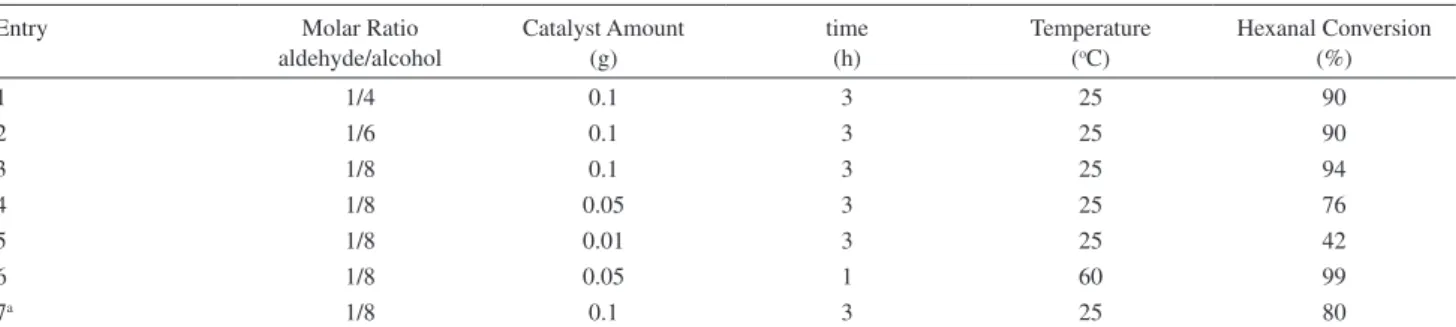
The results obtained in the reaction over Amberlyst 35 are presented in Table 2.
The results have shown that in the reaction at room temperature, an increase in molar ratio aldehyde/alcohol no signiicantly increase the hexanal conversion (entries 1, 2 and 3) after 3 h.
The effect of the catalyst loading in the conversion of the hexanal to hexylaldehyde di-2-ethyl-hexanol is shown in Table 2 (entries 3, 4 and 5). The overall reaction rate was found to increase along with the increase of the catalyst loading in the range employed in this work. An increase in the catalyst loading results in an increase in the number of Bronsted sites, which leads to the formation of a protonated hexanal per unit of time and increases the reaction rate.
The acetalization of hexanal with 2-ethyl-hexanol was carried at temperature of 60 oC and room temperature
(solvent free conditions). The results show (Table 2,
entries 4 and 6) that increases in the reaction temperature result in an increase in the conversion of the hexanal in the hexylaldehyde di-2-ethyl-hexanol and a total conversion was obtained after 1 h. The re-utilization of Amberlyst 35 was evaluated at room temperature and the results have shown that the conversion decreased after the second utilization (Table 2, entries 3 and 7).
Acetalization reaction catalyzed by niobium phosphate
The effect of the activation temperature of niobium phosphate was evaluated in the conversion of the aldehyde in acetal (Figure 1) using a amount of 0.05 g of the catalyst. The temperature had varied from 150 to 300 oC. The
reactions were carried at the temperature of 60 oC.
We verified that an increase in the calcination temperature results in an increase in the conversion of the hexanal. The best results were achieved at a temperature of 300 oC. In this case the increase of calcination temperature
removed the water present in the catalyst and increases the acid sites strength.18,21
The effect of reaction temperature was evaluated and the results were presented in Table 3.
Table 2. Acetalization of hexanal with 2-ethyl hexanol over Amberlyst 35
Entry Molar Ratio
aldehyde/alcohol
Catalyst Amount (g)
time (h)
Temperature (oC)
Hexanal Conversion (%)
1 1/4 0.1 3 25 90
2 1/6 0.1 3 25 90
3 1/8 0.1 3 25 94
4 1/8 0.05 3 25 76
5 1/8 0.01 3 25 42
6 1/8 0.05 1 60 99
7a 1/8 0.1 3 25 80
aRe-utilization.
Figure 1. Effect of calcination temperature of niobium phosphate on the acetalization reaction. Conditions: hexanal/alcohol (1/8), temperature = 60 oC, 0.05 g of catalyst; 300 oC, 250 oC, 200 oC,
150 oC.
When the reaction was carried out at lower temperature, the conversion was above 88% (Table 3, entry 3) after 300 min. The selectivity in acetal product was 100% in all cases. Following a worldwide trend of the development of green catalysts, the reutilization of phosphate niobium in acetalization reactions (Table 3, entries 3 and 4) is possible at solvent free condition. The reutilization of the catalyst keeps the conversion of the reaction at 84%.
The reaction catalyzed by p-toluenosulfonic acid was carried out at relux temperature of solvent as described in the literature.8,9 The yield in hexylaldehyde
di-2-ethyl-hexayl acetal was 98% after 1 h.
The comparison of the three catalysts is presented in Table 4. The use of niobium phosphate as catalyst results in higher turnover number than p-toluenesulfonic acid and sulfonic acid resin.
Acetalization occurs in the presence of Brønsted acids. The protonation of the oxygen atom on the carbonyl group by an acidic site from the catalytic surface of niobium
Table 3. Acetalization of hexanal with 2-ethyl hexanal over niobium phosphatea, effect of reaction temperature
Entry Temperature (oC)
Catalyst amount (g)
Hexanal Conversion (%)
1 60 0.05b 100
2 60 0.025c 100
3 25 0.5d 88
4e 25 0.5d 84
aNiobium phosphate calcinated at 300 oC; b3 h; c4,h; d5 h and ere-utilization.
Table 4. Acetalization of hexanal with 2-ethyl hexanal over niobium phosphate and Amberlyst 35 catalysts
Catalyst Catalyst Amount (g)
Hexanal conversion (%)
TONa
Niobium Phosphateb,c 0.025 98 1306
Amberlyst 35c 0.05 99 30.5
phosphate can be considered the initial step that enables a subsequent nucleophilic attack by an alcohol molecule. After hemiacetal formation it could be protonated, losing water and suffering a new nucleophilic attack by the alcohol. The loss of a proton from the surface of the catalyst yields the acetal. Although the number of acid sites of niobium phosphate are lower compared with Amberlyst 35, the former presented sites with acid strength of H0≤ 8.2 as described by Martins et al.25 The ion exchange resin present
lower acid strength (H0≤ 2.2).26
Shimizu et al.,27 studied the acetalization of different
carbonyl compounds with ethylene glycol over solids acids. They compared the catalytic activity of zeolites, clay, sulfonic acid functionalized mesoporous silica and the sulfonic resin Amberlyst 15. The results showed better yield in acetal with the sulfonic acid functionalized mesoporous silica. In the reaction of octanal with ethylene glycol and toluene as solvent, the aldehyde conversion was 99% after 3 h. The resin Amberlyst 15 showed lower rate and the authors related this result to the low accessibility of the reactant to the acid sites inside the resin that presented lower speciic area than mesoporous silica. Another factor that could affect the acetalization reaction is the strength of the Bronsted acid sites. Although the Amberlyst 15 presented large number of acid sites (4.8 mmol g-1) than mesoporous silica (0.43 mmol g-1)
the latter was more eficient for acetalization reaction. They conclude that the number of acid sites per gram of the catalyst is not necessarily for acetal formation and the high activity of the silica should be due the strong Brønsted acid sites inside the mesopore and higher speciic areas.27
In this work the higher performance of niobium phosphate compared with Amberlyst 35 could be due to the acid strength of the Brønsted acid sites and the higher speciic area of the former in accordance with the results reported by Shimizu et al.27
Conclusions
The present work demonstrates that niobium phosphate is a highly effective and re-usable catalyst for the acetalization of hexanal with 2-ethyl-hexanol under mild conditions in solvent free conditions.
Acknowledgments
The authors would like to thank the CNPq and ANP for their inancial support.
References
1. Whitesel, J. K.; Chem. Rev. 1989, 89, 1581.
2. Nieddu, E.; Cataldo, M.; Pinna, F.; Strukul, G.; Tetrahedron Lett. 1999, 40, 6987.
3. Green, T. W.; Wuts, P. G. M.; Protective Group in Organic Synthesis; John Wiley and Sons: New York, 1999.
4. Wiles, C.; Watts, P.; Haswell, S. J.; Tetrahedron 2005, 61, 5209. 5. Mirjalili, B. F.; Zoligol, A. M.; Bamoniri, C. A.; Hazar, A.;
J. Braz. Chem. Soc. 2005, 16, 877.
6. Capeletti, M. R.; Balzano, L.; Puentes, G. M.; Appl. Catal., A 2000, 198, L1.
7. Thomas, B.; Prathapan, S.; Sugunan, S.; Microporous Mesoporous Mater. 2005, 80, 65.
8. Hille, M.; Wittkus, H.; Scholz, H. J.; Weinelt, F.; US pat. 5,759,963 1998.
9. Barros, A. O.; Procedings of the IVPDPETRO 2007. http:// www.portalabpg.org.br/PDPetro/4/resumos/4PDPETRO_2_2_ 0074-1.pdf, accessed in January 2010 (text in Portuguese). 10. Ballini, R.; Bosica, G.; Frullanti, B.; Raimondo, M.; Giovanni,
G.; Sartori, S.; Schroer, F.; Tetrahedron Lett. 1999, 39,1615. 11. Thomas, B.; Sugunan, S.; J. Porous Mater. 2006, 13, 99. 12. Da Silva, C. X. A.; Gonçalves, V. L. C.; Mota, C. J. A.; Green
Chem. 2009, 11, 38.
13. Gelbard, G.; Ind. Eng. Chem. Res. 2005, 44, 8468.
14. Mahajani, S. M.; Kolah, A. K.; Sharma, M. M.; React. Funct. Polym. 1995, 28, 29.
15. Robinson, M. W.; Graham, A. E.; Tetrahedron Lett. 2007, 48, 4727. 16. Mayoral, E. P.; Martin-Aranda, R. M.; Lopez-Peinado, A. J.;
Ballesteros, P.; Zukal, A.; Cejka, J.; Top. Catal. 2009, 52, 148. 17. Silveira, C. C.; Mendes, S. R.; Ziembowiscz, F. I.; Lenardão,
E. J.; Perin, G.; J. Braz. Chem. Soc. 2010, 21, 371. 18. Nowak, I.; Ziolek, M.; Chem. Rev. 1999, 99, 3603.
19. De la Cruz, M. H. C.; Abdel-Rehim, M. A.; Rocha, A. S.; Da Silva, J. F. C.; Faro, A. C.; Lachter; E. R.; Catal. Commun. 2007, 8, 1650.
20. Rocha, A. S, Forrester A. M. S; De la Cruz M. H. C.; Da Silva C. T.; Lachter, E. R.; Catal. Commun. 2008, 9, 1959. 21. Pereira, C. C. M.; Lachter, E. R.; Appl. Catal., A 2004, 266, 67. 22. De la Cruz, M. H. C.; Da Silva, J. F. C.; Lachter, E. R.; Catal.
Today 2006, 118, 379.
23. Pereira, C. C. M.; De La Cruz, M. H. C.; Lachter, E. R.; J. Braz. Chem. Soc. 2010, 21, 367.
24. de la Cruz, M. H. C;; da Silva, J. F. C.; Lachter, E. R.; Appl. Catal. A 2003, 245, 377.
25. Martins, R. L.; Schitina, W. J.; Castro, F. R.; Catal. Today 1989, 5, 483.
26. Olah, G. A.; Prakash, G. K. S.; Sommer, J.; Superacid, Wiley: New York, 1985.
27. Shimizu, K.; Hatamachi, T.; Kodama, T.; Higuchi, Y.; Satsuma A.; Kitayama, Y.; J. Catal. 2005, 231, 131.
Submitted: March 21, 2010