Roseli La Corte dos SantosI
Arnaldo da Silva FayalII
Antonio Edvaldo F AguiarII
Durval Bertran Rodrigues VieiraII
Marinete Marins PóvoaIII
I Laboratório de Parasitologia. Departamento de Morfologia. Universidade Federal de Sergipe. São Cristovão, SE, Brasil II Departamento de Controle de Endemias.
Secretaria de Estado da Saúde do Pará. Belém, PA, Brasil
III Instituto Evandro Chagas. Ananindeua, PA, Brasil
Correspondence: Roseli La Corte dos Santos Laboratório de Parasitologia
Departamento de Morfologia da Universidade Federal de Sergipe
Av Marechal Rondon s/nº, Rosa Elze 49100-000 São Cristovão, SE, Brasil E-mail: [email protected]
Received: 24/2/2006 Reviewed: 15/9/2006 Approved: 18/1/2007
Evaluation of the residual effect
of pyrethroids on
Anopheles
in
the Brazilian Amazon
ABSTRACT
OBJECTIVE: To evaluate the residual effect of pyrethroids on the mortality rates of Anopheles in order to check their effi cacy in indoor residual spraying in the Amazon Region, Brazil.
METHODS: The study was conducted in public housing unities in the city of Belem, Northern Brazil, in 2003. Twelve houses were randomly chosen, three in each of the four established areas. Pyrethroids cypermethrin wettable powder, deltamethrin suspension concentrate, lambda-cyhalothrin wettable powder, and etofenprox wettable powder, were sprayed on the indoor wall surface of local houses. Their effects on the mortality of Anopheles were assessed from July to November. Wall bioassay was performed using plastic cones attached to insecticide and wild mosquitoes from the town of Peixe Boi.
RESULTS: Mortality rate varied according to the type of wall that received the insecticide. Those inseticides applied to wood and non-plastered brick surfaces were more stable and lasted longer. Lambda-cyhalothrin presented shorter effect than the other insecticides, and Etofenprox had residual effects up to four months and was more effective in non-plastered brick surfaces. There was no statistical difference between the effect of deltamethrin and cypermethrin in all surfaces tested, and the duration of the residual effect was satisfactory up to three months after spraying.
CONCLUSIONS: Deltamethrin and Etofenprox presented grater performance when compared to the others. For these insecticides and formulations, a three- month interval between successive applications can be considered safe. In communities with predominance of houses with plastered brick surfaces, the smaller effectiveness of formulations should be considered, together with the importance of residual spraying as a vector control method in the area.
KEYWORDS: Anopheles. Insecticides, administration & dosage. Vector control. Malaria. Pyrethroids. Residual effect. Insecticides.
INTRODUCTION
Indoor spraying of insecticides is one of the main activities performed for vector control in areas with very high incidence of malaria, leishmaniasis, and Chagas’ disease. Since the 90’s, pyrethroids have been the choice to replace dichloro-diphenyl-trichloroethane (DDT) in spraying of houses in areas with high incidence of malaria in the Amazon.
Publications on insecticides recommended by World Health Organization (WHO) for spraying, indicates that the residual effects of pyrethroids last between two to six months. Such a variation of the time makes it diffi cult to plan fi eld activities, including the amount of product to be bought and the need to better defi ne the cycles.
Purchase of pyrethroids to control malaria by the Brazilian Ministry of Health started in 1996, and until 2003, cypermethrin wettable powder (WP) was most commonly used in residual applications.* In experi-ments conducted by the Fundação Nacional de Saúde (FUNASA – Management of Vector Control of National Health Foundation)** an 80% mortality was found after 60 days of cypermethrin application to unpainted wood surfaces. However, in treated surfaces, painted wood, mud, painted brick walls or lime coated, the mortality rates oscillated at 50% after 30 days, but this test was conducted in a few houses. This pilot essay, pointed out the need for repeating the experiment with a greater number of houses, to provide scientifi c support to the National Program on Malaria Control regarding the duration of spraying cycles of pyrethroids.
In this context, the present study was performed aiming at providing information to guide spraying actions. The objective was to assess the duration of residual effect of pyrethroids: cypermethrin, deltamethrin, etofenprox and lambda-cyhalothrin on the mortality of Anopheles in human houses in the urban area.
METHODS
The study was conducted in the public housing unity of Canarinho, in Belém, State of Pará, in 2003. This district had 829 houses, 85% were plastered with adobe, and 15% were made of wood.*** There was no history spraying in the area. We have chosen to perform the study in normal occupation conditions of the houses so the results would express the action of insecticides in real use condition. After mapping, the district was divided into quadrants, called A, B, C, and D. For each quadrant a type of insecticide was randomly chosen as follows: A= lambda-cyhalothrin, B=deltamethrin, C=etofenprox, and D=cypermethrin. For each of the four areas three plastered mud brick house, three unplastered mud-brick wall houses, and three wood houses were randomly chosen for follow-up. Over the study, some houses were replaced, because of refusal to take part in the study, or the house was closed or being redone. In these cases, that houses which was nearest and most similar to the excluded one was included for follow-up.
Pyrethroids such as cypermethrin WP 125 mg a.i./m2,
deltamethrin suspension concentrate (SC) 25 mg a.i./m2,
lambda-cyhalothrin WP 30 mg a.i./m2, and etofenprox
WP 200 mg a.i./m2 were applied to internal walls of
hous-es, each in one day, for 4 days in a row. Hudson X-Pert compression sprayer was used equipped with nozzle tip 8002-E. To ensure suitable application, eight technicians of the team received technical update one week prior to the study. Application was supervised by a technician of the State Health Secretariat of the State of Para, and for an engineer of the Brazilian Ministry of Health.
Bioassays were performed according to the procedure standardized by WHO.9 Those responsible for bioassay
proof were aware of the type of insecticide applied in each quadrant. Mosquitoes undergoing bioassay which were only Anopheles female mosquitoes, were collected in the night previous to the performance of the tests, in the city of Peixe Boi. Choosing the collection site was based on the knowledge of the high density of Anopheles all year round, and on the treatment of the site without vector control activities because they are low risk for malaria. Mosquitoes were captured from 18h to 21h, in corral of buffalos, using Castro mouth aspirator.
Female collected were carried in plastic wired cups, kept in a humid chamber. In the laboratory, they were fed through cotton soaked in sugared water and were at rest until the next morning. Tests were performed for four days in a row, in the fi rst week of each month, start-ing as of 8h in the mornstart-ing. Every day three houses from each wall of the quadrants type were assessed. Bioas-says, in each house, had three plastic cones at 1.2m from the ground with approximately 20 mosquitoes each, standardized by the World Health Organization.8
A fourth cone was used as control, for each replication, protected from the sprayed wall by a piece of cardboard wrapped in white paper, replaced daily.
After one hour of exposure to treated walls, mosquitoes were transferred from the cones to clean glasses, put into humid chambers and sent to the laboratory where they were fed by cotton soaked in sugared water. The temperature in the lab was kept at 22 to 25ºC. Mortality rate was calculated 24 hours after the end of the test. All mosquitoes that could fl y were considered alive, after shaking the glass gently, regardless of the level of damage suffered. For mortality rates lower than 5% in the control group, no correction was applied. Mortal-ity rates between 5% and 20% were corrected using Abbott’s formula.10
Mortality rates were not higher than 20% in the control group. The fi rst bioassay was performed 24h after initial application of the insecticides and the following with
* Sistema de Informação de Insumos Estratégicos. Secretaria de Vigilância em Saúde. Ministério da Saúde. ** Ministério da Saúde. Programa Nacional de Controle da Malária. Unpublished data.
approximately 30-day intervals, totaling six bioassays in a fi ve month follow up. For analysis effect, mortality rates higher than 70% were established as satisfactory in the exposed group. We decided to accept means lower than 70% whose confi dence interval for the mean included this value.
Comparisons of survival rates, paired by insecticide and type of wall, were performed using Wilcoxon-Gehan’s test to establish the signifi cance level at 5% using the SPSS program.
The original project was submitted and approved by the Ethical Committee in Research of the Institute Evandro Chagas – Secretariat of Health Surveillance/Ministry of Health. Each participant was informed of the volun-teer character of the research and doubts were settled. Inhabitants gave their written consent.
RESULTS
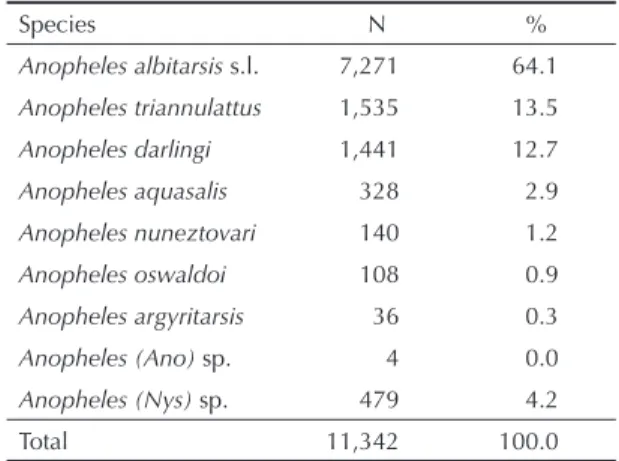
From June 2nd to November 7th, 2003, 11,342
mosqui-toes underwent wall bioassays. Predominant specie
was Anopheles albitarsis s.l., followed by Anopheles
triannulattus and Anopheles darlingi (Table).
The effect of insecticides over time was compared considering surface in which the insecticides were applied and the type of insecticide. Criteria to defi ne
maximum duration of residual effect considered if the confi dence intervals included or were above the line of 70% mortality of the exposed groups.
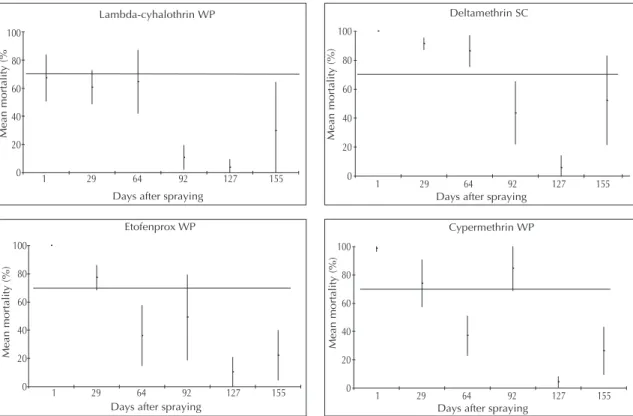
In wood surface, maximum duration of residual effect, considering confi dence intervals for the average was two months for lambda-cyhalothrin WP, three months for deltamethrin CS, four months for etofenprox WP, and one month for cypermethrin WP. In the third and fi fth month, the effect of cypermethrin increased, and it was higher than the 70%limit (Figure 1).
Lambda-cyhalothrin WP
0 20 40 60 80 100
1 29 64 92 127 155
Days after spraying
Mea
n
mortality
(%
)
Deltamethrin SC
0 20 40 60 80 100
1 29 64 92 127 155
Days after spraying
Mean
mortality
(%
)
Cypermethrin WP
0 20 40 60 80 100
1 29 64 92 127 155
Days after spraying
Mea
n
mortality
(%
)
Etofenprox WP
0 20 40 60 80 100
1 29 64 92 127 155
Days after spraying
Mea
n
mortality
(%
)
Figure 1. Mean mortality of Anopheles exposed to walls sprayed with pyrethroids. Vertical lines represent confi dence interval. Belem, Northern Brazil, 2003.
Table. Distribution of the number of mosquitoes used in wall bioassays, according to species. Belém, Northern Brazil, 2003.
Species N %
Anopheles albitarsis s.l. 7,271 64.1
Anopheles triannulattus 1,535 13.5
Anopheles darlingi 1,441 12.7
Anopheles aquasalis 328 2.9
Anopheles nuneztovari 140 1.2
Anopheles oswaldoi 108 0.9 Anopheles argyritarsis 36 0.3
Anopheles (Ano) sp. 4 0.0
Anopheles (Nys) sp. 479 4.2
Comparing mortality through survival analysis, pyre-throids lambda-cyhalothrin WP, presented shorter effect, when compared to the other pyrethroids (p<0.05), and, unlike the others, mean mortality in 24h was lower than 80%. Mortality rates of deltamethrin suspension concen-trate, cypermethrin WP, and etofenprox WP were not sta-tistically different between bioassays over time. For these three last pyrethroids, confi dence interval was huge after 60 days, when mortality reduced. Regarding lambda-cy-halothrin WP, confi dence interval was great in the fi rst bioassay and small for very low mortality rates.
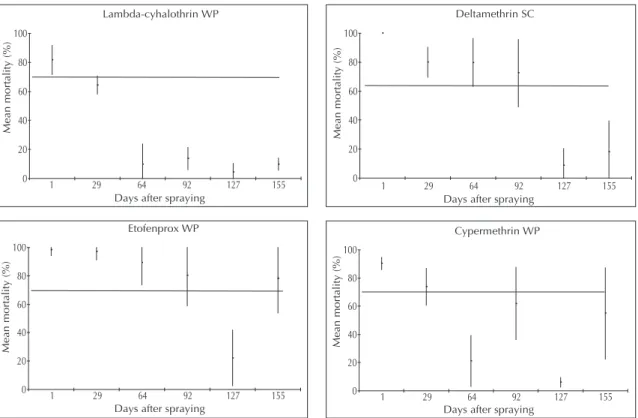
In plastered brick wall houses, maximum duration of residual effect was two months for lambda-cyhalo-thrin WP, and deltamelambda-cyhalo-thrin suspension concentrate, and one month for etofenprox WP, and cypermethrin WP, considering confi dence intervals for the average. Mortality rates presented wide variation in this type of wall. Deltamethrin SC presented satisfactory effect in the fi fth month, etofenprox SC, and cypermethrin WP in the third. Lambda-cyhalothrin WP presented shorter effect, when compared to the others (p<0.05), whereas deltamethrin had longer effect (Figure 2).
In unplastered brick walls, duration of maximum re-sidual effect was one month for lambda-cyhalothrin WP, and three months for deltamethrin SC, and etofenprox WP, considering confi dence intervals for the average. Cypermethrin WP lasted one month, however, with
variable effect, with satisfactory residuality in the third and fi fth month (Figure 3). Lambda-cyhalothrin WP presented shorter effect, when compared to the others (p<0.05), whereas etofenprox PM had longer effect.
Regarding the type of insecticide, the effect of cyperme-thrin on mortality ofAnopheles presented wide variation in all surfaces testes, as of the fi fth month after applica-tion. There was statistical difference between the dura-tion of the effect for the three types of wall (p= 0.002), and cypermethrin WP presented best performance in houses with unplastered brick walls.
Deltamethrin SC presented similar performance in all surfaces tested (p=0.202). Decrease of the effect was gradual and regular, and it lasted three months in wood, and unplastered brick surfaces.
Lambda-cyhalothrin WP presented shorter effective-ness, from three to six months, contrary to the indica-tion of WHO. Statistical difference was not found in the surfaces tested (p=0.085). Low mortality and small amplitude of confi dence intervals observed, generally after the second month, in the different houses, shows loss of insecticide activity, regardless of the surface.
Etofenprox WP was the insecticide that presented greater residuality, with mortality higher than 70% for up to four months after its application in wood surfaces. Statistical difference between mortality over time was
Lambda-cyhalothrin WP
0 20 40 60 80 100
1 29 64 92 127 155
Days after spraying
Mea
n
mortality
(%
Deltamethrin SC
0 20 40 60 80 100
1 29 64 92 127 155
Days after spraying
Mea
n
mortality
(%
)
Etofenprox WP
0 20 40 60 80 100
1 29 64 92 127 155
Days after spraying
Mea
n
mortality
(%
)
Cypermethrin WP
0 20 40 60 80 100
1 29 64 92 127 155
Days after spraying
Mea
n
mortality
(%
)
seen, considering the several surfaces (p<0.05), and the best results were obtained for wood, and unplastered brick wall. Decrease in effect was gradual over time. In unplastered brick wall, this insecticide presented satis-factory effect again in the fi fth month. However, the end of the study hindered from checking if the effect would be maintained in the following months, and residual effect could be longer than checked. In plastered brick walls, etofenprox WP had variable effect similarly to cypermethrin WP (p=0.192).
DISCUSSION
The fi rst consideration to choose the insecticide to be used in a certain situation should be its proven effectiveness on the target species and its safety for inhabitants, workers, animals, and environment. Among the insecticides recom-mended by WHO for residual indoor spraying, because of its safety and effectiveness is the group of pyrethroids.6
Susceptibility of the Brazilian species of Anopheles to cypermethrin has been annually monitored by the Secretaria de Vigilância em Saúde (Secretariat of Health Surveillance) of the Ministry of Health. Results obtained up to the moment indicate that all monitored species, An. darlingi, An. aquasalis, An. nuneztovari
and An. albitarsis sp. remained susceptible.* These
spe-cies follow susceptibility standards for pyrethroids ac-cording to what is expected for the gender of Anopheles, according to Braogdon & McAllister.2 The activity of
entomologic surveillance gives support to the continu-ity of the use of pyrethroids in Brazil and assures that eventual loss of effect would be related to operational problems or degradation of the insecticide molecule rather than the resistance phenomenon.
Some factors hinder bioassays with Anopheles. The main factor is the diffi culty to colonize, especially
An. darlingi. The use of wild mosquitoes implies the
non standardization of age of the species used and, consequently, in the possibility of interference of natural mortality in the result, as well as the different responses between young and old mosquitoes. On the other hand, populations maintained in insectaries may present alterations due to settling that may interfere in the answer of insecticides.
WHO recommends the use of wild mosquitoes in bioas-says in walls because they represent better the response of fi eld populations.9 However, the duration of the study
restricts its performance to places with high density of
Anopheles during all year round and makes it diffi cult
to select species to be tested, once there is change in density of each of them over time.
* Results presented at XXXIX Congresso da Sociedade Brasileira de Medicina Tropical, performed in Belém, PA, 16 to 21 March 2003. Etofenprox WP
0 20 40 60 80 100
1 29 64 92 127 155
Days after spraying
Mean
mortality
(%
)
Cypermethrin WP
0 20 40 60 80 100
1 29 64 92 127 155
Days after spraying
Mea
n
mortality
(%
)
Lambda-cyhalothrin WP
0 20 40 60 80 100
1 29 64 92 127 155
Days after spraying
Mean
mortality
(%
)
Deltamethrin SC
0 20 40 60 80 100
1 29 64 92 127 155
Days after spraying
Mea
n
mortality
(%
)
In the present study, the capture area of mosquitoes was productive during all period for the subgenus
Nys-sorhynchus. Of the 11,342 mosquitoes used, only four
belonged to another sub gender, and An. albitarsis s.l. was the predominant group. An. darlingi represented 12.7% of the total of mosquitoes undergoing tests. The factor that it was an animal and not human justifi es the smaller frequency of An. darlingi in the captures. There are differences in the response between the species of Anopheles to very small concentrations of pyrethroids, in micrograms, as occurs, for example, in susceptibility test.2 However, concentrations routinely
used in spraying are above the level in which these variations of susceptibility manifested. Anyhow, the results presented must be interpreted regarding control
of Anopheles, of the subgenus Nyssorhynchus, not from
any species in particular.
In addition to the sensibility of target species to insecti-cide, duration of residual effect is essential information in the use of indoor spraying. Pyrethroids indicated by WHO to that end are: alphacypermethrine, benafen-trine, cyfl uthrin, deltamethrin, etofenprox, and lambda-cyhalothrin WP, all of them with residuality estimated between two and six months.5
The importance of a more precise defi nition of the dura-tion of the residual effect is in the need for programming cycles so as the human population remains protected until a new spraying is conducted.
In the present study, we have established as a cutoff point for acceptable residual effect, mean mortality rate equal to or higher than 70%, although other works have considered as reasonable, rates higher than 50%.1,4
However, we have chosen to consider satisfactory means inferior to 70%, whose confi dence intervals reached this value. This decision took into account the fact that the study was performed in uncontrolled fi eld conditions, where many external and particular factors of the houses may interfere in the activity of the insecticide.
The amplitude of confi dence intervals for the average refl ects the variation of the effects of pyrethroids in the several houses and types of walls studied. Apart from lambda-cyhalothrin WP, all insecticides were active until the fi rst month after application, with con-fi dence intervals of small amplitude. After this period, confi dence intervals were higher, indicating variation in the effect depending on the house studied. This fact may refl ect the action of other factors on the insecti-cide activity such as temperature and humidity of the house, cleaning of wall, lightening, and ventilation, among others.
Regarding the type of wall, apart from lambda-cyhalo-thrin WP, pyrethroids showed smaller and very variable effect when applied to plastered brick walls. One of the main reasons for the loss of pyrethroids activity is the
fast absorption by porous surfaces. Concrete surfaces are also porous and the application of alkaline sub-stances in addition to plaster may degrade the molecule of the insecticide faster.3
Among the insecticides compared, those which present-ed greater performance were deltamethrin suspension concentrate and etofenprox WP, both recommended by WHO.6 Thus, these products may be considered safe
and effi cient to be used in wood walls and unplastered walls when applied in cycles every trimester.
Lambda-cyhalothrin WP presented one- or- two- month residual effect, lasting less than the other pyrethroids studied, therefore being a less favorable choice for the use in vector control programs because of the need for shorter application cycles.
In fi eld conditions, cypermethrin presented unpredict-able effect of decreasing and increasing residual effect in the three surfaces studied, which may hinder its use in residual application. Variation in the effects of pyre-throids was also noticed by other authors who studied mortality of triatominae exposed to treated surfaces.1,3
The effect of insecticides was not uniform, although spraying quality was assured by updating training of technicians, checking machines, and surveillance. Thus, in the routine of vector control where conditions may be more adverse, the effect of insecticides may be even shorter than the one recorded. Additionally, in com-munities with prevalence of plastered brick houses, the shorter effectivity of the formulations studied must be considered, as well as the importance of using residual spraying.
Assessment activities such as the one from the present study must be part of the routine of the services of vector control, as well as monitoring of the behavior of vector species. Considering that the amount of insecticides of the pyrethroids group is higher than those assessed in the present study, introducing other molecules and formulations will need new assessments so that the objective of decreasing the population of mosquitoes potentially infectious may be achieved.
AKNOWLEDMENTS
1. Arias AR, Lehane MJ, Schofi eld CJ, Fournet A. Comparative evaluation of pyrethroid insecticide formulations against Triatoma infestans (Klug): residual effi cacy on four substrates. Mem Inst Oswaldo Cruz. 2003;98:975-80.
2. Brogdon WG, Macaliister JC. Simplifi cation of adult mosquito bioassays through use of time-mortality determination in glass bottles. J Am Mosq Control Assoc. 1998;14:159-64.
3. Diotaiuti L, Pinto CT. Suscetibilidade biológica do Triatoma sordida e Triatoma infestans à deltametrina e lambdacyhalotrina em condições de campo. Rev Soc Bras Med Trop. 1991;24:151-5.
4. Dorta DM, Vasuki V, Rajavel A. Evaluation of organophosphorus and synthetic pyrethroid
insecticides against six vector mosquitoes species.Rev Saúde Pública. 1993;27:391-7.
5. Najera JA, Zaim M. Malaria vector control: insecticides for indoor residual spraying. Geneva: World Health Organization; 2001.
6. Najera JA, Zaim M. Malaria vector control: decision making criteria and procedures for judicious use of insecticides. Geneva: World Health Organization; 2003.
7. Passerat de Silans LNM, Dedet JP, Arias JR. Field monitoring of cypermethrin residual effect on the mortality rates of the phlebotomine sand fl y Lutzomyia longipalpis in the State of Paraíba, Brazil. Mem Inst Oswaldo Cruz. 1998;93:339-44.
8. World Health Organization. Resistencia a los inseticidas y lucha contra los vectores. Ginebra; 1970. (Informes técnicos n.443).
9. World Health Organization. Instructions for the bioassay of insecticidal deposits on wall surfaces VBC/81.5. Geneva; 1981.
10. World Health Organization. Report of the WHO Informal Consultation. Test procedures for inseticide resistance monitoring in malaria vectors, bio-effi cacy and persistence of insecticides on treated surfaces. Geneva; 1998.
REFERENCES