Lúcia Miana M. PaixãoI Eliane Dias GontijoII
I Gerência de Atenção à Saúde do Distrito
Sanitário Oeste. Secretaria Municipal de Saúde de Belo Horizonte. Belo Horizonte, MG, Brasil
II Departamento de Medicina Preventiva
e Social. Faculdade de Medicina. Universidade Federal de Minas Gerais. Belo Horizonte, MG, Brasil
Correspondence: Lúcia Miana M. Paixão
Av. Afonso Pena, 2336/ 9° andar –Funcionários 30130-007 Belo Horizonte, MG, Brasil E-mail: [email protected] Received: 29/9/2006 Reviewed: 16/11/2006 Approved: 19/1/2007
Profi le of notifi ed tuberculosis
cases and factors associated
with treatment dropout
ABSTRACT
OBJECTIVE: To describe the profi le of notifi ed tuberculosis cases and analyze
the factors associated with treatment dropout.
METHODS: A total of 178 cases of tuberculosis notifi ed in the western region
of Belo Horizonte (Southeastern Brazil) in 2001 and 2002 and recorded in the National System for Notifi able Diseases were described. An unmatched case-control study was conducted, with data collected by means of interviews, to compare patients who dropped out of treatment with those who achieved cure. The following variables were analyzed: sociodemographic and behavioral characteristics, associations with AIDS, side effects, information on the disease and interest in treatment. Univariate analysis and unconditional logistic regression for multivariate analysis were used. Adjusted odds ratios with 95% confi dence limits were used as the measurement for associations.
RESULTS: The coeffi cient of incidence was 56.6/100,000 inhabitants. There
was predominance of men aged 30 to 49 years and of the pulmonary form (76.4%) and bacillary form (72.5%). Among the notifi ed cases, 65.2% achieved cure, 12.4% dropped out of treatment and 9.6% died. Treatment location had no infl uence on the results. In the case-control study, there was no difference regarding gender, color, schooling, income, occupation, family support, association with AIDS and alcohol consumption. The use of drugs, interest in treatment and information about the disease were shown to be independently associated with dropout.
CONCLUSIONS: Adherence to treatment is a challenge in controlling
tuberculosis. The protection factors (interest in treatment and information about the disease) and recognition that drug use is a risk factor must form part of the strategies for patient care in order to reduce dropout rates and restore health.
KEYWORDS: Tuberculosis, epidemiology. Disease notifi cation.
Incidence. Risk factors. Case-control studies. Tuberculosis, treatment dropout.
INTRODUCTION
Although tuberculosis is preventable and treatable with low-cost and
high-ef-fi ciency medications, it has been presenting resurgence, with repercussions on cure and mortality rates.
Brazil is in tenth highest place among national tuberculosis rates. In 2001, the incidence rate for the whole country was 46.5/100,000 inhabitants, and it was 34.6 for Minas Gerais and 53.2 for Belo Horizonte.*
Treatment dropout and incomplete treatment18 favor
drug resistance and are factors that have a negative im-pact on controlling this disease. In the different regions of Brazil, the dropout rate ranges from 4.5 to 20.3%. In 2000, data from the Sistema de Informação Nacional de Agravos de Notifi cação (SINAN – National Infor-mation System for Notifi able Diseases)* showed that in the western region of Belo Horizonte only 57.2% of the cases achieved discharge because of cure, while 31.1% were notifi ed as dropouts or remained without information regarding the conclusion of treatment. These rates are far from the national targets proposed by the Ministry of Health, of 85% cure and less than 5% dropout.
The present study aimed at describing the clinical-epidemiological characteristics of notifi ed tuberculosis cases and identifying factors associated with treatment dropout, with the aim of providing backing for plan-ning interventions and improving the adherence to treatment.
METHODS
The study was developed in the western region of Belo Horizonte, Southeastern Brazil, among an estimated population of 268,698 inhabitants that is characterized by marked social contrasts: 74.6% living in districts with better access to urban facilities and 25.4% living in shantytowns.**
To identify the outcomes among cases notifi ed during the study period, the Monthly Tuberculosis Control Files were used initially. To obtain outcome informa-tion on the 18.5% of the notifi cations for which these
fi les did not give this information, steps were followed that included crossing the SINAN data with data from the Sistema de Informações sobre Mortalidade (SIM – National Mortality Information System) for 2001, 2002 and 2003, consultation with the unit responsible for notifi cations and home visits made by community health agents. This process resulted in reducing the percentage of notifi cations without outcome informa-tion to 2.8%. The undernotifi cation calculation was done according to the algorithm in the Technical Norms Manual of the Ministry of Health.
The case-control study included all the tuberculosis pa-tients aged 15 years and over for whom notifi cation was issued. The exclusion criteria were change of diagnosis and moving away to other municipalities.
Treatment dropout was considered to be situations in which the patient failed to attend a scheduled return visit and also did not appear during the next 30 con-secutive days. In supervised treatment programs, the time limit is 30 days counting from when the drug was last taken.***
The cases were taken to be the tuberculosis patients for whom notifi cations had been issued who dropped out of treatment between July 2001 and June 2002. The controls were patients for whom notifi cations were issued during the same period who were discharged due to cure. The study had a total of 50 participants, of whom 20 were cases and 30 were controls, giving a ratio of 1:1.5.
The controls utilized were living in the same neighbor-hoods, i.e. in the same area of coverage and with the same case risk. The neighborhoods were identifi ed by the vulnerability index of the Municipal Health De-partment of Belo Horizonte, by means of geocoding the addresses of cases and controls using the Mapinfo 5.0 software.
The cases and controls were directly interviewed by one of the authors, at the health unit or at home, using a semi-structured questionnaire that had previously been tested in a pilot study on four patients (two cases and two controls) for whom notifi cations were issued in July and August 2002. The interviews were arranged by telephone or by a community health agent who visited the subject at home.
The descriptive analysis of the SINAN data included epidemiological variables (age, sex and area where the home was located), clinical variables (disease type, sputum bacilloscopy and HIV serological test), treat-ment location and outcome.
This case-control study took the dependent variable to be treatment dropout and the following were explana-tory variables: sociodemographic and behavioral data – sex, color, schooling, occupation, income and high alcohol use (weekly consumption of ethanol greater than 420 g); drug use; clinical history (side effects, association with AIDS, reports of associated diseases or previous treatment, symptomatology at diagnosis, or presence of another person with tuberculosis in the fam-ily); level of information about the disease; data on the organization of the health services (treatment location, availability of medications, access to consultations and time spent waiting to be seen); and variables relating to the patient’s perception of his state of health, family
* Source: Gerência de Regulação, Epidemiologia e Informação do Distrito Sanitário Oeste/Secretaria Municipal de Saúde, Belo Horizonte, Minas Gerais, 2001.
** Prefeitura Municipal de Saúde de Belo Horizonte. Distrito Sanitário Oeste. Available from: http://portal2.pbh.gov.br/pbh/index.html?id_ conteudo=4346&id_nivel1=-1 [Accessed on Apr 15, 2002]
support, interest in treatment, reason for dropping out and stressful situations.
To calculate the incidence in conformity with guidance from the Ministry of Health,* population data from the
Instituto Brasileiro de Geografi a e Estatística (IBGE – Brazilian Institute for Geography and Statistics) was utilized together with the new-case notifi cations in SINAN, excluding duplicated cases.
The statistical analysis on the data from SINAN and the case-control study involved frequency distributions, central trend measurements and investigation of asso-ciations between explanatory variables and the response variable (dropout or cure), using Pearson’s Chi-square or Fisher’s exact test for categorical variables and Student’s t-test for continuous variables. Statistical decisions were made on the basis of the descriptive value of the test (p).
For multivariate analysis on the case-control study, to determine the independent effect of the associations, odds ratios (OR) with 95% confi dence intervals and signifi cance level of 0.05 were used. The modeling process, using non-conditional logistic regression, was performed in successive steps, beginning with the variables selected from univariate analysis (p<0.15) and
the variables of epidemiological importance. Backward elimination (one by one) was used in the modeling. To evaluate the models, the Wald test, likelihood ratio and Hosmer-Lemeshow test were used. For variables that were not shown to be associated with the outcome, the statistical power was calculated.
The database for the case-control study was stored in EpiInfo, which was also used for the statistical analysis, plus the Minitab 12 software.
The study was approved by the Research Ethics Com-mittee of the Universidade Federal de Minas Gerais (ETIC 136/03).
RESULTS
During the study period, 178 confi rmed cases of tu-berculosis were notifi ed in the western region of Belo Horizonte. Among these individuals, 65.2% were cured, 12.4% dropped out of treatment, 9.6% died (Table 1) and 10% moved away, had their diagnoses changed or were still undergoing treatment. All the patients who dropped out were between 15 and 49 years old. The incidence of tuberculosis was 56.6/100,000 inhabit-ants, with a range from 10.54 to 105.84 in the different
* Ministério da Saúde e Sociedade Brasileira de Pneumologia e Tisiologia. Controle da tuberculose: Uma Proposta de Integração Ensino-Ser-viço. Rio de Janeiro (Brasil); 2002
Table 1. Outcomes from notifi ed tuberculosis cases according to sex, age group, clinical form and location of treatment. Belo Horizonte, Southeastern Brazil, 2001-2002.
Variable
Cure Dropout Death *
p
N=116 N=22 N=17
N % N % N %
Sex
Male 83 71.6 13 59.1 13 76.5
Female 33 28.4 9 40.9 4 23.5 0.14
Age group (years)
<15 20 17.2 0 0.0 0 0.0
15-49 82 70.7 22 100.0 8 47.1
50 and over 14 12.1 0 0.0 9 52.9 0.0
Clinical form
Pulmonary 88 75.9 20 90.9 12 70.6
Extrapulmonary 24 20.7 2 9.1 3 17.6
Pulmonary + extrapulmonary 4 3.4 0 0.0 2 11.8 0.23
Location of treatment
Within the area of coverage 54 46.6 12 54.5 4 23.5
Outside of the area of coverage 62 53.4 10 45.5 13 76.5 0.13
Source: SINAN (Sistema de Informação sobre Agravos de Notifi cação - National System for Notifi able Diseases) / Brazilian Ministry of Health - 2001/2002
1). The location of treatment had no infl uence on the outcomes of cure, dropout and death (p>0.05). With regard to the case-control study, among the 22 patients (cases) who dropped out of treatment, 20 (91%) were interviewed. Two cases were not included in the study: one because this person was not known at the address on the notifi cation record and the other by recommendation from the management of the primary health care unit, because this person was involved in drug traffi cking. The 30 eligible controls all participated in the study.
Figure 2 shows that the main reasons for dropping out, according to the patients’ perceptions, were drug or alcohol use (30%) and clinical improvement (25%). The profile of the participants in the case-control study was similar to the profi le of the cases notifi ed in SINAN, with predominance of males (64%) of mean age 35.5 years and median age of 33 years; 88% of the cases were among individuals aged 15 to 49 years. The most frequent form of the disease was pulmonary (75%), accounting for 78.9% of the adult with the bacillus. Furthermore, the cases were seen to be pre-dominantly among non-whites (78%) with less than eight years of schooling (74%), and half of them were living with a per capita income of less than or equal to half a minimum salary. It was observed that 36% were unemployed and almost all of them (92%) reported a family connection.
The mean age (31.1 years) and mean family income (2.3 minimum salaries) were lower among the cases (p<0.05). Univariate analysis (Table 2) indicated that self-reported occupation, interest in treatment, level of information about the disease, drug consumption and occurrence of side effects were shown to be associated with treatment dropout. Regarding the interviewees’ perceptions about their state of health, it was found that those who considered their state of health to be bad were ten times more likely to drop out of treatment, with a dose-response gradient (p=0.004).
There was no difference between the cases and con-trols in relation to gender, color, schooling, alcohol use, stress, reports of associated diseases or previous treatment, symptomatology at diagnosis, presence of another person with tuberculosis in the family, or family support.
Among the variables related to the organization of the health services, it was found that the location of treatment, availability of medications, access to con-sultations and time spent waiting to be seen were not associated with dropout (p>0.05).
The modeling process was started with the variables selected from the univariate analysis: age, occupation, areas of coverage. The estimated undernotifi cation was
7%. The cases notifi ed to SINAN were predominantly among males (69.7%) with a mean age of 34.4 and median age of 32.5 years. The most frequent form of the disease was pulmonary (76.4%), accounting for 72.5% of the adults with the bacillus, followed by extrapul-monary forms (19.1%), which were seen particularly among individuals over the age of 50 years.
Among the 41% with blood tests for HIV, it was found that 12.9% were seropositive, without differences in the clinical form of tuberculosis (p>0.05).
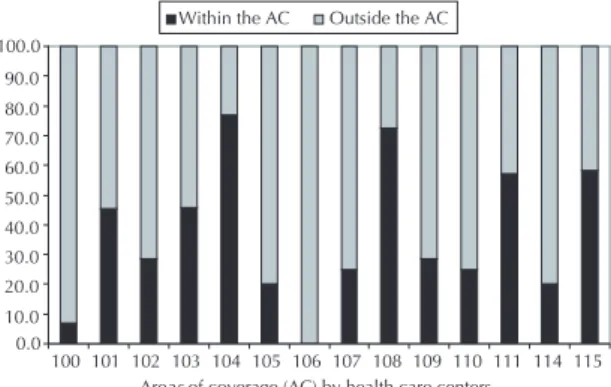
Most of the notifi ed cases (57%) were attended outside of the residential areas covered, mainly in reference hospitals (28.7%) and outpatient clinics (27.1%). The responsibility taken by the health centers for caring for tuberculosis was unequal, ranging from zero to 77% of the people living in their areas of coverage (Figure
Did not like the location of treatment
5%
Lack of food and discomfort caused by treatment
15%
Due to drug and/or alcohol use
30%
Thought that was already cured
25%
Violence -neeeded to escape
5%
Did not believe the treatment
5%
Did not believe that had TBC
5%
Afraid to lose the job
5%
Unemployment -other priorities
5%
Figure 2. Main reasons for dropping out according to tuber-culosis patient’s perception. Belo Horizonte, Southeastern Brazil, 2001-2002.
0.0 10.0 20.0 30.0 40.0 50.0 60.0 70.0 80.0 90.0 100.0
100 101 102 103 104 105 106 107 108 109 110 111 114 115 Areas of coverage (AC) by health care centers
Within the AC Outside the AC
Figure 1. Distribution of notifi ed tuberculosis cases under-going treatment, according to residential areas covered by health care centers. Belo Horizonte, Southeastern Brazil, 2001-2002.
alcohol use, drug use, family income, side effects from medications prescribed in the treatment, number of pre-vious treatments, family support during treatment, inter-est in treatment, state of health and level of information about the disease. The association with AIDS (p=0.20) was included because of its relevance in other studies. The variables that were shown to be signifi cant (p<0.05) were tested in a new model and, because of the
epi-demiological importance, it was decided to keep the variable of alcohol use in the model. This ended up excluded from the fi nal model through the results from the Wald test (p=0.184).
The fi nal model defi ned (Table 3) included the variables of drug use, interest in treatment and level of informa-tion about the disease, all of which showed statistical adequacy (Hosmer-Lemeshow test > 0.05).
Table 2. Personal characteristics, habits, association with AIDS, side effects, location of treatment, information and interest in treatment among the cases (patients who dropped out of tuberculosis treatment) and controls. Belo Horizonte, Southeastern Brazil, 2001- 2002.
Variable Cases Controls OR 95% CI
N % N %
Sex
Male 13 65.00 19 63.30 1.08 0.28;4.13
Female 7 35.00 11 36.70 1.00
Color
Non-white 16 80.00 23 76.70 1.22 0.26;6.04
White 4 20.00 7 23.30 1.00
Schooling
< 8 years of schooling 16 80.00 21 70.00 1.71 0.38;8.16
> 8 years of schooling 4 20.00 9 30.00 1.00
Occupation *
With occupation 13 65.00 28 93.30 0.13 0.02;0.73
Without occupation 7 35.00 2 6.70 1.00
Alcohol use
Yes 5 25.00 2 6.70 4.67 0.67;40.14
No 15 75.00 28 93.30 1.00
Drug use *
Yes 11 55.00 5 16.70 6.11 1.66;22.50
No 9 45.00 25 83.30 1.00
Side effects *,**
Yes 14 73.70 12 40.00 4.20 1.03;18.07
No 5 26.30 18 60.00 1.00
Association with AIDS
Yes 3 15.00 1 3.30 5.12 0.41;138.94
No 17 85.00 29 96.70 1.00
Location of treatment
Within the area of coverage 11 55.00 14 46.67 1.40 0.39;5.09
Outside of the area of coverage 9 45.00 16 53.33 1.00
Interest in treatment *
Yes 12 60.00 29 96.70 0.05 0.01;0.46
No 8 40.00 1 3.30 1.00
Information about the disease *
Yes 12 66.70 27 90.00 0.22 0.05;1.04
No 6 33.30 3 10.00 1.00
Calculation of the statistical power of the non-signifi -cant variables that nevertheless had epidemiological rel-evance indicated that the lack of association may have occurred because of the sample size (sample power for alcohol use = 45%; for association with AIDS = 31.7%; and for loss of employment or income = 45.1%).
DISCUSSION
The choice of the western region for this research was based on the relevance of this area regarding the occurrence of tuberculosis cases in Belo Horizonte (12% of the cases in 2001), the accessibility of the data and the feasibility of the fi eldwork. Although the case-control study was performed with 91% of the treat-ment dropouts notifi ed, it may not have had suffi cient sample size to detect associations with some variables, among which alcohol use and association with AIDS. The care taken in qualifying the database, the search for information on outcomes and the application of a standardized form by a single interviewer contributed towards obtaining reliable data and internal validity for this study.
The high percentage of records without data on the outcome shows negligence in notifying this disease. On the other hand, the subsequent reduction to 2.8% proves that epidemiological surveillance cannot be passive: it requires systematic contacts with the units and sometimes patients need to be approached in their homes.
The rate of incidence was similar to what was estimated for Belo Horizonte in 2001. The wide variability in the distribution of cases, reaching levels of up to twice the coeffi cient of incidence for the region in the areas with
greater vulnerability indices, reveals coherence with the social causes of this disease.
Rich countries present coefficients of less than 10/100,000 inhabitants, with higher incidence among immigrants, people living in the streets, ethnic minori-ties, HIV-positive individuals, users of injectable drugs and elderly people, particularly those living in old peo-ples’ homes.13,17,19,21 Russia, with a rate of 95/100,000
inhabitants in 2000,19 and Spain,5 with 38.5/100,000
inhabitants, present epidemiological patterns differing from other industrialized countries. In southeast Asia and India, the coeffi cient of incidence may reach 200-400/100,000 inhabitants.16
The treatment dropout in the study location was similar to the rate of 12.9% that was estimated for Brazil in 2001,1 and does not meet the Ministry of Health’s target.
The organization of the health services and better qual-ity of care have been indicated as factors of relevance for diminishing treatment dropout.* Greater care, both from the services and for the adults responsible for children may explain the absence of dropout among children under 15 years of age.
The predominance of cases among men confi rms the profi le observed in uncontrolled studies on tubercu-losis.12 The greater frequency of the pulmonary form
coincides with fi ndings from Brazil** and the United States.21
Almost all of the care was provided within the public network. However, a high percentage of the individu-als were seen outside of the coverage area, despite the recommendations for decentralization of care. Such guidance is aimed particularly towards implement-ing supervised treatment. Although the literature has
Table 3. Final model for multivariate analysis on the outcome (cure or dropout) from tuberculosis treatment. Belo Horizonte, Southeastern Brazil, 2001-2002.
Variable Case
N
Control N
Unadjusted odds ratio
Adjusted
odds ratio 95% CI Wald Z
Drug use
Yes 11 5 6.11 7.12 1.38;6.81 2.34
No 9 25 1 1
Information about the disease
Yes 12 27 0.22 0.11 0.02;0.69 -2.35
No 6 3 1 1
Interest in treatment
Yes 12 29 0.05 0.03 0.00;0.30 -2.93
No 8 1 1 1
* Ministério da Saúde e Sociedade Brasileira de Pneumologia e Tisiologia. Controle da tuberculose: Uma Proposta de Integração Ensino - Serviço. Rio de Janeiro (Brasil); 2002
indicated* that there is a lower dropout rate when the individuals live in an area linked to a health center, in the present study the location of treatment (within the coverage area or outside of it) did not infl uence the dropouts.
The differences in the responsibility and control over patients taken by the health centers, which theoretically have the same infrastructure available, indicate the diffi culties of team working and suggest the need for better capacitation or performance among professionals with greater sensitivity and commitment, such that they would be able to care for almost all the local patients at that health care unit. Tuberculosis control could in this way function as a marker for the quality of the service provided at the unit, thus translating the compliance with the protocol and the team’s competence level. The fragility of the care provided was also shown by the low percentage of patients who had undergone serological tests for HIV detection. Although well established,** the recommendation that HIV detection tests should be performed in tuberculosis cases was implemented in the cases of less than half of the patients, with the aggravating factor that AIDS was the principal cause of death among the patients.
Another fact that indicated inadequate control over the disease was the high percentage of young adults with the bacillus, which indicated the occurrence of recent transmission.*** This epidemiological pattern differs from what is found in countries where the disease is under better control and the elderly population is most affected, consequent to exposure in the past.17
To this end, the implementation of the Family Health Program in Belo Horizonte and the computerization of the healthcare units in the western region of the municipality are expected to improve the control over this endemic disease, thus facilitating effective imple-mentation of supervised treatment. As recommended by the World Health Organization (WHO) and by the Ministry of Health, tuberculosis control has been taken up as a target by the Municipal Health Department of Belo Horizonte.
With regard to the case-control study, drug use was confirmed as an important factor associated with treatment dropout.3,* The reasons for dropping out, as
perceived by patients, that have been reported in the literature include the feeling that they are getting better, alcohol or drug use and discomfort with the treatment, including side effects in this.8,***
The level of information about the disease and interest in treatment were shown to be protection factors. It is consistently reported in the literature2,11,*** that
pos-session of information is an important factor in adher-ing to treatment and that lack of knowledge about the possibility of cure may stimulate dropout.4 However,
even when the information is passed on, the process of transmission and incorporation of the knowledge is not always satisfactory and effi cient for all patients*** and does not ensure changes in behavior.10 The verifi cation
of an association between interest in treatment and favorable evolution in the present study coincides with other authors’ fi ndings.8,20
The infl uence of socioeconomic conditions on becom-ing ill and treatment dropout is already known.**** Both employment6,8 and unemployment appear as
reasons for dropping out: the fi rst for fear of losing it and the second because of prioritization of subsistence, which leads to postponement of seeking medical care. In the present study, the exclusion of the income and occupation variables from the multivariate analysis may be explained by the fact that both the cases and con-trols lived in areas of similar vulnerability. Schooling did not appear to constitute a risk factor for treatment dropout.1,6,****
The occurrence of side effects from the medications used in the treatment was not confi rmed as a risk factor for treatment dropout, even after adjustment of the analysis, which contradicts some qualitative studies.8,****
In the unadjusted analysis, it was seen that there was a greater chance of dropping out from treatment among individuals who considered that their state of health was poor, with a dose-response effect. Nonetheless, this association did not remain in the fi nal model. The patients’ perception that they felt better after the initial phase of the treatment was the reason for dropping out that was indicated most.8,*,***
There is controversy in the literature regarding greater likelihood of dropping out from treatment among men and non-white individuals.3, *
The importance of family support in adhering to treat-ment that has been described in several studies,7,8,****
was not confi rmed in the present study.
Although considered to be a factor classically associat-ed with dropping out of treatment and becoming ill,1,3,15
* Dalcolmo MMP. Regime de curta duração, intermitente e parcialmente supervisionado, como estratégia de redução do abandono no trata-mento da tuberculose no Brasil. [Doctoral thesis]. São Paulo (SP): Escola Paulista da Universidade Federal de São Paulo, 2000
** Ministério da Saúde. Plano Nacional de Controle da Tuberculose. Manual de Normas Técnicas, Estrutura e Operacionalização. Brasília (DF). 2000.
*** Perini E. O abandono do tratamento da tuberculose: transgredindo regras, banalizando conceitos. [Doctoral thesis]. Belo Horizonte (MG): Escola de Veterinária da Universidade Federal de Minas Gerais; 1998
abusive alcohol intake was similar between the groups, probably because of the sample size. Nonetheless, in a randomized clinical trial with a large sample from an urban population, there was also no association.* There are reports that patients undergoing retreatment drop out more often than do new cases.1,7 However, in
the present study, the cases and controls did not differ regarding previous treatments, which is in agreement with other authors.3,*
Comorbidities and association with AIDS were not shown to be factors associated with treatment drop-out. There is controversy in the literature regarding the evolution of tuberculosis among HIV-infected individuals.1,3,11
The groups were similar with regard to variables mea-suring stress: important events at the time of becoming ill, death or illness in the family and loss of employment or income. On the other hand, qualitative studies have shown that these tensions within a sociocultural context worsen when a threatening disease is diagnosed.** As in other studies,6,8 no difference was detected in
rela-tion to the distance to the health service, thus verifying that some individuals feel more comfortable undergoing treatment far from home, because of the stigma of the disease, although some studies indicate distance to be a factor making adherence diffi cult.2,*
Some studies have indicated irregularities in the distri-bution of medications, precariousness in the attendance and diffi culties in accessing services as possible causes of patient loss,18,** which were not confi rmed in relation
to the health service studied. The high rate of treat-ment dropout, even when standardized and funded by
the public system, indicates the involvement of other relevant questions8 that must be faced.
The results from the present study confi rm that tuber-culosis persists as an important public health problem. The Ministry of Health’s cure and dropout targets are not being attained. Patient care is still not effectively decentralized and the units are seen to be very different from each other with regard to taking responsibility for care provision. The strategies for controlling this disease need to take into consideration the factors associated with dropout, which are closely related to patients’ habits and the way in which they get hold of information on their disease and are motivated to complete their treatment.
The vulnerability of drug users indicates the need for urgent and specifi c priority interventions. Ignoring dif-ferences between patients’ profi les signifi es failing to reach good treatment results and effective control over tuberculosis transmission.
Tuberculosis control depends on improving the factors relating to health services: reliable information sys-tems, expansion of decentralized care that enables the implementation of supervised treatment, capacitation of professionals and strengthening of the team-working, and optimization of references and contra-references. In addition to this, individualizing the approach and plac-ing value on educational activities will provide decoded information on the disease and stimulate patients to undergo treatment. Establishment of interdisciplinary partnerships and intersectoral actions are powerful al-ternatives for acting on the whole set of factors relating to patients, thus seeking to make them co-responsible for facing up to their illness.
1. Albuquerque MFM, Leitão CCS, Campelo ARL, Souza WV, Salustiano A. Fatores prognósticos para o desfecho do tratamento da tuberculose pulmonar em
Recife, Pernambuco, Brasil. Rev Panam Salud Publica.
2001;9(6):368-374.
2. Caldas AJM, Queiroz LS. Causas do abandono ao
tratamento de tuberculose em São Luis – MA. Nursing
(Säo Paulo). 2000;3(21):13-15.
3. Deheinzelin D, Takagaki TY, Sartori AMC, Leite OHM, Amato Neto V, Carvalho CRR. Fatores preditivos de abandono de tratamento por pacientes com
tuberculose. Rev Hosp Clín Fac Med São Paulo.
1996;51(4):131-135.
4. Dick J, Lombard C. Shared vision: a health education project designed to enhance adherence
to anti-tuberculosis treatment. Int J Tuberc Lung Dis.
1997;1(2):181-6.
5. Diez M, Huerta C, Moreno T, Caloto T, Guerra D, Pozo F, et al. Tuberculosis in Spain: epidemiological
pattern and clinical practice. Int J Tuberc Lung Dis.
2002;6(4):295-300.
6. Ferrer X, Kirschbaum A, Toro J, Jadue J; Muñoz M, Espinoza A. Adherencia al tratamiento de la
tuberculosis del adulto en Santiago, Chile. Bol Ofi cina
Sanit Panam. 1991; 111(5):423-431.
7. Garcia-Garcia ML, Mayar-Maya ME, Ferreyra-Reyes L, Palacios-Martinez M, Alvarez-Garcia C, Valdespino-Gomez JL. Efi cacia y efi ciencia del tratamiento antituberculoso en jurisdicciones sanitarias de
Morelos. Salud Pública Méx. 1998;40(5):421-9.
REFERENCES
* Dalcolmo MMP. Regime de curta duração, intermitente e parcialmente supervisionado, como estratégia de redução do abandono no trata-mento da tuberculose no Brasil. [Doctoral thesis]. São Paulo (SP): Escola Paulista da Universidade Federal de São Paulo, 2000
Article based on master’s dissertation by LMM Paixão, presented to the Departmento de Medicina Preventiva e Social, Faculdade de Medicina, Universidade Federal de Minas Gerais, in 2004.
8. Gonçalves H, Costa JS, Menezes AM, Knauth D, Leal OF. Adesão à terapêutica da tuberculose em Pelotas,
Rio Grande do Sul: na perspectiva do paciente. Cad
Saúde Pública. 1999;15(4):777-87.
9. Grange JM, Zumla A. The global emergency of
tuberculosis: what is the cause? J R Soc
Health. 2002;122(2):78-81.
10. Khan A, Walley J, Newell J, Imdad N. Tuberculosis in Pakistan: socio-cultural constraints and opportunities in
treatment. Soc Sci Med. 2000;50(2):247-54.
11. Liberato IR, Albuquerque M F, Campelo AR, Melo HR. Characteristics of pulmonary tuberculosis in HIV seropositive and seronegative patients in a
Northeastern region of Brazil. Rev Soc Bras Med Trop.
2004;37(1):46-50.
12. Lima MB, Mello DA, Morais AP, Silva WC. Estudo de casos sobre abandono do tratamento da tuberculose: avaliação do atendimento, percepção e conhecimentos sobre a doença na perspectiva dos clientes (Fortaleza,
Ceará, Brasil). Cad Saúde Pública. 2001;17(4):877-85.
13. Long R, Zielinski M, Kunimoto D, Manfreda J. The emergency department is a determinant point of contact of tuberculosis patients prior to diagnosis.
Int J Tuberc Lung Dis. 2002;6(4):332-9.
14. Mejia JM, González EC. Abandono del tratamiento
antituberculoso. Factores asociados. Rev Med IMSS
1995;33:481-485.
15. Menezes AMB, Costa JD, Gonçalves H, Morris S, Menezes M, Lemos S, et al. Incidência e fatores de risco para tuberculose em Pelotas, uma cidade do Sul
do Brasil. Rev Bras Epidemiol. 1998; 1(1): 50-53.
16. Murphy BM, Singer BH, Anderson S, Kirschner D. Comparing epidemic tuberculosis in demographically
distinct heterogeneous populations. Math Biosci.
2002;180:161-85.
17. Ohmori M, Ishikawa N, Yoshiyama T, Uchimura K, Aoki M, Mori T. Current epidemiological trend
of tuberculosis in Japan. Int J Tuberc Lung Dis.
2002;6(5):415-23.
18. Oliveira HB, Moreira Filho DC. Abandono de tratamento e recidiva da tuberculose: aspectos de episódios prévios, Campinas, SP, Brasil, 1993-1994
Rev Saúde Pública. 2000;34(5):437-43.
19. Orellana C. Russia learns to cope with tuberculosis.
Lancet Infect Dis. 2002;2(6):324.
20. Polo Friz H, Kremer L, Acosta H, Abdala O, Canova S, Rojo S, et al. Terapeutica com tuberculostaticos:
cumplimento en un hospital general. Rev Fac Cien
Med Univ Nac Córdoba. 1997;55(1-2):21-5.
21. Small PM, Fujiwara PI. Management of tuberculosis in