Marcia Bicudo de Paula
Almério de Castro Gomes
Departamento de Epidemiologia. Faculdade de Saúde Pública. Universidade de Sao Paulo. São Paulo, SP, Brasil
Correspondence: Marcia Bicudo de Paula Departamento de Epidemiologia
Faculdade de Saúde Pública, Universidade de São Paulo
Avenida Doutor Arnaldo, 715 01246-904 São Paulo, SP, Brasil E-mail: [email protected]
Received: 4/1/2006 Reviewed: 21/7/2006
Approved: 14/11/2006
Culicidae (Diptera) in a
dam construction area in
the state of São Paulo
Abstract
OBJECTIVE: To describe the culicidae fauna in an area impacted by environmental changes caused by the construction of a dam.
METHODS: The studied area was the Porto Primavera dam construction site in Southeastern Brazil. Monthly culicidae samples were taken in six exploratory sites in the pre-fi lling period and in one fi xed site, one year before (1997-1998) and after the fi rst fi lling (1999-2000). Adult mosquitoes were captured in the morning with an aspirator and with Shannon and CDC traps during the evening twilight period. Immature stages were captured using a ladle in the larger breeding sites and with a pipette in the smaller ones.
RESULTS: In the pre-fi lling period of the dam, a total of 944 immature culicidae specimens, from ten species, were captured. A total of 14,932 adults were captured, including 7,031 mosquitoes from ten species in the exploratory points and 7,901 specimens from eight genera in the fi xed site. After the fi rst stage of the dam fi lling, the immature stages total was 1,201, from four genera, and the captured mosquitoes total was 5,912, from nine genera. There was a population reduction of the genera Aedes and Psorophora and an increase of the following species populations: Aedeomyia, Anopheles, Culex (Melanoconion), Mansonia and Uranotaenia.
CONCLUSIONS: The environmental changes caused due to the construction of the Porto Primavera Dam contributed to an increase in the population density of some culicidae vectors, causing a nuisance and the potential risk of the transmission of pathogens to humans.
KEYWORDS: Culicidae. Dams. Environmental impact.
INTRODUCTION
Brazil has a vast and dense hydrographic network, with waterways with a high potential to produce energy generated through the construction of large dams. The hydroelectric undertakings cause social and environmental impacts related to the relocation of the populations who live alongside the river, the alteration of the fl ow of the dammed river and the fl ora and fauna.7 Since the 19th century, there are records of a favoring of the culicidae population caused by the changes in the environment caused by the construction of hydroelectric dams. 9 The environmental changes can alter the population dynamics of culicidae, plac-ing the local or migrant human population at risk of contractplac-ing diseases linked to these mosquitoes. The mosquitoes with a anthropophilic behavior constitute the possible condition of transmitting pathogens and exposure to the nuisance provoked by the action of biting when they are very abundant.12
construction reached the cities of Bataipora and Rosana, in the states of Mato Grosso do Sul and Sao Paulo, respectively, with the fl ooding of the group of lakes of the former Sao Paulo Ecological Lake Reserves and its surroundings. In the western region of the state of Sao Paulo, the plant construction affected the munici-palities of Presidente Epitacio and Caiua, alongside the left bank of the Parana and Peixe Rivers. Presidente Epitacio represents an access port of Sao Paulo state along the highway transportation system that links the South and Southeastern regions of the country with the Amazon states. In this way, the intense population movement between these regions increases the vulner-ability of the areas that for some time did not present cases of malaria transmission. Presidente Epitacio and other municipalities near the Parana River were
identi-fi ed as important centers of this disease in the state of Sao Paulo in 1980 and 1982.16
The objective of the present study was to describe the infl uence of the environmental changes related to the Porto Primavera Hydroelectric Plant Dam on the composition of the culicidae fauna, from deforestation to the fi rst stage of fi lling, aiming at contributing to an ecological analysis of the biological vectors important to public health.
METHODS
The area studied is located in city of Presidente Epitacio (21º45’34”S e 52º06’12”W), alongside the left bank of the Parana River. It is an extensive area inundated by the Porto Primavera Hydroelectric Plant Dam, reach-ing part of the left bank of the Peixe River as well. The vegetation coverage is characterized by a fragment of the Semideciduous Seasonal Forest (Figure 1).*
The collection sites (Figure 2) included a fi xed site and six exploratory sites. The fi xed site was located in the Farm JB, located in front of the Sao Paulo Lake Reserve and Marsh, where the main vegetation is colonial grass (Panicum maximum) and water hyacinth (Eicchornia crassipes). The original path of the Parana River cor-responded to the quota of 247m in relation to sea level. Later, between December 1998 and January 1999, this area was transformed into the path of the Porto Primav-era lake (quota of 253m) with the partial fl ooding of the residual forest, cultivated area, and households.
The monthly samples of the adult mosquitoes and im-mature stages in the fi xed sites occurred in two periods: July 1997 through June 1998 and April 1999 through March 2000. In the exploratory sites, they occurred between the period of July 1997 through June 1998, with the sampling of adult mosquitoes with aspirators, in July and December 1997 and January and April
1998, and with a Shannon trap in July, November, and December 1997 and January, February, April and May of 1998. The sampling techniques in the fi xed sites and in the exploratory sites were aspiration, conducted by a collector in fi xed and standardized period of 15 min-utes for each sample, in natural and artifi cial habitats, involving forest ecotypes, open fi elds, near homes and inside homes, before the fi lling of the lake (quota of 247m) and along the bank and forest of the dam before the lake formation (quota of 253m). Samples with Shannon15 traps were conducted by two collec-tors along the forest outskirts, one in the evening, with the sample schedule stratifi ed as fi rst and second pre-twilight, pre-twilight, and fi rst, second, third, and fourth post-twilight. In the fi xed site, in the period before the
fi lling of the lake, six CDC6 traps were installed for the forest (soil and treetops), open environment (fi elds and marsh) and households (inside and surroundings) between the time period of 17:00 to 21:00h, within one meter of the ground, with the exception of the treetops with a height of 15m.
The samples of the immature specimens in large breed-ing areas were standardized with 30 positive ladles of 500ml (presence of larva and pupas per ladle) and in the Figure 1. Location of the Porto Primavera Hydroelectric Plant Dam and the study area (in the small rectangle) in the western region of the state of São Paulo.
Source: São Paulo Electric Company, 1993.
small breeding areas, pipettes were used.14 In the time period prior to the fi lling of the lake, seven locations were researched among natural and artifi cial breeding grounds. After the lake formation, two natural breeding grounds were analyzed.
The samples of the culicidae collected were sent for identifi cation to the laboratory at Faculdade de Saúde Pública of Universidade de Sao Paulo.
Ochlerotatus was considered as a subgenus4 and the abbreviations for the generic names of the culicidae follow Reinert13 (1975).
RESULTS
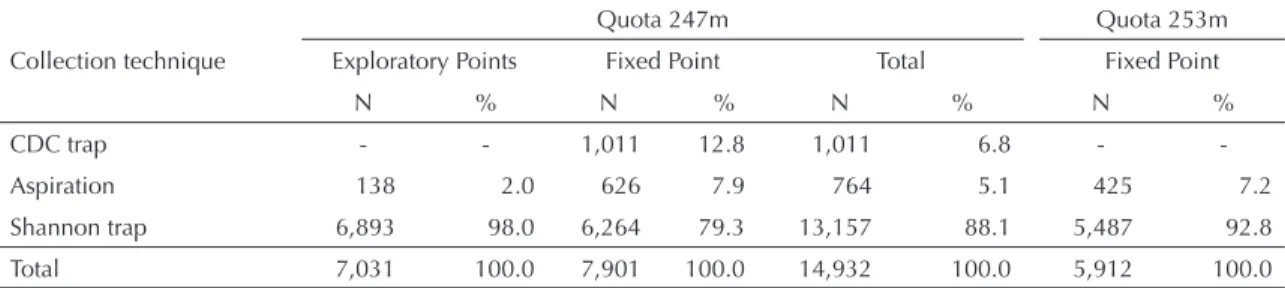
The period prior to fl ooding (quota 247m), 14,932 adult culicidae were collected through aspiration techniques
(5,1%), CDC traps (6,8%) and Shannon traps (88,1%) (Table 1).
In the exploratory sites, 7,031 mosquitoes were captured representing ten genera (Aedeomyia, Aedes, Anopheles, Coquillettidia, Culex, Mansonia, Psorophora, Sa-bethes, Uranotaenia and Wyeomyia). With the aspira-tion technique, 138 (2%) specimens were collected (20 males and 118 females) registering the presence of Ae. albopictus within the richness of 20 species or groups. Through the Shannon traps, 62 species or groups were captured, totaling 6,893 (98%) samples (593 males and 6,300 females). The following species were captured exclusively with this trap in the exploratory sites: An. braziliensis, An. darlingi, An. evansae, An. oswaldoi, Ae. fulvus, Ae. hortator, Cx. (Melanoconion) aureono-tatus, Cx. (Mel.) idottus, Cx. (Mel.) vaxus, Ps. albipes, Ps. cingulata, Sa. glaucodaemon, Wy. melanocephala and Wy. roucoyana/chalcocephala.
In the fi xed sites, 7,091 mosquitoes were captured (Table 1) from eight genera (Aedeomyia, Aedes, Anoph-eles, Coquillettidia, Culex, Mansonia, Psorophora, and Uranotaenia) (Table 2). In the CDC trap, 1,011 (12,8%) species (68 males and 943 females) from 43 species or groups were captured. Cx. (Culex) nigripalpus and Ur. nataliae were species collected only through this tech-nique. The aspirator resulted in capturing 626 (7.9%) samples (215 males and 411 females) and 51 species or groups. The Shannon trap captured 6,264 (79.3%) samples (573 males and 5,691 females). Considering only the total of females captured with this trap, the richness was 37 species or groups. The identifi cation of the males was considered apart and included the species Cx. (Cux.) maxi, Ma. indubitans and Ps. confi nnis.
In the period after the fi rst fi lling (quota 253m), 5,912 adult culicidae in the fi xed site were captured, through the aspiration and Shannon trap techniques (Table 1). These culicidae represent nine genera (Aedeomyia, Aedes, Anopheles, Coquillettidia, Culex, Limatus, Mansonia, Psorophora and Uranotaenia) (Table 2). The richness included a total of 31 species or groups as much for aspiration as for the Shannon trap, being that for considered this one only the females. Aspiration capture resulted in 425 (7.2%) specimens (190 males and 235 females). Through this technique, the presence
Table 1. Distribution of the culicidae fauna in the previous period (quota 247m) and after fi lling (quota 253m) of the Porto Primavera Dam according to type of collection technique. Porto Primavera Dam, Southeastern Brazil, 2000.
Collection technique
Quota 247m Quota 253m
Exploratory Points Fixed Point Total Fixed Point
N % N % N % N %
CDC trap - - 1,011 12.8 1,011 6.8 -
-Aspiration 138 2.0 626 7.9 764 5.1 425 7.2
Shannon trap 6,893 98.0 6,264 79.3 13,157 88.1 5,487 92.8
Total 7,031 100.0 7,901 100.0 14,932 100.0 5,912 100.0
Presidente Epitácio Sítio JB
Córrego do Veado Reserva
Lagoa São Paulo
Barreiro Capoeira.
. Bairro Campinal
Rio do Peixe
Reserva Florestal do RLSP
RLSP
.
.
. .
Rio Paraná
N
5.000 Metros Presidente Epitácio
Sítio JB
Córrego do Veado Reserva
Lagoa São Paulo
Barreiro Capoeira.
. Bairro Campinal
Rio do Peixe
Reserva Florestal do RLSP
RLSP
.
.
. .
Rio Paraná
Figure 2. Location of the collection sites: fi xed and explora-tory. Porto Primavera Dam, 1997.
The fi rst rise in the level of the water (quota 253m) in the plains of the Parana and Peixe rivers, the natural breeding sites of the genera Aedes and Psorophora were fl ooded. This may have infl uenced the lower den-sity of adult mosquitoes and the absence of immature specimens of these species. Meanwhile, an increase in the population density of the adults of the genera Anopheles, Culex (Melanoconion), Mansonia and Uranotaenia, and for the immature stages of the genera Aedeomyia, Anopheles, Culex (Melanoconion) and Uranotaenia was observed, suggesting this as a result of the fl ooding. It is possible that this fact is related to the ecological conditions favorable to the proliferation of mosquitoes from these groups. The accumulation of the aquatic vegetation in the dam may have favored this population growth. The expansion of the macrophites on the banks of the reservoir expanded the area of the culicidae associated with this vegetation. In this case, Ad. squamipennis was one of the predominant species, which was also observed by Lopes & Lozovei8 (1995) in the north of the state of Parana. This suggests the potential risk of the circulation of the virus Gamboa (Bunyavirus) which up until now was transmitted pri-marily by this species,2 and the natural vector of bird malaria in Venezuela.5
Some representatives of the tribe Mansoniini pres-ent the specifi cs of association in relation to aquatic of Ae. aegypti and no other Coquillettidia specie was
captured. In the Shannon trap, 5,487 (92.8%) samples (445 males and 5,042 females) were captured and the presence of Cx. (Cux.) coronator and Li. fl avisetosus was recorded.
A total of 944 immature specimens were collected, from 34 species or groups and ten genera (Table 2) in the period prior to the fi lling of the lake. The pres-ence of Ae. terrens, An. deaneorum, Cx. (Phenaco-myia) corniger, Li. durhami and Orthopodomyia was registered. After the completion of the dam, 1,201 specimens from 27 species or groups and four genera (Table 2) were collected, with an encounter with An. argyritarsis and Cx. (Mel.) clarki.
It was observed that some species of culicidae, among adults and immature specimens, presented an increase or decrease in their population, after the fi rst fi lling of the dam in a fi xed site (Table 2).
DISCUSSION
The biodiversity of the area studied was already altered due to the devastation and installation of agriculture and cattle ranching. With the formation of the Porto Primavera Dam, new environmental changes occurred, interfering in the culicidae population, a fact previously observed by other authors. 11,12
Tabela 2. Distribution of adults and immature stages of Culicidae fauna by genus and study period in the fi xed site. Porto Primavera Dam, Southeastern Brazil, 2000.
Form Adults Immature Specimens
Genus/subgenus
Period prior to the formation of the Porto Primavera
Dam (%)
Period after the fi rst fi lling of the Porto Primavera
Dam (%)
Period prior to the formation of the Porto Primavera
Dam (%)
Period after the fi rst fi lling of the Porto Primavera
Dam (%)
Aedeomyia 47.5 19.6 2.8 39.0*
Aedes 54.2 1.6 0.6
-Anopheles 24.2 26.6* 3.7 16.4*
Coquillettidia 43.9 1.9 -
-Culex 86.6 77.8 81.8 34.2
Cx. (Aedinus) 4.4 0.1 -
-Cx. (Culex) 29.7 13.7 79.3 17.6
Cx. (Melanoconion) 52.5 64.0* 2.4 16.6*
Cx. (Phenacomyia) - - 0.1
-Limatus - 0.1 4.6
-Mansonia 28.8 55.5* 0.2
-Orthopodomyia - - 0.5
-Psorophora 8.5 0.3 5.3
-Sabethes - - 0.2
-Uranotaenia 6.3 16.5* 0.2 10.4*
vegetation,4 a fact which may explain the reduction of the Coquillettidia population and the growth of the Mansonia population soon after the fi lling of the reservoir. The Mansonia species, while not pathogen vectors in Brazil, cause a large nuisance to the human and animal population. Tadei* (1996) reported that of the total of culicidae sampled after the fi lling of the Tucurui reservoir (Para state), 97.1% were Mansonia, with an absolute predominance of Ma. titillans (96.0%). The nuisance caused by this species in the residential area was an average of 612 mosquitoes per man/hour. In Porto Primavera, among the mosquitoes Mansonia present in the study, Ma. humeralis was the most abun-dant species, tending to represent a problem similar to that mentioned in Tucurui.
Anopheles darlingi found favorable conditions for its proliferation after the fi lling of the reservoir, a fact that merits accompaniment as this is the primary vector mosquito of malaria. 4
Specimens of the group Cx. (Melanoconion) were abundant and may introduce arboviruses in anthropic environments. This is because they present suffi cient ecological valiance to be able to permit the evolution of habitats in the sense of domestication,3 and they are responsible for the sylvatic cycle of enzootic of arbovirus.12
Almirón & Brewer1 (1996) observed that the genus
Uranotaenia was collected along the banks of lakes and lagoons, associated with the species of the genera Anopheles and Culex, in various places covered with aquatic vegetation, like that found in the Porto Prima-vera Dam.
The detection of Ae. aegypti in the rural area was atypical. Even though it can be considered a sporadic encounter, this information suggests an attempt to disperse the population through the focus on the urban areas of the city of Presidente Epitacio, situated 20 km from the sample site.
The option of employing various entomological tech-niques to explore aquatic and land sites permitted the recognition of a large number of species or groups of culicidae fauna. On the other hand, the environmental changes caused by the formation of the lake limited the collection sites and affected the populations as refl ected by the alteration of the predominance of the specifi c composition of the mosquitoes. Among these, those of specifi c importance to public health stand out, which indicates the need for a constant monitoring of the area surrounding the dam.
ACKNOWLEDGEMENTS
The Energy Company of Sao Paulo (CESP) for the structure provided for fi eld work.
REFERENCES
1. Almirón WR, Brewer ME. Classifi cation of immature stage habitats of Culicidae (Diptera) collected in Córdoba, Argentina. Mem Inst Oswaldo Cruz.
1996;91:1-9.
2. Dutary BE, Petersen JL, Peralta PH, Tesh RB.
Transovarial transmission of Gamboa virus in a tropical mosquito, Aedeomyia squamipennis. Am J Trop Med Hyg. 1989;40:108-13.
3. Forattini OP, Gomes AC, Kakitani I. Observações sobre mosquitos Culicidae adultos em cultivo irrigado de arroz no Vale do Ribeira, Estado de São Paulo, Brasil.
Rev Saúde Pública. 1989;23:307-12.
4. Forattini OP. Culicidologia médica. São Paulo: EDUSP; 2002. v. 2.
5. Galbadon A, Ulloa G, Godoy N, Marquez E, Pulido J.
Aedeomyia squamipennis (Diptera: Culicidae) vector natural de malaria aviaria en Venezuela. Bol Dir Malariol Saneam Amb. 1977;17:9-13.
6. Gomes AC, Rabello EX, Natal D. Uma nova câmara coletora para armadilha CDC-miniatura. Rev Saúde Pública. 1985;19:190-1.
7. Guimarães AE, Mello RP, Lopes CM, Alencar J, Gentile C. Prevalência de Anofelinos (Diptera: Culicidae) no crepúsculo vespertino em áreas da Usina Hidrelétrica de Itaipu, no Município de Guaíra, Estado do Paraná, Brasil. Mem Inst Oswaldo Cruz. 1997;92:745-54.
8. Lopes J, Lozovei AL. Ecologia de mosquitos (Diptera: Culicidae) em criadouros naturais e artifi ciais de área rural do norte do Estado do Paraná, Brasil. I - Coletas ao longo do leito de ribeirão. Rev Saúde Pública.
1995;29:183-91.
9. Müller AC. Hidrelétricas, meio ambiente e
desenvolvimento. São Paulo: Makron Books do Brasil; 1995.
10. Nasci RS. A lightweight battery-powered aspirator for collecting resting mosquitoes in the fi eld. Mosq News.
1981;41:808-11.
11. Natal D, Barata EAMF, Urbinatti P, Barata JMS. Contribuição ao conhecimento da fauna de imaturos de mosquitos (Diptera, Culicidae) em área de implantação de hidrelétrica na bacia do Rio Paraná, Brasil. Rev Bras Entomol. 1995;39:897-9.
12. Natal D, Barata EAMF, Urbinatti P, Barata JMS, Paula MB.
Sobre a fauna de mosquitos adultos (Diptera, Culicidae) em área de implantação de hidrelétrica na bacia do Rio Paraná, Brasil. Rev Bras Entomol. 1998;41:213-6.
13. Reinert JF. Mosquito generic and subgeneric abbreviations (Diptera: Culicidae). Mosq Syst.
1975;7:105-10.
14. Service MW. Mosquito ecology: fi eld sampling methods. 2nd ed. London: Applied Scince Publications; 1993.
15. Shannon R. Methods for collecting and feeding mosquitoes in jungle yellow fever studies. Am J Trop Med Hyg. 1939;19:131-40.
16. Wanderley DMV, Andrade JCR, Meneguetti LC, Chinelatto MJ, Dutra AP. Malária no Estado de São Paulo, Brasil, 1980 a 1983. Rev Saúde Pública.
1985;19:28-36.