*Correspondence: R. Bushra. Ziauddin College of Pharmacy, Ziauddin Uni-versity, Karachi, 4/B, Shahra-e- Ghalib, Block 6, Clifton, Karachi, Pakistan, 75600. E-mail: [email protected]
A
rti
Pharmaceutical Sciences vol. 46, n. 1, jan./mar., 2010
Enteric coating of ibuprofen tablets (200 mg) using an aqueous
dispersion system
Rabia Bushra
1,*, Muhammad Harris Shoaib
2, Nousheen Aslam
1, Zafar Alam Mehmood
3,
Durriya Hashmat
21Ziauddin College of Pharmacy, Ziauddin University, Karachi, 2Department of Pharmaceutics, Faculty of Pharmacy,
University of Karachi, 3Colorcon Asia Paciic
Ibuprofen is a propionic acid derivative that belongs to the class NSAIDs. Major adverse reactions associated with Ibuprofen are related to GIT and include peptic and mucosal ulcers, dyspepsia, severe gastric pain and bleeding, that results in excessive treatment failure. The goal of this study was to develop enteric coated ibuprofen tablets in order to avoid gastric mucosal irritation, diffusion of drug across mucosal lining and to let active ingredient be absorbed easily in small intestine. The formulation was developed and manufactured through the direct compression process, the simplest, easiest and most economical method of manufacturing. Enteric coating was done using an Opadry white subcoating and an aqueous coating dispersion of Acryl-Eze. Enteric coated formulation was subjected to disintegration and dissolution tests by placing in 0.1 M hydrochloric acid for 2 h and then 1 h in phosphate buffer with a pH of 6.8. About 0.04% of drug was released in the acidic phase and 99.05% in the basic medium. These results relect that ibuprofen can be successfully enteric coated in order to prevent its release in the stomach and facilitate rapid release of the drug in the duodenum, due to the presence of superdisintegrant. Formulating this enteric coated tablets could increase patient compliance by decreasing adverse drug reactions (ADRS) associated with Ibuprofen therapy.
Uniterms: Ibuprofen/adverse reactions. Tablets/enteric coating/aqueous dispersion system. Acryl-Eze. Opadry White. Superdisintegrant.
Ibuprofeno é um derivado do ácido propiônico, que pertence à classe dos fármacos não-esteróides (AINES). As principais reações adversas associadas com o ibuprofeno se referem àquelas do trato gastrintestinal (TGI), como úlceras pépticas e da mucosa, dispepsia, dor gástrica grave e sangramento, que resultam em muitas falhas de tratamento. O objetivo do estudo foi desenvolver comprimidos revestidos de ibuprofeno que impeçam a irritação da mucosa gástrica, difusão do fármaco através da mucosa e permitam, facilmente, a absorção do princípio ativo do intestino delgado. A formulação foi desenvolvida e manufaturada por meio de processo de compressão direta, método mais simples e econômico de preparação. O revestimento entérico foi efetuado utilizando-se subrevestimento com Opadry branco e revestimento por dispersão aquosa de Acryl-Eze. A formulação de revestimento para liberação entérica foi submetida a testes de desintegração e de dissolução, em ácido clorídrico 0,1 M, por 2 h, e, então, a h, em tampão fosfato pH 6,8. Cerca de 0,04% do fármaco foi liberado na fase ácida e 99,05%, no meio básico. Estes resultados reletem o fato de que o ibuprofeno pode ser revestido com sucesso, a im de impedir sua liberação no estômago e facilitar a rápida liberação do fármaco no duodeno, devido à presença de superdesintegrante. A formulação de tais comprimidos aumentaria a adesão do paciente pela diminuição das reações adversas (RAs), associadas à terapia com ibuprofeno.
INTRODUCTION
The application of coatings to the surface of phar-maceutical solid-dosage forms, especially tablets, has been practiced for over 150 years (Porter, Bruno, 1990). A signiicant proportion of pharmaceutical solid dosage forms are coated to give an esthetic touch and to control the bioavailability of the drug (Porter, 2000). Film coating is a technique widely used in the pharmaceutical ield to improve and modify technological and release characteris-tics of capsules, tablets and granules due to the capability of depositing a variety of coating materials onto solid cores (Bonacucina etal., 2006; Fitzgerald, Cole, Taday, 2005, Nastruzzi et al., 2000; Cole et al., 2002; Bobmeir, 1997). The particles prepared by ilm-coating show the best stability (Wieland-Berghausen et al., 2002). Tablet size, shape and coating are pharmaceutical parameters which can be controlled to minimize esophageal contact of a dosage form with esophageal tissue (Perkins et al., 2001). For instance, enteric coating of acetyl salicylic acid tablets is desirable for preventing stomach upset or irrita-tion in patients taking daily doses (Cunningham, Kinsey, Scattergood, 2001).
Enteric polymers have been shown to be safe, and widely accepted for use in drug products (Biju et al., 2004; Nykanen, 2003). These polymers are insoluble at low pH but dissolve at a pH around or below 7 (Peeters, Kinget, 1993; Bauer, Kesselhut, 1995; Hogan, 1995). A number of coating polymers are available commercially. Shellac is a natural enteric polymer which results in good gastric resistance; however, it often dissolves too slowly in intestinal luids (Pearnchob, Dashevsky, Bodmeir, 2004). Hydroxypropyl methylcellulose (HPMC) was selected as a base polymer to develop novel enteric coating agents for acid protection, in contrast to ethyl cellulose (EC), it is water soluble and might leach out of the ilm coating, cre-ating water illed pores through which drug diffuses more rapidly than EC (Kokubo et al., 1997; Gunder, Lippold, Lippold, 1995). Acryl-Eze is a pre-mixed excipient blend based on a methacrylic acid copolymer that is optimized for ilm-coating applications (Young et al., 2005).
A continuing trend in pharmaceutical coating te-chnology is to use water instead of organic solvents as coating vehicles to minimize environmental and safety hazards. Several aqueous enteric coating systems have been developed and are commercially available (Yuan, Clipse, Wu, 2003). Aqueous-based coating systems are ad-vantageous over organic solvents because they overcome the drawbacks of the latter, namely pollution, explosion hazards and solvent toxicity, especially for operators. For, these reasons, water-based systems are now gradually
being applied instead of organic coating systems (Bau-doux, Dechesne, Delattre, 1990). The coating material is added as an aqueous solution or dispersion and the excess liquid phase must then be removed, usually by hot air (Lund, 1994). Although aqueous enteric coating systems were an advance on traditional solvent systems, they requi-re separate addition of plasticizers, detackiiers, pigments and other process aids (Lechmann, 1982). Multiple, time-consuming steps are required in the preparation of these aqueous enteric coating dispersions. In addition, many of theses systems are provided as liquid dispersions, which can be problematic when handling, transporting and con-trolling storage conditions (Cunningham, Fegley, 2001).
The model drug is ibuprofen, a widely used NSAI-Ds. It is an analgesic, anti-inlammatory and anti-pyretic agent (Nazu, 1978; Wood et al., 2006; Potthast et al.,, 2005). NSAIDs are a group of unrelated organic acids that mostly affect GIT. Dyspeptic complaints (Hollenz , Labenz, 2004), upper GI bleeding (Blot et al., 2004)and mucosal and duodenal ulcers (Davis, 1999; Rang, Dale, Ritter, 2003; Ross, DeHoratius, 1990) are common ADRs associated with this group and may be life threatening (Motola et al., 2004). In 2002, Aletaha found that about 72% of the patients with rheumatoid arthritis treated with NSAIDs received GI-protective therapy mainly with histamine antagonists and sucralfalate (Aletaha, Smolen, 2002). Due to GI side effects, the health and economic bur-dens related to these drugs are considerable (Schwappach, Koeck, 2003). A distinct relationship between effects and side effects exists, namely, rapid absorption beginning in the stomach is associated with intensive gastric-duodenal irritation and ulceration (Brune, Beck,1991). Epidemio-logical studies have clearly demonstrated a rank order of risk of ulcer complications for commonly used NSAIDs, with ibuprofen consistently associated with the lowest risk, and piroxicam with the highest (Wolfe, 2003; Langman, 2003).
The aim of current investigation was to develop en-teric coated ibuprofen tablets (200 mg) using an aqueous Opadry/Acryl-Eze system, resulting in protection against gastric ADRs. This study evaluated both systems for ease of use and acid resistance. Stability of coated tablets was determined at room and under accelerated conditions.
MATERIALS AND METHOD
Materials
Techno-logies, Inc. Wayne, NJ) and Magnesium Stearate (FMC Corporation, USA) were used as directly compressible excipients. Sodium hydroxide (Merck, Kga A, and Darms-tadt, Germany); Monobasic Potassium Phosphate (Merck, Kga A, and Darmstadt, Germany); Methanol HPLC grade (RDH, Sigma-Aldrich GmbH, Seelze, Germany) and all other chemicals used were of analytical grade and obtained from commercial sources. The enteric coating materials were methacrylic acid polymer based pigmented Acryl-Eze (93092157) yellow and the sub coat material was Opadry (YS-1-7027) white, all from Colorcon (Verna, Goa, India).
Packaging materials used for the tablet stability test were polyvinyl chloride (PVC), 218 mm and aluminium foil 206 mm (Zibo Omy Economic and Trading Co. Ltd., China).
Preparation of Tablets
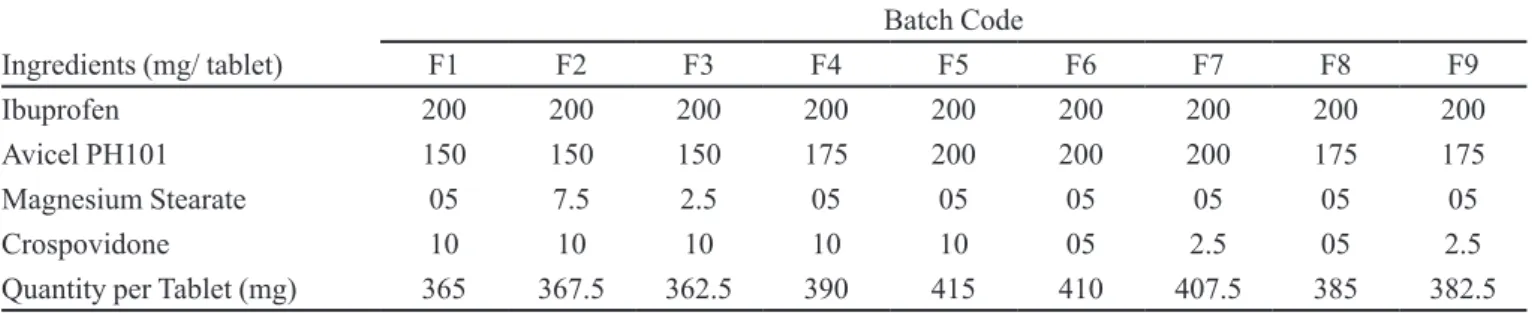
All the ingredients were properly weighed and sie-ved through a 20 mesh sieve. The blend was compressed using a single punch machine (KORSCH Erweka, No. 7570, Frankfurt, Germany). For optimization, nine di-fferent formulations of ibuprofen (200 mg) tablets were developed (Table I) and on the basis of the results obtained from evaluation of different physico-chemical parameters, formulation 6 was selected as an optimized formulation for enteric coating (Bushra et al., 2008).
Enteric Coating of Ibuprofen (200 mg) tablets
• Preparation of Opadry White solution
Compressed tablets were sub coated using Opadry white dispersion. This was prepared by accurately wei-ghing 50g of Opadry white formulated powder while 600 mL of mixture of methyl chloride and ethanol (343 mL of methyl chloride and 257 mL of ethanol) (Cole, 1990) was utilized as the organic solvent, being stirred continuou-sly to form a vortex without drawing air into the liquid. Opadry white coating powder was added steadily to the vortex, avoiding powder lotation on the liquid surface.
This dispersion was thoroughly mixed for 40- 45 minutes in order to obtain a homogenized distribution.
• Preparation of Acryl-Eze Yellow dispersion
320 g of distilled water was weighed into a mixing vessel and stirred to form a vortex. 80 g Acryl-Eze yellow powder was weighed accurately and added to the center of the liquid vortex in a slow steady stream, avoiding clumping and maintaining a vortex. Mixing was continued for around 20 - 25 minutes. Finally Acryl-Eze dispersion was passed through a 250 micron sieve prior to the coating process. Dispersion was continuously stirred during the coating process. Bothcoating dispersions were prepared according to the technical document and guidelines pro-vided by Colorcon (Colorcon, 2006).
• Coating methodology
Tablet coating was performed in a conventional coating pan (Erweka G.m.b.H., type UG, Frankfurt, Germany) with one spray gun. Table II lists the coating conditions and parameters. Tablet cores were pre-heated to about 40 °C utilizing a dryer and air compressor (Type H-2, No. 311319, Meiji air compressor Mfg. Co. Ltd. Osaka, Japan). The spray gun was filled with Opadry white coating dispersion and operated at a proper low rate. The pan was set into motion and seal coating solution
TABLE I - Composition of Ibuprofen 200mg tablets(Bushra et al., 2008)
Batch Code
Ingredients (mg/ tablet) F1 F2 F3 F4 F5 F6 F7 F8 F9
Ibuprofen 200 200 200 200 200 200 200 200 200
Avicel PH101 150 150 150 175 200 200 200 175 175
Magnesium Stearate 05 7.5 2.5 05 05 05 05 05 05
Crospovidone 10 10 10 10 10 05 2.5 05 2.5
Quantity per Tablet (mg) 365 367.5 362.5 390 415 410 407.5 385 382.5
TABLE II - Coating Process Parameters
Factors Conditions
Equipment 12 inch coating pan
Substrate 200-mg Ibuprofen tablets
Pan charge 1 kg
Inlet Temperature 55-65 °C
Bed Temperature 35-40 °C
Distance between spray
gun and tablet bed 6 inches
No. of spray guns 1
was sprayed on to the falling cores under a suitable air pressure (30-35 psi). Upon completion of seal coating, the air heater was switched off and tablets were blow dried for 20-25 minutes in the coating pan. The spray gun was washed thoroughly and illed with prepared Acryl-Eze yellow aqueous dispersion and the same procedure was followed for final coating. The core tablets gained 2% weight during sub coating and about 8-10% weight after Acryl-Eze dispersion. (Table III).
Characterization of coated tablets
• Mechanical strength:
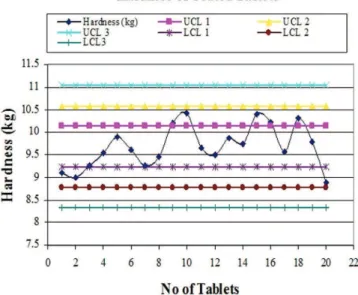
The hardness of the coated tablets was examined by using a tablet hardness tester (Fujiwara, Seisukusho Corporation, Japan). The hardness of 20 randomly selected tablets is shown in Figure 1.
• Disintegration Test
The disintegration test was performed according to
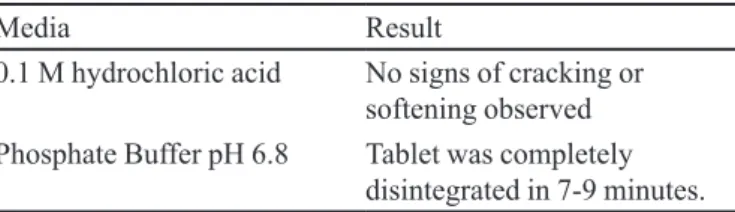
B.P 2004. Six enteric coated tablets were placed in acidic phase consisting of 0.1 M hydrochloric acid. The assembly was operated without the discs for 2 h in a USP basket rack assembly (Erweka ZT-2, Husenstamn). Tablets were re-moved from solution, dried gently with a paper towel and disintegration was continued in buffer phase for 1 h. Buffer phase was composed of mixed phosphate buffer with a pH of 6.8 that was maintained at 37±2 °C. The assembly was removed and tablets were observed for disintegration.
• Dissolution Test
The dissolution testing of enteric coated formulation was carried out according to USP 27 NF 22 <711>, by adopting Method B (USP convention INC., 2004) in pH 1.2 and pH 6.8 buffers.
The Acid Stage was performed using 1000 mL of
0.1 M hydrochloric acid placed in a USP dissolution bath (Erweka DT 700, Husenstamn, Germany), equilibrated to a temperature of 37± 0.5 °C. The paddle stirring rate was set at 50 rpm. Six tablets wereintroduced into the appara-tus and the apparaappara-tus was run for 2 h. After the operation outlined above, an aliquot of the luid was drawn, and the
Buffer Stage was commenced.
The Buffer Stage consisted of a phosphate buffer of pH 6.8 prepared by mixing 0.1 M hydrochloric acid with 0.20 M tribasic sodium phosphate (3:1). The apparatus was operated for a further 1 h. At the end of the time period, an aliquot of the luid was drawn. Samples were assayed spectrophotometrically (UV 150-02, Double beam spec-trophotometer, Shimadzu Corp., Japan) at 221 nm.
Stability test of coated tablets
Ibuprofen coated tablets were blister packed using a blister packing machine (BQS, H 060125, Pam-Pac Machi-nes Pvt. Ltd.) in 1× 10’s using aluminium foil 206 and PVC 218 mm (Zibo Omy Economic and Trading Co.Ltd., China). Stability studies were carried out according to ICH guide-lines. Tests were conducted under room temperature (RT) and accelerated stability conditions. The samples designed for RT storage were kept at 30±2 °C and 65±5% relative humidity (RH) and for accelerated stability were reserved at 40±2 °C and 75±5% RH, in a humidity chamber (Binder GMBH Bergster, 14D-78532, Tuttingen Germany). The RT samples were pulled from stability and tested 0, 3, 6, 9 and 12 months after the date of packaging. The accelerated stability samples were pulled from stability and tested 0, 1, 2, 3 and 6 months after the date of packaging. Dissolution and assay were performed to evaluate the stability of coa-ted tablets. The percent dissolution and assay of the coacoa-ted tablets are shown in Tables V and VI.
TABLE III - Dispersion Preparation Parameters
Parameters Sub coat layer Acryl-Eze
Theoretical weight gain (%) 2 8-10
Dispersion solid content (%) 15 20
Powder (g) 30 80
Organic Solvent (mL) 600 N/A
Deionized Water (g) N/A 320
Total Dispersion (mL) 630 400
FIGURE 1 -Mechanical strength of coated tablets, with upper
RESULTS AND DISCUSSION
Controlled and localized release of drugs in the in-testine can be achieved by enteric coating. The design of enteric-coated tablets has so far remained empirical, in part because of the lack of a quantitative description of the drug release kinetics (Ozturk et al., 1998; Hosny, El-Mahrouk, Gouda, 1998). The functionality of coatings from aqueous dispersions is linked to coalescence of latex particles. Thus any incomplete ilm formation, caused by too high or too low coating temperatures, may result in highly permeable coatings (Petereit,Weisbrod, 1999).
The goal of this study was to develop enteric coated ibuprofen tablets. Opadry white coating dispersion was used for sub coating. Enteric coating was successfully done using Acryl-Eze Yellow polymer which is an aqueous dispersion. Tablets were coated smoothly without having any physical visible defects such as orange peel effect, chipping, tacking or other laws. These two systems are dry, dispersible powders that do not require the use of any additional plasticizer, detackiiers or neutralization agents. During coating, certain parameters require great care such as temperature of coating pan and the spray rate of coating solution. If these are not maintained properly, they affect the smoothness and uniformity of coating. The hardness of 20 coated tablets was measured using a hardness tester and were found to be in accordance with speciications. Tablet hardness is represented graphically with three upper and lower control limits (Figure 1). The eficiency of the coating was determined by subjecting the coated tablets to gastric pH, and drug release was analyzed by a spectro-photometer. Results of disintegration and dissolution are shown in Tables IV and V.
Krogers et al., in 2002, investigated three formu-lation or process parameters of potential importance, including the plasticizer concentration, the temperature of
coating pan and the spray rate of the coating solution. At low spray rates, the temperature of the coating pan did not affect the roughness of the coated tablets. At higher spray rates, higher temperature gave smoother ilms. In another study,process variables investigated were inlet airlow, pan speed, inlet air temperature, coating time, atomization pressure, and fan pressure. Pan speed and coating duration were also identiied as variables signiicantly affecting content uniformity (Krogars et al., 2000; Rege, Garmise, 2003). It was shown that lower rates of drug release from the coated tablets may be obtained by using high inlet-air temperature and low spray rate of the polymeric dispersion during coating. Increased temperature for various time periods to remove water and solvent from the product affects the properties of inal products (Frisbee, Metha, McGinity, 2002).
Tablets used in a functional coating process must be suficiently robust to withstand mechanical stresses and should exhibit a very low potential for erosion and edge chipping. Any defect in the tablet core may result in a localized weakness of the functional ilm. A sub coating process may be used in order to provide a protective co-ating to the cores, although this step is optional. Subcoa-ting does however prevent interaction between the drug substance and coating polymer. In this study, sub coating was done with Opadry white, resulting in smooth tablets with improved mechanical strength. Acryl-Eze Yellow and Opadry white dispersions are fully formulated poly-mer systems, whose mixing process consisted of a simple addition of the powder formulations to water. It requires little effort and time. Sieving was done to ensure that no dispersed particles of polymer remained that could result in gun blockages. Both dispersions were stirred during the experiment to avoid sedimentation and coalescence of particles.
Many authors have described different enteric co-ated formulations using a variety of coating polymers to avoid local gastrointestinal irritation (Debunne, Vervaet, Remon, 2002; Biju et al., 2004; Sinha et al., 2006). In the current study, Crospovidone, a superdisintegrant, was utilized which showed fast in vitro drug release and presented better burst effect and rapid drug release compared to traditional disintegrants (Tables IV and V). This approach is especially important because the release of drug is already delayed for 2h, thus by incorporation of Crospovidone the drug will be rapidly released in the duodenum as the polymer coat erodes at high pH 6-7. Ta-blets showed complete acid resistance for 2 h (Figure 2). Drug release met the criteria outlined in this study i.e. not less than 80% dissolved after 60 minutes in buffer pH 6.8. Although traditional aqueous enteric coating systems can
TABLE IV - Disintegration result of ibuprofen (200 mg) tablets
Media Result
0.1 M hydrochloric acid No signs of cracking or
softening observed
Phosphate Buffer pH 6.8 Tablet was completely
disintegrated in 7-9 minutes.
TABLE V - Dissolution result of ibuprofen (200mg) tablets
Media Average Drug Release (%)
0.1 M hydrochloric acid 0.08
require multiple component mixing steps before coating, these novel systems were dispersed in only one step in the minimum amount of time, and produced acceptable weight gains. The acrylic-based system offers the additional ad-vantage of being fully pigmented, eliminating the need for additional color application if a colored tablet is desired.
Tablets were stored in a temperature and humidity controlled chamber to observe the stability of the formula-tion. Results of stability testing were satisfactory, showing no signiicant variation in physical characteristics, color, hardness or disintegration time of coated tablets. In vitro drug release studies were carried out since these are con-sidered the best tool for assessing in vivo drug behavior.
Percent dissolution and assay were within the acceptable limits of USP (Tables VI and VII). All data indicated that the coating layer was essentially unchanged and provided the desirable enteric protection. Coated ibuprofen tablets were stable under stability testing conditions.
CONCLUSION
The intention was to prepare enteric coated ibu-profen tablets (200 mg) using a novel Acryl-Eze yellow enteric polymer and Opadry white aqueous dispersions that prevent drug liberation in the stomach. The coating process for both systems was free of problems and resulted in highly smooth coated colored tablets with no visible defects. Dissolution and disintegration results showed strong acid resistance whereas the drug was freely released in 6.8 buffer solution. The results of stability testing were satisfactory, indicating that coated ibuprofen tablets were stable under the testing conditions.
REFERENCES
ALETAHA, D.; SMOLEN, J. S. Advances in anti-inlammatory therapy. Acta Medica Austriaca., v.29, n.1, p.1-6, 2002.
BAUDOUX, M.; DECHESNE, J. P.; DELATTRE L. Film Coating with Enteric Polymers from Aqueous Dispersions.
Pharm. Tech. Int., v.12, n.11, p.18-26, 1990.
FIGURE 2 - Drug Release from Ibuprofen tablets in 0.1 M
hydrochloric acid and pH6.8 phosphate buffer.
TABLE VI – Stability testing of Ibuprofen 200mg Tablets at Room Temperature
Batch No Period (Month) Physical Characteristics
(Faint Yellow Tablet) (200 mg/Tab (NLT 80%)%Dissolution Ibuprofen (200 mg/Tab) (95-105%)%Assay Ibuprofen
F6 0 Complies 99.05 100.15
F6 3 Complies 98.95 99.89
F6 6 Complies 98.90 99.56
F6 9 Complies 98.50 99.10
F6 12 Complies 98.25 98.78
TABLE VII - Stability testing of Ibuprofen 200mg Tablets under Accelerated Conditions
Batch No Period (Month) Physical Characteristics
(Faint Yellow Tablet) (200 mg/Tab) (NLT 80%)%Dissolution Ibuprofen (200 mg/Tab) (95-105% )%Assay Ibuprofen
F6 0 Complies 99.05 100.15
F6 1 Complies 98.99 99.95
F6 2 Complies 98.95 99.85
F6 3 Complies 98.65 99.74
BAUER, K-H.; KESSELHUT, J. F. Novel pharmaceutical excipients for colon targeting. S.T.P.Pharma Sci., v.5, n.33, p.54-59, 1995.
BIJU, S. S.; SAISIVAM, S.; RAJAN, M. G.; MISHRA, P. R. Dual coated erodible microcapsules for modiied release of Diclofenac sodium. Eur. J. Pharm Biopharm., v.58, n.1, p.61-67, 2004.
BLOT W, J.; FISCHER, T.; NIELSEN, G. L.; FRIIS, S.; MUMMA, M.; LIPWORTH, L.; DUBOIS, R.; MCLAUGHLIN, J. K.; SORENSEN, H. T. Outcome of upper gastro-intestinal bleeding and use of Ibuprofen versus Paracetamol. Pharm World Sci., v.26, n.6, p.319-323, 2004.
BOBMEIR, R. Tabletting of coated pellets. Eur. J. Pharm.
Biopharm., v.43, n.1, p.1-8, 1997.
BONACUCINA, G.; MARTINO, P. D.; PIOMBETTI, M.; COLOMBO, A.; ROVERSI, F.; PALMIERI, G. F. Effect of Plasticizer on Properties of Pregelatinized Starch Acetate (Amperac 01) Free Films. Int. J. Pharm., v.313, n.1-2, p.72-77, 2006.
BRITISH PHARMACOPOEIA. London: The stationary ofice, 2004. v.3, p.A258.
BRUNE, K.; BECK, W. S. Towards safer nonsteroidal anti-inlammatory drugs. Aents Actions Suppl., v.32, p.13-25, 1991.
BUSHRA, R.; SHOAIB, M. H.; ASLAM, N.; HASHMAT, D.; REHMAN, M. Formulation development and optimization of ibuprofen tablets by direct compression method. Pak J. Pharm. Sci., v.21, n.2, p.113-120, 2008.
COLE, E. T.; SCOTT, R. A.; CONNOR, A. L.; WILDING, I. R.; PETEREIT, H-U.; SCHMINKE, C.; BEVKERT, T.; CADE, D. Enteric HPMC Capsules Designed to Achieve Intestinal Rargetting. Int. J. Pharm., v.231, n.1, p.83-95, 2002.
COLE, G. Pharmaceutical production facilities design and applications. New York, London: Ellis Horwood, 1990. p.137.
COLORCON. Film coatings, preparation and use guidelines, Opadry II. Available at: <http://www.colorcon.com/pharma/ filmcoat/pharma_coatings/opadry_2/lit/reconstition>. Accessed on: 25 jan. 2007.
CUNNINGHAM, C. R.; FEGLEY, K. A. One step aqueous
enteric coating systems scale up evaluation. Pharm.
Technol., v.25, n.11, p.36-44, 2001.
CUNNINGHAM, C. R.; KINSEY, B. R.; SCATTERGOOD, L. K. Formulation of acetylsalicylic acid tablets for aqueous enteric ilm coating. Pharm. Technol. Eur., v.13, n.11, p.44-53, 2001.
DAVIS, N. M. Sustained release and enteric coated NSAIDs: are they really GI safe? J Pharm. Pharmacist Sci., v.2, n.1, p.5-14, 1999.
DEBUNNE, A.; VERVAET, C.; REMON, J-P. Development and in vitro evaluation of an enteric-coated multiparticulate drug delivery system for the administration of Piroxicam to dogs. Eur. J. Pharm. Biopharm., v.54, n.3, p.343-348, 2002.
FITZGERALD, A. J.; COLE, B. E.; TADAY, P. F. Nondestructive analysis of tablet coating thicknesses using terahertz pulsed imaging. J. Pharm. Sci., v.94, n.1, p.177-183, 2005.
FRISBEE, S. E.; MEHTA, K. A.; MCGINITY, J. W. Processing factors that inluence the in vitro and in vivo performance of ilm-coated drug delivery systems. Drug Deliv., v.2, n.1, p.72-76, 2002.
GUNDER, W.; LIPPOLD, B. H.; LIPPOLD, B. C. Release of drugs from ethyl cellulose microcapsules (diffusion pellets) with pore formers and pore fusion. Eur. J. Pharm. Sci., v.3, n.12, p.203-214, 1995.
HOGAN, J. E. Modified release coating. In: COLE, G.;
HOGAN, J. E.; AULTON, M. (Eds.). Pharmaceutical
coating technology. London: Taylor & Francis Books, 1995. p.409-438.
HOLLENZ, M.; LABENZ, J. Gastro-intestinal complications
under NSAID treatment in the doctor’s office. MMW
Fortschr Med., v.146, n.49, p.42-44, 2004.
HOSNY, E. A.; EL-MAHROUK, G. M.; GOUDA, M. W. Formulation and in vitro and in vivo availability of
Diclofenac sodium enteric-coated beads. Drug Dev. Ind.
Pharm., v.24, n.7, p.661-666, 1998.
KOKUBO, H.; OBARA, S.; MINEMURA, K.; TANAKA, T. Development of cellulose derivatives as novel enteric
coating agents soluble at pH 3.5-4.5 and higher. Chem.
KROGARS, K.; HEINÄMÄKI, J.; VESALAHTI, J.; MARVOLA, M.; OSMO, A.; YLIRUUSI, J. Extrusion– spheronization of pH-sensitive polymeric matrix pellets for possible colonic drug delivery. Int. J. Pharm., v.199, n.2, p.187-194, 2000.
LANGMAN, M. J. Adverse effects of conventional non-steroidal anti-inlammatory drugs on the upper gastrointestinal tract.
Fundam. Clin. Pharmacol., v.17, n.4, p.393-403, 2003.
LECHMANN, K. The application and processing of Acrylic coatings n the form of aqueous dispersions compared with organic solutions. Acta Pharm. Fenn., v.91, n.4, p.225-238, 1982.
LUND, W. The Pharmaceutical codex, principles and practice
of pharmaceutics. 12.ed.. London: The Pharmaceutical Press, 1994. p.9-11.
MOTOLA, D.; VACCHERI, A.; SILVANI, M. C.; POLUZZI, E.; BOTTONI, A.; DE PONTI, F.; MONTANARO, N. Pattern of NSAID use in the Italian general population: a questionnaire-based survey. Eur. J. Clin. Pharmacol., v.60, n.10, p.731-738, 2004.
NASTRUZZI, C.; CORTESI, R.; ESPOSITO, E.; GENOVESI, A.; SPADONI, A.; MENEGATTI, E. Influence of Formulation and Process Parameters on Pellet Production
by Powder Layering Technique. AAPs Pharm. Sci. Tech.,
v.1, n.2, p.E9, 2000.
NAZU, K.; Ibuprofen: highly potent inhibitor of prostaglandin synthesis. Biochim. Biophys. Acta., v.529, n.3, p.493-494, 1978.
NYKANEN, P. Development of multiple-unit oral formulations for colon-speciic drug delievery using enteric polymers and organic acid excipients. Helsinki, 2003. p.10. [Academic Dissertation. Faculty of Science of the University of Helsinki for public criticism].
OZTURK, S. S.; PALSSON, B. O.; DONOHOE, B.; DRESSMAN, J. B. Kinetics of release from enteric-coated tablets. Pharm. Res., v.5, n.9, p.550-65, 1998.
PEARNCHOB, N.; DASHEVSKY, A.; BODMEIER, R. Improvement in the disintegration of shellac-coated soft gelatin capsules in simulated intestinal fluid. J Control Release., v.94, n.2-3, p.313-321, 2004.
PEETERS, R.; KINGET, R. Film-forming polymers for colonic drug delivery: I Synthesis and physical and chemical properties of methyl derivatives of Eudragit S. Int. J. Pharm., v.94, n.1-3, p.125-134, 1993.
PERKINS, A. C.; WILSON, C.; FRIER, M.; BLACKSHAW, E. P.; DANSEREAU, R. J.; VINCENT, R. M.; WENDEROTH, D.; HATHAWAY, S.; LI, Z.; SPILLER, R. C. The use of scintigraphy to demonstrate the rapid esophageal transit of the oval ilm- coated placebo risedronate tablet compared to a round uncoated placebo tablet when administered with minimal volumes of water. Int. J. Pharm., v.222, n.2, p.295-303, 2001.
PETEREIT, H. U.; WEISBROD, W. Formulation and process considerations affecting the stability of solid dosage forms formulated with methacrylate copolymers. Eur. J. Pharm. Biopharm., v.47, n.1, p.15-25, 1999.
PORTER, S. C. Coating of pharmaceutical dosage forms. In:
GENNARO, A. R. (Ed.). Remington’s the science and
practice of pharmacy. 21.ed. Philadelphia: Lippincott Williams and Wilkins, 2000. p.894.
PORTER, S. C.; BRUNO, C. H. Coating of pharmaceutical solid-dosage forms. In: LIEBERMAN, H. A.; LACHMAN, L.; SCHWARTZ, J. B. (Eds.). Pharmaceutical dosage forms tablet. 2.ed. New York: Marcel Dekker Inc., 1990. v.3, p.77.
POTTHAST, H.; DRESSMAN, J. B.; JUNGINGER, H. E.; MIDHA, K. K.; OESER, H.; SHAH, V. P.; VOGELPOEL, H.; BARENDS, D. M. Biowaiver monographs for immediate release solid oral dosage forms: ibuprofen. J. Pharm Sci., v.94, n.10, p.2122, 2005.
RANG, H. P.; DALE, M. M.; RITTER, J. M. Anti inlammatory
and immunosuppressant drug. In: Pharmacology. 5.ed.
London: Churchill Living Stone, 2003. p.248.
REGE, P. R.; GARMISE, R. J.; BLOCK, L. H. Spray-dried chitinosans: Part II: in vitro drug release from tablets made from spray-dried chitinosans.” Int. J. Pharm., v.252, n.1-2, p.53-59, 2003.
ROSS, J. M.; DEHORATIUS, J. Non narcotic analgesics.
In: DIPALMA, J.R.; DIGREGORIO G. J. (Eds.). Basic
SCHWAPPACH, D. L. B.; KOECK, C. M. Selective COX-2
inhibitors: A health economic perspective. Wien. Med.
Wochenschr., v.153, n.5-6, p.116-122, 2003.
SINHA, V. R.; BHINGE, J. R.; KUMRIA, R.; KUMAR, M. Development of pulsatile systems for targeted drug delivery of Celecoxib for prophylaxis of colorectal cancer. Drug Deliv., v.13, n.3, p.221-5, 2006.
UNITED STATES PHARMACOPOEIA. Rockville: USP Convention INC., 2004. p.2308-2309.
WIELAND-BERGHAUSEN, S.; SCHOTE, U.; FREY, M.; SCHMIDT, F. Comparision of Microencapsulation Tehniques for the Water-Soluble Drugs Nitenpyram and Clomipramine HCl. J. Control. Release, v.85, n.1-3, p.35-43, 2002.
WOLFE, M. M. Risk factor associated with the development of gastroduodenal ulcers due to the use of NSAIDS. Int. J. Clin. Pract. Suppl., v.135, p.32-37, 2003.
WOOD, D. M.; MONAGHAN, J.; STREETE, P.; JONES, A. L.; DARGAN, P. I. Fatality after deliberate ingestion of sustained- release Ibuprofen; a case report.Critical Care.,
v.10, n.2, p.R44, 2006.
YOUNG, C. R.; DIETZSCH, C.; CEREA, M.; FARRELL, T.; FEGELY, K. A.; RAJABI-SIAHBOOMI, A.; MCGINITY, J. W. Physicochemical characterization and mechanisms of release of Theophylline from melt-extruded dosage forms based on a methacrylic acid copolymer. Int. J. Pharm., v.301, n.1-2, p.112-120, 2005.
YUAN, J.; CLIPSE, N. M.; WU, S. H. The effects of alternating combinations of an enteric coating and HPMC as inner and outer coatings on the performance of coated aspirin tablets.
Pharm. Technol., v.27, n.11 p.70-82, 2003.