Meíssa Vieira dos Santos Mendes
I, Suelen Albuquerque Cavalcante
I, Elenilda Farias de Oliveira
I,
Dayse Mota Rosa Pinto
I, Tânia Santana Menezes Barbosa
II, Climene Laura de Camargo
IIII Faculdade Adventista da Bahia, Nursing Program. Cachoeira, Bahia, Brazil. II Hospital Português, Division of Neonatology. Salvador, Bahia, Brazil.
III Universidade Federal da Bahia, School of Nursing, Department of Community Nursing. Salvador, Bahia, Brazil.
How to cite this article:
Mendes MVS, Cavalcante SA, Oliveira EF, Pinto DMR, Barbosa TSM, Camargo CL. Children
with neuropsychomotor development delay: music therapy promoting quality of life. Rev Bras Enferm. 2015;68(5):515-20. DOI: http://dx.doi.org/10.1590/0034-7167.2015680505i
Submission: 04-08-2015 Approval: 06-04-2015
RESUMO
Objetivo: identifi car a infl uência da musicoterapia no comportamento e qualidade de vida de crianças portadoras de retardo do desenvolvimento neuropsicomotor (RDNPM). Método: pesquisa experimental, com aplicações de musicoterapia (em um grupo de crianças) realizada na associação especializada em Cruz das Almas - Bahia, composta por 17 crianças portadoras de RDNPM com idade entre 5 a 12 anos. Foi observado o comportamento das crianças envolvendo aspectos emocionais, físicos, sociais e escolares. Resultados: houve evolução em todos os aspectos, sendo esta melhora signifi cativa para os domínios Capacidade Emocional e Capacidade Escolar, mostrando os efeitos benéfi cos da musicoterapia. Conclusão: a terapia através da música torna-se uma opção de tratamento para crianças com RDNPM, melhorando a sua qualidade de vida.
Descritores: Musicoterapia; Retardo Mental; Qualidade de Vida.
ABSTRACT
Objective: to identify the infl uence of music therapy on the behavior and quality of life of children with neuropsychomotor development delay (NPMDD). Method: experimental research, with applications of music therapy (in a group of children) held in the specialized association in Cruz das Almas - Bahia, composed of 17 children with NPMDD aged 5 to 12 years. The behavior of children involving emotional, physical, social and school aspects was observed. Results: there was an evolution in all aspects, being this improvement signifi cant to Emotional Capacity and School Capacity domains, showing the benefi cial effects of music therapy.
Conclusion: music therapy becomes a treatment option for children with NPMDD, improving their quality of life.
Key words: Music therapy; Mental Delay; Quality of life.
RESUMEN
Objetivo: identifi car la infl uencia de la musicoterapia en las alteraciones de la calidad de vida en niños portadores de retardo del desarrollo neuropsicomotor (RDPM). Método: se trata de pesquisa experimental con aplicaciones de musicoterapia realizada en una asociación especializada en la ciudad de Cruz das Almas - Bahia, compuesta de 17 niños portadores de RDPM con edad entre 5 y 12 años. Ha sido observado el comportamiento de niños, involucrando aspectos emocionales, físicos, sociales y escolares. Resultados: hubo evolución en todos los aspectos, con mejoría signifi cativa para Capacidad Emocional y Escolar, mostrando los efectos benéfi cos de la musicoterapia. Conclusión: la terapia através de la música se vuelve una opción de tratamiento para niños con RDPM, mejorando así la calidad de vida.
Palabras claves: Musicoterapia; Retardo Mental; Calidad de Vida.
Children with neuropsychomotor development delay:
music therapy promoting quality of life
Crianças com retardo do desenvolvimento neuropsicomotor: musicoterapia promovendo qualidade de vida
Niños con retraso del desarrollo neurológico: musicoterapia promoviendo la calidad de vida
INTRODUCTION
Music is a combination of rhythmic, harmonic and melodic sounds used by many people throughout history. Music ther-apy is defined as a systematic intervention process that helps to promote the health of the patient through musical experi-ences. The use of this therapy improves the relationship of communication, expression, organization, learning and mo-bilization, reaching a better therapeutic effect, regarding the achievement of physical, emotional, mental, social and cogni-tive needs(1). Musical stimuli can also change breathing, blood
flow, heart rate, blood pressure, metabolism acceleration, and oxygenation. They can also reduce fatigue, promote muscle tone, increase attention and stimulate the memory, and re-duce the pain sensory stimuli. These stimuli become useful in the treatment of psychosomatic, physical and emotional disorders such as anguish, anxiety, tension, stress and fear(2-3).
Among many benefits, the potential of music therapy is believed to promote an increase in the quality of life (QOL). The term QOL is understood as an eminently human notion, which is approximated to the level of satisfaction found in family, love, social and environmental life. The improvement in quality of life has become one of the expected results, both in the assistance practices, and in the public policies in the fields of health promotion and disease prevention(4).
Nursing professionals have been exploring various thera-peutic modalities in the performance of their professional activity. Studies claim that the union of Nursing and Music therapy, as adjuvant therapies for several treatments, may of-fer a more humanized assistance, improving the relationship between staff and patient and the relationship of the multidis-ciplinary staff of the healthcare area itself. In addition, it is a way of learning and of education for the staff and the patient(2).
In recent years, some studies involving music therapy and nursing have contributed to a better understanding about the benefits of music therapy. However, few studies are directed to the quality of life provided by music, and few address the relationship of music therapy with children with neuropsycho-motor development delay.
The Neuropsychomotor Development Delay (NPMDD) is a neuropsychiatric disorder common in children and adolescents. It is difficult to be defined, as it varies according to the adopted benchmark - neurological, psychological, speech therapies or others. The essential characteristic of NPMDD is when a person has an intellectual functioning significantly below the average. It occurs accompanied by significant limitations in the adaptive functioning in at least two of the following skill areas: com-munication, self-care, domestic life, social skills, interpersonal relationships, use of community resources, self-sufficiency, aca-demic skills, work, leisure, health and safety. This concept may vary depending on the adopted benchmark(5).
Music therapy applied to psychomotor delay may be favor-able to the prevention or to a possible recovery of motor skills of the patient. People with neurological diseases, mental dis-abilities or global development disorders may respond in a specific way or more intensely to music. Therefore, it can have an immense therapeutic potential(6).
The scarcity of data on the effectiveness of music therapy on the behavior and quality of life in children with NPMDD justifies the conduction of this study. The successful results in the quality of life that music therapy promotes are considered both in the lives of individuals with the disorder, and in the life of their relatives. Its relevance should be noted both for the aca-demia and the scientific community, but mainly for the clinical environment. This study aims to evaluate the influence of music therapy on the quality of life of children with NPMDD, regard-ing physical, emotional, social and of school aspects.
METHOD
The study was preceded by the approval of the Research Ethics Committee of the Physical Therapy Program of the Northeast Brazil College (FAFIS). The informed consent form was signed by the guardians of the children included in the study, according to criteria established in resolution 196/96 of the Nacional Health Council (NHC).
It is a quasi-experimental study whose evaluation was per-formed with the children before and after the intervention of music therapy. The study was conducted in a specialized phil-anthropic association for children with this diagnosis, located in the city of Cruz das Almas - Bahia. The study period was from July to August, 2011.
Seventeen children participated in the research, aged between 5 and 12 years, of both sexes, registered in the in-stitution, with the Neuropsychomotor Development Delay (NPMDD), and their respective parents.
For data collection we used the Pediatric Quality of Life questionnaire (PedsQL Version 4.0)(7), validated in Brazil(8),
adapted to each age group (PedsQL 4.0 - 5 to 7 years old and PedsQL 4.0 - 8 to 12 years old). The PedsQL was designed as a modular approach to the measurement of pediatric QOL. It is applied to healthy children as well as to children with function-al changes. PedsQL includes a self-evfunction-aluation for children and adolescents aged between 5 and 18 years, and questionnaires for parents of children and adolescents aged between 2 and 18 years. Although the questionnaire is not specific to children with NPMDD, it has been proved in literature to be reliable and valid. It was validated for pediatric patients with chronic health disorders and for healthy school and community populations(8).
The instrument was applied to the parents in two moments, at the beginning and at the end of the survey. The researchers were trained and qualified for the standardized application of the questionnaire aiming to minimize the occurrence of biases. The questionnaire comprises questions about the be-havior of the child regarding physical (eight items), emotional (five items), social (five items) and school (five items) aspects. The answers to the questions vary on five levels: 0 (it never occurred), 1 (it almost never occurred), 2 (it occurred some-times), 3 (it often occurs) and 4 (it always occurs). The values attributed to these answers are summed up by category, and the results are compared to the moments, before and after the application of the therapeutics, in this case, the music therapy.
of the values indicates the positive evolution in the QOL of chil-dren. Decrease in the values indicates a reduction in the param-eters evaluated regarding QOL.
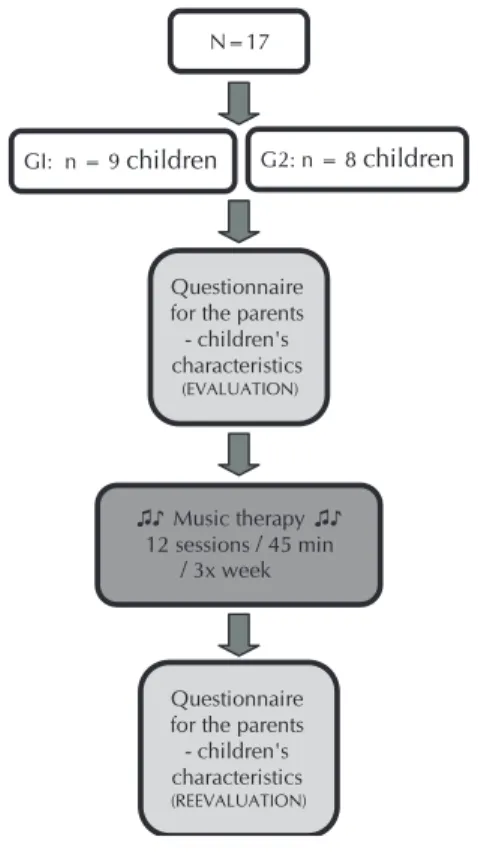
For the execution of the activities, the children were random-ly divided in two groups. This was done to facilitate the devel-opment of the activity and the interaction between the groups. For each group, 12 music therapy sessions were held, lasting 45 minutes per session. Musical instruments (drum, flute, rattle, percussion instruments), nursery rhymes enjoyed by children and a radio with CD were used. The schematic representation of the intervention of music therapy is shown in Figure 1.
Figure 1 - Schematic representation of the intervention of mu-sic therapy
The values of the responses of the children’s parents were accounted before the music therapy sessions (evaluation) and after them (reevaluation). These data were analyzed by the SPSS software (Statistical Package for Social Sciences - 15.0 version). For categorical variables, exploratory analysis (de-scriptive) was performed, from the calculation of simple and crossed frequencies, both in absolute and in percentage terms. The results were organized in tables. For numeric variables, descriptive analyses (mean and standard deviations) were per-formed, and the paired t-test was applied, both before and after music therapy sessions with the same sampling group.
RESULTS
In this study, the ages of the children ranged from 5 to 12 years, with a mean of 8.7 years. Unintentionally, there was a
predominance of males (82.4%) due to the characteristics of the population. The quality of life analysis involved the follow-ing aspects: physical, emotional, social and school capacity.
Physical Capacity
For the Physical Capacity domain, the general evaluation obtained a value of 81.5, and the reevaluation was 80.6 (p = 0.748).
Emotional Capacity
For the Emotional Capacity domain, the general evalua-tion obtained a value of 50.2, and the reevaluaevalua-tion was 66.7 (p = 0.001). In Table 1, the values of the means, standard deviation and the p-value are represented for the emotional capacity domain. This domain has 5 variables. The answers show that variable 1 (to feel afraid or scared) had a mean of 2.3 in the evaluation, and 1.8 in the reevaluation (p = 0.58); variable 2 (to be sad or depressed) reached a mean of 2.1 in the evaluation, and 1.1 in the reevaluation (p = 0.005); vari-able 3 (to be angry) obtained a mean of 2.0 in the evaluation, and 1.7 in the reevaluation (p = 0.096); variable 4 (difficulty sleeping) reached a mean of 2.2 in the evaluation, and 1.4 in the reevaluation (p = 0.014); and variable 5 (to be wor-ried) obtained a mean of 1.1 in the evaluation, and 0.8 in the reevaluation (p = 0.163).
Table 1 - Comparison between the scores of the Emotional Capacity domain through the PedsQL questionnaire, before (evaluation) and after (reevaluation) the music therapy sessions for children with Neuropsychomo-tor Development Delay
Emotional Capacity
(problems with...) Mean
Standard Deviation
p value
1.To feel afraid or scared Evaluation
Reevaluation 2.31.8 ±0.9±0.3 0.58
2.To be sad or depressed Evaluation
Reevaluation 2.11.1 ±0.9±0.7 0.005*
3.To be angry Evaluation
Reevaluation 2.01.7 ±0.8±0.9 0.096
4.Difficulty sleeping Evaluation
Reevaluation 2.21.4 ±1.6±1.4 0.014*
5.To be worried Evaluation
Reevaluation 1.10.8 ±1.2±0.9 0.163
Total 17 17
Note:
* Paired t-test, level of significance 5%
NPMDD = neuropsychomotor development delay; PedsQL = Pediatric Quality of Life questionnaire.
N=17
GI: n = 9 children G2: n = 8 children
Music therapy
♫♪ ♫♪
12 sessions / 45 min / 3x week Questionnaire for the parents - children's characteristics
(EVALUATION)
Questionnaire for the parents - children's characteristics
Social Capacity
For the Social Capacity domain, the general evaluation ob-tained a value of 50.0, and the reevaluation was 53,2 (p = 0.468).
School Capacity
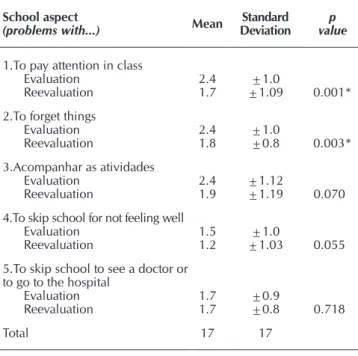
For the School Capacity domain, the general evaluation was of 46.4, and the revaluation was 54.7 (p = 0.007). In Table 2, the values of the means, standard deviation and the p-value are represented for the school capacity domain. This domain has 5 variables. The answers show that variable 1 (to pay attention in class) had a mean of 2.4 in the evaluation, and 1.7 in the reevaluation (p = 0.000); variable 2 (to forget things) reached a mean of 2.4 in the evaluation, and 1.8 in the reevaluation (p = 0.003); variable 3 (to follow the class activities) obtained a mean of 2.4 in the evaluation, and 1.9 in the reevaluation (p = 0.070); variable 4 (to skip school for not feeling well) reached a mean of 1.5 in the evaluation, and 1.2 in the reevaluation (p = 0.055); and variable 5 (to skip school to see a doctor or to go to the hospital) obtained a mean of 1.7 in the evaluation, and 1.7 in the reevaluation (p = 0.718).
Table 2 - Comparison between the scores of the School Capaci-ty domain through the PedsQL questionnaire, applied before (evaluation) and after (reevaluation) the music therapy sessions for children with Neuropsychomotor Development Delay in July and August, 2011
School aspect
(problems with...) Mean
Standard Deviation
p value
1.To pay attention in class Evaluation Reevaluation
2.4 1.7
±1.0
±1.09 0.001*
2.To forget things
Evaluation Reevaluation
2.4 1.8
±1.0
±0.8 0.003*
3.Acompanhar as atividades Evaluation Reevaluation
2.4 1.9
±1.12
±1.19 0.070
4.To skip school for not feeling well Evaluation Reevaluation
1.5 1.2
±1.0
±1.03 0.055
5.To skip school to see a doctor or to go to the hospital
Evaluation
Reevaluation 1.71.7 ±0.9±0.8 0.718
Total 17 17
Note:
* Paired t-test, level of significance 5%
NPMDD = neuropsychomotor development delay; PedsQL = Pediatric Quality of Life questionnaire.
DISCUSSION
The quality of life analysis proposed for this study involved the following aspects: physical, emotional, social and school capacity.
Physical Capacity
The numerical data of this domain show that there was not a significant improvement of QOL of children with NPMDD. This is because the majority of children present minimum mo-tor impairment, featuring an insufficient sample to generate significant relevance in the physical aspect.
Improvement of physical capacity presents distinct results in literature. QOL in children with cerebral palsy shows wors-ening when these children are suffering from more compro-mising physical limitations imposed by the disease, hindering the performance of common activities that other children the same age perform(9). It is believed that the difficulty in
obtain-ing a significant improvement in physical ability is not limited to few music therapy sessions. In addition, it is of great impor-tance the collaboration of other therapists of the staff, such as the doctor, nurse, physiotherapist, occupational therapist, speech therapist, in such a way that there is an effective im-provement of the physical condition of these children, since the physical and muscular activities involve complex brain functions. On the other hand, there are studies which claim that music can help children with special needs to grow their mental or physical boundaries, awakening their perceptive consciousness, hearing development and motor control(10). In
addition, it is known that music favors the development of somatosensory and frontal cortical areas, promoting greater efficiency in the planning and execution of tasks(11).
Emotional Capacity
The numerical data of this domain show that there was a significant improvement of QOL of children with NPMDD. The base of music is the sound. It produces different psychic changes in the person, acting on the individual’s mental and emotional state. Music seems to provoke changes in the con-duct of children with special needs, making them adapt better to school life. It contributes to a better performance in learning activities and socializing with the people surrounding them(12).
Through sound stimuli, music may penetrate the mind and the body, whatever the level of intelligence or the condition of people with special needs. It opens communication channels that extend their possibilities of expression, for whatever their greater impairment, mental, physical or emotional, people with mental deficiency respond to musical stimulus, as much as individuals situated in the range of normality.
The significant improvement in children of this study, con-cerning the emotional aspect, is justified by the fact that the children were receiving music therapy sessions in group. This aided them in the integration and communication process. In a research analyzing the influence of music therapy in people with NPMDD, significant results were obtained regarding the improvement of QOL; development of the capacity of non-verbal communication, self-esteem and self-confidence; de-velopment of the capacity of observation and respect for rules; affirmation and strengthening of the personality; promotion and development of expression, among others(13).
0.005) and in the variable 4 (difficulty sleeping) (p = 0.014). This result is corroborated by recent studies pointing that mu-sic can reduce tension and anxiety caused by stressful situa-tions. In addition, it can contribute to the reduction of pain and improve sleep quality. It is, therefore, a valuable method of distraction(4). Music therapy in pregnant women also proves
to be effective in the process of adaptation of the babies in the first few months of life, improving their sleep pattern(14).
Social Capacity
The numerical data of this domain show that there was not a significant improvement of QOL of children with NPMDD. However, it is believed that as it is a non-verbal language, music facilitates the development of affective, cognitive and social areas, constituting a very important sociological phe-nomenon and becoming a socialization agent.
Despite the non-significant result, behavior change was perceived by researchers, for the children were agitated and uneasy at the beginning of the survey. In the course of the sessions, there were differences in the group, and more in-terest and joy could be noted during the music therapy ses-sions. Thus, we could perceive that music therapy is effective to change the social behavior of the child with special needs. It facilitates the process of speech, communication and vocal-ization, and stimulates the mental process concerning aspects such as conceptualization, symbolism and understanding(15).
In this study, it was observed that some children were shy and did not have a spontaneous verbal communication. How-ever, with the routine of music therapy sessions, and with the trust established by the presence of the researchers during the sessions, the children showed a higher level of interaction and communication. They began to ask for the songs they liked the most, to dance in circles and to sing. This behavior is justi-fied in literature. Music education makes music, movement and language to be presented in a playful and dynamic way, in such a way that the child feels involved and motivated to perform the exercises proposed by the teacher. If a child, for instance, has a problem of language development and can-not speak properly, music, gesture, movement and the orga-nized rhythm of a song facilitate the speech of small sentence fragments. This allows the integration of the child in the class context. The repetition of several creative concepts leads to a learning without fear and inhibitions. Consequently, it devel-ops the self-esteem of the child(12).
The musical experience also acts as a dynamic force of change, facilitating the emotional expression of the subject, his/her communicative development, adaptation and integra-tion to his/her new social reality(15). It is notorious that with the
music therapy sessions there was an improvement throughout the group in the social aspect, despite the non-significant re-sult. Children started to interact with each other, playing musi-cal instruments and teaching one another how to play them, and were vibrating with each song played.
School Capacity
The numerical data of this domain show that there was a significant improvement of QOL of children with NPMDD.
This result reinforces and points to the need of education of children with special needs. The inclusion of children with disabilities in schools is widely discussed around the world, including in Brazil. Not only the inclusion is necessary, but also the integration of children with physical, sensory or men-tal disability in multidisciplinary programs of education that aim to develop their skills. Thus, music therapy becomes an effective method, minimizing the impairment degree of the disease. Hence, it contributes to the inclusion of children with disabilities in both specialized and traditional schools.
Still concerning the School Capacity domain, there was a significant difference in variable 1 (to pay attention in class) (p = 0.000) and variable 2 (to forget things) (p = 0.003). When it comes to children with NPMDD, the learning process becomes more complex as the movement and posture disorders, and com-plications associated with them, interfere in their independence and autonomy. Such factors may hinder the monitoring of school activities. In general, music therapy influenced the learning of the children involved in the survey. At first, most children were dispersed and uneasy, making the first sessions stressful for other children. From the second week, the children showed a signifi-cant improvement in school performance. This can be verified by the report of some educators who are satisfied with the behavior of the children in the classroom, for these children are more fo-cused and improving their school performance in general. This re-sult proves that music seems to provoke changes in the conduct of children with special needs, making them adapt better to school life. It contributes to their social action and improves the achieve-ment of learning activities (12).
The study results show that, among the evaluated domains, there was a significant improvement in the quality of life in the Emotional Capacity and School Capacity domains, dem-onstrating the beneficial effects of music therapy.
As the limitations of the study, you can point the small number of children included. We suggest that future research use a higher sample in size and time of intervention, in order to present full results about the influence of music therapy on the quality of life of children with NPMDD.
Overall, the success of this research was satisfactory ac-cording to reports of mothers whose children participated in the survey. It is believed that music may help children with NPMDD in a differentiated manner by offering motivational resources suitable for the development of attention, memory, communication, motor skills, emotional maturity and social-ization. Although the results achieved are not durable in the absence of music therapy, it is worth mentioning that during its implementation, the families of these children reported a significant improvement in their QOL, which helps, even if temporarily, to promote an improvement in this aspect.
CONCLUSION
children with some kind of mental delay, and acts as a fa-cilitator to minimize their suffering. The scarcity of data on the effectiveness of music therapy on the quality of life of children with NPMDD justifies the conduction of this study.
The successful results in the quality of life promoted by music therapy are considered both in the lives of individuals with the disorder, and in the life of their relatives. Thus, its relevance should be noted both for the academic and the scientific com-munity, but mainly for the clinical environment.
REFERENCES
1. Zanini CRO, Jardim PCBV, Salgado CM, Nunes MC, Ur-zêda FL, Carvalho MVC, et al. Music therapy effects on the quality of life and the blood pressure of hypertensive patients. Arq Bras Cardiol [Internet]. 2009 Nov [cited 2014 Jun 30];93(5):534-540. Available from: http://www.scielo. br/pdf/abc/v93n5/en_a15v93n5.pdf
2. Bergold LB, Alvim NAT. [Therapeutic music as a technology applied to healthcare and to the nursing teaching]. Esc Anna Nery [Internet]. 2009 Jul-Sep [cited 2014 Jun 30];13(3):537-42. Available from: http://www.scielo.br/pdf/ean/v13n3/ v13n3a12.pdf Portuguese
3. Gonçalez DFC, Nogueira ATO, Puggina ACG. O uso da música na assistência de enfermagem no Brasil: uma revisão bibliográfica. Cogitare Enfermagem [Internet] 2008 [cited 2014 Jun 30];13(4):591-96. Available from: http://ojs.c3sl.ufpr.br/ojs/index.php/cogitare/article/ view/13121/8881
4. Taets GGC, Borba-Pinheiro CJ, Figueiredo NMA, Dantas EHM. [Impact of a music therapy program on the stress level of health professionals]. Rev Bras Enferm [Internet]. 2013 May-Jun [cited 2014 Jun 30];66(3):385-90. Available from: http://www.scielo.br/pdf/reben/v66n3/a13v66n3. pdf Portuguese.
5. Miranda LP, Resegue R, Figueiras ACM. [Children and adolescents with developmental disabilities in the pedi-atric outpatient clinic]. J Pediatr (RJ) [Internet]. 2003 May-Jun [cited 2014 May-Jun 30];79(Suppl. 1):S33-S42. Available from: http://www.scielo.br/pdf/jped/v79s1/v79s1a05.pdf Portuguese.
6. Seki NH, Galheigo SM. [The use of music in palliative care: humanizing care and facilitating the farewell]. Inter-face Comun Saúde Educ [Internet]. 2010 Apr-Jun [cited 2014 Jun 30];14(33):273-84. Available from: http://www. scielo.br/pdf/icse/v14n33/a04v14n33.pdf Portuguese.
7. Varni JW, Seid M, Rode CA. The PedsQL: measurement mod-el for the pediatric quality of life inventory. Med Care [Inter-net]. 1999 Feb [cited 2014 Jun 30];37(2):126-39. Available from: http://www.ncbi.nlm.nih.gov/pubmed/10024117
8. Klatchoian DA, Len CA, Terreri MTRA, Silva M, Itamoto C, Ciconelli RM, et al. Quality of life of children and adolescents
from São Paulo: reliability and validity of the Brazilian ver-sion of the Pediatric Quality of Life InventoryTM verver-sion 4.0 Generic Core Scales. J Pediatr (RJ) [Internet]. 2008 Jul-Aug [cited 2014 Jun 30];84(4):308-15. Available from: http:// www.scielo.br/pdf/jped/v84n4/en_v84n4a05.pdf
9. Vasconcelos VM, Frota MA, Pinheiro AKB, Gonçalves MLC. Percepção de mães acerca da qualidade de vida de crianças com paralisia cerebral. Cogitare Enferm [In-ternet]. 2010[cited 2014 Jun 30];15(2):238-44. Available from: http://ojs.c3sl.ufpr.br/ojs/index.php/cogitare/article/ view/17853/11648
10. Pérez EP, Remón YP. [Musicotherapy applied to children with Down’s syndrome]. Rev Cubana Pediatr [Internet]. 2011 Apr-Jun [cited 2014 Apr-Jun 30];83(2):142-8. Available from: http:// scielo.sld.cu/pdf/ped/v83n2/ped03211.pdf Spanish.
11. Rocha VC, Boggio PS. [A neuroscientific perspective on music]. Per Musi [Internet]. 2013 Jan-Jun [cited 2014 Jun 30];27:132-40. Available from: http://www.scielo.br/pdf/ pm/n27/n27a12.pdf Portuguese.
12. Albornoz Y. Emoción, música y aprendizaje significativo [Emotion, music and meaningful learning]. Educere [Internet]. 2009 Jan-Mar [cited 2014 Jun 30];13(44):67-73. Available from: http://www.redalyc.org/articulo.oa?id=35614571008 Spanish.
13. Batanero JMF, Rogão MC. [The influence of John Bean’s music therapy method and of music therapy in general in body spatial representation in people with cerebral palsy (2004-2010)]. Rev Bras Educ Espec [Internet]. 2010 Sep-Dec [cited 2014 Jun 30];16(3):343-58. Available from: http:// www.scielo.br/pdf/rbee/v16n3/v16n3a03.pdf Portuguese.
14. Tabarro CS, Campos LB, Galli NO, Novo NF, Pereira VM. Effect of the music in labor and newborn. Rev Esc Enferm USP [Internet]. 2010 Jun [cited 2014 Jun 30];44(2):441-8. Available from: http://www.scielo.br/pdf/reeusp/v44n2/ en_29.pdf.