Maria Cecilia Toffoletto
I, Ricardo Luis Barbosa
II, Rafaela Andolhe
III,
Elaine Machado de Oliveira
IV, Adriana Janzantte Ducci
V, Katia Grillo Padilha
VII Universidad Andrés Bello, Facultad de Enfermería. Santiago, Chile.
II Universidade Federal de Uberlândia, Instituto de Geografi a. Monte Carmelo, Minas Gerais, Brazil.
III Universidade Federal de Santa Maria, Department of Nursing. Santa Maria, Rio Grande do Sul, Brazil.
IV Universidade de São Paulo, School of Nursing. São Paulo, Brazil.
V Hospital Bandeirantes. São Paulo, Brazil.
VI Universidade de São Paulo, School of Nursing, Department of Medical-Surgical Nursing. São Paulo, Brazil.
How to cite this article:
Toffoletto MC, Barbosa RL, Andolhe R, Oliveira EM, Ducci AJ, Padilha KG. Factors associated
with the occurrence of adverse events in critical elderly patients. Rev Bras Enferm [Internet]. 2016;69(6):977-83. DOI: http://dx.doi.org/10.1590/0034-7167-2016-0199
Submission: 05-23-2016 Approval: 06-14-2016
ABSTRACT
Objective: to identify the factors associated with the occurrence of adverse events in critical elderly patients admitted to intensive care unit according to demographic and clinical characteristics. Method: a retrospective cohort study was conducted in nine units of a teaching hospital. Data were collected from medical records and from monitoring of nursing shift change. We used the t-test/Mann-Whitney, chi-square and logistic regression to test associations. Signifi cance level of 5% was used. Results: out of the 315 elderly, 94 experienced events. Those who experienced events were men (60.6%) with mean age of 70.7 years, length of hospital stay of 10.6 days and survivors (61.7%). Most of the 183 events were clinical processes and procedures (37.1%). There was an association between adverse event and length of hospital stay in the unit (p=0.000; OR=1.10, 95% CI [1.06, 1.14]).
Conclusion: the identifi cation of associated events and factors in the elderly subsidize the prevention of these occurrences before the vulnerability of this age group.
Descriptors: Aged; Intensive Care Units; Patient Safety; Nursing Care; Workload.
RESUMO
Objetivo: identifi car os fatores relacionados à ocorrência de eventos adversos em pacientes idosos críticos internados em Unidade de Terapia Intensiva segundo características demográfi cas e clínicas. Método: estudo de coorte retrospectivo realizado em nove unidades de um hospital universitário. Os dados foram coletados dos prontuários e do acompanhamento de passagens de plantão de enfermagem. Utilizou-se o Teste-t/Mann-Whitney, Qui-quadrado e Regressão Logística para verifi car associações. Nível de signifi cância de 5%. Resultados: do total de 315 idosos, 94 sofreram eventos. Os que sofreram eventos eram homens (60,6%), com média de idade de 70,7 anos, permanência de 10,6 dias e sobreviventes (61,7%). Dos 183 eventos, houve predomínio do tipo processo clínico e procedimento (37,1%). Houve associação entre evento adverso e tempo de permanência na unidade (p=0,000; OR=1,10; IC95%=[1,06;1,14]). Conclusão: a identifi cação dos eventos e fatores associados no idoso subsidiam a prevenção dessas ocorrências perante as vulnerabilidades dessa faixa etária.
Descritores: Idoso; Unidades de Terapia Intensiva; Segurança do Paciente; Cuidados de Enfermagem; Carga de Trabalho.
Factors associated with the occurrence of adverse events
in critical elderly patients
Fatores relacionados à ocorrência de eventos adversos em pacientes idosos críticos
Maria Cecilia Toffoletto E-mail: [email protected] CORRESPONDING AUTHOR
INTRODUCTION
Between 2000 and 2050, the proportion of people over 60 years old will double from 11% to 22%(1). Associated with
ag-ing, multi morbidity is characterized by a combination of dis-eases with a variety of implications, including the poor quality of life, disability, high utilization of health care, hospitaliza-tion, high public spending on health and mortality(2).
The high utilization of health care for the elderly in health institutions, specifically in the Intensive Care Unit (ICU) is evidenced by the increasing mean age in these units(3-7),
rais-ing concerns of health professionals with real effectiveness of treatment and care for this age group(7).
The literature claims that elderly in the ICU have mean age of 75.8 years. They are coming mostly from emergency services, mainly hospitalized for clinical changes, and high length of stay in the unit, with mean of 13.9 days(8). Regarding
mortality, a study conducted in the Netherlands, in ICUs of 21 universities found an overall mortality of 31.3%, with a mean age of 83.4 years in this cohort(9).
Studies have shown that, in health care, the elderly are the protagonists in the occurrence of adverse events (AEs)(10-13)
which, according to the World Health Organization (WHO), are defined as incident or circumstance that causes significant and unnecessary damage to the patient(14). Among the AE,
med-ication administration errors(10,15-16), falls(11,17) unscheduled
re-moval of therapeutic artifacts(10,15-16) and pressure ulcers(18) have
a higher prevalence and are directly related to nursing care. Regarding mortality and the occurrence of these events, a prospective study conducted in an ICU in France with 18 beds showed that the most serious AE occurred in elderly patients with greater lengths of hospital stay and invasive ventilation time in the ICU. They also noted that the preventable deaths were associated with AE(13).
The literature shows how factors related to the occurrence of adverse events increased nursing workload, hospital costs and length of hospital stay(19-20). However, evidence
specifi-cally related to the elderly and the impact of AE on the clinical status and mortality are still incipient.
Thus, in the context of increasing population and increased use of more complex health resources, such as the ICU,
interest in objectively investigate the factors associated with the occurrence of AE is justified not only by the theoretical gap, but provide subsidies for follow-up and monitoring of patients before the characteristics of this age group. Therefore, this research aims to identify the factors related to the occur-rence of adverse events in critical elderly ICU patients accord-ing to demographic and clinical characteristics.
METHODS
Ethical aspects
The project was approved by the Research Ethics Commit-tee of the Hospital Research Projects Analysis.
Design, study site and period
This is a retrospective cohort study conducted in nine ICUs specialties (Surgical, Medical Clinic, Medical Emergency Clin-ic, Infectious Disease, Nephrology, Neurology, Pulmonary Medicine, Trauma and Burns), a public hospital of high com-plexity, located in São Paulo, Brazil, which together account for approximately 75 beds of intensive care in the months of September, October and November 2012.
Population or sample: inclusion and exclusion criteria
In this investigation, the non-probabilistic sample was com-posed of 315 elderly hospitalized in ICUs, aged over 60 years, of any medical specialty, undergoing medical or surgical treat-ment, with a minimum length of stay of 24 hours in ICUs.
Study protocol
Data collection was performed through the analysis of medical records of patients and monitoring of a random sam-ple of 10% shift change of the period, randomized by date, shifts and ICU. The hours of morning, afternoon and night corresponded to the standard in the units, that is, 7, 13 and 19 hours, and included a total of 390 shift changes.
The analysis of the medical records was performed by a group of analysts, composed of fifteen nurses, previously trained by the researches, and two specialist nurses in inten-sive care. To collect the data, each analyst received a set of medical records related to the ICU in PDF format, scanned
RESUMEN
Objetivo: identificar los factores relacionados con el acaecimiento de eventos adversos en pacientes críticos de edad avanzada según características demográficas y clínicas, internados en Unidades de Terapia Intensiva. Método: estudio de corte retrospectivo realizado en nueve unidades de un hospital universitario. Se recolectaron datos de los prontuarios y del acompañamiento de la guardia de enfermería. Las asociaciones se comprobaron mediante la Prueba de Mann-Whitney, la distribución de Pearson (ji cuadrado) y la Regresión Logística. El nivel de significación fue del 5%. Resultados: sufrieron eventos 94 personas mayores del total de 315, siendo del sexo masculino el 60,6%, con edad promedio de 70,7 años, permanencia de 10,6 días y sobrevivencia del 61,7%. De los 183 eventos, predominó el proceso clínico y el procedimiento (37,1%). Se observó que el evento adverso y el tiempo de permanencia en la unidad estaban relacionados (p=0,000; OR=1,10; IC95%=[1,06;1,14]). Conclusión: la identificación de los eventos y de los factores asociados a la vejez auxilia en la prevención de dichos sucesos frente a la vulnerabilidad de ese grupo de edad.
by 14 technicians from the Department of Medical Records (DMR) of the institution, duly authorized.
For the storage and organization of data, a specialist in In-formation Technology (IT) developed and implemented a sys-tem with a SQL (Structured Query Language) database hosted in a database server of the School of Nursing at the
Univer-sidade de Sao Paulo. This system is called Universal, and it
has been installed on the personal computer of each of the collectors (analysts) of the study, who were previously trained for their management, which access was performed through their login and individual password. In this database, analysts fulfilled information regarding patient identification, severity parameters, therapeutic interventions and events with/without damage (AE) under the WHO taxonomy(14).
Regarding the shift change, the data were collected by trained tutors, nurses and nursing graduates who accompanied the shift of a pre-determined team, considering the unit and time, these were randomized and nursing professionals reports were recorded by hand. Subsequently, the reports produced were sent by email to the researchers, who performed the data analysis and classification of AE, entering them in the database.
For the analysis of AE we used the International Classifica-tion for Patient Safety (ICPS) of the World Health OrganizaClassifica-tion (WHO)(14).
In order to standardize the identification and classification of AE after consensus among researchers and nurses, it has developed a handbook with the description and classification of possible situations considered incidents and AE.
The dependent variable, AE was defined according to WHO(14) as an incident that causes injury or death to a patient.
The types of events, according to the same organization, were classified in the following categories: clinical management; clinical process/procedure; documentation; healthcare-asso-ciated infection; medication/IV fluids; blood/blood products, nutrition, oxygen/gas/vapour, medical device/equipment, be-havior, patient accidents, infrastructure/building/fixtures, and resources/organizational management. It is noteworthy that all AE identified were considered for the analysis in the medical records and recorded in the shift change, duplicates that oc-curred during the stay of the elderly in ICUs were excluded.
Also according to the WHO(14), the variables type of AE and
degree of harm were classified respectively as pathophysiol-ogy, injury and other and degree of harm as: mild, moderate and severe. For purposes of this study the AE considered were those with degree of moderate and severe harm.
The independent variables related to the elderly were: gender (male/female), age (in years), length of stay (full days in the ICU), nursing workload obtained through the Nursing Activities Score instrument (NAS score), probability of death obtained by the instrument Simplified Acute Physiology Score II (score SAPS II), comorbidities obtained through the Charls on comorbidity score (score ICC), origin to the ICU of critical areas (operating room, emergency room, another ICU, hemo-dynamics) and noncritical areas: outpatient, inpatient unit, an-other hospital and discharge condition (survivor/no survivor). We should note that the NAS instrument is designed to measure the nursing workload, according to the care needs
presented by patients. With a maximum score of 176.8%, cal-culated by the total score of NAS, resulting from the sum of the items scored, expressed by the percentage of time spent by the nursing staff in assisting the patient in critical condition(21).
Analysis of results and statistics
The data were analyzed by the Statistical Package for Social Sciences (SPSS) version 18.0. The variables were described as absolute and relative frequencies, mean and standard deviation (SD). For the analysis of groups that have experienced or not AE we applied the chi-square test and t-test when the Levene test indicated homogeneity of variance, and the Mann-Whitney test, when the Levene test indicated no homogeneity of vari-ances. Logistic regression with Backward strategy for the selec-tion of variables was used to analyze the associaselec-tion between sociodemographic and clinical variables of the elderly and the moderate and severe AE. The significance level used was 5%.
RESULTS
From the 315 elderly, 221 (70.2%) did not experience any kind of moderate and severeAE, while 94 (29.8%) participants were victims of such occurrences. This group of patients (94), most (57- 60.63%) were male, which was also observed in the group of elderly who have experienced such AE (114-51.6%).
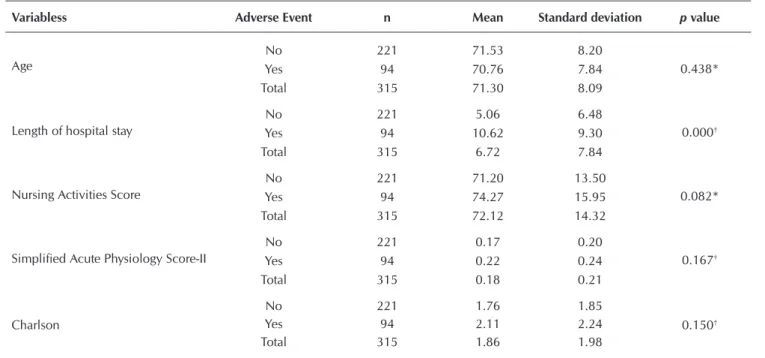
It is observed in Table 1 that mean age of the total sample is 71.30 years and a mean of 70.76 in the group that did not expe-rience moderate and severe AE and 71.53 years in the group that underwent this type of incident. Regarding length of stay in the ICU, the elderly who experienced AE had a mean length of stay of 10.62 days, greater than the mean of 5.06 days of elderly who experienced moderate and severe AE. It was also higher in the elderly who have experienced AE, NAS mean score (74.27%), the likelihood of death (22%) and the Charlson mean score(2,11)
compared with those who did not experience AE (71.20%, 18% and 1.76, respectively). Despite these findings, there was no significant difference between the groups for age (p=0.438), NAS (p=0.082), SAPS II (p=0.167) and Charlson (p=0.150), but rather for the variable length of stay in the ICU (p=0.000).
Among the patients who experienced events, 44 (46.8%) proceeded to critical stage and 36 (38.3%) died, different pro-portions from the group that did not experience AE, with 73 (33.1%) coming from the critical area and 53 (24.0%) with-out survivors. There was a significant difference between the groups for the variables admission to the ICU (p=0.021) and discharge (p=0.010) (Table 2).
As for AE, the total of 94 elderly experienced 183 moderate and severe AE, with mean of 1.95 AE per patient.
It is observed in Table 3 that moderate and severe AE were related to clinical process/procedures with 37.1% (68), fol-lowed by patient accidents (57- 31.1%) and healthcare-associ-ated infection (45-25.5%).
Table 4 shows the total of AE, the types of harm in de-scending order were: pathophysiological harm (54.7%), in-jury (39.3%) and other (6.0%).
Table 1 – Comparison of sociodemographic and clinical variables among the elderly who have experienced/not experienced moderate or severe adverse events in the Intensive Care Unit, Sao Paulo, Brazil, 2012
Variabless Adverse Event n Mean Standard deviation p value
Age
No 221 71.53 8.20
0.438*
Yes 94 70.76 7.84
Total 315 71.30 8.09
Length of hospital stay
No 221 5.06 6.48
0.000†
Yes 94 10.62 9.30
Total 315 6.72 7.84
Nursing Activities Score
No 221 71.20 13.50
0.082*
Yes 94 74.27 15.95
Total 315 72.12 14.32
Simplified Acute Physiology Score-II
No 221 0.17 0.20
0.167†
Yes 94 0.22 0.24
Total 315 0.18 0.21
Charlson
No 221 1.76 1.85
0.150†
Yes 94 2.11 2.24
Total 315 1.86 1.98
Note: *t test; †Mann-Whitney
Table 2 – Chi-square test for the variables admission and discharge status among the elderly who have experienced/not experi-enced moderate or severe adverse events in the Intensive Care Unit, São Paulo, Brazil, 2012
Variables
Adverse Event
No Yes
n % n % p
Admission Notcritical 148 66.9 50 53.2
Criticalstage 73 33.1 44 46.8 0.021
Total 221 100 94 100
Survival 168 76.0 58 61.7
Discharge No survivor 53 24.0 36 38.3 0.010
Total 221 100 94 100
Table 3 – Distribution of types of moderate and severe ad-verse events experienced by elderly in the Intensive Care Unit, São Paulo, Brazil, 2012
Types of moderate and severe adverse events n %
Clinical process/procedure 68 37.1 Patient accidents 57 31.1 Healthcare-associated infection 45 24.5 Clinicaladministration 6 3.2 Medication/IV or fluids for administration 4 2.5 Medical device/equipment 2 1.1 Resources/organizational management 1 0.5
Total 183 100
Table 4 – Distribution of type of harm and moderate and se-vere adverse events experienced by elderly patients in the Intensive Care Unit, São Paulo, Brazil, 2012
Typeofharm n %
Physiopatology 100 54.7
Injury 72 39.3
Other 11 6.0
As data from Table 5, in the logistic regression model, the length of hospital stay in the ICU was the only variable that was associ-ated with the occurrence of moderate and severe AE. Each extra day of ICU stay increased by 10.0% (p=0.000; OR=1.10, 95% CI [1.06, 1.14]) the chance of an elderly patient to experience moder-ate and severe AE during hospitalization in the unit (Table 5).
DISCUSSION
The results of this study with respect to demographic and clinical variables of ICU elderly corroborate evidence from oth-er investigations related to this type of participants(3,6,8-9,12,22-24).
Most were males (60.6%), slightly above the results of studies that found more homogeneous distribution between genders, with prevalence of 56.3%(10) and 54.10%(22).
Regard-ing age, similar results are found in the literature, with means ranging from 72.2 to 83.4 years(6,8-9,23). The dilemma of the
elderly age in the ICU and therefore decisions on the cost-effectiveness of the treatment have been a subject of contro-versy in the literature. One study reported that age explains only a small part of the increase in mortality, which suggests that the functionality, pathological and cognitive conditions associated should be considered for prediction(24).
Concerning the length of hospital stay, there was a total mean of 6.72 days of stay in the ICU, while the elderly who experienced AE showed a higher length of stay of 10.62 days compared with the mean 5.06 days of elderly who did not ex-perience AE. This result draws attention, since study of elderly patients who experienced AE found that these remained less time hospitalized (8.9 days)(16).
Regarding the nursing workload, there was a mean NAS score higher in the elderly who have experienced AE com-pared to those who did not experience them, although they did not present significant differences. Studies on AE and nurs-ing workload carnurs-ing adult patients corroborate the results of this study. Research that analyzed AE and workload found a mean NAS score of 70.03%(5). On the other hand, research
that analyzed the workload in patients who did not undergo AE and incidents found a lower score of 66.5%(22).
Groups of elderly who have experienced and have not ex-perienced AE showed very similar results regarding critical and non-critical areas. In this sense, a Brazilian study devel-oped in general ICUs showed that most patients admitted at the ICU come from critical units such as Emergency and Sur-gical Center(3), which indicates the importance of new studies
that analyze this variable in depth to assess its association with moderate and severe AE.
Mortality of elderly in the ICU is addressed in several stud-ies(3,6-7,9). In this study, 38.3% of the elderly who experienced
moderate and severe AE died. Contrasting, one study conduct-ed in the Netherlands with elderly from 21 universities ICU found lower overall mortality of 31.3%(9).
Although in this study the mortality did not present associa-tion with AE, it is observed that the elderly who have experienced AE had higher mean length of stay in the ICU, greater likelihood of death, greater severity, higher NAS’ means core and higher Charlson’s means core compared to elderly who did not experi-ence AE, which could justify the high mortality in this group.
The types of AE most prevalent were related to clinical processes and procedures, accidents with patients and infec-tions. Although the details of moderate and severe AE related to clinical processes and procedures in this study have not been explored, problems were identified related to intubation (unscheduled withdrawn of endotracheal tube), the lack of performance of tests performed (blood glucose, blood tests) and care with catheters and drains (unscheduled withdrawals, poorly positioned drains).
A Mexican study that analyzed hospital AE in adults by age and gender corroborates the results of this investigation, as it was observed a higher proportion of moderate and severe events related to clinical processes and procedures related to the elderly and characterized by therapeutic interventions(12).
Regarding patients accidents, pressure ulcers were the most frequent among hospitalized elderly. A study analyzing the risk factors for pressure ulcer development in adult patients found a higher mean age among patients who developed ul-cers compared to those without such lesions, demonstrating the possibility of having them with increasing age(18).
AE related to drug administration showed a low prevalence in this study; however, it is noteworthy that we considered only moderate and severe events which affected the elderly. A study shows that the total number of incidents (with and without harm), medication administration errors are the most frequent ones; however, it is not always they cause harm to patients(19).
From the types of damage found, the pathophysiological type was present in 54.7% of the elderly. The pathophysiolog-ical harm is a major cause of clinpathophysiolog-ical instability and are mainly related to the increased length of stay and risk of infection(14).
In this study, the degree of harm, understood as the sever-ity, duration and therapeutic implications derived from an event that was predominantly moderate. Before the presenta-tion of symptoms and consequent need for intervenpresenta-tions, the risk of longer hospital stays and other complications can result in permanent or long-term harm for the elderly(14).
As to the factors of the elderly associated with moderate and severe AE in the ICU, the regression analysis showed that only the length of stay in ICU (10.41 days) was associated with the events, explaining that each day of stay increased the chances of patients to experience AE at almost 11.0%.
It is observed in the literature that increasing length of hos-pital stay before the occurrence of adverse events is a known variable(13,16,22). A French prospective study in an ICU with
18 beds showed that the most serious AE occurred in elderly patients with greater stay and duration of invasive ventilation
Table 5 – Logistic regression of gender, age, discharge and
length of stay factors in the Intensive Care Unit and adverse events, São Paulo, Brazil, 2012
Variable Beta Odds Ratio 95% CI p value
REFERENCES
1. Organização Mundial de Saúde (OMS). Envelhecimento e ciclo de vida. [Internet]. 2015[cited 2015 Jul 14]. Avail-able from: http://www.who.int/ageing/about/facts/es/ 2. Boeckxstaens P, De Graaf P. Primary care and care for
older persons: position paper of the European Forum for Primary Care. Qual Prim Care [Internet]. 2011[cited 2015 Jul 14];19(6):369–89. Available from: http://www.ncbi. nlm.nih.gov/pubmed/22340900
3. Oliveira VCR, Nogueira LS, Andolhe R, Padilha KG, Sousa RMC. Clinical evolution of adult, elderly and very elderly patients admitted in Intensive Care Units. Rev Latino-Am Enfermagem [Internet]. 2011[cited 2015 Jul 14];19(6):1344-51. Available from: http://www.scielo.br/ pdf/rlae/v19n6/pt_10.pdf
4. Ciampone JT, Gonçalves LA, Maia FOM, Padilha KG. [Nurs-ing care need and therapeutics interventions in Intensive Care Unit: a comparative study among elderly and non-el-derly patients]. Acta Paul Enferm [Internet]. 2006[cited 2015 Jul 14];19(1):28-35. Available from: http://www.scielo.br/ pdf/ape/v19n1/a05v19n1.pdf Portuguese.
5. Gonçalves LA, Garcia PC, Toffoleto MC, Telles SCR, Padi-lha KG. [The need for nursing care in Intensive Care Units: daily patient assessment according to the Nursing Activities Score (NAS)]. Rev Bras Enferm [Internet]. 2006[cited 2015
Jul 14];59(1):56-60. Available from: http://www.scielo.br/ pdf/reben/v59n1/a11v59n1.pdf
6. Kelly DM, Kutney-Lee A, McHugh MD, Sloane DM, Aiken LH. Impact of critical care nursing on 30-day mortality of mechanically ventilated older adults. Crit Care Med [Inter-net]. 2014[cited 2015 Jul 14];42(5):1089-95. Available from: https://www.ncbi.nlm.nih.gov/pmc/articles/PMC3993087/ pdf/nihms570089.pdf
7. Avelino-Silva TJ, Farfel JM, Curiati JAE, Amaral JRG, Cam-pora F, Jacob-Filho W. Comprehensive geriatric assess-ment predicts mortality and adverse outcomes in hospi-talized older adults. BMC Geriatrics. 2014;14:129. 8. Sousa CR, Goncalves LA, Toffoletto MC, Leao K, Padilha
KG. Predictors of nursing workload in elderly patients ad-mitted to intensive care units. Rev Latino-Am Enfermagem [Internet]. 2008[cited 2015 Jul 14];16(2):218-23. Avail-able from: http://www.scielo.br/pdf/rlae/v16n2/08.pdf 9. Rooij SE, Abu-Hanna A, Levi M, Jonge E. Identification of
high-risk subgroups in very elderly intensive care unit pa-tients. Crit Care [Internet]. 2007[cited 2015 Jul 14];11(2):R33. Available from: http://ccforum.biomedcentral.com/articles/ 10.1186/cc5716
10. Nascimento CCP, Toffoletto MC, Gonçalves LA, Freitas WG, Padilha KG. Indicators of healthcare results: analysis in the ICU(13). Another study that identified AE in medical
re-cords in hospitalized elderly from two wards found a signifi-cant difference in length of hospital stay between cases where there was event registries(16).
Although mortality and nursing workload have not shown association with AE in this study, despite the methodological differences and different ways of grouping these, the literature shows mixed results. A US study examined the association between mortality and AE in 300 critical adult patients, they found that 6.1% of deaths and 36% of the events were pre-ventable and that the deaths were associated with AE(13).
Re-garding nursing workload, a study conducted in two Brazilian ICUs found that the mean of AE occurrences in the appropri-ate allocations of nurses was lower compared to inadequappropri-ate with a statistically significant difference of 0.000(25).
However, more robust evidence about the AE with the el-derly and the impact of these events on clinical outcomes and nursing care are still incipient.
In short, the length of hospital stay in the ICU was the only factor associated with the occurrence of adverse events in this sample, reiterating the evidence already documented, show-ing the need for careful evaluation of the elderly patient with a view to discharge. As shown in this study, reducing the ICU length of stay is an important measure for prevention of mod-erate and severe AE, besides reducing the cost.
Thus, in the context of an aging population, objectively evaluation of the behavior of these events was justified not only by the theoretical gap, but to provide support in tracking and monitoring characteristics of this age group.
A limitation of this study was performing the study in a single institution, the WHO classification complicated the comparison and exploitation of AE studies that had used the same classification. Regardless, a more detailed exploratory analysis about each type of moderate and severe AE found in-critical care elderly is recommended for further studies. Also, the incipient evidence about AE in this population and the impact of AE on the clinical progression and mortality in this group of patients were other limitations for the comparison of the results with the literature.
CONCLUSION
The development of this study allowed us to conclude that ICU length of stay was the only variable that was associated with the occurrence of moderate and severe AE with elderly patients admitted to the ICU. Each day of stay increased the chance of a patient experiencing AE in 10.0%.
Contrary to what the evidence shows, the variables age, workload and mortality were not significantly associated with the AE.
Regardless, a more detailed exploratory analysis about each type of moderate and severe AE found in critical care elderly is recommended for further studies.
of adverse events during hospital stays. Rev Latino-Am En-fermagem [Internet]. 2008[cited 2015 Jul 14];16(4):746-51. Available from: http://www.scielo.br/pdf/rlae/v16n4/15.pdf
11. Paiva MCMS, Paiva SAR, Berti HW, Campana AO. Char-acterization of patient falls according to the notification in adverse event reports. Rev Esc Enferm USP [Internet]. 2010[cited 2015 Jul 14];44(1):134-8. Available from: http://www.scielo.br/pdf/reeusp/v44n1/en_a19v44n1.pdf 12. Egan LAV, Suárez JR. Analysis of adverse events in hospi-tal facilities in adults by age and gender. Rev Conamed. 2012;17(3):109-13.
13. Ksour H, Balanant PY, Tadié JM, Heraud G, Abboud I, Le-rolle N, et al. Impact of morbidity and mortality conferenc-es on analysis of mortality and critical events in intensive care practice. Am J Crit Care [Internet]. 2010[cited 2015 Jul 14];19(2):135-45. Available from: http://ajcc.aacnjournals. org/content/19/2/135.long
14. World Health Organization (WHO). The conceptual fra-mework for the international classification for patient safety v1.1: final technical report and technical annexes [Internet]. 2009[cited 2015 Jul 14]. Available from: http://www.who. int/patientsafety/taxonomy/icps_full_report.pdf
15. Pedreira LC, Brandao AS, Reis AM. [Adverse event in el-derly patients in Intensive Care Unit]. Rev Bras Enferm [In-ternet]. 2013[cited 2015 Jul 14];66(3):429-36. Available from: http://www.scielo.br/pdf/reben/v66n3/a19v66n3.pdf Portuguese.
16. Santos JC, Ceolim MF. Nursing iatrogenic events in hos-pitalized elderly patients. Rev Esc Enferm USP [Internet]. 2009[cited 2015 Jul 14];43(4):810-7. Available from: http://www.scielo.br/pdf/reeusp/v43n4/en_a11v43n4.pdf 17. Inoue KC, Matsuda LM, Melo WA, Murassaki ACY, Hay-akawa LY. Risk of falling out of bed: nursings challenge for the patients safety. Invest Educ Enferm [Internet]. 2011[cited 2015 Jul 14];29(3):459. Available from: http:// www.scielo.org.co/scielo.php?script=sci_arttext&pid =S0120-53072011000300015
18. Fernandes LM, Caliri MHL. Using the braden and glasgow scales to predict pressure ulcer risk in patients hospital-ized at intensive care units. Rev Latino-Am Enfermagem [Internet]. 2008[cited 2015 Jul 14];16(6):973-8. Available from: http://www.scielo.br/pdf/rlae/v16n6/06.pdf 19. Toffoletto MC, Padilha KG. [Consequences of medical
er-rors in intensive and semi-intensive care units]. Rev Esc En-ferm USP [Internet]. 2006[cited 2015 Jul 14];40(2):247-52. Available from: http://www.scielo.br/pdf/reeusp/v40n2/12. pdf Portuguese.
20. Rozenfeld S, Giordani F, Coelho S. Adverse drug events in hospital: pilot study with trigger tool. Rev Saúde Públi-ca [Internet]. 2013[cited 2015 Jul 14];47(6):1-9. Available from: http://www.scielo.br/pdf/rsp/v47n6/en_0034-8910-r sp-47-06-01102.pdf
21. Miranda DR, Nap R, Rijk A, Schaufeli W, Iapichino G. Nursing Activities Score (NAS). Crit Care Med. 2003;31(2):374-82.
22. Andolhe R. Segurança dos pacientes em Unidades de Te-rapia Intensiva: estresse, coping e burnout da equipe de enfermagem e ocorrência de eventos adversos e incidentes. [Tese]. São Paulo (SP): Escola de Enfermagem, Universidade de São Paulo; 2013.
23. Szlejf C, FarfelJM, CuriatiJÁ, JuniorEBC, Jacob-Filho W, AzevedoRS. Medical adverse events in elderly hos-pitalized patients: a prospective study. Clinics [Internet]. 2012[cited 2015 Jul 14];67(11):1247-52. Available from: http://www.scielo.br/pdf/clin/v67n11/a04v67n11.pdf 24. Boumendil A, Somme D, Garrouste-Orgeas M, Guidet B.
Should elderly patients be admitted to the intensive care unit? Cuidados Intensivos Med [Internet]. 2007[cited 2015 Jul 14];33(7):1252-62. Available from: http://link.springer. com/article/10.1007%2Fs00134-007-0621-3