MUSCLE DAMAGE AND IMMUNOLOGICAL PROFILE
IN THE IRONMAN BRAZIL TRIATHLON
ORIGINAL ARTICLE
EXERCISE AND SPORTS MEDICINE CLINIC
Lourenço Sampaio de Mara1
Tales de Carvalho1
Alexandra Amin Lineburger1
Ricardo Goldfeder1
Roberto Melo Lemos1
Leila Brochi1
1. University of Santa Catarina State – Florianópolis Health and Sports Sciences Center – Florianópolis, SC, Brazil.
Mailing address:
Rua Pascoal Simone, 358, Coqueiros - 88080-350 – Florianópolis, SC, Brasil. [email protected]
ABSTRACT
Introduction: The Ironman triathlon is characterized as an activity of long duration in which acute organic changes are present. The objective of this study was to investigate the relationship between muscle damage and immune system. Methods: Blood samples were obtained from 21 athletes at three different times: 2 days before (pre), immediately after (post) and 6 days after the event (6 days post). The creatine kinase (CK), total leukocytes, lymphocytes, lymphocyte subtypes CD4+ and CD8+ variables were independently assessed, as well as the CD4+ / CD8+ ratio. Additionally, the CK correlation as a marker of muscle damage with the other variables was studied. Results: Significant results observed were: leukocytes pre (6,242.9 mm3; SD: 1,233.3) and post (mean: 18,398.1 mm3; SD: 3,904.0; p< 0.0001), post (mean: 18,398.1 mm3; SD: 3,904.0) and 6 days post event (mean: 6,396.4 mm3; SD: 1299.8; p< 0.0001), CK pre (mean: 173.2 U/l; SD: 103.7) and post (2339.4 U/l; SD: 1729.0; p< 0.0001), CK pre (mean: 173.2 U/l; SD: 103.7) and 6 days post (mean: 368.1 U/l; SD: 274.4; p< 0.0053), CK post (mean: 2339.4 U/l; SD: 1729.0) and 6 days post (mean: 368.1 U/l; DP: 274.4; p< 0.0003), CD4+ / CD8+ pre (mean: 1.9; SD: 0.8) and 6 days post (mean: 2.4; SD: 1.1: p<0.00032). Conclusion: There was muscle damage immediately after the event and improvement in immune profile on the sixth day after the event.
Keywords: creatine kinase, lymphocytes, leukocytes, triathlon.
INTRODUCTION
The Ironman triathlon is a long duration event of 226 km,
com-posed of 3.8 km of swimming, 180 km of cycling and 42.195 km of running with duration range between a bit more than eight hours, which is the time of the first places, and 17 hours, maximal permitted time to finish the event.
The Brazilian phase of the Ironman has been held in Flo-rianópolis, the capital city of Santa Catarina state, since 2001, when 498 athletes participated in the event. Since then, the event has exponentially grown and in 2011 the total number of participants was 1,822. However, the number of enrollments does not supply the real demand, since the 2,000 enrollments made available for 2012 finished in only 14 minutes, which left many athletes out.
In events with duration longer than four hours, organic and psychological alterations are factors which present great in-fluence on the athletic performance and in the onset of health problems1,2. Previous studies have demonstrated the influence
of long- duration physical exercise in the immune function, in-cluding populations of leukocytes, T lymphocytes and natural killer cells (NK)3,4, and induction of muscle damage and systemic
inflammatory response5,6.
Muscle damage, verified in prolonged activities, such as the Iron-man triathlon, is aassociated with increase of the CK levels7,
inter-leukins release (IL)s, and consequently modulation of the immune system. It is suggested that immunological and hormone alterations occur due to training of great volume and intensity, which, associated with the stress caused by the competition, may be perceived after the event8. These alterations may cause immunodepression9, with change
in the number of neutrophils and alterations in the proportion of the subtypes of lymphocytes, being able to cause increase of the susceptibility to infections, commonly in the upper respiratory tract9.
The aim of this study was to verify the onset of muscle damage and its relation with muscle damage and its correlation with the immu-nological profile in the Ironman triathlon Brasil athletes.
METHODS
Initially, 23 amateur athletes members of a triathlon team from Florianópolis, with two female and 21 male subjects, were invited to participate in the study. During the collection period, to individuals were excluded due to have missed two out of the three scheduled blood collections.
The present research project was approved by the Ethics Com-mittee of the institution where the study was conducted. A post--clarified consent form was presented to the subjects according to protocol from 16/05.
Blood collections –Blood collection of 10 ml was performed in three distinct moments: two days before the event (pre), im-mediately after the end of the event (post) and six days after the event (six days after). 21 athletes out of the total of participants were submitted to blood collection only in the first and second moments and 14 athletes in the three moments.
Venous puncture, storage, transportation and method – the venous puncture was performed through vacuum collection in the cubital fossa using Sarstedt collection tubes with EDTA K2
anti-coagulant – volume 1.2 ml; Sarstedt collection tubes without SST
anticoagulant serum gel – volume 4.9 ml; Sarstedt needles of
mul-tiple collection. After collection of the biological material and the
237 necessary time for blood coagulation (minimum of 30 minutes), the
serum gel tubes were centrifuged during 15 minutes at 1.500 rota-tions per minute in a calibrated centrifuge. Subsequently they were stores in a refrigerator and carried in a suitable thermal bag with recycled ice to be evaluated on the same day. The hemogram was analyzed for leukocytes evaluation through: sample – total blood (with EDTA anticoagulant); – SYSMEX-2100D device, which is an automatic hematologic analyzer. The fluorescent flow cytometry system is applied in that device, which presents excellent differential system of the white series.
Determination of total creatine kinase (CK total) – Serum sam-ple, by enzymatic method, through the Advia System – 1650 Bayer. The reference values for the total CK at temperature of 37°C for women is of 25 at 165 U/l, and for men, it is between 26 and 190 U/l.
Determination of the CD4+ and CD8+ lymphocytes levels –
Sample: total blood (with EDTA anticoagulant). Through the use of monoclonal antibodies and through flox cytometry, the presence of cellular and intracellular membrane antigens which are important in the study of the cells and characterize the different lymphocyte populations in relative terms, their function, with the aim to aid in diagnosis and follow-up of immunodeficiency.
Statistical analysis –It consisted of a descriptive part, with de-termination of descriptive statistics and an inferential part, which tested occasional significant difference between the performed exams. Descriptive statistics: determined the arithmetic mean and standard deviation. Inferential analysis: verified occasional tions between some analysis parameters, through Pearson correla-tion. The significance level of the test was of 95% (p < 0.05) and the statistical analyses were developed with the use of the Statistica program, version 7.0.
RESULTS
The studied sample was composed of21 athletes, among which, two were women and 19 men. Mean age was of 37.1 ± 7.9 years, and minimum age of 21 years and maximum of 51 years. Mean time of the event for the participants in the study was of 12h00’ ± 1h30’, with the shortest time being 9h36’ and the longest 6h36’.
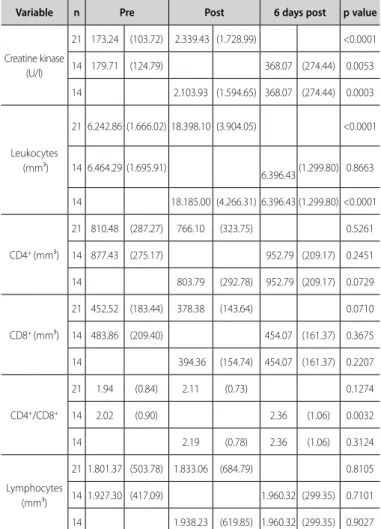
The behavior of the creatine kinase, leukocytes, CD4+, CD8+,
CD4+/CD8+ and lymphocytes variables before, immediately after
and six days after competition is presented in table 1. The statistical tests (Student’s t test) measured the statistically significant differences
between the estimations of the means of the parameters compared in the three situations two by two.
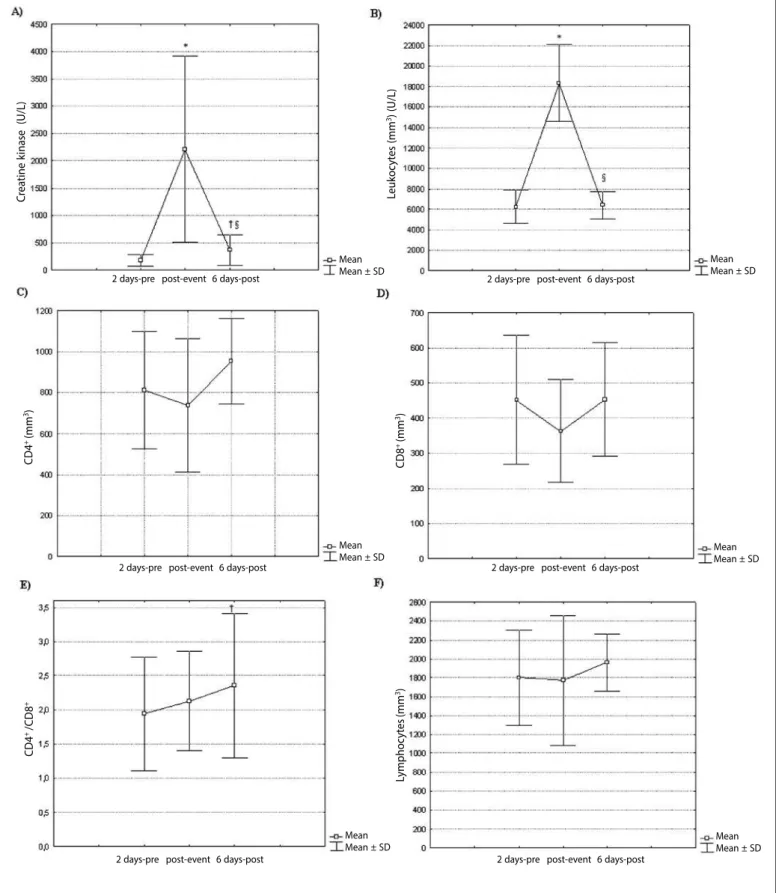
The mean variations of the studied parameters in the different moments are illustrated in figure 1.
There was statistically significant difference in the CK evalua-tion in the three situaevalua-tions, pre with post (p < 0.0001), pre with six days post (p = 0.0053) and post with six days post (p = 0.0003). The leukocytes presented statistically significant difference in two situations, pre with post (p < 0.0001) and post with six days post (p < 0.0001). The CD4+/CD8+ ratio presented statistically significant
difference between pre and six days post (p = 0.0032).
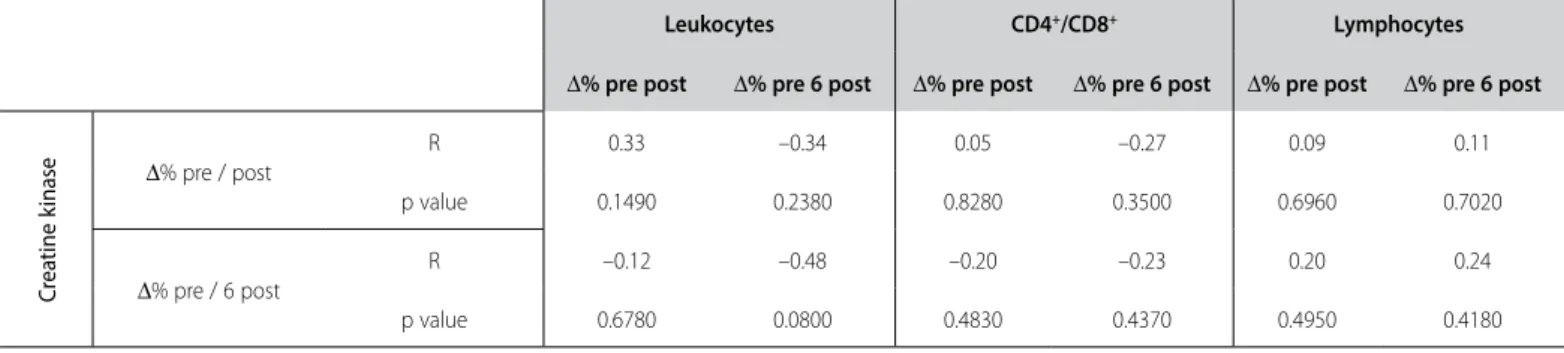
The results of the correlation analysis between the percentage of CK variation with total leukocytes, CD4+/CD8+ and lymphocytes
are presented in table 2.
Table 1. Plasma values of creatine kinase, leukocytes, CD4+, CD8+, CD4+/CD8+ and lymphocytes.
Variable n Pre Post 6 days post p value
Creatine kinase (U/l)
21 173.24 (103.72) 2.339.43 (1.728.99) <0.0001
14 179.71 (124.79) 368.07 (274.44) 0.0053
14 2.103.93 (1.594.65) 368.07 (274.44) 0.0003
Leukocytes (mm³)
21 6.242.86 (1.666.02) 18.398.10 (3.904.05) <0.0001
14 6.464.29 (1.695.91)
6.396.43 (1.299.80) 0.8663
14 18.185.00 (4.266.31) 6.396.43 (1.299.80) <0.0001
CD4+ (mm³)
21 810.48 (287.27) 766.10 (323.75) 0.5261
14 877.43 (275.17) 952.79 (209.17) 0.2451
14 803.79 (292.78) 952.79 (209.17) 0.0729
CD8+ (mm³)
21 452.52 (183.44) 378.38 (143.64) 0.0710
14 483.86 (209.40) 454.07 (161.37) 0.3675
14 394.36 (154.74) 454.07 (161.37) 0.2207
CD4+/CD8+
21 1.94 (0.84) 2.11 (0.73) 0.1274
14 2.02 (0.90) 2.36 (1.06) 0.0032
14 2.19 (0.78) 2.36 (1.06) 0.3124
Lymphocytes (mm³)
21 1.801.37 (503.78) 1.833.06 (684.79) 0.8105
14 1.927.30 (417.09) 1.960.32 (299.35) 0.7101
14 1.938.23 (619.85) 1.960.32 (299.35) 0.9027
Values are means (standard deviation). Pre = two days before the event; Post = immediately after the event ; 6 days Post= six days after the event.
DISCUSSION
Muscle pain, as well as gait limitation, are referred symptoms which make the athlete look for help in the medical kiosk after the event. Such situation derives from muscle damage which may be associated with many factors10. Studies have assessed muscle
da-mage markers as pain and plasma muscular enzymes. It is believed that these parameters do not accurately measure the extension of the muscle damage11, and that flexibility and power parameters
are more efficient methods to evaluate muscle damage11, being
the absence of measurement of these variables a limitation of this study. However, the CK, lactate dehydrogenase (LDH), troponin-I and myoglobin are frequently described as muscle damage markers, since these cytoplasmic molecules do not have the ability to surpass the sarcoplasmic membrane barrier12. In the performed study, the
measurement of the CK enzyme was used since it is considered the best indirect biomarker of damage to the muscle tissue12. The
muscle damage, on its turn, stimulates the inflammatory process through the activation of interleukins (IL’s), which modulate the activity and distribution of the immunological cells12. In a study
conducted with ultramarathoners, significant alterations were veri-fied in biomarkers such as the CK and inflammation markers as IL-6 and C-reactive protein, suggesting hence, that the inflammatory process is associated with muscle damage13; additionally, there is
IL-6 and plasma CK14. Moreover, it is acknowledged that the muscle
contraction and damage stimulate the synthesis of IL-615 and its
effects modulate the immunological and metabolic aspects. Consequently, it is believed that the modulation of the profile of the immunological cells suffer influence of the inflammatory
process caused by the muscle damage. However, other factors, associated with or independent from muscle damage, such as nutritional status and use of antioxidants may influence on the interleukins responses16-19. In the present study, these factors were
not controlled, which becomes a limitation of it. Figure 1. Mean variations of the plasma values of creatine kinase , leukocytes, CD4+, CD8+, CD4+/CD8+ and lymphocytes.
2 days Pre = two days before the event; Post-event = immediately after the event; 6 days Post = six days after the event. A) Creatine kinase variation (CK); B) Leukocytes variation; C) CD4+ activity variation; D) CD8+ activity variation; E) CD4+/CD8+ ratio; F) Lymphocytes variation. * significant variations between pre and post-event; † significant differences between pre and six days after the event; § significant differences between post-event and six days after the event; p < 0.05.
C
rea
tine k
inase (U/L)
Leukoc
yt
es (mm
3) (U/L)
C
D8
+ (mm 3)
C
D4
+ (mm 3)
C
D4
+ /C
D8
+
Lymphoc
yt
es
(mm
3)
2 days-pre 6 days-post
2 days-pre post-event 6 days-post
2 days-pre post-event 6 days-post
2 days-pre post-event 6 days-post 2 days-pre post-event 6 days-post
2 days-pre post-event 6 days-post post-event
Mean Mean ± SD
Mean Mean ± SD
Mean Mean ± SD
Mean Mean ± SD
Mean Mean ± SD
239 When the muscle damage is evaluated through the CK
enzy-me, significant increase of the mean serum levels of this enzyme immediately after the event was observed (second moment) and remained high, with statistical significance; on the sixth day after the event (third moment) in relation to the two days previous to the event (first moment) – figure 1A. Such enzymatic behavior reflects the persistence of the tissue injury and, consequently, of inflammatory activity. The findings agree with Neubauer et al.
(2008), who investigated 42 Ironman triathletes, in the following
moments: two days before, immediately after, one, five and 19 days after the event. This study verified significant relations among the leukocyte dynamics, muscle damage and interleukins. Remarka-ble initial inflammatory response was evidenced, which generally rapidly decreases; however, systemic inflammation of low degree remains at least until the fifth day after the event, possibly reflecting incomplete muscular recovery6.
In acute physical exercise, the inflammatory response conse-quent of the muscle damage, hormone alterations and cardiac debt promote the demargination of leukocytes from the endothelial bed and release of bone marrow cells, which results in the exponential increase of the serum concentration of leukocytes20. Leukocytosis
was observed in the present study immediately after the event and six days post (figure 1B), presenting behavior similar to the CK. Such fact corroborates another study21 in which direct correlation
of leukocytosis as marker of muscle tissue damage was observed. The total leukocytes levels in the third moment were similar to the baseline levels, being probable that on the sixth day post event they do not suffer influence of hemodynamic and neuroendocrine alterations in a remarkable way. The correlation between CK percen-tage variation and leukocytes in these moments was not statistically significant (table 2), which may be explained by different moments of plasmatic peaks of these variables or by a small study sample, being hence, a limitation of the study.
The peripheral blood lymphocytes consist of subtypes of T-cells, B-cells and NK cells. The alterations in the number of total circulating lymphocytes and T subtypes CD4+ and CD8+ are presented as a
two-phase characteristic in which the increase of the circulating lymphocytes (lymphocytosis) occurs during or immediately after the physical exercise, followed by decrease (lymphocytopenia) du-ring the initial recovery stage and return to baseline resting levels. Such alterations are proportional to the exercise intensity and dura-tion8. The results in this study did not verify this behavior, probably
due to the studied moments. On the other hand, the total lym-phocytes did not present statistically significant alterations among
the three investigated moments (figure 1F), being these findings in agreement with another study22. Moreover, statistically significant
correlation has not been observed between the CK percentage variation and total lymphocytes in the different moments, denoting that the muscle damage did not influence on the circulating levels of lymphocytes.
The CD4+ T lymphocytes did not presente statistically significant
difference in the different moments, remaining unchanged after the long-duration exercise (figure 1C), which agreed with the findings of other authors23,24.
The unproportional alteration between subtypes of T CD4+
and T CD8+ cells results in alteration in the CD4+/CD8+ ratio, which
commonly declines during and after exercise. This ratio has been used as a useful index which represents the relative distribu-tion of the T lymphocyte subtypes25, suggesting that decrease
in the CD4+/CD8+ ratio may be associated with the suppression
of the responsiveness of the T cells after exercise26, consequent
immunodepression and susceptibility to infections. Some authors found that moderate training of long duration does not change the CD4+/CD8+
ratio 27,28. On the other hand, endurance exercise
(75% VO2max) decreases the concentration of CD4+ cells, or even
lead to increase in the CD8+ lymphocytes concentration 29,
resul-ting in decrease in the CD4+/CD8+ ratio. However, although some
studies have demonstrated decrease in the CD4+/CD8+ balance,
infection of upper airways (UAII) episode was not observed in these athletes30, suggesting that the body is at potential status
of alertness against external aggression, which tends to take the clinical meaning of the transitory decrease of the CD4+/CD8+
ratio for granted. In the present study, it was verified that there was no statistically significant difference in the CD4+/CD8+ T lymphocytes ratio between two days before and immediately after the event; however, statistically significant increase of the CD4+/CD8+ ratio was observed between two days before and six days after the event (figure 1E). Such fact did not denote tendency to immunossupression in the immediate post-event, and suggests increase of the immunological power six days post, probably due to the exercise characteristic of moderate intensity, despite the long duration.
In addition to that, no statistically significant correlation betwe-en the CK variation percbetwe-entage and CD4+/CD8+ T lymphocytes ratio
and total lymphocytes was observed among the different moments (table 2), which does not let us associate in this study muscle dama-ge injury with alterations in the distribution and absolute number of circulating lymphocytes.
Table 2. Correlation of the percentage variations of the creatine kinase with total leukocytes, CD4+/CD8+ and lymphocytes.
Leukocytes CD4+/CD8+ Lymphocytes
∆% pre post ∆% pre 6 post ∆% pre post ∆% pre 6 post ∆% pre post ∆% pre 6 post
C
rea
tine k
inase ∆
% pre / post
R 0.33 –0.34 0.05 –0.27 0.09 0.11
p value 0.1490 0.2380 0.8280 0.3500 0.6960 0.7020
∆% pre / 6 post
R –0.12 –0.48 –0.20 –0.23 0.20 0.24
p value 0.6780 0.0800 0.4830 0.4370 0.4950 0.4180
To sum it up, exercise of long duration and moderate intensity caused evidence of muscle damage and of alterations in the immu-nological profile, observed by the behavior of the CK and leukocytes levels, besides the CD4+/CD8+ ratio.
CONCLUSION
The study evidence serum enzymatic alterations which let us conclude the onset of muscle damage after the Ironman Brasil triathlon event.
The muscle damage observed did not correlate with the
alte-rations in the profile of the studied immune cells.
An alert or boosted immunological state may be established six days after the Ironman triathlon event.
In Ironman athletes, complementary studies evaluating muscle damage, inflammatory mediators and modulation of immune cells in different moments are necessary.
All authors have declared there is not any potential conflict of interests concerning this article.
REFERENCES
1. Noakes TD, Goodwin N, Rayner BL, Branken T, Taylor RK. Water intoxication: a possible complication during endurance exercise, 1985. Wilderness Environ Med 2005;16:221-7.
2. Burger-Mendonca M, Bielavsky M, Barbosa FC. Liver overload in Brazilian triathletes after half-ironman competition is related muscle fatigue. Ann Hepatol 2008;7:245-8.
3. Pedersen BK. Influence of physical activity on the cellular immune system: mechanisms of action. Int J Sports Med 1991;12 Suppl 1:S23-9.
4. Nieman DC, Henson DA, Sampson CS, Herring JL, Suttles J, Conley M, et al. The acute immune response to exhaustive resistance exercise. Int J Sports Med 1995;16:322-8.
5. Neubauer O, Reichhold S, Nersesyan A, Konig D, Wagner KH. Exercise-induced DNA damage: is there a relationship with inflammatory responses? Exerc Immunol Rev 2008;14:51-72.
6. Neubauer O, Konig D, Wagner KH. Recovery after an Ironman triathlon: sustained inflammatory responses and muscular stress. Eur J Appl Physiol 2008;104:417-26.
7. Machado CNea. Efeito do exercício nas concentrações séricas de creatina cinase em triatletas de ultradistância.. Rev Bras Med Esporte 2010;16:378-81.
8. Walsh NP, Gleeson M, Shephard RJ, Woods JA, Bishop NC, Fleshner M, et al. Position statement. Part one: Immune function and exercise. Exerc Immunol Rev 2011;17:6-63.
9. Gleeson M. Immune system adaptation in elite athletes. Curr Opin Clin Nutr Metab Care 2006;9:659-65. 10. Gleeson M, Bishop NC. Special feature for the Olympics: effects of exercise on the immune system:
modification of immune responses to exercise by carbohydrate, glutamine and anti-oxidant supple-ments. Immunol Cell Biol 2000;78:554-61.
11. Warren GL, Lowe DA, Armstrong RB. Measurement tools used in the study of eccentric contraction--induced injury. Sports Med 1999;27:43-59.
12. Lavender AP, Nosaka K. Changes in markers of muscle damage of middle-aged and young men following eccentric exercise of the elbow flexors. J Sci Med Sport 2008;11:124-31.
13. Kim HJ, Lee YH, Kim CK. Biomarkers of muscle and cartilage damage and inflammation during a 200 km run. Eur J Appl Physiol 2007;99:443-7.
14. Bruunsgaard H, Galbo H, Halkjaer-Kristensen J, Johansen TL, MacLean DA, Pedersen BK. Exercise-induced increase in serum interleukin-6 in humans is related to muscle damage. J Physiol 1997;499:833-41.
15. Steensberg A, Keller C, Starkie RL, Osada T, Febbraio MA, Pedersen BK. IL-6 and TNF-alpha expression in, and release from, contracting human skeletal muscle. Am J Physiol Endocrinol Metab 2002;283:E1272-8. 16. Pinho RA, Silva LA, Pinho CA, Scheffer DL, Souza CT, Benetti M, et al. Oxidative stress and inflammatory
parameters after an Ironman race. Clin J Sport Med 2010;20:306-11.
17. Davison G, Gleeson M, Phillips S. Antioxidant supplementation and immunoendocrine responses to prolonged exercise. Med Sci Sports Exerc 2007;39:645-52.
18. Cox AJ, Pyne DB, Cox GR, Callister R, Gleeson M. Influence of chronic dietary carbohydrate supplemen-tation on plasma cytokine responses to exercise. Int J Sports Med 2010;31:207-12.
19. Cox AJ, Pyne DB, Cox GR, Callister R, Gleeson M. Pre-exercise carbohydrate status influences carbo-hydrate-mediated attenuation of post-exercise cytokine responses. Int J Sports Med 2008;29:1003-9.
20. Pannen BH, Robotham JL. The acute-phase response. New Horiz 1995;3:183-97.
21. Kayashima S, Ohno H, Fujioka T, Taniguchi N, Nagata N. Leucocytosis as a marker of organ damage induced by chronic strenuous physical exercise. Eur J Appl Physiol Occup Physiol 1995;70:413-20.
22. Kratz A, Lewandrowski KB, Siegel AJ, Chun KY, Flood JG, Van Cott EM, et al. Effect of marathon running on hematologic and biochemical laboratory parameters, including cardiac markers. Am J Clin Pathol 2002;118:856-63.
23. Gmunder FK, Lorenzi G, Bechler B, Joller P, Muller J, Ziegler WH, et al. Effect of long-term physical exercise on lymphocyte reactivity: similarity to spaceflight reactions. Aviat Space Environ Med 1988;59:146-51.
24. Nieman DC, Berk LS, Simpson-Westerberg M, Arabatzis K, Youngberg S, Tan SA, et al. Effects of long--endurance running on immune system parameters and lymphocyte function in experienced mara-thoners. Int J Sports Med 1989;10:317-23.
25. Bishop NC, Walker GJ, Gleeson M, Wallace FA, Hewitt CR. Human T lymphocyte migration towards the supernatants of human rhinovirus infected airway epithelial cells: influence of exercise and car-bohydrate intake. Exerc Immunol Rev 2009;15:127-44.
26. Nieman DC, Miller AR, Henson DA, Warren BJ, Gusewitch G, Johnson RL, et al. Effect of high- versus moderate-intensity exercise on lymphocyte subpopulations and proliferative response. Int J Sports Med 1994;15:199-206.
27. Shore S, Shinkai S, Rhind S, Shephard RJ. Immune responses to training: how critical is training volume? J Sports Med Phys Fitness 1999;39:1-11.
28. Pedersen BK, Hoffman-Goetz L. Exercise and the immune system: regulation, integration, and adap-tation. Physiol Rev 2000;80:1055-81.
29. Haaland DA, Sabljic TF, Baribeau DA, Mukovozov IM, Hart LE. Is regular exercise a friend or foe of the aging immune system? A systematic review. Clin J Sport Med 2008;18:539-48.