Artigo Original
Ana Paula de Castro Silva1 Simone Aparecida Capellini2
Descritores
Transtornos de aprendizagem Estudantes Avaliação Reabilitação/métodos Leitura
Keywords
Learning disorders Students Evaluation Rehabilitation/methods Reading
Correspondence address: Simone Aparecida Capellini.
R. Hygino Muzzi Filho, 737, Campus Universitário, Marília (SP), Brasil, CEP: 17525-900
E-mail: [email protected]
Received: 7/16/2009
Accepted: 10/28/2010
Study carried out at Universidade Estadual Paulista “Julio de Mesquita Filho” – UNESP – Marília (SP), Brazil. (1) Clinical speech-language pathologist – Marília (SP), Brazil.
(2) Department of Speech, Language and Hearing Therapy, Post-graduation Program in Education – Faculty of Sciences and Phylosophy – Universidade Estadual Paulista “Julio de Mesquita Filho” – UNESP – Marília (SP), Brazil.
learning difficulties
Programa de remediação fonológica em escolares com
dificuldades de aprendizagem
ABSTRACT
Purpose: To verify the effectiveness of a phonological remediation program in students with learning difi-culties. Methods: Forty students from 2nd to 4th grades, from both genders, ranging from eight years and one
month to 12 years old, were divided into two groups: Group 1 (G1), composed by 20 students with learning disabilities; and Group 2 (G2), composed by 20 students without learning disabilities. The Cognitive-Linguistic Performance Test and the oral reading and comprehension were applied in pre-test and post-test situations in all students. After the pre-test, only the students from Group 1 were submitted to the phonological remediation program. Results: After the phonological remediation program, Group 1 presented differences for reading abilities, auditory and visual processing, and processing speed, evidenced by superior performance in the post-testing situation. Conclusion: The phonological remediation program was eficient to the development of cognitive-linguistic skills and reading and text comprehension of students with learning dificulties.
RESUMO
INTRODUCTION
There is no consensus on the deinition of learning disa-bilities, nor is it agreed upon how, why or when it manifests itself. According to the literature, learning disabilities are characterized by a heterogeneous group of events that leads to low academic performance on tasks of reading, writing and mathematical calculus. They can be categorized as transient and occur at any time during the teaching-learning process(1,2).
Thus, the dificulty of learning can also be regarded as a speciic dificulty in school activities and concerns the discre-pancy between what is assumed that the child is potentially able to learn in a given situation in the classroom and what he/ she actually performs(3).
In Brazil, there is no estimate on the prevalence of learning disabilities, because this diagnostic category is not within the educational system, however, the inability to read affects from 2 to 8% of elementary school students in Brazil(4).
There is a consensus among researchers that phonological awareness is important for reading acquisition and that most individuals with delayed reading skills present disorders on it(5,6). The phonological deicit hypothesis has been supported
by numerous studies which have identiied delays for the sensitivity to rhyme, alliteration, and phonemic segmentation during the development of reading(7-9). However, studies(6,8)
indicate the existence of deicits in addition to problems with phonological processing, such as deicits in working memory, in perceptual-motor automaticity and in rapid naming, which may be present not only in students with learning disabilities, but also in students who have some dificulty in learning the mechanism of phoneme-grapheme conversion during literacy.
Thus, reading dificulties may originate from three kinds of deicits: phonological, naming and double deicit (phono-logical and naming). The existence of a double deicit causes the most severe reading dificulties resulting in dificulty in decoding words. The dificulty in decoding has implications such as a limitation on the reading of texts of increasing com-plexity, decreasing reader’s exposure to new words, limiting the acquisition of vocabulary and hindering the development of expertise in reading comprehension(5).
There is scientiic evidence that highlights the importance of using interventions in early school years(10) for children with
learning dificulties, as there are indications that the initial problems with the acquisition of reading mechanisms may not completely disappear after the irst school years if the child is not subjected to an intervention program(11).
Although there are international and national studies which describe the use of remediation programs(12-15), there are few
national studies on children with learning dificulties, highli-ghting the need for research to adjust or develop remediation programs for the speciic treatment of cognitive-linguistic change in this population.
Due to the above, the aim of this study was to verify the effectiveness of a phonological remediation program in students with learning dificulties.
METHODS
This study is characterized as experimental and longitudi-nal realized with students after the approval of the Ethics in Research Committee of the Universidade Estadual Paulista (UNESP), under protocol number 2576/2007.
Participants were 40 students from both genders aged between 8 years and 1 month old to 12 years old, from 2nd to
4th grade of elementary education in a public school in Marília
– São Paulo - Brazil, divided in the following groups: Group 1 (G1): composed by 20 students, being twelve females and eight males with learning dificulties submitted to a remediation program; Group 2 (G2): composed by 20 students, being ten females and ten males with learning dificulties not submitted to a remediation program.
The students were selected by teachers based on academic performance in two consecutive periods. Those with poor per-formance are considered students with learning dificulties, and those who had suficient performance on tests of Portuguese and Mathematics in two consecutive periods are considered students without learning dificulties. From this irst selec-tion, the researcher analyzed the student’s iles following the inclusion criteria: parent signing the Instrument of Consent, no family history of development dyslexia or attention deicit hyperactivity disorder (ADHD), lack of diagnosis of hearing, visual, motor or cognitive disorders, and exclusion criteria: no signing of the Instrument of Consent by parents.
The students were submitted to the following procedures in pre and post-testing:
- Cognitive-Linguistic Performance Test – Collective Ver-sion(16): This version is composed of ive subtests:
Recog-nition of the alphabet in sequence, copying forms; Arith-metics (addition, subtraction, multiplication and division); Dictation of 30 real words and ten nonwords, Short-term memory (writing of 16 digits sequence, which can contain from two to nine digits). The results of the subtests of the collective version were registered in the form of scoring, one point being assigned to each correct mark of the student. - Cognitive-Linguistic Performance Test – Individual
Ver-sion(16): This version is composed of ten subtests: Reading
words and nonwords (reading of words, reading of correct words in one minute and reading of nonwords), phono-logical awareness (alliteration and rhyme); mathematical ability (arithmetic and counting down), auditory processing (discrimination of sounds, repetition of numbers, repetition of inverse numbers, rhythmic beats, word repetition and nonword repetition), writing (word spelling, nonword spelling, total spelling) visual processing (visual memory for shapes), processing speed (rapid naming of pictures and rapid naming of numbers); sequencing (alphabet and strings); motor skill (motor skills in right, left and both hands); reversals (reversals of numbers). The results of the subtests of the individual version were registered in the form of scoring, which varied from one to 40 points, one point being assigned to each correct mark of the student. - Assessment of oral reading and text comprehension: three
from 2nd to 4th grade of Municipal Schools of Marília - SP.
The texts with higher approval ratings from teachers were selected to each grade. Each student was individually eva-luated. The texts and questions were presented on A4 paper, typed in Arial, size 16, black, double-spaced. The analysis of the texts was done by counting the errors of words read (reading accuracy), total time of reading and reading speed, which was expressed in words per minute, as described in the literature(17,18). The number of words per minute was
calculated by multiplying the number of words per sixty seconds, and this value was divided by the total time of reading in seconds. The comprehension was analyzed by four questions presented sequentially in the text, to which the students wrote their answers. The questions of the texts were analyzed for comprehension from the count of correct answers in written form, with four correct answers = 100% accuracy (full comprehension), three correct answers = 75% correct, two correct answers = 50% correct, one correct answer = 25% accuracy (partial comprehension), no correct answer = no reading comprehension.
Upon completion of the pre-testing, students with learning dificulties were subjected to a remediation program(19). Stra-tegies were drawn up for the program from the description of the original research(19), based on psycholinguistic criteria of adaptation for Portuguese(20,21). The program had a total of 18
cumulative sessions, i.e., every session crafted a new activity associated with the activities from the previous session. The order of activities within the program is described below: 1) Identiication of sound and letter: every letter of the alphabet
was presented on A4 paper and the students should name them and identify the sounds of the alphabet.
2) Words identiication in a sentence: seven statements were spoken and the students were supposed to divide each one into words, marking them by clapping.
3) Syllable identiication and manipulation in the word: two words were spoken for the students to identify their syllables and then manipulate the syllables to form new words in initial, medial and inal position. In each session, six words were provided to students.
4) Phonemic synthesis: seven words were spoken separated by sounds and the students should recognize them. 5) Rhyme: students were solicited to say words that ended
with the same sound and identify pictures that presented rhymes when named.
6) Phonemes identiication and discrimination: a phoneme was spoken and the students were asked to say a word that began with this sound. Then, seven words were spoken to the students and they were asked if the target phoneme was in each word or not. The phonemes were presented by following the order of development of speech and language. 7) Phoneme segmentation: a word was presented orally and the students were asked to speak all of the phonemes on it. In this phase of the program colored cards were used to help the students segment the sounds of words spoken. In each session seven words were provided.
8) Phoneme subtraction: six words were presented to the stu-dents and they were asked to withdraw the inal phoneme,
and then six more words for them to withdraw the initial phoneme.
9) Phoneme substitution: a word was presented orally and the students were asked to withdraw the initial phoneme and substitute it with another, forming thus a new word. In each session students were provided with seven words.
10) Phoneme transposition: the students were asked to speak the words in reverse order to form new words.
All students in this study were subjected to evaluations of pre-testing and post-testing, and only the students from G1 were submitted to a phonological remediation program. All data collection was performed at the school by the researcher in a room designated by the director so that the collection could be accomplished individually. The application of the procedures in this study began in February 2008 and ended in April of the same year. Each student was submitted to two sessions for the implementation of the procedures of pre-testing and post-testing, lasting 40 minutes each, and attended the program twice a week during regular class. Each session lasted 40 minutes, totaling 18 therapy sessions.
Statistical analysis was performed based on the number of correct marks between the two groups. The Wilcoxon Signed Rank Test was applied with the objective of verifying possible differences between the situations of pre-and post-testing in the groups. The results were analyzed statistically at a signiicance level of 5%, with an asterisk when there was a statistically signiicant difference.
RESULTS
To better present the results of this study, data will be pre-sented from the grouping of the skills assessed in the Cognitive-Linguistic Performance Test. Thus, the data are presented accor-ding to the following skills: reaaccor-ding, phonological awareness, auditory processing, processing speed and visual processing.
Table 1 shows the description of the mean, standard de-viation and p-value comparison of performance of students from G1 and G2 in pre- and post-testing in the tests of reading skills and phonological awareness of the Cognitive-Linguistic Performance Test.
It was observed that G1 presented a statistically signiicant difference between pre- and post-testing in the reading skills tests, and there was an increase in the average score in reading words and nonwords and a decrease of reading time, showing that students submitted to the remediation program presented improvement in this skill.
No statistically signiicant difference was found between the scores obtained by students from G1 in pre- and post-testing on the skill of phonological awareness (rhyme and alliteration).
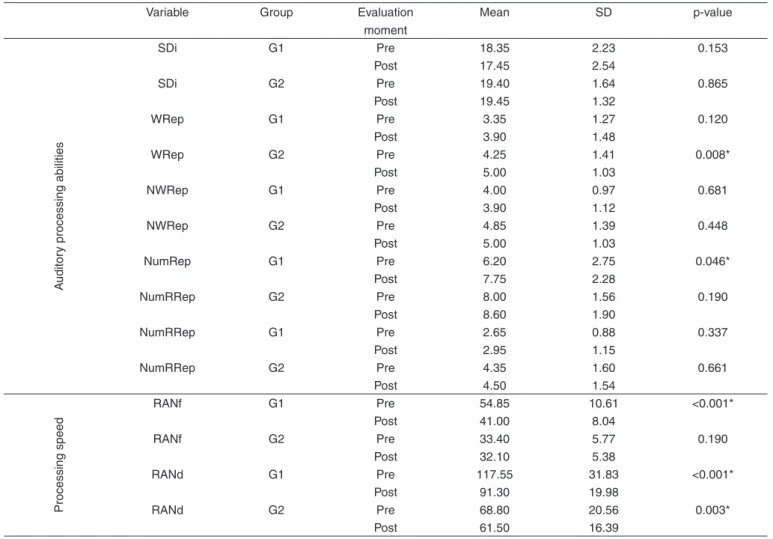
Table 2 shows the description of the mean, standard devia-tion and p-value comparison of performance of students from G1 and G2 in the pre- and post-testing in the tests of auditory processing and processing speed of the Cognitive-Linguistic Performance Test.
speed, there was statistically signiicant difference in pre-testing and post-testing between the scores obtained by G1 for rapid automatized naming of pictures and rapid automatized naming of digits with the reduction of naming time.
Table 3 is the description of the mean, standard deviation and p-value of the performance of students in pre-testing and post-testing regarding visual processing skills of the Cognitive-Linguistic Performance Test.
After applying the Wilcoxon Test, it was observed that there was a statistically signiicant difference between pre-testing and post-testing of the scores obtained by G1 on the tests of access to visual processing, copying forms, visual memory for two cards, visual memory for three cards, visual memory for four cards, visual memory for ive cards, and there was an increase in the number of correct answers in these tests.
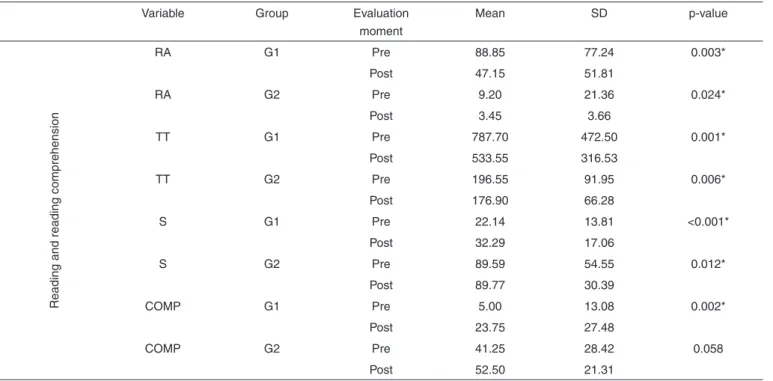
Table 4 shows the description of the mean, standard deviation and p-value of the performance of students in G1 and G2 in pre- and post-testing on reading and reading comprehension.
After applying the Wilcoxon Test, it was observed in rela-tion to G1 statistically signiicant difference between pre- and
post-testing, with an increased number of words read correctly, less time and increased speed in reading and enhanced skills in reading comprehension. As for G2, we found statistically signiicant difference in reading accuracy, speed and total time of reading, however, no statistically signiicant difference in reading comprehension. These results demonstrate that the improvement in the reading comprehension of G1 is due to the remediation program.
DISCUSSION
The analysis revealed the difference in performance of participants from G1 in relation to G2 in reading skills, pho-nological awareness, auditory processing, visual processing speed, assessed by the Cognitive-linguistic Performance Test. These results corroborate studies(5,22,23) showing that the
difi-culties of poor readers compared to good readers are primarily related to phonological processing, including phonological awareness, auditory memory and discrimination, access to the recovery of phonological information and phonological working memory. In this study, the participants from G1
pre-Table 1. Performance of students in the pre-testing and post-testing in subtests of reading and phonological awareness skills of the Cognitive-Linguistic Performance Test
Variable Group Evaluation moment
Mean SD p-value
Reading abilities
Alp G1 Pre 24.50 5.84 0.414
Post 25.80 0.70
Alp G2 Pre 26.00 0.00 0.011*
Post 24.20 3.61
WR G1 Pre 334.15 174.91 <0.001*
Post 237.30 131.53
WR G2 Pre 90.50 40.24 0.007*
Post 79.05 31.57
NWR G1 Pre 33.95 14.38 0.013*
Post 26.20 13.99
NWR G2 Pre 13.45 5.74 0.005*
Post 10.80 3.30
Cor1m G1 Pre 13.45 12.95 <0.001*
Post 22.00 13.11
Cor1m G2 Pre 49.80 17.13 0.009*
Post 54,65 14,08
Phonological a
w
areness
Allit G1 Pre 7.10 2.40 0.254
Post 8.00 1.52
Allit G2 Pre 9.35 1.57 0.776
Post 9.55 0.69
Rhyme G1 Pre 12.35 5.20 0.176
Post 14.10 4.76
Rhyme G2 Pre 17.50 4.94 0.181
Post 19.15 0.88
* Statistically signiicant value (p≤0.05) – Wilcoxon signed-rank test
sented lower performances when compared to G2 in the skills of phonological awareness, auditory processing (words and nonwords repetition), direct and indirect memory for digits, indicating the presence of phonological deicits.
The ability to recognize a pattern of letters within words as a unit is important for luent reading(23). This skill is based
on previously established memory representations of com-mon letter patterns and can be impaired if there is a deicit in naming speed. These deicits are related to the dificulty in accessing and retaining phonological information in long-term memory(24).
These results demonstrate that the students from G1 presen-ted inferior performance in relation to G2 in pre-testing in tests of rapid automatized naming of digits and igures, as shown the literature(25), which indicates the presence of alteration in
auditory memory in children with learning dificulties. These results also corroborate a study(26) which described inferior
results in phonological awareness and rapid naming in children with learning dificulties when compared to children without dificulty.
By analyzing results of G1 on reading skills in pre- and post-testing, statistically signiicant difference was found for
word reading, nonwords reading and words read correctly in one minute, and there was an increase in the average of correct answers and reduction of reading time in post-testing. These results are in line with a study(27) which describes the increase
in performance of children in words and nonwords reading after the application of a therapeutic procedure that included explicit teaching of phonological awareness and grapheme-phoneme correspondence. In this study, the inluence of the remediation program in the progress of students with reading dificulties was also evidenced by a statistically signiicant difference between pre-testing and post-testing for accuracy and speed of reading, but only G1 presented statistically signi-icant difference between the pre- and post-testing for reading comprehension. These results are consistent with a study(28)
which described that after participation in interventions that focused on phonological awareness the children demonstrated superior skills in the post-testing of nonwords reading and reading comprehension tasks.
These results are in accordance with research(27) that linked
the improvement in word recognition with the improvement in reading comprehension. Participants in the G1 had a statistically signiicant difference between pre-testing and post-testing on
Table 2. Performance of students in the pre-testing and post-testing in auditory processing and speed processing skills of the Cognitive-Linguistic Performance Test
Variable Group Evaluation moment
Mean SD p-value
A
uditor
y processing abilities
SDi G1 Pre 18.35 2.23 0.153
Post 17.45 2.54
SDi G2 Pre 19.40 1.64 0.865
Post 19.45 1.32
WRep G1 Pre 3.35 1.27 0.120
Post 3.90 1.48
WRep G2 Pre 4.25 1.41 0.008*
Post 5.00 1.03
NWRep G1 Pre 4.00 0.97 0.681
Post 3.90 1.12
NWRep G2 Pre 4.85 1.39 0.448
Post 5.00 1.03
NumRep G1 Pre 6.20 2.75 0.046*
Post 7.75 2.28
NumRRep G2 Pre 8.00 1.56 0.190
Post 8.60 1.90
NumRRep G1 Pre 2.65 0.88 0.337
Post 2.95 1.15
NumRRep G2 Pre 4.35 1.60 0.661
Post 4.50 1.54
Processing speed
RANf G1 Pre 54.85 10.61 <0.001*
Post 41.00 8.04
RANf G2 Pre 33.40 5.77 0.190
Post 32.10 5.38
RANd G1 Pre 117.55 31.83 <0.001*
Post 91.30 19.98
RANd G2 Pre 68.80 20.56 0.003*
Post 61.50 16.39
* Statistically signiicant value (p≤0.05) – Wilcoxon signed-rank test
Table 3. Performance of students in the pre-testing and post-testing in visual processing skills of the Cognitive-Linguistic Performance Test
Variable Group Evaluation moment
Mean SD p-value
Visual processing abilities
PC G1 Pre 3.80 1.96 0.013*
Post 5.05 1.73
PC G2 Pre 4.85 1.87 0.019*
Post 5.90 1.33
VM2 G1 Pre 3.25 1.07 0.035*
Post 3.90 0.45
VM2 G2 Pre 3.70 0.73 0.083
Post 4.00 0.00
VM3 G1 Pre 4.05 1.50 0.010*
Post 5.15 1.09
VM3 G2 Pre 5.25 1.12 0.387
Post 5.55 0.83
VM4 G1 Pre 3.30 3.11 0.020*
Post 5.40 1.73
VM4 G2 Pre 5.25 2.59 0.190
Post 6.30 1.87
VM5 G1 Pre 3.25 3.73 0.022*
Post 5.65 2.48
VM5 G2 Pre 5.65 2.46 0.003*
Post 8.05 1.76
* Statistically signiicant value (p≤0.05) – Wilcoxon signed-rank test
Legend: PC = Picture copy ; VM2 = visual memory with two cards; VM3 = visual memory with three cards; VM4 = visual memory with four cards; VM5 = visual memory with ive cards; SD = standard deviation
Table 4. Performance of students in the pre-testing and post-testing in reading skill and reading comprehension
Variable Group Evaluation moment
Mean SD p-value
Reading and reading comprehension
RA G1 Pre 88.85 77.24 0.003*
Post 47.15 51.81
RA G2 Pre 9.20 21.36 0.024*
Post 3.45 3.66
TT G1 Pre 787.70 472.50 0.001*
Post 533.55 316.53
TT G2 Pre 196.55 91.95 0.006*
Post 176.90 66.28
S G1 Pre 22.14 13.81 <0.001*
Post 32.29 17.06
S G2 Pre 89.59 54.55 0.012*
Post 89.77 30.39
COMP G1 Pre 5.00 13.08 0.002*
Post 23.75 27.48
COMP G2 Pre 41.25 28.42 0.058
Post 52.50 21.31
* Statistically signiicant value (p≤0.05) – Wilcoxon Signed-rank Test
word reading tests and number of words read correctly in one minute, showing an improvement in decoding skills after the intervention program, as well as in the text comprehension test.
These results are consistent with the literature(29) which
no-ted that eficient decoding relieves the cognitive load, allowing more attention to be directed to comprehension. Literature(30)
has indicated that reading comprehension is based on working memory. In this study, children with reading dificulties (G1) showed a statistically signiicant difference in the situation of pre-and post-testing among the scores for rapid automatized naming of igures and rapid automatized naming of digits, in-dicating an improvement in working memory after the program intervention, and improved skills in reading comprehension.
However, it is noteworthy that students from G2, who were not submitted to a phonological remediation program, showed improvement in post-testing compared to pre-testing, highlighting that the work of teachers in the classroom favored the acquisition and development of the alphabetic principle of the writing system in Portuguese, however, if not carried out systematically and instructionally it can cause delays in the development of cognitive-linguistic skills for reading acqui-sition. What proves this assertion is the fact that students in G1, even after being submitted to a phonological remediation program, could not reach the average performance of students from G2.
CONCLUSION
It can be concluded that the remediation program was effec-tive for students with learning disabilities to obtain improved performance with regard to reading skills, auditory processing, visual processing speed and reading comprehension.
The results of this study indicate the necessity of using ins-truments of intervention with children with learning disabilities which have the basic structure of the writing system in Brazilian Portuguese. Only through the explicit teaching of rules asso-ciated with the phoneme-grapheme conversion and reading and text comprehension practices in the classroom can we minimize the number of students who have learning problems due to lack of systematic education and focus on the alphabetic principle of Portuguese, as the students from G1 could only parallel in the performance of reading skills, auditory processing, visual processing speed and reading comprehension with G2 after they took part in the intervention proposed.
ACKNOWLEDGEMENTS
We are grateful for the National Council for Scientiic and Technological Development (CNPq) for the support given to this research, under process number 135549/2007-8.
REFERENCES
1. Capellini SA. Distúrbios de aprendizagem versus dislexia. In: Ferreira LP, Befi-Lopes DM, Limongi SCO, organizadores. Tratado de fonoaudiologia. São Paulo: Roca; 2004. p. 862-76.
2. Capellini AS, Silva APC, Silva C, Pinheiro FH. Avaliação e diagnóstico
fonoaudiológico nos distúrbios de aprendizagem e dislexias. In: Zorzi JL, Capellini SA. Dislexia e outros distúrbios da leitura-escrita. 2a- ed. São
José dos Campos: Pulso Editorial; 2009. p. 95-111.
3. Rolfsen AB, Martinez CMS. Programa de intervenção para pais de crianças com diiculdades de aprendizagem: um estudo preliminar. Paidéia (Ribeirão Preto). 2008;18(39):175-88.
4. Ciasca SM, Capellini SA, Tonelloto JMF. Distúrbios especíicos de aprendizagem. In: Ciasca SM. Distúrbios de aprendizagem: proposta de avaliação interdisciplinar. São Paulo: Casa do Psicólogo; 2003. p. 55-65. 5. Chard DJ, Stoolmiller M, Harn BA, Wanzek J, Vaughn S,
Linan-Thompson S, Kame’enui EJ. Predicting reading success in a multilevel schoolwide reading model: a retrospective analysis. J Learn Disabil. 2008;41(2):174-88.
6. Savage RS, Frederickson N. Beyond phonology: What else is needed to describe the problems of below-average readers and spellers? J Learn Disabil. 2006;39(5):399-413.
7. Vukovic RK, Wilson AM, Nash KK. Naming speed deicits in adults with reading disabilities: a test of the double-deicit hypothesis. J Learn Disabil. 2004;37(5):440-50.
8. Savage RS, Frederickson N, Goodwin R, Patni U, Smith N, Tuersley L. Relationships among rapid digit naming, phonological processing, motor automaticity, and speech perception in poor, average, and good readers and spellers. J Learn Disabil. 2005;38(1):12-28.
9. Swanson HL, Howard CB, Sáez L. Do different components of working memory underlie different subgroups of reading disabilities? J Learn Disabil. 2006;39(3):252-69.
10. Hay I, Elias G, Fielding-Barnsley R, Homel R, Freiberg K. Language delays, reading delays, and learning dificulties: interactive elements requiring multidimensional programming. J Learn Disabil. 2007;40(5):400-9. 11. Denton CA, Fletcher JM, Anthony JL, Francis DJ. An evaluation of
intensive intervention for students with persistent reading dificulties. J Learn Disabil. 2006;39(5):447-66.
12. Vaughn S, Fletcher JM, Francis DJ, Denton CA, Wanzek J, Wexler J, et al. Response to intervention with older students with reading dificulties.
Learn Individ Differ. 2008;18(3):338-45.
13. Ziolkowska R. Early intervention for students with reading and writhing dificulties.Read Improv. 2007;44(2):76-86.
14. Capellini SA, Padula NAMR, Ciasca SM. Desempenho de escolares com distúrbio especíico de leitura em programa de remediação. Pró-Fono. 2004;16(3):261-74.
15. Germano GD, Capellini SA. Eficácia do programa de remediação auditivo-visual computadorizado em escolares com dislexia. Pró-Fono. 2008;20(4):237-42.
16. Capellini SA, Silva C, Gonzaga J, Galhardo MT, Cruvinel P, Smythe I. Desempenho cognitivo-linguístico de escolares de 1ª a 4ª séries do ensino público municipal. Rev Psicopedagogia. 2007;24(73):30-44.
17. Condemarin M, Blomquist M. Dislexia: manual de leitura corretiva. 3a ed. Porto Alegre: Artes Médicas; 1989.
18. Ramos CS. Avaliação da leitura em escolares com indicação de diiculdade de leitura e escrita [dissertação]. São Paulo: Universidade Federal de São Paulo. Escola Paulista de Medicina; 2005.
19. Hatcher PJ, Hulme C, Ellis AW. Ameliorating early reading failure by integrating the teaching of reading and phonological skills: the phonological linkage hypothesis. Child Dev. 1994;65(1):41-57. 20. Silva C, Capellini SA. Eicácia do programa de remediação fonológica e
leitura no distúrbio de aprendizagem. Pró-Fono. 2010;22(2):131-9. 21. Capellini SA. Eficácia terapêutica do programa de remediação
fonológica, programa de remediação com leitura e programa de remediação fonológica e leitura em crianças com dislexia do desenvolvimento: estudo comparativo (FAPESP - Processo 06/5752-8). 2009. [Relatório de pesquisa].
22. Giangiacomo MCPB, Navas ALGP. A inluência da memória operacional nas habilidades de compreensão de leitura em escolares de 4ª série. Rev Soc Bras Fonoaudiol. 2008;13(1):69-74.
23. Conrad N, Levy B. Letter processing and the formation of memory representations in children with naming speed deficits. Read Writ. 2007;20(3):201-23.
processing, phonemic awareness, and reading disability. J Exp Child Psychol. 2003;84(3):218-43.
25. Billard C, Fluss J, Ducot B, Warszawski J, Ecalle J, Magnan A, et al. Étude des facteurs liés aux dificultés d’apprentissage de la lecture. À partir d’un échantillon de 1062 enfants de seconde année d’école élementaire. Arch Pediatr. 2008;15(6):1058-67.
26. Furbeta TC, Felippe AC. Avaliação simplificada do processamento auditivo e diiculdades de leitura-escrita. Pró-Fono. 2005;17(1):11-8. 27. Aaron PG, Joshi RM, Gooden R, Bentum KE. Diagnosis and treatment
of reading disabilities based on the component model of reading: an alternative to the discrepancy model of LD. J Learn Disabil. 2008;41(1):67-84.
28. Landry SH, Swank PR, Smith KE, Assel MA, Gunnewig SB. Enhancing early literacy skills for preschool children: bringing a professional development model to scale. J Learn Disabil. 2006;39(4):306-24. 29. Shapiro ES, Solari E, Petscher Y. Use of a measure of reading
comprehension to enhance prediction on the state high stakes assessment. Learn Individ Differ. 2008;18(3):316-28.