Pelvic ultrasonography in children and teenagers*
Ultrassonografia pélvica em crianças e adolescentesWellington de Paula Martins1, Stael Porto Leite2, Carolina Oliveira Nastri3
The knowledge of uterine and ovarian changes in the puberty is essential in the investigation changes in the female pelvis of children and teenagers. In these patients, pelvic ultrasonography is routinely performed with a full bladder to produce an acoustic window, although this examination may also be performed with endovaginal approach in sexually active teenagers. Main indications for pelvic ultrasonography in children and teenagers are either early or delayed puberty, pelvic pain or tumors, ambiguous genitalia, vaginal bleeding in children, and primary amenorrhea. In the present paper, the authors describe the scanning technique and the most frequent sonographic findings.
Keywords: Ultrasonography; Early puberty; Ovary.
O conhecimento das mudanças que ocorrem no útero e ovários durante a puberdade é fundamental ao in-vestigar alterações da pelve feminina em crianças e adolescentes. O exame ultrassonográfico nestas pacien-tes é rotineiramente realizado por via abdominal usando o líquido da bexiga como uma janela ultrassônica, embora possa ser algumas vezes realizado pela via vaginal em adolescentes sexualmente ativas. As princi-pais indicações para ultrassonografia pélvica em crianças e adolescentes são a puberdade precoce ou atra-sada, dor ou massas pélvicas, genitália ambígua, sangramento vaginal em crianças e amenorreia primária. Neste artigo relatamos a técnica do exame, além de descrever os achados mais freqüentes.
Unitermos: Ultrassonografia; Puberdade precoce; Ovário. Abstract
Resumo
* Study developed at Escola de Ultrassonografia de Ribeirão Preto (EURP) and at Department of Gynecology and Obstetrics of Hospital das Clínicas da Faculdade de Medicina de Ribeirão Preto da Universidade de São Paulo (HCFMRP-USP), Ribeirão Preto, SP, Brazil.
1. PhD, Associate Professor at Escola de Ultrassonografia de Ribeirão Preto (EURP), Assistant Physician at Department of Gynecology and Obstetrics of Hospital das Clínicas da Faculdade de Medicina de Ribeirão Preto da Universidade de São Paulo (HCFMRP-USP), Ribeirão Preto, SP, Brazil.
2. MD, Specialist, Assistant Physician at Department of Gy-necology and Obstetrics of Hospital das Clínicas da Faculdade de Medicina de Ribeirão Preto da Universidade de São Paulo (HCFMRP-USP), Ribeirão Preto, SP, Brazil.
3. Master, Post-graduation student at Department of Gyne-cology and Obstetrics of Hospital das Clínicas da Faculdade de Medicina de Ribeirão Preto da Universidade de São Paulo (HCFMRP-USP), Ribeirão Preto, SP, Brazil.
Mailing address: Dr. Wellington de Paula Martins. Avenida Bandeirantes, 3900, 8º andar, Campus Universitário, Monte Alegre. Ribeirão Preto, SP, Brazil, 14048-900. E-mail: [email protected]
Received June 13, 2009. Accepted after revision November 3, 2009.
pain or tumor, ambiguous genitalia, vagi-nal bleeding in children, and primary amen-orrhea. Prepubertal vaginal bleeding may indicate the presence of a foreign body, precocious puberty or vaginal rhabdomyo-sarcoma. The most common causes of pri-mary amenorrhea in teenagers include: gonadal dysgenesis (Turner’s syndrome) and Müllerian abnormalities (uterine/vagi-nal malformations). Pelvic pain or tumors in children and teenagers may be caused by ovarian torsion, hemorrhagic ovarian cyst, pelvic inflammatory disease or ectopic pregnancy.
UTERUS AND OVARIES
In female neonates, the uterus is in-creased due to the influence of maternal
and placental hormones(2,3). The uterine
body is larger than the uterine cervix, the uterine length is approximately 3.5 cm, and the maximum thickness is approximately 1.4 cm. Generally, the endometrium is vis-ible and echogenic (Figure 1). A small amount of fluid may be present within the endometrial cavity in approximately 25% of neonatal uteri. In neonates, the ovarian volume is slightly larger than in the
child-Martins WP, Leite SP, Nastri CO. Pelvic ultrasonography in children and teenagers. Radiol Bras. 2009;42(6):395–401.
that takes place in the puberty, the uterus grows and the uterine body becomes prominent. The ovaries can be identified at ultrasonography at either age. Generally, the ovarian volume increases after the age of six years and small follicles can be nor-mally seen during the whole childhood.
In children and teenagers, ultrasonogra-phy is routinely performed through ab-dominal approach, utilizing the liquid within the bladder as a sonographic win-dow. Considering that the presence of gas in the bowel hinders the propagation of sound waves, a full bladder moves the bowel loops up, allowing a better visual-ization of the pelvic organs. Color Doppler ultrasonography allows a rapid identifica-tion of abnormal vessels and vascular struc-tures. In sexually active teenagers, the study may be complemented with the transvagi-nal approach. Additiotransvagi-nally, as a better im-age resolution is required or in cases where the abdominal approach does not provide sufficient information, the rectal approach is a good alternative provided it is per-formed by an experienced sonographer.
Main indications for pelvic ultrasonog-raphy in children and teenagers are the fol-lowing: either early or late puberty, pelvic INTRODUCTION
The knowledge on developmental changes that take place in the female pel-vis during puberty is essential in the inves-tigation of pelvic conditions in children and teenagers. Imaging methods can facilitate the achievement of a correct diagnosis, and ultrasonography is the method of choice in
such cases(1). The prepubertal uterus is thin,
hood (on average, 1 cm3 at the first year as
compared with 0.6767 cm3 at the second
year of life)(4). The presence of ovarian
follicles (< 1 cm) is routinely detected in 84% of neonates up to the second year of life, and in 68% of children between two
and six years of age(5).
Before the puberty, in the age range between two and six years, the size and morphology of the uterus and ovaries re-main relatively stable: the volume of each ovary is < 2 cm3, with follicles < 9 mm, the
uterine length if < 4 cm, and the width and thickness of the uterine body and cervix generally are < 1 cm. The prepubertal uterus is a tubular structure (uterine cervix = uterine body), but sometimes the uterine cervix thickness may be larger than the
uterine body(6,7). Typically the
endome-trium is not apparent, but in some cases it can by visualized with the utilization of high-frequency transducers (Figure 2). From the practical point of view, the fol-lowing values may be adopted as param-eters for prepubertal girls: maximum uter-ine length < 4.5 cm, uteruter-ine thickness < 1
cm and ovarian volume < 3 cm3(8).
A recent study evaluating the utilization of pelvic ultrasonography for differentiat-ing children with precocious puberty from children with early pubarche, thelarche, or normal puberty also has shown that this is
a good diagnostic method(9).
The uterine length and volume, besides the ovarian volume, have played a relevant
role in the differentiation of girls with pre-cocious puberty from those with normal puberty. The uterine body/cervix ratio con-sidered by many as a good method, has also presented a good performance although inferior to the performance of the first ones. However, this study has not evaluated sepa-rately the uterine thickness, probably the most reproducible one, considering the best
limits definition(10). On the other hand,
during the measurement of the uterine length, it may be difficult to differentiate the external uterine orifice from the vagina, while the width limits may be ill-defined due to the similarity between the uterine and tube/ligaments echogenicity.
From the beginning of puberty, (around the age of six to nine years) there is a pro-gressive growth of uterus and ovaries. The uterine body becomes wider and thicker than the uterine body, assuming the piri-form shape observed in adult women, with an increase in the uterine body/cervix ratio
from 1/2 to values between 2/1 and 3/1(8).
Generally, the uterine length ranges be-tween 5 and 8 cm, the width is about 3.5 cm, and the thickness, between 1.5 and 3 cm. The endometrium can be easily iden-tified, with thickness and echographic ap-pearance varying according to the phase of the menstrual cycle. The ovaries assume a
more ovoid shape and volume > 4 cm3 as a
response to the gonadotropins stimulus. The Doppler study of uterine arteries may be utilized as a complementary tool in the
puberty follow-up(11). Such arteries may be
evaluated on a cross-sectional view of the uterus near the uterine body. In prepuber-tal girls, the systolic flow is seen as a nar-row spectral wave, there is no Doppler sig-nal during the diastolic period, and high pulsatility index (PI): mean 6.27, ranging from 3.5 to 8. Typically, early in the puberty a non-continuous Doppler signal is ob-served at diastole with decreased PI: mean 3.7, ranging from 2.5 to 5. On the other hand, late in the puberty, the Doppler spec-trum corresponds to a broader systolic wave with continuous Doppler signal at diastole and PI , 3: mean 2.06, ranging from 1.1 to 2.96. However, uterine and ovarian arterial flow measured by Doppler is less useful than uterine and ovarian volume to differentiate children with precocious
pu-berty from those with normal pupu-berty(12).
ECHOGRAPHIC EVALUATION OF HORMONAL INFLUENCE IN GIRLS
Estrogen stimulation
Echographic findings suggesting estro-gen stimulation are the following: uterine thickness and volume, uterine body thick-ening (uterine body thicker than cervix or uterine body/cervix ratio > 1) and apparent endometrium. The ovary appearance is less useful because of a certain overlapping of measurements along the childhood tween prepubertal and pubertal girls,
be-Figure 2. Longitudinal sonographic view of prepubertal uterus. Similar uter-ine body and cervix thicknesses. With the increasing frequent utilization of high-frequency transducers, sometimes the neonatal endometrium can be identi-fied.
sides the fact that the presence of follicles does not indicate precocious puberty, since follicles with < 1 cm in diameter may be observed in the prepubertal period (Figure 3)(6,13). Ultrasonography has been
consid-ered to be useful in the differentiation be-tween premature thelarche and central pre-cocious puberty, as an adjuvant to LH level measurement, according to a recent con-sensus on the use of GnRH antagonists in
children(14). The main markers reported by
such consensus were the following: appar-ent endometrium, that is highly specific (about 100% specificity), although with a
not so good sensitivity (about 30–80%)(15);
uterine length > 3.0–4.0 cm (depending on the age); and ovarian volume > 1.0 to 1.5
cm3, with sensitivity and specificity around
90%(9,10,16,17). Table 1 is a summary of the
main cut-offs utilized in the diagnosis of precocious puberty according to the age.
Precocious puberty is defined as com-plete sexual development (including me-narche) before the age of eight years, and may be classified into central and periph-eral. Central precocious puberty (true pre-cocious puberty) is gonadotropins-depen-dent and, in about two thirds of cases is idiopathic. Some tumors of the central ner-vous system or increase in the intracranial pressure may lead to central precocious puberty. Uterine and ovarian growth may be demonstrated at ultrasonography before the changes in the LH and FSH secretary patterns as compared with GnRH tests can
be observed(16). As the echographic
follow-up is performed during the treatment with GnRH agonists, a decrease in the uterine and ovarian volume can be demonstrated up to values found in prepubertal children
with the same age(18,19).
Peripheral precocious puberty (pseudo-precocious puberty is not gonadotropin-dependent. McCune-Albright syndrome is characterized by café-au-lait spots, fibrous dysplasia and peripheral precocious pu-berty. Follicular cysts with autonomous production of estradiol represent the most frequent cause of peripheral precocious puberty, and the children present high es-tradiol serum levels and low FSH and LH levels. In such cases, the GnRH test result is negative. The most frequent echographic findings are: uterus characteristic of estro-genic stimulus and unilateral follicular
ovarian cyst(20,21), that may present with
smaller follicular cysts (daughter cysts)
inside (Figure 4)(22). Spontaneous
symp-toms regression and disappearance of the ovarian cyst at echography may occur. Fol-licular ovarian cysts with autonomous es-trogenic production are most frequently found than estrogenic ovarian tumors, such as granulose cell tumors or gonadoblas-tomas.
Isolated premature adrenarche and isolated premature thelarche
These children present echographic findings of the pelvis (uterine body/cervix ratio, uterine length and thickness and ova-rian volume) with values similar to the ones observed in prepubertal children with the same age(13,16).
Table 1 Main sonographic parameters utilized in the diagnosis of precocious puberty, with respective cutoff points above which the possibility of treating central precocious puberty increases(9,10).
Parameter
— 0 to 6 years —
Uterine length (cm) Uterine volume (cm3)
Ovarian volume (cm3)
Uterine body/cervix ratio
— 6 to 8 years — Uterine length (cm)
Uterine volume (cm3)
Ovarian volume (cm3)
Uterine body/cervix ratio
— 8 to 10 years —
Uterine length (cm) Uterine volume (cm3)
Ovarian volume (cm3)
Uterine body/cervix ratio
Cutt of poit
3.5 2.6
1.8 1.0
3.7
3.5 2.0
1.0
4.1 4.4
2.7 1.2
Sensitivity
86% 100%
80% 71%
88%
82% 80%
82%
77% 85%
80% 77%
Specificity
97% 91%
83% 86%
95%
90% 64%
84%
82% 82%
87% 69%
Figure 3. Sonographic view of ovaries in the prepubertal period. The finding of one or several follicles < 1 cm is frequent in this examination.
ECHOGRAPHIC EVALUATION OF VAGINAL BLEEDING IN PREPUBERTAL CHILDREN
Vaginal bleeding in prepubertal children may occur because of the presence of a foreign body inside the vagina, precocious puberty or vaginal rhabdomyosarcoma. Hemangiomas and other vascular malfor-mations also may cause vaginal bleeding in these children.
Foreign body in the vagina
Foreign bodies in the vagina are seen in 18% of children with vaginal bleeding and discharge and in 50% of children with
vagi-nal bleeding and without discharge(8). A
vaginal foreign body may be identified through echogenic imaging, the presence of posterior acoustic shadowing being
fre-quently observed (Figure 5)(23).
Vaginal rhabdomyosarcoma
Vaginal rhabdomyosarcomas are almost exclusively found in very young children. The echographic aspect of these tumors corresponds to large solid, heterogeneous or hypoechoic nodules located posteriorly to the bladder. Five-year survival in cases
of genital rhabdomyosarcomas without
metastasis is of approximately 90%(24–26).
Primary amenorrhea in teenagers
Primary amenorrhea is defined in one of the following three situations: absence of menarche at 16 years of age, absence of thelarche or adrenarche at 14 years of age, absence of menarche within three years from adrenarche or thelarche.
The presence or absence of secondary sexual characteristics at clinical examina-tion and identificaexamina-tion of the uterus at echography constitute the initial steps taken before starting an investigation by means of laboratory tests. Common causes of pri-mary amenorrhea include ovarian failure (for example, Turner’s syndrome – 48.5% of cases), uterine-vaginal malformations (Müllerian anomalies – 16.2% of cases), dysfunction of the hypothalamic-hypophy-seal-ovarian axis (8.3% of cases), consti-tutional or familial delay (6% of cases). Other less common causes, such as malnu-trition, psychiatric disorders, and infections
are responsible for 21% of cases(27).
Turner’s syndrome
Girls with 45 X0 karyotype (approxi-mately 70% of cases) will present prepu-bertal uterus and ovaries unidentifiable at
ultrasonography or inactive ovaries(28,29). In
rare cases, particularly those where a mo-saic-type karyotype is present, the ovaries may present a normal echographic
appear-ance(30). Spontaneous puberty may occur in
up to 20% of cases(31).
Uterine-vaginal malformations (Müllerian anomalies)
Paramesonephric ducts (Müllerian ducts) develop between the 5th and 6th gestational weeks. At about the 8th gesta-tional week they fuse to form the vaginal canal. During this fusion, the utero-vaginal canal reaches the urogenital sinus at the same time that the vaginal plate is formed at the lower end of the utero-vagi-nal cautero-vagi-nal. Thus, the vagina is formed both by the paramesonephric ducts (upper 2/3 or
4/5) and the urogenital sinus(32).
Müllerian agenesis (Mayer-Rokitansky-Kuster-Hauser syndrome) is the second most common cause of primary female in-fertility (the first one is gonadal
dysgen-esis)(33). Echographically, this syndrome is
characterized by vaginal atresia associated with either absence of the uterus or rudi-mentary uterus and normal ovaries. Renal malformations (agenesis, ectopia) occur in up to 50% of cases, and bone malforma-tions in up 12% of cases. Among these women, 6-10% may present with imma-turely formed uterus and functional en-dometrium, possibly with the development of hematometrium.
Obstructive malformations
In most of cases, congenital hydrome-trocolpos is associated with malformation of the urogenital sinus. Utero-vaginal ob-structions may be identified early during the fetal life, in the third trimester, as an abdomino-pelvic mass (Figure 6). Fre-quently, renal obstruction is associated.
Figure 5. Ultrasonography demonstrating a vagi-nal foreign body. A hyperechogenic image with clear posterior acoustic shadowing is observed inside the vaginal canal.
Teenagers with obstructive anomalies typi-cally present primary amenorrhea and cy-clic abdominal pain. In such cases, ultra-sonography is useful for differentiating cases of hematometrocolpos secondary to imperforate hymen or transverse vaginal septum from hematometrium due to
cervi-cal agenesis(34). The differentiation
be-tween such cases plays a significant role in the definition of the prognosis, since hematometrocolpos is resolved after desobstruction, while, because of the cer-vical agenesis, hematometrium generally is managed by means of hysterectomy.
Approximately 45% of vaginal septa are found in the upper vaginal third, 40% in the middle third, and only 15% in the lower
third(35). The presence of obstructed
hemi-vagina with uterine duplication, Herlyn-Werner-Wunderlich syndrome, is almost always associated with ipsilateral renal
agenesis(36). At clinical examination, cyclic
abdominal pain caused by the obstruction is concomitantly present with regular men-strual cycles, which generally may delay a correct diagnosis. Complete vaginal ob-struction must be urgently treated because of the risk for endometriosis and impair-ment of the reproductive capacity.
Non-obstructive malformations
The main non-obstructive malforma-tions result from failure in the parameso-nephric ducts fusion or resorption, leading to septate, bicornuate, unicornuate uteri and didelphia. Two-dimensional ultra-sonography may suspect of the defect type, which can be better evaluated by
three-di-mensional ultrasonography(37).
ULTRASONOGRAPHY: PELVIC MASS AND PAIN
Ultrasonography is the initial modality in the evaluation of children and teenagers with pelvic pain.
Ovarian torsion and tumors
Ovarian torsion is most common in pa-tients with predisposing factors such as
ovarian cysts or masses(38). In children,
ovarian torsion may be due to the fact of the uterine tube being relatively longer and the ovary more mobile. The main cause for a normal ovary torsion is the excessive
ovarian mobility in the infant pelvis. The twisted ovary presents multiple, peripheral
increased follicles (Figure 7)(39). Color
Doppler is not a reliable method for evalu-ating ovarian torsion. The peripheral and/ or central arterial flow may be demon-strated at Doppler ultrasonography in cases of surgically proved ovarian torsion, which may be explained by the doubleness of the ovarian vascularization. Because of the late diagnosis, since pelvic pain is rarely inves-tigated in children with the required rapid-ity, few twisted ovaries may be saved dur-ing surgery.
Ovarian tumors in children primarily occur because of the presence of functional cysts (follicular – 60%) and neoplasms (40%). Two thirds of neoplasms are benign (frequently teratomas), while one third is malignant. At ultrasonography, teratomas present different characteristics (Figure 8), so the diagnosis may be difficult. The his-tological analysis of malignant ovarian tu-mors reveals a prevalence of 60–75% of germ cell tumors, epithelial tumors in 10%-20% of cases, and stromal tumors in 10%(38,40). In children and teenagers,
ova-rian teratomas may lead to torsion in about 30% of cases, and 10% are bilateral. Ultra-sonography demonstrates wall nodules in 55% of cases and echogenic foci with pos-terior shadowing in 44% of cases. Some echographic findings such as ascites, peri-toneal implants, lymphadenopathies or hepatic metastasis may suggest the pres-ence of malignancy. The echographic char-acteristics of the lesion do not suggest malignancy, which makes the diagnosis more difficult.
Hemorrhagic ovarian cysts
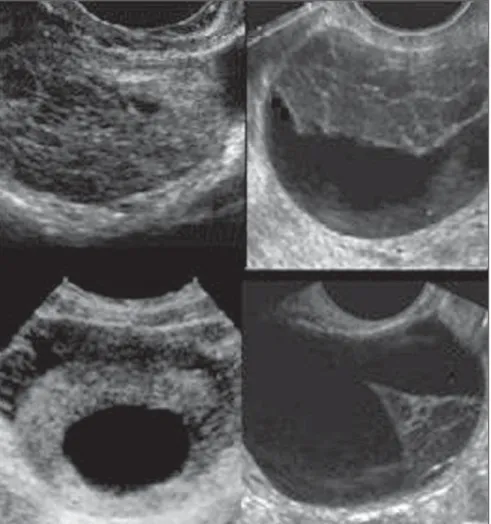
Acute pelvic pain at the middle of the menstrual cycle is clinically suggestive of hemorrhage resulting from ovulation that occurs during the corpus luteum formation. Ultrasonography demonstrates a complex ovarian mass with posterior acoustic shad-owing because of the liquid contents, fre-quently associated with the presence of free fluid in the vaginal pouch fundus. How-ever, the echographic appearance of such cysts is quite variable (Figure 9). Along the echographic follow-up, such cysts become
anechoic in most of cases(41).
Pelvic inflammatory disease
Pelvic inflammatory disease or tube-ovarian abscess are found in sexually
ac-Figure 7. Echographic finding of ovarian torsion. Increased follicles may be seen at the ovary pe-riphery, besides free fluid within the peritoneal cavity.
tive teenagers and may be recognized through clinical findings (pelvic pain, fe-ver, pain at cervical mobilization, adnexal rigidity). Ultrasonography is useful for detecting complications such as tubo-ova-rian abscesses, hydrosalpinx and pyo-salpynx.
Ectopic pregnancy
The incidence of ectopic pregnancy is very low among teenagers, but, in this age
range it presents highest mortality rates(8).
Like in adults, the diagnosis must be based on the presence of any adnexal mass asso-ciated with a positive pregnancy test.
FINAL CONSIDERATIONS
Ultrasonography has demonstrated to be the modality of choice in the initial evaluation of the female pelvis in the
child-hood and adolescence, a situation where the clinical examination is very limited, since the vaginal approach is unfeasible and many times clinicians do not feel com-fortable adopting the rectal approach. Such examination may provide valuable infor-mation on the patient’s pelvis, allowing the definition and planning of clinical and sur-gical treatments. In these cases, a specific knowledge of the changes in the female pelvis during the childhood and puberty is essential to avoid inaccurate diagnosis.
REFERENCES
1. Ziereisen F, Guissard G, Damry N, et al. Sono-graphic imaging of the paediatric female pelvis. Eur Radiol. 2005;15:1296–309.
2. Nussbaum AR, Sanders RC, Jones MD. Neona-tal uterine morphology as seen on real-time US. Radiology. 1986;160:641–3.
3. Hata K, Nishigaki A, Makihara K, et al. Ultrasonic evaluation of the normal uterus in the neonate. J Perinat Med. 1989;17:313–7.
4. Cohen HL, Shapiro MA, Mandel FS, et al. Nor-mal ovaries in neonates and infants: a sono-graphic study of 77 patients 1 day to 24 months old. AJR Am J Roentgenol. 1993;160:583–6. 5. Cohen HL, Eisenberg P, Mandel F, et al. Ovarian
cysts are common in premenarchal girls: a sono-graphic study of 101 children 2-12 years old. AJR Am J Roentgenol. 1992;159:89–91.
6. Holm K, Laursen EM, Brocks V, et al. Pubertal maturation of the internal genitalia: an ultrasound evaluation of 166 healthy girls. Ultrasound Obstet Gynecol.1995;6:175–81.
7. Orbak Z, Sa™söz N, Alp H, et al. Pelvic ultrasound measurements in normal girls: relation to puberty and sex hormone concentration. J Pediatr Endo-crinol Metab. 1998;11:525–30.
8. Garel L, Dubois J, Grignon A, et al. US of the pe-diatric female pelvis: a clinical perspective. Radiographics. 2001;21:1393–407.
9. Badouraki M, Christoforidis A, Economou I, et al. Evaluation of pelvic ultrasonography in the di-agnosis and differentiation of various forms of sexual precocity in girls. Ultrasound Obstet Gynecol. 2008;32:819–27.
10. Martins WP, Nastri CO. Ultrasonographic mea-surement of ovarian volume in the diagnosis of central precocious puberty. Ultrasound Obstet Gynecol.2009;34:484–5.
11. Ziereisen F, Heinrichs C, Dufour D, et al. The role of Doppler evaluation of the uterine artery in girls around puberty. Pediatr Radiol.2001;31:712–9. 12. Golestani R, Sheikhvatan M, Behpour AM, et al. Relationship between uterine and ovarian arterial blood flow measured by Doppler sonography at different stages of puberty. Taiwan J Obstet Gynecol.2008;47:62–5.
13. Buzi F, Pilotta A, Dordoni D, et al. Pelvic ultra-sonography in normal girls and in girls with pu-bertal precocity. Acta Paediatr. 1998;87:1138–45. 14. Carel JC, Eugster EA, Rogol A, et al. Consensus statement on the use of gonadotropin-releasing hormone analogs in children. Pediatrics. 2009; 123:e752–62.
15. de Vries L, Horev G, Schwartz M, et al. Ultrasono-graphic and clinical parameters for early differen-tiation between precocious puberty and premature thelarche. Eur J Endocrinol.2006;154:891–8.
16. Haber HP, Wollmann HA, Ranke MB. Pelvic ul-trasonography: early differentiation between iso-lated premature thelarche and central precocious puberty. Eur J Pediatr. 1995;154:182–6. 17. Herter LD, Golendziner E, Flores JA, et al.
Ova-rian and uterine findings in pelvic sonography: comparison between prepubertal girls, girls with isolated thelarche, and girls with central preco-cious puberty. J Ultrasound Med. 2002;21:1237– 46; quiz 1247–8.
18. Ambrosino MM, Hernanz-Schulman M, Genieser NB, et al. Monitoring of girls undergoing medi-cal therapy for isosexual precocious puberty. J Ul-trasound Med. 1994;13:501–8.
19. Jensen AM, Brocks V, Holm K, et al. Central pre-cocious puberty in girls: internal genitalia before, during, and after treatment with long-acting go-nadotropin-releasing hormone analogues. J Pediatr. 1998;132:105–8.
20. Rodriguez-Macias KA, Thibaud E, Houang M, et al. Follow up of precocious pseudopuberty asso-ciated with isolated ovarian follicular cysts. Arch Dis Child.1999;81:53–6.
21. Fakhry J, Khoury A, Kotval PS, et al. Sonography of autonomous follicular ovarian cysts in preco-cious pseudopuberty. J Ultrasound Med. 1988;7: 597–603.
22. Lee HJ, Woo SK, Kim JS, et al. “Daughter cyst” sign: a sonographic finding of ovarian cyst in neonates, infants, and young children. AJR Am J Roentgenol.2000;174:1013–5.
23. Caspi B, Zalel Y, Katz Z, et al. The role of sono-graphy in the detection of vaginal foreign bodies in young girls: the bladder indentation sign. Pediatr Radiol. 1995;25 Suppl 1:S60–1. 24. Martelli H, Oberlin O, Rey A, et al. Conservative
treatment for girls with nonmetastatic rhab-domyosarcoma of the genital tract: a report from the Study Committee of the International Society of Pediatric Oncology. J Clin Oncol.1999;17: 2117–22.
25. Andrassy RJ, Wiener ES, Raney RB, et al. Progress in the surgical management of vaginal rhabdomyosarcoma: a 25-year review from the In-tergroup Rhabdomyosarcoma Study Group. J Pediatr Surg. 1999;34:731–4; discussion 734–5. 26. Castellino SM, McLean TW. Pediatric genitouri-nary tumors. Curr Opin Oncol.2007;19:248–53. 27. Timmreck LS, Reindollar RH. Contemporary
is-sues in primary amenorrhea. Obstet Gynecol Clin North Am. 2003;30:287–302.
28. Morgan T. Turner syndrome: diagnosis and man-agement. Am Fam Physician. 2007;76:405–10. 29. Haber HP, Ranke MB. Pelvic ultrasonography in Turner syndrome: standards for uterine and ova-rian volume. J Ultrasound Med. 1999;18:271–6.
30. Mazzanti L, Nizzoli G, Tassinari D, et al. Spon-taneous growth and pubertal development in Turner’s syndrome with different karyotypes. Acta Paediatr. 1994;83:299–304.
31. Massa G, Heinrichs C, Verlinde S, et al. Late or delayed induced or spontaneous puberty in girls with Turner syndrome treated with growth hor-mone does not affect final height. J Clin Endo-crinol Metab. 2003;88:4168–74.
32. Gell JS. Müllerian anomalies. Semin Reprod Med. 2003;21:375–88.
33. Chandiramani M, Gardiner CA, Padfield CJ, et al. Mayer-Rokitansky-Kuster-Hauser syndrome. J Obstet Gynaecol. 2006;26:603–6.
34. Blask AR, Sanders RC, Rock JA. Obstructed uterovaginal anomalies: demonstration with sonography. Part II. Teenagers. Radiology. 1991; 179:84–8.
35. Rackow BW, Arici A. Reproductive performance of women with müllerian anomalies. Curr Opin Obstet Gynecol. 2007;19:229–37.
36. Orazi C, Lucchetti MC, Schingo PM, et al. Herlyn-Werner-Wunderlich syndrome: uterus didelphys, blind hemivagina and ipsilateral renal agenesis. Sonographic and MR findings in 11 cases. Pediatr Radiol. 2007;37:657–65. 37. Ferreira AC, Mauad Filho F, Nicolau LG, et al.
Ultra-sonografia tridimensional em ginecologia: malformações uterinas. Radiol Bras. 2007;40: 131–6.
38. Schultz KA, Ness KK, Nagarajan R, et al. Adn-exal masses in infancy and childhood. Clin Obstet Gynecol. 2006;49:464–79.
39. Breech LL, Hillard PJ. Adnexal torsion in pedi-atric and adolescent girls. Curr Opin Obstet Gynecol. 2005;17:483–9.
40. Gribbon M, Ein SH, Mancer K. Pediatric malig-nant ovarian tumors: a 43-year review. J Pediatr Surg. 1992;27:480–4.