RESUMO
Correa JBB, Dellazzana JEF, Sturm A, Leite DMA, Oliveira Filho GR, Xavier RG - Aplicação da Curva CUSUM para Avaliar o Treinamen-to da Intubação Orotraqueal com o Laringoscópio Truview EVO2.
JUSTIFICATIVA E OBJETIVOS: As curvas de aprendizado têm se mostrado ferramentas úteis no monitoramento do desempenho de um trabalhador submetido a uma nova tarefa. Essas curvas vêm sendo utilizadas na avaliação de vários procedimentos na prática médica. O objetivo desta pesquisa foi avaliar o aprendizado da intubação orotraqueal (IOT) com o laringoscópio Truview EVO2
através da curva de aprendizado CUSUM.
MÉTODO: Quatro aprendizes realizaram o treinamento da IOT com o laringoscópio Truview EVO2 em manequim. Eles foram
orien-tados quanto aos critérios de sucesso e falha na IOT e alternaram-se nas tentativas, num total de 300 IOT para cada um deles. Quatro curvas de aprendizado foram construídas a partir do método da soma cumulativa CUSUM.
RESULTADOS: O número calculado para adquirir proficiência na tarefa foi de 105 IOT. Os quatro aprendizes cruzaram a linha de taxa de falha aceitável de 5% antes de completar 105 IOT: o pri-meiro aprendiz alcançou a faixa de proficiência após 42 IOT, o se-gundo e o terceiro aprendizes, após 56 IOT, e o quarto aprendiz, após 97 IOT, mantendo-se constantes em seus desempenhos a partir de então. Não houve diferença na taxa de sucesso entre re-sidentes e anestesiologistas experientes.
CONCLUSÕES: A curva de aprendizado CUSUM é um instrumen-to útil para demonstração objetiva de habilidade na execução de
uma nova tarefa. A laringoscopia com o Truview EVO2 em
mane-quim demonstrou ser um procedimento fácil para médicos com ex-periência prévia em IOT, porém, a transposição dos resultados para a prática clínica deve ser cautelosa.
Unitermos: ANESTESIOLOGIA, Ensino: Intubação; INTUBAÇÃO TRAQUEAL.
SUMMARY
Correa JBB, Dellazzana JEF, Sturm A, Leite DMA, Oliveira Filho GR, Xavier RG – Using the CUSUM Curve to Evaluate the Training of Orotracheal Intubation with the Trueview EVO2® Laryngoscope. BACKGROUND AND OBJECTIVES: Learning curves have proved to be useful tools to monitor the performance of a worker on a new assignment. Those curves have been used to evaluate several me-dical procedures. The objective of this study was to evaluate the learning of orotracheal intubation (OTI) with the Truview EVO2
laryngoscope with the CUSUM learning curve.
METHODS: Four trainees underwent OTI training with the Truview EVO2 laryngoscope in a mannequin. They received orientation on
the successful and failure criteria of OTI and alternated during the attempts, for a total of 300 OTI for each one. Four learning curves were plotted using the CUSUM cumulative addition method.
RESULTS: It was calculated that the 105 OTIs were necessary to achieve proficiency. The four trainees crossed the line of acceptable failure rate of 5% before completing 105 OTIs; the first trainee reached proficiency after 42 OTIs, the second and third after 56 OTIs, and the fourth after 97 OTIs, and from then on their per-formance remained constant. Differences in the success rate between residents and experienced anesthesiologists were not observed.
CONCLUSIONS: The CUSUM learning curve is a useful instrument to demonstrate objectively the ability when performing a new task. Laryngoscopy with the Truview EVO2 in a mannequin proved to be
an easy procedure for physicians with prior experience in OTI; however, one should be cautious when transposing those results to clinical practice.
Keywords: ANESTHESIOLOGY, Teaching: Intubation; TRACHEAL INTUBATION.
INTRODUÇÃO
Há uma necessidade crescente de assegurar a qualidade no desempenho de habilidades exercidas na prática médica.
Aplicação da Curva CUSUM para Avaliar o Treinamento da
Intubação Orotraqueal com o Laringoscópio Truview EVO2
*
Using the Cusum Curve to Evaluate the Training of Orotracheal
Intubation with the Truview EVO2
Laryngoscope
Jaqueline Betina Broenstrup Correa1, José Ernani Flores Dellazzana, TSA2, Alexandre Sturm3,
Dante Moore Almeida Leite3, Getúlio Rodrigues de Oliveira Filho, TSA4, Rogério Gastal Xavier5
* Recebido do (Received from) Laboratório Experimental de Vias Aéreas e Pulmões do Centro de Pesquisas do Hospital de Clínicas de Porto Alegre (HCPA/ UFRGS) - Serviço de Pneumologia, Porto Alegre, RS
1. Anestesiologista
2. Anestesiologista; Instrutor do CET/SBA do HCPA 3. ME do CET/SBA do HCPA
4. Anestesiologista; Responsável do CET/SBA Integrado de Anestesiologia da SES-SC
5. Pneumologista; Doutor em Clínica Médica; Professor Associado do Depar-tamento de Medicina Interna/UFRGS; Coordenador da Unidade de Broncologia e do Laboratório Experimental de Vias Aéreas e Pulmão do HCPA
Apresentado (Submitted) em 6 de novembro de 2008 Aceito (Accepted) para publicação em 28 de janeiro de 2009
Endereço para correspondência (Correspondence to): Dra. Jaqueline Betina Broenstrup Correa
metálica. O sujeito que está procedendo à intubação só verá a extremidade distal da cânula quando ela alcançar a entra-da entra-da glote, num pequeno campo de visão projetado pela óptica. Para os aprendizes, essa foi considerada a parte mais difícil do procedimento: a habilidade de colocar no cam-po de visão da óptica a extremidade distal da cânula, para então inseri-la na glote, através das cordas vocais.
Conforme estabelecido pelas taxas de sucesso e falha acei-táveis, os aprendizes alcançaram a zona de proficiência en-tre a 46ª e a 97ª intubações realizadas em manequim. Esses números podem vir a ser comparados ao desempenho das intubações com pacientes, para determinar se o treinamento prévio em manequim poderia diminuir o número de proce-dimentos necessários na prática clínica. Em um estudo 14
que avaliou a curva de aprendizado de residentes de anestesia para IOT com o laringoscópio Macintosh, 57,14% cruzaram h0 (linha que delimita a zona de proficiência) após 43 ± 33,49 procedimentos. Porém, para um dos aprendizes, a curva permaneceu na zona de indeterminação após 144 procedimentos, mostrando a variabilidade que os sujeitos da pesquisa podem apresentar, bem como a necessidade de identificar aprendizes com maior dificuldade, a fim de gerenciar melhor o treinamento.
A consistência da curva no sentido de aprendizado foi grande para os treinados, com poucas falhas nas primei-ras dez intubações e nenhuma falha até a 300ª intubação. Isso sugere a facilidade no uso do Truview EVO2 para
aqueles que já possuem treinamento prévio em laringos-copia. A facilidade no aprendizado se refletiu na semelhan-ça de desempenho entre residentes e anestesiologistas experientes, sem diferença nas curvas de aprendizado en-tre eles.
O treinamento e a demonstração da aquisição de habilida-de prática no uso habilida-de um novo equipamento são cruciais an-tes de se iniciarem estudos para compará-lo a uma técnica padrão, para que os resultados não possam ser atribuídos à falta de proficiência com o novo equipamen-to. O treinamento prévio no uso do laringoscópio Truview EVO2 permitirá que os pesquisadores o comparem à
téc-nica de IOT padrão, em situações onde existe uma promes-sa de superioridade de seu uso sobre a laringoscopia tradicional, como nas IOT difíceis por limitação da extensão cervical e em pacientes com cordas vocais menos visíveis (Cormack 3 e 4). É crítico que se esteja equipado e treina-do em técnicas alternativas de abordagem das vias aéreas difíceis, como recomendam os algoritmos de várias socie-dades internacionais de Anestesiologia e Medicina de Emergência 17,27.
A facilidade demonstrada na aquisição da habilidade de IOT com o Truview EVO2, para médicos que já possuem
algu-ma prática nessa tarefa, estimula a expansão do uso des-se equipamento no treinamento de outros profissionais, como os médicos que trabalham em Medicina Intensiva e de Urgência, e como parte integrante do arsenal para o ma-nuseio das vias aéreas.
Os autores agradecem ao Grupo de Reanimação Cardiorres-piratória do Hospital de Clínicas de Porto Alegre, pela cessão do manequim de treinamento Laerdal Airway Management (Laerdal®).
Using the Cusum Curve to Evaluate the
Training of Orotracheal Intubation with
the Truview Evo2
Laryngoscope
Jaqueline Betina Broenstrup Correa, M.D.; José Ernani Flo-res Dellazzana, TSA, M.D.; Alexandre Sturm, M.D.; Dante Moore Almeida Leite, M.D.; Getúlio Rodrigues de Oliveira Fi-lho, TSA, M.D.; Rogério Gastal Xavier, M.D.
INTRODUCTION
There is a growing need to guarantee the quality of proce-dures in the medical field. Such abilities have impacts on patient care and results obtained by teams and institutions 1.
In the first half of the XXth Century, mathematical models were applied to quality control of industrial production lines. The Cumulative Sum curve (CUSUM) is one of the statistical tech-niques known as Sequential Analysis. Sequential tests were developed as an instrument to evaluate whether the quality of a production process was “under control” (producing items within a predefined limit of quality) or “out of control” and based on a predetermined standard stop the process, correct it, and restart within an acceptable performance 2,4.
The introduction of mathematical models for quality control in the biomedical field was based on the successful applica-tion of those models in industrial producapplica-tion lines. CUSUM analysis has been proved to be an objective and effective tool to help the learning process and monitor performance in procedures such as colonoscopies, ultrasound-guided biop-sies, surgical and anesthetic procedures, and laboratorial tests, to mention only a few 5-15.
The most difficult aspect on applying this technique to eva-luate training is to establish an acceptable and unacceptable failure rate. This information may come from the guidelines of Expert Commissions in the intended area of study, studies on the same subject, or information collected at the study site from the performance of a more experienced team and using them as guidelines for the performance to be achieved by trainees. As long as success and failure can be strictly de-fined and the consistency of those definitions can be gua-ranteed, the procedure to be followed can be submitted to CUSUM analysis 3.
Orotracheal intubation (OTI) belongs to the different abilities developed in anesthesia. The number of attempts of OTIs necessary for residents to acquire proficiency varies 5,11,13-15.
trauma victims demonstrated that the failure rate of OTI can achieve up to 5% when performed by experienced profes-sionals in a hospital setting 16. In general anesthesia, the
fre-quency of difficult OTIs varies from 0.5% to 2%, but it might be greater when isolated surgical subspecialties are stu-died17. Failure of OTI is less frequent, ranging from 0.05% to
0.35%, depending on the study 17-19.
The objective of this study was to evaluate, using the CUSUM curve, the learning of OTI in a mannequin with a new model of laryngoscope recently available in the national market, the Truview EVO2 – Truphatek. Laryngoscopy and OTI with this
model have differences when compared with the standard equipment, i.e., the Macintosh laryngoscope, which the authors are very familiar with, and this could influence the results of the study.
METHODS
During November and December 2007, seven training ses-sions of OTI with the Truview EVO2 laryngoscope in the
mannequin Laerdal Airway Mangement (Laerdal®) were
scheduled to plot the CUSUM learning curve.
Four of the investigators were the study subjects and they had to agree to participate in the project by signing an in-formed consent. The study was approved by the Ethics Committee of the Hospital das Clínicas de Porto Alegre.
Description of the Equipment:
The Truview EVO2 (Truphatek – Israel) laryngoscope has of
a standard handle which houses two alkaline C batteries that feed a 2.5 volts xenon bulb. The handle articulates with an angled blade (Figures 1 and 2). The blade has a 42-degree refraction optical lens: the 15-mm diameter optical visor, which allows the indirect view of the glottis and vocal cords is located in the proximal extremity. The visor can be connected to the handle of an endoscopic system to show the OTI on a video screen. The blade has an oxygen connec-ting port, which can be used to keep the lens mist-free. The use of medical anti-fog solutions can also be used for this end.
Description of the procedure:
The procedure began by reading the instruction in the User Manual that comes with the product.
Success and failure criteria of the OTI were explained to the trainees, who alternated on the attempts, totaling 300 attempts for each one distributed throughout the seven training sessions.
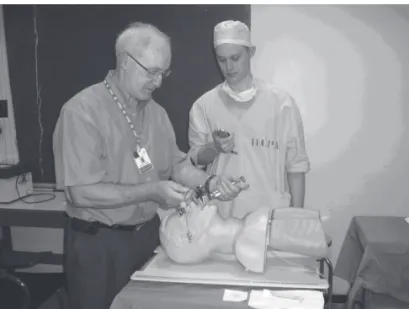
While one trainee performed the OTI, the second controlled the time, the third recorded it on a form, and the fourth ven-tilated the mannequin with a balloon-valve device (Figure 3).
Success and failure criteria for the OTI:
• Success: orotracheal intubation in 45 seconds or less, confirmed by visualizing the orotracheal tube in the
trachea of the mannequin and lung expansion with ma-nual ventilation with the balloon-valve device.
• Failure: orotracheal intubation in more than 45 seconds and/or failure to intubate.
The acceptable failure rate (p0) for OTI was 5% and the unacceptable failure rate (p1) was 10%. The acceptable and unacceptable failure rates established were stricter than
Figure 1 - Truview EVO2 Laryngoscope. Observe the optical piece
connected to the blade. The visor allows the indirect view of the glottis by projecting the image reflected at a 42° angle. The visor can be connected to an endoscopy system, allowing projection on a video screen. The oxygen connector is located on the right, close to the optical visor.
Figure 2 – The Image Shows a Laryngoscopy with the Truview EVO2. The individual performing the procedure sees the glottis
those in the literature since residents and anesthesiologists experienced in OTI were being evaluated. The probability of a type I (α) and II (β) error was established at 0.1.
The calculated sample size (number of OTIs) for an accep-table failure rate of 5% was 105 attempts.
Using the data of the 300 OTIs, CUSUM curves were plotted for each trainee according to the formula in Chart I.
The success rate of experienced residents and anesthesio-logists was compared by the Fisher Exact test, with a 5% level of significance.
On the graphic representation of the CUSUM curve, each trainee was represented by a geometric figure (s, n, l, u)
to guarantee anonymity.
RESULTS
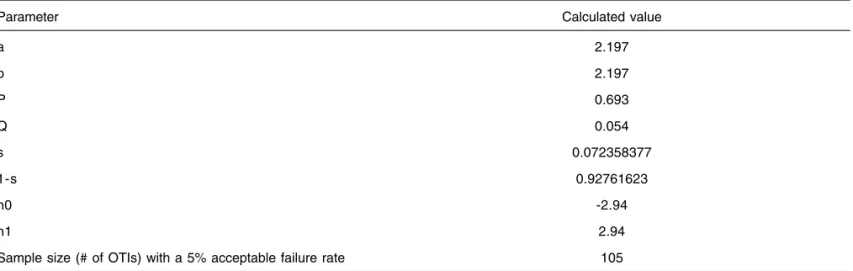
Table I shows the calculated values to plot the CUSUM curve. Lines h0 and h1 (Figure 4) were derived from the determi-nation of α and β of 0.1, 5% acceptable failure rate, and 10%
unacceptable failure rate. Between those two horizontal lines shown in the chart is the undefined area of proficiency in the sequence of OTI attempts. The chart of the learning curve starts at zero. The calculated values for s (for each success) and 1-s (for each failure) determine the direction of the curve upwards and downwards, respectively. When the curve cros-ses the h1 line, it means the trainee has an unacceptable failure rate for the procedure in question, according to the consensus of the subspecialty, and the causes of those failures should be investigated if they persist. When the cur-ve crosses the h0 line, it shows the trainee has acquired proficiency on the procedure, i.e., he presents an acceptable failure rate. Calculating the size of the sample is equivalent to the number of repetitions necessary to define the tendency of the trainee within those three possibilities: proficiency, undefined, or lack of proficiency. A very strict failure rate is reflected on a small calculated sample size, and may gene-rate failure warnings too early in the training 7. To generate
an intervention to determine and correct those failures, the choice of this value depends on the impact that failures will have on patients 12.
The determination of equal alpha and beta values generates identical distances for h0 and h1 from zero. However, other values can be chosen for alpha and beta, according to the risk one is willing to take as to consider proficient someone who is not, or not proficient someone who is already trained enough within the criteria established 14.
The calculated number of repetitions necessary for our study was 105 OTI for an acceptable failure rate of 5% with the Truview EVO2 laryngoscope. The four trainees, with
dif-ferent experience in Anesthesiology, completed the propo-sed training of 300 OTIs, divided in seven sessions, once a week.
All failures were seen on the first training day (Table II). All four trainees crossed the line of acceptable failure rate of 5% (h0) before completing 105 OTIs (Figure 4): trainee s reached
proficiency after 42 OTIs; trainees n and u after 56 OTIs; and
trainee l after 97 OTIs, and their performance remained
constant from there on.
The rate of success of residents and anesthesiologists sho-wed no differences (Fisher Exact test, p = 0.2).
Figure 3 – The Procedure was Repeated 300 Times by Each Trainee, Who Alternated in the Tasks of Intubation, Chronometry, Data Recording, and Ventilation with the Balloon-Valve Device.
Chart I – Formulas Involved in Plotting the CUSUM Curve
a = ln [(1 - β) / α] b = ln [(1 - α) / β] P = ln (p1 / p0)
Q = ln [(1 - p0) / (1 - p1)] s = Q / (P + Q)
s = represents the increment for each success 1-s = represents the increment for each failure h0 = -b / (P + Q)
h1 = a / (P + Q)
Sample size with failure rate = p0 = [( h0 ( 1- α ) - αh1 / s - p0)] Sample size with failure rate = p1 = [( h1 ( 1- β ) - βh0 / p1 - s)] p0 = acceptable failure rate
p1 = unacceptable failure rate
Table II – Performance Data of Trainees with the Use of the Truview EVO2 Laryngoscope for OTI in Mannequins
Trainee 1 (s) 2 (n) 3 (l) 4 (u)
Time of experience* in OTI, in years 10 31 1 2
Number of failures in the first training session 0 1 4 1
Number of failures in the remaining sessions 0 0 0 0
Number of OTIs needed to demonstrate proficiency 42 56 97 56
*Experience in laryngoscopy (residency + professional practice); OTI = orotracheal intubation
Figure 4 – CUSUM Curve for Orotracheal Intubation (OTI) with the Truview EVO2 Laryngoscope on a Mannequin. The geometric figures
represent the four trainees. The x axis represents the number of intubations; the y axis represents: 0, the starting point; h0 = -2.94; h1 = 2.94; and their multiples. The area between h0 and h1 corresponds to the undefined zone. The area above 2.94 corresponds to the zone of lack of proficiency, while the area below -2.94 corresponds to proficiency. The four trainees passed h0 before 105 OTIs and remained in the proficiency zone, demonstrating stability in the performance of the task.
CUSUM
5,88
2,94
0
-2,94
-5,88
-8,82
-11,76
cums1 cums2 cums3 cums4
Table I – Calculate Values to Plot the CUSUM Curve According to the Formulas Presented
Parameter Calculated value
a 2.197
b 2.197
P 0.693
Q 0.054
s 0.072358377
1-s 0.92761623
h0 -2.94
h1 2.94
DISCUSSION
A mannequin was used to evaluate learning ability of OTI using a Truview EVO2 laryngoscope. Transposition of the
results to the daily practice has limitations that should be considered. Real life has more complex situations that might cause a reduction in efficiency when compared to simulations. The diversity of airways anatomy, the urgency of the procedure, and prior experience are examples of some of the factors that can influence the results of studies with patients. However, the repetitive execution of tasks can be initiated with simulations. The use of simulators and mannequins for training in the medical field is based on the idea of developing a minimal level of ability to enhance the performance when dealing with patients 20,21. Classical examples of the use of
manne-quins and simulators include the regular training on cardio-respiratory arrest 21 and flight simulators used in the airline
and aerospace industries 22. Applying the CUSUM curve to
clinical situations that require risk stratification may need mathematical adaptations to more accurately reflect learning in those circumstances. Rogers et al. published an important review on the subject, discussing the different adaptations of the CUSUM curve according to what is being evaluated. Learning curves have been the focus of attention of medical investigators who look for a systematic way of evaluating residents and to monitor the performance of experienced professionals 1,2,515.
The CUSUM curve can determine when the trainee has achie-ved an acceptable performance on a specific task, similar to that of experienced professionals, which can influence the planning of training programs, both concerning the number of training sessions the trainee should be exposed to and establishing minimal requirements that allow safer progres-sion to increasingly more complex tasks. Another positive aspect of learning curves is the possibility to evaluate perfor-mance within a specific period of time instead of on a single moment, which is the case of tests and exams that cannot detect the real performance of a trainee 24,25.
Orotracheal intubation with the standard Macintosh laryngos-cope is a well known technique in which all four subjects of this study had experience with at two different proficiency levels: two residents and two anesthesiologists. However, the Truview EVO2 laryngoscope requires a different
intubation routine. The main difference consists on the indirect view of the glottis and vocal cords through an optical lens, while traditional laryngoscopy allows direct view of the vocal cords. The tracheal tube has to be shaped with a metallic guide wire to be introduced with the Truview EVO2.
The individual performing the procedure can only see the distal extremity of the tube when it reaches the entrance of the glottis, on a small field of vision projected by the lens. The trainees considered this the most difficult aspect of the procedure: the ability to place the distal end of the tube within the field of vision of the lens in order to insert it in the glottis through the vocal cords.
According to what was determined by the acceptable success and failure rates, trainees achieved the proficiency level between the 46th and 97th intubation in the mannequin.
Those numbers can be compared with the performance of intubations in patients to determine whether prior training in mannequins could decrease the number of procedures necessary in daily practice. In a study 14 that evaluated the
learning curve of anesthesiology residents on OTIs with the Macintosh laryngoscope, 57.14% crossed the h0 line (the line that limits the proficiency zone) after 43 ± 33.49 proce-dures. However, for one of the trainees the line remained in the undetermined zone after 144 procedures, demonstrating the variability that study subjects may present, as well as the need to identify trainees with greater difficulties in order to better manage training.
The consistency of the learning curve was high for the trainees, with few failures in the first ten intubations and no failures up to the 300th intubation. This suggests that the Truview EVO2
is easy to work with for those who already have prior laryngoscopy training. The easiness of learning was reflected on the similar performance of residents and anesthesio-logists, without differences among their learning curves. Training and acquisition of practical ability in the use of a new equipment are crucial before studies comparing it with a standard technique can be undertaken. It helps to avoid attributing the results to the lack of proficiency with the new equipment. Prior training with the Truview EVO2
laryngos-cope will allow investigators to compare it with the standard OTI technique in situations where a promise of its superiority over traditional laryngoscopy exists, such as in difficult intuba-tions due to limitaintuba-tions of cervical extension and in patients with less visible vocal cords (Cormack 3 and 4). Being trained in alternative techniques of approaching difficult airways is critical, as recommended by the algorithms of several interna-tional Anesthesiology and Emergency Medicine societies 17,27.
It was demonstrated that acquiring OTI ability with the Truview EVO2 laryngoscope by physicians who already have some
experience in this task is easy and stimulates the spread of the use of this equipment in the training of other professionals, such as Intensive Care and Emergency Care physicians, and as an integral part of the armamentarium for handling the airways.
The authors would like to acknowledge the contribution of the Cardiorespiratory Resuscitation Group of the Hospital das Clínicas de Porto Alegre for providing the Laerdal Airway Management (Laerdal®) training mannequin.
REFERÊNCIAS – REFERENCES
01. Steiner SH, Cook RJ, Farewell VT et al. - Monitoring surgical performance using risk-adjusted cumulative sum charts. Bios-tatistics 2000;1:441-452.
03. Anzanello MJ, Fogliatto FS - Curvas de aprendizado: estado da arte e perspectivas de pesquisa. Gest Prod 2007;14:109-123. 04. Williams SM, Parry BR, Schlup MMT - Quality control: an
application of the cusum. Br Med J 1992;304:1359-1361. 05. Kestin IG - A statistical approach to measuring the competence
of anaesthetic trainees at practical procedures. Br J Anaesth 1995;75:805-809.
06. Nan Rij AM, McDonald JR; Pettigrew RA et al. - Cusum as an aid to early assessment of surgical trainee. Br J Surg 1995;82:1500-1503.
07. Lim TO, Soraya A, Ding LM et al. - Assessing doctors’ co-mpetence: application of CUSUM technique in monitoring doctors’ performance. Int J Qual Health Care 2002;14:251-258.
08. Lim TO - Statistical process control tools for monitoring clinical performance. Int J Qual Health Care 2003;15:3-4.
09. Leandro G, Rolando N, Gallus G et al. - Monitoring surgical and medical outcomes: the Bernoulli cumulative SUM chart. A novel application to assess clinical interventions. Postgrad Med J 2005;81:647-652.
10. Chang WR, McLean IP - CUSUM: A tool for early feedback about performance? BMC Med Res Methodol 2006;6:8.
11. Konrad C, Schüpfer G, Wietlisbach M et al. - Learning manual skills in anesthesiology: is there a recommended number of ca-ses for anesthetic procedures? Anesth Analg 1998;86:635-639. 12. Rogers CA, Reeves BC, Caputo M et al. - Control chart methods for monitoring cardiac surgical performance and their interpre-tation. J Thorac Cardiovasc Surg 2004;128:811-819.
13. Charuluxananan S, Kyokong O, Somboonviboon W et al. -Learning manual skills in spinal ansthesia and orotracheal in-tubation: is there any recommended number of cases for anesthesia residency training program? J Med Assoc Thai 2001;84(suppl 1):S251-5.
14. Oliveira Filho GR - The construction of learning curves for basic skills in anesthetic procedures: an application for the cumulative sum method. Anesth Analg 2002;95:411-416.
15. Plummer JL, Owen H - Learning endotracheal intubation in a clinical skills learning center: a quantitative study. Anesth Analg 2001;93:656-662.
16. Ollerton JE, Parr MJA, Harrison K et al. - Potencial cervical spine injury and difficult airway management for emergency intuba-tion of trauma adults in the emergency department: a systematic review. Emerg Med J 2006;23:3-11.
17. BoissonBertrand D, Bourgain JL, Camboulives JL et al. -Intubation difficile. Ann Fr Anesth Reanim 1996;15:207-214. 18. Reed AP - Evaluation and Recognition of the Difficult Airway,
em: Hagberg CA - Benumof’s Airway Management: Principles and Practice, 2 Ed, Philadelphia, Mosby-Elsevier 2007:221-235.
19. Barak M, Philipchuck P, Abecassis P et al. - A comparison of the Truview® blade with the Macintosh blade in adult patients. Anaesthesia 2007;62:827-831.
20. Gaba DM - Improving anesthesiologists’ performance by simulating reality. Anesthesiology 1992;76:491-494.
21. Gagne AH - Training and Education to Increase the Effectiveness of Technology Introduction in Medicine, em: Health Care Technology Policy 1 – The Role of Technology in the Cost of Health Care 1994;366-369.
22. Anonymous - Highlights of the 2005 American Heart Association guidelines for cardiopulmonary resuscitation emergency cardiovascular care. Curr Emerg Cardiovasc Care 2005-2006; 16:1-27.
23. Cooper JB, Taqueti VR - A brief history of the development of mannequin simulators for clinical education and training. Qual Saf Health Care 2004;13(suppl 1):11-18.
24. Newble D - Techniques for measuring clinical competence: objective structured clinical examinations. Med Educ 2004;38: 199-203.
25. Sivarajan M, Miller E, Hardy C et al. - Objective evaluation of clinical performance and correlation with knowledge. Anesth Analg 1984;63:603-607.
26. Hagberg CA, Benumof JL - The American Society of Anesthe-siologists’ Management of the Difficult Airway Algorithm and Explanation: analysis of the algorithm, em: Hagberg CA - Benu-mof’s Airway Management: Principles and Practice, 2 Ed, Phila-delphia, Mosby-Elsevier 2007;236-251.
RESUMEN
Correa JBB, Dellazzana JEF, Sturm A, Leite DMA, Oliveira Filho GR, Xavier RG - Aplicación de la Curva CUSUM para Evaluar el Entre-namiento de la Intubación Orotraqueal con el Laringoscopio Truview Evo2® .
JUSTIFICATIVA Y OBJETIVOS: Las curvas de aprendizaje han sido herramientas útiles en el monitoreo del desempeño de un tra-bajador sometido a una nueva tarea. Esas curvas han venido siendo utilizadas en la evaluación de varios procedimientos en la práctica médica. El objetivo de esta investigación, fue evaluar el aprendizaje de la intubación orotraqueal (IOT) con el Laringoscopio Truview Evo2® a través de la curva de aprendizaje CUSUM. MÉTODO: Cuatro aprendices realizaron el entrenamiento de la IOT con el Laringoscopio Truview Evo2® en un maniquí. Se les orientó
en cuanto a los criterios de éxito y falla en la IOT y se intercam-biaban los intentos, en un total de 300 IOT para cada uno de ellos. Cuatro curvas de aprendizaje fueron construidas a partir del mé-todo de la suma acumulativa CUSUM.
RESULTADOS: El número calculado para adquirir el desempeño en la tarea fue de 105 IOT. Los cuatro aprendices cruzaron la línea de rango de falla aceptable de un 5% antes de completar 105 IOT: el primer aprendiz alcanzó el rango de desempeño después del 42 IOT, el segundo y el tercer aprendiz después de 56 IOT, y el cuarto aprendiz, después de 97 IOT, manteniéndose constantes en sus desempeños a partir de ese momento. No se registró diferencias en la tasa de éxito entre residentes y anestesiólogos expertos.
CONCLUSIONES: La curva de aprendizaje CUSUM es un instru-mento útil para la demostración objetiva de la habilidad en la ejecución de una nueva tarea. La laringoscopia con el Truview-Evo2® en un maniquí, demostró ser un procedimiento fácil para