Received from Public Health Department; Universidade Federal de Minas Gerais, Brazil. 1. Anesthesiologist, Santa Casa de Belo Horizonte; MSc in Public Health/Occupational Health, Universidade Federal de Minas Gerais (UFMG).
2. Professor, Department of Preventive and Social Medicine, UFMG; PhD in Public Health, Universidade de Campinas (Unicamp).
Submitted on October 24, 2011. Approved on December 4, 2011. Correspondence to:
Bárbara Silva Neves, MD Rua Herval, 423/401 – Serra 30240-010 – Belo Horizonte, MG, Brazil E-mail: [email protected]
SCIENTIFIC ARTICLE
Epidemiological and Occupational Profile of Anesthesiologists
Practicing in Belo Horizonte, Minas Gerais – Brazil, in 2010
Bárbara Silva Neves
1, Tarcísio Márcio Magalhães Pinheiro
2Summary: Neves BS, Pinheiro TMM – Epidemiological and Occupational Profile of Anesthesiologists Practicing in Belo Horizonte, Minas Gerais – Brazil, in 2010.
Background and objectives: Exposed to many occupational risk factors, the anesthesiologist should know how to experience situations related to work and everyday life, so that illness is not part of his reality. Knowledge of work through the worker himself is one way to look deeper into the universe surrounding health professionals in order to seek effective solutions that increase satisfaction and minimize damage. The objective of this paper was to outline an epidemiological and occupational profile of the anesthesiologist in Belo Horizonte, Minas Gerais.
Methods: Quantitative, cross-sectional randomized study conducted among members of the Society of Anesthesiology of Minas Gerais. Data collected through a questionnaire, including the CAGE, for evaluation of alcoholism and Self-Report Questionnaire (SRQ-20) to evaluate the pre-valence of common mental disorders (CMD).
Results: There was predominance of male (62.4%) working on-call schedule (91.1%), both day and at night. The average number of night shifts was 5.4% in the last 30 days. Most of them (88.3%) working in emergency departments. Most professionals reported being very tired and over-loaded or very overover-loaded, but satisfied with the work. There was statistical association between CAGE positive and work overload and between CAGE and SRQ-20.
Conclusions: The population studied indicates that the anesthesiologist is a professional rather overloaded, which corroborates trends seen in the medical field. Major attention should be given to these professionals who live surrounded by harmful occupational hazards.
Keywords: Anesthesiology; Quality of Health Care; Safety; Occupational exposure; Health Personnel.
©2012 Elsevier Editora Ltda. All rights reserved.
INTRODUCTION
The relationship between human beings and work is very res-trict, and it is surrounded by elements other than damages 1,2.
In the search for a plane understanding, the worker and his work (one giving meaning to the other) should be done in a comprehensive manner, as the knowledge of this relationship leads to the elucidation of the health/disease process attu-ned with the set of values, beliefs, ideas, and workers’ social representations. In this context, the concepts advocated by occupational health are marked by offering a broad view that recognizes the various areas surrounding the professional’s life and breaks with the conception of injury and agent, or spe-cific group of agents, as a single causal link in the process of
illness. Subjectivity is also of concern because the worker’s participation becomes part of the understanding and design of the work process 3. Thus, the representation of a universe is the first step in the quest for understanding, followed by the search for the meaning given by the worker to his work, which breaks with the assumption to elucidate the true thou-ght of the worker in the health-work-disease process. These features will be sought in the present study with the group of anesthesiologists practicing during the year 2010 in the city of Belo Horizonte, Minas Gerais.
METHODS
Questionnaire-20 (SRQ-20) 6,7. In this case, seven positive responses were considered indicative of common mental di-sorders (CMD) 8,9,10.
A randomly selected group undertook a test prior to the survey to characterize the feasibility of the questionnaire.
Data collection was conducted in the city of Belo Horizonte with the support of the Society of Anesthesiology of Minas Gerais (SAMG) and was based on the address registered as the city of Belo Horizonte. In total, 367 members were inclu-ded for randomization, with 326 active professionals and 41 assistants. Taken into consideration that this study is explora-tory, with an error of 5% and a significance level of 10%, the size of the representative cohort sample was of 157 anesthe-siologists 11. The survey was approved by the Ethics Resear-ch Committee of the Universidade Federal de Minas Gerais (COEP-ETIC 0344.0.203.000-10). Data were tabulated in a database and statistically analyzed using the statistical sof-tware SPSS 17.0 (Statistical Package for Social Science). To assess the existence of an association between CAGE and SRQ-20 and work overload, chi-square test was used 11.
RESULTS
We applied 157 questionnaires between October 1, 2010 and December 28, 2010. For many reasons, 36 anesthesiologists were replaced in the study, according to the criteria proposed for exclusion and inclusion. The results regarding sex, age, and marital status of participants is shown in Table I.
The distribution for higher level of education showed the Specialist in Anesthesiology (TEA) as a major title for 70 of the respondents (44.6%), followed by the Anesthesiology Su-perior Title (TSA from Portuguese) for 34 (21.7%); residency in anesthesiology for 31 (19.7%), complete or in progress master’s degree for 12 (7.6%), and complete or in progress doctoral or postdoctoral for 9 (5.7%). The time practice of anesthesiology was one year (minimum) and 44 years (maxi-mum), mean of 16.1 years.
Table II shows the percentage of weekly time devoted to anesthesiology and related activities, but two participants did not answer this question. Regarding the activity as an anes-thesiologist, the work schedule of night shift is practiced by 91.1% of participants and only 7.6% do not work in this sche-me. Considering only those who answered the question, the percentage rises to 92.26% (143) working in night shift and 7.74% who do not work in this scheme.
As for time shifts, of the 143 physicians, 79.7% work in day and night shifts, 10.5% in day shifts, and 9.8% in night shifts. Considering the distribution by quartiles, 25% of respondents worked between none and two night shifts in the last 30 days, 50% between two and four shifts, and 25% more than four night shifts in the last 30 days. Of 139 respondents, 7.91% do not work in shifts in areas of urgent and emergency care.
Regarding the workplace, 67 anesthesiologists devote 100% of their working time to hospitals. Considering all respondents, the mean weekly time devoted to the hospital is 88.6%, 12.5% to clinics, 9.9%, to the office, and 9.8% to other places.
Regarding the type of health insurance used by patients (three did not respond), the mean is 57.1% health plan, 44.3% SUS (Brazilian Unified Health System), 9.5% individuals, and 6% other types.
Data on anesthesia applied to patients according to their physical status were on average 33.7% ASA I, 43.3% ASA II, 17.8% ASA III, 7.1%, ASA IV, 3.1% ASA V, and 2.6% ASA VI. Regarding surgery complexity (two participants did not res-pond), there were low (36.9%), medium (40.6%), and high (24.9%) complexity.
There was job overlapping, as one single anesthesiologist has one or more jobs. Thus, 65.6% reported being self-em-ployed, 63.1% were partners in anesthesiologist companies, 47.1% employees, 16.6% hired by some service, and 0.6% reported having another source of work.
Regarding work conditions and considering 155 respon-dents, the office received the highest rating followed by the hospital. Time interval for meals was also investigated and showed a mean of 31 minutes, with a minimum of zero (no in-terval for meals) and maximum of 90 minutes. Considering the division by quartiles, 25% of respondents have between zero and 20 minutes for meals and only 25% have longer than 40 minutes. Intervals for meals were considered inadequate by 101 of anesthesiologists (64.3%), sufficient by 45 (28.75%), and 9 (5.75%) reported having no time interval for meals.
The mean time to rest at work was 15 minutes, with ma-ximum of 360 minutes and minimum of zero. Excluding two reported values of 360 minutes, the mean drops to 10. Among 151 respondents, time to rest is nonexistent for 68.2% and 14.1% reported 20 minutes or less.
Table I – Distribution of Anesthesiologists from Belo Horizonte According to Age, Sex, and Marital Status, year 2010
Category Frequency
N
%
Sex
Female 59 37.6
Male 98 62.4
Total 157 100.0
Age Group
< 30 years 2 1.3
30 – 39 years 59 37.6
40 – 49 years 55 35.0
50 – 59 years 26 16.6
60 – 69 years 15 9.6
Total 157 100.0
Marital Status
Married 115 73.2
Divorced 8 5.1
Single 26 16.1
Other 7 4.5
Not Informed 1 0.6
When asked about their relations to work, 94.9% of anes-thesiologists reported some level of overhead and 96.8 some level of tiredness. However, regarding job satisfaction, 95.5% reported some level of satisfaction, while 77.1% would not have chosen another profession or medical specialty.
With respect to tasks performed, 52.2% said that tasks vary with days of the week and 37.6% said that work activities are always the same or vary slightly.
Current health status was considered good by 45.9% of respondents and 24.2% consider it very good. Only 1.3% con-siders it bad, and none of them concon-siders their health as very bad. More than half of respondents (52.9%) have some kind of health problem. They reported 35 different health problems present in 95 subjects, with 22 of them complained of two or more health problems. The health problem most often repor-ted by 14 individuals was Hypertension (HBP), followed by stress and herniated discs, mentioned seven times each. Use of any medication on regular basis was reported by 48.4% (79) of participants, with 39 different medications mentioned, the most used (16 individuals) belong to the class of anxio-lytics, followed by antidepressants (seven individuals) and omeprazole and statin (five subjects each). The relationship between health and work is shown in Table III.
Considering the work-related health problems that led to absence and were reported by 31 participants, fatigue accoun-ted for 16.6%, burnout 9.7%, and labyrinthitis 9.7%. For those who have been absent due to work-related health problems,
one day was the minimum and 60 days the maximum (mean 19 days). The relationship between work accidents and seeking an occupational physician was also questioned (Table IV).
The risks to which anesthesiologists are exposed are nu-merous and some of them were asked to be qualified by the professional regarding damage (Table V). Work may be an impairment for relationships, so anesthesiologists were asked about this possible damage. For 38% of participants, working as an anesthesiologist moderately affects their relationships outside the workplace, 37.6% reported that it affects a little, and 12.7% stated that it greatly affects their relationships out-side the workplace.
The relationship with colleagues was also questioned. Of participants, 58% consider their relationship with colleagues “good”, 21.7% consider it “very good”, 12.1% consider it “me-dian”, and only 5.7% consider it “very bad”. Four subjects (2.5%) did not answer this question and no one rated the re-lationship as “bad.”
Alcohol consumption in this population had a positivity rate to 104 of respondents (67%) and of these, 16 were conside-red CAGE positive (two or more positive responses). Because of the sensations that the anesthetics and other drugs can trigger, its use for relaxing or recreational purposes was su-ggested and 20 respondents (12.7%) reported having used some of these drugs for this purpose (Table VI).
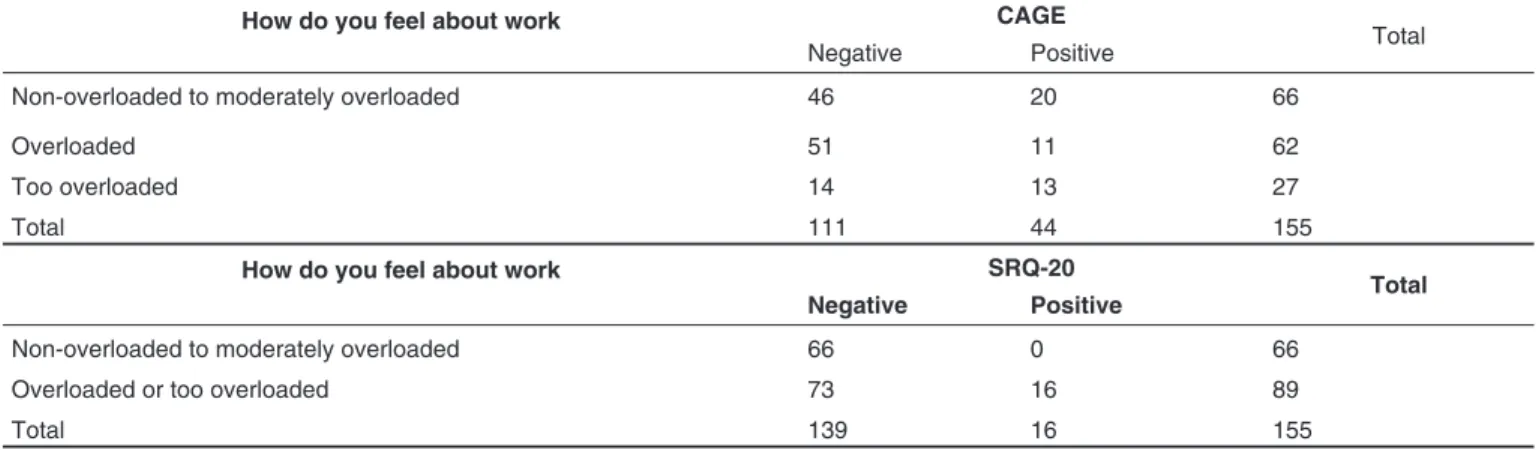
The association between CAGE and work overload could be demonstrated using the chi-square test. Those who feel overloaded or too overloaded tend to have very positive score on CAGE (Table VII).
Table II – Weekly Time Dedicated to Anesthesiology and Related Activities by Anesthesiologists from Belo Horizonte, year 2010 Weekly Time Dedicated to Each Activity CI (95%)
Activity N# respondents Min Max Mean SD Lower limit Upper limit
Anestesiology 155 50.0% 100.0% 93.2% 12.5% 91.2% 95.2%
Intensive Care 9 5.0% 20.0% 11.1% 7.0% 5.8% 16.5%
Pain Clinic 12 1.0% 35.0% 12.7% 11.2% 5.6% 19.7%
Other Proffessional Activity 38 2.0% 50.0% 21.2% 14.8% 16.3% 26.0%
Table III – Distribution of Anesthesiologists from Belo Horizonte According to Various Health Problems Resulting in Absence from Work, Anesthesiology as a Cause of Illness Affecting Co-workers, and Work that Triggers Health Problem, year 2010
Variables Yes No No informed Total
N % N % N % N %
Health problems resulting in absence from work 31 20 122 78 4 3 157 100
Practice of anesthesiology caused illness in a co-worker 122 78 31 20 4 3 157 100
Work triggered health problems 77 49 78 50 2 1 157 100
Table IV – Distribution of Anesthesiologists from Belo Horizonte According to Number of Occupational Accidents and Visiting the Occupational Health Doctors, year 2010
Have experienced any occupational accident
If, in case of accident, visited the occupational physician Total
Yes 44 44 88
No 1 64 65
Not informed 4 4
Table V – Classification of Anesthesiology Related Risks by Anesthesiologists from Belo Horizonte, year 2010
Risk Classification
Risks
VH H MH LH NH NI Total
N % N % N % N % N % N %
Anesthetic gases 24 15% 45 29% 50 32% 21 13% 13 8% 4 3% 157
Latex 16 10% 44 28% 41 26% 32 20% 18 11% 6 4% 157
Addition 41 26% 26 17% 40 25% 22 14% 9 6% 19 12% 157
Ionizing radiation 73 46% 43 27% 26 17% 8 5% 0 0% 7 4% 157
Blood and secretions 79 50% 47 30% 25 16% 2 1% 0 0% 4 3% 157
Work overload 82 52% 48 31% 21 13% 2 1% 0 0% 4 3% 157
Explosions and fires 25 16% 26 17% 30 19% 41 26% 29 18% 6 4% 157
Electricity 20 13% 27 17% 33 21% 51 32% 22 14% 4 3% 157
Piercing/Cutting material 99 63% 39 25% 12 8% 3 2% 0 0% 4 3% 157
Noise 28 18% 52 33% 41 26% 24 15% 8 5% 4 3% 157
Other risk factors 3 38% 1 13% 0 0% 0 0% 0 0% 4 50% 8
VH: Very harmful; H: harmful; MH: moderately harmful; LH: little harm; NH: no harm; NI: not informed.
Table VI – Frequency of the Use of Substances Listed by Anesthesiologists from Belo Horizonte, year 2010
Substance
Use of any substance
Yes No Not informed Total
N % N % N %
Opioids 5 3 146 93 6 4 157
Amphetamines 3 2 148 94 6 4 157
Inhalation anesthetics 2 1 149 95 6 4 157
Anxiolytics 42 27 110 70 6 4 158
Hallucinogens 0 0 151 96 6 4 157
Marijuana 5 3 146 93 6 4 157
Cocaine /Crack 0 0 151 96 6 4 157
Other substances 2 1 151 96 4 3 157
Table VII – Frequency of the Level of Workload Related to CAGE and SRQ-20 in Anesthesiologists from Belo Horizonte, year 2010
How do you feel about work CAGE
Total Negative Positive
Non-overloaded to moderately overloaded 46 20 66
Overloaded 51 11 62
Too overloaded 14 13 27
Total 111 44 155
How do you feel about work SRQ-20
Total Negative Positive
Non-overloaded to moderately overloaded 66 0 66
Overloaded or too overloaded 73 16 89
In the analysis of CMD using SRQ-20 and considering the criterion of positivity as seven affirmative questions for both sexes, 23 women and 21 men were classified as SRQ-20 positive. To assess the association between two variables (overload at work and SRQ-20), we also used Pearson’s chi-square test that showed an association between how the individual feels about the work and SRQ-20 score, with the highest frequency of SRQ-20 positive among those who feel too overloaded (Table VII).
DISCUSSION
The random selection of the population to participate in the study was done actively, which is not suitable for compari-son with the literature on adherence to research performed by sending questionnaires.
The number of male participants was higher in this study, unlike the study conducted in other Brazilian state 12. Howe-ver, there was similarity regarding predominance of married anesthesiologists with TEA as the highest degree, followed by TSA 12. It was not possible to assess the prevalence of specia-lizations, such as Intensive Care and Pain Clinic, as they may not have been considered by the professional as their highest level of education and, consequently, were not mentioned. In addition, there are professionals without the specializations considered engaged in these activities, which could be contra-dictory when portrayed the percentage of weekly time devoted to each work activity. Nevertheless, the fact that a large num-ber of anesthesiologists evaluated devotes most of their time to the practice of Anesthesiology was seen.
Considering the medical work in general 13 and in particular the anesthesiologist 14,15, the working conditions associated with the current pay has led these professionals to exhaustive schemes of shifts exceeding 24 hours uninterrupted, i.e., no respite, which is advocated by the Federal Council of Medi-cine after shifts. In this sense, no reason for pride, this study corroborates the current situation of the Brazilian medicine.
Of 155 anesthesiologists, 145 reported working in shifts, ac-counting for 91.1%. Most have day and night work schedules, and one participant reported having worked 22 night shifts of 12 hours in the previous month. Considering a month’s work, this professional spent 73.3% of his nights working. The same participant reported having no time to rest after duty. Sleep deprivation is an important feature and extremely relevant to be considered, not to mention burnout and its disastrous consequences both for professionals and their patients 14,16. Most of these physicians reported that at least one of their shifts happen in urgent and emergency services, which can be considered as another risk factor for illness, as control over the work, a very important factor in job satisfaction, especially in these cases, is nonexistent, and any type of patient may require assistance at any time 17,18.
Working at hospitals is a reality in anesthesiology, although the service of anesthesiology at outpatient clinics and office presents strong growth trends. Regarding employment, as an important epidemiological characterization because it is
directly related to payment, anesthesiologists have followed a trend of the current medical market: to work independently or becoming a partner with anesthesiology companies 19. Also following this trend, the private sector through health insuran-ce was the most reported as the universe served 8.
Surgical complexity and type of patient under anesthesia can be considered as a stress factor for this professional, as complications are expected in more complex procedures and more critically ill patients, although this correlation was not questioned here. Moreover, time restrictions and work inter-ference in everyday life are factors already studied and seen as strongly associated with damage 20. In this study, however, the relationships with co-workers and outside the workplace seem not to interfere or appear to have little influence on the work, which goes against previous studies 20.
Analyzing working conditions and risk perception, the anesthesiologists surveyed see hospitals, their main place of work, as a supplier of suitable conditions. If we consider that organizational factors are depicted as working conditions, this would be regarded as an important causative agent of stress here shown as controlled and, therefore, a possible generator of satisfaction 20.
The anesthesiologist is classified here as an overworked and tired professional. The routine work does not allow time to rest during their journey. Time interval for meals is reported as insufficient and even nonexistent for some. Nevertheless, the vast majority rated themselves as satisfied with their medical specialty and they would not have chosen another profession or medical specialty. This could be justified by the satisfac-tion reported with the organizasatisfac-tional factors 20, the fact that everyday tasks are considered as varying over the day of the week, in addition to observing the poor working conditions and payment of most Brazilian physicians from different special-ties 8,19,21.
Despite the satisfaction, they recognize the work overload and this occupational risk and “blood and secretions” are clas-sified as the most important risk factors, receiving the worst score in terms of damage by most professionals 22,23.
It is noteworthy that half of anesthesiologists perceive work as a trigger of illness at some stage of their working life and the other half consider it as a cause for the illness of colleagues.
In case of work accidents, very common among health pro-fessionals, especially with piercing/cutting instruments, only 60% of anesthesiologists surveyed reported having experien-ced some type of accident at work, with 30% seeking medical care, according to legislation 24.
Alcohol and drugs such as marijuana may serve as a trig-ger for abuse of other substances, such as opioids and inha-led anesthetics. Among the medications used at work and consumed by the professional, the most commonly used were anxiolytics. Of major concern to the field, the powerfully addic-tive drugs such as opioids were mentioned, as well as inhaled anesthetics 26,27.
The prevalence of SQR-20 positive was 28.4%, a value much higher than those found in studies of physicians and other professionals 8,9,10. When SQR-20 was related to work overload, this association was statistically positive, indicating an expected result, as work overload is shown as a major ge-nerator of illness 20.
REFERENCES
1. Laurell AC, Noriega M – Processo de produção e saúde: trabalho e desgaste operário. São Paulo: Hucitec, 1989.
2. MendesR, Dias EC – Da medicina do trabalho à saúde dos trabalha-dores. Rev Saúde Pública, 1991;25 (5):341-349.
3. Oddone I (org) – Ambiente de trabalho: a luta dos trabalhadores pela saúde. São Paulo: Hucitec, 1986.
4. Marconi MA, Lakatos EM – Metodologia científica. São Paulo: Editora Atlas SA, 2007, 5ª ed..
5. Masur J, Monteiro M – Validation of the CAGE alcoholism screen-ing test in Brazilian Psychiatry Inpatient Hospital Settscreen-ing. J Biol Res, 1983;16:215-218.
6. Harding TW, Arango MV, Baltazar J et al. – Mental disorders in pri-mary health care: a study of their frequency and diagnosis in four de-velopment countries. Psychol Med, 1980;10:231-241.
7. Mari J, Williams P – A validity study of a psychiatry screening ques-tionnaire (SRQ-20) in primary care in the city of São Paulo. Br J Psy-chiatry, 1986;148:23-26.
8. Sobrinho CLN, Carvalho FM, Bonfim TAS, Cirino CAS, Ferreira IS – Condições de trabalho e saúde mental dos médicos de Salvador, Bahia, Brasil. Cad Saúde Pública, 2006;22(1):131-140.
9. Borges LH, Faria MAM – Transtornos mentais menores entre traba-lhadores de uma usina siderúrgica. Rev Bras Saúde Ocupacional, 1993;21:7-18.
10. Faria NMX, Facchini LA, Fassa AG, Tomasi E – Processo de produ-ção rural e saúde na Serra Gaúcha. Rev Saúde Pública, 1999;33:391-400.
11. Bolfarine H, Bussab WO – Elementos de amostragem. São Paulo: Editora Blucher, 2005.
12. Calumbi RA, Amorim JA, Maciel CMC, Filho OD, Teles AJF – Avalia-ção da qualidade de vida dos anestesiologistas da cidade do Recife. Rev Bras Anestesiol, 2010;60(1):42-51.
13. Barbosa GA – A saúde dos médicos no Brasil. Brasília: Conselho Federal de Medicina, 2007, pp. 220.
14. Howard SK, Rosekind MR, Katz JD et al. – Fatigue in anesthesia: implications and strategies for patient and provides safety. Anesthesi-ology, 2002;97:1281-1294.
15. Howard ASK – The anesthesiologist and fatigue. Am Soc Anesth Newsletter, 2001;65:1-4.
16. Calabrese G – Impacto de los calendarios laborales del aneste-siólogo en la salud, el rendimiento y la seguridad. Rev Arg Anest, 2004;62(5):356-363.
17. Kinzl JF, Knotzer H, Traweger C et al. – A influence of working condi-tions on job satisfaction in anaesthetists. Br J Anaesth, 2005;94(2):211-15.
18. Araújo TM, Graça CC, Araújo E – Estresse ocupacional e saú-de: contribuições do modelo demanda-controle. Cien Saúde Colet, 2003;8(4):991-1003.
20. Kluger MT, Townend K, Laidlaw T – Job satisfaction, stress and burn-out in Australian specialist anaesthetists. Anaesthesia, 2003;58:339-345.
21. Goulart FAA (org) – Os médicos e a saúde no Brasil. Brasília: Conse-lho Federal de Medicina, 1998, pp. 200.
22. Nyssen AS, Hansez I, Baele P, Lamy M, De-Keyser V – Occupa-tional stress and burnout in anaesthesia. Br J Anaesth, 2003;90:333-337.
23. Greene ES, Berry AJ, Arnold III WP et al. – Percutaneous injuries in anesthesia personnel. Anesth Analg, 1996;83:273-278.
24. Mérat F, Mérat S – Risques professionnels liés à la pratique de l’anesthésie.Ann Fran Anesth Réanim, 2008;27(1):63-73.
25. Rego RA, Oliveira ZMA, Berardo FAN, Oliveira MB, Ramos LR – Epi-demiologia do alcoolismo: prevalência de positividade do teste CAGE em inquérito domiciliar no município de São Paulo. Rev ABP-APAL, 1991;13(2):75-80.
26. Farley WJ, Talbott GD – Anesthesiology and addiction. Anesth Analg, 1983;62:465-466.