Annals of the University of Petroşani, Economics, 12(4), 2012, 109-116 109
COMPARATIVE ANALYSIS OF THE UNEMPLOYMENT
BETWEEN ROMANIA AND MOLDOVA
CLAUDIA ISAC, MIHAELA BAHNARU,
ANA-PETRINA STANCIU
ABSTRACT: Recently, the social security literature noted a major change towards the legal aspects in this field, lowering the importance of the expense and tax issues pursued by economists in their activities. Without minimizing the consistent and continuous importance of the legal foundations of the social security policy implementation, it is necessary that not only the media and the governmental authority websites to disclose information in the social insurance field, but the role of specialists, researchers and academics in finance, tax and even accounting have the role to interpret and give relevant solutions to these issues. Therefore, in this paper, we present in detail the comparative aspects of how the social security segment is organized, mainly the unemployment insurance in both Romania and Moldova by highlighting the financial differences and similarities of these systems.
KEY WORDS: unemployment; social insurance; financial statements; unemployment allowance.
JEL CLASSIFICATION:J64; J65.
1. UNEMPLOYMENT - LABOR MARKET ADJUSTMENT LEVER
Etymologically, the term unemployment is synonymous with "inactive", and after a derivation from the latin expression "high heat" which caused every activity to stop, we get to the French "chomage" and thus is taken into Romanian "şomaj".
The International Labor Office defines the unemployed as a person who reached 15 and meets all the following requirements: is able to work, is deprived of a job, is looking for a paid job, is available for a paid or unpaid activity.
Assoc. Prof., Ph.D., University of Petrosani, Romania, [email protected]
Student, University of Petrosani, Romania, [email protected]
110 Isac, C.; Bahnaru, M.; Păun, A.P.
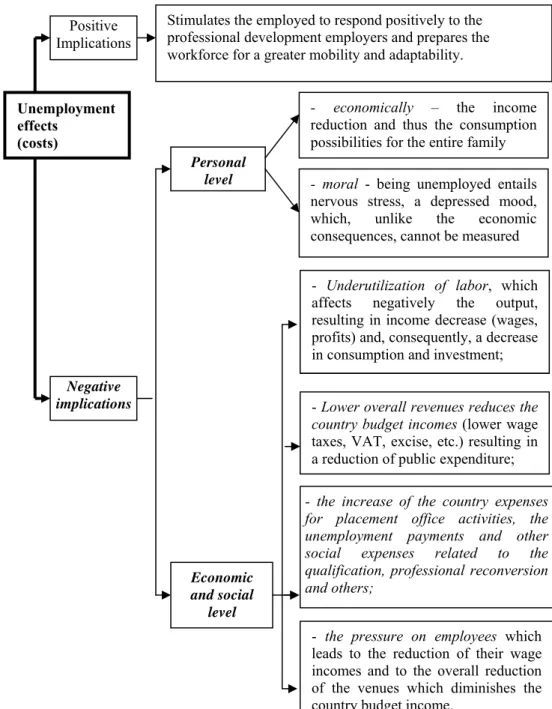
As a recent economic phenomenon in Romanian economy, the unemployment was perceived as a major labor market dysfunction defined by a surplus of labor compared to the demand or as a negative aspect of the economy, whose consequences affect a part of the population which is able to work by failing to assign jobs (figure 1).
Source: Dobre-Baron, O.; Niţă, D.; Fleşer, A. (2009) Economics II, Manual for distance learning, Petrosani, p.89
Figure 1. Unemployment effects
Stimulates the employed to respond positively to the professional development employers and prepares the workforce for a greater mobility and adaptability.
Unemployment effects
(costs)
Positive Implications
Negative implications
Personal level
- economically – the income
reduction and thus the consumption possibilities for the entire family
- moral - being unemployed entails nervous stress, a depressed mood, which, unlike the economic consequences, cannot be measured
Economic and social
level
- Lower overall revenues reduces the country budget incomes (lower wage taxes, VAT, excise, etc.) resulting in a reduction of public expenditure;
- the pressure on employees which leads to the reduction of their wage incomes and to the overall reduction of the venues which diminishes the country budget income.
- Underutilization of labor, which affects negatively the output, resulting in income decrease (wages, profits) and, consequently, a decrease in consumption and investment; - Underutilization of labor, which affects negatively the output, resulting in income decrease (wages, profits) and, consequently, a decrease in consumption and investment;
Comparative Analysis of the Unemployment between Romania and … 111
Following the trend of increasing the human role at micro and macro economic level, the unemployment becomes a normal phenomenon in a well developed economy, where the mechanisms are self adjusting and operate from the equilibrium given by the ratio of supply and demand which is freely and continuously active in all the business and social sectors of the national economy. Therefore, unemployment should be seen as an economic adjustment process and as a normal social phenomenon as long as the unemployment rate and other indicators do not notice any threats on the labor market. We should not develop a negative view on the unemployment, but rather a better perspective on its positive and negative consequences and a more effective focus on how to increase the employment ratio and to offer training flexibility to the subjects (Niță & Fleșer, 2011).
The opinions of specialists from national and international literature, emphasize that even though generally the characteristics, effects, costs for this phenomenon are relatively similar in countries with the same level of development, the specific aspects of every country have to be studied, analyzed and compared separately. Starting from this premise, we will present several elements of the unemployment problems and unemployment insurances in Romania and Moldova.
2. STATISTICAL ANALYSIS ON THE UNEMPLOYMENT AND WORKFORCE IN MOLDOVA AND ROMANIA
Unemployment represented for Moldova and Romania, as former communist countries, a new phenomenon, whose appearance caused multiple social effects and costs for reducing these effects. Thus, to reduce the negative influences of the unemployment and to increase the employment of labor in both countries there were established government organizations to manage this phenomenon. The main indicators which are monitored by the two institutions, called National Employment Agency, are calculated using the methodology of the International Labor Office.
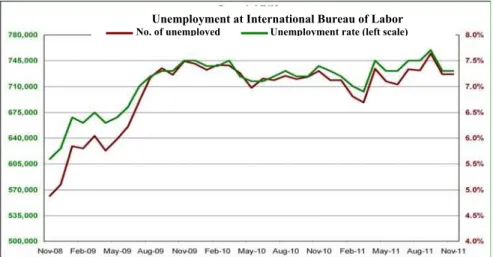
Figure 2. International Bureau of Labor unemployment levels in absolute and relative values in Romania
112 Isac, C.; Bahnaru, M.; Păun, A.P.
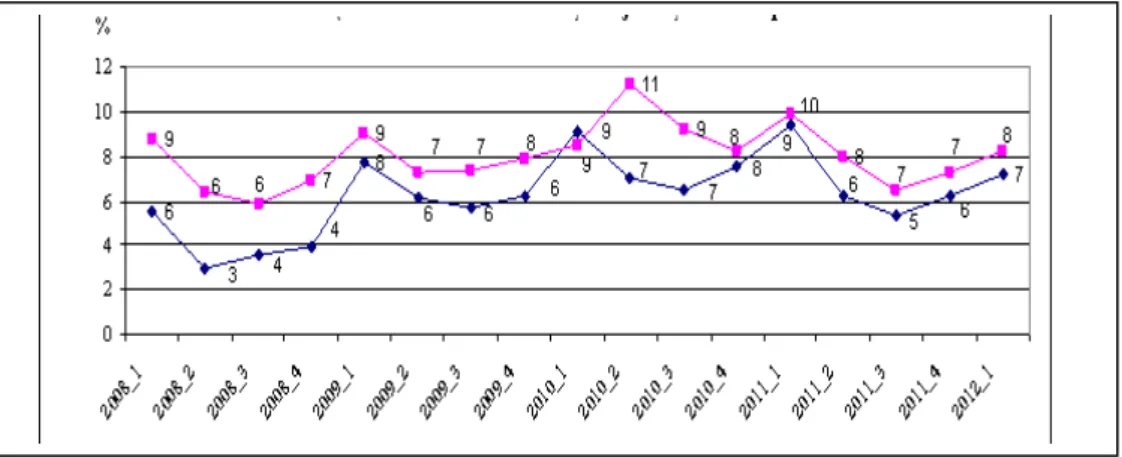
Thus, when we analyze the unemployment rate in the two countries, we observe that in Romania during November 2008 and- November 2011, although the rate is generally increasing with a ratio of over 2% in the first year of the period, it records a slight decrease towards the end of the interval. Meanwhile Moldova records less fluctuating unemployment ratios, but higher values of about 9% in the beginning of every year. As shown in figures 2 and 3, both countries have at the end of 2011 unemployment values of about 7%.
Source: http://www.statbank.statistica.md
Figure 3. International Bureau of Labor unemployment levels in absolute and relative values in Moldova during 2008-2011
Related to the structural unemployment evolution it may be identified the following estimation elements:
A. Distribution by level of education. Generally, statistics show that the unemployment ratio is inversely proportionate with people’s training level, therefore, as an example, in Romania in 2013, there is a low percent of unemployed with high education, only 7%. Instead, the unemployment of non-educated and of those with only primary, secondary or vocational studies represents 73% of total unemployment (figure 4).
Comparative Analysis of the Unemployment between Romania and … 113 73 20 7 0 10 20 30 40 50 60 70 80
Nivel primar, gimnazial,
profesional şi fără studii
Nivel liceal şi post-liceal Nivel universitar
Di st ri b u ţ ia n u m ă ru lu i d e ş o m e ri, %
Source: http://www.legestart.ro/somaj-februarie-2013
Figure 4. Unemployment distribution by level of education in Romania in 2013
0 10 20 30 40 50
2000 2001 2002 2003 2004 2005 2006 2007 2008 2009 2010 2011 2012
Ani Ş o m er i B IM , m ii p e rs o a n e
Superior Mediu de specialitate Secundar profesional Liceal, mediu general Gimnazial Primar sau fărășcoală
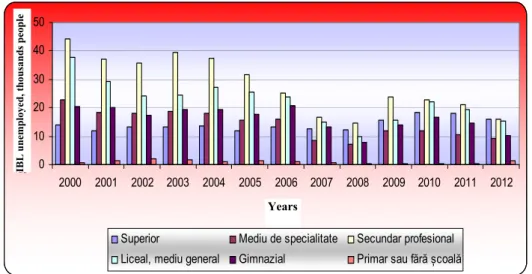
Figure 5. Unemployed distribution by level of education in Moldova during 2000-2012
B. Urban / rural distribution. According to figure 6 in Romania during 2008-2011, the unemployment rate in urban areas is higher than in rural areas, the recorded values are ranged between 7.2% and 9.9%. The unemployment in rural areas is constant between 5.3% -5.9%.
Roughly, the same trend occurs in Moldova, namely the higher unemployment ratios in urban areas. However, if we consider a longer period, since 2000, the conclusions of the analysis are quite different from some simple or normal unemployment and its influence within the two environments. Moldova is a very interesting case considering that, in the beginning of the period, the urban unemployment rate was 4 times higher than in rural areas, while lately this proportion was halved. This positive phenomenon is expressed by the development of some
Unemp
loyment d
ist
ribut
ion %
No education, primary, secondary or vocational school
High school High education
114 Isac, C.; Bahnaru, M.; Păun, A.P.
specific urban sectors, respectively services, commerce and even industry. Another explanation given by sociologists is the population migration from rural areas to abroad looking for work, unlike Romania, where most citizens who left the country to work comes from urban areas.
7,2 7,5
9,9
8,8
5,3 6 5,8 5,9
0 2 4 6 8 10 12
2008 2009 2010 2011
Ani
Ra
ta
ş
om
aj
u
lui
, %
Urban Rural
Source: www.insse.ro
Figure 6. Unemployment distribution in urban/rural areas in Romania
0 20 40 60 80 100 120
2000 2001 2002 2003 2004 2005 2006 2007 2008 2009 2010 2011 2012
Ani
Ş
om
e
ri B
IM
,
m
ii p
e
rs
oa
n
e
Urban
Rural
Source: http://www.zf.ro
Figure 7. Unemployment distribution in urban / rural areas in Moldova
4. COMPARATIVE ANALYSIS OF THE UNEMPLOYMENT ALLOWANCE BETWEEN ROMANIA AND MOLDOVA
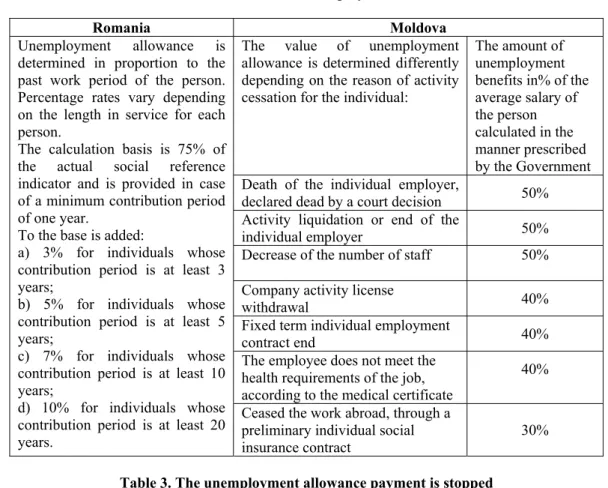
Elements that differentiate the unemployed financial protection system, respectively the payment period and the value of the unemployment allowance are presented in the following tables:
Unemployment r
a
te, %
Years
IBL unemp
loyed, th
ousand
s pe
ople
Comparative Analysis of the Unemployment between Romania and … 115
Table 1. The payment period of the unemployment allowance
Length period in:
Romania Moldova
The payout period of unemployment allowance in Romania and Moldova
1 to 5 years 9 months to 5 years 6 months
From 5 to 10 years 9 months
For over 10 years 12 months
Table 2. The amount of unemployment allowance
Romania Moldova
The value of unemployment allowance is determined differently depending on the reason of activity cessation for the individual:
The amount of unemployment benefits in% of the average salary of the person calculated in the manner prescribed by the Government Death of the individual employer,
declared dead by a court decision 50%
Activity liquidation or end of the
individual employer 50%
Decrease of the number of staff 50%
Company activity license
withdrawal 40%
Fixed term individual employment
contract end 40%
The employee does not meet the health requirements of the job, according to the medical certificate
40% Unemployment allowance is
determined in proportion to the past work period of the person. Percentage rates vary depending on the length in service for each person.
The calculation basis is 75% of the actual social reference indicator and is provided in case of a minimum contribution period of one year.
To the base is added:
a) 3% for individuals whose contribution period is at least 3 years;
b) 5% for individuals whose contribution period is at least 5 years;
c) 7% for individuals whose contribution period is at least 10 years;
d) 10% for individuals whose contribution period is at least 20 years.
Ceased the work abroad, through a preliminary individual social insurance contract
30%
Table 3. The unemployment allowance payment is stopped in the following cases
In Romania In Moldova
Similarities
In case of unreasonable refusal of a proper job provided by the Agency
In case of unjustified refusal to participate in to work training and stimulating courses or in case of their stoppage
In case of fulfilling the age conditions for retirement In case of death of the individual
Differences
At the date of legal employment for a period of at least 12 months
116 Isac, C.; Bahnaru, M.; Păun, A.P.
At the date when he / she gets, through authorized activities, higher incomes than the actual social reference indicator
On obtaining the entrepreneurship authorization
On individual's departure abroad for more than 3 months
On the abroad departure of the individual
On the start of an imprisonment sentence for at least 12 months
At the date of conviction decision
On admission to an educational institution for school graduates or special disability schools graduates of at least 16 years
The individual studies full time in an education institution
5. CONCLUSIONS
Based on the comparisons from this paper we can conclude that the two unemployment insurance systems are similar and the differences can be eliminated in favor of more efficient ones. Therefore, changing the unemployment allowance conditions by lowering the contribution period from 12 to 9 months or lowering from 3 to 2 years the compulsory enrollment period of the graduates by the employers which get financial grants and facilities from Labor National Agency for their employment are two measures which can be taken by Romania in order to have a positive influence on unemployment. For Moldova, it can be considered the introduction of the social reference indicator as base for calculating unemployment allowance, an indicator based on a minimum budget/person.
REFERENCES:
[1]. Dobre-Baron, O.; Niţă, D.; Fleşer, A. (2009) Economics II, Manual for distance learning,
Petrosani, p.89
[2]. Niță, D.; Fleșer, A. (2011) Youngster disadvantage group on the labour market – alternative employment, Annals of the University of Petroşani, Economics, 11(1), pp.179-186
[3]. http://www.statbank.statistica.md
[4]. http://www.legestart.ro/somaj-februarie-2013
[5]. www.insse.ro