*e-mail: [email protected]
1. Introduction
SiC ceramics have many applications because they allow the combination of important properties such as low density, high elastic and rupture modulus, high thermal shock resistance, and high resistance to corrosion and oxidation at high temperatures1-13.
One of the properties of SiC ceramics that limits many applications is their low fracture toughness. Research investments have been made in the control or improvement of this property using additives in liquid phase sintering, as well as in the control of morphology and grain size during sintering and post-sintering heat treatments9,10.
Various additives have been studied for the formation of this liquid phase in order to improve sintering and promote the formation of favorable microstructures with higher fracture toughness values than the existing ones. Examples of well known additives are mixtures of Al2O3 or AlN with earth oxides (Y2O3, La2O3, Sm2O3, Tb2O3)[2-4,9,10]. Among the aforementioned rare earth oxides, the one best known for production of the liquid phase during sintering is Y2O3, which appears in numerous publications1-13. Yttrium is one of the four most abundant rare earths and dysprosium and ytterbium occupy the eighth and ninth place13,14.
The most signiicant properties of the liquids used in
liquid phase sintering are the melting temperature and the degree of wetting of these liquids in the ceramic base material,
which is measured by the contact or wetting angle, θ[5-8]. The melting temperature and wettability of the Al2O3-Y2O3, Al2O3-Yb2O3 and Al2O3-Dy2O3 additive systems in SiC have been studied and are described in the literature7,15.
This article evaluates the properties of compactability,
densiication, rupture modulus, fracture toughness and hardness
of SiC ceramics doped with the Al2O3+Y2O3, Al2O3+Yb2O3 and Al2O3+Dy2O3 systems. The values of these properties of these additives will be used to select the best system for sintering SiC from the technical standpoints.
2. Experimental
In this work three mixtures were prepared: SiC + 10 vol.% (Al2O3 + Y2O3), SiC + 10 vol. % (Al2O3 + Yb2O3) and SiC + 10 vol.% (Al2O3 + Dy2O3). Each mixture contained 90% in volume of SiC and 10% in volume of additives.
The SiC used here was of the type GRADE BF-12 from Hermann C Starck. The characteristics of the SiC are listed in the Table 1.
The purity and average particle sizes of the oxides are listed in the Table 2.
The quantities of Al2O3, Y2O3, Yb2O3 and Dy2O3 were calculated based on the phase diagrams8,15. Because the Al2O3+Dy2O3 system lacks a phase diagram, a presumably eutectic composition was chosen as the basis, the Al2O3+Yb2O3 phase diagram15. Table 3 lists the quantities of SiC, Al
2O3, Y2O3, Yb2O3 and Dy2O3 used in each mixture.
The powders used in each mixture (ALY, ALYB and ALD) were placed in an attrition mill with isopropyl alcohol P.A. and mixed for 6 hours at 300 rpm. After mixing, the suspensions were vacuum dried at 90 °C in a rotary evaporator until they reached a constant weight.
The powders of the mixtures were desagglomerated in a 20 mesh sieve and pressed under 300 MPa in an isostatic press with the following dimensions: 52.4 mm × 29.2 mm × 6.5 mm. After pressing, the samples were measured and weighed, and the density of each mixture was calculated based on the
Properties of SiC Ceramics Sintered via Liquid Phase Using Al
2O
3+ Y
2O
3, Al
2O
3+ Yb
2O
3and Al
2O
3+ Dy
2O
3as Additives: a Comparative Study
Sebastião Ribeiroa*, Giseli Cristina Ribeiroa, Marcela Rego de Oliveiraa
aDepartamento de Engenharia de Materiais – DEMAR, Escola de Engenharia de Lorena – EEL,
Universidade de São Paulo – USP, Pólo Urbo Industrial, Gleba AI6, CP 116, CEP 12608-970, Lorena, SP, Brazil
Received: July 22, 2014; Revised: May 23, 2015
Silicon carbide (SiC) ceramics show excellent performance at high temperatures. Due to the high covalence of Si-C bonds, these ceramics are produced successfully only via liquid phase sintering (LPS). In this work, SiC ceramics were sintered via LPS using eutectic mixtures of Al2O3+Y2O3, which served as a standard for comparison, Al2O3+Yb2O3 and Al2O3+Dy2O3. The oxides mixtures were used to form liquid phase during the SiC sintering. Mixtures of SiC and additives were ground, pressed at 300 MPa and sintered at 1950 °C for 2 hours. All mixtures showed similar hardness, fracture toughness
and lexural strength slightly different. Also the microstructure and crystalline phase were similar,
showing that the ytterbium’s and dysprosium’s oxides can be also used as additive as well the most used oxide, yttrium oxide.
mass to volume ratio. The relative densities were calculated based on the rule of mixtures.
Samples of each composition were sintered in a furnace at 1950 °C for two hours in an argon atmosphere, applying a heating and cooling rate of 30 °C/min.
The density of the sintered samples was also calculated by the geometrical method, but the real density was determined by helium pycnometry. The densities of SiC mixtures were calculated based on the sintered and real density values of the samples.
The sintered plate-shaped samples were ground on both sides using a grinding wheel with 120 µm grains, after which they were cut into 39 × 4 × 3 mm specimens, using a diamond disc. Some of these specimens were used to determine the bending modulus of rupture and some of them to measure the fracture toughness.
To measure the modulus of rupture, the specimens were subjected to a 3-point bending test using a standard MTS 64205A-01 Bend Fixture with 20 mm spacing between rollers. An MTS 810 universal testing machine with a 5 kN load cell was used, applying a loading rate of 10 N/second. The modulus of rupture was calculated using following equation:
2 3 2 f f P L bh
σ = (1)
where σf is the fracture stress or modulus of rupture (MPa); Pf is the maximum load withstood by the body (N), L is the distance between the two rollers (mm), b is the width of the test specimen (mm), and h is the height of the test specimen (mm)11.
The SEVNB (Single Edge V-Notched Beam) method was used to determine the fracture toughness. Groups of seven test specimens were placed on a steel plate in preparation for
notching. A 0.02 mm thick razor blade and 6 μm diamond
paste were used to produce the coarse notches, followed by
1 μm paste to produce ine notches. The dimensions of the
radius of curvature of the notches were on average equal
to 6 μm. After notching, the samples were subjected to
three-point bending using the same aforementioned device and testing machine operating at a speed of 0.5 mm/min.
After the samples fractured, the notches were measured using a stereoscopic microscope with a precise graduated scale. The fracture toughness, KIC, was calculated using the following equations:
1 IC,SEVNB
S F 3 a
K Y
W 2 B W
∗
= (2)
a W
α = (3)
2 3
Y∗=1.964 2.837− α +13.7714α −23.250α +24.129 4α (4)
where KIC,SEVNB is the mode I fracture toughness (MPa.m1/2) determined by the SEVNB method, F is the fracture load (MN) at the instant of rupture, B is the sample thickness, W is the height of the sample, S1 is the distance between
the two rollers, α is the ratio between notch size (depth) and
height of the sample, and Y is the shape factor. The unit of B, W and S1 is the meter 9,11.
For the microstructural evaluation, the samples were
sanded, polished with a diamond suspension of up to 1 μm
and etched with sodium tetraborate for 5 min at 770 °C, using a LEO 1450VP scanning electron microscope.
The phases in the samples of the three compositions were analyzed by X-ray diffraction using JCPDS XRD patterns. This analysis was performed using a Panalytical Model
Empyrean X-ray difractometer equipped with a copper ilter.
For the hardness measurements, samples were sanded, polished and subjected to Vickers indentations using a load of 19.62 N for 15 seconds.
Table 1. Characteristics properties of the SiC powder.
Characteristic Values
Chemical composition (%)
Carbon (C) 30.1
Oxygen (O) 1.3
Free silicon (Si) 0.1
Impurities (%)
Iron (Fe) 0.01
Aluminium (Al) 0.02
Calcium (Ca) 0.00
Phisical characteristic
Area supericial (m2/g) 11.4
SiC beta (%) 95.7
D50% (µm) 0.8
Table 2. Purity and average particle size (D50) of the oxides.
Al2O3 Dy2O3 Yb2O3 Y2O3
Purity (%) 99.8 99.9 99.9 99.9
D50(µm) 1.0 3.8 4.8 0.8
Table 3. Composition and respective code of each mixture under study
Mixtures Code Compounds/quantities (g)
SiC Al2O3 Y2O3 Yb2O3 Dy2O3
SiC+10vol.%(Al2O3+Y2O3) ALY 120 11.25 6.60 0.00 0.00
SiC+10vol.%(Al2O3+Yb2O3) ALYB 120 12.76 0.00 9.39 0.00
3. Results and Discussion
Table 4 describes some of the properties of the three mixtures under study.
The density of the sintered ALY mixture shows value close to those reported in the literature, about 97%. The literature does not have standards of comparison for the other two mixtures, because they are only recently being studied in greater depth. A comparison of the ALY, ALYB and ALD
mixtures indicates that the densiication of the ALD ceramics
was slightly greater than the ALYB mixture, which was similar to the ALY mixture. In practice, it can be considered that
the three mixtures show an identical densiication behavior.
The fracture toughness of samples of the ALYB and ALD mixtures is slightly higher than the ALY mixture, but the slight difference leads us to conclude that the former are as tough as the latter.
Likewise, the result for the ALY sample is in the standards found in the literature; hence, it can be stated that the two new mixtures also show interesting and promising results.
As for the modulus of rupture, the ALYB and ALD ceramics showed much higher values than the ALY ceramic, and these values were considered very good in terms of mechanical strength, indicating a slight advantage in sintering SiC with these two new oxides.
Interestingly, the three mixtures showed very similar results in terms of the mechanical properties under study. This tendency has been demonstrated in previous studies, particularly with regard to the wetting angle, and can be
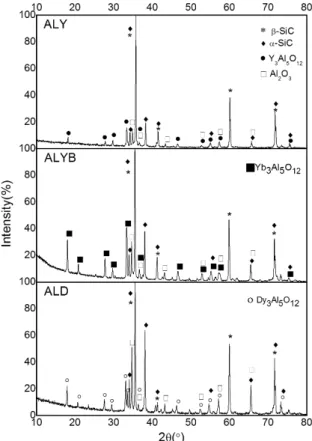
justiied by the similarities among the rare earths elements15. Figure 1 shows X-ray diffraction patterns of the sintered samples for three mixtures, which presented the following phases: (ALY) α-SiC, β-SiC, Al2O3, Y3Al5O12; (ALYB) α-SiC, β-SiC, Al2O3, Yb3Al5O12 and ALD α-SiC, β-SiC, Al2O3, Dy3Al5O12. The rare earth oxides form a solid solution and the formation of the RE3Al5O12 phase showing that Dy2O3 and Yb2O3 have the same behavior as Y2O310.
As the densities were similar for sintered samples (Table 4) of the three mixtures, it can be attributed to the Dy3Al5O12 phase as responsible for the biggest modulus of rupture for ALD sample than ALYB and ALY.
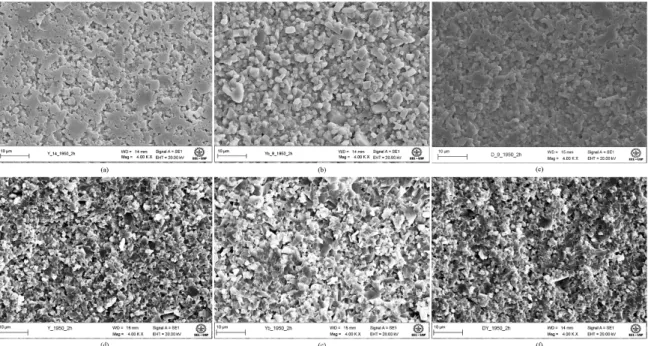
Figure 2 shows micrographs of the three SiC ceramics sintered at 1950 °C for 2 hours. The micrographs on the left (a, b and c) show the ground, sanded and polished surfaces etched with sodium tetraborate for 5 min at 770 °C. These
micrographs show microstructures consisting of small grains. Also note that the microstructure of the ceramic obtained with the ALYB mixture (micrographs b and e) is slightly coarser than the other two. A comparison of these microstructures with the properties described in Table 4 leads to the conclusion that, albeit coarser, the structure of the ALYB ceramic did
not show signiicant differences in its measured properties.
Micrographs d, e and f illustrate the fracture surfaces of the ceramics under study, showing the type of fracture and the secondary phases produced by the additives. Note that, in the three cases, the fractures are predominantly intergranular, because SiC grains do not have a very high aspect ratio, the three compositions also do not show very high fracture toughness values.
Table 4. Density, fracture toughness, modulus of rupture and hardness of the compacted and sintered samples.
Measured properties Mixtures
ALY ALYB ALD
Green density (g/cm3) 1.75 ± 0.01 1.82 ± 0.02 1.80 ± 0.01
Relative green density (%) 52.87 ± 0.52 53.53 ± 0.61 53.41 ± 0.48
Sintered density (g/cm3) 3.21 ± 0.04 3.26 ± 0.02 3.24 ± 0.01
Real density (g/cm3) 3.31 ± 0.01 3.36 ± 0.01 3.33 ± 0.01
Sintered relative density (%) 96.98 97.02 97.30
KIC,SEVNB (MPa.m1/2) 3.45 ± 0.20 3.51 ± 0.16 3.51 ± 0.15
Modulus of rupture (MPa) 453 ± 43 478 ± 91 501 ± 69
Vickers hardness (GPa) 23.43 ± 1.79 23.05 ± 1.25 24.75 ± 1.63
4. Conclusions
An analysis of the results showed in Table 4, using the three different additives, it can be concluded that all the oxides can be used to produce the liquid phase sintered SiC ceramics.
The values of modulus of rupture, hardness and fracture toughness of SiC ceramics doped with mixtures of Al2O3 + Yb2O3 and Al2O3 + Dy2O3 are quite similar to those presented by Al2O3 + Y2O3, which are already well known in the literature.
The values found for SiC doped with Al2O3 + Y2O3 are comparable to those reported in the literature for liquid phase sintering without pressure.
The KIC,SEVNB values may be slightly lower than those found in the literature, when measured by the indentation method followed by measurement of the propagated crack (KIC,IF), because the method used here – SEVNB – presents lower values; however, these values are much more accurate than those obtained by indentation fracture method.
Acknowledgements
The authors thank the Brazilian research funding agencies FAPESP (Process 2010/51925-6) and CNPq (Process 304760/2010-2) for granting productivity scholarships, and CAPES for the master’s and doctoral grants awarded to the Postgraduate Program in Materials Engineering of the Lorena School of Engineering (EEL/USP).
Figure 2. Secondary electron SEM images of the samples: (a, d) ALY; (b, e) ALYB; and (c, f) ALD, with (a, b, c) corresponding to the polished surfaces etched with sodium tetraborate, and (d, e, f) to the fracture surfaces.
References
1. Negita K. Effective sintering aids for silicon carbide ceramics: reactivities of silicon carbide with various additives. Journal of the American Ceramic Society. 1986; 69(12):C-308-310. http://dx.doi.org/10.1111/j.1151-2916.1986.tb07398.x.
2. Noviyanto A and Yoon D-H. Metal oxide additives for the sintering of silicon carbide: reactivity and densification.
Current Applied Physics. 2013; 13(1):287-292. http://dx.doi. org/10.1016/j.cap.2012.07.027.
3. Noviyanto A and Yoon D-H. Rare-earth oxide additives for the sintering of silicon carbide. Diamond and Related Materials. 2013; 38:124-130. http://dx.doi.org/10.1016/j.diamond.2013.07.003.
4. Biswas K, Rixecker G and Aldinger F. Gas pressure sintering of SiC sintered with rare-earth-(III)-oxides and their mechanical properties. Ceramics International. 2005; 31(5):703-711. http:// dx.doi.org/10.1016/j.ceramint.2004.06.027.
5. Taguchi SP, Ribeiro S, Balestra RM and Rodrigues JD Jr. Infiltration of Al2O3/Y2O3 and AlN/Y2O3 mixes into SiC performs. Materials Science and Engineering A. 2007; 454-455:24-29. http://dx.doi.org/10.1016/j.msea.2006.10.083.
6. Ribeiro S, Taguchi SP, Motta FV and Balestra RM. The wettability of SiC ceramics by molten E2O3(ss)/AlN (E2O3(ss) = solid solution of rare earth oxides). Ceramics International. 2007; 33(4):527-530. http://dx.doi.org/10.1016/j.ceramint.2005.10.026.
7. Taguchi SP, Motta FV, Balestra RM and Ribeiro S. Wetting behaviour of SiC ceramics: Part II – Y2O3/Al2O3 and Sm2O3/ Al2O3. Materials Letters. 2004; 58(22-23):2810-2814. http:// dx.doi.org/10.1016/j.matlet.2004.05.004.
9. Strecker K, Ribeiro S and Hoffmann MJ. Fracture toughness measurements of LPS-SiC: a comparison of the indentation technique and the SEVNB method. Materials Research. 2005; 8(2):121-124. http://dx.doi.org/10.1590/S1516-14392005000200004. 10. Strecker K, Ribeiro S, Camargo D, Silva R, Vieira J and
Oliveira F. Liquid phase sintering of silicon carbide with AlN/ Y2O3, Al2O3/Y2O3 and SiO2/Y2O3 additions. Materials Research. 1999; 2(4):249-254. http://dx.doi.org/10.1590/ S1516-14391999000400003.
11. Strecker K, Ribeiro S, Oberacker R and Hoffmann MJ. Influence of microstructural variation on fracture toughness of LPS-SiC ceramics. International Journal of Refractory Metals & Hard Materials. 2004; 22(4-5):169-175. http://dx.doi.org/10.1016/j. ijrmhm.2004.05.001.
12. Magnani G, Antolini F, Beaulardi L, Burresi E, Coglitore A and Mingazzini C. Sintering, high temperature strength and
oxidation resistance of liquid-phase-pressureless-sintered SiC-AlN ceramics with addition of rare-earth oxides. Journal of the European Ceramic Society. 2009; 29(11):2411-2417. http://dx.doi.org/10.1016/j.jeurceramsoc.2008.12.020. 13. Klyucharev DS, Volkova NM and Comyn MF. The problem
associated with using non-conventional rare-earth minerals.
Journal of Geochemical Exploration. 2013; 133:138-148. http://dx.doi.org/10.1016/j.gexplo.2013.03.006.
14. Suzuki K and Sasaki M. Microstructure and mechanical properties of liquid-phase-sintered SiC with AlN and Y2O3 additions. Ceramics International. 2005; 31(5):749-755. http:// dx.doi.org/10.1016/j.ceramint.2004.08.014.