Composite Films from Polystyrene with Hydroxyl end Groups and Carbon Nanotubes
Francisco Gabriel Granados-Martíneza, Lada Domratcheva-Lvovaa*, Nelly Flores-Ramíreza,
Leandro García-Gonzálezb, Luis Zamora-Peredob, María de Lourdes Mondragón-Sánchezc
Received: October 21, 2016; Revised: January 09, 2017; Accepted: January 15, 2017.
Composites from polystyrene with hydroxyl end groups and multiwall carbon nanotubes were fabricated to evaluate their properties. The Carbon Nanotubes (CNTs) were synthetized by chemical vapor deposition technique using ferrocene and benzene as precursors. Polystyrene with hydroxyl end groups was prepared by solution polymerization employing styrene as monomer, 2-mercaptoethanol
as chain transfer agent and AIBN as initiator. Thin ilms were obtained by two methods: pouring into
petri dishes and dip-coating slides. CNTs were characterized to identify morphology and characteristic spectroscopic signals. The polystyrene with hydroxyl end groups and composites were analyzed by SEM, FTIR, Raman and UV-vis spectroscopies, Vickers microhardness and electrical resistivity. Raman analysis demonstrated chemical interactions between CNTs and polystyrene. Results showed that resistivity and transparency decreased by increasing CNTs concentrations in composites; transmittance was about 80% with 0.8 wt% content of nanotubes. The highest Vickers hardness registered value was at 1.6 wt% CNTs concentration.
Keywords: carbon nanotubes, composite materials, polystyrene
* e-mail: [email protected]
1. Introduction
Nowadays, the carbon nanotubes are widely studied materials due to their exceptional chemical and physical properties1,2; by joining them with other materials these extraordinary characteristics can be transferred. Numerous researches look for interactions between carbon nanotubes and polymer matrices; CNTs dispersion into polymer matrices is a good method to provide electrical and enhanced mechanical properties to these macromolecules3,4. The Van der Waals forces that usually agglomerate carbon nanotubes present an impediment to spread them into polymers5. Successful dispersion of nanotubes into polymers could be achieved
through several chemical modiication techniques by adding
functional groups to CNTs6,7. Common methods to prepare composites from carbon nanotubes and polymers consist of mixing the materials in a solvent that subsequently evaporates. Other authors achieved well results using the melt mixing technique8. This method is used in order to accomplish a physical and chemical interaction between the CNTs and the polymers; also were proposed as the most promising route on the preparation of polymer/CNTs composites9. Covalent bonding of polymer chains to CNTs plays an
important role in research and development on CNT-based materials10. Some researches were focus in the efect of pristine and functionalized carbon nanotubes in polystyrene (PS) matrices11. A good dispersion of CNTs in PS thin ilms, produced by solution casting, was achieved by grafting the nanotubes surface with polystyrene chains12. Spitalsky et al. remark that the excellent electrical properties of composites containing multiwall carbon nanotubes are promising for the design of low cost polymer composites for numerous future applications13.
Spectroscopy techniques, including Raman and Fourier Transform Infrared Spectroscopy (FTIR), are techniques that provide information for material characterization. Raman spectroscopy can identify carbon nanotubes and characterize
diferent interaction types with polymers14; also has become one of the main characterization tools for CNTs due to the analysis of material quality, the microscopic structure of the
tube and phonon and electron quantum coninement, data
that could be acquired by other techniques, however they require time consuming or special sample preparations15.
The present research proposes the introduction of hydroxyl groups and the use of shorter chains of polystyrene matrices to form composites with carbon nanotubes. The CNTs were synthesized by Chemical Vapor Deposition (CVD) with aUniversidad Michoacana de San Nicolás de Hidalgo, Gral. Francisco J. Múgica, Felicitas del Río,
Morelia, Michoacán, 58030, México
bCentro de Investigación en Micro y Nanotecnología de la Universidad Veracruzana, Boca del Río,
Veracruz, 94294, México
cInstituto Tecnológico de Morelia, Av. Tecnológico 1500, Lomas de Santiaguito, Morelia, Michoacán,
laboratory conditions similar to those described on16; the
nanotubes were obtained with a speciic characteristic, OH functional group. The matrix modiication, using short
chains and the addition of OH functional groups in the polymer, represents a new focus on composite polystyrene synthesis, looking for a better interaction between carbon nanotubes and polymer molecules. The aim of this research was to incorporate CNTs into polystyrene with hydroxyl end group matrices, characterize the materials and evaluate their properties.
2. Materials and Methods
CNTs synthesis was performed by chemical vapor deposition into an experimental reactor based on16-18. Benzene (99.8%, Aldrich) and ferrocene (98%, Aldrich) were used as organic precursors, the second compound acted also as catalyst source. Reaction temperature was 760 ºC; time process was
1 hour with 80 ml/min constant argon low. Polystyrene with
hydroxyl end groups (PSOH) was synthesized by solution polymerization according to Gutierrez et al.19, using styrene
(≥ 99%, Aldrich) as monomer, 2-mercaptoethanol (98%,
Aldrich) as chain transfer agent and azobisisobutyronitrile (98%, Aldrich) as initiator. The polymerization took place under nitrogen atmosphere for 4 hours, with magnetic stirring at 450 rpm and 60 ºC; this temperature value was applied to obtain short chain lengths.
Composites from PSOH and CNTs were obtained by
mixing both materials inside a lask. The PSOH mixture with
0.2, 0.4, 0.6, 0.8, 1.6 and 3.2 wt% nanotubes concentrations were stirred at 1200 rpm during 20 min and settled in an ultrasonic cleaner (Branson 1510) afterwards. Two methods
to produce composite ilms were used. For the irst technique
the slurry was poured into petri dishes and vacuum dried inside an Isotemp Vacuum Oven (282A) in order to obtain 100
µm thickness ilms. The second method to produce thinner composites ilms (< 5 µm) was using a digital immersion
apparatus (E-ANT1; SK-UV). Slides were dipped at 20 cm/ min for 5 seconds in the mixture.
In order to describe morphology of carbon nanotubes, Field Emission Scanning Electron Microscopy (FESEM) in a JEOL 7600 were performed. Scanning Electron Microscopy (SEM) in a JEOL JSM-IT300 characterized the polymer and the composites, the samples were coated with gold using a Denton vacuum sputter coater.
CNTs, PSOH and composites were analyzed by Fourier Transform Infrared Spectroscopy in a Tensor 27 Bruker. Raman Spectroscopy of nanotubes and PSOH were carried
out in a MicroRaman DXR Thermo Scientiic (solid state laser
532 nm with 30 samples exposures). An Ultraviolet - Visible spectroscope Mprobe UV-visNIR Semiconsoft examined the PSOH and composites; to perform the observation the
ilms were placed without previously preparation upon a base to analyze thin ilms.
To acquire the material resistance, the composites were cut to form 0.5 cm2 rectangular areas (1 cm x 0.5 cm) and the measurements were taken positioning the tip at the shorter length with a Multitester Steren - Mul600. PSOH and all composites concentrations were indented, 4 times by charge, with 0.001, 0.003, 0.005, 0.01 and 0.025 kgf forces by a Mitutoyo Micro Vickers Hardness Tester.
3. Results and Discussion
3.1. CNTs
FESEM micrographs showed carbon nanotubes blocks with diameters around 60 nm and lengths up to 40 µm (Figure 1a and b). The EDS analysis demonstrated that the carbon content in atomic percentages were 97.4, oxygen 2.3 and iron 0.3%. The oxygen percentages could be explained by the presence of OH functional groups on MWCNTs corroborated by FTIR.
Figure 1. FESEM Micrographs: a) CNTs blocks, b) CNTs diameters.
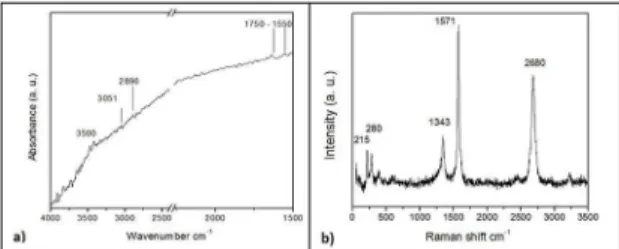
CNTs FTIR spectra signals (Figure 2a) at 3051 cm-1 correspond to the CH2 stretch in aromatic rings20, around 2890 cm-1 to CH
2 and CH3 vibrations, common to CNTs obtained by CVD21,22. Bands on the 1750 - 1550 cm-1 region have been assigned to C=C in aromatic rings23. Furthermore the typical CNTs signals, the intensity that corresponds to OH functional group around 3500 cm-1 was found.
Figure 2. CNTs spectra: a) FTIR, b) Raman.
The Raman spectra (Figure 2b) confirmed CNTs characteristic bands for Multiwall Carbon Nanotubes (MWCNTS). G band reported for graphite like materials at 1571 cm-1, D band assigned to defects in carbon nanotubes at 1343 cm-1 and the G’ band, at 2680 cm-1, assented to the
that the signals around 200 cm-1 correspond to the radial breathing mode of single wall carbon nanotubes, suggesting also their presence, however the D band width indicates that the principal structures are MWCNTs. The ID/IG ratio was 0.31, this result allows comparing the structural defects in MWCNTs and a higher relation suggests imperfections on the structure, related to sp3 hybridizations27,28.
3.2. PSOH and Composites
SEM images of PSOH and composites are shown in Figure 3. The micrographs showed a uniform polymer surface (Figure 3a). A subsequent analysis of composites demonstrated that despite the CNTs concentration increase, no carbon nanotube presence was observed on their surfaces, upper and lower ends. Figure 3b showed a covering surface of the composite, MWCNTs are focused, a similar picture was observed from the other side, demonstrating that the CNTs were dispersed inside the composites, like a natural sandwich structure. This behavior could be related to the
ainity of the matrix and iller materials.
Figure 3. SEM micrographs: a) polymer surface, b) sandwich arrangement.
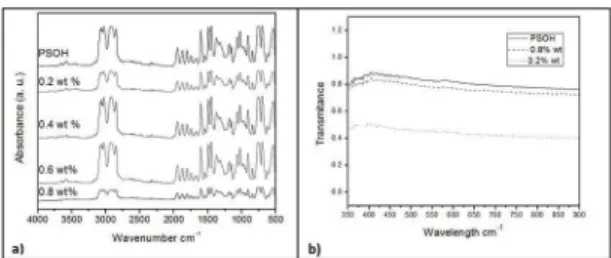
FTIR spectra of polystyrene with hydroxyl end groups and composites are depicted in Figure 4a. The 3077, 3058 and 3026 cm-1 bands correspond to C-H vibrations in aromatic rings. Asymmetric and symmetric tensions of CH2 were observed at 2923 and 2850 cm-1. The 2000-1672 cm-1 region corresponds to the aromatic monosubstituted ring overtone bands. The signals at 1601 and 1493 cm-1 were assigned to aromatic C=C stretching. These bands are characteristic to conventional polystyrene29-31. Additionally the spectra showed a broad band at 3462 cm-1 due to OH interactions19,20. FTIR composites spectra, from 0.2 to 0.8 CNTs wt% concentrations (Figure 4a), did not show band displacements of polystyrene with hydroxyl end groups. However interactions in the composites could be present. Hoult et al. suggest that the change of absorption intensities
is related to ilms thickness variations32.
Figure 4b shows the UV-vis spectra for PSOH and 0.8, 3.2 CNTs wt% PSOH composites. Similar transmittance values, near 80%, were obtained from polystyrene with hydroxyl end groups and PSOH composites with 0.8 CNTs wt%. A 40% transmittance value was reached with the highest CNTs concentration composite. Increasing CNTs
Figure 4. PSOH and composites spectra: a) FTIR, b) UV-vis.
concentration in PSOH composites, transparency decreases.
Liu et al. have mentioned the efect on materials optical properties by CNTs concentrations and ilm preparations33. The transmittance value is related to transparency on the
ilms, a constant behavior through several wavelengths
(350- 900 nm) can open the door to multiple applications
for these composite ilms.
The pristine PSOH Raman spectra (Figure 5a) show a strong and sharp peak at 1000 cm-1, assigned to the ring breathing mode. The signal around 1300 cm-1 corresponds to the benzene trigonal deformation. The intensities corresponding to the CH stretching and to C-C stretching mode in aromatic rings were located at 1602 cm-1 and 3052 cm-1 respectively34,35.
Figure 5. Raman spectra: a) PSOH and composites, b) D band appearance, c) G band appearance and displacement, d) G’ band appearance and displacement.
process37. The G’ band appeared in composites at 1698 cm-1, presenting the same displacement that G band (Figure 5d). The enhanced ID/IG ratio (0.49), found on the composites spectra, in comparison to the pristine carbon nanotubes suggest higher structural defects27; thus is indicative of possible CNTs covalent bonding with polymer through interactions between OH functional groups of the multiwall carbon nanotubes and the PSOH28.
Pristine PSOH is an electric insulator; however, the addition of CNTs provided a decrease in resistance to
composite ilms. The resistivity was calculated according to:
R
l
S
t
=
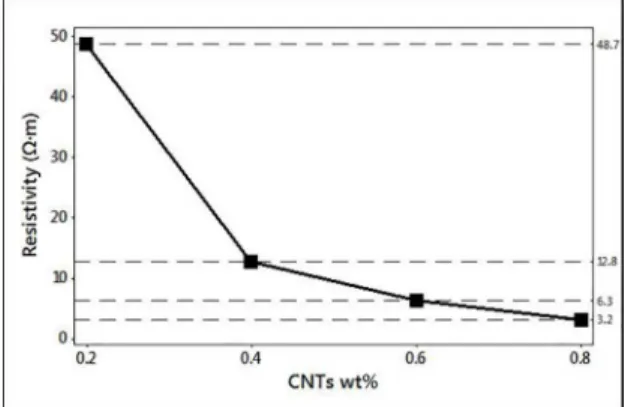
where “R” is the electrical resistance (Ohms), “S” is the cross-sectional area (m2) and “l” is the composite ilm length (m). The resistivity composite values with 0.2 to 0.8 CNTs wt% concentrations were 48.7, 12.8, 6.3 and 3.2
Ω•m, respectively (Figure 6). This behavior could be for
the contribution of the sp2 carbon-carbon bonds, a higher concentration allows more contact between carbon nanotubes
and the current passes more freely. For ilms with 0.8 CNTs
wt% the electrical resistance was higher than the ones obtained by Jung et al.38 with super aligned carbon nanotubes used as transparent heaters.
Figure 6. Composites resistivity behavior according to CNTs addition.
Energy dispersion for 0.005 kgf indentation can be appreciated in Figure 7. Several halos were formed with 0.4 CNTs wt% composite, nevertheless plastic deformation energy was better dispersed with a 3.2 CNTs wt% concentration. Data was collected for analysis of variance (ANOVA). Hardness was selected as response variable, composites nanotubes concentration (wt%) and loads were chosen as factors. Results showed an enhanced hardness through force increments, reaching an average of 30 HV (Figure 8a).
Figure 8b shows hardness luctuation in composites at diferent CNTs concentrations; the highest HV value was at
1.6 wt% of carbon nanotubes in composites, demonstrating
Figure 7. Vickers 0.005 kgf indentation: a) 0.4 CNTs wt%, b) 3.2 CNTs wt%.
Figure 8. ANOVA results, hardness as response variable, factors: a) force, b) CNTs wt%.
a similar behavior to Yang et al. that work with CNTs and conventional polystyrene39.
4. Conclusions
Thin composite ilms were obtained through carbon
nanotubes and polystyrene with hydroxyl end groups. SEM micrographs showed that CNTs were dispersed inside the composites, like a natural sandwich structure, demonstrating
the ainity of the PSOH matrix and carbon nanotubes. Raman
analysis demonstrated chemical bonding between MWCNTs and PSOH. The PSOH-CNTs composites mechanical, optical and
electrical properties vary with diferent CNTs concentrations.
Carbon nanotubes provided electrical conductivity to the
PSOH ilms. Composite ilms electrical conductivity was
CNTs, with OH group, to enhance their chemical interaction, opening the door to some future applications.
5. Acknowledgments
The authors would like to acknowledge “Universidad
Michoacana de San Nicolás de Hidalgo” Scientiic Research
Coordination, “Nanostructured Materials” Collaboration Network of PRODEP (SEP, Mexico) and to CONACYT doctoral fellowship. We acknowledge to Ph. D. Orlando Hernández and Ph. D. Yesenia Arredondo for SEM analysis, ENES (Morelia) UNAM. This research form part of doctoral thesis in process of M. Sc. Francisco Gabriel Granados directed by Ph. D. Lada Domratcheva and Ph. D. Nelly Flores.
6. References
1. De Volder MFL, Tawick SH, Baughman RH, Hart AJ. Carbon
nanotubes: present and future commercial applications. Science. 2013;339(6119):535-539.
2. Aqel A, El-Nour KMMA, Ammar RAA, Al-Warthan A. Carbon nanotubes, science and technology part (I) structure, synthesis and characterisation. Arabian Journal of Chemistry. 2012;5(1):1-23.
3. Kaempgen M, Duesberg GS, Roth S. Transparent carbon nanotube coatings. Applied Surface Science. 2005;252(2):425-429. 4. Mirri F, Ma AWK, Hsu TT, Behabtu N, Eichmann SL, Young
CC, et al. High-Performance Carbon Nanotube Transparent Conductive Films by Scalable Dip Coating. ACS Nano. 2012;6(11):9737-9744.
5. Sahoo NG, Rana S, Cho JW, Li L, Chan SH. Polymer nanocomposites based on functionalized carbon nanotubes.
Progress in Polymer Science. 2010;35(7):837-867.
6. Ma PC, Siddiqui NA, Marom G, Kim JK. Dispersion and functionalization of carbon nanotubes for polymer-based nanocomposites: A review. Composites Part A: Applied Science and Manufacturing. 2010;41(10):1345-1367.
7. Eitan A, Jiang K, Dukes D, Andrews R, Schadler LS. Surface
Modiication of Multiwalled Carbon Nanotubes: Toward the
Tailoring of the Interface in Polymer Composites. Chemistry of Materials. 2003;15(16):3198-3201.
8. Lu L, Zhou Z, Zhang Y, Wang S, Zhang Y. Reinforcement of styrene-butadiene-styrene tri-block copolymer by multi-walled carbon nanotubes via melt mixing. Carbon. 2007;45(13):2621-2627.
9. Zhang Z, Zhang J, Chen P, Zhang B, He J, Hu GH. Enhanced interactions between multi-walled carbon nanotubes and polystyrene induced by melt mixing. Carbon. 2006;44(4):692-698.
10. Wang C, Guo ZX, Fu S, Wu W, Zhu D. Polymers containing fullerene or carbon nanotube structures. Progress in Polymer Science. 2004;29(11):1079-1141.
11. Yuan JM, Fan ZF, Chen XH, Chen XH, Wu ZJ, He LP. Preparation of polystyrene-multiwalled carbon nanotube composites with individual-dispersed nanotubes and strong interfacial adhesion. Polymer. 2009;50(14):3285-3291.
12. Lin TS, Cheng LY, Hsiao CC, Yang ACM. Percolated network of entangled multi-walled carbon nanotubes dispersed in polystyrene
thin ilms through surface grafting polymerization. Materials Chemistry and Physics. 2005;94(2-3):438-443.
13. Spitalsky Z, Tasis D, Papagelis K, Galiotis C. Carbon nanotube-polymer composites: chemistry, processing, mechanical and electrical properties. Progress in Polymer Science. 2010;35(3):357-401.
14. Rahmat M, Hubert P. Carbon nanotube-polymer interactions in nanocomposites: A review. Composites Science and Technology. 2011;72(1):72-84.
15. Thomsen C, Reich S. Raman Scattering in Carbon Nanotubes. In: Cardona M, Merlin R, eds. Light Scattering in Solid IX. Berlin, Heidelberg: Springer; 2007. p. 115-234.
16. Gómez Sánchez A, González PG, García González L, Granados Martínez FG, Flores Ramírez N, López Garza V, et al. Carbon nanotubes obtained along variations in chemical vapor deposition process for improvement in mechanical properties of an epoxy composite. Journal of Analytical and Applied Pyrolysis. 2015;113:483-490.
17. Granados-Martínez FG, Contreras-Navarrete JJ, García-Ruiz DL, Gutiérrez-García CJ, Durán-Navarro A, Gama-Ortega EE, et al. MWCNTs synthesis from butanol, diethyl ether, ethyl acetate and hexane by chemical vapor deposition with a stainless steel core as catalyst. Supericies y Vacío. 2015;28(4):108-110.
18. Granados-Martínez FG, Contreras-Navarrete JJ, García-Ruiz DL, Gutiérrez-García CJ, Durán-Navarro A, Gama-Ortega EE,
et al. Carbon Nanotubes Synthesis from Four Diferent Organic
Precursors by CVD. MRS Online Proceedings Library Archive. 2016;1817.
19. Gutiérrez-Arriaga O, Vásquez-García SR, Flores-Ramírez N, Luna-Bárcenas G, Barrera Cardiel G, León-Patiño CA. A Film of Polystyrene Hydroxyl end Group Supported on SiO2 Monoliths: Thermal Conductivity and Micro-Indentation. Global Journal of Science Frontier Research Chemistry. 2012;12(6B).
20. Pavia DL, Lampman GM, Kriz GS, Vyvyan JA. Introduction to spectroscopy. 4th ed. Boston: Cengage Learning; 2009. p.
43-47.
21. Teng L, Tang T. IR study on surface chemical properties of
catalytic grown carbon nanotubes and nanoibers. Journal of Zhejiang University-SCIENCE A. 2008;9(5):720-726.
22. Contreras-Navarrete JJ, Granados-Martínez FG, Domratcheva-Lvova L, Flores-Ramírez N, Cisneros-Magaña MR. MWCNTs oxidation by thermal treatment with air conditions. Supericies
y Vacío. 2015;28(4)111-114.
23. Stobinski L, Lesiak B, Kövér L, Tóth J, Biniak S, Trykowski
G, et al. Multiwall carbon nanotubes puriication and oxidation
by nitric acid studied by the FTIR and electron spectroscopy methods. Journal of Alloys and Compounds. 2010;501(1):77-84.
24. Belin T, Epron F. Characterization methods of carbon nanotubes: a review. Materials Science and Engineering: B. 2005;119(2):105-118.
26. Delhaes P, Couzi M, Trinquecoste M, Dentzer J, Hamidou H, Vix-Gurtel C. A comparison between Raman spectroscopy and surface characterizations of multiwall carbon nanotubes.
Carbon. 2006;44(14):3005-3013.
27. Antunes EF, Lobo AO, Corat EJ, Trava-Airoldi VJ. Inluence of
diameter in the Raman spectra of aligned multi-walled carbon nanotubes. Carbon. 2007;45(5):913-921.
28. Abdalla M, Dean D, Adibempe D, Nyairo E, Robinson P,
Thompson G. The efect of interfacial chemistry on molecular
mobility and morphology of multiwalled carbon nanotubes epoxy nanocomposite. Polymer. 2007;48(19):5662-5670.
29. León-Bermúdez AY, Salazar R. Synthesis and characterization of the polystyrene - asphaltene graft copolymer by FT-IR spectroscopy.
CT&F-Ciencia, Tecnología y Futuro. 2008;3(4):157-167.
30. Jaleh B, Madad MS, Tabrizi MF, Habibi S, Golbedaghi R,
Keymanesh MR. UV-degradation efect on optical and surface
properties of polystyrene-TiO2 nanocomposite ilm. Journal of the Iranian Chemical Society. 2011;8(Suppl 1):S161-S168.
31. Kaniappan K, Latha S. Certain investigations on the formulation and characterization of polystyrene, poly (methyl meth acrylate) blends. International Journal of ChemTech Research. 2011;3(2):708-717.
32. Spragg RA, Perston B, Hoult RA. Polystyrene Film as a Standard for Testing FT-IR Spectrometers. Spectroscopy. 2013;28(2):38-43.
33. Liu B, Hsu C, Wang W. A comparative study on preparation of
conductive and transparent carbon nanotube thin ilms. Journal of the Taiwan Institute of Chemical Engineers. 2012;43(1):147-152.
34. Hong PP, Boerio FJ, Clarson SJ, Smith SD. An investigation
of the interdifusion of polystyrene and deuterated polystyrene
using surface-enhanced Raman scattering. Macromolecules. 1991;24(17):4770-4776.
35. Granadino-Roldán JM, Fernández-Gómez M, Navarro A. The vibrational analysis of styrene, revisited. Chemical Physics Letters. 2003;372(1-2):255-262.
36. Wang HC, Li Y, Yang MJ. Sensors for organic vapor detection based on composites of carbon nanotubes functionalized with polymers. Sensors and Actuators B: Chemical. 2007;124(2):360-367.
37. Fantini C, Pimenta MA, Strano MS. Two-Phonon Combination Raman Modes in Covalently Functionalized Single-Wall Carbon Nanotubes. The Journal of Physical Chemistry C. 2008;112(34):13150-13155.
38. Jung D, Kim D, Lee KH, Overzet LJ, Lee GS. Transparent ilm
heaters using multi-walled carbon nanotube sheets. Sensors and Actuators A: Physical. 2013;199:176-180.