Mg-based Nanocomposites for Hydrogen Storage Containing Ti-Cr-V Alloys as Additives
Ricardo Florianoa*, Daniel Rodrigo Leivab, João Guilherme Dessib, Alexandre Augusto Cesário
Assellic, Alberto Moreira Jorge Juniorb, Walter José Bottab
Received: February 29, 2016; Revised: July 20, 2016; Accepted: August 16, 2016
In this study, we have investigated the synthesis, microstructure and hydrogen storage properties
of Mg-based nanocomposites containing diferent concentrations of TiCrV and TiCr1.2V0.8 alloys. The
Mg-based nanocomposites of Mg containing Ti-Cr-V additives were prepared by reactive milling (RM)
under hydrogen atmosphere. The structural characterization revealed the presence of the β-MgH2,
γ-MgH2 and BCC phases in the powders samples after RM. In addition, a very reined and homogenous
microstructure with average MgH2 crystallite size of around 10-12 nm was observed, including a
nanometric dispersion of the additives in the magnesium hydride matrix. The doping with TiCrV and TiCr1,2V0,8 greatly improves the hydrogen desorption behavior of Mg in comparison with the sample
without additive, resulting in the lowest onset temperature (240 °C) for the sample containing 5%mol.
of TiCrV. Very fast absorption and desorption kinetics at 275 °C and 300 °C (7 minutes and 5 minutes
for full desorption and absorption, respectively) were observed in the samples containing TiCrV and
TiCr1,2V0,8 without any notable diference between the type of additive used in comparison with the
pure sample. However, a slight reduction in hydrogen capacity is observed in the mixtures than for the pure sample (6.7 wt.% against 7.3 wt.%).
Keywords: Hydrogen storage; Magnesium hydride; Reactive Milling; BCC Alloys; Additives.
* e-mail: [email protected]
1. Introduction
Hydrogen is considered the ideal energy carrier since it has
a very high energy content and water is the only by-product after its use in a fuel cell or internal combustion engine1.
However, the development of safe and efective forms of H2 storage remains as a critical technological challenge.
Gaseous hydrogen can react with some metals and alloys to form metal or complex hydrides, which allow hydrogen
storage at the solid state. This represents a more suitable form of storage than the use of H2 gas at high pressures or
alternatively liquid hydrogen at very low temperatures1.
MgH2 is a very interesting phase for hydrogen storage,
mainly due to the low cost of Mg and its very high gravimetric
capacity (7.6 wt.%), being the highest among the metal
hydrides2. However, the conventional (microcrystalline)
magnesium hydride has some disadvantages, as slow
H-absorption/desorption kinetics even at relatively high temperatures (generally, a few hours are needed even at
400°C). On the other hand, MgH2 produced by high-energy
ball milling (HEBM) can present very fast reaction kinetics
at lower temperatures3-5 (e.g: a few minutes at 300°C).
HEBM is not only suitable to increase the concentration of defects and to reduce the crystallite size to nanometer scale but also to introduce a ine dispersion of additives with catalytic efect. Diferent families of additives were tested
with success to improve the hydrogen storage properties of
nanocrystalline MgH2, producing nanocomposite powders.
Transition metals, their oxides or luorides are known to
exhibit important catalytic action during the reactions of
hydrogen absorption/desorption by Mg/MgH2
6-8. However,
clear descriptions of the mechanisms involved in the catalytic action of the additives are still unclear in most of the cases, remaining as an interesting topic of fundamental research9,
even considering the high amount of studies published on this topic over the last years1-10.
On the other hand, Ti-Cr-V alloys were one of the irst
systems studied for hydrogen storage applications11,12. These
alloys exhibit a BCC solid solution structure and maximum
hydrogen absorbing capacity of these alloys can reach
about 3.7 wt% at room temperature (with hydrogen atoms dissolved in the BCC structure). However, these alloys sufer from disadvantages like diicult activation treatment, aFaculdade de Ciências Aplicadas, Universidade Estadual de Campinas, Rua Pedro Zaccaria, CEP
13484350, Limeira, SP, Brazil
bDepartamento de Engenharia de Materiais, Universidade Federal de São Carlos, Rod. Washington
Luiz, km 235, 13565-905, São Carlos, SP, Brazil
cInstitut de Recherche sur l’Hydrogène, Université du Québec à Trois-Rivières, Trois-Rivières, Québec,
poor kinetics, large hysteresis, low cyclic stability, high
desorption temperature and high cost. In order to improve the
hydrogen storage characteristics of Ti-Cr-V system, all these drawbacks has been overcome by the preparation of these alloys by using HEBM, heat treatment and by the addition of diferent catalysts in the alloys14-18. The substitution of Ti,
V or Cr with elements like Zr, Co, Fe or Mn leads to drastic
changes in the hydrogen storage properties of the alloys due to the formation of secondary Laves phases that coexist
with the BCC phase12,13. The presence of a secondary Laves
phase makes the activation procedure easier as compared to pure BCC phase, though the secondary phase decreases the
maximum hydrogen storage capacity12,17. Thus, combining
magnesium with a BCC Ti-Cr-V alloy could be an interesting
approach to produce a composite material, presenting an
enhanced hydrogen absorption/desorption behavior, when
compared to the MgH2 or to the BCC alloy taken alone as
hydrogen storage materials19.
In this study, we showed results of the synthesis, microstructure and hydrogen storage properties of Mg-based
nanocomposites containing two types of BCC alloys as additives, TiCrV and TiCr1.2V0.8. The nanocomposites were
prepared by reactive milling under hydrogen atmosphere
and diferent concentrations of the both additives were tested, from 2.5 to 7.5 mol%. The correlations between the
microstructure and obtained hydrogen storage properties are discussed.
2. Experimental
TiCrV and TiCr1,2V0,8 alloys used as additives were
produced by arc-melting from the pure elements (Ti: Alfa Aesar, 99.7%; Cr: Aldrich, 99.7%; V:CERAV, 99.7%). The
mixtures were melted three times to ensure a good level of homogeneity and the as-cast alloys were crushed into small pieces with diameters of a few millimeters using a
forging die. The Mg-based nanocomposites were obtained by reactive ball milling of pure magnesium (Aldrich, 98% of purity) containing 2.5, 5 and 7.5 mol% of TiCrV or TiCr1.2V0.8. A tool steel milling vial with an internal volume
of 160 cm3containing 25 chromium steel milling balls was
used. The ball-to-powder mass ratio was ixed at 40:1 and a hydrogen pressure of 3 MPa was employed. Reactive milling was performed in a Fritsch P6 planetary mill for 24
h. Before and after processing by RM, the powder samples
were handled and stored in a MBraun Labmaster 130 glovebox. X-ray difraction (XRD) analysis was carried out in a Rigaku Geigerlex difractometer equipped with
CuKα radiation and a graphite monochromator. The XRD
data was also used to calculate the mean crystallite size
through Scherrer analysis. For that, the contribution of the
instrumental broadening was deconvoluted using a known pattern (silicon). The hydrogen desorption behavior of the powder samples was investigated by Diferential Scanning
Calorimetry (DSC) performed in a NETZSCH STA 449C coupled to quadrupole mass spectrometer (QMS). Samples with mass around 10 mg were used. The measurements were performed with the heating rate of 10 K/min under argon lux of 20 ml/min. Scanning and transmission electron microscopy (SEM and TEM) were performed respectively in a Phillips XL30 FEG and in a FEI TECNAI G2-F20 microscope. The hydrogen absorption/desorption kinetics were evaluated in
a home-made Sievert apparatus using samples with mass
of around 100 mg and at two diferent temperatures, 275oC
and 300oC, respectively. The pressure used at absorption
was 20 bar and 1 bar for desorption.
3. Results and Discussion
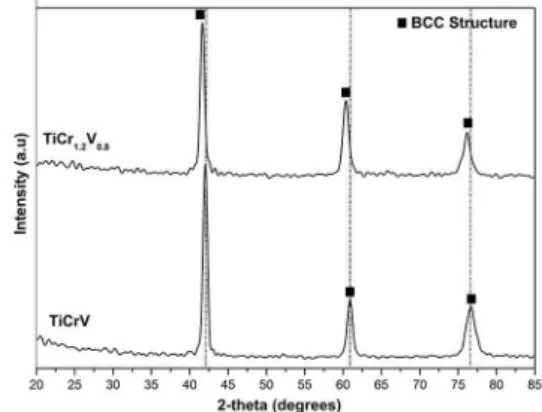
Figure 1 shows the XRD patterns of the as-cast TiCrV and TiCr1.2V0.8 alloys produced by arc-melting followed by
crushing in a forging die. It can be noticed that both alloys
display only the BCC-type phase, and the Bragg peaks of the TiCr1.2V0.8 alloy present a slight shift in 2θ to the left (better
viewed in the dashed line located at 2θ: ~ 42, 61 and 78o)
in comparison with the TiCrV alloy. This shift to lower 2θ position, it’s due to the higher Cr/V ratio of the TiCr1.2V0.8
composition that increases the crystal cell parameters of
the BCC-structure20.
Figure 1. XRD patterns of the as-cast TiCrV and TiCr1,2V0,8 alloys produced by arc-melting followed by crushing.
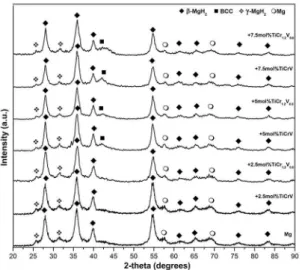
Figure 2 shows the XRD patterns of the Mg pure and the Mg-based nanocomposites containing 2.5, 5.0 and 7.5 mol% of TiCrV and TiCr1.2V0.8 as additives after 24 h
of reactive milling. In these XRD patterns, the following
phases were identiied: β-MgH2; γ-MgH2, BCC-type phase
and Mg. These XRD patterns reveal that the most part of
Mg was converted into the β-MgH2 and the high-pressure
γ-MgH2 phases after reactive milling. Some difraction peaks
of the Mg phase were detected in all samples, indicating
5 mol% of both type of additives. The difraction peaks of the TiCr1,2V0,8 additive are slightly broader than TiCrV.
The presence of Mg oxide and hydride phases containing additives species were not observed in the XRD patterns of
the powders mixtures after processing.
Mg-pure sample where the QMS analysis has only indicated
the hydrogen release.
Figure 2. XRD patterns of Mg pure and Mg-based nanocomposites
containing 2.5, 5 and 7.5 mol % of TiCrV and TiCr1.2V0.8 milled
under hydrogen for 24 hours.
Other interesting features can be seen in the XRD patterns of Figure 2. The proile of the Bragg peaks of the majority
β-MgH2 phase is typical of ball milled samples where both
reduction of the grain size and the presence of micro-strains lead to peak broadening and a decreased difraction intensity. The average crystallite size of β-MgH2 phase was estimated by
Scherrer analysis in all samples and it provided an estimation
of the average crystallite size of around 10 nm in all samples without any signiicant diference regarding to the additive
type and the amount used. Apparently, this result shows
that there is no inluence of additive type on crystallite size reduction of β-MgH2, with the milling conditions used here.
Nanograin sizes of β-MgH2 phase, in the same range were
observed in the reference21 when the Mg was ball milled
under hydrogen atmosphere.
Figure 3a shows the DSC curves for Mg pure and Mg-based nanocomposites containing 2.5, 5.0 and 7.5 mol% of TiCrV and 2.5, 5.0 mol% of TiCr1.2V0.8. The onset and the
peak temperatures are indicated in the top of each curve. The DSC curves for all nanocomposites show a signiicant
decrease in the desorption temperature ranges compared
with the Mg pure, showing an important catalytic efect of
the additives. Furthermore, all samples showed the presence
of only endothermic peaks with the nanocomposites having
desorption temperature range much broader than the pure
sample. The QMS analysis indicated only hydrogen release associated to all DSC peaks and for all samples. This feature can be well illustrated by looking into Figure 3b for the
Figure 3. (a) DSC curves for Mg pure and for Mg containing 2.5,
5 and 7.5 mol % of TiCrV and 2.5 and 5 mol% of TiCr1.2V0.8 after
RM. The values for the onset and peak temperatures are included in the top of each curve. (b) QMS analysis for Mg pure sample
after reactive milling indicating only the hydrogen release from
the DSC peak.
As we can clearly see, the addition of TiCrV or TiCr1.2V0.8
dramatically changes the desorption temperature range independently of the concentration added into the Mg. For
the samples containing TiCr1.2V0.8, the DSC curves present
two very well endothermic peaks while for the samples containing TiCrV three endothermic peaks are observed (while for the Mg pure sample only one single peak is observed). The occurrence of double or tree peaks of desorption should be related to: (a) to the heterogeneous distribution of the particle size after milling (feature not observed during the further SEM analysis, Figure 4)21; (b) the coexistence of γ
and β-MgH2 phases and their diferent dissolution steps in
hydrogen desorption22 (as already observed in XRD analysis,
but less likely to play a role here since that the pure Mg
sample has indicated the presence of both hydride phases
and only one single peak was observed); (c) more probably
due to the decomposition of hydride phases formed with the
additives species, likely TiH2 or TiCrVH5,7 (FCC phase). These
majority MgH2 phase. But some previous studies
23,24 already
reported the incidence of at least two or three desorption
peaks of Ti-Cr-V alloy in the hydrogenated state regarding to the decomposition of the hydride TiH2 or TiCrVH5,7 phases.
These hydrides, TiH2 and TiCrVH5,7, are very stable since
the desorption occurs at temperatures higher than 557 oC in
the as-received state due to the stronger bond Ti-H 20. But
when TiCrV alloys are prepared by RM, lower desorption
temperatures are observed25.
Figure 6(a) to 6(c).The mapping reveals that the agglomerate region is partially composed by additive particles Ti, Cr and V which appears brighter in their respective maps, beyond Mg (not mapped, but can be understood as the dark regions in each map). Also, the additives particles appear relatively
in low amount and are very well distributed over the Mg
matrix. The additive particles have grains in the same range of the Mg particles. This good level of homogeneity seen in the mixture is in agreement with the SEM images. A more reined analysis from the maps show that they look similar. However, for some areas, the Ti seems to be in
high concentration in comparison to the others, indicating that the additive could probably decompose during milling.
This was already reported by Santos25 during the reactive
milling of BCC alloys.
Figure 4. SEM micrographs (BSE images) for the nanocomposites:
(a) MgH2 + 5 mol% TiCrV and (b) MgH2 + 5 mol% TiCr1.2V0.8.
Based on the values presented at Figure 3 for the onset temperatures, both additives used were efective in the reduction of desorption temperature ranges. However, TiCrV was more efective than TiCr1.2V0.8 for reducing the desorption
temperature of MgH2 (reducing the onset temperature from
344oC to 240 oC in the best sample). The best results are
observed in the following sequence: Mg containing 5 mol% of TiCrV followed by 7,5 mol% of TiCrV; 2,5 mol% of TiCrV; 5 mol% of TiCr1.2V0.8 and 2,5 mol% of TiCr1,2V0,8.
From the Figure 3 analysis, we can concluded that 5% mol.
is an optimum concentration value for doping of Mg and
the further increase of TiCrV content to 7,5 mol% elevates
the onset temperature being almost similar to the amount
of 2,5 mol%.
SEM images obtained in back-scattered electrons (BSE) mode for the nanocomposites containing 5 mol% of TiCrV and TiCr1.2V0.8 are shown in Figure 4. These images reveal
a morphology type characterized by very ine agglomerates containing particles with diferent formats (with planar and spherical faces) and average size around 0,3 - 5 μm. Again, there is no notable diferences according to the additive type used, conirming that the milling time employed (24 h), was not only enough to reduce Mg and additive to the same particle size scale but also to result in a good level of
mixing and homogeneity between them.
The nanocomposite containing 5 mol% of TiCrV was selected for a detailed TEM investigation. Figure 5 shows (a) bright ield (BF) and (b) dark ield (DF) STEM images showing the selected area for X-ray mapping. These images shows the presence of small agglomerates (black and gray in BF image) with grain sizes around 12-20 nm. The nanosize
of the particles is in agreement with values estimated by the
Scherrer analysis. The elemental X-ray mapping (100x100
nm2 scanning area) of elements Ti, Cr and V are shown in
Figure 5. TEM images of the nanocomposite containing Mg + 5
mol% TiCrV. In the left the bright ield (BF) image and in the right the dark ield (DF) image, highlighting the scanned area.
Figure 6. X-ray mapping of the additive elements: (a) Ti; (b) Cr;
(c) V for the nanocomposite containing 5 mol% TiCrV. Scanning
area of 100 x 100nm2.
Finally, the desorption and absorption kinetics at 275 oC
and 300 oC for the Mg pure and the nanocomposites containing
5 mol% of TiCrV and TiCr1,2V0,8 are shown in Figure 7 (a)
and Figure (7b). For the desorption at 275 oC under 1 bar
of hydrogen pressure, the pure Mg sample did not release any hydrogen and its curve was not recorded while for the
nanocomposites containing TiCrV and TiCr1.2V0.8 a partial
hydrogen desorption was observed, releasing 5.4 wt.% of hydrogen in 15 minutes. For the subsequent absorption at
presented again the same kinetic behavior, absorbing the
same amount of hydrogen in approximately 8 minutes.
the Mg pure sample presented a very fast hydrogen storage capacity.
We have observed that when the kinetics measurements
are only carried out at a condition where the driving force
was too high, i.e. 275 and 350 oC K under 20 bar of H
2, the
efects between the both additives tested could be hardly
noticed. For the samples containing additives, the absorption process is found to mainly depend on temperature and pressure conditions and, in this case, the role of the microstructure
which appears very reined and homogeneous as indicated by SEM and TEM analysis, seems to play a more important role. While for the desorption kinetics, it starts irst in the
mixtures instead of the pure sample. It due to fact that the
additive particles act as catalysts, dissociating H2 molecules
into H atoms, which could difuse more easily along the grain
boundaries between magnesium and the additive materials7,26.
4. Conclusions
The following conclusions could be drawn from this
investigation:
- After milling, the powders samples showed the presence
of the hydride phases, β and γ-MgH2 (high-pressure phase)
and the BCC alloy structure (for samples with concentration
of TiCrV and TiCr1,2V0,8 higher than 5 mol%.). Nanograin
sizes around of ~10 nm and good level of homogeneity were
also observed as typically noticed in ball milled powders.
- The doping with TiCrV and TiCr1,2V0,8 greatly improves
the hydrogen desorption behavior of Mg in comparison
with the sample without additive. The amount of 5 mol%
of TiCrV was slightly more efective than TiCr1.2V0.8 in
desorption temperature reduction (~240 oC), also this
concentration showed to be an optimum value for doping
Mg since that an increase to 7,5 mol% resulted in higher
desorption temperature.
- Very fast absorption and desorption kinetics at 275 oC
and 300 oC were observed for the mixtures in comparison
with the Mg pure. At 275°C, the pure Mg sample did not
release any hydrogen while for the nanocomposites containing
TiCrV and TiCr1,2V0,8 , a very fast hydrogen desorption was
observed, releasing 5,4 wt.% of hydrogen in 15 minutes.
At 300oC much faster hydrogen desorption (~7 min.) and
higher hydrogen capacity (6.7 wt.%) were observed. The improvements in kinetics could be associated to: (a) the reined microstructure; (b) the good level of mixing and; (c) the catalytic efect of additives during absorption and
desorption processes.
5. Acknowledgments
The authors wish to thank CAPES and CNPq for the inancial support.
Figure 7. (a) Desorption kinetics at 275oC and 300oC for the pure
Mg and for the nanocomposites containing 5 mol% of TiCrV and TiCr1,2V0,8 under 1 bar of hydrogen pressure. (b) Absorption kinetics
at 275oC and 300oC for the pure Mg and for the nanocomposites
containing 5 mol% of TiCrV and TiCr1,2V0,8 under 20 bar of hydrogen pressure.
When the temperature is increased up to 300oC, the kinetic
behavior and the hydrogen capacity between the samples are
changed. The desorption and absorption kinetics becomes faster and the hydrogen capacity measured is slight higher than at 275
oC. At 300 oC, the nanocomposite containing TiCrV released
6.5 wt.% against 6.7 wt.% of the one containing TiCr1.2V0.8.
Nevertheless, both additives presented very fast desorption kinetic behavior, releasing those amounts of hydrogen after 7 minutes. For the subsequent absorption, their hydrogen
capacities are reached, again, after 8 minutes. It interesting
to point out that for the both additives tested here, diferent desorption behavior based on DSC analysis were presented but very similar kinetic properties were observed. It worth to point out that the DSC measurements were performed in
the powders samples immediately after milling.
Not less important, the Mg pure sample needed more than 50 minutes to complete its desorption at 300oC, but it
showed, as expected, a higher hydrogen capacity, releasing
6. References
1. Niaz S, Manzoor T, Pandith AH. Hydrogen storage: Materials,
methods and perspectives. Renewable and Sustainable Energy Reviews. 2015;50:457-469.
2. Wang H, Lin HJ, Cai WT, Ouyang LZ, Zhu M. Tuning kinetics
and thermodynamics of hydrogen storage in light metal element based systems - A review of recent progress. Journal of Alloys and Compounds. 2016;658:280-300.
3. De Castro JFR, Santos SF, Costa ALM, Yavari AR, Botta WJ, Ishikawa TT. Structural characterization and dehydrogenation behavior of Mg–5 at.%Nb nano-composite processed by reactive
milling. Journal of Alloys and Compounds. 2004;376(1-2):251-256.
4. Floriano R, Leiva DR, Deledda S, Hauback BC, Botta WJ. MgH2 -based nanocomposites prepared by short-time high energy ball milling followed by cold rolling: A new processing route.
International Journal of Hydrogen Energy. 2014;39(9):4404-4413.
5. House SD, Vajo JJ, Ren C, Rockett AA, Robertson IM. Efect of
ball-milling duration and dehydrogenation on the morphology,
microstructure and catalyst dispersion in Ni-catalyzed MgH2 hydrogen storage materials. Acta Materialia. 2015;86:55-68.
6. Hanada N, Hirotoshi E, Ichikawa T, Akiba E, Fujii H. SEM and TEM characterization of magnesium hydride catalyzed with Ni nano-particle or Nb2O5. Journal of Alloys and Compounds. 2008;450(1-2):395-399.
7. Liang G, Huot J, Boily S, van Neste A, Schulz R. Catalytic efect
of transition metals on hydrogen sorption in nanocrystalline
ball milled MgH2 – Tm (Tm=Ti, V, Mn, Fe and Ni) systems.
Journal of Alloys and Compounds. 1999;292(1-2):247-259.
8. Yavari AR, LeMoulec A, de Castro FR, Deledda S, Friedrichs O, Botta WJ, et al. Improvement in H-sorption kinetics of MgH2 powders by using Fe nanoparticles generated by reactive FeF3 addition. Scripta Materialia.2005;52(8):719-724.
9. Chen D, Wang YM, Chen L, Liu S, Ma CX, Wang LB. Alloying efects of transition metals on chemical bonding in magnesium hydride MgH2. Acta Materialia. 2004;52(2):521-528.
10. Shang CX, Bououdina M, Song Y, Guo ZX. Mechanical alloying and electronic simulations of (MgH2+M) systems (M=Al, Ti,
Fe, Ni, Cu and Nb) for hydrogen storage. International Journal of Hydrogen Energy. 2004;29(1):73-80.
11. Nomura K, Akiba E. H2 Absorbing–desorbing characterization
of the Ti–V–Fe alloy system. Journal of Alloys and Compounds.
1995;231(1-2):513-517.
12. Iba H, Akiba E. The relation between microstructure and hydrogen
absorbing property in Laves phase-solid solution multiphase alloys. Journal of Alloys and Compounds. 1995;231(1-2):508-512.
13. Akiba E, Iba H. Hydrogen absorption by Laves phase related BCC solid solution. Intermetallics.1998;6(6):461-470.
14. Itoh H, Arashima H, Kubo K, Kabutomori T. The inluence of microstructure on hydrogen absorption properties of Ti–Cr–V
alloys. Journal of Alloys and Compounds. 2002;330-332:287-291.
15. Sorescu M, Gabrias A, Valeanu M. Symmetry and hyperine magnetic ields in Nd-based intermetallics. Intermetallics.
2001;9(1):67-71.
16. Yan Y, Chen Y, Liang H, Wu C, Tao M, Mingjing T. Efect of Al on hydrogen storage properties of V30Ti35Cr25Fe10 alloy.
Journal of Alloys and Compounds. 2006;426(1-2):253-255.
17. Chen L, Li L, Wang X, Dai F, Zheng F, Lei Y. Phase structures and electrochemical properties of V2.1TiNi0.4Zrx (x=0-0.06) hydrogen storage electrode alloys. Acta Physico-Chimica Sinica. 2006;22(5):523-527.
18. Martínez A, dos Santos DS. Hydrogen absorption/desorption properties in the TiCrV based alloys. Materials Research. 2012;15(5):809-812.
19. Asano K, Enoki H, Akiba E. Synthesis process of Mg–Ti
BCC alloys by means of ball milling. Journal of Alloys and
Compounds. 2009;486(1-2):115-123.
20. Lin HC, Lin KM, Wu KC, Hsiung HH, Tsai HK. Cyclic hydrogen absorption–desorption characteristics of TiCrV and Ti0.8Cr1.2V alloys. International Journal of Hydrogen Energy.
2007;32(18):4966-4972.
21. Varin RA, Czujko T, Chiu Ch, Wronski ZJ. Particle size efects
on the desorption properties of nanostructured magnesium
dihydride (MgH2) synthesized by controlled reactive mechanical
milling (CRMM). Journal of Alloys and Compounds.
2006;424(1-2):356-364.
22. Gennari FC, Castro FJ, Urretavizcaya G. Hydrogen desorption behavior from magnesium hydrides synthesized by reactive
mechanical alloying. Journal of Alloys and Compounds.
2001;321(1):46-53.
23. Shashikala K, Banerjee S, Kumar A, Pai MR, Pillai CGS. Improvement of hydrogen storage properties of TiCrV alloy by Zr substitution for Ti. International Journal of Hydrogen Energy. 2009;34(16):6684-6689.
24. Liu X, Huang Z, Jiang L, Wang S. Thermal stabilization and hydrogen storage properties of Mg–40 wt% Ti0.28Cr0.50V0.22 composite prepared by mechanical milling. International Journal of Hydrogen Energy.2007;32(8):965-968.
25. Santos SF, Costa ALM, de Castro JFR, dos Santos DS, Botta WJ, Ishikawa TT. Mechanical and reactive milling of a TiCrV BCC solid solution. Journal of Metastable and Nanocrystalline Materials. 2004;20-21:291-296.
26. Rivoirard S, de Rango P, Fruchart D, Charbonnier J, Vempaire
D. Catalytic efect of additives on the hydrogen absorption properties of nano-crystalline MgH2(X)- composites. Journal