Abstract
A new elastio–plastic stress solution in axisymmetric problems (rotating disk, cylindrical and spherical vessel) is presented. The rotating disk (cylindrical and spherical vessel) was made of a ceramic/metal functionally graded material, i.e. a particle– reinforced composite. It was assumed that the material’s plastic deformation follows an isotropic strain-hardening rule based on the von-Mises yield criterion. The mechanical properties of the graded material were modeled by the modified rule of mixtures. By assuming small strains, Hencky’s stress–strain relation was used to obtain the governing differential equations for the plastic region. A numerical method for solving those differential equations was then proposed that enabled the prediction of stress state with-in the structure. Selected fwith-inite element results were also presented to establish supporting evidence for the validation of the proposed approach.
Keywords
Rotating disk, pressure vessel, elastic–plastic analysis, functionally
Elasto-Plastic Stress Analysis in Rotating Disks and Pressure
Vessels Made of Functionally Graded Materials
1 INTRODUCTION
The intensity of stress concentrations and stress effects due to the large mismatch in material prop-erties can be substantially reduced if the microstructure transition behaviour is graded. Advances in material synthesis technologies have spurred the development of functionally graded materials (FGM) with promising applications in aerospace, transportation, energy, cutting tools, electronics, and biomedical engineering (Chakraborty et al., 2003). An FGM comprises a multi-phase material with volume fractions of the constituents varying gradually in a predetermined profile, thus yielding a non-uniform microstructure in the material with continuously graded properties (Jin et al., 2003).
Elastic and elastic-plastic analyses of thick-walled pressure vessels have always attracted a lot of research interest because of their importance in engineering applications. One of the first studies in analytical elastic solutions for functionally graded cylindrical vessels was presented by Horgan and
Amir T. Kalali a * Saied Hadidi Moud a Behrooz Hassani a
a Mechanical Engineering Department, Ferdowsi University of Mashhad, Iran
*Author email: [email protected]
http://dx.doi.org/10.1590/1679-78252420
Chan (1999). Figueiredo et al. (2008) proposed a numerical methodology in order to predict the elastic-plastic stress behaviour of functionally graded cylindrical vessels subjected to internal pres-sure. It was assumed that the structures undergo small strain and that the material properties of the graded layer are modeled by the modified rule of mixtures approximation. Furthermore, the plastic domain for ductile phases was defined through the von-Mises yield criterion. They proposed an iterative method for solving the nonlinear system, combining a finite element approximation and an incremental-iterative scheme. Haghpanah et al. (2009, 2010) extended the Variable Material Property (VMP) method developed by Jahed and Dubey (1997) for materials with varying elastic and plastic properties. In the VMP method, the linear elastic solution of a boundary value problem is used as a basis to generate the inelastic solution. Through iterative analysis, the VMP method was used to obtain the distribution of material parameters which were considered as field variables. The application of the VMP method, generally applied to homogeneous elastic-plastic materials (Jahed et al., 2001, 2005, 2006), was extended to materials with varying elastic-plastic properties in order to calculate the residual stresses in an autofrettaged FGM cylindrical vessel.
Although there are several papers in the elastic analysis of FGM spherical pressure vessels in the literature (You et al., 2005; Dai et al., 2006; Chen and Lin, 2008), elastic-plastic stress analysis of FGM spherical pressure vessel is not such a customary study. Sadeghian and Ekhteraei (2011) studied the thermal stress analysis for an FGM spherical pressure vessel made of elastic–perfectly plastic and power law material model.
Similar FGM cylindrical and spherical vessels, much of the studies on FGM rotating disk has been carried out numerically (Durodola and Attia, 2000; Bayat et al., 2008). Haghpanah et al. (2012) applied VMP method to solve for estimating the elasto-plastic stresses in a rotating disk with varying elastic and plastic properties in the radial direction.
In this paper a new analytical method is proposed for predicting stress components of a strain-hardening cylinder based on the von-Mises yield criterion under plane-stress conditions by assuming an isotropic material model. Results obtained from finite element analysis using the commercial software, ABAQUS (v 6.10), were used to validate the proposed analytical method. The method was further extended to obtain solutions for FGM spherical vessels and rotating disks.
Elastic-plastic governing equations of functionally graded cylindrical and spherical pressure ves-sels and rotating disks are presented in the next section. Section 3 describes the material properties of the graded layer modelled by the modified rule of mixtures approximation. Solution procedures and results of the elastic-plastic analyses are presented in section 4. Finally in section 5 key conclu-sions are pointed out.
2 GOVERNING EQUATION FOR CASE STUDIES 2.1 Cylindrical Pressure Vessel
0
r dr
dr r
(1)
where
rand
are the radial and hoop stresses respectively. Considering the geometric relations:dr du
r
u r
r
r
(2)
where
and
rare the hoop and radial strains in terms of the radial displacement,urmust satisfy the compatibility equation:dr d r r
(3)
Considering the quasi-static plasticity and small deformations hypothesis, the total strains may be split into elastic and plastic components as follows:
) (
) (
) (
) (
r E
v r E
v
r p
e p
r p r e r p r r
(4)
whereE(r)and are the Young modulus and the Poisson’s ratio respectively. It is assumed that
is a material constant whileE(r)varies with the position across the wall thickness of the cylindrical
vessel.
The governing equation for the functionally graded cylindrical vessel is obtained by substituting Eq. (4) into Eq. (3). This equation shows the relationship between stress and plastic strain (Eq. (5)).
) (
) (
) ( ) (
)
( 2 r
r p
p p r
dr r dE r E
r dr d dr d r E
r dr d
r
(5)
Stress and plastic strain in the cylindrical vessel may be obtained by solving the differential equations (1) and (5) simultaneously. However solving this system of differential equation is not possible because the number of variables (
r,
,p r
, p
) is more than the number of equations. Substituting plastic strains in terms of stresses, this system of differential equations can be solved. For a von Mises material with associated flow rule, plastic strain increment is defined as (Dunne, 2006):
S d d
e p e p
2 3
(6)
where p e
e r2 2 r (7)
and
3 3 2
3 2
r r r
z r
S S S
(8)
Assuming small strains, the plastic stress–strain relation proposed by Hencky may be written as Eq. (9), better known as ‘total strain theory’ (Chakrabarty, 2011). Mendelson (1968) explained that the total strain theory is applicable to cylindrical problems (disks), and provides the results that match well with the actual material response.
S
e p e p
2 3
(9)
For a linear strain hardening material (Fig. 1), the equivalent stress
eis determined by:p e p y
e r h r
0( ) ( ) (10)
and the equivalent plastic strain is obtained from:
) (
) (
0
r h
r
p y e p e
(11)
where hp(r) is plasticity modulus (i.e. the gradient of the stress–plastic strain curve) and y0(r)is
the initial yield stress of the FGM material. Both hp(r)and y0(r) are functions dependent on the
radial position, r.
The plastic strain components can be determined by substituting Eqs. (7),(8), and (11) into Eq. (9): 3 3 2 3 2 2 ) ( 3 2 3 0 r r r e p y e z r e p e p z p p r h S S S (12)
Furthermore, differentiating the hoop plastic strain with respect to the radius,r, gives:
dr d dr d h dr dh h dr d dr dh h dr d dr d h dr d r r r e p y y p p y e p r p r p p ) ( ) ( 4 3 )) ( 1 )( 2 ( 2 1 ) 2 ( 2 1 2 3 0 0 0 2 (13)
Finally, the system of differential equations (14) is obtained by substituting Eqs. (12) and (13) into Eq. (5):
r dr d dr d dr d h dr dh h dr d dr dh h dr d dr d h E h r E dr dE E r dr d r r r r r e p y y p p y e p r p r p r e p y e r r ) ( ) ( 4 3 )) ( 1 )( 2 ( 2 1 ) 2 ( 2 1 ) ( 2 3 ) ( 1 2 3 0 0 0 2 0 (14)
By applying the appropriate boundary conditions, the distributions of radial and tangential stresses in the plastic region may be obtained from the above equations. The distribution of stress components in the elastic zone may also be obtained from Eqs. (15).
r dr d dr dE E r dr d r r r r ) ( 1 (15)
2.2 Spherical Pressure Vessel
2 0
r dr
d r r
(16)
where
and are the circumferential stresses and
ris the radial stress component Considering the geometric relations:dr du r u r r r
(17)where
and
are the circumferential strains and
ris the radial strain in terms of the radial dis-placement,ur. The compatibility equation must be satisfied:dr d r r
(18)Following similar procedures to those explained in the previous section, i.e. considering the qua-si-static plasticity and small deformations hypothesis, the total strains may be split into its elastic and plastic components as follows:
E E r p e p r p r e r p r r )) ( ( ) 2 ( (19)
By substituting Eq. (19) into Eq. (18), the governing equation for the functionally graded spherical vessel is obtained (Eq. (20)).
) ) 1 ( ( ) 2 ( 2 ) 1 ( 2 r r p p p r dr dE E r dr d dr d E r dr d
r
(20)
e
, the equivalent stress and S, the deviatoric stress for spherical vessel are defined asr r
r
e
2 ) ( ) ( )
( 2 2 2
(21) and ) ( ) ( ) ( 2 3 1 r r r r S S S (22)
0 0 0 ) ( ) ( 2 ) ( 2 2 1 2 3 y r y r y r p r e p e p p p r h S S S (23)
Furthermore, differentiating the hoop plastic strain with respect to radius,r, gives:
( ) ( ) 2 1 0 0
2 r y
p y r p p p dr dh dr d dr d dr d h h dr
d
(24)
Finally, the system of differential equations (25) is obtained by substituting Eqs. (23), and (24) into Eq. (20):
r dr d dr dh dr d dr d dr d h h E h r E dr dE E r dr d r r y r p y r p p y r p r r 2 ) ( ) ( ) 1 ( 2 ) 1 ( 2 ) 1 ( 1 ) ( 2 0 0 2 0 (25)The distributions of radial and circumferential stresses in the plastic region are obtained by ap-plying the appropriate boundary conditions. Also the distribution of stress in the elastic zone may be obtained from Eq. (26).
r dr d dr dE E r dr d r r r r 2 ) 1 ( 1 (26)
2.3 Rotating Disk
The equilibrium equation for a thin rotating disk as an axi-symmetric problem is:
0 )
( 2
r r
r dr
d
r
r
(27)
where
,
r, and(r)are the tangential and radial stress components, the angular velocity of the disc and its mass density respectively.Due to axisymmetric deformations, the only displacement component is the radial displace-ment,ur ur(r)and the strain field is given by:
dr du r u r r r
where
and
r are the strains in tangential and radial directions. As before the radial displace-ment,urmust satisfy the compatibility equation:dr d r r
(29)
Also the total strain may be split into its elastic and plastic components as follows:
E v E v r p e p r p r e r p r r ) ( ) ( (30)
Substituting Eq. (30) into Eq. (29), the governing equation for the functionally graded rotating disk is obtained.
2 2 2 1 ) ( ) ( r E dr dE E r dr d dr d E r dr d
r r r
p p
p
r
(31)
The equivalent stress,
e, and the deviatoric stress,S, for plane stress case in a rotating disk are the same equations as for the cylindrical vessel can be used. Therefore, the governing system of differential equations for the rotating disk can be obtained by substituting Eqs. (11), (12) and (13) into Eq. (31): r r dr d dr d dr d h dr dh h dr d dr dh h dr d dr d h E r h r E dr dE E r dr d r r r r r e p y y p p y e p r p r p r e p y e r r 2 2 3 0 0 0 2 2 0 ) ( ) ( 4 3 )) ( 1 )( 2 ( 2 1 ) 2 ( 2 1 ) 2 ( ) ( 2 3 ) ( 1 (32)
One can also obtain the stress distribution in the elastic zone from Eq. (33).
r r dr d r dr dE E r dr d r r r r 2 2 ) 2 ( ) ( 1
(33)
3 MECHANICAL BEHAVIOUR OF THE FUNCTIONALLY GRADED MATERIAL
are the elastic modulusE(r), the initial yield stress
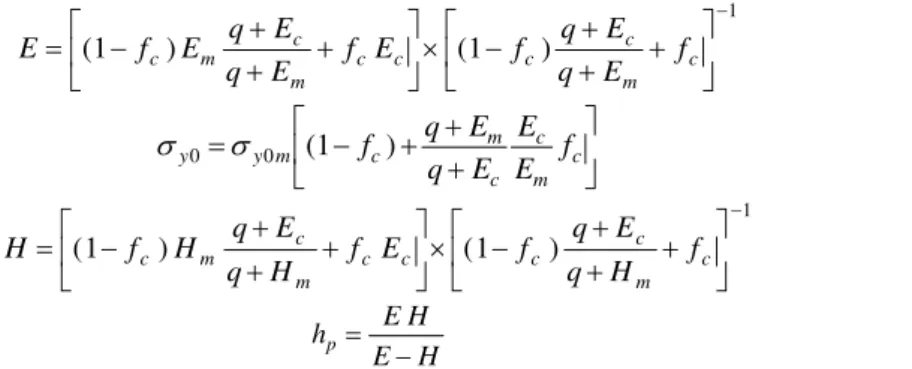
y0(r)and the tangent modulusH(r). These properties can be calculated using the modified rule of mixtures for composites (Suresh, 1998).1 ) 1 ( ) 1 ( c m c c c c m c m c f E q E q f E f E q E q E f E c m c c m c m y y f E E E q E q f ) 1 ( 0 0 1 ) 1 ( ) 1 ( c m c c c c m c m c f H q E q f E f H q E q H f H H E H E hp (34)
where the subscripts ‘c’ and ‘m’ indicate ceramic and metal material respectively. The volume frac-tion of ceramic particles is denoted byfc, and q is the ratio of stress to strain transfer as follows, where
c,
cand
m,
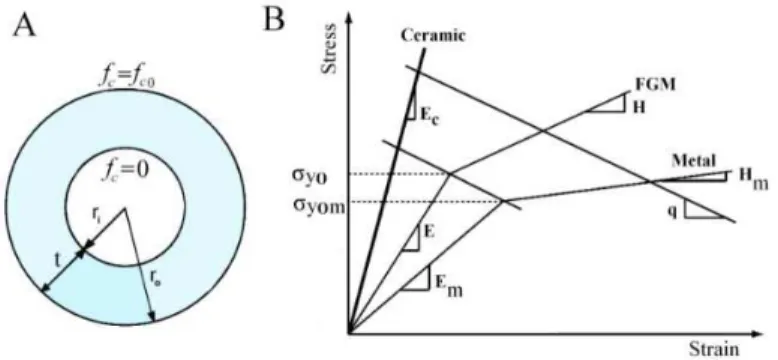
mare the average stress and strain in ceramic and metal respectively (Figure 2). q q m c mc , 0
(35)
The empirical parameterqdepends on many factors including material composition, microstruc-tural arrangements, and the internal constraints. For example qif the constituent elements deform identically in the loading direction, while q0 if the constituent elements experience the
same stress level. In present analysis the ceramic particle reinforcement was assumed to have a vol-ume fraction that varies from 0 at the inner radius,ri, to fc0 at the outer radius,ro according to the following relationship:
n i o i c c r r r r f r
f ( ) 0( )
(36)
where n is the reinforcement distribution exponent (n0 denotes uniformly-reinforced metal-ceramic)
The material properties for each constituent phase are listed in Table 1. The parameter q may be approximated by calibration of experimental data from tensile tests performed on monolithic composite specimens. For example a value of q4.5Gpa was used for a TiB/Ti FGM (Carpenter, 1999) whereas the Poisson ratio was taken constant and equal to 0.3.
Materials E (GPa) σy0 (MPa) H (GPa)
Ti 107 450 10
TiB 373
Figure 2: A) Schematic representation of a thick FGM vessel (rotating disk) with internal radius ri
and external radiusro. (B) Schematic representation of modified rule of mixtures used to estimate the behaviour of ceramic particle-reinforced metal composite.
4 ANALYSIS OF RESULTS
By substituting Eqs. (34) – (36) into the system of differential equations (14), (25) and (32), a set of complicated equations are obtained that are difficult to solve parametrically. Therefore, numerical methods may be used as an alternative. ODE45 solver in MATLAB (2008) was used for this pur-pose. ODE45 is a function for the numerical solution of ordinary differential equation and employs variable step size Runge-Kutta integration methods. ODE45 varies the size of the step of the inde-pendent variable in order to meet the accuracy specified at any particular point along the solution. If ODE45 can take big steps and still meet this accuracy, it will do so and will therefore move quickly through regions where the solution does not change greatly. In regions where the solution changes more rapidly, ODE45 will take smaller steps. This solver uses a 4th and 5th order pair for higher accuracy (Jamshidi, 2001).
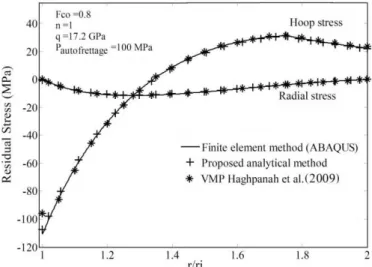
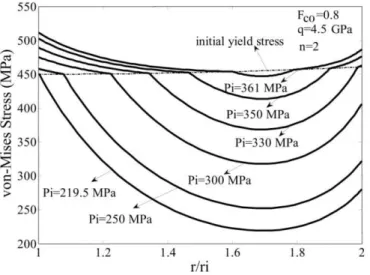
In order to evaluate the analytical method, a set of results from the finite element calculation and the VMP method (Haghpanah, 2009) obtained for the plane strain conditions were compared with results obtained from the analytical method for an FGM cylindrical vessel subjected to an autofrettage internal pressure 100 MPa (Fig. 3). The results indicated that the proposed analytical method was capable of calculating stress components in a cylindrical vessel with great accuracy (in ODE45, the size of the step is variable and Number of solution points is 142 points. In the finite element calculation, Number of elements in the thickness of cylinder is 400 elements). The devel-oped method was also used to study the stress components in a cylindrical FGM vessel with various ceramic particle reinforcement distributions. All the results are presented for the plane stress condi-tion and the material properties listed in Table 1. Fig. 4 illustrates the distribucondi-tion of von-Mises stresses across the thickness in the cylindrical vessel subjected to different levels of internal pressure where n2 and fc00.8. The magnitude of von Mises stresses, indicate that with increasing the
internal pressure, the plastically deformed region extends across the thickness of the cylinder from both the inner and the outer surfaces. In cylindrical vessels made of homogeneous material the plas-tic region grows only from the inner surface. Fig. 5 shows the von-Mises stress distribution in an FGM vessel subjected to an internal pressure of 300 MPa with fc0 1 and different reinforcement
distribution exponents,n. By increasing n, the plastic region gradually spreads from the inner
sur-face of the cylinder.
Figure 3: Comparison with VMP method (Haghpanah, 2009) and the finite element method. The results show the residual stresses in an autofrettaged vessel. In this calculation,
GPa
Figure 4: von-Mises stress along the thickness in an FGM cylindrical vessel subjected to different internal pressure with t/ri1 and plane-stress condition.
Figure 5: von-Mises stress along the thickness in an FGM cylindrical vessel subjected to internal pressure 300MPa with t/ri 1 and plane-stress condition.
Figure 6: Comparison with the finite element method. The results show the stress components in a spherical vessel with t/ri 1.
Figure 7: von-Mises stress along the thickness in an FGM spherical vessel subjected to different internal pressure with t/ri1.
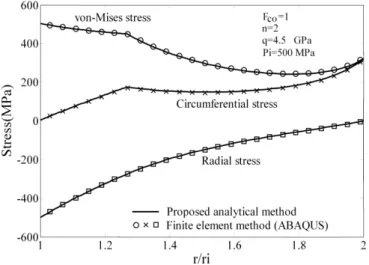
Similar to the case of the cylindrical and spherical vessels, Fig. 8 presents the excellent agreement of the analytical and finite element predictions of elastic-plastic stresses for a rotating disc. The distri-bution of von-Mises stresses across the thickness in a disk rotating at different angular velocities where n2 and fc0 1 is presented in Fig. 9 Results clearly indicate that the growth of the plastic
Figure 8: Comparison with the finite element method. The results show the stress components in a rotating disk.
Figure 9: von-Mises stress along the thickness in an FGM rotating disk at different angular velocity with t/ri1.
5 CONCLUSIONS
Finite element analysis of the problem using ABAQUS commercial code was used for verifica-tion of the proposed analytical soluverifica-tion technique. An alternative modelling approach was devel-oped and used for this purpose. The numerical analysis within the software was performed by the application of a “virtual thermal load” that enabled the continuous variation of material behaviour through the wall thickness of the FGM cylinder in the finite element model. An accurate solution was therefore obtained from the FE analysis. This was achieved without the need to consider a multi-layered cylinder with a stepwise solution as used in most previous solutions in the existing literature (Haghpanah et al., 2009, 2010, 2012; Figueiredo et al., 2008 ).
The analysis results obtained in this work also indicate the possibility of formation and growth of the plastic region within the wall thickness from the external surface of the FGM vessels or rotat-ing disks whereas in a cylindrical (spherical) vessels and rotatrotat-ing disks made of homogeneous mate-rials, plasticity starts essentially from the inner surface.
References
Bayat, M., Saleem, M., Sahari, BB., Hamouda, ASM., Mahdi, E., (2008). Analysis of Functionally Graded Rotating Disks With Variable Thickness. Mechanics Research Communications 35:283-309.
Carpenter, RD., Liang, WW., Paulino, GH., Gibeling, JC., Munir, ZA., (1999). Fracture testing and analysis of a layered functionally graded Ti/TiB beam in 3-point bending. Materials Science Forum 308:837–42.
Chakrabarty, J. (2006). Theory of plasticity. 3rd ed, UK Elsevier Butterworth Heinemann.
Chakraborty, A., Gopalakrishnan S., Reddy, J., (2003). A new beam finite element for the analysis of functionally graded materials. International Journal of Mechanical Sciences 45:519–539.
Chen, YZ., Lin, XY., (2008). Elastic analysis for thick cylinders and spherical pressure vessels made of functionally graded materials. Computational Materials Science 44:581–587.
Dai, HL., Fu, YM., Dong, ZM., (2006). Exact solutions for functionally graded pressure vessels in a uniform magnet-ic field. International Journal of Solid and Structure 43:5570-80.
Dunne, F., Petrinc, N. (2006). Introduction to computational plasticity, Oxford University Press.
Durodola, JF., Attia, O., (2000). Deformation and Stresses in Functionally Graded Rotating Disks. Compo-sites Science and Technology 60:987–995.
Figueiredo, F., Borges, L., Rochinha, F., (2008). Elasto-plastic stress analysis of thick-walled FGM pipes. AIP Con-ference Proceeding 147–52.
Haghpanah Jahromi, B., Ajdari, A., Nayeb-Hashemi, H., Vaziri, A., (2010). Autofrettage of layered and functionally graded metal–ceramic composite vessels. Composite structures 92:1813–22.
Haghpanah Jahromi, B., Farrahi, GH., Maleki, M., Nayeb-Hashemi, H., Vaziri, A., (2009). Residual stresses in autof-rettaged vessel made of functionally graded material. Engineering Structures 31:2930–5.
Haghpanah Jahromi, B., Nayeb-Hashemi, H., Vaziri, A., (2012). Elasto-plastic stresses in a functionally graded rotat-ing disk. ASME Journal of Engineerrotat-ing Materialsand Technology 134:21004–15.
Horgan, C.O., Chan, A.M., (1999). The pressurized hollow cylinder or disk problem for functionally graded isotropic linearly elastic materials. Journal of Elasticity 55:43-59.
Jahed, H., Dubey, RN., (1997) .An axisymmetric method of elastic-plastic analysis capable of predicting residual stress field. Journal of Pressure Vessel Technology 119:264–73.
Jahed, H., Farshi, B., Karimi, M., (2006). Optimum autofrettage and shrink-fit combination in multi-layer cylinders. Journal of Pressure Vessel Technology 128:196–201.
Jahed, H., Shirazi, R., (2001). Loading and unloading behaviour of a thermoplastic disc. International Journal of Pressure Vessels and Piping 78:637–45.
Jamshidi, N., Abouei, A., Molaei, R., Rezaei, R., Jamshidi, M., (2011). Applied guide on MATLAB, Tehran Abed. Jin, ZH., Paulino GH., Dodds Jr RH., (2003). Cohesive fracture modelling of elastic–plastic crack growth in func-tionally graded materials. Engineering Fracture Mechanics 70:1885–912.
Karlsson, Hibbitt, Sorensen., (2008). ABAQUS/CAE, v 6.8-1
Mendelson, A. (1968). Plasticity: Theory and Application, New York Macmillan.
Sadeghian, M., Ekhteraei, H., (2011). Axisymmetric yielding of functionally graded spherical vessel under thermo-mechanical loading. Computational Materials Science 50:975–81.
Setoodeh, A., Kalali, A., Hosseini, A., (2008). Numerical analysis of FGM plate by applying virtual temperature distribution. 7th conference of Iranian aerospace society, Tehran.