Scalable Automated Proving and Debugging of Set-Based
Specifications
∗J.-F. Couchot
1& D. D´eharbe
2& A. Giorgetti
1& S. Ranise
31
LIFC, U. de Franche-Comt´e, Besan¸con (France)
2
DIMAp/UFRN, Natal (Brazil)
3
LORIA & INRIA-Lorraine, Nancy (France)
{couchot, giorgett}@lifc.univ-fcomte.fr, [email protected], [email protected]
Abstract
We present a technique to prove invariants of model-based specifications in a fragment of set the-ory. Proof obligations containing set theory constructs are translated to first-order logic with equality aug-mented with (an extension of) the theory of arrays with extensionality. The idea underlying the transla-tion is that sets are represented by their characteris-tic function which, in turn, is encoded by an array of Booleans indexed on the elements of the set. A theo-rem proving procedure automating the verification of the proof obligations obtained by the translation is de-scribed. Furthermore, we discuss how a sub-formula can be extracted from a failed proof attempt and used by a model finder to build a counter-example. To be concrete, we use a B specification of a simple process scheduler on which we illustrate our technique.
Keywords: Set-theory, First-order logic with equal-ity, Decision procedures, Superposition, BDDs, haR-Vey.
∗Partially funded by INRIA/CASSIS project, CAPES grant
BEX0006/02-5, and CNPq grant 500473/2003-0.
1
Introduction
Formal methods are increasingly integrated in the development cycle of both hardware and software ar-tifacts. For software specification, industry is open to trying out rigorous notations like VDM [9], Z [18] or B [1]. Also, a combination of theorem proving and model checking is becoming increasingly popular to formally validate specifications.
Theorem proving discharges proof obligations en-tailing the correctness of a system with respect to its specification; it is a tedious activity requiring a sig-nificant amount of user interaction since it is usually conducted in undecidable logics. For example, Z and B are based on (variants of) set theory [1] which is well-known to be difficult to mechanise. State-of-the-art theorem provers (such as PVS1) provide only a
limited amount of automation although a great deal of effort has been put into the automation of routine rea-soning tasks. Indeed, a lot of research deals with the combination of decision procedures for selected theo-ries and their incorporation in more general reasoning
1
http://pvs.csl.sri.com
activities [17]. The main advantage of theorem prov-ing is that it permits reasonprov-ing about infinite domains which are ubiquitous in software systems. The main disadvantage is that it can be difficult to say whether a property is not proved because the assumptions are not sufficiently strong or whether just some extra ef-fort in theorem proving is required. Model checking consists of searching for a counter-example violating some property that the system is supposed to com-ply with. It can be made automatic for finite-state systems and only semi-automatic (i.e. the search may not terminate) for infinite-state systems. For infinite domains, the main drawback of model checking is that it can find counter-examples proving that the specifi-cation is contradictory with the system, but it may fail to prove that the specification is correct.
In this paper, we propose to leverage recent ad-vances in the design of decision procedures for first-order theories [3, 10] to build automatic and flexible tools for proving and debugging set-based specifica-tions. The key idea of our approach is that only frag-ments of set theory are used in many situations of prac-tical relevance and such fragments can be translated into decidable theories of equational first-order logic. In order to test the feasibility of our approach, we have chosen the specification language of the B method. However, we intend the underlying method to be gen-erally applicable to the model-based approach to spec-ifications which encompasses also other notations such as Z or VDM.
The main ingredients of our method are fourfold.
First, we translate a selected subset of the B specifica-tion language to first-order logic augmented with some set-theoretic constructs. More precisely, a B speci-fication module—called Abstract Machine (AM)—is
translated to first-order formulae encoding the rela-tions between the before and after values of the vari-ables of the AM according to its operations. Such formulae may contain sets (with a particular struc-ture) and selected set-theoretic constructs. Second, the before-after representation of the system together with the invariant of the AM is translated into a set of first-order proof obligations (containing set-theoretic constructs) which entail that the invariant is inductive for the AM. (The first two ingredients of our method are briefly sketched in Section 2 since they are an adaptation of existing techniques, e.g. [1].) Third, we eliminate the set-theoretic constructs in the proof obligations by interpreting them in an extension of the decidable theory of arrays with extensionality (Sec-tion 3), see e.g. [3] . Such a transla(Sec-tion is based on the idea that an array of Booleans indexed by the elements of a set s represents the characteristic function of s.
Related work. The closest related work is [15, 14] since it tries to combine the best of theorem proving and model finding by loosely coupling AtelierB2 with
the Alloy analyser3. The main difference is that the
entire proof obligation is used for both theorem prov-ing and model findprov-ing whereas we use theorem provprov-ing to simplify the formula so that only a small portion of it (ultimately responsible for its invalidity) is passed to a model finder, thereby considerably simplifying the task of the latter. There is some work (e.g. [4]) in using state-of-the-art theorem provers for formal reasoning in state-based specification languages such as B, Z, and VDM. The emphasis of such works is on the soundness of the translation from set theory to the logic used by the prover, ignoring the issues of automation thereby leaving the user with the burden of long and tedious interactive proofs. On the contrary, our work focuses on translating a fragment of set theory for which the theorem proving problem can be effectively automated by using decision procedures for first-order equational theories. To our knowledge, it is the first time that the idea of using (an extension of) a decision procedure for the theory of arrays is put forward to mechanise the reasoning in (fragments of) set theory by representing characteristic functions of sets with arrays. Section 4.4 reports some experiments which confirm the scalabil-ity of our approach on a class of large specifications manipulating simple data structures.
2
http://www.atelierb.societe.com/index.html
3
http://sdg.lcs.mit.edu/alloy
2
The B Specification and Verification
Method
The B method has an associated specification nota-tion called Abstract Machine Notanota-tion (AMN). This is a state-based notation similar to Z or VDM which fea-tures constructs such as assignments (:=), conditionals (IF THEN ELSE), multiple assignments (||), and non-deterministic choice (ANY) [1].
Roughly, an AM is composed of some state vari-ables, an initialisation, and some operations that may alter the value of the state variables. Although the B method includes refinement and implementation of a specification, we consider here only the problem of checking whether an invariant is established by the initialisation and is preserved by the execution of all the operations of an AM. Proof obligations implying the correctness of the AM operations and initialisation with respect to its candidate invariant are generated following an effective procedure (along the lines in [1]).
Example 1 (The Process Scheduler) As a running example on which we illustrate our techniques, we
con-sider the process scheduler introduced in [11]. Although
simple, this example allows us to discuss the typical
problems arising in handling the type of AMs our
tech-nique is aimed at, i.e. (large) AMs which manipulate
simple data structures, represented by sets of primitive
elements. Its B specification is shown in Figure 1. At
any one time, the system may have some processes
ready to be scheduled, some processes waiting for some external action before they become ready and, possibly, a single active process. Each process is uniquely identified by an identifier (taken out of a set
MACHINE PSAM SETS PID
VARIABLES active,ready,waiting INVARIANT
ready ⊆ PID ∧ active ⊆ PID ∧ waiting ⊆ PID ∧
ready ∩ waiting = ∅ ∧ ready ∩ active = ∅ ∧
active ∩ waiting = ∅ ∧ card(active) ≤ 1 INITIALISATION
active,ready:= ∅,∅ || waiting:= PID
OPERATIONS Swap =
IF active 6= ∅ THEN waiting:= waiting ∪ active || IF ready 6= ∅ THEN
ANY pr WHERE pr ∈ ready THEN
active:= {pr} || ready:= ready - {pr}
END
ELSE active:= ∅
END END
Ready =
ANY pw WHERE pw ∈ waiting THEN
IF (active 6= ∅) THEN ready:= ready ∪ {pw}
ELSE
active:= {pw}
END END END;
Figure 1: The Process Scheduler Abstract Machine.
waitingare pairwise disjoint subsets ofPIDand that at most one process can be in theactivestate (this en-forces mutual exclusion in the execution of processes).
The initialisation requires that all the processes are
in the waiting state at the beginning. The operation
Swapallows the AM to evolve by exchanging the cur-rently active process with a ready one, leaving the system idle if there are no ready processes. In the
op-eration Ready, a process pw, that has been waiting, is somehow unblocked and can go to the ready state or
to the active state, if the system is idle (we will see
in Section 4.3 that the specification of this operation
contains a bug).
The specification of an operation such asSwapis a description of certain relevant properties that the
in-tended state modification must fulfil. To formally
ex-press such properties, a common technique is to write
the, so called, before-after predicatewhich relates the values of the state variables (i.e.ready,waiting, and
active) as they are immediately before and immedi-ately after the operation takes place (see [1] for
de-tails). In order to write down such predicates, we
adopt the convention of denoting the values of the
vari-ables just after the execution of the operation by
prim-ing the correspondprim-ing identifiers. The followprim-ing
before-after predicatePSwap(r,w,a,r′,w′,a′)specifies the
oper-ationSwap:
if a6=∅
then w′=w∪a∧
if r6=∅ then
∃pr.(pr∈r∧a′ ={pr} ∧r′=r− {pr}) else
a′=∅ ∧r′=r
else a′=a∧r′=r∧w′=w
where r,w,a,r′,w′,a′ abbreviate ready, waiting,
active, ready′, waiting′ and active′ respectively. The Boolean conditional connective if A then B else
C abbreviates (A ⇒ B) ∧(¬A ⇒ C) where
A, B, and C are formulae. We use such a construct
in order to preserve the structure of the B
specifi-cation in the before-after predicate. Notice that the
non-deterministic choice operator (ANY) is expressed by existential quantification and the multiple
assign-ment operator (||) by conjunction. Also, state vari-ables that are not explicitly assigned retain their
pre-vious value. Although this is not in the scope of this
paper, we believe it would be easy to adapt our
ap-proach to handle other B constructs such as constants,
machine parameters and properties.
The invariant (cf. INVARIANT clause of Figure 1) can easily be translated to the following predicate:
r⊆p∧w⊆p∧a⊆p∧
r∩w=∅ ∧r∩a=∅ ∧a∩w=∅∧ card(a)≤1,
(2)
where pis a constant representing PID; it is abbrevi-ated byInv(r,w,a).
Once both an operation and the invariant have been
specified by predicates, we can prove that the operation
preserves the invariant by checking the validity of the
following formula which encodes the fact thatInvholds
after the execution ofSwap, provided that it holds be-fore:
∀r,w,a,r′,w′,a′. [Inv(r,w,a)∧PSwap(r,w,a,r′,w′,a′) ⇒Inv(r′,w′,a′)].
(3) In addition to proving that each operation
pre-serves the invariant Inv, one also has to check that
Inv is satisfied by the initialisation condition (cf.
INITIALISATION clause of Figure 1). We omit the corresponding proof obligation, since this does not add
much to the discussion.
Proof obligations—such as (3)— shall be discharged by using automated theorem provers. Typically, in currently available commercial tools supporting the B method, there is a number of proof obligations that the automated prover cannot discharge so the devel-oper can switch the prover to an interactive mode and attempt to try to discharge the remaining proof obliga-tions manually. The B method is actually supported by two commercially available tools: the B-Toolkit4
and the AtelierB.5 Although quite successful, both
tools leave the developer without help to discover why a certain proof obligation has failed to be shown valid. In the rest of this paper, we describe a technique to check the validity of proof obligations and to pro-vide the user with counter-examples when the validity check fails.
3
Translating Set-Based Proof
Obliga-tions
In Section 2, we have relied on the reader’s intu-ition of basic concepts of first-order logic and naive set theory to write down the before-after predicates specifying the operation, the invariant, and the proof obligation of the AM in Figure 1. Here, we define the simple version of set theory we use and explain how to translate it into a suitable extension of first-order logic with equality so thathaRVey(cf. Section 4.2)—a system to check the validity of equational first-order
4
http://www.b-core.com/btoolkit.html
5
formulae—can be used to discharge such proof obliga-tions (if possible).
Below, we assume the usual syntactic and semantic notions of first-order logic with equality as defined for example in [12]. We say that a formulaφissatisfiable modulo a theory T iffφ∧ T is satisfiable.6
3.1
A Simple Set Theory
For simplicity, in this paper, we consider a re-stricted fragment of set theory, which we denote with SSET. Notice, however, that our approach can be extended to handle more expressive fragments of set theory such as the theory of Hereditarily Finite Sets with Atoms (see, e.g. [5]), which permits sets of prim-itive elements, sets of sets of primprim-itive elements, and so on. SSET is a theory of first-order sorted logic with equality. It contains two distinct sort symbolselem
and set. Its set of terms contains the variable and
constant symbols of sortelem and set. We assume
there is at least one constant of sortelem. The
distin-guished constant∅is a term of sortset. Ifeis a term
of sortelem, then {e} is a term of sortset; also, if
s1ands2are terms of sortset, thens1⊲⊳ s2 is also a
term of sortset, where⊲⊳is one of the binary function
symbols∩(intersection),∪(union), and\ (set differ-ence). We also write {e1, . . . , en} as an abbreviation of{e1} ∪ · · · ∪ {en}. The set of atoms ofSSET con-tains expressions of the forme1=e2,e∈s, s1⊆s2, s1 = s2, where e, e1, e2 are terms of sort elem and
s, s1, s2 are terms of sortset. Literals, Boolean
com-binations of literals, and possibly quantified formulae are inductively defined in the usual way. Furthermore, letAx(SSET) be the set obtained by adding the fol-lowing axioms to the theory of equality:
∀E.(¬E∈ ∅), (4)
6
A theory is a set of formulae closed under logical conse-quence.
∀E.(E∈ {E}), (5)
∀E, F.(E6=F⇒ ¬E∈ {F}), (6)
∀E, S1, S2.(E∈S1∪S2⇔(E∈S1∨E∈S2)), (7)
∀E, S1, S2.(E∈S1∩S2⇔(E∈S1∧E∈S2)), (8)
∀E, S1, S2.(E∈S1\S2⇔(E∈S1∧ ¬E∈S2)), (9)
∀S1, S2.(S1⊆S2⇔ ∀E.(E∈S1⇒E∈S2)), (10)
∀S1, S2.(S1=S2⇔ ∀E.(E∈S1 ⇔E∈S2)), (11)
whereE, F are variables of sortelemandS1, S2 are
variables of sortset. The semantics ofSSET is given
by the classI(SSET) of first-order interpretations sat-isfying each axiom inAx(SSET) whose domain inter-preting sortsetis “generated by”∅,{ }, and∪; i.e. all
elements of the domain of sortsetare the
interpreta-tions of terms containing only∅,{ }, and∪as function symbols whose application yields terms of sort set.7
This allows us to prove properties by induction over
∅,{ }, and∪(see, e.g. Fact 1 below).
Intuitively, the set theory we are considering per-mits to reason about sets with a very simple structure, i.e. sets (represented by terms of sortset) which are
subsets of a given universal set (e.g. the set PID in the example of Figure 1) and whose elements (repre-sented by terms of sort elem) are primitive. So, for
example, if the universal set is that of integers, the set {1,2,3} is a valid set of SSET, whereas {1,{2}}
is not. Notice that SSET is already useful in many practical verification problems involving large systems (say some pages of B specifications) which manipulate simple data structures represented by sets of primitive elements.
7
3.2
The Theory of Arrays with
Extension-ality
LetAe
sbe the many-sorted theory with sortsvalue,
index and array, with function symbols write
(ab-breviated below withwr) andread(abbreviated below withrd) of typearray×index×value−→array
andarray×index−→valuerespectively.
Further-more, let Ax(Ae
s) be the set of axioms obtained by adding the following axioms to the theory of equality:
∀A, I, E.(rd(wr(A, I, E), I) =E),(12)
∀A, I, J, E.(I6=J⇒rd(wr(A, I, E), J) =rd(A, J)),(13)
∀A, B.(∀I.(rd(A, I) =rd(B, I))⇒A=B),(14)
where A and B are variables of sort array, I and
J are variables of sort index, and E is a variable of
sort value. ΣAe
s denotes a signature containing the
function symbols rd, wr, and a finite set of constant symbols. We assume that the signature ofAe
s admits at least one ground term for each sort. Checking the satisfiability of conjunctions of ground literals modulo
Ae
s is decidable (see, e.g. [3]).
3.3
From Set Theory to Array Theory
We explain how to translate formulae ofSSET to (extensions of)Ae
s so that the reasoning system
haR-Vey(cf. Section 4.2) can be used to discharge the proof obligations which imply that an invariant of an AM is an inductive property of the machine (along the lines sketched in Section 2).
The intuition underlying our approach is based on using the characteristic function to represent sets. Such a function, in turn, can be encoded by an array of Booleans whose indexes are the elements of the set. For example, the sets:={1,2}can be represented as
s[1] = s[2] = true and s[x] =false, for all x distinct
from 1 and 2.
First, letBAes⊃ Aesbe an extension ofAes contain-ing two distcontain-inguished constantsttandffof sortvalue
together with the axiom
tt6=ff. (15)
In this way, we consider arrays storing Boolean values (from this, the ‘B’ in front of ‘Ae
s’ in ‘BAes’). Further-more, BAe
s contains a distinguished constant symbol
mtyof sort arrayand the axiom
∀I.(rd(mty, I) =ff), (16)
where I is a variable of sort index (the intuition is
thatmtyis the counterpart of the empty set inAe s). Then, we define three functionsS,T, andFfrom the sorts, terms, and formulae ofSSET to the sorts, pairs of terms and set of formulae, and pairs of formulae and set of formulae (respectively) ofBAes. Below, we will see that other symbols and axioms will be added to
BAe
sin the process of translating a formula ofSSETto a formula in first-order logic with equality by applying functionsTandF. Formally, this is done by returning the translated terms together with the set of formulae to be added to BAes. Such formulae will implicitely determine the symbols to be added toBAes.
We define S(elem) := index and S(set) := array. Then, we assume thatT is s.t. it maps
(one-to-one) constants of sortelemandsetto constants of
sortindex and array, respectively. Now, we
home-omorphically extend T to compound terms of SSET as follows, where i and u are fresh constants of sort
indexandarray, respectively: T(∅) := (mty,∅);
T(e1∪e2) := (u,{a∪} ∪α1∪α2),
T(e1∩e2) := (u,{a∩} ∪α1∪α2), and
T(e1\e2) := (u,{a\} ∪α1∪α2),where
a∪is∀I.(rd(eb1, I) =tt∨rd(eb2, I) =tt⇔rd(u, I) =tt), a∩is∀I.(rd(eb1, I) =tt∧rd(eb2, I) =tt⇔rd(u, I) =tt), a\ is ∀I.(rd(eb1, I) = tt∧rd(eb2, I) = ff ⇔ rd(u, I) =
tt) and T(ej) = (ebj, αj) for j = 1,2. We re-gard {e1, ..., en} (for n > 1) as an abbreviation of {e1} ∪ · · · ∪ {en}.
Then, for each constantuof sortarray
(represent-ing a set), we add toBAesthe following axiom:
∀I.(rd(u, I) =tt∨rd(u, I) =ff), (17)
whereI is a variable of sort index. Axiom (17)
con-strains the co-domain of the characteristic function represented byuto be {tt,ff}.
Furthermore, we translate the ground atoms of SSET by defining the function Fas follows:
F(e1∈e2) := (rd(eb2,eb1) = tt, α1∪α2),
F(e1=e2) := (eb1=eb2, α1∪α2),
F(e16=e2) :=F(¬(e1=e2)),
F(e1⊂e2) :=F(e1⊆e2∧e16=e2),
F(e1⊆e2) := (q, α1∪α2∪α),
whereqis a fresh propositional letter,T(ei) = (ebi, αi) for i = 1,2 and α is {q ⇔ ∀X.(rd(eb1, X) = tt ⇒
rd(eb2, X) =tt)}.
Then, the translation process is homeomorphically extended to Boolean combinations of atoms in the fol-lowing way:
F(¬φ) := (¬φ, αb ) whereF(φ) = (φ, αb ), F(φ1⋄φ2) := (cφ1⋄ cφ2, α1∪α2)
where F(φi) = (φbi, αi) for i = 1,2 and ⋄ stands for either∨,∧,⇒or⇔, and
F(if φ1 then φ2 elseφ3) := (if φb1 then φb2 else φb3, α1∪α2∪α3)
whereF(φi) = (φbi, αi) fori= 1,2,and 3.
Now, we are in the position to state the main prop-erty of our translation process (we state it in terms of satisfiability since our theorem proving approach is based on refutation; see Section 4.2). Let φ be a ground formula of SSET and (φ, αb ) = F(φ) be its translation. We denote byBAesthe theory containing Ae
s, the axioms (15), (16), (17) and the formulae inα.
Theorem 1 φis satisfiable modulo SSET iffφbis sat-isfiable moduloBAes.
In order to prove the Theorem, we need some technical definitions and facts.
Fact 1 For any ground term t of SSET , there exists a termt′ containing only the function symbols ∅,{ }, and ∪ s.t. t = t′ is satisfied by an interpretation in
I(SSET).
The proof consists of an easy induction on∅,{ }, and
∪. Then, we introduce the functioninsas follows:
ins(e,∅) = {e} (18)
ins(e, s) = {e} ∪s, (19)
for all ground terms e and s of sort elem and set,
respectively.
Fact 2 Let R be the term rewriting system consist-ing of (18) and (19), oriented from right to left, and
ins(e,mty)∪s= ins(e, s), oriented from left to right. Then,Ris terminating and confluent.
applied. The fact of being confluent is an immedi-ate consequence of the fact that the set of equations is closed under the rules of the superposition calculus [16].8 As a consequence, we are entitled to define a
function·′ on terms ofSSET obtained by using Facts 1 and 2. By abuse of notation, we extend such a func-tion to formulae as follows: φ′ will denote the formula obtained fromφby applying·′ to its sub-terms. Then, we introduce the set Ax(SSET′) of axioms obtained fromAx(SSET) by replacing (5) and (6) with
∀E, S.(E∈ins(E, S)), (20)
∀E, F, S.(E6=F ⇒(E∈ins(F, S)⇔E∈S)),(21)
whereE, F are variables of sortelemandSis a
vari-able of sortset. The signature of SSET′ is obtained
from that ofSSET by replacing{ } withins.
Fact 3 φ is SSET -satisfiable iff φ′ is SSET′ -satisfiable.
To see this, it is sufficient to observe that both (20) and (21) are logical consequences of Ax(SSET) and of (18) and (19). Now, we consider the mapping T′ from ground terms ofSSET′ to pairs of ground terms and set of formulae ofBAes defined as follows, where ianduare fresh constants of sortindex andarray,
respectively:
T′(ins(e, s)) := (wr(bs, e,tt), α) whereT′(s) = (bs, α); T′(∅) := (mty,∅);
T′(x) := (i,∅) if xis of sortelem;
T′(x) := (u, au) if x is of sort set, where au is
∀I.(rd(u, I) =tt∨rd(u, I) =ff),andI is a variable of sortindex;
T′(e1∪e2) := (u,{a∪} ∪α1∪α2),where 8
In fact,ins(e,mty)∪s=ins(e, s) is obtained by superposition of (18) and (19).
a∪is∀I.(rd(eb1, I) =tt∨rd(eb2, I) =tt⇔rd(u, I) =tt)
andT′(ej) = (ebj, αj) forj= 1,2.
Lemma 1 Lettbe a ground term on the signature of SSET andt′ be the translated term on the signature of SSET′. Let T(t) = (s, α)and T′(t′) = (s′, α′). Then,
s=s′ is a logical consequence ofAe
s,α,α′, (15), (16)
and (17).
Again, the proof is obtained by induction on the struc-ture of the termtand therefore is omitted. If we define F′ as F above where the calls to T are replaced with calls toT′, then we can easily derive thatψis logically equivalent toψ′ moduloAe
s∪ {α, α′}as a corollary of Lemma 1, where (ψ, α) =F(φ) and (ψ′, α′) = F(φ′). The following diagram summarizes the situation:
SSET SSET′
BAe s ·′
F F′
Proof of Theorem 1. We prove (the counterposi-tive of) ifφis satisfiable moduloSSETthenφbis satisfi-able moduloBAes. First of all, we translate the formula φofSSET to a formula φ′ of SSET′ by using Fact 1 and Fact 2. Then, we observe that the translation of the ground instances of the axioms inAx(SSET′) (un-derF′) are all logical consequences of Ax(BAes). If φb′ is the formula of BAe
s which is the translation of φ′ under F′, then, by Fact 3, Lemma 1, and the previ-ous observation, we are entitled to conclude thatφis unsatisfiable moduloSSET if φbis unsatisfiable mod-uloBAes. The other implication of the biconditional is
3.4
Two Important Extensions
In order to enlarge the scope of applicability of our technique, we consider two extensions of the transla-tion defined above. The former handles (a restricted form of) the cardinality operator which is frequently used in set-based specification. The latter considers non-ground formulae containing quantifiers over the elements of the universal set. We do not consider quantifiers over sets since it is well-known that the full first-order theory of arrays is undecidable (see [3] for further references on this point).
The cardinality operator. Let us consider only ground atoms of the form card(s) = k, where s is a term of sort set and k is a given numeral. Then,
we can replace each atom of the form card(s) =
k with s = {f1, ..., fk}, where fi is a fresh con-stant of sort elem (for i = 1, ..., k). After the
exhaustive application of such a rule we obtain a formula of SSET which can be translated to BAes as described above. We can generalise the ap-proach to handle more complex arithmetic relation. For example, card(active)≤1 can be rewritten as
card(active) =0∨card(active) =1 which, in turn, rewrites toactive=∅ ∨active={f1}, wheref1is a fresh constant of sortelem. Formally, we extend the
definition ofFabove as follows:
F(card(e) = 0) := (be=mty, α)
whereT(e) = (be, α),
F(card(e) =k) := (q, α∪ {q⇔ ∃x1,· · ·, xk.β})
F(card(e)≤k) := (q, α∪ {q⇔ ∃x1,· · ·, xk.ϕ})
whereq is a fresh propositional letter,k is a numeral constant denoting an integer s.t.k6= 0,T(e) = (be, α),
ϕ is be = wr(· · ·wr(mty, x1,tt)· · ·, xk,tt), and β is V
1≤i<j≤k(xi6=xj)∧ϕ.
By applying the above three equations defining the extension ofF, we can eliminate all occurrences of the cardinality operator in a formula. As a consequence, we obtain a formula ofSSET to which Theorem 1 is still applicable. In other words, Theorem 1 can be straightforwardly adapted to hold for the extension of SSET with the restricted form of the cardinality operator considered here.
Quantifiers over set elements. Frequently, the proof obligations resulting from the verification of in-variants of B machines are not ground. They usu-ally contain quantifiers over the elements of a cer-tain set. For example, we will obcer-tain existentially quantified sub-formulae whenever we handle the non-deterministic choice operator (i.e.ANY), see the Exam-ple below. To handle quantifiers over elements of sets, we define the functionFQ to be equal to Fon ground formulae and s.t.
FQ(Qx.φ) := (Qx.φ, αb )
wherexis a variable of sortelem,Qis either∀ or∃,
andFQ(φ) = (φ, αb ).
the predicatePSwapeq :
if a6=mty then
w′=w U a∧
if r6=mty then
∃pr.(rd(r,pr) =tt∧a′ =wr(mty,pr,tt)∧
r′=wr(r,pr,ff)) else
a′=mty∧r′=r
else
a′=a∧r′=r∧w′=w
(22) wherew,a,rand their primed versions are variables of
sortarray.
It is possible to express the set-theoretic constructs
in the verification condition (3) by using the
transla-tion described above, thereby obtaining the formula
∀r,w,a,r′,w′,a′. [Inveq(r,w,a)∧PSwapeq (r,w,a,r′,w′,a′) ⇒Inveq(r′,w′,a′)]
(23) of (pure) first-order theory (with equality), wherePSwapeq
is as specified above andInveq is the translation ofInv.
If we reason by refutation, Theorem 1 allows us to say
that the satisfiability of the negation of (23) modulo
BAe
sis equivalent to the satisfiability of the negation of
(3) modulo SSET . It is easy to see that in the negation
of (23), the variables r, w, a, r′, w′ and a′ become existentially quantified while the variable pr in PSwapeq
will still be existentially quantified. As a consequence,
all the variables can be replaced by Skolem constants
so that the negation of (23) can be considered as a
ground formula (see Section 4 for a more systematic
handling of quantifiers).
Theorem 1 can be extended to the restricted class of quantified formulae considered here by using the following observations. First, the function T above
acts as the identity on ground terms of sort elem.
Second, a quantified formula is unsatisfiable iff there exists a ground instance which is unsatisfiable by Her-brand Theorem (see, e.g. [7]). Let Gbe the function that given an unsatisfiable quantified formula returns its (smallest) unsatisfiable ground instance. Then, it is not difficult to show that ψ is logically equivalent toG(ψ′) moduloAe
s∪ {α, α′}, where (ψ, α) =F(G(φ)) and (ψ′, α′) =FQ(φ).
3.5
Relationships with WS1S
The reader with some knowledge of WS1S [6] may wonder whether SSET can be translated to such a logic so that proof obligations can be discharged by existing tools such as, for example, Mona [13]. The answer to this question is indeed positive. However, we point out that the proof obligations generated in our applications are typically very big since the origi-nal AM is large. Now,Monasuffers from memory con-sumptions problem as all tools based on automata do. For this reason, in practice,Monadoes not seem suited to handle some of the largest proof obligations arising in our applications (see Section 4.4 for more details on this issue). Furthermore, as already noted above, our approach can be extended to handle more expressive set theories. This is not the case for the translation whose target is theMONAtool. Since WS1S logic can only handle primitive elements (integers) and sets of primitive elements, it is not straightforward to encode in such logic a set of sets of primitive elements. Our theory extends to sets of sets of primitive elements, and so on, simply by extending the theory of arrays
Ae
4
Discharging Proof Obligations
We are left with the problem of checking that for-mulae of first-order logic with equality, such as (23), are logical consequences of the equational theoryBAes. To do this, we reason by refutation and prove that the negation of the formula is unsatisfiable moduloBAes.
Example 3 (The Process Scheduler—continued) To discharge proof obligation (23), we prove that
∃r,w,a,r′,w′,a′. [(Inveq(r,w,a)
∧PSwapeq (r,w,a,r′,w′,a′)
∧¬Inveq(r′,w′,a′)]
(24)
is unsatisfiable moduloBAes.
Our refutation-based theorem proving technique consists of three phases. We describe them in detail in the following subsections.
4.1
Eliminating Quantifiers
We show how to reduce the satisfiability of a first-order formulaφ(possibly containing quantifiers) mod-ulo BAes to the satisfiability of a ground formula φg modulo a theoryEBAess.t.φis satisfiable moduloBAes iffφg is satisfiable modulo EBAes and BAes ⊆ EBAes. The key idea is to transformφinto a ground formula
φg by replacing the quantified sub-formulae of φwith fresh propositional letters and to add their definitions ∆ to the axiomsAx(BAes) ofBAes in such a way that Ax(BAes)∧φis satisfiable iffAx(BAes)∧∆∧φg is.
Some preliminary definitions (borrowed from [19]) are required. A position is a word over the natural numbers. The setpos(φ) of positions of a formulaφis defined as follows: the empty wordǫis in pos(φ), i.p
is inpos(φ) ifφis of the formφ1◦ · · · ◦φn, 1≤i≤n, p is in pos(φi), and ◦ is a Boolean connective or a
quantifier; nothing else is inpos(φ). We defineφ|ǫ to beφandφ|i.pto beφi|pwhenφis of the formφ1◦· · ·◦ φn. We writeφ[ψ]p whenφ|pisψandφ[x/c] to denote the formula obtained by replacing all the occurrences ofxwithc inφ. Thepolarity pol(φ, π) of the formula
φ|πoccurring at positionπin a formulaφis defined as follows: pol(φ, ǫ) := +1,pol(φ, π.i) :=pol(φ, π) ifφ|π is a conjunction, disjunction, formula whose top-most symbol is a quantifier, an implication with i = 2, or anif then else withi= 2 or i= 3, pol(φ, π.i) :=
−pol(φ, π) ifφ|πis a formula whose top-most symbol is the negation or the implication withi= 1, and finally,
pol(φ, π.i) := 0 if φ|π is a formula whose top-most symbol is the biconditional or theif then elsewith
i= 1. We say that the variablexofQx.ψisessentially existentially quantified in the formulaφ[Qx.ψ]πeither whenQ is ∀ andpol(φ, π) = −1 or when Q is∃ and
pol(φ, π) = +1. Now, we are in the position to describe the details of our algorithm to handle quantifiers.
First of all, a pre-processing step replaces all es-sentially existentially quantified variablesawith fresh Skolem constantsaand their quantifiers are removed. This can be mechanised by invoking the function dropExistential which is defined in Figure 2 together with the auxiliary function de whose second parame-ter is the polarity of the sub-formula being considered (in the Figure, for the sake of conciseness, the mixfix Boolean connective if then elsehas been written as the prefix ternary operatorite). It is easy to check thatφis satisfiable iffdropExistential(φ) is.
dropExistential(φ) := de(φ,+1) de(φ, p) := φifφis atomic, de(¬φ, p) := ¬de(φ,−p) de(φ∧ψ, p) := de(φ, p)∧de(ψ, p) de(φ∨ψ, p) := de(φ, p)∨de(ψ, p) de(ite(φ, ψ, ξ), p) := ite(φ,de(ψ, p),de(ξ, p))
de(φ⇒ψ, p) := de(φ,−p)⇒de(ψ, p) de(φ⇔ψ, p) := φ⇔ψ
de(∀x.φ,+1) := ∀x.φ de(∃x.φ,−1) := ∃x.φ de(∀x.φ,−1) := de(φ[x/c],+1) de(∃x.φ,+1) := de(φ[x/c],−1)
Figure 2: Definition ofdropExistentialandde.
prenex form9(see again [12] for details) but in the
op-posite direction. For example, the formula∃x.(φ⇒ψ) is transformed to (∀x.φ)⇒ψifxdoes not occur inψ. This operation, known asminiscoping, can be mech-anised as shown in Figure 3. We assume that only formulae obtained as the result of the invocation of dropExistential are fed to mini. The function is de-fined on the structure of first-order formulae. When it encounters an atomic formula it simply returns it whereas when a quantified sub-formula is met, the auxiliary function mq is invoked. In the definition of
mq, the following notation is used: Q abbreviates ei-ther∀ or ∃, −Q abbreviates ∀ (∃) when Q is ∃ (∀),
V(φ) denotes the set of free variables inφ andx′ is a fresh variable. The first and the second arguments of mq are the quantifier and the quantified variable whose scope is reduced by the function while the third argu-ment is the already processed sub-formula. Again, it
9
A formula is in prenex form if it has the structure
Q1x1...Qnxn.φ, where Qi is either ∀ or ∃, xi is a variable (i= 1, ..., n), andφis a quantifier-free formula whose free vari-ables arex1, ..., xn.
mini(φ◦ψ) := mini(φ)◦mini(ψ) where◦ ∈ {∧,∨,⇒,⇔}
mini(¬φ) := ¬mini(φ)
mini(ite(φ, ψ, ξ)) := ite(mini(φ),mini(ψ),mini(ξ)) mini(φ) := φifφis atomic
mini(Q x1,· · ·, xn.φ) := mq(Q, x1, . . .mq(Q, xn,mini(φ)). . .)
mq(Q, x, φ) := φifx6∈ V(φ)
mq(Q, x,¬φ) := ¬mq(−Q, x, φ)
mq(Q, x, φ⋄ψ) := mq(Q, x, φ)⋄ψifx6∈ V(ψ),⋄ ∈ {∧,∨}
mq(Q, x, φ⋄ψ) := φ⋄mq(Q, x, ψ) ifx6∈ V(φ),⋄ ∈ {∧,∨}
mq(∀, x, φ∧ψ) := mq(∀, x, φ)∧mq(∀, x′, ψ[x/x′]) otherwise
mq(∃, x, φ∨ψ) := mq(∃, x, φ)∨mq(∃, x′, ψ[x/x′]) otherwise
mq(Q, x, φ⇒ψ) := φ⇒mq(Q, x, ψ) ifx6∈ V(φ)
mq(Q, x, φ⇒ψ) := mq(−Q, x, φ)⇒ψifx6∈ V(ψ)
mq(∃, x, φ⇒ψ) := mq(∀, x, φ)⇒mq(∃, x′, ψ[x/x′])
mq(Q, x,ite(φ, ψ, ξ)) := ite(φ, ψ,mq(Q, x, ξ)) ifx6∈ V(φ)∪ V(ψ)
mq(Q, x,ite(φ, ψ, ξ)) := ite(φ,mq(Q, x, ψ), ξ) ifx6∈ V(φ)∪ V(ξ)
mq(Q, x, φ) := Q x.φotherwise
Figure 3: Definition ofminiandmq.
is a routine exercise to check that φ is satisfiable iff mini(φ) is.
As the third and last step, we replace each out-ermost quantified sub-formulaψ with a fresh propo-sitional letter q and we add q ⇒ ψ (resp. ψ ⇒ q,
q ⇔ ψ) to Ax(BAes) if φ|π = ψ and pol(φ, π) = +1 (resp. pol(φ, π) = −1, pol(φ, π) = 0). Notice that if there is a quantified sub-formula ψ′ occurring in
ψ, we do not recursively apply the above process to
renameFormula(φ) := rf(φ,+1)
rf(φ, p) := (φ,∅) ifφis atomic rf(¬φ, p) := (¬ψ,A)
where (ψ,A) =rf(φ,−p) rf(φ1⋄φ2, p) := (ψ1⋄ψ2,A1∪ A2)
where (ψi,Ai) =rf(φi, p)
rf(ite(φ1, φ2, φ3), p) := (ite(ψ1, ψ2, ψ3),A1∪ A2∪ A3)
where (ψ1,A1) =rf(φ1,0),
(ψ2,A2) =rf(φ2, p)
and (ψ3,A3) =rf(φ3, p)
rf(φ1⇒φ2, p) := (ψ1⇒ψ2,A1∪ A2)
where (ψ1,A1) =rf(φ1,−p)
and (ψ2,A2) =rf(φ2, p)
rf(φ1⇔φ2, p) := (ψ1⇔ψ2,A1∪ A2)
where (ψi,Ai) =rf(φi,0)
rf(Qx.φ,0) := (p,{p⇔Qx.φ}) rf(Qx.φ,+1) := (p,{p⇒(Qx.φ)}) rf(Qx.φ,−1) := (p,{(Qx.φ)⇒p})
Figure 4: Definition ofrenameFormulaandrf.
returns a pair whose first argument is the result of replacing quantified sub-formulae with fresh propo-sitional letters and the second is the set of implica-tions between quantified sub-formulae and proposi-tional letters to be added to the background theory. We can show thatφ is satisfiable iff φ′∧Φ is, where (φ′,Φ) = renameFormula(φ). The proof is by induc-tion on the structure of the formulaφ. To illustrate, we consider the case whereφ is of the form ξ∨ ∃x.ψ
s.t. renameFormula(φ) = (ξ∨q,{q ⇒ ∃x.ψ}), where
q is a fresh propositional letter. Now, any model of (ξ∨q)∧(q⇒ ∃x.ψ) is also a model ofξ∨ ∃x.ψ since this last is a logical consequence ofξ∨qandq⇒ ∃x.ψ. Conversely, a modelM′ for (ξ∨q)∧(q⇒ ∃x.ψ) can be obtained from a modelMforξ∨ ∃x.ψ by defining
qs.t.M′ satisfiesq⇔ ∃x.ψ. The remaining cases are similar and therefore omitted.
Let (φg,Φg) =renameFormula(mini(dropExistential(φ))) andEBAesbe the theory axiomatized byAx(BAes)∪Φg.
Theorem 2 φ is satisfiable modulo BAe
s iff (the
ground formula) φg is satisfiable modulo EBAes.
The proof of this theorem is an immediate consequence of the fact that each function preserves satisfiability as argued above.
Example 4 (The Process Scheduler—continued) Let us consider formula (24). First of all, we replace the
outermost existentially quantified variables with fresh
constants obtaining the formula:
Inveq(r,w,a)∧PSwapeq (r,w,a,r′,w′,a′)∧ ¬Inv eq
(r′,w′,a′).
which is satisfiable iff (24) is (by basic
proper-ties of first-order logic [12]).10 The sub-formula PSwapeq (r,w,a,r′,w′,a′) in the formula above is left
un-modified since the only existential quantifier cannot be
further moved inward and we replace the existentially
quantified sub-formula by the fresh propositional letter
q. Thus, we obtain the following equisatisfiable
for-mula
if a6=mty then
w′ =w U a∧
(if r6=mty then q else a′=mty∧r′ =r) else
a′ =a∧r′=r∧w′ =w
and the formula q ⇒ ∃pr.(rd(r,pr) = tt ∧ a′ = wr(mty,pr,tt) ∧ r′ = wr(r,pr,ff)) is added to
Ax(BAes). 10
4.2
Checking Satisfiability
We are left with the problem of checking the unsat-isfiability of the ground formulaφg modulo the first-order theoryEBAes. We solve this problem by invok-ing haRVey11, a tool based on the flexible and effi-cient combination of BDDs and superposition theorem proving (see [10] for details). The idea is to abstract ground atoms to propositional letters and then let BDDs represent the Boolean structure of (an abstrac-tion of)φg. Since it is easy to extract the Disjunctive Normal Form (DNF) ofφg from its BDD representa-tion, we check the satisfiability of each disjunct in the DNF moduloEBAes by invoking a superposition the-orem prover. In practice, a refinement of this schema which greatly improves performances (based on the ca-pability of generating suitable lemmas to simplify the BDD) is implemented in the system. In order to build procedures which check for the satisfiability modulo a first-order theory, we adopt the superposition-based approach of [3]. This permits the flexible implementa-tion of many decision (and semi-decision) procedures by simply feeding a superposition theorem prover with the axioms of the theory and the literals to be proved satisfiable. It is also an efficient alternative to special-ized decision procedures as shown in [2, 10].
The algorithm underlyinghaRVeyis shown in Fig-ure 5. LetAtm be the set of distinct ground atoms in φg and PAtm be a set of propositional letters s.t. the cardinalities of Atm and PAtm are equal and Atm∩PAtm = ∅. Let atm2pl be a bijective func-tion from Atm to PAtm. We define the mapping
fol2prop from the ground first-order formula φg to a propositional formula as the homeomorphic exten-sion of atm2pl to φg. Then, abs takes the
propo-11
http://www.loria.fr/equipes/cassis/softwares/haRVey
functionhaRVeyCheckSat(EBAe
s: first-order theory,
φg: ground formula)
φa
←abs(fol2prop(φg))
whileφa6=⊥do
βa←pickBranch(φa)
(ρ, π)←checkSatBranch(Ax(EBAe
s),prop2fol(βa))
if ρ6=⊥then returnyes
φa←φa∧ ¬fol2prop(π)
returnno
end
Figure 5: The Algorithm of haRVey.
4.3
Providing the User with
Counter-Examples
If a branch β has been found satisfiable by haR-Vey, then we can use it as the starting point to build a model for the formula φg under consideration, i.e. a counter-example for the formula to be proved valid (which is the negation ofφg). Notice that this is an ad-vantage w.r.t. building a model for the whole formula
φg since the branch is usually much smaller.
In preliminary investigations, we have tried to build a (finite) model of β by using state-of-the-art model finders (such as MACE12 and SEM13) without
suc-cess. As a matter of fact, the theoryEBAes generates a search space which is too large to be treated in a rea-sonable amount of time. In order to overcome these difficulties, we have investigated the possibility to use the CLPS tool [5], a constraint solver for the theory of Hereditarily Finite Sets with Atoms which includes SSET. This tool has already been successfully used on industrial verification problems. Since the input lan-guage of CLPS is based on set theoretic constructs, we need to translate the branchβback to a conjunctionη
of literals inSSET. Once the universal set of the AM (cf. the setPIDin Figure 1) is manually instantiated to a certain finite set, CLPS can find a solution (if any) to η which (possibly) constitutes a transition of (an instance of) the AM leading to a state which violates the invariant. However, notice that we are not guar-anteed that such a state is reachable by executing the AM starting in the initial state (specified by the clause
INITIALISATIONin Figure 1). To establish whether the state is reachable or not, two solutions are possi-ble. First, one can use an animation tool (e.g. the one
12
http://www-unix.mcs.anl.gov/AR/mace2/
13
http://www.cs.uiowa.edu/~hzhang/sem.html
Ready =
ANY pw WHERE pw ∈ waiting THEN
/* waiting := waiting - {pw} || */
IF (active 6= ∅) THEN ready := ready ∪ {pw}
ELSE
active := {pw}
END END
Figure 6: An Erroneous Specification of the Operation
Ready.
integrated in [14]) in order to discover if there exists an execution of the AM going from the initial state to the one found by CLPS. Second, use a model checker (such as SMV) to check whether the state found by CLPS is reachable from the initial state. In this sec-ond case, we should translate the AM to the input language of the model checker. This should be possi-ble because we are considering a finite instance of the original AM since we have instantiated to a finite set the universal set in the AM in order to invoke CLPS. Once the reachability of the state found by CLPS is established, the counter-example can be used as the basis to correct the initial AM, either by changing the system or by strengthening the invariant.
Example 5 (The Process Scheduler—continued) To illustrate, we consider the (erroneous) specification of
theReady operation given in Figure 6, which must be
considered as part of the AM in Figure 1. In this
oper-ation, a processpw, that has been waiting, is somehow
unblocked and can go to the ready state or to the
ac-tive state, if the system is idle. The bug consists of
leaving pw in waiting. As a result, the invariant is
violated since the intersection ofwaitingandactive
empty. (Notice that to correct the problem it is
suf-ficient to uncomment the line delimited by/*and */
in Figure 6.) We want to detect the anomalous
situa-tion by using the approach described above. First, we
generate the verification condition (along the lines of
Section 2). Then, we translate and manipulate the
re-sulting formula so thathaRVeycan process it (cf.
Sec-tions 3 and 4). The system finds that the proof
obliga-tion is not valid and returns the following set of
liter-als (intended conjunctively): {q0,q1,q2,q3,active = mty,waiting′ =waiting,ready′ =ready,active′ =
i25,rd(waiting,pw) =tt,i17=mty,i14=mty,i11= mty,i35 6= mty}.14 As the reader can see, it is quite
difficult to understand the problem in the specification
by looking at this set of literals, even for this simple
example. As a matter of fact, it is rather obscure to
see the meaning of the propositional letters q0, ...,q3
and of the constantsi25, ...,i35which have been
intro-duced to eliminate set-theoretic constructs and
quan-tifiers as specified in Sections 3 and 4.1. However,
it is easy to maintain a table (during the translation)
which associates the original set theoretic literals with
the literals passed to haRVey. The table for the
for-mula under consideration is shown in Table 1. The
boxed literal corresponds to the violation of the
invari-ant, namely the intersection of waiting and active
at the next state will be non-empty (contrary to what
is stated in the clauseINVARIANTof Figure 1). Now, we can invoke the CLPS solver on the conjunctions of
the literals in the right column of Table 1 after having
instantiated the universal set PID to be the singleton set{p1}. The solver returns the following solution for
14
The output of haRVeyhas been slightly edited in order to improve the readability.
haRVeyLiteral Set-theoretic Literal
q0 waiting⊆PID
q1 ready⊆PID
q2 active⊆PID
q3 |active′|= 1
active=mty active=∅
waiting′=waiting waiting′ =waiting ready′=ready ready′=ready active′=i25 active′={pw} rd(waiting,pw) =tt pw∈waiting
i17=mty active∩waiting=∅ i14=mty ready∩waiting=∅ i11=mty ready∩active=∅ i356=mty active′∩waiting′ 6=∅
Table 1: Associations between haRVey Literals and Atoms of Set-Theory.
such a set of constraints:
waiting=waiting′=active′ ={p1}
active=ready=ready′=∅. (25)
Then, the user is free to run an animation tool so to
check that the state identified by (25) is reachable from
the initial state given in Figure 1. Afterwards, he/she
can make modification to the operation (sometimes, it
is also required to strengthen the invariant to make it
inductive) so that the generated proof obligation will be
found valid. After some experiments with the
anima-tion tool, it is easy to see that all we need to do is to
add the commented line of Figure 6 to correct the bug.
4.4
Prototype Implementation
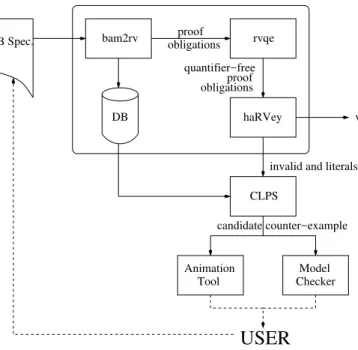
B Spec. bam2rv rvqe
haRVey DB
CLPS
Animation
Tool Checker Model obligations
proof
proof quantifier−free
obligations
valid
invalid and literals
candidate counter−example
USER
Figure 7: The Architecture of our System.
are the tools which are already available. bam2rv15
takes a B abstract machine and returns a set of proof obligations in pure equational first-order logic along the lines of Section 3. rvqe16 is a pre-processor to eliminate the quantifiers from the proof obligations along the lines of Section 4.1. The second and the last authors are also developinghaRVey[10] as a flexi-ble and efficient reasoning module to be used in larger verification tools, as it is the case for the application described here. bam2rvand rvqeare implemented in Java whilehaRVeyis developed in C. The various tools exchange information by using the ATerms data struc-ture.17 Let us briefly analyse the flow of the data in
the architecture. The specification of a B machine annotated with an invariant is given tobam2rv. This
15
http://lifc.univ-fcomte.fr/~giorgett/Rech/Software/ bam2rv/
16
http://lifc.univ-fcomte.fr/~couchot/rvqe
17
http://www.cwi.nl/htbin/sen1/twiki/bin/view/SEN1/ ATermLibrary
discussed here and to detect the invalidity of those generated from some buggy versions.
4.5
Experimental Results
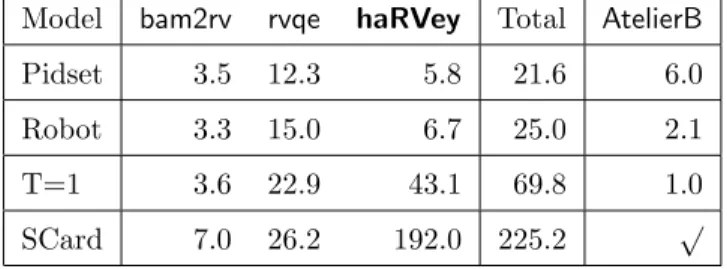
Table 2 presents a comparison of an implementa-tion of our approach withAtelierB.18The first column
(“Model”) lists the identifier of the considered B AMs. The columnshaRVey, bam2rv, and rvqe give the par-tial time spent in each module of the system while the column “Total” lists the total time to prove the in-variant of the machine (which is the sum of the times in the previous three columns). The columnAtelierB gives the time spent by this commercial tool on the various machines.
Four problems have been considered: “Pidset” is the running example used in this paper, “Robot” is a device to move blocks around, “T=1” is a communi-cation protocol between a smart card and its reader, and “SCard” specifies a smart card terminal developed by an industrial partner. The first three problems are small (at most one A4-page) while the last consists of about six A4-pages without comments. We stress here that “SCard” is the perfect example of the kind of specifications our technique has been designed for, i.e. large models with a rich control path (giving rise to a large and complex Boolean structure of the resulting proof obligation obligations) performing operations on relatively simple data structures (which require only selected fragments of set theory, such asSSET, to be specified).
Experience. AtelierB (we have used version 3.6 BOM.1) is one order of magnitude faster than our
18
All the experiments have been run on a Pentium II 250 Mhz running Linux with 128 Mb of RAM. Timings are expressed in seconds.
Model bam2rv rvqe haRVey Total AtelierB
Pidset 3.5 12.3 5.8 21.6 6.0
Robot 3.3 15.0 6.7 25.0 2.1
T=1 3.6 22.9 43.1 69.8 1.0
SCard 7.0 26.2 192.0 225.2 √
Table 2: Experimental results.
fact that for “SCard”, AtelierB generates more than 10,000 formulae (its maximal bound) after about 45 minutes.
We have also built a prototype tool which encodes the proof obligations in the logic of WS1S19so that the
systemMona[13] can be invoked. On “SCard”,Mona runs out of memory after two hours of computation, having built more than 140 automata in memory.
We believe that these preliminary results confirm the viability of our approach.
5
Conclusion and Future Work
We have presented a technique to prove invariants of model-based specifications in a fragment of set the-ory. Proof obligations containing set theory constructs are translated to first-order logic with equality aug-mented with (an extension of) the theory of arrays with extensionality. A theorem proving procedure au-tomating the verification of the proof obligations ob-tained by the translation has also been described. The technique has been implemented and experimental re-sults confirm the viability of our approach.
The lines of future research are essentially fourfold. First, we envisage extending the decidability result for
Ae
s in [3] to the theory BAes considered in this pa-per. Second, we plan to handle a larger number of constructs: on the one hand we will integrate oper-ators as Cartesian product and relations which are commonly used in state-based specifications and, on the other hand, we will add some B syntactic sugar. Third, we want to integrate the CLPS solver in our tool so that meaningful counter-examples can be au-tomatically built from failed proof attempts. Finally,
19
This is possible as observed in Section 3.5.
we plan to apply our technique to a larger number of case studies.
Acknowledgement
We thank Fr´ed´eric Dadeau for his implementation of bam2rv and many useful discussions on the work reported in the paper. We would also like to thank Dominique Cansell and Stephan Merz for useful com-ments on a preliminary version of this paper.
References
[1] J.-R. Abrial. The B-Book: Assigning Programs to Meanings. Cambridge University Press, 1996.
[2] A. Armando, M.P. Bonacina, S. Ranise, M. Rusi-nowitch, and A. K. Sehgal. High-Performance De-duction for Verification: A Case Study in the The-ory of Arrays. InProc. of VERIFY’02 (FLoC’02 Affiliated Wokshop), 2002.
[3] A. Armando, S. Ranise, and M. Rusinowitch. A Rewriting Approach to Satisfiability Procedures. Info. and Comp., 183(2):140–164, June 2003.
[4] J.-P. Bodeveix and M. Filali. Type Synthesis in B and the Translation of B to PVS. In Proc. of ZB 2002, volume 2272 of LNCS, pages 350–369. Springer Verlag, 2002.
[5] F. Bouquet, B. Legeard, and F. Peureux. CLPS-B - A Constraint Solver for B. InInternational Con-ference on Tools and Algorithms for Construction
[6] J. R. B¨uchi. Weak second order arithmetic and finite automata. Zeitschr. f. math. Logik und Grundlagen d. Math., 6:66–92, 1960.
[7] C.-L. Chang and R. C.-T. Lee.Symbolic Logic and Mechanical Theorem Proving. Academic Press, 1973.
[8] M. D’Agostino, D. M. Gabbay, R. Hhnle, and J. Posegga, editors. Handbook of Tableau Meth-ods. Kluwer Ac. Publ., Dordrecht, 1999.
[9] J. Dawes. The VDM-SL Reference Guide. Pit-man, 1991.
[10] D. D´eharbe and S. Ranise. Light-weight theorem proving for debugging and verifying units of code. In International Conference on Software Engi-neering and Formal Methods (SEFM03). IEEE Computer Society Press, 2003.
[11] J. Dick and A. Faivre. Automating the Genera-tion and Sequencing of Test Cases from Model-Based Specifications. In Proc. of FME’93, vol-ume 670 of LNCS, pages 268–284. Springer Ver-lag, 1993.
[12] H. B. Enderton. A Mathematical Introduction to Logic. Ac. Press, Inc., 1972.
[13] J. G. Henriksen, J. L. Jensen, M. E. Jørgensen, N. Klarlund, R. Paige, T. Rauhe, and A. Sand-holm. Mona: Monadic second-order logic in prac-tice. In Proc. of Tools and Algorithms for the Construction and Analysis of Systems, volume 1019 of LNCS, pages 89–110. Springer Verlag, 1996.
[14] M. Leuschel and M. Butler. The ProB Animator and Model Checker for B. InProc. 12th Interna-tional FME Symposium 2003 (FM2003), 2003.
[15] L. Mikhailov and M. Butler. An Approach to Combining B and Alloy. In Proc. of ZB 2002, volume 2272 of LNCS, pages 140–161. Springer Verlag, 2002.
[16] R. Nieuwenhuis and A. Rubio. Paramodulation-based theorem proving. In A. Robinson and A. Voronkov, editors, Hand. of Automated Rea-soning. 2001.
[17] N. Shankar. Little Engines of Proof. In For-mal Methods Europe (FME’02), volume 2391 of LNCS, pages 1–20. Springer-Verlag, 2002.
[18] M. Spivey.The Z Notation: A Reference Manual. Prentice Hall, 2nd edition, 1992.