Structuring Reflective Middleware using Meta-Information Management:
The Meta-ORB Approach and Prototypes
Fábio M. Costa and Bruno da Silva Santos
Instituto de Informática
Universidade Federal de Goiás
Cx. Postal 132, CEP 74001-970 - Goiânia GO - BRAZIL
{fmc | brunosilva }@inf.ufg.br
Abstract
Reflection is now an established technique for achiev-ing dynamic adaptability of middleware platforms. It pro-vides a clean and comprehensive way to access the inter-nals of a platform implementation, allowing its customi-sation in order to achieve the best performance and ad-equacy under given operation environments and user re-quirements. In addition, the use of a runtime component model for the design of the internal platform structure fa-cilitates the identification of the elements to be adapted, as all platform aspects are built in terms of components. The major limitation of this approach, however, is related to the multitude of aspects that make up a middleware platform, together with the requirement of keeping platform consis-tency after adaptations take place. This paper presents the results of ongoing research contributing to reduce this lim-itation. The approach is based on the use of a common meta-model, together with meta-information techniques to provide a uniform way to specify and manipulate platform configurations. Both platform configuration and runtime adaptation are always specified using a small number of building blocks defined in the meta-model. The paper also describes the overall architecture of the Meta-ORB plat-form, which demonstrates this approach, and presents its two implementations: a proof-of-concept prototype writ-ten in Python, and a Java-based implementation aimed at supporting mobile devices. The results are also evaluated from a quantitative perspective, according to the require-ments of multimedia applications, one of the major areas of application of reflective middleware.
Keywords: Reflective middleware, Meta-information
management, Dynamic reconfiguration.
∗This work was partially supported by FUNAPE/UFG and CNPq.
1
Introduction
The Meta-ORB platform is one of the instantiations of the Open-ORB reflective middleware architecture [1]. It is based on an novel approach that seamlessly integrates, through a common meta-modelling architecture, the reflec-tive capabilities of the platform (used for dynamic adapta-tion) and its flexible configuration features [4, 3]. Static configuration is achieved through the use of a well defined component model, which identifies the main constructs available for building the platform. Using this model, cus-tomised instances of the platform can be achieved as con-figurations of interconnected components, each one fulfill-ing a particular functionality of the middleware. Such con-figurations are specified using the concepts and constructs defined by the meta-model, such as components, interfaces and bindings (explicit connections between components). These same concepts are equally used to build the end-user applications that run on top of the platform, thus achieving a uniform programming model that spans both the infras-tructure and the application levels.
Dynamic reconfiguration, on its turn, is achieved through a reflective meta-level architecture, which provides a meta-object protocol (MOP) for inspection and adapta-tion of the structure and behaviour of the platform. In par-ticular, the MOP allows the programmer to discover the interfaces of the components and make dynamic calls to the operations defined on those interfaces. Most impor-tantly, however, is the MOP’s ability to provide a causally-connected representation of the platform’s configuration. This allows the meta-programmer to inspect the configura-tion (in terms of a graph of components) and make changes on it, such as by the addition, removal or replacement of components.
The meta-model of the platform underlies all the above functionality. It is present in the form of meta-information which is distilled from the definitions (using a compo-nent configuration language) of compocompo-nents, interfaces
and bindings. Such meta-information is made available through a repository, which provides component and bind-ing factories with the necessary information to create
spe-cific platform configurations. In addition, the
reposi-tory also feeds the reflective objects with the meta-information required to reify the internal configuration of the platform, in the form of a graph of components inter-connected through their interfaces and bindings. In this way, both configuration and dynamic reconfiguration activ-ities are based upon the same conceptual framework, free-ing the developers from the burden of havfree-ing to learn dif-ferent terminology and concepts for each case.
This paper presents a detailed description of the Meta-ORB approach, focusing on the foundational concepts and their application in the context of a reflective middleware architecture. The paper also describes the two existing im-plementations of this architecture: a Python-based proof-of-concept prototype, and a newer implementation based on Java and aiming at mobile devices. The remaining of the paper is structured as follows. Section 2 introduces the basic concepts of reflection and meta-level architectures, as well as the concept of meta-information management and its application in middleware. Section 3 describes the base-level architecture of Meta-ORB, together with the major elements of its meta-model, while section 4 presents the meta-level architecture and the reflective facilities of the platform. Both sections present useful examples of plat-form configuration and dynamic reconfiguration in order to illustrate the use of such facilities. Section 5 then de-scribes the architecture and implementation of the two ex-isting prototypes, followed by section 6, which presents a performance evaluation of the Python-based prototype. Fi-nally, section 7 discusses relevant related work, and section 8 presents some conclusions of this research.
2
Foundation
2.1
Reflection and meta-level architectures
The fundamentals of reflective computing systems were introduced by B. C. Smith and can be summarised by his reflection hypothesis [31], which argues that a system can be made to manipulate representations of itself in the same way as it manipulates representations of its application do-main. Such a system is said to have a self-representation, which can encompass both its state and behaviour. In ad-dition, if there is a relationship of causal connection [22] between the self-representation and the actual state and be-haviour of the system, meaning that changes in one have corresponding effects in the other, the system is said to be reflective. The self-representation can thus be used for in-spection and adaptation of the system’s internals.
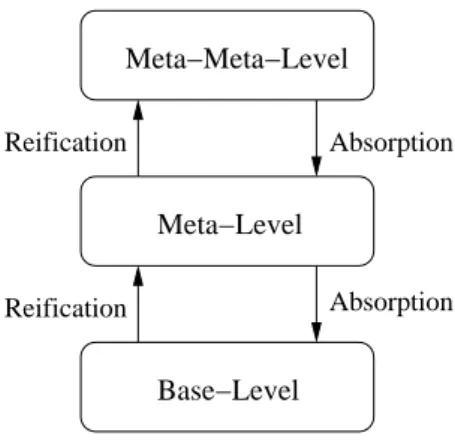
The architecture of a reflective system is usually struc-tured in levels, thus the term meta-level architecture. The bottom level, known as base-level, deals with computation about the domain of application, whereas the levels above it, known as meta-levels, perform computation about the system itself. More precisely, each meta-level is concerned with the representation and manipulation of the level be-low it (which is its relative base-level), giving rise to the notion of a reflective tower of meta-levels, as illustrated in Figure 1. In principle, as with recursive procedures, this tower can have an indefinite number of levels. In practice, however, the use of techniques such as the lazy creation of meta-levels (instantiating them on demand, upon a reifica-tion operareifica-tion) means that typically only a few levels are actually present.
Absorption Absorption Reification
Reification
Base−Level Meta−Level Meta−Meta−Level
Figure 1: Overall architecture of a reflective meta-level system.
As shown in Figure 1, the act of a meta-level exposing the internals of its (relative) base-level is known as reifi-cation. This corresponds to the establishment of an ex-plicit representation of the base-level system and its inter-nal implementation in terms of programming entities that can then be manipulated at runtime. Modifications to this self-representation result in corresponding changes to the reified elements of the base-level, a process known as re-flection or absorption. Given a particular base-level entity, the set of meta-level entities reifying it is know as the en-tity’s meta-space.
2.1.1 Behavioural and structural reflection
data types that are part of the program. On the other hand, behavioural reflection (also referred to as computational re-flection [22]) is the ability of a language to provide a com-plete representation of its own semantics, in terms of the internal mechanisms of its runtime environment (such as method scheduling and dispatching). Note that these two styles of reflection are complementary to each other, with many reflective architectures providing both.
2.1.2 Object-oriented reflection
A well-defined meta-level structure is an important ingre-dient to facilitate the use of a reflective architecture, due to the multitude of aspects that may need to be handled. What is needed is a meta-level that allows each of the concepts of the system to be easily identified, in terms of discrete ele-ments that can be handled separately from each other. The object-oriented paradigm provides a clean way to struc-ture the meta-level. In general, object-orientation allows the partitioning of the reflection mechanisms and interfaces among multiple, distinct, meta-level entities [22]. Regard-ing terminology, in object-oriented reflection, the entities that populate the meta-level are called meta-objects, while those entities at the base-level are known as base-level ob-jects. Thus, while the interfaces of base-level objects pro-vide an object protocol for access to the system’s externally visible functionality, the interfaces of meta-objects provide a meta-object protocol (MOP) [18], which allows reflec-tive access to the internal implementation of the system. Importantly, the same object model should be employed at both base- and meta-level, meaning that reflection can be re-applied at the meta-level itself.
2.2
Meta-information management
Reflective techniques inherently deal with meta-information in order to build the self-representation of base-level entities. Meta-information is kept about the rei-fied aspects of a system, in either explicit or implicit form, as part of the state of the meta-objects. Reflection, how-ever, does not imply a consistent framework for modelling and maintaining meta-information, especially considering issues of sharing and distribution. The provision of such a framework is precisely the goal of meta-information man-agement, and its presence is an important, often overlooked requirement for reflective middleware.
For the purposes of this paper meta-information can be defined as information about the system itself, instead of about the application domain of the system. The struc-tured use of meta-information is typically based on the con-cepts of model and model. Models represent meta-information about the runtime entities that compose a given
system, and may provide enough detail to enable instanti-ation of the system, as well as introspection on its inter-nals. On the other hand, meta-models comprise higher-level meta-information, targeted at the representation of models. A meta-model thus describes the constructs that are available for modelling the entities of a system or ap-plication [9]. This paper is mainly concerned with the man-agement of meta-information at the level of models.
In addition, besides the use of models and meta-models, an effective architecture for the management of meta-information must also provide facilities to assist with [6]:
• meta-information definition, such as with a language
with well-defined syntax and semantics (conforming to the meta-model), as well as tools, such as compil-ers to validate and translate textual meta-information into a machine-readable form; alternatively, interac-tive tools (such as with a GUI) can be used for this purpose;
• meta-information maintenance, with a distributed and
persistent repository with features for creating, delet-ing, managing and manipulating meta-information;
• definition, storage and evaluation of relationships,
such as compatibility and substitutability, between different entities of meta-information; and
• meta-information interchange, based on mappings
and tools to transfer meta-information between dif-ferent repositories, possibly using difdif-ferent meta-models.
A well-known example of a general-purpose meta-information management architecture is the OMG Meta-Object Facility (MOF) [27], which provides a framework for defining and managing models and meta-models, along with the meta-information they comprise. Another exam-ple, although restricted to the CORBA meta-model, is the Interface Repository defined as part of the CORBA speci-fication [28].
2.2.1 Meta-information management for middleware
runtime meta-information describing the types of servers and clients is vital for the dynamic discovery of services, as well as for type checking and bridging of service types before binding [20].
Configuration management, in turn, refers to the activi-ties of building a system from smaller parts in a structured way. This involves the creation, allocation and binding of primitive components in order to form more complex, com-posite components [10]. Explicit meta-information can be used to describe the internal configuration of the compo-nents of a system, in terms of templates with enough de-tail to allow their instantiation. Such templates also serve as runtime documentation of the configuration of a system and its components, thus providing a basis for reconfigu-ration. Using meta-information management techniques, templates can be defined and managed in terms of a meta-model. This enables the association between templates and typing meta-information, which in turn permits the use of type relationships to search and compare configurations, as well as to validate interconnections between the elements of a configuration.
It is therefore important to recognise the role of meta-information management as a principled basis for the defi-nition, instantiation and management of customised mid-dleware platforms. A promising scenario for the future would be the widespread existence of libraries of template and type meta-information describing alternative imple-mentations for the several functional elements of middle-ware, which can then be selected and combined (or even extended) in order to produce platforms that are tailored to particular requirements. It is important, however, that a uniform meta-information management architecture (such as the MOF) is used, so that types and templates can be consistently defined and unambiguously interpreted in the kind of heterogeneous environment typically supported by middleware
3
Core meta-model
Configurations of the Meta-ORB platform are built in terms of a set of building blocks defined according to a well defined meta-model [3]. The major building blocks are components and binding objects. While the former are used for encapsulating local functionality of the platform (or applications), the latter are aimed at realising remote access between components in an explicit way. In addition, all interactions among components and bindings are made via well-defined interfaces. The meta-model definition was inspired by the ISO RM-ODP (Reference Model for Open Distributed Processing) standard [17], with the concept of object replaced with that of a component [35].
Meta-ORB components can be of two kinds: primitive or composite. Primitive components can be seen as en-capsulation of implementation artefacts (such as language-level classes), giving them a higher language-level status, as an entity that can be manipulated and interacted with using the plat-form programming model. Composite components, on the other hand, are more elaborate entities, which are made up with other components, interconnected by their interfaces and forming a component graph, as shown in the examples below.
Following the same idea, binding objects are also clas-sified as primitive and composite. A primitive binding rep-resents an encapsulation of a transport protocol, in order to allow its use according to high-level interfaces that are more tailored to the types of the components connected through the binding. A composite binding, on its turn, is an encapsulation of more elementary binding objects, pro-viding a higher level of abstraction and services on top of them. For instance, as shown in Figure 2, a composite bind-ing for a video streambind-ing application can be composed of a pair of video codecs (one at each side of the binding), which are connected through a primitive binding based on UDP. As the figure shows, another kind of component in a binding are stubs, which are responsible for the adaptation of the services provided by the binding object with respect to the external interfaces it must support. In addition, no-tice that a binding object also has a third interface, which is provided for the purpose of controlling its operation.
Object
Application Application
Video Codec Video Codec
Stub Primitive Binding
Object Control Interface
Stub
Figure 2: Example composite binding object.
Specific types of component and binding objects, as well as their interfaces, are defined using a special object definition language, called Meta-ORB ODL (Object Defi-nition Language) [3]. This is an extension of the standard CORBA 2.2 IDL [26], with constructs for the definition of components and bindings as first-class entities. Compo-nent, interface and binding type definitions are then stored in the type repository [4], which provides runtime access to this meta-information for other parts of the platform. Notably, the instantiation of such objects is performed by component and binding factories, which obtain the appro-priate definitions from the repository in order to create the proper configurations.
descrip-tion. Examples include: media types, constructed types and primitive types. In addition, the meta-model includes
non-type-related meta-model elements. These elements
correspond to the scope-defining constructs of the type sys-tem (e.g., module) and to auxiliary constructs, used in the definition of the first-class meta-types (e.g. operation, flow, signal and QoS annotation). A complete description of the Meta-ORB meta-model is out of scope in this paper and can be found in [3].
3.1
Examples of platform configurations
This section presents a few representative examples that should provide an idea of how the basic meta-model con-structs can be used for building customised platform in-stances. A textual notation is used, based on the Meta-ORB ODL. Typically, the platform designer provides a set of specifications in ODL that define a particular middle-ware configuration. These definitions are stored as meta-information objects in a repository, from where they can later be retrieved and used to instantiate the whole or parts of the middleware configuration. Additionally, meta-information stored in the repository can be re-used as part of newly defined configurations.
In the first example, shown in Figure 3, ODL defini-tions for a composite component are presented. Note that auxiliary definitions have been omitted for brevity (notably those for interfaces, which are based on a multimedia ex-tension to OMG IDL). The last definition specifies a
com-ponent for audio/video processing (AVDeviceComp), which
is composed of three primitive components, also defined in the example. The configuration of the composite compo-nent is specified in terms of its set of internal compocompo-nents, the object graph representing the way such internal com-ponents are connected (adjacent comcom-ponents are linked by means of their interfaces), and the interfaces that the over-all component presents to its users. This example illus-trates how arbitrarily complex units of functionality can be modelled and configured in terms of structured component composition, using primitive components (which encapsu-late binary implementations) and composite components.
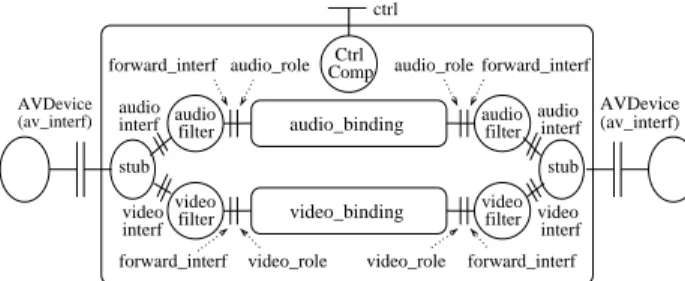
The next example similarly shows how distributed con-figurations can be specified using the binding construct. Figure 4 shows the specification of a complex binding object, aimed at connecting the interfaces of audio/video components of the kind defined above (the structure of the resulting binding is shown in Figure 5). The binding is built out of components and other binding objects (their defini-tions were omitted for brevity) that implement the different elements of middleware functionality, such as stubs, proto-col filters and transport protoproto-cols. The binding definition is given in terms of the type of the binding control inter-face (which exposes functionality to control the operation
module Example{
primitive component AudioDevComp{ implementation: AudioDevImpl; interfaces: AudioDev audio_interf; };
primitive component VideoDevComp{ implementation: VideoDevImpl; interfaces: VideoDev video_interf; };
interface <stream> AVDev: AudioDev, VideoDev{}; primitive component MixerComp{
implementation: MixerCompImpl; interfaces: AudioDev audio_interf;
VideoDev video_interf; AVDev av_interf; };
component AVDevComp{
internal components: AudioDevComp audio_comp; VideoDevComp video_comp; MixerComp mixer_comp; object graph: (audio_comp, audio_interf):
(mixer_comp, audio_interf); (video_comp, video_interf):
(mixer_comp, video_interf); interfaces: AVDevice av is
(mixer_comp, av_interf); };
};
Figure 3: An example specification of a composite compo-nent.
of the binding, such as to pause and resume its operation), the type of the internal binding objects used in the config-uration, and the roles implemented at each of the binding endpoints. In this particular case, a single role is defined, as the binding is symmetrical (i.e., both its endpoints are meant to connect interfaces of the same type and with the same semantics). The definition of the binding role is sim-ilar to a composite component definition, except for the cardinality part, which specifies the maximum number of endpoints conforming to the role that can be created in a given binding instance (this means that multi-point bind-ings are supported). In addition, the definition of a binding role configuration (i.e., its object graph) must also specify the connection points between the binding’s components and the appropriate roles of its internal bindings.
4
Reflective meta-level
meta-module Example{ binding AVBinding{
control interfaces: CtrlInterf ctrl is
(CtrlComp, ctrl_interf); internal bindings: AudioBinding audio_binding; VideoBinding video_binding; role AVBindingPartic{
components: AVStubComp stub;
AudioFilterComp audio_filter; VideoFilterComp video_filter; target interface: AVDevice is
(stub, av_interf); cardinality: 2;
configuration:
(stub, audio_interf):
(audio_filter, audio_interf); (stub, video_interf):
(video_filter, video_interf); (audio_filter, forward_interf):
(audio_binding, audio_role); (video_filter, forward_interf):
(video_binding, video_role); };
}; };
Figure 4: An example specification of a composite binding.
information elements. Reflection thus requires some means to manipulate such meta-information at runtime, in a way that is causally connected with the respective instances of platform configuration. This is the role of the reflective meta-level, which completes the architecture.
Reflection in Meta-ORB can be used for dynamic in-spection and adaptation in the context of both platform and application elements. To this end, the design of the meta-level follows the principles of the Open ORB reflec-tive middleware architecture [1], as discussed below.
The meta-object protocol (MOP) is realised in terms of the interfaces of components that play the role of
meta-ctrl
Comp Ctrl
filter filter
forward_interf filter
AVDevice (av_interf)
video interf interf audio interf
video_role video_role forward_interf audio
video
audio filter
video stub stub
video_binding audio_binding
AVDevice (av_interf)
interf video
audio
audio_role forward_interf audio_role
forward_interf
Figure 5: Composite binding for audio-video interaction (as described in Figure 4).
objects. In addition, the base-level is similarly structured in terms of objects, meaning that meta-objects are used to reify components, binding objects and interfaces. Impor-tantly, in the Meta-ORB approach the state of meta-objects must always have a direct correspondence with the meta-information elements that describe their respective base-level objects. In practice, such meta-information is used, during the reification process, as the basis for initialising the state of meta-objects.
In addition, considering the multitude of aspects that must be reified in reflective middleware, the meta-space is partitioned into a number of independent meta-space models. The approach is similar to the multi-model re-flection framework introduced by [25]. Each separate con-cern of the meta-level is defined in terms of a meta-space model, which represents the structure and functionality for the reification of a base-level object according to that as-pect. Figure 6 illustrates the concept of using distinct meta-objects (each one corresponding to a different meta-space model) to reify a given base-level object.
Interface Interface
Discovery Architecture Resources
Base−level
Interception
Object
Meta−Level
Base−Level
Figure 6: The meta-space reifying a base-level object.
Currently, five meta-space models are specified, with
well-defined abstract design and semantics. The
meta-space models are categorised according to the usual dis-tinction between behavioural and structural reflection [38]. The behavioural part of the meta-space consists of two meta-space models: Resources and Interception. These are however out of scope in this paper, so we will not further refer to them. Structural reflection, on its hand, is the fo-cus of the prototype and is represented by three distinct
meta-space models: Interface Discovery(which reifies the
set of interfaces supported by a component or binding ob-ject),Interface(which reifies the constitution of a particu-lar interface, in terms of the operations, flows or signals it provides)1, andArchitecture(which reifies the internal con-figuration of a component or binding object, in terms of an object graph representing its internal components and the
1In other implementations of the general OpenORB framework, these
way they are connected). These three meta-space models are designed so as to be independent of each other with re-gard to adaptation. This basically means that changes in the configuration of an object effected through theArchitecture meta-space model need to respect the types of the inter-faces involved. For instance, if a component is replaced by another, the substitute must provide the same interfaces of the replaced component (or interfaces derived from sub-types of the original interface sub-types).
4.1
Examples of adaptation
The current version of Meta-ORB is focused on struc-tural reflection, based on theInterface Discovery,Interface, andArchitecture meta-space models. However, only the latter is meant for adaptation, whereas the former two are meant for inspection only (i.e., to discover the services pro-vided by a component, in terms of interfaces and their op-erations). The reason for this is to avoid possible incom-patibilities (at the level of local bindings) that may arise from the addition or removal of interactions and interfaces. In future versions, this restriction may be removed with the adoption of rules (such as subtype-based evolution) to constrain the adaptations made via these two meta-space models.
Adaptation according to the Architecture meta-space
model is achieved through the manipulation of the object graph that represents the configuration of a given plat-form element. The meta-object protocol associated with this meta-space model offers operations for inspecting the structure of a configuration, as well as for changing it, by adding, removing or replacing components. For instance, in a binding configuration, such as the one specified in Fig-ure 4, if the available bandwidth of the underlying network suffers a drop, it may become impossible to sustain the pre-viously agreed quality of service. Under the circumstances of rigid middleware infrastructures, such as with conven-tional middleware, this would typically mean that the bind-ing should be torn down. On the other hand, in the
Meta-ORB reflective middleware, the Architecturemeta-object
may help overcome the problem in a more satisfactory way. The solution could involve selecting an alternative video encoding method with lower bandwidth requirements, as well as a component type (defined in the meta-information
repository) that implements it. The Architecture
meta-object can then be used to replace the current video codec components (at each of the binding endpoints) with com-ponents of the selected type, without disrupting the overall service (although the user might experience some down-grading of the video output quality, due to the change of encoding). The code for implementing such reconfigura-tion, in Python, is shown in Figure 7.
The bottom line for using reflection in such a way is
import MetaORB
# Obtain a reference to the Architecture # meta-object.
arch_mobj = MetaORB.get_arch_mobj(
bind_ctrl.get_binding_name())
# Obtain the type of the new component from # the Type Repository
type_of_new_comp = MetaORB.TypeRep.lookup_name( ‘LowBandwidthVideoFilter’, dk_Binding)
# Pause the binding, so that reconfiguration can # take place without affecting its consistency bind_ctrl.pause()
# Invoke the appropriate operation of the # Architecture MOP to replace all occurrences of # the old video filter component (in all binding # endpoints conforming to the AVBindingPartic # role) with components instantiated from the # new component type.
arch_mobj.role_replace_component(AVBindingPartic, video_filter, type_of_new_comp) # Resume normal binding operation
bind_ctrl.resume()
Figure 7: Example script for dynamic binding reconfigura-tion.
therefore the convenience of making runtime structural changes to an application or to the underlying platform. In addition to smoothing the change process (by preserv-ing continuous availability of the adapted service), this ap-proach also enables a simplification of the process of sys-tem evolution, as changes can be made in a localised way, without affecting the whole system.
4.2
Combining reflection and meta-information
management
constructs prescribed in that version of CORBA are also supported.
According to the usual functionality of a meta-information facility ([6]), the repository provides functions for registering new types, for checking type compatibility, and for the lookup and browsing of existing types. All these functions are meant (though not necessarily) to be auto-matically generated, based on the description of the meta-model, using MOF-related tools.
All configuration and reconfiguration facilities depend upon these meta-information management features. For in-stance, in order to create a platform configuration (e.g., a set of components and binding objects), the object factories need to obtain the right type definitions from the reposi-tory. In addition, the structural reflection features need to obtain meta-information describing the (type of the) base-level object, so that it can be properly reified.
However, a more subtle relationship between the meta-information management and reflection facilities may arise due to the fact that reification is strongly based on meta-information from the repository. An important requirement of every reflective system is that the self-representation maintained by a meta-object is always consistent with the type of its base-level object. However, as a result of succes-sive adaptations, the configuration of the base-level object (and thus its self-representation) becomes different from that specified in the type. To solve this apparent contradic-tion, Meta-ORB adopts an approach based on type evolu-tion [4], which means that the type of an object is changed (into a new version of the original type) once the object is subject to adaptation. However, the new type is only pub-lished in the repository when the base-level object becomes stable (i.e., no further adaptations are envisaged) and the meta-object is explicitly asked to do so (until then, a pri-vate copy of the type is kept in the meta-object). As an interesting consequence, the approach enables new com-ponent and binding types to be derived as a result of reflec-tive adaptations. Such new types (once published) can be used to create objects that contain, from scratch, the results of previous adaptation efforts. Another consequence of us-ing type evolution is the possibility to constrain adaptations based on type relationship rules, so that a dynamically cre-ated new type does not contradict the properties of the type used to derive it. This is important to keep compatibility with existing clients of an adapted object. Currently, we support subtyping as a type evolution rule, so that the new type must be a subtype (i.e., present all the interfaces) of the original type. The investigation of this approach as a way to check more global properties of the system remains an issue for future work.
5
Implementation
5.1
Python-based prototype
A prototype implementation of the Meta-ORB architec-ture has been developed with the goal of demonstrating its feasibility and applicability. The focus of this work was on the functionality and the qualities of the architecture, rather than performance. This is reflected on the chosen imple-mentation environment, based on the Python programming language [36], which favours rapid prototyping instead. Despite this, experiments have shown that the performance of the prototype is appropriate for simple multimedia ap-plications [3]. In addition, by implementing the prototype purely in Python, portability to a variety of operating sys-tems is guaranteed, which was also a factor when choosing the language. The implementation is structured in three main modules, according to the abstract design discussed in section 5. These modules are briefly described below.
5.1.1 Platform Core
This module implements the core features that are nec-essary to support the Meta-ORB programming model. Specifically, it contains the basic distribution infrastruc-ture, with naming and capsule management services, as well as the primitive constructs to support the meta-model, such as interface references and local bindings (which are links between the interfaces of locally connected compo-nents). In addition, this module defines the runtime repre-sentation for the first-class constructs of the programming model: interfaces, components and binding objects. In par-ticular, regarding the latter, the implementation encourages the use of the General Inter-ORB Protocol (GIOP) as the basis for communication between the components of bind-ing objects. This is on the way of providbind-ing interoperability with CORBA, though further work is still needed (e.g., to use interface references that are compatible with the IOR standard). Finally, higher-level services are also defined in this module, notably component and binding factories, which are the entities responsible for the instantiation of components and binding objects based on specified type meta-information.
5.1.2 Type Repository
replica-tion of the repository, in order to increase performance when accessing type definitions. Persistence of type def-initions is achieved through their simple serialisation and storage in the local file system of each repository replica (use of a database system is considered for future devel-opment). Creation of new type definitions, in turn, is per-formed through a master-slave collaboration between the repository replicas, where the master is the replica that re-ceives and processes a given type creation request, propa-gating the new type definition to the slave replicas. Type versions are created in a similar way, though there is a cen-tralised manager responsible for generating unique version numbers. Note that because type definitions (once stored in the repository) are immutable, the problem of keeping consistency among the replicas can be solved quite sim-ply. The solution is based on the reliable distribution of newly created types to all replicas and on the uniqueness of type names and version numbers (which is guaranteed by the central manager). Finally, the Type Repository module also introduces tools to facilitate the definition and manip-ulation of meta-information, such as a GUI-based browser, used to specify, edit, publish and search for type defini-tions.
5.1.3 Meta-level
This module corresponds to the mechanisms and facilities for structural reflection provided by the platform. It fol-lows the framework described in section 4, with the de-sign defined in terms of the constructs of the programming model. Thus, meta-objects are themselves components, and are created and managed using the services provided by the Platform Core and Type Repository modules. The overall approach is to provide a default design and imple-mentation, with meta-object types that offer a representa-tive meta-object protocol. This design can then be extended with new meta-object types, either through static type defi-nition, or through reflection (i.e., using meta-meta-objects) and type evolution. The precise meta-object protocols cur-rently implemented are described in [3].
The implementation of theInterfaceandInterface Dis-coverymeta-objects is straightforward, as they simply pro-vide a convenient way to access type meta-information about the base-level objects. Their use is preferred instead of direct access to the respective types in the repository, as they should provide up-to-date type meta-information (considering any previous adaptations and evolution of the type).
Architecture meta-objects, on the other hand, have a more complex implementation, as they also provide for adaptation. This means that causal connection must be ex-plicitly maintained, which is achieved by allowing meta-objects to directly manipulate the runtime representation
of their respective base-level objects, such as by creating and deleting componets, and disconnecting and reconnect-ing local bindreconnect-ings between their interfaces. In this way, meta-objects can perform the absorption of reflective com-putation (see Figure 1).
5.2
Java-based prototype
The first prototype, described above, was mainly aimed at demonstrating the concepts introduced in the Meta-ORB architecture. Current activity in the project is now target-ing the development of a fully functional Java version of the platform, aimed at portability across a range of dif-ferent platforms, as well as better performance. The fo-cus is on exploring the dynamic adaptation facilities of Meta-ORB in mobile computing environments, especially involving handheld devices such as palmtops and mobile phones. This has led to the adoption of J2ME [34], accord-ing to the CLDC configuration [32] and the MIDP profile [33], as the main runtime environment. As a result, seam-less portability and a smaller footprint of the runtime were naturally achieved, enabling the new version to run on a variety of devices.
An effort was made to retain total compatibility with the previous version, including the programming model and runtime data representation, thus enabling interoper-ability. However, due to the limitations of J2ME, a num-ber of adaptations were needed in the core architecture. In particular, the use of version 1.0 of MIDP restricted us to HTTP as the sole communication protocol. This means that all primitive and implicit bindings are based on this protocol, having to provide all their features through con-ventional HTTP request/reply text-based messages, which may affect interaction performance. We expect to remove this constraint as implementations of the latest version of MIDP (2.0) become available, enabling the use of more capable datagram and socket-based connections. Another limitation of J2ME that has influenced the implementation was the lack of native reflection support (as available in the conventional Java Class Library). In particular, it is not possible to make dynamic method calls, which has com-promised the flexibility of local bindings (connections be-tween local interfaces) in the platform. As a result, the run-time representation of a component’s interface (in terms of a Java class) has to be generated specifically for the partic-ular interface type, as opposed to the generic, interface-independent, counterpart in the Python prototype. Note however, that this limitation is not related to the implemen-tation of the reflection mechanisms of the platform, which are completely independent of the reflective features of a particular programming language.
battery, have led to the need to save as much resources as possible in this implementation. As a result, only the plat-form core was ported, consisting of the runtime infrastruc-ture (capsule, local name server, component and binding factories, and implicit binding support). Some features, notably the Type Repository, were kept from the previous version (with some adaptations, discussed below, to enable the Python-Java interoperability), whereas others, such as the naming service, where implemented in the more capa-ble J2SE platform. In what follows, a high level description of the architecture of the prototype is presented.
5.2.1 Architecture
As stated above, under CLDC/MIDP1.0, all networking has to be done through HTTP. Furthermore, only the client part of this protocol is implemented, meaning that a J2ME device cannot be the target of interactions (e.g., to receive requests). These two limitations have posed the need for a proxy-based architecture, where each J2ME device partic-ipating in the distributed environment of Meta-ORB must have a representative object residing in a more capable de-vice located elsewhere (e.g., in the fixed network), which is able to receive interactions from clients (or media produc-ers) and redirect them to the target object in the device. The overall architecture is illustrated in Figure 8, which shows the major elements involved in a platform infrastructure, along with the several possibilities of runtime environment (mainly J2ME and J2SE in this case).
As the figure shows, access to the Type Repository (in Python) is achieved through a servlet that redirects HTTP requests as appropriately formatted sockets-based messages to the closest Type Repository server. The re-quested type definitions are formatted as text-based mes-sages before returning them to the caller. A similar ap-proach is used for access to the global name server.
Figure 8 also illustrates access to component interfaces through implicit binding. This is achieved using a proxy-based approach, in a way similar to the Middleman archi-tecture proposed in [23]. For each J2ME-based capsule, there is a proxy in charge of receiving and processing re-quests directed to interfaces located in that specific capsule, as well as handling the replies back. This proxy is created by the capsule manager at the same time as the capsule itself, by using a well-known configuration service
(Con-figServer).2Communication between clients and the proxy
can be either through HTTP (in the case of J2ME clients) or object requests (in the case of J2SE clients). Commu-nication between the proxy and the target interface in the J2ME capsule is always based on HTTP, by superimposing
2Although not shown in the figure, the ConfigServer need not be in the
same capsule as the proxy.
an object request protocol on top of it. As J2ME-based ob-jects (midlets) can only act as clients, requests directed to them have to be conveyed within normal HTTP reply mes-sages. Such communication is based on a polling scheme, where the communications server object (CommsServer) residing in the J2ME capsule sends HTTP requests to the port associated with the proxy and waits for replies con-taining proper object requests. In other words, there is an inversion of the client and server roles.
As an example of this kind of interaction, consider the access to the (server) interfaces of component and bind-ing factories in order to request the creation of components or the establishment of (explicit) bindings. In this exam-ple, the CommsServer object would poll (using an HTTP request message) the Proxy for newly arrived object re-quests. Such requests would be sent to the CommsServer in an HTTP reply message, which would then be parsed by the CommsServer in order to generate the appropriate local calls to the interfaces of the target components (in the ex-ample, the component factory or the binding factory com-ponents). The reply for an object request would be sent by the CommsServer to the Proxy via an HTTP request mes-sage. The Proxy would then handle the reply to the actual client in an appropriate way.
Finally, the figure also shows an explicit binding object connecting the interfaces of two remote components. Al-though not shown, the internal implementation of the bind-ing (more precisely, the primitive bindbind-ing inside of it), is based on a similar proxy mechanism as described above. In particular, the stub component at the J2ME side of the bind-ing is a dedicated version of the communications server, while the stub at the other side takes the role of the (ded-icated) proxy. In case both endpoints are based on J2ME capsules, we need an intermediate proxy (located in a J2SE capsule) to handle the HTTP request/reply messages prop-erly.
5.2.2 Ongoing work
The above description corresponds to a lightweight ver-sion of the Meta-ORB base-level architecture. It fulfils the major elements of the core meta-model and enables the development of applications targeting mobile devices. In particular, all the facilities for flexible platform config-uration are present under the headings of the component and binding factories, which take object definitions from the Type Repository and perform the instantiation of cus-tomised platform configurations.
resource-TRServlet
Global nameserver
Type Repository
Local
nameserver App Object
Factory Component
Binding Factory
CommsServer
obj. App
Client App ConfigServer
(servlet) Proxy
object request Capsule
manager
J2SE Python J2SE/J2EE
J2ME/J2SE
J2EE
J2ME
HTTP
HTTP
Distributed Explicit Binding (on top of HTTP)
socket socket
Comms Server
Object App
J2ME
J2SE HTTP
Figure 8: Overall architecture of the Java-based Meta-ORB prototype.
constrained environment, which provides the most interest-ing requirements for this kind of capability.
6
Performance evaluation
In this section we present a detailed performance evalu-ation of the Meta-ORB Python-based prototype according to three aspects: static configuration, interaction, and re-flective reconfiguration. This is provided with a note of
caution, due to the interpreted nature of Python.3
How-ever, the aim is to highlight the relative overhead compared with non-reflective platforms and with the demands of dis-tributed multimedia. Indeed, the results are quite encourag-ing, giving a rough indication of the level of performance that can be achieved in more efficient language environ-ments.
All experiments were conducted on a 10Mbps Ether-net LAN, using identical Pentium III 800MHz PCs with 256MB RAM, running Windows 2000 and Python 2.1. All measurements were taken using the clock function of the standard Python library, with several runs and averaging to smooth the effects of non-determinism introduced by the OS scheduler and network.
6.1
Static configuration performance
As particular instances of the platform are made up with component and binding objects, an evaluation of their in-stantiation performance is crucial to understand the cost of establishing complete platform infrastructures.
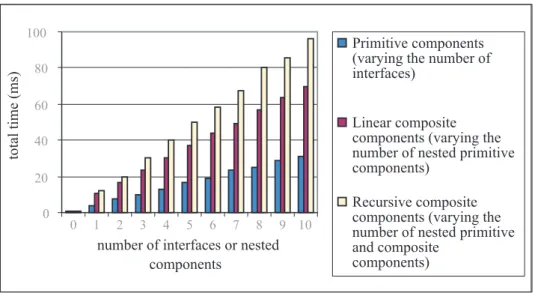
The cost of component instantiation is shown in Fig-ure 9 for three representative cases: primitive components
3A corresponding evaluation of the Java-based implementation is the
subject of ongoing work.
with a varying number of interfaces, composite nents made up with flat compositions of primitive nents, and composite components with a recursive compo-sition pattern (i.e., hierarchically nested components). As can be seen, the cost scales up linearly with the compo-nent’s complexity. The graph also gives a rough idea about the cost incurred by other component configurations (e.g., the instantiation of a flat composite component with five in-ternal primitive components and three interfaces will cost approximately 48ms – 38ms for the composition plus 10ms for its three interfaces).
The next experiment shows the performance and scal-ability of binding instantiation. It considers multi-point bindings with up to six endpoints, each one located in a different machine and consisting of a stub and the endpoint of a primitive binding. The use of such minimal bindings is so that the inherent cost of instantiating distributed ings is made more evident (the cost of more complex bind-ings would be the sum of the cost of a simple binding plus that of their internal components).
Given the distributed nature of the binding protocol, where binding endpoints are created in parallel by different local binding factories (see [3]), the impact of the number of endpoints is made less significant. The increases shown in Figure 10 are mainly due to the additional processing performed by the primary binding factory (which coordi-nates the whole process) to stich the several endpoints to-gether. Nevertheless, the results seem to suggest that such increases tend to attenuate as the number of binding end-points grow.
6.2
Interaction performance
Figure 9: Cost of component instantiation.
Figure 10: Cost of binding instantiation.
Fnorb [13], a CORBA-compliant middleware platform; and minimal implementations based on TCP/UDP sockets (in order to highlight the overhead introduced by the Meta-ORB programming model). All experiments use the same binding configuration as above, though with only two end-points.
6.2.1 End-to-end delay
The first experiment, shown in Figure 11, illustrates, in log-arithmic scale, the round trip delay for request-reply inter-action. The comparison with TCP-based sockets shows an overhead of about 30% for small interactions (up to 128 bytes), although the overhead decreases for larger inter-actions (above 4KB, it does not exceed 10%). This extra cost can be explained by the higher level of abstraction of the Meta-ORB programming model. The complementary
analysis shows that the Meta-ORB framework can be used to achieve superior performance in comparison with Fnorb (which is at least about 5ms slower in all cases). In part, this is due to the extra processing performed on an invo-cation by Fnorb, such as marshaling/unmarshaling, which is significantly more generic than in our prototype. This demonstrates that reflective middleware can achieve better performance by removing unnecessary overhead.
Figure 11: Round trip delay for request-reply interaction in a distributed binding.
An analysis of the end-to-end delay of stream interac-tions, comparing a Meta-ORB binding with UDP sockets, is shown in Figure 12 (a comparison with Fnorb does not apply, as it does not have support for streams). The delay is estimated by halving the round-trip time.
mul-timedia applications (maximum of 250ms for both audio and video, according to [16]), these figures seem appropri-ate, especially considering frames of moderate sizes (up to 8KB). However, the extra cost of processing complex me-dia in the binding should also be taken into account, sug-gesting that such functionality should be implemented in C/C++ and integrated into the platform using Python’s ex-tension facilities [37].
Figure 12: End-to-end delay of stream interaction.
6.2.2 Throughput
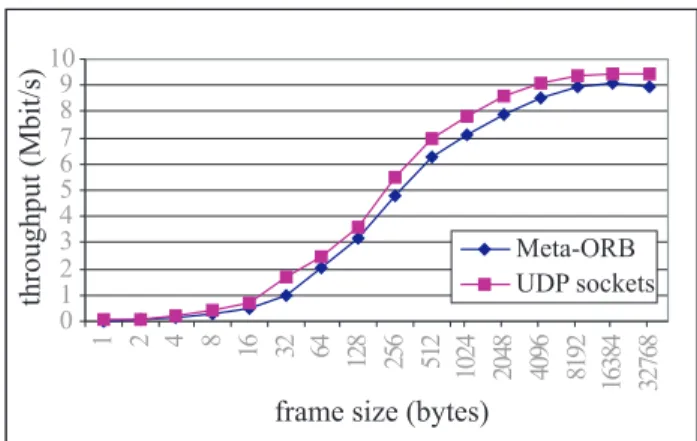
Figure 13 shows the result of an experiment measuring the user-level throughput of a stream binding on a lightly loaded network, along with a comparison with UDP sock-ets. As the graph shows, for frame sizes over 32 bytes, the absolute difference in achievable throughput is nearly con-stant (300-700 Kbits/s). In relative terms, the throughput of a Meta-ORB binding is only 10 percent lower for frame sizes over 512 bytes. This lower throughput is a result of the high-level programming model of Meta-ORB, showing a tradeoff between programmability and raw performance. Finally, to put the figures in perspective, they can also be compared with the typical requirements of continuous media. In particular, for audio streams, the throughput is clearly suitable. For video streams, however, it can be less than adequate. Nevertheless, considering the requirements of compressed TV-quality video (2-10Mbit/s), as well as the use of larger (over 512 bytes) frame sizes, reasonable results may be achieved.
6.3
Reflection performance
6.3.1 Meta-object instantiation
The performance of reification is examined here using sev-eral experiments that illustrate the creation of meta-objects according to the three structural meta-space models de-scribed earlier.
Figure 13: Composite binding throughput.
The time required to createInterface Discovery
meta-objects is independent of the particular base-level object to be reified, being around 8.8ms for components and 9.8ms for bindings. Similarly, forInterfacemeta-objects, reifica-tion time is independent of the particular interface, and was about 9.5ms.
On the other hand, forArchitecturemeta-objects, perfor-mance depends on the complexity of the particular base-level object. Two experiments were chosen to show the scalability of architecture reification: firstly, for compos-ite components, using linear composition and a varying number of nested components; and secondly, for binding objects with an increasing number of endpoints (with the simple binding configuration described in 6.1).
The results have shown that reification time is linearly proportional to the number of features present in the base-level object. For components with one internal component, reification takes 10.6ms, with each extra internal compo-nent adding up about 0.4ms (e.g., reifying a compocompo-nent with 5 internal components would take 12.6ms). For bind-ing objects, both the number of internal components and binding endpoints influence reification time. We observed that for simple bindings with two endpoints, architectural reification takes about 19.9ms, with each extra endpoint adding up about 0.2ms.
These figures indicate that meta-objects should ideally be created in advance of the need for reflection, especially in the case ofArchitecturemeta-objects and in time-critical applications. Once meta-objects are created, though, their access time is less significant.
6.3.2 Adaptation performance
cur-rent implementation, three experiments were run, using the most common adaptation operations. In order to isolate the inherent cost of reflective adaptation, all components involved in the adaptations are primitive. (Adaptations in-volving complex, composite, components would have the added costs incurred in the instantiation of the component’s internal configuration.) The results, for binding adaptation, are as follows: inserting a new component takes 37.5ms, while component removal takes 44ms and component re-placement takes about 90ms. Adaptation of components, in turn, require slightly lower times, as both base- and meta-objects would always be local to each other.
Considering the typical requirements of continuous me-dia, in particular the short inter-frame intervals for audio and video streams, the above results seem to suggest a need for more efficient meta-object implementations, e.g., in C or C++, in order to reduce the possibility of frame loss or even to schedule a given adaptation in between frame ar-rivals.
7
Related work
In the context of the Open ORB architecture, several prototypes have been implemented, each exploring a dif-ferent aspect of the architecture. In particular, the Open-COM runtime component model, together with the ReM-MoC middleware built on top of it [15, 2], strive for ef-ficiency of implementation and memory footprint. This platform was written in C++, which, besides being an ef-ficient compiled language, allows access to low-level fea-tures (such as virtual pointer tables), which greatly opti-mise performance. The performance of this platform has been shown to be on a par with non-reflective middleware, with the added benefit of further optimisations that can be achieved with the very use of reflective adaptation [5]. Our approach has several similarities with this work, especially the use of reflection for platform optimisation. However, the aim here was to highlight the benefits of the combined use of meta-information management, also showing that it does not impose considerable overhead.
Another relevant outcome of the Open ORB project was the FORMAware framework, aimed at the management of adaptation in component architectures [7]. The approach is based on software architectures as a way to fully de-scribe configurations of components, together with con-straints that specify the criteria for validating reconfigura-tions. For dynamic reconfiguration, a comprehensive meta-object protocol is provided, which enables the handling of all aspects of an architecture. We note that such an ap-proach can conceptually complement our architecture,
fit-ting into the scope of theArchitecturemeta-space model.
In addition, our approach towards the integration of reflec-tion and meta-informareflec-tion management can further lever-age the idea of architecture adaptation, especially regarding the seamless integration of configuration and reconfigura-tion, as well as the notion of type evolution discussed in 4.2, which could use architectural constraints as a basis to validate adaptations.
Outside the scope of Open ORB, other projects have also adopted reflection as a principled way to build flexi-ble middleware platforms, though following different ap-proaches. OpenCORBA [21], for instance, is a reflective implementation of CORBA based on the meta-class ap-proach and on the idea of modifying the behaviour of a middleware service by replacing the meta-class of the class defining that service. This is mainly used to dynamically adapt the behaviour of remote invocations, by applying the above idea to the classes of stubs and skeletons. The use of meta-classes, however, has the consequence of making such adaptations reflect on all instances of a class. In con-trast, in Meta-ORB reflection is based on per-object meta-objects, enabling to isolate the effects of reflection (so that other objects are not affected when reflection is used to al-ter a particular object). In reflective middleware, this is a desirable property as the components of a middleware system tend to be fairly independent of each other (even though they might have the same class).
DynamicTAO [8] is another representative reflective middleware architecture. It is based on an extension of the TAO ORB [30] with the concept of architectural aware-ness, making explicit the architectural structure of a system in a causally connected way. Middleware configurations are defined in terms of prerequisite specifications, which represent the components of the platform and the depen-dencies among them. These specifications are used by an automatic configuration service to instantiate the platform components and the components on which they depend. At runtime, such prerequisites are managed by component configurators, which are in charge of keeping the consis-tency of dependencies as new components are added or re-moved from the system. This approach is similar to the use of architectural reflection in Meta-ORB, with the added value of dependency management. However, dynamicTAO restricts the use of reflection to coarse-grained components, limiting its applicability to control more detailed structures of the platform.
comput-ing. Their approach is based on a set of abstract classes and interfaces describing general middleware functional-ity, which can be specialised to produce particular kinds of middleware. One such example is the use of the framework to build an object-oriented middleware for J2ME-enabled devices. Their approach thus differs from ours in the way middleware configurations are specified, which in our case is based on an object definition language. However, in the same way as FORMAware, we can conceive an integration of the two approaches, using frameworks as a way to con-strain configuration definitions. Another important differ-ence, however, is the absence of support for runtime reflec-tion and dynamic reconfigurareflec-tion in Arcademis, although such support could possibly be developed following our overall approach and having a runtime representation of the underlying component framework.
Regarding the management of meta-information, al-though all reflective middleware architectures (such as the ones discussed above) deal with meta-information in one way or another, the treatment is typically ad hoc. On the other hand, the isolated use of meta-information manage-ment in middleware, notably for type managemanage-ment pur-poses has been proposed in the literature (such as in [11]). To our knowledge, however, Meta-ORB is the first mid-dleware architecture to integrate a comprehensive and per-vasive framework for meta-information management with a principled reflective meta-level. This has the benefit of unifying the use of meta-information in the system (e.g., preventing that different meta-object implementations use different meta-level representations), as well as providing a basis to closely integrate the configuration and adaptation features of the platform.
Finally, we also mention the efforts in the area of aspect-oriented programming (AOP) [19], which is similar to re-flection in the sense that it is also a technique to enable separation of concerns in systems such as middleware. The original proposals of AOP were targeted at static aspects, which are combined by the weaving process andthus made unavailable at runtime. There is however a number of research efforts in the direction of dynamic aspects [12], which preserve the distinction among the aspects of a sys-tem at runtime, enabling new aspects to be added and old ones to be removed or replaced. We consider reflection and AOP complementary techniques, as reflection (and meta-object protocols) can be used as the mechanism enabling the dynamic manipulation of aspects. In this sense, aspects can be seen as another approach to structure the middle-ware system, in a way that is orthogonal to the way compo-nent composition is used in our approach. Further investi-gation about this combined use of aspects, components and reflection in Meta-ORB remains an issue for future work.
8
Concluding remarks
This paper has presented Meta-ORB, a reflective mid-dleware platform based on a combination of a meta-level architecture with meta-information management concepts. The overall aim of the research is to develop an approach that permits the integration of configuration and reconfig-uration facilities in a highly flexible middleware architec-ture. The foundation concepts used in the research have been surveyed, together with their application in the con-text of middleware. The paper discussed the architecture of the platform, together with its two implementations, a Python-based proof-of-concept prototype, and a Java-based implementation, which is currently under develop-ment and targets wireless mobile devices. The paper also presents an evaluation of the approach based on the first prototype.
The work has enabled us to draw some important con-clusions about the design and implementation of adap-tive middleware platforms. The most important of such conclusions is related to the benefits of an integrated ap-proach combining runtime reflection an explicit runtime meta-model representation of the platform. This enables the use of the same set of abstractions for configuring a platform from scratch and for adapting it at runtime, re-lieving the user from the need to learn a different set of concepts and tools. In addition, the concept of type evo-lution has shown to be an important step towards enhanc-ing the process of developenhanc-ing customised middleware, as new versions of a platform configuration can be produced at runtime, by successive adaptations in order to match real operation scenarios. The most promising versions can then be turned into proper configuration definitions and stored in the Type Repository for later use in order to reproduce the successful evolved configurations in other contexts. We be-lieve this is a promising approach to software development in general, and to adaptive middleware in particular.
program-ming model itself. Future work will investigate the above argument with the development of primitive components and component factories implemented in C++, in order to verify if the related performance impact is significant. Ongoing work is also investigating the performance of the platform in environments with more limited resources available, notably comprising the J2ME-based prototype in handheld computers connected by wireless LANs.
References
[1] Gordon S. Blair, Fábio M. Costa, Katia Saikoski, and Nikos Parlavantzas Hector Duran Mike Clarke. The design and implementation of Open ORB version 2. IEEE Distributed Systems Online Journal, 2(6), 2001.
[2] Mike Clarke, Gordon S. Blair, and Geoff
Coul-son. An efficient component model for the
con-struction of adaptive middleware. In Proceedings
of the IFIP/ACM International Middleware Con-ference (Middleware’2001), Heidelberg, Germany, 2001. Springer-Verlag.
[3] Fábio M. Costa. Combining Meta-Information
Management and Reflection in an
Architec-ture for Configurable and Reconfigurable
Middleware. Ph.D. thesis, University of
Lancaster, Lancaster, UK, September 2001.
http://www.comp.lancs.ac.uk/computing/users/ fmc/pubs/thesis.pdf.
[4] Fábio M. Costa and Gordon S. Blair.
Integrat-ing reflection and meta-information management in
middleware. In Proceedings of the International
Symposium on Distributed Objects and Applications (DOA’00), Antwerp, Belgium, 2000. IEEE, IEEE.
[5] Geoff Coulson, Gordon S. Blair, and Paul Grace. On the performance of reflective systems software. In Proceedings of the International Workshop on Middleware Performance (IWMP’04), Phoenix, AZ, April 2004. IEEE Computer Society.
[6] Steve Crawley, S. Davies, Jaga Indulska, Simon
McBride, and Kery Raymond. Meta-information
management. In Proceedings of the 2nd IFIP
In-ternational Conference on Formal Methods for Open Object-based Distributed Systems (FMOODS’97), Canterbury, UK, 1997. IFIP.
[7] Rui Jorge da Silva Moreira. FORMAware: Frame-work Of Reflective components for Managing archi-tecture Adaptation. Ph.d. thesis, Computing Depart-ment, Lancaster University, Lancaster, UK, March 2004.
[8] Fabio Kon et al. Monitoring, security and dynamic configuration with the DynamicTAO reflective ORB. In Proceedings of the IFIP International Conference on Distributed Systems Platforms and Open Dis-tributed Processing (Middleware’2000), New York, 2000.
[9] H. Mili et al. Metamodelling in OO - workshop
summary. In Addendun to the Proceedings of OOP-SLA’95, Austin, TX, 1995.
[10] Stephen Crane et al. Configuration management for distributed software services. In Proceedings of the IFIP/IEEE International Symposium on Integrated Network Management (ISINM’95), Santa Barbara, CA, 1995. IFIP/IEEE.
[11] Waine Brookes et al. Types and their management in open distributed systems. Distributed Systems Engi-neering, 4(1):177–190, 1997.
[12] Robert Filman, Michael Haupt, Katharina Mehner, and Mira Mezini, editors. Proceedings of the 2004 Dynamic Aspects Workshop (DAW04), volume 1, Lancaster, UK, March 2004. Research Institute for Advanced Computer Science. RIACS Technical Re-port 04.01.
[13] Fnorb. Fnorb - release 1.1. CRC for Distributed Sys-tems Technology, University of Queensland, Queens-land, Australia, 2000. http://www.fnorb.org.
[14] Brian Foote. Object-oriented reflective metalevel
ar-chitectures: Pyrite or panacea? In Proceedings
of ECOOP/OOPSLA’90 Workshop on Reflection and Metalevel Architectures, Ottawa, 1990. ACM.
[15] Paul Grace, Gordon S. Blai, and Sam Samuel. ReM-MoC: A reflective middleware to support mobile client interoperability. In Proceedings of the Inter-national Symposium on Distributed Objects and Ap-plications (DOA’03), Sicily, Italy, 2003. IEEE, IEEE Computer Society.
[16] D. B. Hehnmann, M. G. Salmony, and H. J. Stuttgen. Transport services for multimedia applications on
broadband networks. Computer Communications,
13(4):197–203, 1990.
[17] ITU-T/ISO. ITU-T X.901 | ISO/IEC 10746-1 Open Distributed Processing Reference Model - Part 1: Overview, 1995.
[19] Gregor Kiczales, J. Lamping, C. Maeda A. Mend-hekar, C.V. Lopes, J-M. Loingtier, and J. Irwin.
Aspect-oriented programming. In Proceedings of
the 11th European Conference on Object-Oriented Programming (ECOOP’97), number 1241 in Lecture Notes in Computer Science, pages 220–241, Jyvask-ila, Finland, June 1997. Springer-Verlag.
[20] Lea Kutvonen. Management of application federa-tions. In Proceedings of the International IFIP Work-shop on Distributed Applications and Interoperable Systems (DAIS’97), Cottbus, Germany, 1997. IFIP.
[21] Thomas Ledoux. OpenCORBA: A reflective open broker. In Proceedings of the 2nd International Con-ference on Reflection and Meta-level Architectures (Reflection’99), St. Malo, France, 1999. Springer-Verlag.
[22] Patie Maes. Concepts and experiments in
compu-tational reflection. In ACM Conference on Object-Oriented Programming, Systems, Languages and Ap-plications (OOPSLA’87), Orlando, FL USA, 1987. American Computer Machinery, ACM Press.
[23] Qusay Mahmoud. Advanced MIDP
net-working, acessing using sockets and RMI
for MIDP-enabled devices. Technical
re-port, Sun Microsystems, Inc., January 2002.
http://developers.sun.com/techtopics/mobility/ midp/articles/socketRMI/.
[24] Jacques Malenfant, M. Jacques, and F. Demers. A tutorial on behavioural reflection and its implementa-tion. In Proceedings of Reflection’96, San Francisco, 1996.
[25] Hideaki Okamura, Yasuhiru Ishikawa, and Mario Tokoro. AL-1/D: A distributed programming system with multi-model reflection framework. In Proceed-ings of the International Workshop on New Models for Software Architecture (IMSA’92), 1992.
[26] OMG. The Common Object Request Broker:
Ar-chitecture and Specification. Object Management Group, Needham, MA, rev. 2.2 edition, 1998.
[27] OMG. Meta Object Facility (MOF). Object Manage-ment Group, Needham, MA, 2000. OMG DocuManage-ment formal/2000-04-03.
[28] OMG. The Common Object Request Broker:
Ar-chitecture and Specification. Object Management Group, Needham, MA USA, rev. 3.0 edition, 2003.
[29] Fernando Magno Pereira, Danielle Gordiano Valente, Geraldo Robson Mateus, and Antonio Alfredo Fer-reira Loureiro. Arcademis: A java-based framework for middleware development. In Proceedings of the 22nd Brazilian Symposium on Computer Networks (SBRC’2004), Gramado, RS, 2004. SBC.
[30] Douglas Schmidt, D. L. Levine, and S. Mungee. The design of the TAO real-time object request broker. Computer Communications, 21(4):294–324, 2000.
[31] Brian C. Smith. Reflection and Semantics in a Pro-cedural Language. Ph.D. thesis, MIT Laboratory of Computer Science, 1982. MIT Technical Report 272.
[32] Sun. Connected Limited Device
Configura-tion (CLDC). Sun Microsystems, Inc., 2004. http://java.sun.com/products/cldc/index.jsp.
[33] Sun. J2ME Mobile Information Device
Pro-file (MIDP). Sun Microsystems, Inc., 2004. http://java.sun.com/products/midp/index.jsp.
[34] Sun. Java 2 Platform Micro Edition. Sun Microsys-tems, Inc., 2004. http://java.sun.com/j2me/.
[35] Clemens Szyperski. Component Software: Beyond object-orientation. Addison-Wesley, 1997.
[36] Guido van Rossun. Python Documentation, version 2.3. Python Labs., 2002. http://www.python.org/doc/.
[37] Guido van Rossun and F. L. Drake.
Ex-tending and embedding the Python
inter-preter. Technical report, Python Labs., 2001.
http://www.python.org/doc/current/ext/ ext.html.
[38] Takuo Watanabe and Akinori Yonezawa.