Corresponding Author: 2011 Mar-Apr;19(2):293-300
www.eerp.usp.br/rlae
Corresponding Author: Célia Mara Garcia de Lima Rua: Primo Tronco, 129, Ap. 34 Bairro: Vila Virgínia
CEP: 14030-020 Ribeirão Preto, SP, Brasil E-mail: [email protected]
Evaluation of Care for At-Risk Newborns from the Perspective of a
Public Health Policy
1Ana Lúcia Forti Luque
2Célia Mara Garcia de Lima
3Maria Antonieta de Barros Leite Carvalhaes
4Vera Lúcia Pamplona Tonete
5Cristina Maria Garcia de Lima Parada
6The aim was to evaluate the care for at-risk newborns under follow-up in their first year
of life by the Growing Happily Program, developed in a city in inner São Paulo state. It
is a population-based epidemiological health program evaluation study, which was based
on the national guidelines of the Agenda of Commitments to Children and Child Mortality
Reduction for data analysis. Results showed the program’s institutional vulnerability,
caused by problems related to its structure and process, with implications for its outcomes.
Considering the adaptation of the criteria adopted by the Program for defining at-risk
newborns, as well as the proposed interventions and strategies, in consonance with the
Agenda of Commitments, the need for managers to make it a priority is appointed, by
effectively including it in public health care policies to be developed in cities, in order to
reverse the institutional vulnerability identified.
Descriptors: Health Services Evaluation; Risk Groups; Infant, Newborn; Vulnerability.
1 Paper extracted from Master’s Thesis “Avaliação da atenção prestada ao recém-nascido de risco no município de Botucatu-SP”,
presented to Programa de Pós-graduação em Enfermagem, Faculdade de Medicina, Universidade Estadual Pauslita “Júlio de Mesquita Filho”, Botucatu, SP, Brazil. This research was supported by Secretaria de Estado da Saúde de São Paulo.
2 RN. E-mail: [email protected].
3 Dentist, Ph.D. in Nursing. Prefeitura Municipal de Ribeirão Preto, SP, Brazil. E-mail: [email protected].
4 Nutritionist, Ph.D. in Nutrition, Professor, Faculdade de Medicina, Universidade Estadual Pauslita “Júlio de Mesquita Filho”, Botucatu,
SP, Brazil. E-mail: [email protected].
5 RN, Ph.D. in Nursing, Professor, Faculdade de Medicina, Universidade Estadual Pauslita “Júlio de Mesquita Filho”, Botucatu, SP, Brazil.
E-mail: [email protected].
6 RN, Ph.D. in Nursing, Adjunct Professor, Faculdade de Medicina, Universidade Estadual Pauslita “Júlio de Mesquita Filho”, Botucatu,
Avaliação da atenção ao recém-nascido de risco, na perspectiva de uma política pública de saúde
Objetivou-se avaliar a atenção à saúde de recém-nascidos de risco, acompanhados
no primeiro ano de vida pelo Programa Crescer Feliz, desenvolvido em município do
interior paulista. Trata-se de estudo epidemiológico populacional, do tipo avaliação de
programa de saúde, que se baseou, para análise dos dados, nas diretrizes nacionais
da Agenda de Compromissos da Criança. Os resultados evidenciaram a vulnerabilidade
institucional do programa, decorrente de problemas relacionados à estrutura e processo,
com implicações nos resultados. Considerando a adequação dos critérios adotados pelo programa, para deinição dos recém-nascidos de risco e das intervenções e estratégias propostas, que se mostram em consonância com a Agenda de Compromissos,
aponta-se a necessidade dos gestores priorizá-lo, inaponta-serindo-o, efetivamente, na política pública
de saúde a ser desenvolvida no âmbito do município, para reversão da vulnerabilidade institucional identiicada.
Descritores: Avaliação de Serviços de Saúde; Grupos de Risco; Recém-Nascido;
Vulnerabilidade.
Evaluación de la atención al recién nacido con riesgo bajo la perspectiva de una política pública de salud
Se objetivó evaluar la atención a la salud de recién nacidos con riesgo acompañados
en el primer año de vida por el Programa Crecer Feliz, desarrollado en un municipio del
interior del estado de Sao Paulo. Se trata de un estudio epidemiológico poblacional del
tipo evaluación de programa de salud que se basó, para el análisis de los datos, en las
directrices nacionales de la Agenda de Compromisos del Niño. Los resultados evidenciaron
la vulnerabilidad institucional del programa, proveniente de problemas relacionados a la
estructura y proceso, con implicaciones en los resultados. Considerando la adecuación de los criterios adoptados por el programa para deinición de los recién nacidos con riesgo y de las intervenciones y estrategias propuestas, que se muestran en consonancia con la
Agenda de Compromisos, se apunta la necesidad de los administradores de priorizarlo,
introduciéndolo efectivamente en la política pública de salud a ser desarrollada en el ámbito del municipio, para reversión de la vulnerabilidad institucional identiicada.
Descriptores: Evaluación de Servicios de Salud; Grupos Vulnerables; Recién Nacido;
Vulnerabilidad.
Introduction
Historically, Brazilian health policies have focused on
the maternal-infant group. In this sense, the
Maternal-Infant Health Program was created, which evolved to
the Comprehensive Care Delivery Program to Woman’s
and Child Health in the last decades of the 20th century. Speciically regarding the development of Brazilian childcare policies, with a view to organizing the main
guidelines and overcoming the disarticulation among
different care levels, in 2004, the Ministry of Health
proposed the Agenda of Commitments to Children and
Child Mortality Reduction, in which activities focus on
care lines, which in general presupposed a global view
on the dimensions of users’ lives(1).
In view of the main child morbidity and mortality
causes in Brazil, one of the priority care lines was
At-Risk Newborn Monitoring, establishing Health
based on active search(1).
In the municipal context of this study, since 1997,
the Secretary of Health has developed the Growing Happily Program, aiming for the identiication of at-risk newborns, which should receive home visits (HV) during the irst ten days of life, involving the multiprofessional team working at health units (HU). Then, the newborns receive priority monitoring. The irst medical appointment should take place within one month of life and, from
that point onwards, intercalated medical and nursing
consultations every two weeks or, if necessary, every
week.
To establish the neonatal risk, the program under
analysis focuses on biological aspects: weight at
birth below 2500g, gestational age at birth below 37
weeks, disease leading to hospitalization at intensive
or intermediary care units during neonatal period, congenital malformation, ifth-minute Apgar below seven and being a child of a human immunodeiciency virus-positive mother. Social aspects are also taken into
account: living in a risk area, maternal age below 18
years, unemployed family head or mother as family head,
parents using drugs, illiterate mother, two or more dead
children, no partner, less than four prenatal consultations
or psychiatric problems jeopardizing childcare.
This study aimed to assess the structure, process
and outcomes of at-risk newborn care delivery to infants
enrolled in the Growing Happily Program during their irst year of life. The intent is to help professionals to improve primary health care delivery and managers to
elaborate public health policies for the child group.
Method
A population-based epidemiological health program
assessment study was carried out. Donabedian’s model(2)
was used as a reference framework for the assessment
and outcomes were discussed in view of the current
guidelines determined in the national child healthcare policy, more speciically in the Agenda of Commitments to Children and Child Mortality Reduction(1). The concept
of program vulnerability was also used, which provides
a practical and objective sense to verify the success and
failure of health actions(3).
Botucatu, where this study was accomplished, is
considered a medium-sixed city, located in the central
region of São Paulo State, Brazil, with a population of
approximately 120,000 inhabitants. Its public primary healthcare network comprises three Polyclinics; ive HU
working in the traditional health center model and eight
Family Health Units (FHU) with ten teams.
Two questionnaires were constructed for data
collection: the nurses responsible for the HU answered the irst, with variables related to program structure; one of the researchers completed the second questionnaire,
about the process and outcomes of at-risk newborn care during the irst year of life, based on existing records in the children’s iles at the HU. Before reaching the inal form, these instruments went through adjustments, so
as to comply with the study aims.
The indicators regarding the structure to put the
Program in practice considered the number of units
where: the newborns enrolled in the program were identiied in the ile; children in the program were registered in a speciic book; HV cards were iled in the children’s ile; at-risk children were considered a priority for medical and nursing consultations; there was a copy
of the Program; physicians and nurses participated in
groups of pregnant women and newborns during the
month before data collection. As for human resources,
the studied indicators were based on the number of
units where: care delivery to at-risk newborns was
considered part of nurses and physicians’ activities;
nursing auxiliaries were trained for care delivery to
at-risk newborns and physicians and nurses knew about
the total number of children in the Program.
To study the care process, the proportions of children who received HV during the irst ten days of life and who were monitored in childcare consultations in the primary
healthcare network were analyzed as indicators, as well
as the number of occasional attendances at HU during the irst year of life and the proportion of children who were attended at the HU for all occasional attendances during the irst year of life.
The proposed indicators to assess the program
outcomes were: percentage of children who received all vaccines indicated for the irst year of life: percentage of adverse health results (death or hospitalization) during the irst year of life; percentage of children attended during medical or nursing consultations at the age of 12
months and percentage of children who received breast
milk at the age of 12 months.
Research participants included all newborns living in Botucatu who were classiied as at risk, born between March 3rd and September 5th 2006, totaling
298 children, which corresponds to 52.9% of the 563
births that occurred in the city during this period. The
Rev. Latino-Am. Enfermagem 2011 Mar-Apr;19(2):293-300.
of the Program’s inal version, put in practice at the start of 2006.
Independently of the place of birth or monitoring during the irst year of life, it was considered that all newborns should receive HV and be vaccinated in the
public health network. As part of the children was
monitored at private childcare services, however, the
total number of newborns considered for some variables
was 185.
One of the authors typed the database, whose
consistency was tested based on associated questions.
EpiInfo software version 3.4.3 was used for analysis,
based on descriptive statistics, and indicators are
presented through relative and absolute frequencies.
Approval for this study was obtained from the
Institutional Review Board. Orientations for research
involving human beings (Of. 598/2006-CEP) were
complied with. After receiving further information
about the research, the interviewed nurses were
invited to participate and those who agreed signed the Informed Consent Term for Participation in Scientiic Research. Exemption from the signing of this term was
requested to the Institutional Review Board for the use
of secondary data.
Results
In total, 298 children were studied, briely characterized as follows. Most were born at a
secondary-level hospital (52.0%), full-term (77.0%) and through
vaginal birth (61.0%). At birth, 31.6% were low weight
and 92.0% received an Apgar score of seven or more in the ifth minute of life. Half of the children were male, 2% displayed malformation and 4.4% had to be
hospitalized at intensive or intermediary care units at
birth. Regarding risk factors at birth, social factors were
the most frequent (59.7%), followed by the association
between biological and social (22.8%) and biological
only (17.5%). Most of the mothers were between 19 and
30 years old (52.8%), had been approved in school for
eight years or more (62.3%), received support from the
child’s father (59.4%) and had participated in seven or
more prenatal consultations (62.8%). The family head
was unemployed in 10.7% of cases.
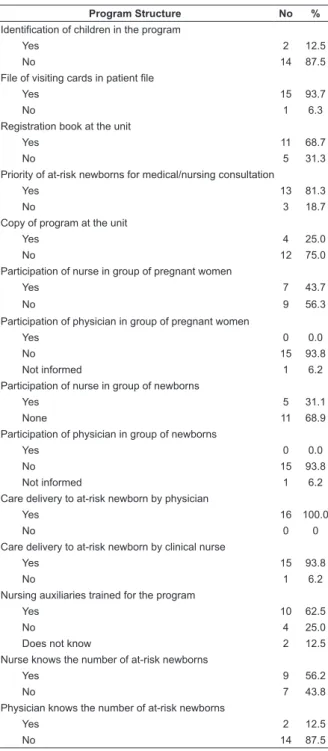
Structure data at the 16 Health Units evidence that,
at most of these, children enrolled in the Program were not identiied, but received priority care; 56.2% of the nurses and 12.5% of the physicians knew about the
number of children enrolled in the Program (Table 1).
Table 1 – Structure of the Growing Happily Program at the
Primary Health Care Unit (n=16). Botucatu, Brazil, 2007
Program Structure No %
Identification of children in the program
Yes 2 12.5
No 14 87.5
File of visiting cards in patient file
Yes 15 93.7
No 1 6.3
Registration book at the unit
Yes 11 68.7
No 5 31.3
Priority of at-risk newborns for medical/nursing consultation
Yes 13 81.3
No 3 18.7
Copy of program at the unit
Yes 4 25.0
No 12 75.0
Participation of nurse in group of pregnant women
Yes 7 43.7
No 9 56.3
Participation of physician in group of pregnant women
Yes 0 0.0
No 15 93.8
Not informed 1 6.2
Participation of nurse in group of newborns
Yes 5 31.1
None 11 68.9
Participation of physician in group of newborns
Yes 0 0.0
No 15 93.8
Not informed 1 6.2
Care delivery to at-risk newborn by physician
Yes 16 100.0
No 0 0
Care delivery to at-risk newborn by clinical nurse
Yes 15 93.8
No 1 6.2
Nursing auxiliaries trained for the program
Yes 10 62.5
No 4 25.0
Does not know 2 12.5
Nurse knows the number of at-risk newborns
Yes 9 56.2
No 7 43.8
Physician knows the number of at-risk newborns
Yes 2 12.5
No 14 87.5
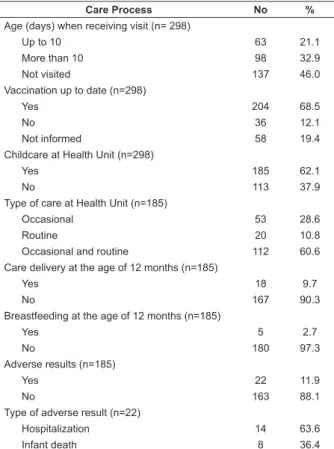
As for the care process, HV coverage was 54.0%.
For 68.5% of the children, vaccines were up-to-date
and 2.7% received breast milk at the age of 12 months
(Table 2).
Table 2 – Care process of the Growing Happily Program.
Botucatu, Brazil, 2007
(continue...)
Care Process No %
Visits (n=298)
Yes 161 54.0
Table 2 – continuation
Care Process No %
Age (days) when receiving visit (n= 298)
Up to 10 63 21.1
More than 10 98 32.9
Not visited 137 46.0
Vaccination up to date (n=298)
Yes 204 68.5
No 36 12.1
Not informed 58 19.4
Childcare at Health Unit (n=298)
Yes 185 62.1
No 113 37.9
Type of care at Health Unit (n=185)
Occasional 53 28.6
Routine 20 10.8
Occasional and routine 112 60.6
Care delivery at the age of 12 months (n=185)
Yes 18 9.7
No 167 90.3
Breastfeeding at the age of 12 months (n=185)
Yes 5 2.7
No 180 97.3
Adverse results (n=185)
Yes 22 11.9
No 163 88.1
Type of adverse result (n=22)
Hospitalization 14 63.6
Infant death 8 36.4
Discussion
All at-risk infants born during one semester of
2006 were studied. The collected data referred to the irst year of life. The population representativeness is a highly positive aspect of this study. Some weak points
should be highlighted though: to analyze the structure,
the nurses responsible for the HU, who were aware of the
study objectives, served as the informants; to analyze the process, data were obtained from the children’s iles and, occasionally, health actions that were performed
but not registered were not considered. Thus, the results
of the structure analysis may contain some positive
bias, while the process analysis results may contain a
negative bias.
The incidence of at-risk newborns during the study
period can be considered high: 52.9%. It should be kept
in mind that, according to the program, these children
need to be visited until the tenth day of life and that, during the irst year, they should receive a distinguished care routine. This clearly demonstrates the challenge
posed to local health units.
A irst aspect that needs to be observed relates to the pertinence of classiication in the risk area the Growing Happily Program currently adopts. This classiication was deined in 1995, based on a study about perinatal mortality carried out in the same city(4).
The present study results revealed that 87.6% of at-risk newborns lived in those areas, a level that is deinitely high. Living in a risk area corresponds to one of the axes
of social risk, according to the Program. Other social risk
axes include: mother younger than 18 years; illiterate
mother; previous history of child death; unemployed
family head or mother as family head; mother without
partner/support; mother without prenatal follow-up
(three consultations or less) and mother with psychiatric
problem. Hence, more factors were included than in
the Agenda of Commitments(1), which only includes
adolescent mother, with low education level, history of
child death and living in a risk area.
Probably due to this expansion, the frequency of
children at social risk was high: 82.5%, with 59.7%
displaying exclusively social risk. The Program also
considers biological risk factors, such as: birth weight
of 2500g or less; gestational age at birth below 37
weeks; disease justifying hospitalization at intensive or intermediary neonatal care units; ifth-minute Apgar score below seven; congenital malformation and
HIV-positive mother. Among the children under analysis,
40.3% showed one or more of these factors. The
biological criteria closely approximate those established
in the Agenda of Commitments(1) and allow health
services to develop speciic strategic actions for adequate child healthcare delivery, with a view to minimizing
damage. Only the last two risk factors mentioned are not
covered in the Agenda of Commitments which, on the
counterpart, proposes the inclusion of children whose
mothers/caregivers needed special orientation upon
discharge from the maternity/newborn care unit(1).
Public health program and project assessment
models should be accomplished in a crescendo,
starting with the measurement of service provision
indicators, that is, by the assessment of the program
in terms of its foundations and technical adequacy for
the epidemiological context and for the health system. Regarding technical and political criteria to deine the child as at-risk, the Growing Happily Program is adequate.
With respect to the interventions and strategies to put
it in practice, the program also showed to be adequate,
establishing health actions that can knowingly exert positive inluence on child health, such as HV during the irst ten days of life. Now, what was programmed should be confronted with what was offered to the target
population, which is the second phase of the assessment
model(5).
The Agenda of Commitments states that health
Rev. Latino-Am. Enfermagem 2011 Mar-Apr;19(2):293-300.
unit, at the newborn’s home or in collective spaces, so as to beneit the child through comprehensive and multiprofessional care delivery(1), which is even more
relevant for at-risk newborns. According to the guidelines
of the Growing Happily Program, at-risk children should be identiied and registered in speciic books at the reference units. Their forms should be included in their patient iles, so that professionals can immediately recognize them when they visit health services. These
study results appoint that these procedures are not
constant practice in the city: some units do not have a registration book, the children are not identiied at most of them and no copy of the Program is available.
Hence, how can one not lose opportunities if the target
population is unknown, and sometimes even the Program
proposal?
Departing from the principle that the central issue
health policies aiming for health equity should keep
in mind is the reduction or elimination of differences
deriving from factors that are considered avoidable and
unfair(6), the priority at-risk newborns should receive is
justiied. Besides guaranteed access, increased problem-solving ability and care quality should be guaranteed(1).
Regarding the priority given to care delivery to at-risk
newborns, however, the data surveyed in this study
reveal that problems may occur, due to the fact that these children are not identiied in the service routine and due to the nurses and physicians’ lack of knowledge
about the number of children enrolled in the program.
Another process indicator adopted was: the
development of educative activities in groups of pregnant
women and newborns was unsatisfactory. Physicians and
nurses’ participation in this action was limited, revealing
the maintenance of the traditional care model, in which
care is offered almost exclusively based on individual
medical consultations, not always enhancing welcoming
of the anxieties, complaints and fears that are culturally
associated with pregnancy and child care. On the
opposite, the groups of pregnant women and newborns
should constitute a space for sharing experiences,
feelings and affection and for socializing technical-scientiic and popular knowledge with participants(7).
According to the Growing Happily Program, all
professionals should participate in welcoming and care
delivery to the newborns, although the strategies that
should be used are not explicitly states. The same is
true for the Agenda of Commitments, which appoints
the need to overcome the disarticulation between
different health system levels and the guarantee of
comprehensive health care, with an agile and timely
low at each care level until the individual’s complete recovery is achieved(1).
In this study, the physician, and in most cases
also the nurse, routinely attended all at-risk newborns.
These professionals’ limited participation indicates that
this type of attendance has been mostly made feasible
through individual consultations.
The Agenda of Commitments proposes the First
Week of Comprehensive Health, directed at care delivery
to mothers and newborns, recommending HV during the irst week after birth(1). In the analysis of the care
process, HV coverage was generally low (54.0%), and
even lower when considering visits made until the tenth
day of life (21.1%). Based on HV as the most important
process indicator, the Growing Happily Program’s
performance was quite unsatisfactory, reducing its
potential for health surveillance and a positive impact
on this group’s health.
Home care in health is a device to review the health/
disease/care process concept and, therefore, capable of
enhancing the incorporation of values leading to changes
towards a care model committed to the establishment
of a welcoming relation, marked by commitment and
accountability for users’ health(8).
Besides the fact that the possibility of early HV to
the newborn contributes to bring down mortality rates,
other outcomes of this care form should be taken into
account, such as the strengthening of bonding between
health services and families, so as to facilitate health
promotion actions at the family level(9), as well as the
active search and early identiication of at-risk children, as proposed in the Agenda of Commitments(1).
The municipal public primary health care service’s
coverage in the periodical follow-up of at-risk newborns
can be considered low (62%). In view of the above
characterization of mothers and newborns, as well as
their residence areas, it seems quite improbable that
the remaining 38% of children were being monitored in
the private or convened health service system. Hence,
part of the at-risk newborns at birth may be distanced
from health surveillance, an action recommended in
the program under assessment and in the Agenda of
Commitments(1).
When considering children who attend childcare
consultations in the primary healthcare network, the fact
that 28.6% did not receive routine care is remarkable,
that is, each time these children were attended, there
was a health problem that demanded the search for
care at the HU. This situation observed in the city is a
be under routine and frequent monitoring, including
consultations to supervise their growth and development
and vaccination status, among other fundamental child
health promotion actions(1).
In view of the low implementation level of
recommended surveillance and newborn care actions
and the low coverage, the possibility that the Program
produced positive results regarding child health outcomes
is small. Hence, it can be inferred that this condition is
repeated, or gets even worse, for other children.
Negative indicators regarding the implementation
process of the Program practically discredit the analysis
of outcome or impact indicators(5). Merely to describe the
behavior of outcome indicators, vaccination coverage,
breastfeeding indicators, hospitalizations and deaths
were examined in the group of at-risk newborns followed
in the Program.
At the end of the irst year of life, vaccination was up-to-date for only 68.5% of the children. Vaccination
in this age range is a priority in the federal and state
context(1,10). For years, the basic operational target has
been to vaccinate 100% of children younger than one
year with all vaccines indicated for this age(11). In the
city under analysis, vaccination rooms are computerized,
which should permit better monitoring of children’s
vaccination situation and active search actions for
missing ones.
It is known that, when exclusively practiced until the
age of six months and complemented with appropriate
foods until the age of two years or more, breastfeeding
shows great potential to transform growth and
development and prevent illnesses in childhood and adult
age. That is why the Agenda of Commitments proposes
encouragement and orientations regarding maternal
breastfeeding(1). Only 2.7% of the children received
breastfeeding at the age of 12 months though, which is
very low in comparison with the Brazilian situation. In
1989, 37% of children were breastfed at the age of 12
months(12) and, since then, the duration of breastfeeding
has continuously increased in the country(13).
The mother and the family, sociocultural and economic context inluence the introduction of complementary feeding and breastfeeding. It is known, however, that health services’ support can signiicantly contribute to improve the conduction of the child feeding
process(14). These results appoint the need for new
strategies to approach mothers.
The existence of the program could not avoid that
14 at-risk children attended at the HU were hospitalized during their irst year of life, which may be related to the
weaknesses indicated above. Besides, eight newborns
died before completing one year. As six of them were
extremely premature and were not discharged from
hospital after birth, so that they were beyond the Program’s reach, prenatal care qualiication actions are suggested, in accordance with the Agenda of Commitments(1). It
should also be highlighted that two deaths were related to term children with ifth-minute Apgar scores of more than seven, characterizing avoidable deaths and, again,
the fragility of the Program.
The fragility of at-risk newborn surveillance
and care programs does not seem to be uncommon. Although rare, two papers were identiied with similar program assessments. One of them, the newborn
surveillance program in Londrina (PR), was assessed
in terms of coverage and process. Like in the present
research, participating nurses served as the informants. It was veriied that 15.3% of at-risk children were not followed at primary health care units (better coverage
than observed in Botucatu), 9.4% attended convened
or private services and the remainder was not found.
Moreover, 60% of the units used standardized forms for the registration, identiication and control of at-risk children(15). The authors underlined deiciencies in
the program, some of which were also observed in the
Growing Happily Program, especially regarding the care
process.
A second paper discusses the assessment of the
previous version of Growing Happily, put in practice at
a primary health care unit in Botucatu. Characteristics
and indicators were similar to the present study,
such as the predominance of children at social risk
in comparison with biological risk, extremely low HV
coverage, predominance of individual attendance and
low vaccination coverage(16).
Conclusion
On the whole, these study results evidence the
institutional vulnerability of the assessed program’s
actions, due to structure and process-related problems,
and affecting the program outcomes.
In terms of structure, the lack of a Program copy at the units is highlighted; the non-identiication of at-risk children in the iles: absence of group education activities for pregnant women and newborns and
physicians and nurses’ lack of knowledge about the
total number of at-risk children at birth being followed
Rev. Latino-Am. Enfermagem 2011 Mar-Apr;19(2):293-300.
life, a relatively small proportion of at-risk children at
birth being followed in public child health services and
a large number of occasional healthcare attendances
for these children. As for the outcomes, as expected, a
large number of children showed incomplete vaccination,
did not followed the proposed care protocol for at-risk
newborns and did not receive breast milk at the age
of 12 month. Hospitalization and death rates were also
high, despite the priority established for these children.
In summary, the criteria the Program adopts to deine at-risk newborns are adequate and the proposed interventions and strategies are in line with the Agenda
of Commitments. Thus, managers need to make it a
priority by effectively including it in public health care
policies to be developed in cities, in order to reverse the identiied institutional vulnerability. The researchers hope that the dissemination of these results will help
managers and health professionals to elaborate municipal
child healthcare policies.
References
1. Ministério da Saúde (BR). Agenda de compromissos
para a saúde integral da criança e redução da mortalidade
infantil. Brasília (DF): Ministério da Saúde; 2005. 80 p.
2. Donabedian A. The quality of care – how come it be
assessed? J Am Med Assoc. 1988;260(12):1743-8.
3. Ayres JRCM. Vulnerabilidade e avaliação de ações
preventivas. São Paulo: Casa de Edição;1996.
4. Macharelli CA. Mortalidade perinatal em Botucatu
- SP 1991/1992. [Dissertação]. Ribeirão Preto (SP):
Faculdade de Medicina/USP;1995.
5. Santos IS. Avaliação do impacto de programas
nutricionais. Rev Nutrição. (PUCCAMP)
2009;22(1):141-50.
6. Viana ALd’Á, Fausto MCR, Lima LD. Política de saúde e
equidade. São Paulo em Perspectiva. 2003;17(1):58-68.
7. Delfino MRR, Patrício ZM, Martins AS, Silvério MR.
O processo de cuidar participante com um grupo de
gestantes: repercussões na saúde integral
individual-coletiva. Ciênc Saúde Colet. 2004;9(4):1057-66.
8. Pereira MJB, Mishima SM, Fortuna CM, Matumoto
S. A assistência domiciliar: conformando o modelo
assistencial e compondo diferentes interesses/
necessidades do setor saúde. Rev. Latino-Am.
Enfermagem. 2005;13(6):1001-10.
9. Leite WCL, Perico LAD. Vigilância à saúde do recém
nascido na Divisão de Saúde Comunitária. Acta Paul
Enferm. 1996;9:74-8.
10. Governo do Estado de São Paulo (SP). Norma
técnica do programa de imunização. São Paulo (SP):
Coordenadoria de Controle de Doenças. Centro de
Vigilância Epidemiológica “Prof. Alexandre Vranjac”;
2008. 68 p.
11. Ministério da Saúde (BR). Manual de Procedimentos
para vacinação. Brasília (DF): Ministério da Saúde;
2007. 111 p.
12. Venâncio SI, Monteiro CA. Tendência da prática da
amamentação no Brasil nas décadas de 70 e 80. Rev
Bras Epidemiol. 1998;1:40-9.
13. Réa MF. Reflexões sobre a amamentação no Brasil:
de como passamos a 10 meses de duração. Cad Saúde
Pública. 2003;19(Suppl):S37-45.
14. Santos CS, Lima LS, Javorski M. Fatores que
interferem na transição alimentar de crianças entre
cinco e oito meses: investigação em Serviço de
Puericultura do Recife, Brasil. Rev Bras Saúde Mater
Infant. 2007;7:273-80.
15. Rossetto EG, Pizzo LG. Avaliação do programa de
vigilância do recém-nascido de Londrina-Paraná. Ciênc
Cuid e Saúde. 2007;6(2):148-56.
16. Manoel CM, Carandina L, Giarola LC. Programa de
vigilância ao recém-nascido de risco: ações desenvolvidas
no Centro de Saúde Escola de Botucatu. Rev Paul Pediatr.
2006;24(3):227-32.
Received: Nov. 18th 2009