ARTIGO ORIGINAL
SUMMARY
Objective: To identify preoperative and transoperative risks factors for postoperative com-plications developed in lung resection surgery. Methods: During 14 months; 189 patients underwent pulmonary resection and were enrolled to the study. Ater a clinical interview, patients were evaluated by laboratory, pulmonary function tests and radiography, submitted to a surgical procedure, and were followed during their stay in the ICU and hospital, evaluat-ing postoperatory complications and death. Results: he postoperative rate of complications was 52.9%: respiratory (34.3%), infectious (31%), and cardiovascular (21.4%). Respiratory complications were related to smoking (p < 0.01, RR 2.31), airway obstruction by spirometry (p = 0.01, RR 2.60), presence of anemia (p < 0.01, RR 2.13), and prolonged protrombine time [PT] (p = 0.03, RR 1.77). Infection complications were related to smoking (p < 0.01, RR 2.69), airway obstruction by spirometry (p = 0.01, RR 3.31), presence of anemia (p < 0.01, RR 2.10), and prolonged PT (p = 0.03, RR 2.29). Cardiovascular problems were related with older age (p < 0.01, RR 2.66), cigarette smoking (p < 0.01, RR 4.55), and hypoxemia (p = 0.03, RR 2.43). he postoperative mortality rate was 7.1%. Conclusion: A preoperative evaluation can pro-vide a suitable and safe postoperative prediction of complications in patients submitted to lung resection. Patients with COPD, hypoxemic, older, and anemic patients must be classiied as high-risk for developing these complications.
Keywords: horacic surgery; preoperative care; risk factors; prognosis hospital mortality.
RESUMO
Cirurgia torácica: fatores de risco para complicações pós-operatórias na ressecção pulmonar
Objetivo: Identiicar os fatores de risco pré e transoperatórios para o desenvolvimento de complicações pós-operatórias na cirurgia de ressecção pulmonar. Introdução: Os pacientes submetidos à cirurgia de ressecção pulmonar desenvolvem graves e frequentes complicações pós-operatórias. A identiicação dos fatores de risco para o desenvolvimento das mesmas é fundamental na predição das complicações no pós-operatório. Métodos: Durante 14 meses, 189 pacientes foram submetidos à intervenção cirúrgica torácica e foram incluídos no estudo. Depois de uma entrevista clínica, os pacientes foram avaliados por exames laboratoriais, es-pirometria e exames de imagem. Os mesmos foram submetidos ao procedimento cirúrgico e foram seguidos durante a sua permanência na UTI e no hospital, avaliando as complicações pós-operatórias e o risco de morte. Resultados: A taxa de complicações pós-operatórias foi de 52,9%, principalmente respiratórias (34,3%), infecciosas (31%) e cardiovasculares (21,4%). As complicações respiratórias foram relacionadas ao tabagismo (p < 0,01, RR 2,31), obstru-ção das vias aéreas (p = 0,01, RR 2,60), presença de anemia (p < 0,01, RR 2.13), e prolonga-do tempo de protrombina [PT] (p = 0,03, RR 1,77). As complicações infecciosas estiveram relacionados ao tabagismo (p < 0,01, RR 2,69), obstrução de vias aéreas (p = 0,01, RR 3,31), presença de anemia (p < 0,01, RR 2.10) e TP prolongado (p = 0,03, RR 2,29 ). Os problemas cardiovasculares, especialmente a presença de arritmias, foram relacionados com idade mais avançada (p < 0,01, RR 2,66), tabagismo (p < 0,01, RR 4,55) e hipoxemia (p = 0,03, RR 2,43). A taxa de mortalidade pós-operatória foi de 7,1%. Conclusão: A identiicação dos fatores de risco pode predizer complicações pós-operatórias nos pacientes submetidos a ressecção pul-monar. Pacientes com DPOC, hipoxêmicos, idosos e anêmicos devem ser classiicados como de alto risco para o desenvolvimento de complicações.
Unitermos: Cirurgia torácica; cuidados pré-operatórios; fatores de risco; prognóstico; mor-talidade hospitalar.
Study conducted at Pavilhão Pereira Filho da Santa Casa de Porto Alegre, Porto Alegre, RS
Submitted on: 11/27/2010
Approved on: 03/17/2011
Correspondence to:
Cassiano Teixeira Rua Riveirat, 355/403 Porto Alegre – RS CEP: 90670-160 Tel/Fax: +55 (51) 3312-2608 [email protected]
Conlict of interest: None.
Thoracic surgery: risk factors for postoperative complications of lung
resection
EDUARDO OLIVEIRA FERNANDES1, CASSIANO TEIXEIRA2, LUIS CARLOS CORREADA SILVA3
1 MD, Coordinatorof the General Medicine Residency Program at Grupo Hospitalar Nossa Senhora da Conceição, Porto Alegre, RS
2 MD, Intensive Care Medicine at Complexo Hospitalar da Santa Casa de Porto Alegre; Professor at Clínica Médica, Universidade Federal de Ciências da Saúde de Porto Alegre
(UFCSPA), Porto Alegre, RS
3 MD, Pneumologist at Pavilhão Pereira Filho da Santa Casa de Porto Alegre; Coordinator of the Pulmonary Function Test Laboratory at Pavilhão Pereira Filho and Professor of the
INTRODUCTION
Beneits of pulmonary surgical treatment are well-estab-lished. Life expectation of patients with non-small cell lung cancer is increased to 48 months, compared to 17 months of survival of patients submitted only to medical
treatment1. Furthermore, surgery for bronchiectasis
in-creases the quality of life2 and survival of these patients3. However, postoperative complications are a signiicant cause of morbidity and mortality in patients submitted to thoracic or abdominal surgeries4.
Managing of these patients requires an understanding of the predictable changes in pulmonary physiology oc-curring with surgery and anesthesia as well as a knowledge of factors associated with development of postsurgical complications. he surgical procedure causes reduction of lung capacity (represented by forced vital capacity [FVC]
and forced expiratory volume in one second [FEV1])
dia-phragm dysfunction, impairs gas exchange, and cough and mucociliary clearance leading to development of
micro-atelectasis and postoperative hypoxemia4,5. hese
modii-cations are exacerbated in chronic obstructive pulmonary disease [COPD]6,7, as well as in older patients8, survivors of recent myocardial infarction9, in starvation10 and smoking patients11.
he patients submitted to pulmonary resection proce-dures developed severe and frequent postoperative com-plications, so these patients frequently are submitted to the
preoperative risk evaluation12. Advances in surgical and
anesthetic techniques, combined with a detailed preop-erative and sophisticated perioppreop-erative assessment, have contributed to an increasing number of adults undergoing these procedures12-14.
he objective of this study was to identify preoperative, and transoperative risks factors for developed postopera-tive complications in lung resection surgery.
METHODS
PATIENTMANAGEMENT
All patients submitted to lung surgery at a reference for clinical and surgical lung diseases hospital over a 14 month period were prospectively studied. All subjects enrolled underwent elective lung resection surgeries (lobectomy and pneumonectomy) with or without chest wall resec-tion due to cancer, abscesses, or bronchiectasies. Exclu-sion criteria were: < 18 years of age, palliative resection, lung transplantation, thoracic trauma, thoracic surgery with no lung resection, thoracoscopy or thoracotomy for lung nodule biopsy, tracheostomy, emergency surgery, and informed consent declined. he study was approved by the Ethics in Research Committee of both hospitals and Informed Consent was obtained from all patients or next of kin.
he preoperative evaluation included a complete his-tory, physical examination, blood cell count, biochemical
proile, chest ilm, 12-lead ECG, and pulmonary function tests. When FEV1 was < 60% of the predicted value, a dif-ferential lung perfusion scan was performed. Patients with borderline spirometric results or impaired exercise toler-ance underwent a cardiopulmonary exercise test on a bi-cycle ergometer. Transthoracic echocardiography, thalli-um-dipyridamole myocardial scintigraphy, or coronary angiogram were performed in patients with risk factors for coronary artery disease [CAD] and in those patients with low functional capacity, according to guidelines
pub-lished by the American College of Physicians [ACP]15,16.
Preoperatively, as routine a thoracic epidural catheter was inserted, except for patients who refused placement of the catheter, patients with coagulation disorders, acute neu-rologic problems, local or systemic infections, or techni-cal failures (i.e., catheter malpositioning or malfunction). Prophylactic antibiotic therapy (i.e., cefuroxime, 1.5 g ev-ery 8 h for 24 h) was administered routinely. All patients were operated by one of three specialized surgeons in tho-racic surgeries and were managed by the same team of an-esthesiologists and chest critical care physicians.
Ater surgery, patients were monitored for at least 48 h in the postanesthesia care unit or intensive care unit [ICU] to provide intensive nursing and respiratory care with emphasis on pain control, diaphragmatic breathing, aggressive pulmonary toilet by aggressive postoperative physical therapy, as well as early mobilization, ambulation, and feeding. Intravenous [IV] luid infusion was limited to compensate for volume of blood loss with 0.9% saline solution and to replace evaporation loss with 5% glucose in saline solution at a rate of 1 mL/kg/h. Postoperative pain was assessed at rest and during coughing with a visual ana-log scale. he analgesic regimen was titrated to keep the visual analog scale at < 4/10 using either IV (morphine sulfate and nonsteroidal anti-inlammatory drugs) or epi-dural catheter (morphine sulfate) from 2 to 4 days.
DATACOLLECTIONANDEXTRACTION
he preoperative data registered during standard interview and physical exam included: age, gender, smoking history (positive when smoking more than 20 pack years), pres-ence of concomitant diseases (diabetes, cardiovascular, re-nal, and pulmonary disease). Other preoperative data reg-istered were: arterial blood gases on air, blood cell count,
biochemical proile, pulmonary function test [PFT](FEV1
Diagno-sis of COPD was based on criteria of the American horacic Society [ATS] and on results of pulmonary functional tests (i.e., FEV1/FVC, ≤ 70% of predicted value)17. Speciic cut-of points were selected to deine risk factors: (a) advanced age: ≥ 65 years; (b) moderate to severe COPD: FVC or
FEV1 ≤ 60% of the predicted; (c) hypoxemia in room air:
PaO2 ≤ 60 mmHg; (d) hypercapnia: PaCO2 ≥ 45 mmHg;
(e) lymphocytopenia: lymphocyte count < 1500/μL; (f) in-creased hemorrhage risk: prothrombin time [PT] > 13 sec; and (g) anemia: hemoglobin ≤ 10 g/dL.
Intraoperative risk factors studied were perioperative estimated blood loss (3 or more packed red blood cells re-quirement), and occurrence of a hemodynamic instabil-ity deined as need for IV vasopressor or IV vasodilator during procedure. Experience of the surgeon and anesthe-tist were not recorded since all surgical procedures were performed by the same surgical and anesthesia team with more than 20 years of experience in management of lung diseases. he duration of the surgical procedure (from skin incision to closure) was not registered.
Patients were followed during ICU and hospital stay to evaluate postoperative complications and mortality. Com-plications were grouped as (a) respiratory: atelectasis, en-dotracheal reintubation, mechanical ventilation require-ment > 24 h, and pleural air leak for more than 7 days; (b) cardiovascular: arrhythmias, hemodynamic instability with need for inotropic or vasodilators and coronary acute syndrome; (c) infectious: pneumonia (deined as new and persistent lung iniltrates at chest ilm, axillary tempera-ture > 38.5°C, and macroscopically proven purulent tra-cheal secretions), wound infection and pleural empyema; (d) metabolic: hyperglycemia (need of continuous insu-lin), eletrolite disturbances, and acute renal insuiciency (need of dyalisis); and (e) prognosis (survival or death). Severe postoperative complications were considered: en-dotracheal reintubation, hemodynamic instability with need for inotropic or vasodilators, coronary acute syn-drome, pneumonia, pleural empyema, acute renal insuf-iciency, and death. Each patient could have one or more complications therefore, the number of complications was greater than the number of patients. Operative mortality was deined as death until 30th day ater procedure.
Data were classiied as preoperative, and intraopera-tive, risk factors and as postoperative complications.
STATISTICALANALYSIS
Data were analyzed using statistical sotware (Epi-Info version 6.0). Univariate analysis was carried out using the χ2 test or Fisher’s Exact Test for categorical variables and the Wilcoxon or Kruskal-Wallis test for continuous vari-ables. Multivariate analysis (multiple logistic regression) was used to determine the relative risk (RR) and odds ratio (OR) and their 95% conidence intervals (95%CI) in variables with a p value <0.05 in univariate analysis
for postoperative complications and death. All tests were two sided, and p values of < 0.05 were considered statisti-cally signiicant.
RESULTS
STUDYPOPULATION
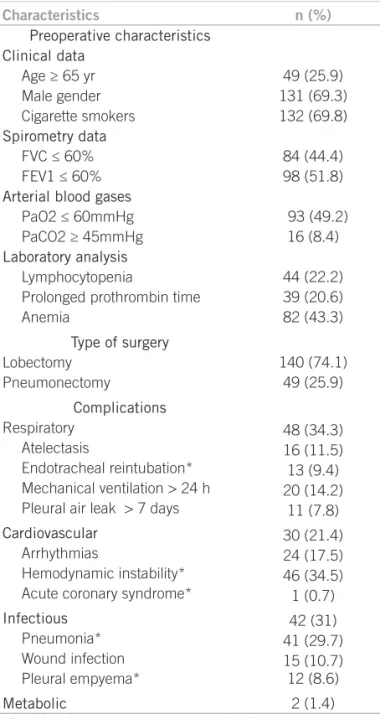
During the 14 months reference period, 532 thoracic sur-geries were performed, and 189 patients were prospective-ly enrolled, and submitted to elective lung resection sur-gery (lung lobectomy and pneumonectomy). Sixty-nine point three percent were male, mean age of 62.2 ± 12.4 years, and 104 smokers (mean cigarette consumption was 49 pack years). More men than women were smoking (92.1% and 53%, respectively). Lung cancer was present in 75.5% of the cases. Preoperative clinical characteristics of patients, laboratory data and type of surgery as well as intraoperatory data are presented in Table 1.
Table 1 – Preoperative characteristics, type of surgery, transoperatory data, and postoperative complications
Characteristics n (%)
Preoperative characteristics Clinical data
Age ≥ 65 yr Male gender Cigarette smokers Spirometry data
FVC ≤ 60% FEV1 ≤ 60% Arterial blood gases
PaO2 ≤ 60mmHg PaCO2 ≥ 45mmHg Laboratory analysis
Lymphocytopenia
Prolonged prothrombin time Anemia
49 (25.9) 131 (69.3) 132 (69.8)
84 (44.4) 98 (51.8)
93 (49.2) 16 (8.4)
44 (22.2) 39 (20.6) 82 (43.3)
Type of surgery Lobectomy
Pneumonectomy
140 (74.1) 49 (25.9)
Complications Respiratory
Atelectasis
Endotracheal reintubation* Mechanical ventilation > 24 h Pleural air leak > 7 days
Cardiovascular Arrhythmias
Hemodynamic instability* Acute coronary syndrome*
Infectious Pneumonia* Wound infection Pleural empyema*
Metabolic
48 (34.3) 16 (11.5) 13 (9.4) 20 (14.2)
11 (7.8)
30 (21.4) 24 (17.5) 46 (34.5) 1 (0.7)
42 (31) 41 (29.7) 15 (10.7) 12 (8.6)
2 (1.4)
POSTOPERATIVECOMPLICATIONS
Postoperative complications are presented in Table 1. he postoperative rate of complications was 52.9%: respi-ratory (34.3%), infectious (31%), cardiovascular (21.4%), and metabolic (1.4%). he mortality rate was 13.7%, and mostly due to sepsis (52.9%) follow pneumonia (29.7%) or pleural empyema (8.6%).
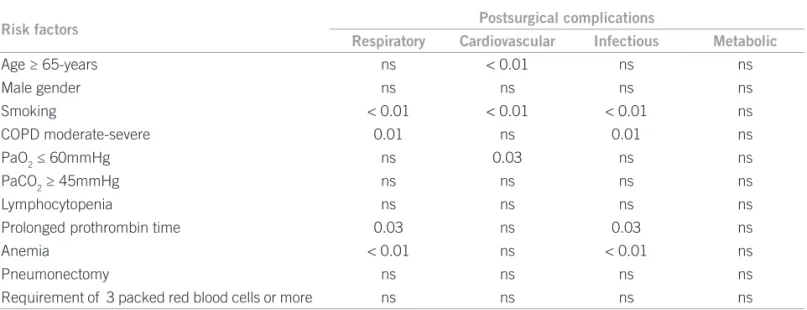
Respiratory postoperative complications were related with smoking (p < 0.01, RR 2.31 [95% CI 1.92 - 2.95]), air-way obstruction in spirometry (p = 0.01, RR 2.6 [95% CI 1.8 - 3.1]), presence of anemia (p < 0.01, RR 2.13 [95% CI 1.12 - 3.92]), and prolonged PT (p = 0.03, RR 1.77 [95% CI 0.94 - 4.16]). Delay in extubation was the only respira-tory complication that correlated individually with the cigarette smoking risk factor (p = 0.02, RR 2.76 [95%CI 1.53 - 3.38]). Table 2 shows the relationship between post-operative complications and prepost-operative characteristics, type of surgery, and intraoperative data.
Infectious postoperative complications were related with smoking (p < 0.01, RR 2.69 [95% CI 1.28 - 3.54]), airway obstruction in spirometry (p = 0.01, RR 3.31 [95% CI 2.56 - 3.85]), presence of anemia (p < 0.01, RR 2.10 [95% CI 1.25 - 3.12]), and prolonged PT (p = 0.03, RR 2.29 [95% CI 1.82 - 3.17). Pneumonia was the only in-fectious complication correlated with smoking (p < 0.01, RR 2.69 [95% CI 2.42 - 2.98]), airway obstruction in spi-rometry (p < 0.01, RR 3.31 [95% CI 2.96 - 3.77]), presence of anemia (p < 0.01, RR 2.12 [95% CI 1.37 - 3.75]), and prolonged PT (p < 0.01, RR 2.26 [95% CI 0.76 - 5.78]). Pre and intraoperative risk factors were unable to predict oc-currence of wound infection or pleural empyema.
Cardiovascular problems were related with older age (p < 0.01, RR 2.66 [95% CI 2.21 - 2.96]), cigarette smoking (p < 0.01, RR 4.55 [95% CI 3.65 - 5.95]), and hypoxemia (p = 0.03, RR 2.43 [95% CI 1.02 - 3.68]).
Metabolic postoperative problems were not predicted by the presence of pre or intraoperative risks. Pneumonec-tomies did not present more postsurgical complications when compared with lobectomies. When evaluating ar-terial blood gases, hypercapnia did not relate with com-plications. Detailed analysis of preoperative ECG did not predict risk of surgical complications. It is important to re-member that patients could have one or more postsurgical complications.
POSTOPERATIVEMORTALITY
Smoking (p = 0.01, RR 3.76 [95% CI 2.54 - 5.02]) and hy-poxemia (p = 0.02, RR 3.56 [95% CI 3.08 - 3.97]) were the preoperative risk factors that increased patient postop-erative mortality. Although requirement for intraoppostop-erative blood transfusion did no increase postoperative compli-cations individually, it increased postoperative mortality (p = 0.01, RR 4.53 [95% CI 1.72 - 7.65]), as well as the need of pneumonectomy (p < 0.01, RR 2.31 [95% CI 1.22 - 4.19]).
Table 3 shows the increase of mortality due to inding of postsurgical complications.
DISCUSSION
horacic surgeries are procedures associated with rela-tively high rates of postsurgical complications18. Incidence of pulmonary complications is uncertain, due to the vari-ability of deinitions used by diferent authors19. Although physicians involved in preoperative evaluations can base surgical risk assessment on extensive research, their ability to do so correctly is limited by methodological problems in literature such as poor standardization and deinition of postoperative complications, inadequate blinding of ob-servers, selection bias, limitation by study size, and report-ing of non-clinical signiicant complications (e.g., micro-atelectasis)20.
Table 2 – Univariate analysis of potential risk factors for operative risk factors*
Risk factors Postsurgical complications
Respiratory Cardiovascular Infectious Metabolic
Age ≥ 65-years ns < 0.01 ns ns
Male gender ns ns ns ns
Smoking < 0.01 < 0.01 < 0.01 ns
COPD moderate-severe 0.01 ns 0.01 ns
PaO2 ≤ 60mmHg ns 0.03 ns ns
PaCO2 ≥ 45mmHg ns ns ns ns
Lymphocytopenia ns ns ns ns
Prolonged prothrombin time 0.03 ns 0.03 ns
Anemia < 0.01 ns < 0.01 ns
Pneumonectomy ns ns ns ns
Requirement of 3 packed red blood cells or more ns ns ns ns
PATIENT-RELATEDRISKFACTORS
Age. Some authors consider advanced age as a risk factor
for mortality and perioperative complications8,21-24, others disagree with it25-30. Ergina et al.31 demonstrated that older patients have more respiratory or cardiovascular complica-tions, and Tisi et al.7 suggested that it was due to the physi-ological efect of aging (reduction of the vital capacity, peak-low, elastic lung retraction, and increase of residual lung volume). Despite early suggestions of an increased risk of pulmonary complications with advanced age, this is not an independent risk factor for pulmonary complications. he healthy status of a patient, mainly cardiorespiratory seems to be much more important than age26. In our study, those older 65 years had no increase of postoperative mortality, and in agreement with Kroenke et al.23, we observed an as-sociation with cardiovascular complications.
Smoking. he beneicial efects of smoking cessation, including improvement in ciliary and small airway func-tion and a decrease in sputum producfunc-tion, occur gradually over several weeks. he risk is highest in patients who were smoking within the last 2 months, and patients who had quit smoking for more than 6 months, have a risk simi-lar to those who do not smoke. Postoperative morbidity did not decrease in patients who had quit smoking for less
than 4 weeks32. Our study showed increase of pulmonary
and cardiovascular complications as well as increase of mortality rates.
Pulmonary function tests. Results of several retrospec-tive studies of routine preoperaretrospec-tive PFT disclosed only a marginal beneit in predicting postoperative complications in patients except in those undergoing lung resection. PFT could be used to identify high-risk patients for whom ag-gressive perioperative management is warranted. he ACP consensus statement15,16,33 suggests the following indications for preoperative PFT: (a) patients undergoing cardiac or up-per abdominal surgery with a history of smoking or dys-pnea; (b) patients undergoing lower abdominal surgery if
dyspnea or history of smoking indicates prolonged surgery; (c) patients undergoing orthopedic surgery with uncharac-terized lung disease; (d) patients undergoing lung resection; (e) older than 60 years of age; (f) positive smoking history; (g) presence of pulmonary disease; and (h) presence of pul-monary symptoms. PFT results should not be the sole rea-son to change plans necessary for surgery.
PFT remain the standard screening tests performed be-fore pulmonary resection. It is generally agreed that a
mini-mum value of FEV1 is required preoperatively (2 L before
pneumonectomy and 1.5 L lobectomy, respectively) and that further cardiopulmonary testing is needed in patients
with marginal lung function34. Variable cut-of values of
FEV1 (ranging from 35% to 80%) have been arbitrarily cho-sen to assess the severity of COPD and to predict the risk for
pulmonary complications, but preoperative FEV1 less than
60% is still a main predictor of perioperative mortality and respiratory morbidity35.
COPD. Patients with severe COPD are 6 times more likely to have a major postoperative complication35. Elective surgery should be deferred in patients who are symptom-atic, have poor exercise capacity, or have acute exacerbation. PFT results do not facilitate identiication of the high-risk patients or of severity of dysfunction when risk of surgery is forbidding. herefore, surgery should never be withheld based on PFT results33. Patients with severe COPD, classi-ied as very high risk, may undergo surgery and will face a moderate risk of postoperative complications (29%)23,35. We use the Kroenke et al.23 criteria and more than 40% of the patients presented with severe COPD based upon
spiro-metric indings, and identiing an association between FEV1
and respiratory, cardiovascular complications.
Arterial blood gases. A PaCO2 of more than 45 mmHg oten occurs in persons with severe COPD and indicates a high risk, although it is not necessarily prohibitive for surgery7,36,37. Hypoxemia is not a signiicant predictor of
complications36. In our study, we verify that hypoxemia
Table 3 – Multivariate analisys of the increase of mortality due to presence of postsurgical complications and type of surgery
Postsurgical complications p value OR (95% CI)
Pneumonia < 0.01 5.20 (1.93-14.04)
Mechanical ventilation required > 24 h < 0.01 13.85 (6.85-30.18)
Arrhythmias < 0.01 7.85 (3.15-19.52)
Endotracheal reintubation need < 0.01 18.45 (7.47-45.46) Pleural empyema < 0.01 7.06 (3.16-15.79)
Atelectasis < 0.01 4.39 (1.75-11.03)
Pleural air leak for more than 7 days < 0.01 5.02 (2.21-11.43) Need of vasodilators < 0.01 10.42 (4.70-22.74) Need of vasopressor < 0.01 14.67 (5.76-37.32) ≥ 3 packed red blood cells < 0.01 4.53 (2.10-9.13)
Pneumonectomy < 0.01 2.31 (1.22-4.19)
was associated with cardiac complications, principally oc-currence of arrhythmias. We did not ind an association between hypercapnia and prognosis, perhaps due to the small number of patients with this alteration.
Anemia. Anemia is present in 10% of patients admitted to general hospitals38. Hemoglobin values above of 10 g/dL do not signiicantly reduce oxygen transport and treatment is not required before surgery, and almost 45% of our pa-tients had anemia, based in this criteria. Our data showed that anemic patients had more respiratory and infectious complications, probably due to nutritional deiciencies not identiied during the preoperative evaluation.
Lymphocytopenia. his is a malnutrition marker just as albumin level, and malnutrition is a risk of morbidity and mortality in critical care and surgical patients39,40. More-over, patients submitted to thoracic surgery, frequently have cancer and are smokers; predisposing factors to mal-nutrition. Busch et al.41, in 106 patients submitted to lung surgery due to bronchogenic cancer, did not correlate lym-phocytopenia with higher postoperative complications, in agreement with our study data.
Prothrombin time. High values of PT are a contrain-dication for surgical procedures, due to an increase of
hemorrhagic complications42. Our data showed increased
respiratory complications, which in our opinion is due to PT being a marker of hepatic synthesis capacity and not because of coagulation defects43.
INTRAOPERATIVERISKFACTORS
Perioperative blood transfusion. Whitson et al.44 showed that perioperative blood transfusion was associated with
increased postoperative complications (53.5% vs. 30.5%,
p < 0.001). In our study, blood transfusion was
associat-ed with an increasassociat-ed operative mortality (3.4% vs. 1.7%,
p = 0.005) and length of stay ater surgery (median 6 vs. 5 days, p < 0.001).
POSTOPERATIVECOMPLICATIONS
Keagy et al.45,46 reported on 369 patients, 244 had postop-erative complications during follow-up of 30 days, mainly cardiovascular (41%) and pulmonary (21%). Wahi et al.28, in 197 pneumonectomies followed-up during 30 days, showed 23% of arrhythmias and prolonged MV in 9.1% of the cases. Ferguson et al.47, evaluating 271 patients, showed postoperative complications in 52% of the cases; and Asamura et al.48, in 267 patients submitted to thora-cotomy, found 23.6% of arrhythmias. Our study found respiratory complications in 34.3% of the cases, and pneu-monia in 29.7% of the cases.
POSTOPERATIVEMORTALITY
Some authors34,45-47,49 described variables postoperative
mortality rates (2.8% - 12.6%), and the higher mortality rates found in patients submitted to pneumonectomies
(7.1% - 27.4%)28,47,49. Ginsberg et al.50, reviewed 2,220 pa-tients submitted to thoracotomies in North-American and Canadian reference hospitals, and showed mortality post-segmentectomies of 1.4%, ater lobectomies of 2.9%, and af-ter pneumonectomies of 6.7%. Our data demonstrated global mortality of 7.1%, and pneumonectomy mortality of 19.4%.
Strengths and limitations: We believe that the strengths of this paper are: (a) large sample; (b) research developed in a hospital specialized in respiratory diseases; and (c) follow-up of all patients studied. We are mindful of sev-eral limitations related to: (a) design of the study (cohort study); (b) no evaluation of preoperative creatinine values (despite all patients have values lower than 1.5 mg/dL); (c) single center report; (d) no evaluation of intraoperative
data (e.g. duration of the surgery or anesthesia, and
in-traoperative luid balance); and (e) no evaluation of stairs climbing test in patients with preoperative VEF1 < 2 L51.
CONCLUSION
In an era of progressive cost containment and public scru-tiny, the wisdom of aggressive preoperative evaluations for all surgical candidates have been questioned. Current data quantify the risks and morbidities associated with the care of seriously ill patients with coronary artery disease and demonstrate the need for professional and public discus-sions focusing on the association of a high preoperative risk status and the consumption of resources. A concise and standarized preoperative evaluation can provide a suitable and safe postoperative prediction of complica-tions in patients submitted to lung resection, and patients with COPD, hypoxemic, older, anemic patients, and need of pneumonectomy must be classiied as high-risk for de-velop postoperative complications.
REFERENCES
1. homas SD, Berry PD, Russel GN. Is this patient it for thoracotomy and resection of lung tissue? Postgrad Med J. 1995;71:331-5. 2. Ellis DA, hornley PE, Wightamn AJ, Walker M, Chalmers J,
Crot-on JW. Present outlook in brCrot-onchiectasis: clinical and social study and review of factors inluencing prognosis. horax 1981;36:659-64. 3. Sanderson JM, Kennedy MCS, Johnson MF, Manley DC. Bronchiec-tasis: results of surgical and conservative management. A review of 393 cases. horax 1974;29:407-16.
4. Wright CD, Gaissert HA, Grab JD, O´Brien SM, Peterson ED, Allen MS. Predictors of prolongated length of stay ater lobectomy for lung cancer: a Society of horacic Surgeons General horacic Surgery Da-tabase risk-adjustment model. Ann horac Surg. 2008;85:1857-65. 5. Bofa DJ, Allen MS, Grab JD, Gaissert HA, Harpole DH, Wright CD.
Data from he Society of horacic Surgeons General horacic Sur-gery database: the surgical management of primary lung tumors. J horac Cardiovasc Surg. 2009;138:295-9.
6. Stein M, Koota GM, Simon C, Frank HA. Pulmonary evaluation of surgical patients. JAMA 1962;181:765-70.
7. Tisi GM. Preoperative evaluation of pulmonary function. Am Rev Respir Dis. 1979;119:293-10.
8. Cole WH. Medical diferences between the young and the aged. J Am Geriat Soc. 1970;18:589-614.
10. Buzby GP. Prognostic nutritional index in gastrointestinal surgery. Am J Surg. 1980;139:160-7.
11. Morton HJV, Camb DA. Tobacco smoking and pulmonary compli-cations ater operation. Lancet 1944; 1:368-372.
12. Bryant AS, Cerfolio RJ.he inluence of preoperative risk stratii-cation on fast-tracking patients ater pulmonary resection. horac Surg Clin. 2008;18:113-8.
13. Jordan S, Evans TW. Predicting the need for intensive care follow-ing lung resection. horac Surg Clin. 2008;18:61-9.
14. Cohn SL. Preoperative cardiac evaluation of lung resection candi-dates. horac Surg Clin. 2008;18:45-59.
15. Qaseem A, Snow V, Fitterman N, Hornabake ER, Lawrence VA, Smetana GW et al. Risk assessment for and strategies to reduce perioperative pulmonary complications for patients undergoing noncardiothoracic surgery: a guideline from the American College of Physicians. Ann Intern Med. 2006;144:575-80.
16. Bapoje SR, Whitaker JF, Schulz T, Chu ES, Albert RK. Preop-erative evaluation of the patient with pulmonary disease. Chest 2007;132:1637-45.
17. Stocks J, Quanjer PH. Reference values for residual volume, func-tional residual capacity and total lung capacity. ATS Workshop on Lung Volume Measurements. Oicial Statement of European Res-piratory Society. Eur Respir J. 1995;8:492-506.
18. Datta D, Lahiri B. Preoperative evaluation of patients undergoing lung resection surgery. Chest 2003;123:2096-103.
19. Agostini P, Singh S. Incentive Spirometry following thoracic sur-gery: what we are doing? Phisiotherapy 2009;95:76-82.
20. Dales RE, Dionne G, Leech JA, Lunau M, Schweitzer I. Preopera-tive prediction of pulmonary complications following thoracic sur-gery. Chest 1993;104:155-9.
21. Winter H, Meimarakis G, Pirker M, Spelsberg F, Kopp R, Rüttinger D et al. Predictors of general complications ater video-assisted thoracoscopic surgical procedures. Surg Endosc. 2008;22:640-5. 22. Gerson MC, Hurst JM, Hertzberg VS, Baughman R, Rouan GW,
Ellis K. Prediction of cardiac and pulmonary complications related to elective abdominal and noncardiac thoracic surgery in geriatric patients. Am J Med. 1990;88 101-7.
23. Kroenke K, Lawrence VA, heroux JF, Tuley MR, Hilsenbeck S. Postoperative complications ater thoracic and major abdominal surgery in patients with and without obstructive lung disease. Chest 1993;104:1445-51.
24. Harpole DH, Liptay MJ, DeCamp MM Jr, Mentzer SJ, Swanson SJ, Sugarbaker DJ. Prospective analysis of pneumonectomy: risk factors for major morbidity and cardiac dysrithmias. Ann horac Surg. 1996;61:977-82.
25. Jones LW, Peddle CJ, Eves ND, Haykowsky MJ, Courneya KS, Mackey JR et al. Efects of presurgical exercise training on cardi-orespiratory itness among patients undergoing thoracic surgery for malignant lung lesions. Cancer 2007;110:590-8.
26. Jesek V, Ouredník A, Lichtemberg J, Mostecký H. Cardiopulmo-nary function in the lung resection performed for bronchogenic cancer in patients above 65 years of age. Respiration 1970;27:42. 27. Didolkar MS, Moore RH, Takita H. Evaluation of the risk in
pul-monary resection for bronchogenic carcinoma. Am Surg Surg. 1974;127:700-3.
28. Wahi R, McMurtrey MJ, DeCaro LF, Montain CF, Ali MK, Smith TL et al. Determinants of perioperative morbidity and mortality ater pneumonectomy. Ann horac Surg. 1989;48:33-7.
29. Morandi U, Stefani A, Golinelli M, Ruggiero C, Brandi L, Chiappo-ni A et al. Results of surgical resection in patients over the age of 70 years with non small-cell lung cancer. Eur J Cadiothorac Surg. 1997;11:432-9.
30. Roxburgh JC, hompson J, Goldstraw P. Hospital mortality and long term survival ater pulmonary resection in the elderly. Ann horac Surg. 1991;51:800-3.
31. Ergina PL, Gold SL, Meakins JL. Perioperative care of the elderly patient. World J Surg. 1993;17:192-8.
32. Vaporciyan AA, Merriman KW, Ece F, Roth JA, Smythe WR, Swish-er SG et al. Incidence of major pulmonary morbidity atSwish-er pneu-monectomy: association with timing of smoking cessation. Ann horac Surg. 2002;73:420-5.
33. Wyser C, Stulz P, Solèr M, Tamm M, Müller-Brand J, Habicht J et al. Prospective evaluation of an algorithm for the functional as-sessment of lung resection candidates. Am J Respir Crit Care Med. 1999;159:1450-6.
34. Zibrak JD, O´Donnel CR, Marton K. Indications for pulmonary function testing. Ann Intern Med. 1990;112:763-71.
35. Licker MJ, Widikker I, Robert J. Operative mortality and respirato-ry complications ater lung resection for cancer: impact of chronic obstructive pulmonary disease and time trends. Ann horac Surg. 2006;81:1830-7.
36. Chen C, Ding JA, Gao W. Risk factors scoring system for predicting acute respiratory failure general thoracic surgery. Zhongguo Wei Zhong Bing Ji Jiu Yi Xue. 2004;16:274-6 (abstract).
37. Milledge JS, Nunn JF. Criteria of itness for anesthesia in patients with chronic obstructive lung disease. Br Med J. 1975;3:670-3. 38. Harvey KB, Moldawer BS, Bistrian RB, Blackburn GL. Biological
measures for the formulation of a hospital prognostic index. Am J Clin Nutr. 1981;34:2013-22.
39. Morice RC, Peters EJ, Ryan MB, Putnam JB, Ali MK, Roth JA. Ex-ercise testing in the evaluation of patients at high risk for complica-tions from lung resection. Chest. 1992;101:356-61.
40. Mullen JL. Consequences of malnutrition in surgical patients. Surg Clin North Am. 1981;61:465-87.
41. Busch E, Verazin G, Antkowiak JG, Driscoll D, Takita H. Pulmo-nary complications in patients undergoing thoracotomy for lung carcinoma. Chest. 1994;105:760-6.
42. Suchman AL, Griner PF. Diagnostic uses of the activated partial thromboplastin time and prothrombin time. Ann Intern Med. 1986;104:810-6.
43. Aghajanian A, Grimes DA. Routine prothrombin time determi-nation before elective gynecologic operations. Obstet Gynecol. 1991;78:837-9.
44. Whitson BA, Huddleston SJ, Savik K, Shumway SJ. Bloodless car-diac surgery is associated with decreased morbidity and mortality. J Card Surg. 2007;22:373-8.
45. Keagy BA, Lores ME, Starek PJ, Murray GF, Lucas CL, Wilcox BR. Elective pulmonary lobectomy: factors associated with morbidity and operative mortality. Ann horac Surg. 1985;40:349-52. 46. Keagy BA, Schorlemmer GR, Murray GF, Starek PJ, Wilcox BR.
Correlation of preoperative pulmonary function testing with clini-cal course in patients ater pneumonectomy. Ann horac Surg. 1983;36:253-7.
47. Ferguson MK, Reeder LB, Mick R. Optimizing selection of pa-tients for major lung resection. J Thorac Cardiovasc Surg. 1995;109:275-81.
48. Asamura H, Naruke T, Tsuciya R, Goya T, Kondo H, Suemasu K. What are the risk factors for arrhythmias ater thoracic operations? J horac Cardiovasc Surg. 1993;106:1104-10.
49. Foster R, Toth S, Redmann K. A prospective risk analisys of contemporary thoracic surgery. Eur J Cardiothorac Surg. 1996;10:641-8.
50. Ginsberg RJ, Hill LD, Eagan RT, homas P, Mountain CF, Deslauri-ers J et al. Modern thirty day operative mortality for surgical resec-tions in lung cancer. J horac Cardiovasc Surg. 1983;86:654-8. 51. Nikolić I, Majerić-Kogler V, Plavec D, Maloca I, Slobodnjak Z.