Rev Bras Ter Intensiva. 2014;26(4):407-409
Haf disease complicated by multiple organ failure
after crayish consumption: a case study
CASE REPORT
INTRODUCTION
Haf disease was irst reported in the Baltic region in 1924 and is deined as unexplained rhabdomyolysis in a person who consumed ish within 24 hours before the onset of symptoms.(1) Since the irst report, outbreaks of Haf disease have been reported in Sweden, the former Soviet Union, the United States, Brazil, and China.(2-5) Haf disease is a rare clinical syndrome. If patients receive prompt treatment, the prognosis is good. his paper reports a case of severe Haf disease complicated by multiple organ failure caused by eating crayish.
CASE PRESENTATION
A 66-year-old man with a 20-year history of hypertension ate cooked crayish from a local seafood market on the night of June 23, 2013. Twelve hours later, he began to feel back pain and was misdiagnosed with lumbar disc disease. he patient felt better after analgesic therapy at a local hospital. At 8:00 on the morning of June 25, 2013, the patient developed difuse myalgia accompanied by weakness and rigidity of the limbs, oliguria, cofee-colored urine, and shortness of breath. He arrived at our hospital and was admitted to the intensive care unit (ICU). Physical examination upon admission revealed a body temperature of 37° C, pulse of 110 beat/min, respiratory rate of 30/min, blood pressure of 100/60mmHg, bilateral slight yellowing of the sclera, rapid and shallow respirations, and a few rales in the lungs bilaterally. he patient Gang Feng1, Qiancheng Luo1, Ping Zhuang1,
Enwei Guo1, Yulan Yao1, Zhongyu Gao2,3
1. Intensive Care Unit, Gongli Hospital, Second Military Medical University, Pudong New Area - Shanghai, China.
2. Office of Teaching, Gongli Hospital, Second Military Medical University, Pudong New Area - Shanghai, China.
3. Department of General Surgery, Gongli Hospital, Second Military Medical University, Pudong New Area - Shanghai, China.
Haf disease is a syndrome consisting of unexplained rhabdomyolysis. Patients sufering from Haf disease report having eaten ish within 24 hours before the onset of illness. Most patients survive and recover quickly. he present study is the irst report of Haf disease complicated by multiple organ failure after crayish consumption. A 66-year-old Chinese man ate cooked crayish on the night of June 23, 2013. He arrived at our hospital 2 days later and was admitted to the intensive care unit.
Conflicts of interest: None.
Submitted on June 30, 2014 Accepted on August 2, 2014
Corresponding author:
Zhongyu Gao
Gongli Hospital, Second Military Medical University, Pudong New Area
Nº 219, Miaopu Road, Gongli Shanghai, 200135, China E-mail: [email protected]
Responsible editor: Rui Moreno
Doença de Haff complicada por falência de múltiplos órgãos após
ingestão de lagostim: estudo de caso
ABSTRACT
Keywords: Rhabdomyolysis; Astacoidea; Eating; Case reports
After admission, the patient was diagnosed with Haf disease complicated by multiple organ failure. Despite supportive and symptomatic treatments, the condition of the patient deteriorated, and he died due to his illness.
Haf disease is a rare clinical syndrome that is sometimes misdiagnosed. Early diagnosis and proper treatment are essential to prevent progression to multiple organ failure.
Haff disease complicated by multiple organ failure after crayfish consumption 408
Rev Bras Ter Intensiva. 2014;26(4):407-409
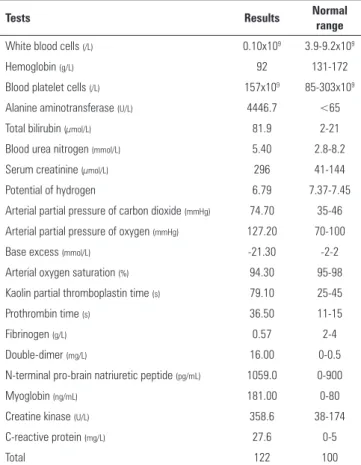
presented obvious full-body muscular tenderness, but no neurological abnormalities, splenomegaly, or hepatomegaly were observed. Laboratory tests revealed elevated white blood cell count at 20.10×10⁹/L (Table 1). Urobilirubin and urobilinogen were negative. Electrocardiography revealed sinus tachycardia. Computed tomography (CT) revealed exudate in the right middle lung lobe, the lingula of the left lung, and the lower lobes bilaterally. Distension and luid retention were observed in the esophagus and stomach, as well as reduced liver density. Low-density shadowing and exudation and swelling changes were present in muscle tissues (latissimus dorsi, subscapular muscle, bilateral psoas major, iliopsoas, gluteus maximus, and abdominal muscles), accompanied by unclear muscle borders (Figure 1).
Table 1 - Test results at hospital admission
Tests Results Normal
range
White blood cells (/L) 0.10x10⁹ 3.9-9.2x10⁹
Hemoglobin (g/L) 92 131-172
Blood platelet cells (/L) 157x109 85-303x109
Alanine aminotransferase (U/L) 4446.7 <65
Total bilirubin (µmol/L) 81.9 2-21
Blood urea nitrogen (mmol/L) 5.40 2.8-8.2
Serum creatinine (µmol/L) 296 41-144
Potential of hydrogen 6.79 7.37-7.45
Arterial partial pressure of carbon dioxide (mmHg) 74.70 35-46
Arterial partial pressure of oxygen (mmHg) 127.20 70-100
Base excess (mmol/L) -21.30 -2-2
Arterial oxygen saturation (%) 94.30 95-98
Kaolin partial thromboplastin time (s) 79.10 25-45
Prothrombin time (s) 36.50 11-15
Fibrinogen (g/L) 0.57 2-4
Double-dimer (mg/L) 16.00 0-0.5
N-terminal pro-brain natriuretic peptide (pg/mL) 1059.0 0-900
Myoglobin (ng/mL) 181.00 0-80
Creatine kinase (U/L) 358.6 38-174
C-reactive protein (mg/L) 27.6 0-5
Total 122 100
After admission, the patient was diagnosed with Haf disease complicated by multiple organ failure. Treatment included endotracheal intubation with artiicial ventilation, infusions of dopamine and norepinephrine to increase blood pressure, methylprednisolone to inhibit the inlammatory response, omeprazole to prevent stress
Figure 1 - Computed tomography showing low-density shadows, exudation and swelling changes in muscle tissues (latissimus dorsi and subscapular muscle, bilateral psoas major muscles, iliopsoas, gluteus maximus, and abdominal muscles) accompanied by unclear muscle borders.
ulcers, sodium bicarbonate to alkalize the urine, and other supportive and symptomatic treatments. Despite treatment, the condition of the patient deteriorated and he died at 22:00 on the evening of June 25, 2013.
DISCUSSION
Haf disease is a syndrome consisting of unexplained rhabdomyolysis characterized by sudden, extreme muscular rigidity, difuse myalgia, chest pain, shortness of breath, full-body numbness and weakness, and cofee-colored urine, as well as elevated serum creatine kinase, myoglobin, transaminases, and lactate dehydrogenase. Generally, neurological abnormalities, fever, splenomegaly, or hepatomegaly are not observed.(1-5) All patients sufering from Haf disease report a history of eating ish (pomfret, bufalo, or crayish) within 24 hours before the onset of illness.(6,7) A few patients have died from Haf disease, but most survive and recover quickly.
409 Feng G, Luo Q, Zhuang P, Guo E, Yao Y, Gao Z
Rev Bras Ter Intensiva. 2014;26(4):407-409
delayed treatment. Early diagnosis and proper treatment are essential to improving the prognosis for patients with Haf disease.
he etiology of Haf disease remains unclear. One possible cause is an unknown heat-stable biological toxin that accumulates in the implicated food, but the toxin has not yet been identiied. his putative biological toxin causes rhabdomyolysis, renal dysfunction, and coagulation abnormalities, and it damages the liver, respiratory system, and gastrointestinal tract. Striated muscle damage leads to full-body myalgia, weakness, and muscle rigidity. Carbon dioxide retention and respiratory failure occur due to respiratory muscle weakness. When Haf disease is suspected, proper treatment should be initiated as soon as
possible to prevent deterioration in the condition of the patient. A CT scan of our patient revealed low-density shadow, exudation, and swelling changes in the muscle tissues throughout the body. CT can be performed as a painless, noninvasive method of conirming a diagnosis of Haf disease.
CONCLUSION
his is the irst report of Haf disease complicated by multiple organ failure after crayish consumption. Early diagnosis and proper treatment are essential to prevent progression to multiple organ failure. Computed tomography can be used to conirm a diagnosis of Haf disease.
A doença de Haf é uma síndrome que consiste de rabdomiólise não explicada. Pacientes que apresentam a doença de Haf relatam ter ingerido pescado nas últimas 24 horas antes do início da doença. A maioria dos pacientes sobrevive apresentando breve recuperação. O presente artigo é o primeiro relato de doença de Haf complicada por falência de múltiplos órgãos após ingestão de lagostim. Um homem chinês de 66 anos de idade ingeriu lagostim cozido na noite de 23 de junho de 2013. Chegou ao hospital 2 dias mais tarde, sendo admitido
à unidade de terapia intensiva. Após a admissão, o paciente recebeu o diagnóstico de doença de Haf complicada por falência de múltiplos órgãos. Apesar dos tratamentos de suporte e sintomático, a condição do paciente deteriorou, vindo o mesmo a falecer em consequência da doença. A doença de Haf é uma rara síndrome clínica que é, às vezes, mal diagnosticada. O diagnóstico precoce e o tratamento adequado são essenciais para prevenir a progressão para falência de múltiplos órgãos. RESUMO
Descritores: Rabdomiólise; Astacoidea; Ingestão de alimentos;
Relatos de casos
REFERENCES
1. Buchholz U, Mouzin E, Dickey R, Moolenaar R, Sass N, Mascola L. Haff disease: from the Baltic Sea to the U.S. shore. Emerg Infect Dis. 2000;6(2):192-5.
2. Berlin R. Haff disease in Sweden. Acta Med Scand. 1948;129(6):560-72. 3. dos Santos MC, de Albuquerque BC, Pinto RC, Aguiar GP, Lescano AG,
Santos JH, et al. Outbreak of Haff disease in the Brazilian Amazon. Rev Panam Salud Publica. 2009;26(5):469-70.
4. Zhang B, Yang G, Yu X, Mao H, Xing C, Liu J. Haff disease after eating crayfish in east China. Intern Med. 2012;51(5):487-9.
5. Tolesani Júnior O, Roderjan CN, do Carmo Neto E, Ponte MM, Seabra MC, Knibel MF. Haff disease associated with the ingestion of the freshwater fish Mylossoma duriventre (pacu-manteiga). Rev Bras Ter Intensiva. 2013;25(4):348-51.
6. Langley RL, Bobbitt WH 3rd. Haff disease after eating salmon. South Med J. 2007;100(11):1147-50.