SPEECH AND LANGUAGE DEVELOPMENT IN HEARING
IMPAIRMENT: TWO- CASE REPORT
Desenvolvimento de fala e linguagem na deiciência auditiva:
relato de dois casos
Ana Carolina de Oliveira Sobreira (1), Bianca Maria Capo (1),
Thássia Silva Dos Santos (2), Daniela Gil (1)
(1) Universidade Federal de São Paulo (UNIFESP) São Paulo – SP – Brasil.
(2) Hospital São Paulo (HSP), São Paulo – SP – Brasil.
Conlict of interest: non-existent
Hearing impairment is a factor that directly compromises the individual’s language. This can vary according to the type and degree of hearing loss. It is known that sensorineural hearing loss is severe to profound that can cause more damage languages, making the acquisition and devel
-opment of oral language, especially in people with pre-lingual hearing loss. Language acquisition is a process dependent on the integrity of the auditory system and when it is damaged by a hearing loss. It is important to speech therapy intervention, along with the use of sound ampliication devices, so that the child may have a chance to develop speech, consequently learning and expanding your knowledge of the world.
Educational Audiology is the area of speech therapy that treats the relationship hearing and INTRODUCTION
First years of life are critical for the development of auditory and language abilities. This period that is the peak of the process of maturation of the central auditory system and neural plasticity occurs in the auditory pathway. Patients with hearing loss require that the diagnosis be made early so that a reduced impact on language development, auditory and cognitive abilities occurs. Thus, the interval between the suspected hearing loss, diagnosis and intervention should be minimized1-3.
ABSTRACT
This study aims at monitoring the development of speech and language of two children who have hearing loss – one of which is a user of bilateral auditory prosthesis and the other has unilateral cochlear implant and auditory prosthesis. Assessment List of Expressive Vocabulary protocols and Symbolic Maturity were used in both cases, and the children were cared for in the educational audiology outpatient clinic the Federal University of Sao Paulo through aurioral approach. Both were submitted to the application of Symbolic Maturity, having the following recordings: free play, semi-guided play, and action imitation; videos were transcribed and analyzed. Assessment List of Expressive Vocabulary was applied to parents in order to investigate the words which the children were able to pronounce; the number of words was counted and analyzed in conjunction with the results of Symbolic Maturity. Both tests were applied on both children in two moments within an interval of ive months. Both had a development in all the tests of the Symbolic Maturity and on Assessment List of Expressive Vocabulary when the two applications were compared. On the irst application of Assessment List of Expressive Vocabulary was applied, the girl could say three words (0,9%) and the boy 90 words (29,4%); on the second application, 25 words (8,1%) and 176 words (57,5%) respectively.The boy presented a better development on the tests of Symbolic Maturity and Assessment List of Expressive Vocabulary when compared to the girl. Protocols applied in two different moments of the children’s developments were eficient in monitoring the development of speech and language. The better development achieved by the male child could be associated to the degree of auditory loss.
space, since the results obtained by joining the technological resources to therapeutic approaches have been increasingly satisfactory. For the eficacy of this combination is proven, it is very important to use standardized assessment protocols to quantify the improvement of the subjects, to show parents how to use the devices and attendance to therapy is important and makes all the difference in the devel
-opment of hearing impaired children.
The purpose of these case reports is to charac
-terize and compare the development of speech and language in two deaf children with similar ages, being a user of bilateral hearing aids and other cochlear implant and hearing aid using the protocols, LAVE9
and Symbolic Maturity10, which was applied at two different times.
CASE REPORTS
Research approved by the Ethics Committee of UNIFESP as Embodied Opinion No. 192.036 of
21/12/2012.
The children’s parents signed a consent form to allow the participation of children in research.
Participated in this study, two individuals, one male and one female, with 3 and 4 years old, respectively, in the Outpatient educational audiology speech therapy course at the Federal University of São Paulo – UNIFESP on visits made twice a week with 45-minute sessions in aurioral approach. The goal of therapeutic procedures performed was to develop auditory skills, acquire and develop oral communication and cognitive aspects, in addition to providing guidance to the family and school.
Case 1- Male, date of birth 27/05/2009 (3 years
old), sensorineural, moderate hearing loss in the left ear and profound in the right ear; preterm (7 months), addict mother. Transient evoked otoacoustic emissions (TEOAE) performed in March 2011 with absent responses bilaterally. Evoked Auditory Brainstem Response (ABR) conducted in April 2011, results of the left ear showed waves I, III and V with preserved morphology, absolute latencies and inter-latencies within the benchmarks. Wave V cannot be observed in the intensity of 50 decibels (dB) with latency abruptly shifted (cochlear component). The results of the right ear showed absence of electrophysiological responses to 90 dB. 1 year and 11 months old, was diagnosed with Sensorineural Hearing Loss moderate degree of left ear and profound of right ear. It was adapted bilaterally with BTE hearing aids in December 2011, 2 years and 7 months of age (Table 1 – Functional Gain Case 2) and started speech therapy in January 2012 at the clinic of educational audiology at UNIFESP.
language. A therapeutic approach is the aurioral. In this context are created therapeutic strategies for the acquisition and development of oral language are stimulated by residual hearing in order to avoid the limitations of comprehension and verbal expression, providing opportunities to hear the individual as its development, expansion of their knowledge, life experiences, becoming active in society using visual and auditory integration4. For this type of therapy
to be successful, the use of hearing aids and / or cochlear implants is essential.
Studies say that hearing aids allows the hearing-impaired children greater access to acoustic infor
-mation from the sounds of language, which creates more chances for oral language development5. This technology is suitable for various types and degrees of hearing losses. However, cases that the hearing aid is unable to adequately provides these acoustic information by excessive low residual hearing, cochlear implant (CI) may provide better results in rehabilitation6.
The cochlear implant is currently the most effective technological resource to facilitate access for the deaf person sound world7. Until then no electronic device would have allowed the individual who acquired severe / profound deafness before the acquisition of language, the ability to understand and express it with functionality and abstraction.
For the combination of speech therapy and sound ampliication device to be effective it is necessary to monitor the oral language of the individual to verify quantitatively and qualitatively the evolution of hearing impaired children. There are protocols that aim to evaluate the performance of expressive vocabulary and the symbolic maturity of the child, such as LAVE – Assessment List of Expressive Vocabulary Test, an adaptation to Portuguese of LDS – Development Language Survey, which inves
-tigates and detects expressive language delays in oral. Proof of Symbolic Maturity investigates the relationship between the development of language, gestures and symbolic play through the interactions with the child.
Language development is essential to the child’s entry into the symbolic world, so that she can reach levels of greater complexity in language. The symbolic function is the ability to represent the lived world and is composed of language, symbolic play, imitation, problem solving by combination of actions and mental imagery8.
best hearing device in right ear. In September 2011 started speech therapy at the clinic of educational audiology at UNIFESP. In October 2011, underwent surgery cochlear implant in the left ear, which was activated in December 2011, at 3 years and 5 months old. Currently uses cochlear implant in his left ear and a hearing aid in the right ear (Table 2 – Gain Functional Case 2).
Case 2 – Female, date of birth 18/06/2008 (4
years old), bilateral profound sensorineural hearing loss; preterm (8 months). 1 year and 6 months of age, and held the ABR was diagnosed. In August 2011, at 3 years and 2 months old, received a donation of a pair of BTE hearing aids and after use, the child began to become more attentive to the sounds, but the mother observed behavior with the Table 1 – Functional Gain Case 1
Frequency (Hz) 250 500 1000 2000 4000
Intensity (dB) 15 20 35 35 50
Table 2 – Functional Gain Case 2
Frequency (Hz) 250 500 1000 2000 4000
Intensity (dB) 45 30 30 25 55
Children were assessed using two protocols: Maturity Assessment Symbolic and LDS applied in two stages, with an interval of ive months between one and another application. Parents answered
• Symbolic imitative play (SIP) 4 points;
• Symbolic object play replaced (SOPR) 5 points; • Simple combinatorial symbolic play (SCSP) 6
points;
• Combinatorial symbolic play multiple (CSPM) 7
points.
Every action taken by the child in a situation addressed / imitation of gesture schemes, a point was added, totaling the values below:
• Gestural imitation of simple schemes (up 9
points);
• Imitation of sequential gestural schemes in
familiar routines (up 12 points).
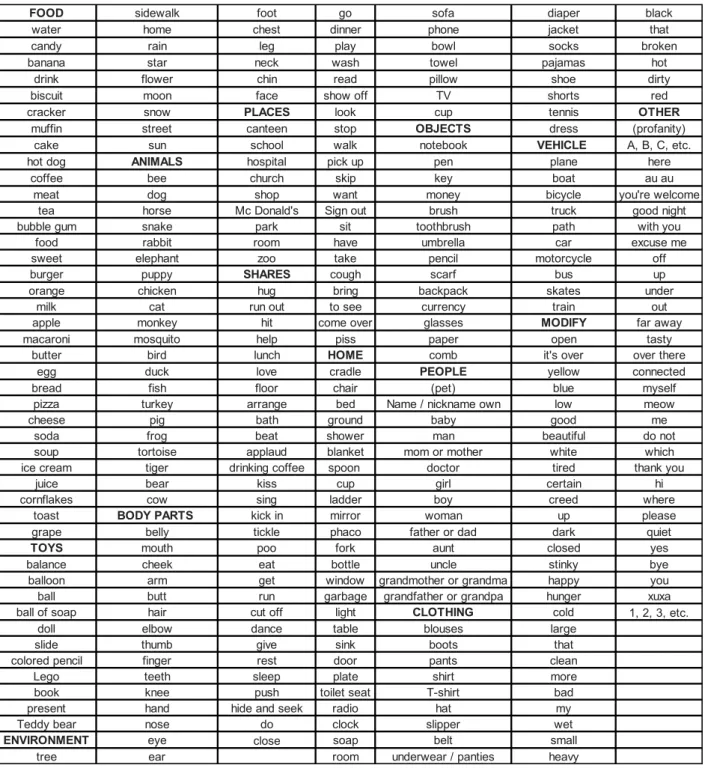
Assessment List of Expressive Vocabulary – LAVE (Capovilla, 1997) (Figure 4)
The questionnaire LAVE takes into illing in personal data relating to the history of the child and his family: registration data, education, employment and income of the parents, number of children, past medical history, chronic diseases, childbirth, perinatal complications, prematurity, ear infections if the child is cared for by nanny, concurrent or previous speech therapy and / or psychological treatment, schooling, maximum number of words in a sentence issued, another type of classroom beyond the school, including sports, level of parental concern with child’s language, words and best built and long sentences that the child has already spoken to the date of application.
After completing the brief history of the child, the guardian should select on a board, the words that the child issues, even those that do not say clearly. On board, the words are divided into 14 categories: food, toys, environment, animals, body parts, places, actions, house, objects, people, clothes, vehicles, modiiers, and others. Words the child can understand are not allowed, but emits nor did repetitions and imitations that are not characterize as spontaneous speech.
LAVE Protocol was examined by the number of words that the child produced in the irst application as compared to that produced in the second appli
-cation. After this individual comparison, there was a comparison between the performances of two children.
Maturity Assessment Symbolic (Figure1)
The test was applied in two steps in the same
session:
• First step:
A. Free play that the therapist offers the child the object of the protocol in a box and tells her to play as you wish. The therapist stands next to the patient, responsive to his initiatives, but does not interfere nor suggests any activity (Duration 20 minutes).
B. Play semi-guided that the therapist use the same earlier object. The therapist interacts with the child, in moments of shared attention, suggesting activities, but providing a time for the child to have their own initiatives (Duration
20 minutes).
• Second step: Play directed that the therapist
performs imitation activity with the child. The therapist performs an action with certain objects and then give the child to do the same, calling attention only to the object, without naming the action. Each scheme was presented only once, repeated only when the child was losing attention during the presentation.
Box Objects: Toy telephone, a large ball, dolls
and animals textiles and plastics, small vehicles, kitchen utensils, baby bottle, a blanket and a small pillow, a long necklace, glasses and serial blocks, abacus and two mechanical windup toys (Figure 2).
Objects for imitation: Cup, toothbrush, spoon,
doll, soap, lower, frog, airplane, hat, car, banana, cot, bath, bib, blanket, book and towel (Figure 3).
All sessions were recorded, transcribed and analyzed to obtain the test results.
Videos of the irst and second application of the Test Maturity Symbolic of each subject were analyzed in order to compare the child with herself and check your progress and then comparing the two children was performed. Each type of schema or symbolic game receives a score that was added to each activity performed by the child, as noted in the items below (Schemes evaluated in free play
situation):
ASSESSMENT OF SYMBOLIC MATURITY – Research Part
Do not reproduce without permission of the authors (Bei-Lopes, Takiuchi & Araújo, 2000)
I) Situation of Free Play and Semi-guided Play
No Descriptions of Episodic Units EPS EAS JSA JSI JSOS JSCS JSCM Other
More elaborate play presented by child: _________ Play more used by the child: _________
Total: _________
II) Guided Situation/ Imitation of Gesture Schemes
1) Imitation of simple gestures schemes Practical test: ( ) Yes ( ) No
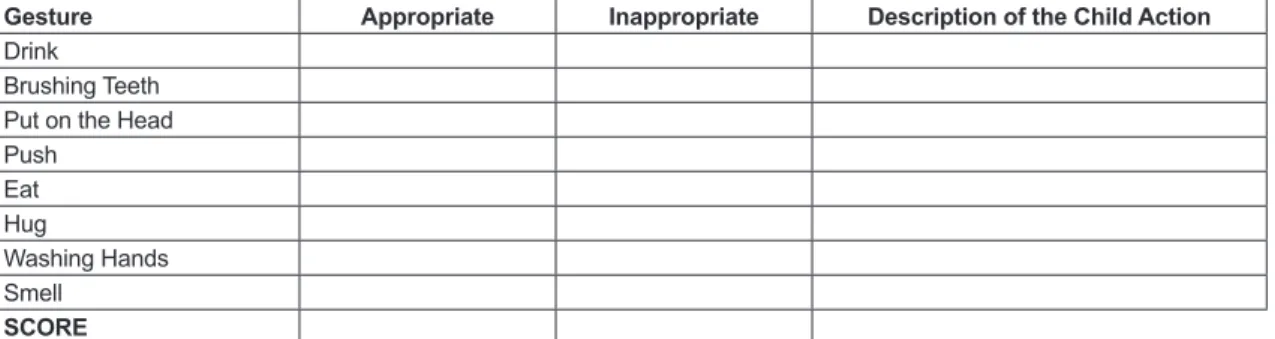
Gesture Appropriate Inappropriate Description of the Child Action Drink
Brushing Teeth Put on the Head Push
Eat Hug
Washing Hands
Smell
SCORE
2) Imitation of sequential gestural schemes in family routines: Practical test: ( ) Yes ( ) No
Gesture Total No. of schemes Different schemes Description of the Child Action Feed the Baby
Putting Baby on Bed Give Baby a Bath TOTAL SCORE Mean
Figure 1 – Protocol of symbolic maturity
Assessment Listo f Expressive Vocabulary – LAVE
(Translation and adaptation by Capovilla, 1997 LDS – Rescorla, 1989) Authorization to research for Prof. Dra. Márcia Regina Marcondes Pedromônico
Please complete the form below to allow us access to important information about the child.
Date: __/__/___ Your Name: __________________________________________ Relationship with the child: _____________ Name of the Child: __________________________________________________ Birth Date: __/__/__ Sex: ______________
Mother Father
Name
Address
Telephone Birth Date
Civil Status
Schooling
Employment Unemployed ( ) Unemployed ( )
Part-time Employment ( ) Part-time Employment ( ) Full-time Employment ( ) Full-time Employment ( ) Occupation
Family Income: R$ _____________
Please write the sex and age of other children in the family: ____________________________________________ There is someone in your family was late in learning to talk: ______ If yes, who? ___________________________
Morbid history: chronic diseases of children: ___________________________ birth weight:_______ Type of delivery: ________ Perinatal complications: ( ) yes ( ) no. What? ___________ High hospital in ____ days. Did your child is premature? ___________________________ If yes, how many weeks? ___________________________ How many ear infections your child ever had? ___________________________ Other infections or seizures? Which? _______________________________________
Your child is cared for by a nanny? ______________________________ how many hours per week? ______________________________ your child has been to a speech therapist? ___________________________ What is the reason? ___________________________ your child has been to a psychologist? _____________________________ What is the reason? _____________________________
Your child is __ years old and ___ months old. She already has ___ months of enrollment (not including holiday periods and to form sentences with: ( ) one word ( ) two words ( ) three words ( ) four words ( ) six words ( ) seven or more words.
Besides school lessons your child has any other kind? ( ) Swimming ( ) ballet ( ) Music ( ) language ( ) day care ( ) other ___________________________________________
Are you worried about the development of your child language? ___If yes, in what way?____________________________________
PLEASE NOW COMPLETE THE VOCABULARY LIST ON NEXT PAGE. After answering the list, answer the questions below:
Please write a few other words that your child uses here:____________________________________
Please list make a risk on every word that your child speaks. You can add words that the child does not clearly pronounced. Do not include words that your child can understand, but not speak. It also does not include words that your child repeat after you, by imitation, but does not speak spontaneously.
FOOD sidewalk foot go sofa diaper black
water home chest dinner phone jacket that
candy rain leg play bowl socks broken
banana star neck wash towel pajamas hot
drink flower chin read pillow shoe dirty
biscuit moon face show off TV shorts red
cracker snow PLACES look cup tennis OTHER
muffin street canteen stop OBJECTS dress (profanity)
cake sun school walk notebook VEHICLE A, B, C, etc.
hot dog ANIMALS hospital pick up pen plane here
coffee bee church skip key boat au au
meat dog shop want money bicycle you're welcome
tea horse Mc Donald's Sign out brush truck good night
bubble gum snake park sit toothbrush path with you
food rabbit room have umbrella car excuse me
sweet elephant zoo take pencil motorcycle off
burger puppy SHARES cough scarf bus up
orange chicken hug bring backpack skates under
milk cat run out to see currency train out
apple monkey hit come over glasses MODIFY far away
macaroni mosquito help piss paper open tasty
butter bird lunch HOME comb it's over over there
egg duck love cradle PEOPLE yellow connected
bread fish floor chair (pet) blue myself
pizza turkey arrange bed Name / nickname own low meow
cheese pig bath ground baby good me
soda frog beat shower man beautiful do not
soup tortoise applaud blanket mom or mother white which
ice cream tiger drinking coffee spoon doctor tired thank you
juice bear kiss cup girl certain hi
cornflakes cow sing ladder boy creed where
toast BODY PARTS kick in mirror woman up please
grape belly tickle phaco father or dad dark quiet
TOYS mouth poo fork aunt closed yes
balance cheek eat bottle uncle stinky bye
balloon arm get window grandmother or grandma happy you
ball butt run garbage grandfather or grandpa hunger xuxa
ball of soap hair cut off light CLOTHING cold 1, 2, 3, etc.
doll elbow dance table blouses large
slide thumb give sink boots that
colored pencil finger rest door pants clean
Lego teeth sleep plate shirt more
book knee push toilet seat T-shirt bad
present hand hide and seek radio hat my
Teddy bear nose do clock slipper wet
ENVIRONMENT eye close soap belt small
tree ear room underwear / panties heavy
1 in the second application of semi-guided play. We observe better performance on proof of free play in the child in case 1 and in simple imitation in child in case 2. (Table 3 and 4).
In LAVE observed an increase in the number of words produced by the two subjects in the second application. However, we observed better perfor
-mance of the child in case 2 to the oral expression. (Table 5)
RESULTS
The study compared the development of two children with hearing loss, speech and language stimulation after language, evaluating the score of the level of symbolic play and oral language in two different periods.
Both children demonstrated improvement in all tests of symbolic maturity, except the child in case
Table 3 – Results symbolic maturity case 1
Task Application I Application II
Free Play 23 52
Semi-guided Play 43 28
Simple Imitation 6 (66.6%) 8 (88.8%)
Sequential Imitation 9 (75%) 12 (100%)
Table 4 – Results symbolic maturity case 2
Task Application I Application II
Free Play 11 22
Semi-guided Play 13 25
Simple Imitation 0 8 (88.8%)
Sequential Imitation 11 (91.6%) 11 (91.6%)
Table 5 – Results LAVE case 1 and case 2
Task Application I Application II
Case 1 LAVE 90 (29.4%) 176 (57.5%)
Case 2 LAVE 3 (0.9%) 25 (8.1%)
DISCUSSION
Through language protocols applied at different times in the two cases, it was possible to charac
-terize and compare the development of speech and two deaf children with similar language ages, being a user of bilateral hearing aids and other cochlear implant and hearing aid.
The two participants in this study demonstrated improvement on tests of symbolic maturity. However, the child of Case 1 had a lower score in the second application of semi-guided play compared with the irst application. Nevertheless, the reduction in the score can be explained by the fact that children
have entertained longer in the same activity and the fact you have used more oral communication in the second application compared to the irst.
over time of sensory deprivation, which was lower in Case 1, which was itted 10 months before (at 2 years and 7 months) than case 2, which activated the IC only at 3 years and 5 months old. As reported in other studies, the later the child is aided or implanted, the greater its limitations both in relation to its development as auditory cognitive, social and
personal12. Another factor in improving the perfor -mance of case 1 is the degree of hearing loss that is moderate in the left ear and profound in the right ear. Thus, it is favorable access to auditory cues with the use of hearing aids.
The sensorineural hearing loss of severe or profound, it submitted the participant of this study (Case 2), is the degree that causes more damage in the acquisition and development of oral language7. This may have inluenced that evolution has been lower compared to the other participant.
Despite child of Case 2 be older than the child of Case 1, it has a profound bilateral hearing loss, which causes her to have a slower development. In addition, the child of Case 2 has a more intro
-spective behavior when compared to children of Case 1. Child of case 2 demonstrated that she had always wanted to get into something; she did not, by shyness or not understood whether she had allowed playing.
CONCLUSION/FINAL CONSIDERATIONS
The protocols applied in two different moments in the development of children have been effective to monitor the development of speech and language, as demonstrated better performance in functions evaluated over time. The best child performance of Case 1 may be associated with moderate degree of hearing loss on the left ear and the shorter sensory
deprivation.
In evidence of free and semi-guided plays of Symbolic Maturity, both participants showed the irst pre-application schemes more symbolic and less complex plays and the second application, the opposite occurred, were made less “pre-symbolic schemes” (PS) and more complex plays as: Symbolic imitative play (SIP); Symbolic object play replaced (SOPR); Simple combinatorial symbolic play (SCSP); Combinatorial symbolic play multiple (CSPM).
It was observed that deaf children exhibit symbolic play less complex when compared to children with normal hearing8, ie, more presymbolic scheme (PS) and assimilative symbolic play (SAP). There is consensus that child with pre-lingual hearing loss presents the greatest risk for language delay, which differs from the development of that child to a child with normal hearing. This delay imposes limitations that may delay primitive aspects of development, as the irst signs of symbolic play prior to the use of oral language. The presence of less complex play was also observed in this study in the irst application, but with therapy, along with the eficiency of sound ampliication devices, observed evolution in the type of play performed in all tests of symbolic maturity.
The results showed that the evolution of the study participants occurred at the level of vocab
-ulary (expressive language), as in play (symbolic play). This inding corroborates another study, in which the author stated that the lack of language, very common in the hearing-impaired child, makes the same has underperformed in symbolic play that way if there is improvement in the child’s speech, therefore it will also provide superior performance in symbolic play, as seen in the cases presented11.
Corretas (PCC) em crianças com e sem deiciência auditiva. J Soc Bras Fonoaudiol. 2011;23(2):107-13. 6. Mildner V, Sindija B, Zrinski KV. Speech perception of children with cochlear implants and children with traditional hearing aids. Clin Linguist Phon. 2006;20:219-29.
7. Fortunato CAU, Bevilacqua MC, Costa MPR. Análise comparativa da linguagem oral de crianças ouvintes e surdas usuárias de Implante Coclear. Rev CEFAC. 2009;11(4):662-72.
8. Quintas TA, Curti LM, Goulart BNG, Chiari BM. Caracterizaçao do jogo simbólico em deiciente auditivo: estudo de casos e controles. Pró-fono R Atual Cient. 2009;21(4):383-8.
9. Capovilla FC, Capovilla AGS. Desenvolvimento linguístico na criança dos dois aos seis anos: tradução e estandardização do Peabody Picture Vocabulary Test de Dunn & Dunn, e da Language Development Survey de Rescorla. Ciência Cognitiva: teoria, pesquisa e aplicação. 1997;1(1):353-80. 10. Bei-Lopes DM Takiuchi N & Araujo K. Avaliação da maturidade simbólica nas alterações do
desenvolvimento da linguagem. J Bras Fonoaudiol.
2000;1(3):6-15.
11. Goldfeld M. A criança surda: linguagem e cognição numa perspectiva sócio-interacionista. 2a edição. São Paulo: Plexus; 1997.
12. Lanzetta BP, Frota S, Goldfeld M. Acompanhamento da adaptação de próteses auditivas em crianças surdas. Rev CEFAC. 2010;12(3):360-70.
REFERENCES
1. Pinto MM, Raimundo JC, Samelli AG, Carvalho ACM, Matas CG, Ferrari GMS et al. Idade no diagnóstico e no início da intervenção de crianças deicientes auditivas em um serviço público de saúde auditiva brasileiro. Arq. Int. Otorrinolaringol. / Intl. Arch. Otorhinolaryngol.2012;16(1):44-9.
2. Theunissen M, Swanepoel DW. Early hearing detection and intervention services in the public health sector in South Africa. Int J Audiol. 2008;47(1):23-9.
3. Nóbrega M, Weckx LLM, Juliano Y, Novo NF. Aspectos diagnósticos e etiológicos da deiciência auditiva em crianças e adolescentes. Rev Paul Pediatr. 1998;16(1):28-43.
4. Bevilacqua MC, Formigoni GMP. Audiologia Educacional: uma opção terapêutica para a criança deiciente auditiva. Carapicuíba: Pró-fono, 2000. 5. Zanichelli L, Gil D. Porcentagem de Consoantes
RESUMO
O objetivo émonitorar o desenvolvimento de fala e linguagem de duas crianças deicientes auditivas, utilizando os protocolos da Lista de Avaliação de Vocabulário Expressivo e Maturidade Simbólica, sendo uma criança do sexo masculino, três anos de idade, perda auditiva neurossensorial moderada na orelha esquerda e profunda na orelha direita, usuária de prótese auditiva bilateral e a outra do sexo feminino, quatro anos de idade, perda auditiva neurossensorial profunda bilateral, com implante coclear unilateral e prótese auditiva, ambas atendidas no ambulatório de audiologia educacional da Universidade Federal de São Paulo, na abordagem aurioral. Os sujeitos foram submetidos à aplicação da Maturidade Simbólica (brincadeira livre, brincadeira semi-dirigida e imitação de ações) e Lista de Avaliação de Vocabulário Expressivo para investigação do jogo simbólico e da linguagem expressiva, respectivamente. Os testes foram aplicados nas duas crianças em dois momentos, num intervalo de cinco meses.Ambas tiveram evolução em todas as provas da Maturidade Simbólica e na Lista de Avaliação de Vocabulário Expressivo quando comparadas as duas aplicações. Na primeira aplicação
da Lista de Avaliação de Vocabulário Expressivo, a criança do sexo feminino emitia três palavras (0,9%) e a do sexo masculino 90 palavras (29,4%); na segunda aplicação 25 palavras (8,1%) e 176 palavras (57,5%) respectivamente.O menino apresentou melhor evolução nas provas de Maturidade Simbólica e Lista de Avaliação de Vocabulário Expressivo, quando comparada a menina. Os proto
-colos aplicados em dois momentos diferentes do desenvolvimento das crianças foram eicazes para monitorar o desenvolvimento de fala e linguagem. O melhor desempenho da criança do sexo mascu
-lino pode estar associado ao grau de perda auditiva.
DESCRITORES: Linguagem; Perda Auditiva; Surdez; Criança; Fala; Audição
Received on: January 29, 2014 Accepted on: June 09, 2014
Mailing address:
Ana Carolina de Oliveira Sobreira
Rua Estado de Israel, 181, ap. 71, Vila Clementino
São Paulo – SP – Brasil
CEP: 04022-000