Official Journal of the Brazilian Psychiatric Association Volume 34 • Number 2 • June/2012
Psychiatry
Revista Brasileira de Psiquiatria
Abstract
Objective: The aim of this study was to assess re-hospitalization rates of individuals with psychosis and bipolar disorder and to study determinants of readmission. Methods: Prospective observational study, conducted in São Paulo, Brazil. One hundred-sixty-nine individuals with bipolar and psychotic disorder in need of hospitalization in the public mental health system were followed for 12 months after discharge. Their families were contacted by telephone and interviews were conducted at 1, 2, 6 and 12 months post-discharge to evaluate readmission rates and factors related. Results: One-year re-hospitalization rate was of 42.6%. Physical restraint during hospital stay was a risk factor (OR = 5.4-10.5) for readmission in most models. Not attending consultations after discharge was related to the 12-month point readmission (OR = 8.5, 95%CI 2.3-31.2) and to the survival model (OR = 3.2, 95%CI 1.5-7.2). Number of previous admissions was a risk factor for the survival model (OR = 6.6-11.9). Family’s agreement with permanent hospitalization of individuals with mental illness was the predictor associated to readmission in all models (OR = 3.5-10.9) and resulted in shorter survival time to readmission; those readmitted were stereotyped as dangerous and unhealthy. Conclusions: Family’s stigma towards mental illness might contribute to the increase in readmission rates of their relatives with psychiatric disorders. More studies should be conducted to depict mechanisms by which stigma increases re-hospitalization rates.
Stigma and higher rates of psychiatric re-hospitalization:
São Paulo public mental health system
Alexandre Andrade Loch
11 Department and Institute of Psychiatry, School of Medicine, Universidade de São Paulo, Brazil
Received on August 1, 2011; accepted on October 14, 2011 ORIGINAL ARTICLE
Corresponding author: Alexandre Andrade Loch; CEAPESQ, R. Dr. Ovídio Pires de Campos, 785, 3º andar, ala norte, São Paulo, SP, Brazil; CEP 05403-000; Phone: (+55 11) 96201213; Fax: (+55 11) 38812009; E-mail: [email protected]
1516-4446 - ©2012 Elsevier Editora Ltda. All rights reserved.
DESCRIPTORS
Schizophrenia; Psychosis; Community Mental Health;
Mood Disorders - Bipolar Disorder;
Estigma e frequências mais altas de re-hospitalização psiquiátrica: o sistema público de saúde mental de São Paulo
Resumo
Objetivo: O objetivo desse estudo foi avaliar a frequência de re-hospitalizações de indivíduos portadores de psicose e transtorno bipolar, para estudar os determinantes da readmissão. Métodos:
Estudo de observação prospectivo realizado em São Paulo, Brasil. Foram acompanhados 169 portadores de psicose e de transtorno bipolar precisando de hospitalização no sistema público de saúde mental por 12 meses após a alta. Após contato por telefone com suas famílias, foram realizadas entrevistas a 1, 2, 6 e 12 meses após a alta para se avaliar a frequência de readmissões e os fatores relacionados às mesmas. Resultados: A frequência de re-hospitalizações após um ano foi de 42,6%. A contenção física durante a estadia hospitalar foi um fator de risco (RC = 5,4-10,5) de readmissão em muitos modelos. O não comparecimento às consultas após a alta foi relacionado à readmissão pontual aos 12 meses (RC = 8,5, IC 95% 2,3-31,2) e ao modelo de sobrevivência (RC = 3,2, IC 95% 1,5-7,2). O número de readmissões anteriores foi um fator de risco para o modelo de sobrevivência (RC = 6,6-11,9). A aprovação da família para a hospitalização permanente de indivíduos portadores de doença mental foi o fator de predição associado à readmissão em todos os modelos (RC = 3,5-10,9) e ocasionou tempos de sobrevivência mais curtos até a readmissão; aqueles readmitidos foram considerados de forma estereotipada como perigosos e não sadios.
Conclusões: O estigma da família em relação à doença mental pode contribuir para o aumento na frequência de readmissões de seus familiares portadores de transtornos psiquiátricos. Outros estudos devem ser realizados para demonstrar os mecanismos pelos quais o estigma aumenta a frequência de re-hospitalizações.
Introduction
In the past, psychiatric hospitalization was closely linked to stigma towards the mentally ill.1 People with mental
disor-ders were kept in hospitals, away from the community, for long periods and there was a stigmatizing belief that their treatment should be conducted in these facilities most of the time.2 However, in recent decades a great effort has been
made to change such beliefs and practices.3-6
Firstly, the World Mental Health Organization stimulated the creation of public health policies worldwide to reduce psychiatric beds and substitute them with community treat-ment facilities.7 From 1990 to 2002, the numbers of
psychiat-ric beds have decreased drastically in Europe. For instance, igures fell from 169 to 58 and from 132 to 63 psychiatric hos -pital beds per 100,000 population in Sweden and in England, respectively.8 Secondly, deinstitutionalization movements
have tried to return and reintegrate long-stay psychiatric inpatients to the community.9,10 Some studies demonstrated
that this return to community had a positive effect on the clinical condition of the patients,11 whereas others showed
that society’s stigmatization towards them increased.12 This
contradicts the theory that contact with individuals with mental illnesses might reduce stigma against them.13 Finally,
several anti-stigma campaigns have been launched to ight prejudice against the mentally ill.14,15
In order to solidly integrate these individuals into soci-ety, however, the three factors mentioned above must act together. Otherwise stigma, an issue that has proven itself to be resilient within societies,16 can persist in diverse forms,
also through psychiatric hospitalization. With the persistence of stigmatizing beliefs and given that current policies no
longer allow lasting stays at psychiatric hospitals, this forced community contact with the mentally ill could elicit a “re-volving door pattern”.17 Without a non-stigmatizing culture
of deinstitutionalization irmly in place and an adequate community treatment services to shelter these individuals with mental illnesses, multiple brief hospitalizations would replace traditional long-term hospitalization.18 Thus, these
heavy-users of psychiatric beds19 relect resilient stigma and
desire to maintain the mentally ill apart from society. According to this hypothesis, even though current psychi-atric hospitalization criteria are mainly dictated by medical parameters, stigma could still have an enduring veiled effect on admission rates.20 Although numerous studies have focused
on psychiatric re-hospitalization as a measure of relapse21 and
many have used this issue to assess psychotropic effective-ness,22,23 few have analyzed the inluence of stigma at the
time of re-hospitalization.
The aim of this study was to assess re-hospitalization rates of individuals with psychosis and with bipolar disorder in the city of São Paulo, Brazil, and to study risk factors related to early readmission.
Methods
Background
The study was conducted in São Paulo, the largest metropolis of Brazil. The city has an estimated population of 11 mil-lion inhabitants,24 and is the sixth most populous city in the
world. A major mental health care reform has been carried out over the last 20 years in São Paulo:25,26 a national public
health system was created, the Sistema Único de Saúde DESCRITORES:
(SUS); the number of psychiatric hospital beds has been drastically reduced; and many Centers for Psychosocial Care (Centro de Atenção Psicossocial – CAPS) – community outpa-tients services – were created.26,27 CAPS are supposed to be
intensive outpatient services, where individuals with greater need for assistance can attend the service more than once a week. Each CAPS has a multidisciplinary team consisting of psychiatrists, psychologists, nurses, social workers and occupational therapists. Aside from hospital beds and CAPS, there are the Basic Health Units (Unidade Básica de Saúde – UBS): community services, many of them with psychiatrists, where patients are seen on a monthly basis. At the time of the study, there were 5 stand-alone psychiatric hospitals, 10 general hospitals with psychiatric beds, 43 CAPS and 546 UBS operating in the city.28 Studies published a few years before
this present study showed that mental health care resource igures were similar to other developed countries: in 2005, São Paulo had 13.2 psychiatric beds per 100,000 population, a number comparable to countries where deinstitutionalization has been longstanding, and 6.13 psychiatrists per 100,000 population, which was similar to igures of high-income countries as well.7,28 According to Saxena et al.,29 Brazil
has a good number of human resources for mental health care per capita, as represented by São Paulo, the country’s richest city.
The statistics mentioned above relect the public mental health care system. In parallel, there is a private mental health care system – called supplementary health system – which will not be considered in the present study because, irst, data on this system is scarce if not absent; second, the great majority of the population uses the public health system.
Sampling and procedure
The subjects for this study were recruited from the Hospital Psiquiátrico Philippe Pinel, one of ive public stand-alone psychiatric hospitals of São Paulo. This facility has 36 acute psychiatric beds for males and 12 for females, being respon-sible for almost 10% of the hospitalizations of individuals with psychosis and bipolar disorder (ICD-10 F2 and F31/F30) of the metropolis.30
Patients are only admitted to the facility through emer-gency units located throughout the city. Individuals are referred from these units to the hospital on an as-needed basis; thus, inpatients originate from all regions of the met-ropolitan area. Also, speciically at this hospital, all psychiatric diagnoses are accepted for hospitalization; the only exception being subjects with substance use disorder as the primary diagnosis. These individuals are admitted elsewhere. Hence, individuals at this hospital are considered representative of the city’s bipolar and psychotic disorder patients who required hospitalization in the public health system.
The study sample comprised adult subjects consecutively discharged from the hospital from May to August 2009. During each month of the study, patients and their families were consecutively asked at the time of their discharge whether they were willing to participate in the study. After provid-ing a description of the study to the participants, a written, informed consent was obtained. If a number between 40 and 50 participants was reached for the month, the recruiting was suspended and reinitiated at the beginning of the following
month. After discharge, an appointment was made at the CAPS nearest to the patient’s home. As a rule, this took place no more than one month after they left the hospital.
Of the total discharges in this four-month period (n = 271), 216 (79.7%) were randomly invited to participate in the study. Of these, 176 (81.5%) agreed to collaborate, signed an informed consent form and would be contacted at least once after discharge.
The sample had an array of different diagnoses. In order to obtain a more homogenous sample, only individuals with the diagnosis of psychosis or bipolar disorder (ICD-10 F2 or F31/F30) were considered for analysis; individuals with substance abuse disorder (n = 1, 0.6%), unipolar depression (n = 2, 1.1%), mental retardation (n = 1, 0.6%) and organic mental disorder (n = 3, 1.7%) as the primary diagnosis were not considered. This resulted in a final sample of 169 individuals.
Next, a social worker contacted the patient’s family by telephone at four different points in time: 1 month, 2 months, 6 months and 12 months after discharge from the index hos-pitalization. The social worker tried to reach every family at the speciic time points several times. If contact was not made in the month designated for the team to call the family, it was considered a refusal. From the 169 families, 145 (86%) were contacted in the irst month, 136 (81%) in the second month, 134 (79%) at month 6 and 108 (64%) at month 12.
Instrument and measures
The instrument was a speciic questionnaire designed for the study. The irst part was illed out by the main investigator with data from the patient’s hospital ile. Sociodemographic data, data on the psychiatric disorder, information about the hospital stay and the hospital discharge were collected. The second part was illed out by the social worker by telephone interviews. It consisted of 6 parts; 1) individual’s general behavior; 2) attendance to his/her outpatient con-sultations, and if not, why; 3) medication compliance; 4) in this part the interviewer asked whether the subject was re-hospitalized since index hospitalization (re-hospitalization was also considered if the patient was readmitted elsewhere than the hospital where the study was conducted), including reason why the individual was re-hospitalized; 5) informa-tion about drug use; 6) quesinforma-tions about the family’s opinion on psychiatric hospitalization (“Do you agree with brief hospitalization?”; “Do you wish your relative had stayed a longer time at the hospital?”; “Do you agree with permanent hospitalization of the mentally ill?”).
For the last phone interview (12 months post-discharge), a stereotype questionnaire used in previous studies was illed out.31 The family member was asked to compare his
relative to someone in the general population, regarding 12 stereotypes: dangerous, creative, unpredictable, healthy (body and soul), less intelligent, bedraggled, controlled, abnormal, gifted, unreliable, reasonable, weird. Possible answers to the questions on stereotypes were: “more pres-ent”, “equally prespres-ent”, or “less present”.
were considered. A further variable was created representing the survival to re-admission (“re-hospitalization survival”), considering data obtained from all time-points.
We used the following 15 predictors: age (years, continu-ous), sex (male vs. female), number of previous hospitalizations (none; 1; 2 to 5; 6 to 10; 11 or more), not taking medication before admission (yes vs. no), duration of hospitalization (con-tinuous, days), physically restrained during hospital stay (yes vs. no), anti-psychotic dose on discharge (continuous, calculated on chlorpromazine-equivalents), type of anti-psychotics on discharge (typical; atypical; atypical plus typical), depot anti-psychotics on discharge (yes vs. no), number of antianti-psychotics on discharge (continuous), number of psychotropics on discharge (continuous), attending outpatient consultations after discharge (yes vs. no), taking medication after discharge (yes vs. no), family’s agreement with permanent hospitalization (yes vs. no), family’s agreement with brief hospitalization (yes vs. no).
Outcome variables did not show statistically signiicant differences between individuals with psychosis and individu-als with bipolar disorder; therefore, the sample was analyzed as a whole as opposed to being split up according to diagnosis.
Statistical analysis
Participants and non-participants were compared. An inde-pendent t-test was conducted for the continuous variables (age and duration of hospital stay); and for categorical variables (sex, diagnosis of entry and of discharge, number of previous hospitalizations and time since the illness began) Chi-square tests were used.
Backwards stepwise logistic regression was conducted be-tween the predictors and outcome variables. Other variables differing from those described in the previous subsection as “predictors” (family member visits during hospital stay, reason of admission and family’s desire for a longer hospital stay) were excluded since exploratory analysis conducted by calculating chi-square coeficients between them revealed no association with the outcome.
Afterwards, a Cox proportional hazards regression model was used to obtain the best predictor for time to one-year re-hospitalization. Variables that yielded signiicant cor -relations in the logistic regression were entered. Next, this predictor was used to conduct two distinct Kaplan-Meyer survival curves, considering “re-hospitalization survival” as the outcome. Log rank was used to estimate statistical dif-ference between the two curves.
Since stereotype information was obtained only in the last round of interviews, at 12 months after discharge this information was not included in the previous analyses in order to not reduce the sample for the regression. Only 108 fami-lies could be contacted at this inal time-point. Stereotypes were thus compared between those re-admitted and those not re-admitted by means of chi-square analysis.
All statistical analyses were conducted with SPSS 18.0 (PASW) for Windows. Two-tailed tests and level of signiicance (p) of 0.05 were used.
Results
Analyzing participants and non-participants, no statistical differences were found between them regarding mean age, sex, diagnosis of entry and of discharge, mean duration of
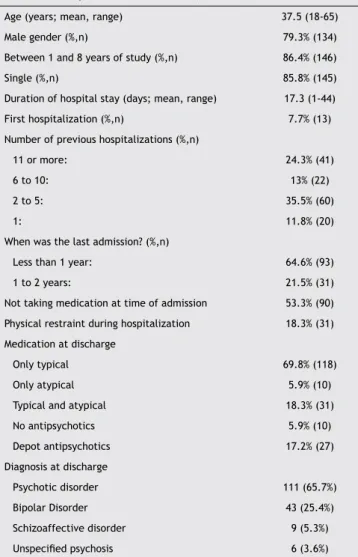
hospital stay, number of previous hospitalizations and time since the illness began (data not shown). The majority of par-ticipants were single males, with their last admission within one year before study entry (64.6%). Sample characteristics are shown in Table 1. Of the 169 individuals of the study, 72 (42.6%) were readmitted at least once within 12 months of their hospital discharge date.
At the 1-month post-discharge time-point, not taking medication before the hospitalization was protective (OR = 0.2, 0.1-0.7 95%CI) and physical restraint during admission was a risk factor (OR = 7.4, 1.9-28.4 95%CI). At the 2-month time-point, again, not taking medication before the hospitalization was protective (OR = 0.3, 0.1-0.8 95%CI) and physical restraint during admission was a risk factor (OR = 5.4, 1.5-19.2 95%CI). Depot antipsychotics at discharge were also a risk factor (OR = 6.0, 95%CI 1.7-21.8). At the 12-month time-point not taking medica-tion before the hospitalizamedica-tion was protective (OR = 0.3, 0.1-0.9 95%CI) and physical restraint during hospital stay was a risk factor (OR = 10.5, 2.2-50.8 95%CI). Having 11 or more previous admissions was a risk factor for individuals contacted at this time (OR = 8.8, 95%CI 1.1-68.6), as well as not going to outpa-tient consultations after discharge (OR = 8.5, 95%CI 2.3-31.2). Summing data from all time points in the “re-hospitalization survival” model, a higher number of previous admissions
Table 1 Sample characteristics (n = 169)
Age (years; mean, range) 37.5 (18-65)
Male gender (%,n) 79.3% (134)
Between 1 and 8 years of study (%,n) 86.4% (146)
Single (%,n) 85.8% (145)
Duration of hospital stay (days; mean, range) 17.3 (1-44)
First hospitalization (%,n) 7.7% (13)
Number of previous hospitalizations (%,n)
11 or more: 24.3% (41)
6 to 10: 13% (22)
2 to 5: 35.5% (60)
1: 11.8% (20)
When was the last admission? (%,n)
Less than 1 year: 64.6% (93)
1 to 2 years: 21.5% (31)
Not taking medication at time of admission 53.3% (90)
Physical restraint during hospitalization 18.3% (31)
Medication at discharge
Only typical 69.8% (118)
Only atypical 5.9% (10)
Typical and atypical 18.3% (31)
No antipsychotics 5.9% (10)
Depot antipsychotics 17.2% (27)
Diagnosis at discharge
Psychotic disorder 111 (65.7%)
Bipolar Disorder 43 (25.4%)
Schizoaffective disorder 9 (5.3%)
(OR = 6.6 to 11.9) and not attending outpatient consultations (OR = 3.2, 95%CI 1.5-7.2) were also risk factors. What was consis-tent among all models was family’s agreement with permanent hospitalization of the mentally ill being a risk factor (OR ranging from 3.5 to 10.9). Other variables, such as age, sex, duration of hospital stay, antipsychotics dose, type of antipsychotics and number of psychotropics at discharge, as well as taking medica-tions after discharge, did not show a signiicant correlation to readmission in any of the models (Table 2).
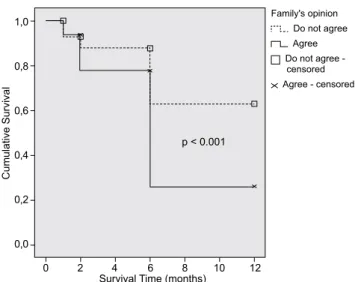
All the above-mentioned variables were used in the Cox proportional hazards regression model, which after 8 steps indicated “family’s agreement with permanent hospitaliza-tion of the mentally ill” as the best predictor for time to one-year re-hospitalization (OR = 2.24, 95%CI 1.34-3.75). Thus, Kaplan-Meier survival analysis showed that individuals whose family agreed with permanent hospitalization had a signiicantly worse outcome with a shorter time to re-hos -pitalization (mean survival time = 10.44 vs. 11.00 months; chi2 = 13.65, p < 0.001) (Figure 1). Individuals readmitted
were signiicantly more stereotyped as dangerous (chi2 = 9.76,
p < 0.01) and ill (chi2 = 12.01, p < 0.01) (Figure 2).
Table 2 Logistic regression of re-hospitalization at different time-points and re-hospitalization survival
1 month (n = 145)
2 months (n = 136)
6 months (n = 134)
12 months (n = 108)
Re-hospitalization suvival (n = 169)
OR (95%CI)
OR (95%CI)
OR (95%CI)
OR (95%CI)
OR (95%CI)
Higher age * * 0.9
(0.9-1.0)
* 1.0
(0.9-1.0)
Number of previous hospitalizations
0 * * * 1 1
1 0.5
(0.0-9.7)
2.4 (0.3-17.5)
2 to 5 3.5
(0.5-26.1)
6.6 (1.2-37.1)
6 to 10 6.0
(0.6-56.6)
10.8 (1.6-75.2)
11 or more 8.8
(1.1-68.6)
11.9 (1.9-74.7)
Not taking medication before hospitalization 0.2 (0.1-0.7)
0.3 (0.1-0.8)
* 0.3
(0.1-0.9)
0.5 (0.2-1.0)
Physical restraint during hospital stay 7.4 (1.9-28.4)
5.4 (1.5-19.2)
* 10.5
(2.2-50.8)
*
Longer hospitalization 0.9
(0.9-1.0)
* * * *
Number of psychotropics on discharge * 0.7
(0.4-1.0)
* * *
Depot antipsychotic on discharge * 6.0
(1.7-21.8)
* * *
Not attending to consultations after discharge * * * 8.5
(2.3-31.2)
3.2 (1.5-7.2)
Agreement with permanent hospitalization 5.0 (1.7-14.7)
3.8 (1.3-10.7)
4.1 (1.6-10.6)
10.9 (3.1-37.9)
3.5 (1.6-7.6)
* Variable not present in the inal model.
Figure 1 Kaplan-Meier Survival functions according to family’s agreement with permanent hospitalization.
C
u
mu
la
ti
ve
Su
rvi
va
l
Survival Time (months) p < 0.001
0 2 4 6 8 10 12 1,0
0,8
0,6
0,4
0,2
0,0
Family's opinion Do not agree Agree Do not agree - censored
When asked what could have possibly prevented the re-hospitalization, families were unanimous in choosing the option that “the patient should have stayed longer in the hospital before leaving it”. No family stated insuficiency of outpatient services as the cause of re-admittance.
Discussion
This is one of the few studies to analyze re-hospitalization rates in a Latin American country where psychiatric beds have been drastically reduced.32 Our results showed that in such
settings stigma might play an important role in inluencing readmission.
Similar to what is usually stated in the literature,33,34
after one year the re-hospitalization rate for individuals of the sample was of 42.6%. Not taking medication before index hospitalization was protective, whereas physical restraint during hospitalization was a risk factor for readmission in most models. Depot antypsichotics on discharge was a risk factor for the 2-month assessment point, while greater number of previous admissions and not attending consulta-tions after discharge were factors related to the 12-month assessment and to the survival model. Family’s agreement with permanent hospitalization of the individual with mental illness was the variable associated with readmission in all models, being the best predictor for readmission and result-ing in a shorter survival time to rehospitalization. Also, those readmitted were stereotyped as dangerous and unhealthy. Families complained about the short duration of hospitaliza-tion as the main cause for rehospitalizahospitaliza-tion.
Our results suggest that risk to readmission may depend mainly on three factors: adherence, severity of illness and stigma.
The main reason for admission for patients reporting that they were “not taking medication at time of admission” probably was their non-compliance to medical treatment.35-37
For adherent patients who reported they were taking their medication, stigma or refractoriness might have been the cause of admission instead. For patients reporting not taking medication before hospital entrance, the admission itself and the restored adherence during their hospital stay protected them against future hospitalizations and thus non-adherence turned into a protective factor (for the other patients, ad-mission did not interfere with stigma and refractoriness).
Along the same lines, in clinical practice depot-medication is usually administered for those who are non-adherent.38,39
At the 2-month post-discharge period, haloperidol-decanoate (the only depot antipsychotic available in the public health system) administered just before departure would no longer produce an effect; consequently, non-adherent individuals discharged on this medication became more prone to rehos-pitalization at this period. Another proxy to non-adherence acting as a risk factor, for instance, would be not attending outpatient treatment after leaving the hospital.
As for the second factor, when considering medication quantity as a proxy for illness severity, variables related to this issue did not show a correlation. With the exception of the above-cited depot-antipsychotic, the type of antipsychot-ics again did not predict earlier re-hospitalization, similarly to what was suggested by Kennedy and colleagues.40 However,
the need for physical restraint during hospitalization could indicate a more aggressive behavior, being a consequence of a more severe disorder or even a non-compliance character-istic of the individual.37 As in our indings, other studies have
shown that the number of previous hospitalizations was the strongest predictor for rehospitalization;41 this fact could
also be interpreted in part as a proxy for disorder severity. These irst two factors are well described in the litera -ture. What our study brings to light, though, is the third factor mentioned: stigma and readmission. The family’s agreement with permanent hospitalization of the psychiat-ric patient was the best predictor of readmission and could be interpreted as a reiterated wish to institutionalize their relative with mental illness, to keep them away from the family. The number of previous hospitalizations as a risk fac-tor could also be seen as a relection or consequence of this desire. A hypothesis linking the three factors would be that stigma could possibly result in a vicious cycle: more family stigma leads to neglect of the relative’s treatment, which in turn could lead to worse symptom control, leading to more stigma and recurrent hospitalizations. This could worsen the outcome, make the disorder chronic, and, inally, consolidate stigma. Also, if long-term hospitalization is no longer possible today due to worldwide mental health care reform, which has also reached Brazil,42 such a desire to segregate the
in-dividual with mental illness from society could probably be camoulaged into multiple brief hospitalizations. This is also reinforced by the fact that those with family stigma had a signiicantly shorter survival to readmission.
Although several studies have assessed stigma towards mental illness in São Paulo and Brazil in general,43-45 none
have linked stigma to their practical consequence, such as higher readmission rates. Accordingly, literature states that stigma comprises three different but correlated aspects: stereotyping, prejudice and social distance.46 Stereotypes
are knowledge structures designed to categorize people in order to deal with them. Re-hospitalized individuals were repeatedly stereotyped as dangerous and unhealthy. Their families more often reported beliefs that people with mental illness should be permanently hospitalized (prejudice) and, therefore possibly brought these patients more often for psychiatric hospital admission (social distance).
Finally, what might also be seen somewhat as a sign of stigmatization of individuals with mental illness is that all families stated a short duration of hospitalization as the
Figure 2 Stereotypes attributed to patients compared to someone of the general population, considering survival to re-admission after 12 months.
Dangerous
Not Readmitted Readmitted Not Readmitted Readmitted
Healtlly Stereotype is:
Less present More present 100%
75%
50%
25%
0% 7%
18%
46%
32%
10%
2% 58%
major cause of re-hospitalization instead of an insuficiency of outpatient services. This reveals the hospital-based treatment beliefs of these families, despite all efforts to maintain the individual with psychiatric disorders integrated into the community.
One limitation of the study is that side-effects were not addressed after discharge. As the majority of the sample was under the effect of typical anti-psychotics, side-effects related to them could be an issue inluencing adherence and relapse, for example. However, type of anti-psychotics was not signiicantly related to compliance issues, and were excluded from inal regression models. Another debatable point is that, although the study is representative of bipolar and psychotic patients of the public mental health system, no data on the private system is available. Thus, it would be of interest to know whether the indings are different for those using the private health system for psychiatric issues. One could argue that another limitation is that no structured instrument evaluating illness severity could be applied before the patients left the hospital, since this was an observational study. However, we chose to use several variables such as physical restraint and medication issues as proxy to case severity.
Conclusion
The present study replicates indings of the literature report -ing that factors such as adherence and severity of illness might inluence readmission rates. However, stigma was also observed as an important factor contributing to the risk of re-hospitalization. A family’s wish to keep individuals with mental illness permanently hospitalized might contribute to the “revolving door” readmission pattern of their relatives with psychiatric disorders.
Therefore, in order to more precisely depict the nature of this correlation between stigma and readmission rates, more studies in the ield should be conducted. Also other services and regions of the country should be involved, so as to assess whether this is related to the psychiatric culture of the Brazilian population, or with mental health care reform, for example. Those families whose relatives have recurrent hospitalizations should be especially addressed regarding, for instance, stigma and beliefs about psychiatric illness and psychiatric treatment.
Acknowledgments
The author would like to thank Dr. Eduardo Guidolin and Dr. Jeferson Valim for supporting the conduction of the study, and Prof. Yuan-Pang Wang and Prof. Wulf Rössler for the advice on the preparation of the present manuscript.
Disclosures
Alexandre Andrade Loch
Employment: Department and Institute of Psychiatry, School of Medicine, Universidade de São Paulo, Brazil. Other: Centro de Atenção Integrada em Saúde Mental Philippe Pinel – Secretaria de Estado de Saúde de São Paulo, Brazil.
* Modest
** Signiicant
*** Signiicant. Amounts given to the author’s institution or to a colleague for
research in which the author has participation, not directly to the author.
References
1. Foucault M. History of Madness. Abingdon, Oxford (UK): Routledge; 2009.
2. Shorter E. The history of Psychiatry: From the Era of the Asylum to the Age of Prozac. New Jersey (USA): Wiley; 1998.
3. Hudson CG, DeVito JA. Mental health under national health care reform: the empirical foundations. Health Soc Work. 1994;19(4):279-87.
4. Kavanagh S, Knapp M. Mental health care reform. Ment Health Rev. 1995;2:5-8.
5. World Health Organization. Mental health policy project: policy and service guidance package – Executive summary. Geneva, Switzerland: World Health Organization; 2001
6. Liptzin B, Gottlieb GL, Summergrad P. The future of psychiatric services in general hospitals. Am J Psychiatry. 2007;164:1468-72. 7. Saxena S, Sharan P, Cumbrera MG, Saraceno B. World Health
Organization’s Mental Health Atlas 2005: implications for policy development. World Psychiatry. 2006;5(3):179-84.
8. Priebe S, Badesconyi A, Fioritti A, Hansson L, Kilian R, Torres-Gonzales F, Turner T, Wiersma D. Deinstitutionalisation in mental health care: comparison of data on service provision from six European countries. BMJ. 2005;330:123-6.
9. Ufing HT, Ceha MM, Saenger GH. The development of
de-institutionalization in Europe. Psychiatr Q. 1992;63(3):265-78. 10. Thornicroft G, Gooch C, Dayson D. The TAPS project. 17:
Readmission to hospital for long term psychiatric patients after discharge to the community. BMJ. 1992;305(6860):996-8. 11. Furlan PM, Zuffranieri M, Stange F, Ostacoli L, Patta J, Picci
RL. Four-year follow-up of long-stay patients settled in the community after closure of Italy’s psychiatric hospitals. Psychiatr Serv. 2009;60(9):1198-202.
12. Torrey EF. Out of the shadows: confronting America’s mental illness crisis. New York (USA): John Wiley & Sons; 1997. 13. Rose D, Willis R, Brohan E, Sartorius N, Villares C, Wahlbeck
K, Thornicroft G; INDIGO Study Group. Reported stigma and discrimination by people with a diagnosis of schizophrenia. Epidemiol Psychiatr Sci. 2011;20(2):193-204.
14. Sartorius N. Fighting schizophrenia and its stigma. A new World Psychiatric Association educational programme. Br J Psychiatry. 1997;170:297.
15. Stuart H. Fighting the stigma caused by mental disorders: past perspectives, present activities and future directions. World Psychiatry. 2008;7(3):185-8.
16. Falk G. Stigma: how we treat outsiders. New York (U.S.A.): Prometheus Books; 2001.
17. Haywood TW, Kravitz HM, Grossman LS, Cavanaugh JLJr, Davis JM, Dan A. Predicting the “Revolving Door” phenomenon among patients with schizophrenic, schizoaffective and affective disorders. Am J Psychiatry. 1995;152:856-61.
18. Lien L. Are readmission rates inluenced by how psychiatric
services are organized? Nord J Psychiatry. 2002;56(1):23-8. 19. Harrison-Read P, Lucas B, Tyrer P, Ray J, Shipley K, Simmonds
S, Knapp M, Lowin A, Patel A, Hickman M. Heavy users of acute psychiatric beds: randomized controlled trial of enhanced community management in an outer London borough. Psychol Med. 2002;32:403-16.
20. Rüsch N, Corrigan PW, Wassel A, Michaels P, Larson JE.
Self-stigma, group identiication, perceived legitimacy of
discrimination and mental health service use. Br J Psychiatry. 2009;195(6):551-2.
21. Gleeson JFM, Alvarez-Jimenez M, Coton SM. A systematic review of relapse measurement in randomized controlled trials of
relapse prevention in irst-episode psychosis. Schizophr Res.
22. Castro AP, Elkis H. Rehospitalization rates of patients with schizophrenia discharged on haloperidol, risperidone or clozapine. Rev Bras Psiquiatr. 2007;29(3):207-12.
23. Kim JH, Kim D, Marder SR. Time to rehospitalization of clozapine versus risperidone in the naturalistic treatment of comorbid alcohol use disorder and schizophrenia. Prog Neuropsychopharmacol Biol Psychiaty. 2008;32(4):984-8. 24. Prefeitura de São Paulo. Sao Paulo, Brazil, Secretaria Municipal
de Planejamento, 2010. Available from: URL: http://sempla. prefeitura.sp.gov.br/infogeral.php.
25. Ministério da Saude. Reforma Psiquiátrica e política de saúde mental no Brasil. Conferência Regional de Reforma dos Serviços de Saúde Mental: 15 anos depois de Caracas. Brasília, Brasil: Ministerio da Saude; 2005.
26. Paim J, Travassos C, Almeida C, Bahia L, Macinko J. The Brazilian health system: history, advances, and challenges. Lancet. 2011;377(9779):1778-97.
27. Gentil V. Principles that should guide mental health policies in low-and middle-income countries (LMICs): lessons from the Brazilian experiment. Rev Bras Psiquiatr. 2011;33(1):2-3. 28. Zappitelli MC, Gonçalves EC, Mosca I. Panorama da Saúde Mental
no Estado de São Paulo: leitos psiquiátricos e assistência extra-hospitalar. São Paulo, Brasil: Secretaria de Estado da Saude de Sao Paulo; 2005.
29. Saxena S, Thornicroft G, Knapp M, Whiteford H: Resources
for mental health: scarcity, inequity and ineficiency. Lancet.
2007;370:878-89.
30. Ministerio da Saude. DATASUS, Departamento de Informática do SUS, 2010. Available from: URL: http://www2.datasus.gov. br/DATASUS/index.php .
31. Lauber C, Nordt C, Rössler W: Do mental health professionals stigmatize their patients? Acta Psychiatr Scand Suppl. 2006;429:51-9.
32. Almeida JMC, Horvitz-Lennon M. An overview of mental health care reforms in Latin America and the Caribbean. Psychiatr Serv. 2010;61(3):218-21.
33. Montgomery P, Kirkpatrick H. Understanding those who seek frequent psychiatric hospitalizations. Arch Psychiatr Nurs. 2002;16:16-24.
34. Schmutte T, Dunn CL, Sledge WH. Predicting time to readmission in patients with recent histories of recurrent psychiatric hospitalization. A matched-control survival analysis. J Nerv Ment Dis. 2010;198:860-3.
35. Ayuso-Gutierrez JL, del Rio Vega JM. Factors influencing relapse in the long-term course of schizophrenia. Schizophr Res. 1997;28:199-206.
36. Bobo WV, Shelton RC. Risperidone long-acting injectable (Risperdal Consta®) for maintenance treatment in patients with bipolar disorder. Expert Rev Neurother. 2010;11:1637-58. 37. Llorca PM. Partial compliance in schizophrenia and the impact
of patient outcomes. Psychiatry Res. 2008;161:235-47. 38. Agid O, Foussias G, Remington G. Long-acting injectable
antipsychotics in the treatment of schizophrenia: their role in relapse prevention. Expert Op Pharmacother. 2010;14:2301-17. 39. El-Mallakh RS. Medication adherence and the use of long-acting
antipsychotics in bipolar disorder. J Psychiatr Pract. 2007;2:79-85. 40. Kennedy J, Tien YY, Cohen LJ, Sclar DA, Liu D, Blodgett EG,
Engle J. The association between class of antipsychotic and rates of hospitalization: results of a retrospective analysis of
data from the 2005 Medicare Current Beneiciary Survey. Clin
Ther. 2006;31(12):2931-9.
41. Bernardo AC, Forchuk C. Factors associated with readmission to a psychiatric facility. Psychiatr Serv. 2001;52(8):1100-2. 42. Andreoli SB, Almeida-Filho N, Martin D, Mateus MD, Mari Jde J.
Is psychiatric reform a strategy for reducing the mental health budget? The case of Brazil. Rev Bras Psiquiatr. 2007;29(1):43-6. 43. Villares CC, Redko CP, Mari JJ. Concepções de doença por
familiares de pacientes com diagnóstico de esquizofrenia. Rev Bras Psiquiatr. 1999:21(1):36-47.
44. Loch AA, Hengartner MP, Guarniero FB, Lawson FL, Wang YP, Gattaz WF, Rössler W. Psychiatrists’ stigma towards individuals with schizophrenia. Rev Psiq Clín. 2011;38(5):173-177. 45. Peluso ETP, Blay SL. Public stigma and schizophrenia in São Paulo
city. Rev Bras Psiquiatr. 2011:33(2):130-6.