UNIVERSIDADE DA BEIRA INTERIOR
Ciências Sociais e Humanas
Trade Credit, inventories and contagion effect:
Evidence from Portuguese SME
Marina Marques Monteiro
Master submitted for requirement to the degree of Master in
Management
(2nd cycle of studies)
Advisor: Prof. Doutora Ana Paula Matias Gama
Co-advisor: Prof. Doutor João Monteiro
Acknowledgements
This dissertation would not have been possible without the support and knowledge of my professor. I am especially grateful to Prof. Doutora Ana Paula Matias Gama for her rigor and constructive comments that enlightened me on many perspectives of my research.
I'm also thankful to Universidade da Beira Interior, that provide me in two years of investigation a substantial amount of resources that have allowed me to get further in this research. Additionally, to my other professors that during first year of master degree shared their knowledge with me.
Thank you to my parents, sister, brother in law and nephew, for the amount of time and effort to get me sane and motivated. A very special thanks to João Antunes, for his always great mood, patience, his tremendous support and encouragement.
Resumo
Esta investigação procura avaliar se a motivação para a gestão de inventários explica o uso do crédito comercial, bem como se algum efeito de contágio ocorre no crédito comercial durante períodos de crise financeira. Desta forma, através de um painel de dados referente a empresas industriais Portuguesas de pequena e média dimensão que abrangem o período de 2000 a 2009, e utilizando a metodologia de dados em painel, os resultados confirmam a existência de um incentive para as empresas procurarem e concederem crédito comercial. Este incentivo baseia em primeiro lugar na promoção das vendas, e sem segundo lugar, na redução dos inventários e dos custos que lhe estão associados. Além disso, as restrições de crédito frequentes em períodos de crise financeira leva a que empresas com elevadas contas a receber adiem os pagamentos aos fornecedores. Particularmente, empresas com risco elevado recebem mais crédito dos seus fornecedores uma vez que estes estão mais sensibilizados para a sobrevivência dos clientes.
Palavras-chave
Abstract
This investigation access if an inventory management motivation could explain the use trade credit, as well if a trade credit contagion effect occurs during periods of financial crisis. Therefore, a panel dataset of Portuguese manufacturing SME firms, over the period of 2000-2009, and employing a panel data methodology, the results confirm the existence of an incentive for firms to offer and receive trade credit in order to promote sales in the first instance, and in a second instance, to reduce inventory levels and the associated costs. Moreover, credit constraints during a financial crisis cause firms holding high-levels of accounts receivable to postpone payments to suppliers. Specifically, high-risk firms receive more suppliers’ credit due to suppliers concern about their customer's survival.
Keywords
Index
1.INTRODUCTION 1
2.LITERATURE REVIEW 7
2.1.FINANCIAL MOTIVATIONS 7
2.2.TRANSACTION MOTIVATIONS 11
3.THEORY AND RESEARCH HYPOTHESES 17
3.1.BOUGHEAS,MATEUT AND MIZEN (2009) MODEL:AN OVERVIEW 17
3.2.RESEARCH HYPOTHESES 18
4.DATA, EMPIRICAL MODEL AND METHOD 27
4.1.DATA 27 4.2.EMPIRICAL MODEL 28 4.3.METHOD 31 5.EMPIRICAL RESULTS 33 5.1.UNIVARIATE ANALYSIS 33 5.2.MULTIVARIATE ANALYSIS 37 6.CONCLUSION 49 APPENDIXIES 53 REFERENCES 57
List of Figures
FIGURE 1 Univariate analysis: Trade Credit offered and received, 35 scaled by total sales, by year.
FIGURE 2 Univariate analysis: Trade Credit offered and received, 36 scaled by total assets, by year.
List of Tables
TABLE 1 Independent variables and expected sign 25
TABLE 2 Univariate analysis: Descriptive statistics 33
TABLE 3 Univariate analysis: Trade Credit offered and received by year 34
TABLE 4 Univariate analysis: Trade Credit offered and received by size 37
TABLE 5 Multivariate analysis: Relationship between trade credit offered and firm’s characteristics 39
TABLE 6 Multivariate analysis: Relationship between trade credit received and firm’s characteristics 40
TABLE 7 Multivariate analysis: Influence of the financial crisis on trade
List of Acronyms
AP Accounts Payable
AR Accounts Receivable
CAE Classificação de Actividades Económicas EOQ Economic Order Quantity
FE Fixed Effects
GPEARI Gabinete de Planeamento, Estratégia, Avaliação e Relações Internacionais
IAPMEI Instituto de Apoio às Pequenas e Médias Empresas e à Inovação INE Instituto Nacional de Estatística
JIT Just-in-Time
RE Random Effects
SABI Iberian Balance sheet Analysis System SME Small and Medium Size Enterprise UBI Universidade da Beira Interior
UK United Kingdom
1. Introduction
When supplier firms deliver goods to their customers, they often do not require to be paid immediately. Instead, who is delivering goods offers credit terms upon the purchase - accounts receivable (AR) - to who is receiving the goods and have the obligation to repay - accounts payable (AP). This practice is called trade credit.
Since trade credit requires two separate transactions - goods for a loan and loan for money - to effect what is essentially one exchange - goods for money; suppliers effectively finance their customer's purchases with short-term debt. However, this is one particular type of short-term loan because, according with Cuñat (2012) it differs relatively to other types of corporate debt in three main aspects. First, suppliers lend ‘in kind’, not in cash. Second, in contrast with bank loans, trade credit is frequently not subject to specific, formal contracts between the lender and the borrower. Finally, is issued by non-financial firms. This last feature is the most remarkable of this short-term financing source because suggests an intermediary role of trade credit (Bukart and Ellingsen, 2004).
Trade credit is a regular component of market transactions, representing an average of 8,22% of total assets of United States listed firms between 1992 and 2007 (Aktas, De Bodt, Lobez & Statnik, 2012). Similar observations have been made about firms in Europe as well. Guariglia and Mateut (2006) reported that in the United Kingdom, 70% of total short-term debt (credit extended) and 55% of total credit received by firms was made up of trade credit.
This dominance of trade credit within the sources of financing in first world countries is puzzling and likely to raise questions. By any standard, trade credit it is an expensive form of finance because of its implicit cost, which involves the
renounced rebate for cash payments that the firm suffers to benefit from payment delays (Aktas et al., 2012). In this case, why should a firm that specializes in production/sales act as a financial intermediary when specialized intermediaries, like banks, provide capital to financially constrained buyers in order to buy goods from sellers in goods markets? Why not cut out the middleman?
The literature in economics, finance and operations management has tried to provide theoretical explanations for trade credit usage. From these attempts, two major theories can be pointed out. Financial theories of trade credit (Meltzer, 1960; Schwartz, 1974; Emery, 1984; Smith, 1987; Nilsen, 2002) posit that firms with easy and ample access to credit markets finance those with limited access. However, these theories focus exclusively on how financial market imperfections, like information asymmetry (Biais and Gollier, 1997; Burkart and Ellingsen, 2004), can affect the demand of trade credit.
The non-financial theories deal with purely operational considerations for trade credit: allows for price discrimination (Brennan, Maksimovic and Zechner, 1988), serves as a warranty for product quality (Long, Malitz and Ravid, 1993), fosters long-term relationship with customers (Wilson and Summers, 2002), and optimize firm's cash and inventory management (Ferris, 1981; Emery 1987; Daripa and Nilsen, 2005; Bougheas, Mateut and Mizen, 2009).
Since trade credit combines the normal business activity of a firm – production/sell of goods - with financial intermediation - delayed payment (a function that was traditionally assumed by a financial institution); it allows a link between goods and financial markets, that goes further than the comparison of the relative costs of alternative forms of finance to firms.
Therefore, since the essence of this research arises from a distinctive motivation of the financial view of trade credit, relying on a more strategic view of trade credit; the present work attempts to assess if an inventory management, in the context of the transactions costs theory, exists as a motive for firms to use trade credit; i.e., to assess if when firms face product uncertainty, they are incentivized to increase overall sales trough the extension of trade credit to financially constrained customers, in order to reduce costly inventories, which can take too long time to be sold for cash.
Another purpose of this study is to determine if a trade credit contagion effect occurs during periods of financial crisis, and how is that affects trade credit policies. This latter motivation has arisen from the fact that global economy went, very recently, through a financial crisis (2008-09). Thus, once that financial crisis causes financial contagion between financial intermediaries, and because of that a trade credit contagion in the supply chain may occurs; this topic is then of enormous relevance to be studied.
Considering in greater detail the model proposed by Bougheas et al. (2009) and Bastos and Pindado (2013), this investigation employs a panel data methodology to test for Portuguese SME firms the response of accounts payable and accounts receivable, proxies to trade credit demand and supply, respectively; to changes in the cost of inventories, profitability, risk profile, liquidity position and bank finance access; and to financial crisis, when a credit contagion effect occurs on trade credit channel. The sample, extracted from SABI (Iberian Balance sheet Analysis System), covers a ten years period, ranging since 2000 until 2009.
This is a distinctive study because in a first instance, it relies on a literature stream that frequently do not explores inventory transactions costs as a motive for offering trade credit. The few studies on this area are mainly the ones from Emery
(1987), Daripa and Nilsen (2005), Bougheas et al. (2009), and Mateut, Mizen and Ziane (2011). Moreover, to our knowledge, this is the first study to address the reason for inventory management in Portuguese firms.
As already mentioned, the sample in analysis regard Portuguese firms. Ferrando and Mullier (2013) using observations from 8 euro area countries in the period 1993-2009, showed that trade credit channel was a major element of corporate finance for firms located in Mediterranean countries, such as Italy, Spain and Portugal, to which trade credit channel represented 51%, 45% and 44% of the firm's total assets, respectively. Specifically to Portuguese firms, they show that in general, accounts receivable are higher than accounts payable. In the last year of the study (2009), accounts receivable were almost 30% of total assets, and accounts payable exceeded slightly more than 15% of total assets.
Finally, the SME’s firms are the study focus since they are predominant in corporate structure of the Portuguese industrial sectors and widely recognized as the mainstay of the national economy. In 2008, there were 349.756 micro, small and medium enterprises in Portugal, representing 99,7% of the non-financial corporate sector, which were responsible for 72,5% of employment in companies in the non-financial sector and for 57.9% of turnover (INE, 2010). Moreover, according with Ferrando and Mulier (2013) results, within the group of countries studied, Portugal was the second country with the highest percentage of small firms (91%), in the universe of firms studied, i.e., small, medium and large.
Two main results were observed from the tests to predictions of the study. First, in line with Bougheas et al. (2009), inventories have direct influence on both accounts payable and receivable, even after controlling for firm's characteristics.
This confirms the existence of an inventory management purpose for Portuguese SME firms in providing credit to their customers. Second, in concordance with Bastos and Pindado (2013), during financial crisis a cascade trade credit contagion in the supply chain arise, increasing consequently the use of trade credit. Specifically, high-risk firms receive more suppliers’ credit due to suppliers concern about their customer's survival.
The study is structured in the following way. The next section presents an overview about trade credit literature. The third section describes the theory and research hypotheses. Data, empirical model and method are presented in section four. The fifth section present and discuss the results concerning the response of accounts receivable and payable to changes in the cost of inventories, profitability, risk, liquidity, bank debt, and to the occurrence of a credit contagion effect during periods of financial crisis. Section six summarizes the main conclusions.
2. Literature review
There has been a long debate in the literature about the motives that suppliers and customers face in offering or receiving trade credit. Theoretical studies on trade credit developed different models not necessarily mutually exclusive directions to explain the existence of trade credit (e.g., Long et al., 1993). But the most inconclusive question is why non-financial firms (i.e., suppliers) participate in the financial intermediation process by extending trade credit (i.e., to customers), when there are specialized financial intermediaries, such as commercial banks.
The literature appoints two distinct motives to justify the delay of payment in transaction of goods: (i) Financial and, (ii) Transaction Motivations. More recent Schiozer and Brando (2011) provides three hypotheses to justify the use of trade credit: (i) Trade credit as a substitute to bank loans; (ii) trade credit as complement to bank loans and, (iii) trade credit as a strategic instrument for the agents (i.e., suppliers and customers).
Next, we summarise these three strands of the literature, combining it with early classifications. Thus, the first two hypotheses relate to financial motivations, while the latter is related to the transaction motives.
2.1. Financial motivations
There is significant relationship between two primary sources of financing firm’s current activities: trade credit and bank credit. Beside the high implicit interest rate that firm suffers to not benefit from payment delays associated the renounced rebate for cash payments, customers prefer to increase liabilities to suppliers of
goods and services, instead of taking a lower interest rate charged by financial institutions for working capital loans (Aktas et al., 2012).
This puzzling choice, according to Atanasova (2007) can be justified by two lines of research within financial motivations: (i) a demand effect that implies firms to use trade credit because they are denied access to institutional finance, and (ii) a supply effect, that assume trade credit granted by suppliers as a facilitator way to access to institutional loans.
The first line of research mentioned was firstly raised by Meltzer (1960) and is known as SUBSTITUTION HYPOTHESIS. From a macroeconomic point of view, he
suggested that exists a trade credit channel that mitigates restrictions in obtaining conventional bank lending by firms discriminated by monetary restriction policy, - traditionally small businesses. In turn, large companies use their ability to access the capital markets to extend financial support to customers in this situation.
In the same point of view, recently Nilsen (2002) claims that when monetary authorities are conducting a restrictive policy, particularly in periods of recession, the supply of external finance may decrease significantly, such that a sufficient allocation of funds to all demanding borrowers may no longer be possible, creating the need for alternative channels to manage growth. Therefore, trade credit is a substitutable form of bank financing available not only for big companies but also virtually the only source of alternative funding for small firms.
However, a more pure financial perspective than that Meltzer (1960) explains the role of trade credit is due to the existence of market imperfections. Stiglitz and Weiss (1981) show that due to unequal access to information about borrowers defaults risk - information asymmetry - creditworthy borrowers are difficult to
appropriate to its risk class, financial institutions face an adverse selection problem, which forces them to rationing credit. As a result, some borrowers that have excess bank credit demand are forced to use other alternative sources of financing.
In this context, Schwartz (1974) examined the financial motive as a response to credit rationing, which does not have a homogeneous effect across firms. For this reason, trade credit flows primarily from companies that have easier access to capital markets - it specifies as the more liquid firms, usually large firms-, that act as financial intermediaries, utilizing their borrowing capacity in order to channel more of their monetary resource, to those that have difficulties to access them - again he specifies as the less liquid firms (i.e., small firms).
Emery (1984) analysed the financial market imperfections, focusing purely on financial intermediation motive. He argues that capital market imperfections require selling firms to maintain adequate liquid reserves, which they can invest in marketable securities or lend out through trade investments. Smith (1987), focusing on informational asymmetry present in financial markets, showed that the terms of trade credit act as a signal. Through the establishment of high implicit interest rates, creditors can obtain private and high value information about debtor risk of default.
At this point, market imperfections provide an excellent basis for trade credit. Once that customer’s of product markets are more homogeneous than in financial markets, the extension of trade credit involves a supplier’s cost advantage over third party intermediaries (Emery, 1984) that allows them to offer trade credit at an implicit interest rate that is lower than the purchaser could obtain elsewhere.
According to Emery (1987), the information costs include the search costs, which is inexistent because borrowers are already customers; and the cost of assessing and monitoring default risk, which due to the frequency of interactions and contacts
implicit on the selling process (Petersen and Rajan, 1997), enables suppliers to monitor the business and assess the creditworthiness, not only at a lower cost, but also in a timely manner.
Collection costs are other advantage of supplier firms over financial intermediaries (Emery, 1984). A more recent explanation of this cost advantage in achieving the credits was given on Frank and Maksimovic (2005), where they relate the use of trade credit with legal ability of creditors to repossess goods as collateral in a scenario of bankruptcy. Once that inputs sold on credit can provide collateral to suppliers, in case of customers do not pay, suppliers are in better position than financial institutions to repossess and liquidate those assets, in order to recoup the full value of goods; because the seller is in the industry, having established a sales network and own distribution channels that allows them to redirect the goods to its other customers, while a bank has no such network (Petersen and Rajan, 1997).
Enforcement advantage is another advantage listed in the literature and is related with threaten power of the suppliers. If supplier’s products constitute a large share in the buyer’s sales, the risk of interruption in the supply of an essential input is more fatal than the risk of losing future access to the financial market, thus according to Petersen and Rajan (1997), the likelihood to buyer's failure a payment on a trade credit loan is lower than a market loan. Later, Cuñat (2007) argued that not only customers are more willing to repay their suppliers, but also suppliers will effectively provide liquidity, through debts forgiven and extension of maturity period of credit, in order to increase the survival chances of their customer when these experience temporary liquidity shocks. These results establish trade credit as type of insurance.
credit mostly is short-term (e.g., Burkart and Ellingsen, 2004). Since firms need short-term and long-term credit as well, both types of credit are complementary rather than substitutable.
Biais and Gollier (1997) article was pioneer in the analysis of the dynamic and complementary relationship existing between trade credit and bank credit. Their model emphasizes the different signals that banks and suppliers have about borrower’s creditworthiness. Since accounts payable reveals supplier’s unique and private information and act as a valuable and positive sign about a firm's quality, firms that cannot initially access bank debt may actually enhance their subsequent access to bank debt because banks, observing the use of trade credit, update their beliefs about a customer default risk and, therefore, are better positioned to identify healthy investment opportunities.
More recently, Burkart and Ellingsen (2004) show the supplier’s informational advantage was linked to the input transaction itself. In their model, trade credit usage increases the investment size, increasing consequently the residual return; however, unlike banks suppliers are less concerned with resource diversion by their customers because they borrow goods instead of money. Thus, they argue that due to the illiquidity of inputs, moral hazard risk that is in the basis of resource diversion problem can be reduced. Firms financing their current activity with trade credit assume, in the presence of imperfect financial markets, a credible commitment not to divert, and then, as a consequence, banks are willing to increase their lending to that customer.
2.2. Transaction motivations
The theories about financial motivations explains the existence of trade credit, but these arguments still not be sufficient to explain the existence of a trade credit
channel. For example, why small suppliers offer trade credit? Or on the other hand, why large buyers often take trade credit? Why trade credit terms vary between customers and industries?
To answer these questions, literature also provides non-financial motives that consider that the trade credit involves purely operational considerations for transactions (Ferris, 1981). From the existing literature, four main transaction motives can thus be established for trade credit usage: (i) allow firms to practice price discrimination, (ii) offers implicit quality guarantees, (iii) promote long-term relationship with customers, and (iv) minimize transaction costs.
The underlying hypothesis about price discrimination was for the first time analysed by Meltzer (1960), who found that through the increase and decrease of the extent of average collection periods – administered prices -; firms are able to increase overall sales and obtain liquidity during periods of tight monetary policy. This theory assumes that, although buyer heterogeneity should imply sellers to charge different prices to different customers but antitrust laws forbid direct price discrimination. In this context, Brennan et al. (1988) show that in the imperfectly competitive industries, upstream firms in production channel are able to offer trade credit as a so-called premium on risky customers. Offering different trade credit terms between customers paying in cash and using credit, firms can reduce the effective price to low-quality borrowers – typically credit rationed.
The literature also stresses out the role of trade credit as an effective warranty for product quality. According with Long et al. (1993), due to asymmetric information, firms without reputation or whose products are not well known in the product market, extend trade credit to signal the firm's quality control efforts. Thus,
The capitalization of benefits coming from long-term supplier/buyer relationships, as part of a long-term strategy; is another line of research within the transaction motive. According with Wilson and Summers (2002), if a seller have made specific investments in the buyer-seller relationship (either in physical or relationship terms), then it is in their economic interest to act to maintain the buyer in business so long as sufficient future returns are anticipated. Consequently the supplier will be more willing to extend credit (as a short-term loss), if they can perceive benefits of: (i) capturing and retaining new business, and (ii) future income stream originated by the long-term commitment to the market/customer, i.e., from the implicit equity stake in the customer business.
Finally, Ferris (1981) was one of the first to emphasise the importance of trade credit in reducing transaction costs between suppliers and their customers, showing that trade credit is a cash management tool. In his model, firms have to make optimal production decision before demand is realized. Thus, facing high degrees of uncertainty with respect to the timing and magnitude of orders, they are forced to increase precautionary cash. In this context, the author suggest that by the separation of the payment cycle and the delivery cycle, trade credit enables trading partners to forewarning the timing of money flows, pooling the trading risk present in stochastic money flow. As a consequence, by allowing the accumulation of invoices to be paid periodically instead of each moment that goods are delivered, trade credit decreases the number of settlements and the associated fixed costs. Moreover, it can reduce or eliminate transaction costs derived from situations of uncertainty on trade, including the costs associated with carrying/maintaining cash held as precautionary motive.
Another version of the theory of transaction costs assumes that when are wide instability in the pattern of consumption of the products of a company; in order to
maintain smooth production cycles; companies would have to maintain large inventories. This behaviour would involve two types of costs: (i) costs of storage, and (ii) financing costs to maintain inventories. In order to reduce them, suppliers may offer trade credit as an incentive to buyers to hold higher stocks of inventories, shifting inventory holding from seller to buyer.
Emery (1987) developed from the purely operational reason, a positive theory of trade credit. His results show that by partitioning the inventories costs into its operating and financial components through trade credit, the buyer and seller will specialize in the respective costs of accommodating variable demand and, consequently, perform economies of scale. The buyer incurs the operating cost. Because supplier's inventories are passed to buyers, they have to the carry out the storage cost, which includes inventory taxes, insurance, and expenditures to prevent or repair deterioration of stored goods. This increase on costs is partially but not completely offset by paying a lower price for inputs. The seller incurs the financial cost, which is related with the opportunity cost of late payment. Because trade credit smooth’s demand, the seller's wealth increases via total costs reduction.
The trade-off between inventories and trade credit was recently analysed by Daripa and Nilsen (2005). In their model, in the presence of demand uncertainty, the final producer decides whether to hold inventory to meet sales or to order supplies when final demand for goods arrives. The decision is influenced by the cost of holding the inventory, which is not based on storage costs, but on inventory financing costs to the final producer firm, which are often realized through bank loans. If their suppliers have better credit terms than banks to subsidy inventories, thus suppliers will provide trade credit to downstream firms, inducing them to hold the inventories.
production and sales when subject to uncertain demand. In their model, because of uncertainty on the transaction flows, upstream firm, in the middle of a product chain; are forced to hold inventories of unsold finished goods, which are held at a cost. In this context, the firm faces a trade-off between costly inventories and sales on credit. The supplier's willingness to offer trade credit on appropriate terms to enhance sales and boost demand rather than accumulate costly inventories of finished goods; it is limited by the need to obtain liquidity to meet their obligations. This result is especially true for small firms, which face higher storage costs, comparatively to large firms, since their capacity to store finished goods is smaller.
This investigation provides an overview of the most relevant studies on trade credit in appendix I.
3. Theory and research hypotheses
Since this work attempts to assess if an inventory management, in the context of the transactions costs theory, exists as a motive for firms to use trade credit; as well if a trade credit contagion effect occurs during periods of financial crisis, and how is that affects trade credit policies; in this section are derived testable hypotheses with respect to accounts receivable and accounts payable, taking into account the models reported by Bougheas et al. (2009) and Bastos and Pindado (2013).
3.1. Bougheas, Mateut and Mizen (2009) model: An overview
All firms in production chain finance their production every time they are paid for his goods at the moment of delivery. Some times however, firms might deliver the goods to their customers down the chain without requiring immediate payment. Thus, as Petersen and Rajan (1997) confirmed the use of trade credit of a firm is twofold, i.e., a firm that receive trade credit from his supplier will, in turn, extend trade credit to its own customers.
Considering an upstream firm in the production chain, that produces and sells intermediate goods to a downstream firm; when the production problem is deterministic, i.e., when demand is known; their optimal production decision is simple once there is no need to keep inventories in reserve for unexpected shocks. However, firms frequently make their optimal production decision in an environment where the final demand for its products is unknown. The qualitative effect of adding a stochastic component to demand require firm's to keep a stock of inventories on hand to deal with unexpected shocks. Obviously, all else equal, if there is a long lag between the production and the sale of goods, the supplier firm will have to bear out the financing cost of keeping unsold goods in inventory, until these are sold.
Once the upstream firm accept trade credit from its own suppliers, increasing their inventories; the firm clearly faces a trade-off which influences the levels of trade credit through two separate effects. First, the called sales motive incentives the supplier to sell on credit. Second, through the financial motive of reducing costs, trade credit transfers the holding costs of inventories from the supplier to its customers. However, the financial motive is a double-edged sword, because it encourages the supplier to offer trade credit to further reduce storage costs, but it also incentivizes the supplier to limit the amount of trade credit, in order to increase the liquid resources of the firm to meet their own obligations, i.e., needs in cash to repay its own trade creditors.
3.2. Research Hypotheses
The hypotheses about the response of accounts payable and receivable to changes to the cost of inventories, risk profile, profitability and liquidity position and bank loans (Bougheas et al. 2009), will be next established. Then, the behaviour of accounts receivable and payable will be analysed under the hypothesis that there is a contagion effect on trade credit channel during periods of crisis (Bastos and Pindado, 2013).
I
)
I
NVENTORIES ANDT
RADEC
REDITOne of the main variables of interest in use in this study is stock of inventories (𝑆𝑡𝑜𝑐𝑘𝑠). Although have not been used as explanatory variable in empirical studies many often, it will allow focusing the cost reduction due to reduced inventories, i.e., on how trade credit can be used for inventory management purposes (e.g., Emery, 1987; Daripa and Nilsen, 2005).
According to this motive, firms that accumulate large inventories of finished goods face high inventory costs, such as warehousing and stockout costs. Therefore, in order to avoid them, supplier firms will promote sales (in first instance), and consequently reduce the level of inventories, by extending trade credit to customer firms. From this point of view, it is expected a positive relation between inventory and trade receivables.
Additionally, since some firms have less flexibility in their choice of purchasing methods, particularly small firms (e.g., Fazel, 1997), some opt more frequently for methods that require higher levels of inventories1. Thus, considering that credit
conceived by suppliers imply a inventory shift from them to customer firms; small firms facing higher inventory costs at the margin, will show lower accounts payable. This way, and in line with Bougheas et al. (2009), it is expected a negative relation between inventory and accounts payable.
II) CHANGES IN RISK PROFILE, PROFITABILITY, LIQUIDITY POSITION AND BANK ACCESS
The study includes the “𝑅𝑖𝑠𝑘” variable, measure the firm’s probability of insolvency, to assess the credit quality of a firm that gives it access to formal credit. This variable will regard most the theoretical concept and the results considered by Bastos and Pindado (2013), which used probability of insolvency (PI) as a proxy for credit risk; than the similar variable considered by Bougheas et al. (2009).
The decision to extend trade credit terms must consider the trade-off between increased credit risk and enlarged income from sales. A seller that allows customers to delay cash payments in order to promote sales exposes a large proportion of assets
1 For example, the Economic Order Quantity (EOQ) purchasing option, which requires more inventories
than Just-in-Time (JIT) (Bougheas et al., 2009). This last option might be difficult to implement in small firms since they suffer several limitations (e.g., limited staffing and material resources, and reduced bargaining power with customers, suppliers and financial institutions).
to the threat that some portion of the receivables may never be collected. In other words, when a seller extends trade credit, he is assuming a credit risk. Therefore, when a customer goes bankrupt, due to marketable situations, which influence customer’s ability to regulate their accounts payable; it is likely to create not only a financial distress for credit supplier (bad debts) but also the loss of an important customer relationship.
Relatively to demand side, trade credit is most preferred by firms most likely to default. Risky-firms, i.e., firms with high probability of insolvency, which are incapable of raise internal liquidity and unable to obtain funds from financial markets, rely proportionally more on expensive financing from the suppliers in order to maintain operations and more importantly, to ensure own survival.
From this perspective, similarly to Bougheas et al. (2009) predictions, it is not possible to determine the sign of accounts receivable. However, it is probable that this explanatory variable will have positive coefficient relatively to accounts payable (e.g., Bastos and Pindado, 2013).
Another dimension of trade credit is firm's ability to generate cash internally, which is measured by the net funds provided by operations. Thus, “𝑃𝑟𝑜𝑓𝑖𝑡” (balance sheet item) is set out as a proxy to this variable. An obvious expectation is that firms with high margin, i.e., with sales higher than variable costs, have an incentive to make additional sales, because the next unit sold will generate an extra profit. Thus, more profitable firms will subsidize the low quality customers, through trade credit extension, in order to promote the sell of additional units (e.g., Petersen and Rajan, 1997; Bougheas et al., 2009).
Regarding accounts payable, profitable firms will acquire trade credit more easily from their suppliers (Bougheas et al., 2009). However, if there is a pecking-order behaviour involved in firms’ financing, firms with more internally generated resources will prefer to use these resources to finance investments instead of more expensive external finance (Myers and Majluf, 1984). If this proves to be an observable behaviour, profitability and accounts payable will be negatively correlated (Petersen and Rajan, 1997).
Therefore, the sign of the “𝑃𝑟𝑜𝑓𝑖𝑡” variable in the AP regression is considered to be uncertain. With basis on price-discrimination motive, a positive relation between profitability and accounts receivable could be expected.
A firm's holding of liquid assets (𝐿𝑖𝑞𝑢𝑖𝑑𝑖𝑡𝑦), which include cash and other short-term securities; has also been used on literature as explanatory variable (e.g.: Petersen and Rajan, 1997; Love, Preve and Sarria-Allende, 2007; Cuñat, 2007).
According to Bougheas et al. (2009), the inventory management motive justifies, once again, a firm’s trade credit usage. Due to the fact that firms with a liquidity deficit cannot hold inventories, firms are incentivized to increase liquid reserves through increased trade credit extension. On the demand side, in order to protect themselves from external shocks, firms may refrain from offering trade credit to their customers when they target a higher liquidity goal. Because of this, the authors have predicted a negative relationship between liquid assets and both accounts receivable and payable.
However, according to Van Horne and Wachowicz (2008:211), traditional prescription in corporate finance is to adopt a matching approach, i.e., firms should finance short-term needs with short-term funds, and long-term needs with long-term
funds. One would expect, therefore, is that firms with more liquidity should have a higher demand for accounts payable. Additionally, in line with Schwartz (1974), firms with more liquidity are in a better position to provide trade credit to their customers. In this case, liquidity and trade receivables would be positively related.
In short, due to the various conjunctures that allows the ”𝐿𝑖𝑞𝑢𝑖𝑑𝑖𝑡𝑦” variable, the relationship of accounts receivable and accounts payable with a firm liquidity position is stated as indeterminate.
Finally, “𝐵𝑎𝑛𝑘” variable, which measures short-term debt, was included in this study because firm's use of trade credit relies heavily on their use of bank loans (Bougheas et al., 2009). The focus on short-term debt for bank credit is because short-term loans are more likely to be affected by exogenous monetary shocks compared to long-term debt (Yang, 2011).
Lines of bank credit are generally revolving credit secured by a portion of a firm's accounts receivable. According with Klapper (2006), this possibility appears to be a powerful tool in providing financing to high-risk informationally opaque firms such as SME (Berger and Undell, 1998), since they can help to qualify firms for a loan. In this case, a high-quality list of trade customers will incentivize lenders to make a positive decision about financing firm's working capital needs. In this case, according with Bougheas et al. (2009), it is predictable that accounts receivable will be positively related to bank loans i.e. they are compliments.
Upon trade credit debt, short-term bank loan substitutes for accounts payable. If pecking-order behaviour is in the basis of credit demand decisions, firms who can borrow from financial institutions will have lower accounts payable because trade
particularly important for small firms, who tend to face credit rationing more often (e.g., Petersen and Rajan 1997; Wilner 2000; Nilsen 2002; Wilson and Summers 2002; Bougheas et al., 2009). Thus, under the substitution hypothesis, it would be expected a negative relation between bank credit and accounts payable.
However, under the complementary hypothesis, bank credit is positively related with accounts payable, meaning that firms would be using two sources of financing simultaneously, one of which is more expensive than other. Although it might seem paradoxical, if firms did not use trade credit, then information from the seller could not be conveyed to the bank, and the last one would not be willing to lend (Biais and Gollier, 1997; Burkart and Ellingsen, 2004).
In this case, according with Bougheas et al. (2009) predictions, the sign of 𝐵𝑎𝑛𝑘!"
variable for accounts payable cannot be precisely determined, since it can either be positive or negative.
III) CRISIS AND TRADE CREDIT
Trade credit study, as an important source of finance for firms, during periods of financial crisis becomes an extremely important topic to analyse (Meltzer, 1960; Nilsen, 2002; Love et al., 2007; Yang 2011; Coulibaly, Sapriza and Zlate, 2013; Bastos and Pindado 2013), since the recent global economic crisis of 2008-09 severely hit European economies, particularly some countries with high sovereign debt, and therefore more vulnerable to external risks; such as Ireland, Greece, Portugal, Italy and Spain.
The spread of economic difficulties between countries and financial difficulties among businesses, known as contagion effect of credit (Weber and Giesecke, 2006), affected the liquidity of banks (e.g., difficulties in maintaining regulatory minimum
ratios and increased bad debts); having led the financial institutions to diminish the loan activity. Consequently, a large number of companies have been driven to extinction (Coulibaly et al., 2013; Ferrando and Mullier, 2013). In this context, given that on major purpose of this investigation is to test the effect of trade credit contagion as a consequence of financial contagion between financial intermediaries; the study include a 𝐶𝑟𝑖𝑠𝑖𝑠 dummy, similarly to Bastos and Pindado (2013).
Considering that economies are linked, and consequently firms are linked by their trade and investments partnerships; during a financial crisis a credit contagion effect occurs through two main channels: reduction in demand (trade channel), and the deterioration in financing conditions (investment channel). At aggregate level, the decline in real economic activity coincided with a market slowdown in private credit growth - during banking distress, panicked depositors withdraw their bank deposits. At the firm level, the decline in sales was coincident with a drop in their external financing. This subtraction that firms suffered on their liquidity was higher than firms could generate internally, thus they were forced to finance production, inventories and sales in part through trade credit (Coulibaly et al., 2013).
However, with basis on Bastos and Pindado (2013) findings, a credit contagion effect also occurs in the trade credit channel. As firms sell and buy on credit, those firms with higher levels of accounts receivable, that are not succeed in collecting them in time from their customers, are forced to postpone payments to their suppliers, with the aim of surviving. Thus, in crisis periods, not only firm's characteristics determine trade credit policies, but also a probable credit contagion cascading effect arises from the fact that supplier firms can act in exactly the same way with their respective suppliers, as a natural reaction of the supplier to customer
Although they do not study the effects regarding accounts receivable, indeed is quite obvious which signal this variable present relatively to 𝐶𝑟𝑖𝑠𝑖𝑠 dummy. Since after the crisis hits the market, customers stop making payments (at least temporarily) to suppliers, trade credit will accumulate until either the suppliers take the write-downs or the customers resume payments. Thus, an increase on accounts receivable is expectable, even if that result is involuntary or forced. The prediction of a positive relationship between accounts receivable and 𝐶𝑟𝑖𝑠𝑖𝑠 dummy is in line with Yang (2011) results.
Summarizing, in a general point of view, it is expected that during periods of financial recessions, due to the existence of a trade credit cascading effect between customer firms and supplier firms; the trade credit to become a relatively more important means of finance for firms, especially smaller firms - traditionally the more credit-constrained.
Table 1 presents a summary of the independent variables to be tested, and the sign of the expected relation with these dependent variables.
Table 1
Independent variables and expected sign.
Variables
Expected Sign
Accounts
Receivable (AR) Payable (AP) Accounts
Stocks + - Profit + +/- Risk +/- + Liquidity +/- +/- Bank + +/- Crisis + +
4. Data, empirical model and method
This section presents the data, the theoretical model (based on the research hypotheses), and the adopted analysis method of the relationship between theoretical constructs and observed reality.
4.1. Data
To test the hypotheses proposed in the previous section, this investigation uses firm data obtained from SABI2, a database provided by Bureau Van Dijk, which comprises general information of the financial statements of Iberian companies.
Since the Portuguese business consists mostly for small or medium sized firms (SME)3, this study analyses the Portuguese SME firms, which operate according to the
Portuguese Classification of Economic Activities (CAE) in manufacturing industry (CAE C) 4. The sector CAE C was chosen because the use of trade credit in this sector is
more expressive comparing to other sectors (e.g., services sector - Blasio, 2005; Ferrando and Mullier, 2013).
The time period to study covers the years 2000 to 2009. This timeframe allows analysing the international financial crisis that occurred in 2008 and affected the Portuguese economy, and consequently SMEs. The study ends in 2009 because in
2 SABI (Iberian Balance sheet Analysis System) provides balance sheets information of more than 1.25
million domestic and more than 500,000 Portuguese companies.
3 According to the European Commission Recommendation, to be considered a small firm, two from the
tree criteria need to be respected: (i) having less than 250 employees and (ii) having an annual business volume not exceeding €50 million or assets not exceeding €43 million.
4 The Portuguese Classification of Economic Activities (CAE), available since 1 January 2008 in its version
3, is a system of classification and clustering of economic activities in statistical units of goods and services.
2010, occurs changes in accounting standards, i.e., the Sistema de Normalização Contabilística was introduced, which could bias the results.
To select the sample, several restrictions were imposed: (i) firms could not have zero sales and zero total assets, meaning that firms should report any activity, and (ii) data should be available at least for three years.
4.2. Empirical Model
Following Bougheas et al. (2009), to analyse the response of both trade credit extended and received to changes in the cost of inventories and to changes in firm’s characteristics such as risk, profitability and liquidity, the empirical models proposed are as follows:
AR!" = 𝛼!+ 𝛼!𝑆𝑡𝑜𝑐𝑘𝑠!"+ !!!!𝛼!𝜒!"+ 𝜀!", (1)
AP!" = 𝛽!+ 𝛽!𝑆𝑡𝑜𝑐𝑘𝑠!"+ !!!!𝛽!𝜒!"+ 𝜇!", (2)
As a proxy for the dependent variables trade credit supply and trade credit demand, the study defines accounts receivable (AR) and accounts payable (AP), respectively; observable from the balance sheet items trade debtors and creditors, for the company 𝑖 in year 𝑡.
The coefficients 𝛼! and 𝛽! are the parameters that will be estimated. Both trade
credit extended and received are explained by the same independent variables (𝜒!"):
𝑆𝑡𝑜𝑐𝑘𝑠!", the total stock of inventories (stocks, raw materials, work in progress,
by-products and finished by-products); 𝑃𝑟𝑜𝑓𝑖𝑡!", is the firm´s profit (or loss) for the period;
bank loans; and 𝑅𝑖𝑠𝑘!" measures the probability of insolvency. With the exception of
𝑅𝑖𝑠𝑘!", all variables are scaled by total sales. Finally, 𝜀!" and µμ!"are the error term.
To measure 𝑅𝑖𝑠𝑘!" we use the model proposed by Begley, Ming e Watts (1996), as
an extension of the Altman´s (1968) Z-score5 model, defined as follow:
𝑍 − score!" = 0.104𝜒!+ 1.01𝜒!+ 0.106𝜒!+ 0.003𝜒!+ 0.169𝜒!
where 𝜒! is working capital divided by total assets; 𝜒! is retained earnings divided by
total assets; 𝜒! is earnings before interest and taxes (net operating profits) divided
by total assets; 𝜒! is the ratio of market value of equity to the book value of total debt; and 𝜒! is total sales divided by total assets.
Therefore, the previous models in the equations (1) and (2) assume, respectively, the form of:
!"!" !"#$%!" = 𝛼!+ 𝛼! !"#$%&!" !"#$!!" + 𝛼! !"#$%&!" !"#$%!" + 𝛼!𝑅𝑖𝑠𝑘!"+ 𝛼! !"#$"%"&'!" !"#$%!" + 𝛼! !"#$!" !"#$%!"+ 𝜀!"
,
(3) !"!" !"#$%!" = 𝛽!+ 𝛽! !"#$%&!" !"#$%!" + 𝛽! !"#$%&!" !"#$%!" + 𝛽!𝑅𝑖𝑠𝑘!"+ 𝛽! !"#$"%"&'!" !"#$%!" + 𝛽! !"#$!" !"#$%!"+ 𝜇!", (4)In order to check whether the usage of trade credit is sensitive to differences in the size within the sample, which comprises micro, small and medium size firms, the study uses the “𝑆𝑖𝑧𝑒” variable, defined as the natural logarithm of firm’s real assets.
Since Bougheas et al., (2009) postulate that the holding costs decrease not only with the level of inventories, but also with the size of the firm (Fazel, 1997), the
5 The Z-score is the best-known financial distress test. It is widely used by financial institutions, which
implies that it serves as a reference indicator for external creditors to judge the soundness of the firm’s investment policy, those that seldom are followed by Rating Agencies (Aktas et al., 2012).
“𝑆𝑖𝑧𝑒” and “𝑆𝑡𝑜𝑐𝑘𝑠” variables are then interacted to control for these differences. In this context, the equations above take now the following form:
!"!" !"#$%!" = 𝛼!+ 𝛼! !"#$%&!" !"#$%!" + α! !"#$%&!" !"#$%!" ∗ 𝑆𝑖𝑧𝑒!"+ 𝛼! !"#$%&!" !"#$%!" + 𝛼!𝑅𝑖𝑠𝑘!"+ 𝛼! !"#$"%"&'!" !"#$%!" + 𝛼!!"#$!"#$%!" !"+ α!Size!"+ ε!"
,
(5) !"!" !"#$%!" = 𝛽!+ 𝛽! !"#$%&!" !"#$%!" + β! !"#$%&!" !"#$%!" ∗ 𝑆𝑖𝑧𝑒!"+ 𝛽! !"#$%&!" !"#$%!" + 𝛽!𝑅𝑖𝑠𝑘!"+ 𝛽! !"#$"%"&'!" !"#$%!" + 𝛽!!"#$!"#$%!" !"+ β!Size!"+ 𝜇!",
(6)To move forward in the examination of how accounts receivable and payable responds to changes in the cost of inventories, profitability, risk and liquidity, this investigation performs an estimation to find out whether the most recent financial-crisis period in any way influenced trade credit usage.
Thus, following Bastos and Pindado (2013), the model adds a dummy variable named 𝐶𝑟𝑖𝑠𝑖𝑠, which assumes the value of one in the year 2008, and zero otherwise, in order to verify if a credit contagion effect occurred during the financial crisis. Additionally, to verify how periods of financial crisis influences the relation between a firm’s insolvency risk and trade credit usage, it is reported an interaction between the dummy variable 𝐶𝑟𝑖𝑠𝑖𝑠 and the independent variable “𝑅𝑖𝑠𝑘”.
Finally, the empirical estimation model below models trade credit received and taken during periods of financial crisis:
!"!" !"#$%!" = 𝛼!+ 𝛼! !"#$%&!" !"#$%!" + α! !"#$%&!" !"#$%!" ∗ 𝑆𝑖𝑧𝑒!"+ 𝛼! !"#$%&!" !"#$%!" + 𝛼!𝑅𝑖𝑠𝑘!"+ 𝛼! !"!"#$#%&!" !"#$%!" + 𝛼!!"#$!" !"#$%!"+ α!Size!"+ 𝛼!𝐶𝑟𝑖𝑠𝑖𝑠 + 𝛼!𝐶𝑟𝑖𝑠𝑖𝑠 ∗ 𝑅𝑖𝑠𝑘!"+ ε!" , (7) !"!" !"#$%!" = 𝛽!+ 𝛽! !"#$%&!" !"#$%!" + β! !"#$%&!" !"#$%!" ∗ 𝑆𝑖𝑧𝑒!"+ 𝛽! !"#$%&!" !"#$%!" + 𝛽!𝑅𝑖𝑠𝑘!"+ 𝛽! !"#$"%"&'!" !"#$%!" +
4.3. Method
Since the sample data covers the period 2000-2009, and thus, for the same firm there will be several observations; this study employs Panel Data method, which allows to examine each firm as longitudinal and as well as across-sectional time-series data.
This method proves to be the most appropriate because, since it significantly increases the number of degrees of freedom due to the larger number of observations obtained; it ensures more efficiency to the estimates and allows avoiding the two main problems (Wooldridge, 2002): (i) the unobservable heterogeneity (equal variances of residues), and (ii) the endogeneity (correlation of the explanatory variables with the error term).
The first problem - unobservable heterogeneity, is a relevant problem when we analyse trade credit, since its usage depends on the firms' characteristics. Thus, in order to avoid the bias of the coefficients, the study models this heterogeneity, assuming an individual effect (𝜂!). Accordingly, the idiosyncratic error components in
the models above - 𝜀!" and 𝜇!", will be split into three components. First, 𝜂! stands
for the already cited firm-specific effect (e.g., the propensity to the risk). Second, 𝒹! is the temporary dummy variables that change overt time (time-specific effect),
but that are equal for all firms in each period considered, and that can not be controlled by them (e.g.: macroeconomic influences, as suggested by Meltzer, 1960 and Nilsen, 2002). Finally, 𝜈!" is the random disturbance. In the baseline equations
(1) and (2), the idiosyncratic error is then:
AR!" = 𝛼!+ 𝛼!𝑆𝑡𝑜𝑐𝑘𝑠!"+ !!!! 𝛼!𝜒!"+ 𝜂!+ 𝒹!+ 𝜈!" ,
The second problem is the possible endogeneity of the regressors, i.e., the likelihood of the dependent variables to explain some of the independent variables. Particularly, suppliers tend to match their terms for trade credit offered (AR) with that of trade-credit received (AP). Hence, a double direction exists in those variables (e.g., on the one hand, firms might define their trade credit policies and, after that, try to negotiate terms of credit with suppliers; or, on the other hand, firms buy goods from suppliers and then, depending on the suppliers' terms of credit, they decide their own credit policies).
Therefore, in order to provide evidence of the robustness of the results to different estimation methods of panel data methodology, the regressions were estimated using the Least Squares Method (Pooled OLS), the Fixed-Effects model (FE) and the Random-Effects model (RE).
5. Empirical results
In this section the baseline results for the main testable hypotheses are discussed. In the univariate analysis, the average ratio of trade credit offered and received is compared by year and size. Afterward, a multivariate analysis is performed, firstly to test whether AR and AP are determined by changes in inventory costs and firm’s characteristics; and secondly, to find out how the most recent financial-crisis period influenced, in any way, the trade credit usage.
5.1. Univariate analysis
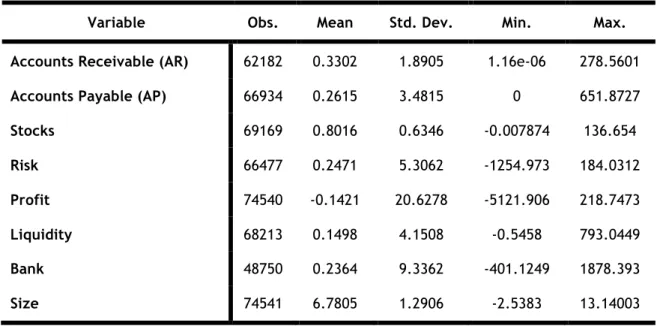
Table 2 reports the descriptive statistics. The correlations matrix is presented in appendix II.
Table 2
Univariate Analysis: Descriptive Statistics.
Variable Obs. Mean Std. Dev. Min. Max.
Accounts Receivable (AR) 62182 0.3302 1.8905 1.16e-06 278.5601
Accounts Payable (AP) 66934 0.2615 3.4815 0 651.8727
Stocks 69169 0.8016 0.6346 -0.007874 136.654 Risk 66477 0.2471 5.3062 -1254.973 184.0312 Profit 74540 -0.1421 20.6278 -5121.906 218.7473 Liquidity 68213 0.1498 4.1508 -0.5458 793.0449 Bank 48750 0.2364 9.3362 -401.1249 1878.393 Size 74541 6.7805 1.2906 -2.5383 13.14003
In average, the amount of accounts receivable (33,02%) is greater than the amount of accounts payable (26,15%). Thus, is obvious that in general terms, firms
extend more trade credit than borrow. Inventories play a greater role on firm’s assets (80%). The average value of risk, profit and liquidity variables is 24.71, 14.21 and 14.98, respectively. Just profit variable is negative, meaning that in average, Portuguese SME firms report negative operational results. Firms of the sample are highly dependent on bank financing (mean value of bank variable is 23,64%). Size is a natural logarithm of total assets.
Table 3 shows the average amount of trade credit granted and received in respect to Portuguese SME firms for a period of ten years from 2000 to 2009. From 2003 to 2004 there was a large growth of both trade credit offered and received, displaying until 2009 the higher scores for the firms in the sample.
Table 3
Univariate Analysis: Trade Credit Offered and Received by Year.
Year Receivable (AR) Accounts Payable (AP) Accounts
2000 25,28% 21,97% 2001 26,69% 22,18% 2002 27,42% 21,43% 2003 29,61% 22,84% 2004 35,08% 25,91% 2005 34,84% 27,18% 2006 31,30% 28,02% 2007 35,83% 27,58% 2008 34,40% 23,57% 2009 32,69% 28,08%
Notes: The percentages reported correspond to the mean values for both dependent variables.
From 2005 to 2006, accounts receivable suffered a sharp drop (-3,54pp), followed by a great increase in 2007 (4,53pp). Once the accounts receivable are scaled by sales, its behaviour from 2005 to 2006 is justified as a subsequent aftermath of the
effects until 2006. After that, Portuguese exports increased from 2006 to 2007 (GPEARI, 2009). Therefore, considering that the vast majority of exports in 2007 were carried out by SMEs (82.9% - IAPMEI, 2008), this fact is a potential factor to explain the consequent increase in accounts receivable between 2006 and 2007. Accounts Payable also recorded a sharp fall of 4,01pp in 2008, and an increase of 4,51pp in 2009. The justification is the global economic crisis, which had a negative impact on business investment6. Many firms, which had at the time access to their own resources or bank loans to finance their customers, began to reduce credit granted to other firms.
Figure 1 allows visualizing this interpretation. In Figure 2, the same results are reported, but now, the average amount of accounts receivable and payable is scaled by total assets (the results were previously scaled by total sales).
Figure 1
Univariate Analysis: Trade Credit offered and received, scaled by total sales, by year.
6 The global economic crisis began to feel more pronounced in the Portuguese economy in 2008, having
become a financial crisis due to bank panic and significant credit crunch (GPEARI, 2009).
0,00% 5,00% 10,00% 15,00% 20,00% 25,00% 30,00% 35,00% 40,00% 2000 2001 2002 2003 2004 2005 2006 2007 2008 2009 Accounts Receivable Accounts Payable
Figure 2
Univariate Analysis: Trade Credit offered and received, scaled by total assets, by year.
Figure 2 shows that AR and AP variables, scaled by total assets, report a behaviour much more linear than when they are scaled by total sales. These results confirm earlier conclusions, that is, dependent variables are subject to temporal changes (e.g.: macroeconomic effects), which could skew the results if the methodology panel data were not used. Since this allows you to control these effects, it is proven that the chosen methodology is the best option for this study.
Table 4 provides the distribution of trade credit offered and received by size. Although medium firms, i.e., firms above 3rd quartile of total assets, take more trade credit than grant, the difference is not significant (1.11pp), and therefore, it can be said that in a general way, Portuguese SMEs extend more trade credit than received. This is consistent with previous results.
0,00% 5,00% 10,00% 15,00% 20,00% 25,00% 30,00% 35,00% 2000 2001 2002 2003 2004 2005 2006 2007 2008 2009 Accounts Receivable Accounts Payable
Table 4
Univariate Analysis: Trade Credit Offered and Received by Size.
Firm’s Type Receivable Accounts (Mean) Accounts Payable (Mean) Micro 23,60% 15,35% Small 35,83% 25,93% Medium 34,82% 35,93%
Note: Microenterprises are companies whose total assets are below the 1st quartile of the distribution of
total assets of all firms considered in the sample. Small businesses hold total assets whose value is between the 1st and 3rd quartile. Finally, medium-sized firms are those with total assets above the 3rd quartile.
Firms that resort less to trade credit are those that the total assets are below the 1st quartile, i.e., small firms. The fact that are the smaller firms the ones who less resort to trade credit may be justified by the lack of confidence by their suppliers in providing finance, since they might feel that will not be able to have the return of that same credit.
The firms with total assets between the 1st and 3rd quartile are the ones that
extend more trade credit. This is in line with the substitution hypothesis. As the size of a company increases, these firms no longer need to resort to trade credit as the main source of funding, whereas are themselves, by having easy access to alternative and cheaper sources of funding; who now assumes the role of financing with smaller companies.
5.2. Multivariate analysis
As suggested by the Hausman (1978) test, if the effects are uncorrelated with the independent variables, then the fixed effects and random effects estimates should not be significantly different. Thus, once the test rejected the null hypothesis for
each regression, the study uses the fixed-effects models. The model controls the macroeconomic impact by including 10-year dummies variables, which correspond to the years of 2000 to 2009. For reasons of brevity, the results are not reported but are available on request to the author.
The multivariate analysis is reported in 3 tables. Table 5 reports the relationship between AR and the independent variables, whereas table 6 reports the results for AP. Column 1 in both tables presents regression results ignoring the influence of “𝑆𝑖𝑧𝑒”, while the remaining columns include “𝑆𝑖𝑧𝑒” as an additional variable (column 2), as an interaction term with “𝑆𝑡𝑜𝑐𝑘𝑠” (column 3), and both variables in column 4.
The results from table 5, column 1, show that “𝑆𝑡𝑜𝑐𝑘𝑠” variable have a positive and statistically significant coefficient (at 1% level), indicating that when firms have higher inventories, they tend to extend more trade credit. Once that higher inventory may reflect unintended accumulation of unsold goods, firms facing declining demand will have an incentive to promote overall sales through increased sales on credit and, consequently, an incentive to hold fewer inventories. This result relies significantly on Wilson and Summers (2002) argument that firms extend sales by offering goods on account in the first instance.
Moreover, it is consistent with Ferris (1981) and Emery (1987) transactions cost theory of trade credit. If sellers are subject to a high degree of uncertainty with respect to the timing and magnitude of orders, they will carry high inventory. In this situation, the buyer and seller have a common incentive to use trade credit in order to reduce the storage costs of good and the cost of maintaining liquidity