MARKETING PERSONA FORMULATION AND CONTENT
STRATEGY ANALYSIS FOR PHC SOFTWARE, SA
Ana Rita Belo Pereira Francisco
Project submitted as partial requirement for the conferral of Master in International Management
Supervisor:
Prof. Hélia Maria Gonçalves Pereira, ISCTE Business School, Marketing Department, Operations and General Management
Spine
-MARK
ET
ING P
E
RSONA F
ORM
U
LAT
ION
AND
C
ONTE
NT
STRAT
EGY
AN
A
LYSI
S
FOR
PHC
SOFTWAR
E,
S
A
A
n
a
R
ita
B
el
o
P
ere
ira
F
ra
n
ci
sc
o
Acknowledgements
I would like to thank ISCTE-IUL, an excellent school with inspiring professors, for the wonderful experience and for providing me with the tools to succeed.
I also would like to thank my supervisor, Prof. Hélia Pereira, for the limitless expertise, valuable input and belief in my work.
To Ana Morais, at the time Product Marketing Coordinator and Rita Gomes, Business Analyst, both from PHC Software, thank you for your patience and for making all this possible.
To my family and friends for supporting me throughout this journey. Thank you.
Abstract
The customer’s role has grown in importance through the years. In the current technological and information age, it is crucial for companies to understand the customer’s needs and motives, as well as ways to attract new customers (Derunova and Semenov, 2013).
In this paper, the persona tool is created for each of the PHC Software SaaS Products, PHC Business FX, PHC Billing FX and the PHC POS FX. Personas are fictitious representations embodying behaviours, pain points, goals and characteristics of real customers or target audiences (Junior and Filgueiras, 2005) that can be used as a tool to better understand customers and from there develop strategies.
After the analysis of the main target audiences for these products, this paper then, elaborates an analysis of the correspondent content marketing strategy. By analysing the current content and its communication channels, this paper aims to find gaps in the current strategy with the use of the persona’s tool and provide recommendations on how the company might minimize its distance to the customers and further improve its relationship.
Keywords: Marketing; Personas; Marketing Content; PHC Software.
Resumo
O papel do consumidor tem vindo a ganhar importância ao longo dos anos. No atual panorama tecnológico e informacional, compreender as atuais necessidades e motivações do consumidor, assim como, novas formas de atrair novos clientes é determinante para as empresas (Derunova e Semenov, 2013).
Neste trabalho, a ferramenta ‘Persona’ é criada para cada um dos produtos SaaS da PHC Software: PHC Business FX, PHC Billing FX e o PHC POS FX. Personas são representações ficcionais que incorporam os comportamentos, adversidades, objetivos e características de consumidores reais ou públicos alvo (Junior e Filgueiras, 2005), que podem ser utilizados como uma ferramenta para melhor compreender os consumidores e a partir dai desenvolver estratégias.
Após a análise do público-alvo destes produtos, é elaborada uma analise à correspondente estratégia de conteúdo da empresa. Ao analisar o conteúdo atual e os meios de comunicação utilizados, este trabalho tem por objetivo encontrar lacunas na atual estratégia, através do uso de personas, e fornecer recomendações de como a empresa poderá minimizar a distância e otimizar as relações para com os atuais consumidores e público-alvo.
Palavras-Chave: Marketing; Personas; Conteúdo de Marketing; PHC Software. Sistema de Classificação JEL: M15; M31
Content
Acknowledgements ... i
Abstract ... ii
Resumo ... iii
Figure Index ... vii
Table Index ... viii
Executive Summary ... ix
I. Contextualisation ... 1
II. Context of the issue ... 4
III. Literature Review ... 5
3.1 Introduction ... 5
3.2 Marketing in the High-Technology Sector ... 5
3.3 Personas ... 8
3.3.1 Characteristics and types of personas ... 9
3.3.2 Opponents to this method ... 11
3.3.3 Benefits of personas ... 12
3.3.4 Personas in Marketing ... 13
3.4 Content Marketing ... 14
IV. PHC Software, S.A ... 16
4.1 Introduction ... 16 4.2 History ... 16 4.3 Competitors ... 17 4.4 PHC FX ... 18 4.4.1 The PHC Business FX ... 18 4.4.2 The PHC Billing FX ... 19 4.4.3 The PHC POS FX ... 19 4.5 Selling Process ... 19 4.6 Content Marketing ... 20 4.6.1 PHC FX Website ... 21 4.6.2 Social Media ... 21 4.6.3 Type of content ... 22 V. Research Methodology ... 24 5.1 Personas ... 24 5.2 Content Marketing ... 27
6.1 Introduction ... 28
6.2 Persona Structure ... 29
6.3 Archetypes based on Assumptions ... 30
6.3.1 PHC Business FX ... 30 6.3.2 PHC Billing FX ... 34 6.3.3 PHC POS FX ... 35 6.4 Customer Feedback ... 37 6.4.1 PHC Business FX ... 37 6.4.2 PHC Billing FX ... 38 6.4.3 PHC POS FX ... 39
6.5 Target Audience Analysis ... 40
6.5.1 PHC Business FX ... 40 6.5.2 PHC Billing FX ... 43 6.5.3 PHC POS FX ... 44 6.5.4 New Persona ... 46 6.6 Interviews ... 46 6.6.1 PHC Business FX ... 47 6.6.2 PHC Billing FX ... 49 6.6.3 PHC POS FX ... 50 6.6.4 New Persona ... 52 6.7 Formulation of Personas ... 53 6.7.1 PHC Business FX ... 53 6.7.2 PHC Billing FX ... 55 6.7.3 PHC POS FX ... 57 6.7.4 New Persona ... 59
VII. Content Gap Analysis ... 61
VIII. Forms of Implementation ... 64
IX. Academic and Business Contributions ... 65
X. Conclusion ... 66
10.1 Limitations ... 67
Bibliography ... x
Appendices ... xvii
1. Emails exchanged with PHC Software (Translated to English) ... xvii
1.1 First Email ... xvii
1.2 Second Email ... xviii
2. Internal Questionnaire- PHC FX Team ... xx
3. Analyse Customer Feedback ... xxix
3.1 PHC Business FX ... xxix
3.2 PHC Billing FX ... xxx
4. General People Questionnaire ... xxxi
4.1 General Results ... xxxvi
4.2 PHC Business FX ... xxxviii 4.3 PHC Billing FX ... xlvii 4.4 PHC POS FX ... lvi 4.5 New Persona ... lxv 5. Interview Layout... lxvii
Figure Index
Figure 1 ... 6 Figure 2 ... 7 Figure 3 ... 8 Figure 4 ... 10 Figure 5 ... 14 Figure 6 ... 16 Figure 7 ... 20 Figure 8 ... 23 Figure 9 ... 24 Figure 10 ... 27 Figure 11 ... 28 Figure 12 ... 33 Figure 13 ... 33 Figure 14 ... 35 Figure 15 ... 36 Figure 16 ... 37 Figure 18 ... 53 Figure 19 ... 54 Figure 20 ... 54 Figure 21 ... 55 Figure 22 ... 55 Figure 23 ... 56 Figure 24 ... 56 Figure 25 ... 57 Figure 26 ... 57 Figure 27 ... 58 Figure 28 ... 58 Figure 29 ... 59 Figure 30 ... 59 Figure 31 ... 60 Figure 32 ... 61 Figure 33 ... 62Table Index
Table 1. ... 2 Table 3 ... 5 Table 4 ... 63
Executive Summary
The increasing pace of technologic progression, forces companies to adapt and innovate to maintain their position, especially in the technological sector. The world is drowning in content and information. As marketers and companies struggle for customer attention, content is globally moving in milliseconds entertaining consumers (Brenner, 2013). Persona is a type of user modelling technique, more commonly used by high-tech companies, that represents a target audience that shares the same pain points, goals and characteristics. It is a fictitious representation of real consumers in which a picture, name and life story is included to ‘bring the persona to life’ (Miaskiewicz and Kozar, 2011). In this paper, personas for each SaaS product of PHC Software SA are drawn which, if correctly used, can allow a better understanding of their own customers and potential consumers, by the company.
The identification of the different components of personas is done through the use of different methods each complementing the other, from the unpredictable assumptions to quantitative and qualitative research, in order to gain better insight.
Moreover, with the persona’s tool in consideration, a gap analysis of the company’s content strategy is made. From the type of content used, to the level of engagement made through the online communication channels, the website or social media. The goal is to understand which type of content and social media can be improved in accordance to the what the target audience is looking for.
With this paper, it is expected that PHC will be able to create and improve the customer relationship, engagement and retention, by having a more targeted approach to the consumer and the market.
I. Contextualisation
The notion of high technology is an ambiguous one. There are several variations of definitions for this concept. This term is usually connected with something new and advanced (Gronhaug, and Moller, 2005).
The Organisation for Economic Co-operation and Development (OECD) classifies high tech products and services as those whose development has demanded the highest R&D investments.
The European Network for Small and Medium Enterprises (SME) Research (2002) classifies enterprises as high-tech if they meet one of the following three criteria: high innovative and/or R&D intensive and/or using sophisticated and complex production technologies.
According to Moriarty and Kosnik (1989) and Mohr et al., (2010) in order for a company to be classified as high-tech, it must have characteristics such as Market Uncertainty, Technology Uncertainty and Competitive Volatility.
Other researchers define high technology based on the input used in the manufacturing of the end product, either human resources, technology or machinery. Output used definitions are also plausible where high technology companies are characterised based on the services or products offered (Yadav, et al., 2006).
Technological products and services create a natural complementary system. As the number of users of a given technology increases, additional complementary technology becomes available as well as substitute products or services, hence raising exponentially the value of the overall system for both existing and potential users. (Yadav, et al., 2006). This industry is seen today as the main booster of the worldwide economy and considered a decisive factor of country influence.
Software belongs to the category of information goods that can be delivered and sold either in material or in an intangible form through the internet (Ojala,2013). It can be divided in Systems Software, including the operating system and all utilities that allow the computer to function and Applications Software where all programs used by users are inserted.
The worldwide software revenue has increased 4.8 %, totalling $407.3 billion in 2013, as can be seen in Table 1 (Gartner Inc.,2014)
Table 1.Top 10 Worldwide Software Vendors, Worldwide, 2012-2013 (Billions of Dollars) Source: Gartner (March 2014)
Microsoft continues to be the world leading Software Company, followed by Oracle and IBM. The United States is the country with the highest share of the most influential and successful software companies. In Europe these type of firms are generally small sized and exclusively concentrated in serving their home markets (Alajoutsijarvi, Mannermaa, and Tikkanen,2000).
In Portugal, the technology sector (ITC) is analysed in €12.804 Million (2012), representing 6 % of the GDP (Informa D&B, 2014). Nevertheless, the biggest slice of the revenue results is from telecommunication enterprises.
Table 2 - Ranking of the biggest software companies in Portugal by turnover (Sousa,2014)
Rank 2013 Rank 2012 2013 2012 2012-2013 Vendor Revenue (billion) Revenue (billion) Growth Rate (%) 1 1 Microsoft 65.7 62.0 6.0 2 3 Oracle 29.6 28.7 3.4 3 2 IBM 29.1 28.7 1.4 4 4 SAP 18.5 16.9 9.5 5 5 Symantec 6.4 6.4 -0.8 6 6 EMC 5.6 5.4 4.9 7 7 HP 4.9 5.0 -2.7 8 9 VMware 4.8 4.2 14.1 9 8 CA Technologies 4.2 4.3 -2.6 10 12 Salesforce.com 3.8 2.9 33.3 Others 234.6 224.0 4.7 Total 407.3 388.5 4.8
Position Company Turnover 2013 (Million)
1 NOVABASE 23 2 IBM 17 3 BIZDIRECT 16 4 EXICTOS 14.8 5 REDITUS 14.4 6 JP SÁ COUTO 13 7 PRIMAVERA BSS 12.9 8 CPCDI 12.1
In the Portuguese IT sector, the 200 biggest companies reported a €4.9 billion turnover in 2013,28% being from overseas, a result that represents a 7% growth compared to 2012 (Sousa, 2014). In Table 2, NOVABASE is seen as the biggest company in terms of software revenue, followed by IBM and BIZDIRECT.
The software market in Portugal is composed mainly by SMEs. These,are the main type of general technological companies in Portugal, with an estimated growth of 3.2 for each insolvency (Informa D&B, 2014). The main export markets for Portuguese high-tech companies are Spain, Holland, Germany and China (Informa D&B, 2014).
In the words of Joanne Correia, Vice President of Gartner, the software market has been changing through the years and the internet of things (IoT) is revolutionising businesses. Presently, the cloud is the main intervenient in this change as software vendors acquire and deliver applications and technology to support the cloud movement.
The cloud is predominant in a wide variety of businesses. Ojala (2013) considers cloud computing to cover not only software applications delivered through the internet, but also the system software in which data centres provide these services.
A Software-as-a-Service (SaaS) provider can potentially eliminate the maintenance and implementations of software applications. Here, the customer can access the software online instead of permanently installing on their computers. (Ojala,2013)
The up-front cost reduction, the flexibility and mobility, and the periodically updated anti-virus and security monitoring are leading SaaS to surpass the traditional software (Fan, Kumar, and Whinston, 2009)
However, this type of products is still seen with concern and scepticism due to different features from the traditional software. Plus, SaaS create major uncertainties related to the data storage in a public cloud server and the necessity for a reliable internet connection (Ojala, 2013).
II. Context of the issue
This project was developed in cooperation with PHC Software Portugal, a software company that caters mainly to small and medium enterprises, helping them increase their productivity and performance through their products.
The main goal is the creation of Personas, a fictional characterisation of real buyers, based on real data, with common characteristics and goals (Kusinitz, 2014), and analysis of the Marketing Content for each of the PHC FX Products.
This necessity arises due to the novelty of the PHC FX, a SaaS that compiles a set of products with distinct settings and functions with the possibility of complementing one another. This allows companies to choose the appropriate product for the required needs. Having not yet attained the intended results, PHC believes there is the need for a more focused approach towards the products and potential clients.
The personas will serve as a guide to the design team of PHC FX and as support to the formulation of marketing strategies mainly of digital purpose.
The PHC FX products to be analysed are: PHC POS FX, PHC Business FX and PHC Billing FX. For each of these products there will be the creation of five personas.
Each of these products has specific marketing content already developed that will be further analysed after each persona’s creation. The personas will give insights on the type of content that best suits the audience.
Hence, existing problems/conflicts between each component will be identified as well as certain matters that require posteriori solution for additional reformulation.
The current content comprises of videos, webinars, infographics, product reviews and feedback by current customers, research and original data, articles, slideshare presentations, cartoons, social media (Facebook, Twitter and LinkedIn), among others. The company believes the PHC FX products have a complex portfolio, possibly making it a challenge for customer to understand all features for each of the products.
Therefore, this project will allow PHC to know more about their customers for each product and adapt its content to fit customer’s needs. Plus, it will help the company achieve the intended objectives and increase focus on their target audience.
III. Literature Review
3.1 Introduction
Nowadays, with the pace of technological progression, the level of insight from businesses on customers, competition and persons of interest lead to a large amount of pressure on all parties. To understand and know the customer, companies procure several tools, techniques and strategies, to later implement the best actions for attaining and engaging the target audience.
In the first part of this project, there is a theoretical framework in which the foundation of the following sections is shaped.
Initially, a differentiation of the field of marketing in Business-to-Business (B2B) Market from the Business-to-Consumer (B2C) is set; and afterwards the difference from the high technological sector to the the low technological sector. Here, in this last section, the marketing challenges and characteristics are mentioned.
Next, the main themes are approached. Primarily, personas are defined and characterised, afterwards, arguments against and in favour are discussed, and finally the role of personas in Marketing is analysed. To conclude, the marketing content definition, importance and organisational goals are addressed.
3.2 Marketing in the High-Technology Sector
Marketing is a discipline that analyses customers, competitors and industry trends to formulate an overall understanding of the market (Pruitt & Adlin, 2006).
Table 3- Difference between B2B and B2C Marketing (Wall, 2012)
B2B Marketing B2C Marketing
Relationship driven
Maximise the value of the relationship Small, focused target market
Multi-step buying process, longer sales cycle
Brand identity created on personal relationship
Educational and awareness building activities
Rational buying decision based on business value
Product driven
Maximise the value of the transaction Large target market
Single step buying process, shorter sales cycle
Brand identity created through
repetition and imagery
Merchandising and point of purchase activities
Emotional buying decision based on status, desire, or price
As can be seen in Table 3, marketing methodologies differ from Business-to-Consumer (B2C) to Business-to-Business (B2B) markets. In this paper, there will be a focus on B2B Marketing strategies and approaches.
Marketing in the high-technological sector has characteristics that differ from the low- technological markets (Moriarty and Kosnik, 1989). With the current evolution pace, a marketeer must recognise that both technological and market conditions are rapidly changing. Figure 1 shows the marketing challenges in the technological sector.
Figure 1- Marketing in the High-Tech Sector (Gliga, and Evers, 2010)
Competitive Volatility is a common characteristic that all high-tech companies face due to the fierce competition encountered in this sector. Technology Uncertainty is the customer’s concern for not knowing whether the product or service acquired will deliver the expected outcome.
Finally, Market Uncertainty is the result of customer anxiety. High technological products are often difficult for the general public to understand creating the FUD factor - fear, uncertainty and doubt (Moore, 2001). This leads to some reluctance when buying certain high tech products.
Meuter et al. (2003) introduced a concept named Technology Fatigue that describes this problem. Technology fatigue occurs when buyers must deal with lack of information regarding a product, leading to the postponement of their purchase decisions or investments until the costs and benefits of the new technology are fully comprehended or the technology itself undergoes additional improvements.
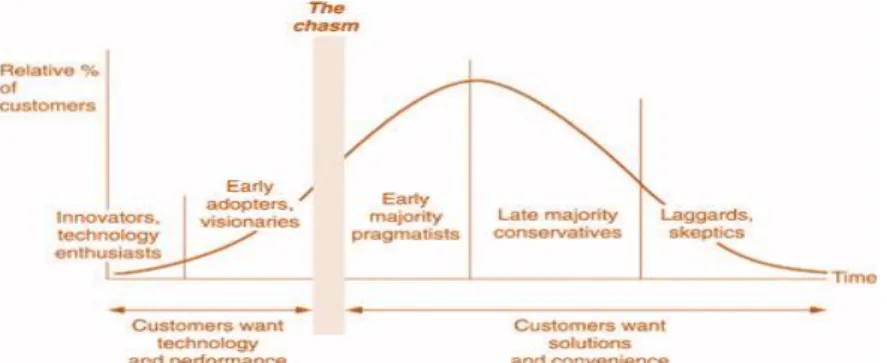
Another challenge for marketers in high-technological markets is to surpass the knowledge gap between the customer and the seller. There must be the attention to ´translate´ the product in a language the end consumer understands. (Sarin and Mohr, 2008). The adoption of high technology products or services is a complex process for the customer, requiring deep analysis. In Figure 2 we can observe the lifecycle adoption of a new technological product or service. Here we can observe a community’s acceptance of
• Market Uncertainty • Technological Uncertanty • Competitive Volatility High-Tech Environments • Access to capital • Competitive Human resources High-Tech
SMEs • Acquiring Marketing Intellegence • Customer STP • Strategise the Marketing
Program
Marketing Challenges
a disruptive innovation, divided in four stages and where the concept of ´valley of death´, gap or chasm is present (Moore, 2001). The chasm is considered a critical point for both customers and enterprises. At this point, the crossing for the adoption of a technological innovation between the early adopters and the mainstream markets is necessary. Often, this crossing does not occur as technology that suits early adopters often does not work for the pragmatists and conservatives.
Figure 2- The high tech product adoption lifecycle (Moore, 2001)
Plus, high-tech products are characterised for having short lifecycle periods being rapidly replaced by a new version within the same brand or confronted by a new model of a competitor. This, often leads the customer to postpone the purchase in order to wait for a ´better´ product or service.
The decision to purchase a high-tech product or service requires, as previously stated, a high degree of complexity. The quantity and quality of information on the product, quality, assistance and support received and the customer’s emotional connection with the brand and product may generate reluctance from the consumer. (Dovleac, and Balasescu, 2013)
Currently, the market is very saturated. Customer’s preferences are shifting at an alarming rate as new products are constantly being introduced to the market. As result, marketers must have a comprehensive knowledge about the buyer, either regarding the purchasing process or his/her motives and reservations (Derunova, and Semenov, 2013).
User modelling techniques have been a common tool in marketing for many years (Moore, 2001). There are several types of user modelling techniques (Figure 3):
Figure 3- Different types of modelling techniques (Junior, and Filgueiras, 2005)
The user role and user profile are respectively, a definition of the customer either by the intentional interaction with the product or by the summarisation of the customer’s goals and motivations. The marketing segments and user segments include the description of a group of people who will use the product. Market segmentation relies mostly on demographic data to classify users (Sinha, 2003).
On the other hand, extreme characters are radical personalities modelled to cover all types of customers or users.
3.3 Personas
The term ´Persona´ first appeared in 1999 in Alan Cooper’s book ´The Inmates are
running the Asylum: Why High-Tech Products drive us Crazy and How to Restore the Sanity´, presented as hypothetical archetypes of actual users. In its simplest form Cooper
describes this tool’s function as to create a precise description of the product or service user and his motives.
This tool was created from the necessity to embed digital products’ software applications with end users’ requirements and needs. Cooper argued that designers often had an erroneous idea of their target users leading to possible failure of customer retention. Cooper (1999), defines two types of personas: primary and secondary. The primary persona is the vital focus of the design, it represents the user that must be satisfied, whereas, the secondary persona represents those whose needs are only satisfied after the primary persona’s ones.
The persona concept was further developed by other authors and, today, created with different methodologies and implemented with diverse techniques, yet leading towards the same goal, understanding the behaviour pattern of the consumer.
In 2002, Pruitt & Grudin extended Cooper’s technique. They refer personas as a medium of communication, a channel of information about users and work environments. In 2006,
User modelling techniques
User Role User Profiles User Segments Marketing
Segments
Extreme
Pruitt joined Adlin to define personas as abstractions of an aggregate of real consumers or target users who share common characteristics and needs.
Sinha (2003) argues that personas substitute the abstract and elastic user with a vibrant presence by becoming part of the design process and helping the definition of the product. It differs from previous authors by using quantitative data in its creation.
Junior & Filgueiras (2005) define personas as fictional user representations created to embody a group of users’ behaviours and motivations during a project development process. All definitions above refer to this tool as used in the process of product design. Design personas separate the market according to people’s goals and behaviours in the specific standpoint of using a product. Alternatively, marketing usually segments along various dimensions and is mainly concerned with foreseeing behaviours and motives within the context of buying a product (Pruitt & Grudin, 2003).
Marketing personas, also referred as buyer personas are, therefore, examples or archetypes of actual buyers that help marketers to craft strategies to promote products to current and potential customers.
Personas are in essence, created to represent a real person describing his/her motivations, behaviour patterns and demographic characteristics representing a whole customer segment (Klishina, 2013).
Adele Revella (2015), founder of the Buyer Persona Institute and currently considered a leading expert in this tool, defines personas as a composite frame of the real people who buy, or might buy a company’s product based on the learning of direct interviews with real buyers.
The persona technique shows several advantages comparing to other techniques due to the representation of a real person, encouraging the importance given by the company to the user. (Junior, and Filgueiras, 2005)
3.3.1 Characteristics and types of personas
Personas can be characterised and differentiated by three key variables (Figure 4): the source of information; the amount of detail, and the purpose for which has been constructed. (Floyd, Jones, and Twidale, 2008).
The first variable is the source of information used in the creation of a persona. Empirical data is attained through studies as ethnography, focus groups or surveys; whereas fictional components arise from the stereotypes or fictional creations to justify
certain aspects of a persona, for instance the use of a face to characterise the persona. The latter can be used to complement empirical data personas by giving them fictional aspects that might help authenticity.
Figure 4- Personas’ attributes (Floyd, Jones, and Twidale, 2008)
The amount of detail used in a persona’s description may vary, depending on the final intent of the persona. Some argue that personas’ description should not be longer than a single page, while others believe the more the merrier to have a clear idea of the end user. However, as it will be explained in the following section (section 3.3.2), when creating personas, one must be careful with the ´Curse of Dimensionality´.
The third major variable described by Floyd, Jones, and Twidale, is the purpose for which personas are created. This variable is complex, leading to a wide number of attributes. The purpose for creating a persona is referred to the intentionality behind constructing a persona; the use of persona defines how and why the persona is used and applied; the way this tool is constructed is described in the method of creation attribute; permanence refers to the customer’s retention; and finally the user characteristics attribute represents the space of customer characteristics which the persona kind covers.
Regarding types, Cooper differentiates three types of personas: Design personas, Proto-personas and Marketing Proto-personas (Ilama, 2015).
Personas Attributes Source of Data Empirical Data Fictional Components Detail of Description Intended Purpose Purpose for creating persona Use of persona Method of creation Permanence User Characteristics
The aim of design personas is to be remembered throughout the product development process, it emphasises on user goals, pain points and current behaviour. On the other hand, Proto-personas are not verified by data research and are used when there is limited time and money. Finally, according to Cooper (1999), marketing personas are ideal for the evaluation of the potential return on investment (ROI) of a product and what kind of customers will be receptive to certain products or content. These personas are characterised by demographic information, buyer motivations, preferences and fears, media habits, among others.
Nunes, Silva, and Abrantes, (2010) define personas as a Human-Computer Interaction tool (HCI). This connotation does not differ from the Cooper’s definition of design persona; the main difference is the limitation to study a particular user group when using an object.
Another type is Ad-hoc personas, introduced by Norman in 2006. These, reflect the designers’ intuitive understanding of users, they are non-empirical personas created by designers to comprise their intuitions about the user behaviour.
Ardath Albee (2015) in her book Digital Relevance: Developing Marketing Content and
Strategies that drive results differentiates personas as: Buyer personas, Customer
personas and User personas. Here, Albee (2015) differentiates types of personas according to its final use instead of the information provided.
Buyer personas are created to solve a problem or meet a goal relating a product. These are usually represented by roles; User personas are what we previously referred as design personas. Customer personas are indicated for people that are currently a customer of the product meaning that the goal of the persona’s creation is to increase retention, value and loyalty.
The success of personas depend on which kind of personas are being used, how they are being used and for which purpose (Floyd, Jones and Twidale, 2008).
3.3.2 Opponents to this method
Several issues and concerns have been pointed out throughout the years against the use of this technique.
The fact that personas are fictitious characters may cause some ambiguity. Product designers often look at personas as too abstract, preferring to use the data on which they are based, developing their own conclusions (Faily, and Lyle, 2013).
According to Chapman, and Milham, (2006) the impossibility of verifying if the created personas are accurate is the most serious limitation. Problems that initially created the necessity for personas would eventually arise if failure to properly validate or maintain personas throughout the process occurs.
Other problem identified by the same authors is the ‘Curse of Dimensionality’- as the specificity of a persona increases, the proportion of the population represented decreases. Furthermore, it is argued that one cannot use scattered data points to gather a composite description relationship with a population with a probability equal to 1.0. Hence, the generalization from a specific persona to a population of interest is not possible (Chapman, and Milham, 2006).
3.3.3 Benefits of personas
Contrarily to the previous section, advantages are more common within the existing literature.
Pruitt and Adlin (2006) characterised three main advantages: first, self-centredness can be avoided and user-centeredness can be promoted; then users are increasingly complex and the use of personas can help the understanding of their needs and preferences; and finally personas can act as a proxy of customers.
The most powerful characteristic of this tool as stated by Pruitt and Grudin (2002) is the engagement it can create within a company. People are often engaged in fictional characters in movies or television programs. One of the features used in personas is pictures or images characterising the persona, creating a more realistic feeling towards this technique. Well-crafted personas can create this feeling among team members resulting in an effortless projection of the persona for current situations.
This will then increase communication within a team, leading idea’s discussion and a better understanding of the customer and the product itself (Nunes,.et al 2010).
The concerns of Chapman and Millham, previously mentioned, were later addressed in 2009 by Frank Long in his work The effectiveness of using personas in user design. Here the author proved that personas are indeed as effective as defended by Cooper or Pruitt. Long (2009), used student surveys, focus group feedback and students’ design work to create objective evidence. One of the conclusions reached is that personas indeed increase concern and attention on the end-user or customer as well as his/her motivations, tasks and goals. Plus, personas can guide decision-making within the teams toward the consumer’s needs by making those needs more explicit and easy to understand.
Also, Long’s study confirmed Pruitt and Adlin’s premise that personas can improve communication.
3.3.4 Personas in Marketing
This method has shifted from the IT system development where was initially applied whether by Cooper (1999) or Pruitt (2006) with focusing on design, to being applied to a wider variety of settings, from product development to marketing or business strategy The goal of Business-to-Business (B2B) persona is to function as a tool that provides guidance and helps define the marketing programs and strategies regarding a specific market segment. Each company creates unique personas, even if in the same industry, due to different business models, values and demographics (Albee, 2014).
When marketers have insights on their buyer’s expectations they know which buyers their message needs to influence and which of their solution’s attributes are adequate and important for the consumer’s decision (Revella,2015).
Adele Revella (2015) in her book Buyer Personas describes the universe of buyers divided into five categories:
1. The customer (those who consider you and chose you); 2. Those who consider you and choose a competitor;
3. Those who consider you and decide to maintain the status quo by keeping things as they were;
4. People who never considered you and choose another 5. Those who are currently considering your solution.
Personas will provide buyer insights that will help a company align their marketing strategies with the buyer’s expectations. Revella, (2015) describes five rings of buyer insights: Priority Initiative, Success Factors, Perceived Barrier, Buyer’s Journey; and Decision Criteria.
The priority initiative gives feedback on the reason why a buyer decides to buy either the competitor’s products, the company’s products or maintain the current situation; the Success factors describes the results the consumer expects from the product acquired; perceived barriers are the opposite of the previous insight, as it shows the marketer the reasons preventing the buyer from acquiring the company’s product; the buyer’s journey is the narrative describing the buyer path on evaluating options and settling their final choice; finally the decision criteria describes the compared products’ attributes evaluated
3.4 Content Marketing
Personas are often used to support content marketing creation. Content marketing is the marketing and business process of generating and distributing valuable and captivating content to attract, acquire and engage a target audience (Pulizzi, 2014). This concept can be applied to everything that engages the customer, from newsletters to webinars, mobile apps, blogs etc., it is a soft-selling approach that moves beyond the brand promotion to the assistance or entertaining of the customer. (Korosec, 2012).
The buyer journey identification is often used in this stage. This, is the journey a person goes through as he or she becomes a buyer (Nickoaisen, 2015). Traditionally, this journey is divided in three stages: awareness, consideration and decision. The first stage is the realisation of a problem or the customer’s needs; consideration is the stage in which the buyer is considering all possible solutions for the problem, researching and understanding it; and the final stage is the decision on a specific product or vendor (Kukesh, 2014). Content marketing can be employed at any stage of this process, from awareness-oriented strategies to loyalty ones.
There are three mapping fundamentals in content marketing around the buying process, as we can see in Figure 5.
Figure 5-Three content mapping fundamentals (Kukesh, 2014).
Personas can help marketers achieve their goals in content creation by mapping content to the buying stages, optimising resources by only allocating content to the audience’s preferred channels, brainstorming new content; and finally allowing the writer to understand and grasp the customers’ interests quickly (Albee, 2014). If the marketer is able to find the ´sweet spot´ between the buyers needs and the solution capabilities, the goal is reached. In this ´sweet spot´ effective messaging is found between what the customer wants to hear and what the company wants to say and offer.
Companies can adjust their current messaging to the buyer persona’s insights to obtain effective results and create an effective communication channel. (Gollner, 2013). A great experience from the customer can also be obtained with a great content by enhancing the relationship between the company and its target audience. Specific keywords identified to help increase the content effectiveness is another point that is crucial for the success of the content created. Finally, of course, the type of format used is very important to attract the intended attention of the target audience.
Social networks are vital to the success of content marketing strategies. They are the intermediary between the company’s content and the customer. Social media marketing usually tends to focus on two main goals: brand awareness by creating activity and discussion surrounding the brand, and customer retention and satisfaction, where forums can use social channels for direct dialogues with the consumers answering to issues or questions that these might have.
On the other hand, the lead generation is often a website content marketing focus. Where, the brand is developed and can reach the desired goals, leading towards a lead conversion or purchase. (Pulizzi, 2014). According to Pullizi (2014), the essence of the content marketing strategy is the belief that if businesses deliver constant and consistent valuable information to the target audiences, these will reward the company with purchase and loyalty.
IV. PHC Software, S.A
4.1 Introduction
PHC Software is a Portuguese company that provides management software mainly for Small and Medium Enterprises (SME’s) to support its business and enhance their capability of generating revenue and results
It has offices in Lisbon, Porto, Madrid, Luanda, Maputo and London. With over 160 employees it has recorded over 8 million euros in profit in 2014. PHC is structured as follow:
Figure 6 - PHC Software Portugal Organogram(Source: http://www.slideshare.net/PHCsoftware)
4.2 History
Ricardo Parreira, the CEO and Miguel Capelão, the Strategy, Risk & Control (SRC) Officer founded PHC Software in 1989. Initially the objective was to create a consulting company but later the project ended up being software development. At the time, the software was developed within the client company.
Only in 1997 does PHC launch the software platform CS which has been in development ever since, widening its offer and customer range, reaching 100.000 users in 2009. The PHC CS is a management software platform designed for a wide variety of industries to help increase productivity and functionality of the companies. With over 123.000 users worldwide, this is the main product offered by the company.
This product is provided through third parties that sell it in physical stores. It includes solutions for human resources department, technical support, retail, logistics and distribution, Customer Relationship Management (CRM), construction, among others. In 2010 the PHC FX is launched. This is a Software-as-a-Service (SaaS) model characterised for being accessed through a web browser, typically the Internet, where users log into the system.
Through PHC FX, the company provides customers with several different types of software: PHC POS FX, PHC Business FX, PHC Billing FX, PHC CRM FX, PHC
CEO
Development Research Service Commercial Marketing Finance SRC OFFICER
Service FX, PHC Team FX, and PHC Documents FX. Nowadays, it has over 20.000 clients.
This type of product is frequently provided on a subscription basis, with the software being located on external servers rather than on local servers. (Radcliffe, 2011)
PHC Software is nowadays, a SME ranked 73th in the 200 Biggest IT companies in Portugal, being considered a reference company in the Portuguese software industry. In 2011 was considered the SME leader by IAPMEI; in 2012 Best Cloud Service Product Award by EuroCloud and 2013, 2014 and 2015 Awarded Best Management Software by PC Guia.
4.3 Competitors
PHC has several competitors in the Portuguese market for the PHC FX product, the critical and important ones are as follow:
KeyInvoice is a one management and billing software provider, founded in 2007, it has
over 10.000 users. The product can integrate CRM and Point of Sale (POS), if the correspondent features are chosen. With nearly 17.000 likes, Facebook is clearly the social media chosen to interact with customers. This product competes directly with the PHC Billing FX and indirectly with the PHC POS FX.
InvoiceXpress, was the first online invoicing Software-as-a-Service (SaaS) in Portugal. Launched in 2010, has now more than 2750 active clients. It is a service provided by Rupeal, created in 2007 by Rui Alves, today it has over 25.000 users in Portugal and abroad. InvoiceXpress is considered an example of success within the Portuguese start-ups standpoint. With over 8.000 likes on Facebook and 600 followers on Twitter, it is considered a direct competitor of PHC Billing FX.
Sage Portugal, ranked 49th in the 200 Biggest IT companies in Portugal, competes with PHC with the product Sage One. This, is characterised by being an online billing software that allow clients to issue invoices, consult current accounts, control the company’s financial situation and issue sales documents efficiently. With 400 000 likes on Facebook and 1380 followers on twitter Sage Portugal competes directly with PHC Billing FX.
Primavera Business Software Solutions SA, founded in 1993 is a major competitor of
PHC Software, ranked 43rd in the 200 Biggest IT companies in Portugal, it has businesses
in more than 20 countries and more than 40 thousand clients. It provides, through the product Primavera Business Suite, CRM, inventory, current accounts and sales
management. With 5300 followers on LinkedIn and 20 550 likes on Facebook, the company, through its product, is a direct threat mainly to the PHC Business FX.
Moloni is a management software intended for micro, small and medium enterprises. It
allows orders, purchasing and document management, client, suppliers and inventory management, billing issuance and event calendar. With 3300 likes on Facebook and 1590 followers on Twitter this product is directly competing with the PHC Business FX
Vendus is a POS APP, created in 2015 that can be accessed online by any device. It
provides performance reports, billing invoice, real time access to several stores or more than one selling point, stock management and client management for micro and small companies. With the incentive of three free months for entrepreneurs, this app competes directly with the PHC POS FX product.
4.4 PHC FX
The PHC FX is a 100% online software that allows customers to experience a flexible, complete and secure system for a more economical price without having to install anything.
This product is targeted to micro and small enterprises where one to five users are able to access remotely the software.
It can be accessed in any browser (Internet Explorer, Firefox, Google Chrome, Safari etc.) and operating system (Mac, Windows or Linux). There is also a feature that allows to work either in English Spanish or Portuguese and personalise the whole software, from colours or letter type, to the main features shown on the dashboard.
At the start, the PHC FX allow users to choose the option between beginner and advanced, where for the beginner several tips and hints serve to help the user to go through the program.
Integrated with all PHC FX products comes the PHC Dashboard FX. This, allows the user to get all analysis, statistics and indicators on any mobile device interactively. The PHC Dashboard FX has a very similar layout to the Microsoft Windows Application or Desktop.
4.4.1 The PHC Business FX
The PHC Business FX is a very complete software designed to manage all the vital departments of a company. It can provide data on clients, suppliers, stock levels, orders and billing.
The PHC business FX has all the features of the following product (in section 4.3.2) and more, allowing companies to be up to date with their business situation and get access to the entire information of the company. It is, for instance, an excellent product for a business start-up, a service or a trade company who want to manage purchases and treasury.
4.4.2 The PHC Billing FX
The PHC Billing FX is specifically designed for the electronic billing management software in order to increase operational efficiency. It was created mainly for micro enterprises and sole proprietors that need a certified software to issue invoices.
According to the Portuguese legislation, all billing software has to be properly certified by the tributary authority.
4.4.3 The PHC POS FX
The PHC POS FX was created to support companies with necessity for stock management, billing and points of sale. These can be retail stores, family own businesses, fairs or anywhere one wants to sell their products.
POS means Point of Sale and simplifying, it is a system that involves a group of networked computers that send and collect information from a central computer. In other words, it is the software that manages a company’s process of selling to customers. 4.5 Selling Process
PHC Software uses its partners as a sales main channel, leaving the function of customer support to fall entirely on the PHC partner’s responsibility. PHC has over 400 partners with four levels of partnership for PHC FX: Developer, sales, support and total.
When there is a new customer, the process can go in two different ways, either the client already has a preferred partner and it is allocated to him, or in case it does not have one, it is allocated by PHC itself taking into consideration the customer’s location.
The sales partners only have the role of the solution pre-sale and sale. Afterwards, the client will receive support by a support partner. The support partner only collaborates if the customer wishes so. The main roles of the support partner are help with implementation, formation and after sales.
The total partner is qualified for the whole selling process from the pre-sale to the formation and customer assistance.
Somewhat different from the previous partners, the developer is a company or entrepreneur accepted by PHC to develop external applications using the PHC FX Engine system.
As we can see in figure 7, this extension leads to the integration of external applications in the PHC FX software, allowing the platform to be more adapted to the needs of each specific customer.
Figure 7- PHC Engine FX Model
However, PHC also has a Customer Success Team (CST), which assists the partners in the sales process and support, either regarding questions relating to the products or other important issues.
4.6 Content Marketing
Nowadays, customers would rather look for the brand and product information than be overwhelmed by it.78% of consumers start the buying process with a web search, and 50% turn to social media and peer reviews to help with their decision (Anderson, 2016). A study by OberCom shows that in 2014 around 57.2% of households have internet subscription in Portugal and 72.9% of individuals use the internet on a daily basis. (Cardoso et al, 2014)
Marketers have now the role of convincing the target audience that their brand is actual relevant to them. Therefore, a good content marketing strategy is of the utmost importance.
Content marketing is a broad term that is applied to a variety of subjects, from newsletters and white papers, to podcasts or blogs, virtual events such as webinars, social media posts and even consumer generated videos.
As are the majority of brands and mainly the B2B companies, PHC Software is already online. It has two main websites in Portugal: www.phc.pt where it includes all
information regarding the company in general and the product PHC CS; and another for the cloud products, the PHC FX, www.phcfx.com . It also has adapted websites for the different regions where PHC is operating in (Peru, Spain, Mozambique and Angola). PHC is also present on several social media networks, with two accounts for Twitter and Facebook each for PHC Software and PHC FX; LinkedIn, Google + and YouTube Channel.
4.6.1 PHC FX Website
The website is the most important communication channel between the company and the general public.
The website is accessed mainly from Portugal with 77% of traffic, 19% from Spain and the rest 4% not specified. The English website also have the highest rate of traffic from Portugal, followed by USA and UK. The homepage, “about phcfx” and the demo request
page reported the highest rate (Google Analytics Report June 2015 to August 2015).
The website contains all the announcements relevant to the public, from new product launches to new features or simply future webinars or conferences; plus, explanatory videos about the product and FAQs where questions and answers about doubts that users might have regarding the product.
Furthermore, the company’s blog is a crucial source of information where posts regarding the products or general topics related to the PHC FX product, technology or cloud software in general, create a source of engagement between both company, clients and the general public.
The strategy used by PHC is to maintain a frequency of one blog post per week regarding subjects around the scope of interest of those who work in a company or have a business. Furthermore, there is not a division between products when it comes to content publication and creation, all content is in the same place with some articles referring to one product and others to another.
Finally, through the website, people can sign up for newsletters regarding products regularly publicised.
4.6.2 Social Media
On social media the PHC engagement with the public is mainly through Twitter and Facebook, having the last the highest rate of engagement. With 3.586 likes the PHC FX page is not far behind the PHC Software page with 5.654 likes. PHC FX posts on
Regarding Twitter, PHC FX has 590 followers with the last post in December 30th 2015.
On LinkedIn, PHC Software has 5.229 followers yet, posts regarding the PHC FX are scarce, the last one was published in November 2015.
The YouTube channel has 76 subscribers and 53.421 total views and 77 videos that are mainly shared on the website and throughout the others social networks.
4.6.3 Type of content
The content marketing message differs from communication channel. There are four goals when transmitting a message through the internet: entertain, inspire, educate and finally convince (Bosomworth, 2014). Entertainment is related to brand awareness as inspiration creates a bond between the brand and the consumer. Education is very important especially when products are complex, finally when convinced the consumer can take the final step- purchase and the company has reaches its final goal (Bosomworth, 2014).
The Matrix, in Figure 8, shows the researcher’s analysis of the current type of content message that the PHC uses and through which it has communicating channels.
The YouTube is mainly composed of educational, informational and customer feedback videos that are later posted on the website therefore being located between the educational side of the matrix. This channel is mainly used to store content and embed videos. Twitter is a very common marketing tool in the B2B market. PHC FX uses this means of communication to post engagement banners, infographics, website blog articles, trends, and event promotions.
Facebook posts include a diverse type of content, from workshop, webinar and product promotion to infographics, daily trend banners and branded photos and videos.
Facebook is mainly used to promote the blog posts and share eventual banners, and the twitter is used as an extension of Facebook.
On LinkedIn, PHC has an account, not only for the PHC FX, but for the company in general, contrarily to the two previous social networks mentioned.
Although the content is generalised, it is mainly focused on webinars, educational advertising, case studies and generalised product promotion.
PHC has also a Pinterest account where solely infographics are shared and stored. The website is the most important communication channel between PHC and the public. Therefore, the principal objective of all social media and communication channels is to attract the public to the website.
Figure 8- PHC FX’s Content Marketing Matrix
Here all the information regarding products, prices and features are present. Furthermore, the demo and the videos allow the public to experiment and get to understand more about the company and the products itself.
Also present on the website is the blog, where articles posted are of considerable importance. This type of strategy is used to engage customers while educating them. Mainly explaining how, why and which PHC FX product is suitable for the reader. The person might discover necessities or issues he was unaware of having in the business that can be solved or minimised with a PHC’s product.
V. Research Methodology
According to Rajasekar, Philominathan and Chinnathambi (2013), research is a logical and systematic search for knowledge by discovering new and valuable information on a specific subject.
For a better understanding of the following sections and to provide better insight on the subjects, an exploratory research is required. Literature concerning the Personas and Content Marketing was researched throughout a variety of books, scientific and non-scientific articles, white-papers and official websites and webpages.
In order to analyse the current situation of the PHC Software SA., data was collected regarding the background information of the company via the official website, online information, news releases and social media. Furthermore, information was exchanged via email (Annex 1) and through a first meeting with Ana Morais, Product Marketing Coordinator and Rita Gomes, Business Analyst at PHC.
5.1 Personas
For the persona creation, there will several stages with different methods used.
Cooper’s (1999) method includes ethnography to create more detailed characters. In other words, the creation of personas should be based upon interviews and observation. Grudin & Pruitt (2002) improved Cooper’s concept by arguing that the persona process creation should entail both quantitative and qualitative information, as a crucial point in unveiling the representative user. They argue that this tool derives from a combination of several methods, from ethnographies to user’s studies, interviews, observation, market research, among others.
When creating personas stereotyping has always been a concern for most researchers leading to non-precise personas, nonetheless Turner & Turner (2011) reasoned that complementing the designer’s stereotype with user data and ethnographic research might lead to more efficient personas.
The creation of each of the PHC FX product’s persona follows the same methodology. Both quantitative and qualitative data is collected, analysed and crossed.
Figure 9- Persona Creation Methodology
A Priori Assumptions Customer Feedback Analysis Target Audience Analysis In Depth
At an initial stage, there is a deductive approach where qualitative data is extracted. This stage is divided in two steps: a priori assumptions created by the researcher and the analysis of the questionnaire presented to the PHC FX Team.
Archetypes are initially constructed from a priori assumptions, developed with support from the existent literature, the in depth analysis of the PHC FX Products and its specifications, for a better understanding of the customer itself. Competition will be also taken in consideration, as well as all information present on the company’s website, social media or blogs.
The following step includes the submission of an online questionnaire to the PHC FX Team from PHC Software with the objective of understanding their opinions on the ideal buyer for each product. A total sample of 16 answers was retrieved, all characterised as valid. This questionnaire is divided into five parts. Initially it starts with two questions with a general basis regarding PHC and its customers; afterwards it is divided in four different parts each concerning a specific PHC FX Product in the following order: PHC POS FX, PHC Business FX and PHC Billing FX. (Annex 2)
This step will provide new insight to be crossed with the previous assumptions, increasing reliability and consistence.
The personas created at this stage will be crucial for the next stages and the final outcome. Because this is an initial stage where the personas created are not based on empirical data, they are still non-reliable or sustainable as a marketing tool.
The next stage includes the analysis of the customer feedback presented in the PHC FX’s website (Annex 3). The testimonies were made by current customers of the products regarding the motive of choosing PHC.
The customer feedback has a sample of 30 results of which 21 refer to the PHC Business FX; 8 to the PHC Billing FX; and 1 to the PHC POS FX. This analysis includes the collection of demographic information and information regarding the impression each customer has of the product and the company.
The demographic information covers the name of the company, size, and industry; plus, name of customer, his/her position within the company, roles, age, matrimonial status and education.
The information regarding the company and the product covers how the customer knows about PHC; why the need for this kind of software, why PHC and not another competitor,
the experience the customer is looking for; his/her values and goals, the technological background and the decision drivers.
Finally, important keywords are taken from each customer’s feedback in order to further complement each persona.
Subsequently, the target audience is contacted via email, social networks such as Facebook or LinkedIn and by the researcher personally, in order to answer an online questionnaire.
This questionnaire is divided in four parts, the initial part is aimed to gather socio-demographic information; the second part is to gather information on the respondents’ needs, choices and preferred characteristics of this type of software; the third part focuses on the decision process and the communication channels preferred by the respondents to obtain information regarding this type of products, and lastly there are two final questions focusing on PHC Software and its products to understand if the respondent has knowledge of the PHC FX products. (Annex 4)
A total of 119 results were retrieved in this stage, from which 107 are valid and 12 null. The null results are either for lack of response, for being a large-size business or repeated answers.
A total of 43 are interested in a business software, therefore linked to the PHC Business FX; 31 for PHC Billing FX; and finally 33 for the point of sale.
The final stage includes semi-structured individual interviews for each product conducted face-to-face between the researcher and a specific individual, targeted thoroughly after the previous stages results. The structure drafted for the interview have a total of 26 questions, initiating with demographic questions such as name, age, education level, position and role. Then, there are questions regarding challenges and motivations related to the correspondent business activity.
Later, the interview inserts the opinion of the respondent regarding the software in use, the characteristics valued, the availability for a SaaS and their decision process.
The next questions focus on the online preferences of the individual, both the social media or devices used, the tech level or even how this person stays informed on technology. The last question is a brief description of the daily routine of this person, in order to help later on develop the fictional story of the persona. (Annex 5)
A total of 13 interviews are made, 4 for each persona of PHC Business FX, PHC Billing FX and for the PHC POS FX’s personas and 1 for the PHC FX General persona.
5.2 Content Marketing
The methodology used on the Content Marketing creation includes three steps (Figure 10).
Figure 10- Content Marketing Creation Methodology
Initially, there is a qualitative research to analyse the digital presence and influence of PHC Software and mainly of the PHC FX Products.
This first step encompasses an in-depth analysis to the company’s social media content, e-books, white papers, blog, webinars and website analytics.
Afterwards, this content marketing analysis is crossed with each persona created for PHC POS FX, PHC Billing FX and the PHC Business FX. Keywords, online behaviour patterns and general preferences are identified, which later can be used in content creation to improve engagement levels and customer retention.
Lastly, a content gap analysis is made with the aim of identifying which type of content is having higher engagement levels and what can be improved, as well as the main channels of communication and overall strategy.
Analyse of Current Content
Cross analysis with
VI. Persona Creation
6.1 Introduction
As the technological sector is growing more and more aggressive, companies need to drive their attention to their target audience needs and interests. B2B enterprises are increasing investment in marketing teams to understand customers, have a differentiation strategy, generate leads and gain competitive advantage.
The software industry has a very complex task when approaching regular customers, whom are not familiar or lack understanding with the technology being sold. For PHC Software it is no different.
Ana Morais, Product Marketing Coordinator at PHC considers that at the moment, the PHC FX has a very complex portfolio that requires concentration and focus from the end customer in order to understand all functions and features of each of the products. Therefore, Ana believes the company needs a more targeted approach for the PHC FX products, to get to know better the product’s audience.
Each persona created for a PHC product will represent the needs of a cluster audience thus, a total of four personas will be created for each of the products: PHC Business FX, PHC Billing FX and PHC POS FX.
The goal is to minimise the distance between the company and the target audience, either current customers, prospect customers or even people who might not have yet considered the product. The existing amount of information will decrease and be segmented accordingly, as methods progress, initially there is far generalised information, afterwards the focus increases until finally reaching the final goal (Figure 11).
6.2 Persona Structure
When dividing and selecting the results, by common characteristics, there are several methodologies. There is no correct way to segment users, what matters is determining users that are important for the company (Goltz, 2016).
As cited by Allan Cooper (1999, p.129) “It is more important that a persona be precise
than accurate”. In other words, a persona does not have to correspond exactly to the
customer base as it has to be precise according to its information and objective of use. The intention when creating this tool for PHC is the use in the medium and long term. Therefore, the content involved in its creation has to be general enough for this period of time, and precise enough to be reliable, grounded and able to be used in strategic decisions.
The final persona will comprise of three sections of main information: the fictional profile, the demographic information and finally the attitudes towards the product. The fictional profile includes a fictitious photo and a name representing the persona. Plus, a small story around the persona’s personal and professional life is created, in order to give more credibility and deliver a sense of reality and personification. However, the story is not as detailed as is usually presented, to represent the highest number of prospect and current customers as possible.
On the other hand, information concerning demographic, attitudes and feelings towards the product, are based in qualitative and quantitative research. The demographic information comprises the age range, level of education and location of the persona, plus the size of the company and the work position within it.
Finally, the relationship towards the product provides information on the reasons the persona might have to choose the product, the challenges, either personal or professional, are faced with daily and the goals or objectives that she or he has.
Both the information regarding the researcher’s assumptions and the PHC FX team are crossed in accordance to common characteristics. The process begins with the segmentation of the information into reasons why the buyer might choose the product in analysis. Here, there is the answer to the question: why would individuals use this product in the first place?
Afterwards, the goals the buyer aims to achieve and in which the product can be related to are selected and linked to each segment accordingly. There are three types of goals: life goals, experience goals and end goals.