Research Article
Olivier Butzbach* and Kurt E. von Mettenheim
Alternative Banking and Theory
Abstract: Unlike business models of private banks based on profit maximization and shareholder-oriented governance, alternative banks (such as cooperative banks, government savings banks, and special purpose banks) share business models based on sustainable returns with longer time horizons, corporate mis-sions that include social and public policy goals, and stakeholder-oriented governance. Strong evidence from recent research suggests that alternative banks often equal or outperform joint-stock banks in terms of efficiency, profit-ability, and risk management. This counters core ideas in contemporary banking theory and expectations of regulators about the superiority of private ownership and market-based banking. Concepts and theories from banking studies help explain how alternative banks outperform private banks in core functions such as creating and managing liquidity, pooling deposits, and reducing information asymmetries and agency costs. However, heterodox theories of the firm and institutional approaches to competitive advantage broaden the scope of analysis to explain further historical, social, and organizational advantages (and risks) in alternative banking. Alternative banks therefore require, and may inspire, alter-native theories of banking and new approaches to bank regulation.
Keywords: banking, non-profit banks, agency theory, theory of the firm, banking theory
DOI 10.1515/ael-2013-0055 Table of contents
1 Introduction
2 Defining and differentiating alternative banks
3 Alternative banking history
3.1 Italy
3.2 Germany
3.3 Postal Savings Banks
*Corresponding author: Olivier Butzbach, Department of Political Science, Second University of Naples, Caserta, Italy, E-mail: [email protected]
Kurt E. von Mettenheim, Department of Social and Legal Sciences, FGV-EAESP, Av. 9 de Julho 2029, São Paulo 01313-902, Brazil, E-mail: [email protected]
4 Alternative banks after liberalization, deregulation, privatizations, and IT revolution: a discussion of empirical evidence
5 Why alternative banks matter
5.1 Alternative banks as institutions for social and economic development
5.2 Alternative banks as buffer for systemic stability
6 Explaining competitive advantages of alternative banks with banking theory15
7 Alternative banking and agency theories of shareholding and market discipline
7.1 Manager–shareholder agency conflicts
7.2 Other agency conflicts
8 Alternative banks mitigate information asymmetries through relationship banking
9 Alternative bank funding, equity, reserves, and patrimony
10 The sustainable business models of alternative banks 11 Alternative banks help smooth inter-temporal risk 12 Conclusions
Appendices References
1 Introduction
Explanations of the 2007–2008 global financial crisis (Lo, 2012; and the special issue in this journal: various authors, 2013) and debates about regulation in its wake rely on implicit or explicit normative assumptions about the business models of banks. Banks use to be seen as deposit-taking and loan-making institutions (Allen & Santomero, 2001). However, since Battacharya and Thakor (1993), contemporary banking theory favors market-based banking in the sense of banks offering products and services that can be traded on financial markets to manage risk, price assets and liabilities, allocate credit, and manu-facture assets (Berger, Molyneux, & Wilson, 2010). Critics of contemporary bank-ing theory such as Hardie and Howarth (2013a) suggest that market-based banking caused the recent financial crisis and has slowed recovery since. De Jonghe (2010) and Gorton (2010) call for a return to narrow banking (traditional deposit-taking and loan-making). Proposals to separate investment banking from commercial and retail banking such as the Volcker rule in the US, or ring-fencing in the UK (UK Independent Commission on Banking, 2011) also imply a return to traditional banking. However, to date, reforms have been watered down through compromises with market-based views of banking (Lall, 2012) and appear unable to reverse the trend toward market-based banking in large private banks.
Remarkably, contemporary academic research on banks and policy debates both have largely ignored alternative bank groups, large and small, that avoided the excessive risk-taking and market-based, profit-maximizing business models
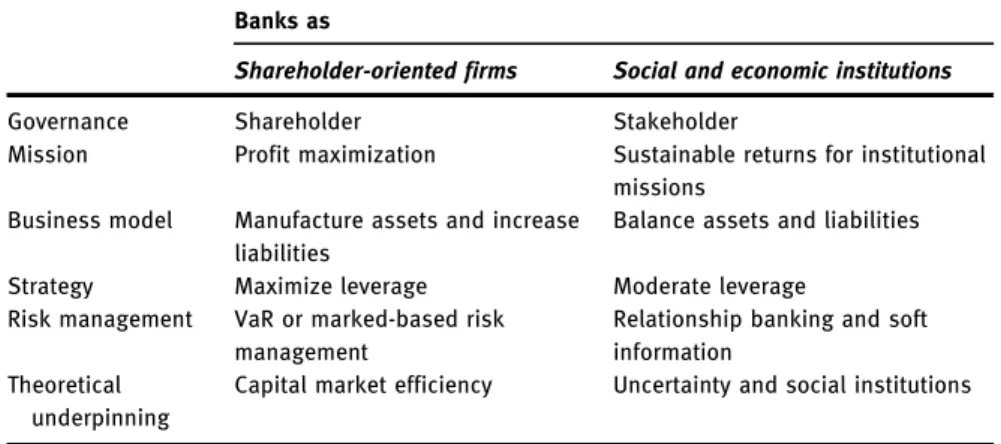
so widely blamed for crisis in 2007–2008. New associations such as the Global Alliance for Banking on Values1 suggest the importance of initiatives in social and ethical banking, whatever the form of ownership and governance; and member institutions have also reported positive performance (Weber, 2013; Cornée & Szafarz, 2013; Cornée, Masclet, & Thenet, 2012; Weber & Remer, 2011). However, our category of alternative banks (Butzbach & Mettenheim, 2014) covers a much broader population of often very longstanding institutions such as cooperative banks, credit unions, government savings banks, special purpose (development) banks, building societies, thrifts, and mutual savings banks. Although broad, the concept of alternative banking is justified because these institutions differ from private banks and share business models based on: (1) disavowal of profit maximization and shareholder-oriented governance; (2) longer term business horizons involving sustainable returns; (3) business mis-sions that include social and public goods; and (4) stakeholder-oriented, board-centered governance.
Several European alternative bank groups strayed from these principles. By mimicking private bank management strategies, Spanish Cajas de Ahorro (sav-ings banks) helped drive the real estate boom and bust cycle that has devastated the country. In Germany, several Landesbanken (provincial government banks) sought to become global investment banks during the 2000s, only to be caught in the 2007–2008 crisis. The Austrian Raiffeisen cooperative bank group also strayed from core principles while expanding commercial operations across Eastern and Central Europe after the collapse of the Soviet Union, only to retreat after crisis hit the region in 2008. Likewise, in the UK, aggressive business strategies at odds with traditional alternative banking models also led to rever-sals at the Coop Bank in 2012–2013. Government banks in developing and emerging countries have long drawn criticism for crony credit, poor manage-ment, and environmental damage. However, many government-owned savings banks and development banks in these countries have recovered from capture and mismanagement under military rule and dictatorships to shape growth amidst democratization and reforms (Mettenheim, 2006); to provide counter-cyclical credit and adjust (unexpectedly well) to crisis after 2008; and, perhaps most importantly, to help reach vast numbers of bankless citizens through new social policies such as basic income (Mettenheim, Diniz, & Gonzalez, 2013).
This article builds on recent empirical research that finds alternative banks equal to or superior to private banks in terms of efficiency, profitability, risk management, and other standard criteria used in banking studies. These find-ings have been reported in many settfind-ings, most ironically many years after 1 See references below.
liberalization, deregulation, privatizations, and foreign bank entry. Instead of converging toward private, market-based banking, alternative banks have mod-ernized in a variety of ways to maintain or expand market shares, while seeking to maintain their peculiar identity and remain faithful to their core missions (see also Mettenheim, 2013). We explain this anomaly for contemporary banking theory, neo-classical economic approaches, and neo-liberal policy designs by focusing on the main features of savings banks, cooperative banks, and govern-ment special purpose banks. Our explanations of alternative bank performance are drawn from contemporary banking theory but also from heterodox research on firms and the institutional foundations of competitive advantage. Concepts from banking theory reveal how alternative banks perform core functions of modern banking such as creating liquidity, pooling deposits, reducing information asymme-tries, and managing agency conflicts. However, heterodox theories of the firm reveal further institutional foundations of competitive advantages in alternative banking.
Since the 2007–2008 crisis, scholars, the financial press, and policy-makers have criticized the risky business models of private commercial and investment banks (Admati & Hellwig, 2013; US Government Financial Crisis Inquiry Commission, 2011). Although still marginal to policy debates and research in accounting, political economy and law, the errors of private banks have none-theless begun to produce reassessment of alternative banks (Butzbach & Mettenheim, 2014) and raise concern about the loss of organizational diversity in banking (Michie & Oughton, 2013; Liikanen, 2012; Goodhart & Wagner, 2012; Ayadi, Schmidt, Llewellyn, Arbak, & De Groen, 2010; Ayadi, Schmidt, & Carbò Verde, 2009). However, this belated reassessment pales in comparison to dec-ades of research biased toward private banks and reforms that sought to reduce or eliminate government and non-profit banks and credit institutions through privatizations, demutualization, liberalization, foreign bank entry, and deregu-lation of credit markets that, together, have profoundly changed the competitive setting for banks and other financial institutions such as pension funds and investment funds.
The bulk of financial economists and personnel at international policy-mak-ing institutions expected alternative banks to disappear, either sooner through privatizations or later because of liberalization; as the latter was expected to reveal the greater efficiency of private and foreign banks. Alternative bank man-agers were expected to abandon outmoded traditions of social and state banking in favor of profit-maximizing, market-based business models taken from private commercial and investment banks. However, defying expectations, alternative banking groups have, through a variety of strategies, modernized to hold their ground– maintaining or gaining market shares in many advanced and develop-ing countries, especially in retail bankdevelop-ing (deposits, savdevelop-ings accounts, and
lending to small and medium enterprises and households). And empirical studies have gone beyond descriptive evidence on market shares to demonstrate that alternative banks have often equaled or exceeded the performance of private banks in terms of cost, operational efficiency, and profitability. This is a paradox. As Canning, Jefferson, and Spencer (2003, p. 244) put it,“a central issue is why not-for-profit banks arise and survive in a world dominated by investor-owned banks, run for profit”.
This article explains the unexpected persistence of alternative banks as follows. Section 2 defines alternative banks and differentiates these institutions from private banks. Section 3 explores the history of alternative banks to introduce their institutional foundations of competitive advantage. Section 4 summarizes and discusses recent evidence on the (good overall) performance of alternative banks in the challenging context of a changing bank industry and regulatory environment over the past decades. Section 5 explores why these findings about alternative banks matter for socio-economic development and banking system stability. Section 6 discusses the ability (and limits) of contem-porary banking theory to explain the competitive advantages of alternative banks. Section 7 turns to agency theory, the dominant approach in banking theory and the literature on comparative bank performance, to identify several important competitive advantages of alternative banks– against the very con-clusions offered by mainstream banking studies on the basis of their use of agency theory. However, Section 8 goes beyond agency theory to show how stakeholder governance embedded in social and political institutions helps alternative banks better mitigate information asymmetries through relationship banking. Section 9 further explores how alternative banks obtain funding and hold equity, reserves, and patrimony differently, and often better, than private banks. Section 10 summarizes the sustainable business models of alternative banks. Section 11 reviews evidence that alternative banks help smooth inter-temporal risk, a critical function of banking systems. The conclusion synthesizes recent findings to suggest that banking studies may benefit both from analysis of alternative banks and the institutional foundations of competitive advantage in banking.
2 Defining and differentiating alternative banks
Our concept of alternative banks encompasses a broad, heterogeneous set of financial institutions including cooperative banks and savings banks, credit unions, mutual savings associations, government development banks, and
special purpose banks. These institutions may appear to have little in common. How can we compare small British building societies or local (sometimes“single window”) Italian cooperative banks with financial behemoths such as the Rabobank or Crédit Agricole? Notwithstanding their differences, alternative banks share three core characteristics that differ fundamentally from private banks:
Organizational goals: Alternative banks reject profit maximization for the benefit of shareholders. This does not mean that alternative banks produce losses. As discussed below, they have been found by many empirical studies to be more profitable than for-profit banks. However, the corporate missions of alternative banks span a broad range of explicitly stated objectives to which sustainable profits are allocated, such as economic and social development, local public project finance, savings and credit for poorer households and small businesses, and long-term investments in public goods, social capital, and public policies.
Governance structure: The governance of alternative banks is stakeholder-oriented and board-centered in the sense that they (a) are not run for the exclusive benefit of shareholders (when they have them); (b) are controlled and governed by a broader range of stakeholders: members in the case of mutuals, credit unions, and cooperatives; local and regional governments (and often clients/citizens) in the case of savings banks; and regional or national governments in the case of special purpose or development banks; and (c) are governed by corporate boards that tend to keep executives and staff under closer supervision and control than private banks.2
Business models: The business models of alternative banks differ from private banks along two crucial dimensions: (a) more cautious, longer term strategies to complete social and public policy missions through prudent banking and sus-tainable returns, and (b) corporate cultures and missions that value the social, cultural, and economic needs of their geographic areas or functionally defined members and clients.3
Table 1 compares the stakeholders, corporate missions and local rooting of private banks with the three major types of alternative banks: government savings banks, cooperative banks, and special purpose banks.
2 See Section 7 for a discussion of this point.
These characteristics of alternative banks are mutually reinforcing. The absence of profit maximization weakens potential residual claims by shareholders; sta-keholder-oriented governance helps maintain a broad range of corporate goals, often written in bank statutes and mission statements; stakeholder-oriented governance and a focus on sustainable returns instead of profit maximization through risky operations help lengthen the business horizons of alternative banks; the links of alternative banks to social organizations and government entities empower social forces and political representatives as stakeholders in corporate governance. To explain how these characteristics of alternative banks provide competitive advantages over private banks, we first turn to illustrations from the long history of alternative banking, then to banking theory and, finally, to heterodox theories of the firm and institutional foundations of competitive advantage.
Table 1: Comparing private banks and alternative banks
Private
banks4
Savings banks Cooperative banks Special purpose
banks Key stakeholder Shareholders Local, regional or
national governments
Members State agencies
Mission Profit Provision of savings
and banking services to citizens; financial education; local public finance; small and medium enterprises finance; social and cultural project funding (public housing; local and regional development; public service provision)
Pool member resources to secure and improve access to credit and sustain local community development National or regional development; mobilize private capital for public finance; secure credit for small and medium enterprises; public policy implementation (such as greening of industry and energy, human capital)
Local rooting5 Weak Strong Strong Medium
4 The key features of private banks summarized here are taken from banking theory and theories of the firm discussed below. Private banks may also have social missions that temper profit maximization for shareholders. However, most large, commercial banks have gradually shifted toward profit maximization in the past 30 years, as a result of financialization (see Berger et al., 2010).
5 Understood here as a combination of (i) the importance of local stakeholders in the govern-ance of the bank and (ii) the local focus of bank activities.
3 Alternative banking history
Alternative banks emerged alongside private commercial and merchant banking very early in European history (Mettenheim & Butzbach, 2014). Savings banks were founded by local governments and entities throughout Europe in the late eighteenth and early nineteenth century (Mura, 1996). But savings banks remit further back in history: to early Christian fund management; to the pawn-credit foundations of religious orders in medieval Italy; and to the Monti di pietà savings and pawn banks founded throughout Italy in the fifteenth century (Menhegin, 1986). Raiffeisen and Schultz-Delitz credit cooperatives were founded across German speaking areas after crop failures and economic crisis ravaged small farmers and communities in the late 1840s, while Louis Blanc and Pierre Joseph Proudhon also inspired public and cooperative credit movements across francophone countries. Development banks were created to finance infra-structure and accelerate industrialization across Continental Europe in the nine-teenth century and in many developing countries during the twentieth century (Aghion, 1999; Zysman, 1983; Diamond, 1957). In Europe (and its colonies), government postal savings banks rapidly improved access to payment services and savings accounts after the 1860s.
Some alternative banks were indeed captured in the early twentieth century by governments that bypassed parliaments to use saving deposits for public finance and war (Marks, 1905). Fascist and communist governments nationalized, often by force, the vast branch office networks, and assets and liabilities, of cooperative banks and savings banks (Castronovo, 2003; Kooper, 1995; Born, 1967). However, after 1945, alternative banks once again proved more positive, becoming instrumental for recovery from war and sustained growth across Europe (Shonfield, 1965) to remain critical institutions in complementary relations (Schmidt & Tyrell, 2001) with public savings and pension programs and other core features of Welfare States. The following sub-sections draw from the history of alternative banking groups (especially in Italy and Germany) to illustrate better their differences from private banks – especially during critical junctures of national economic development (i.e. before World War I and after World War II).
3.1 Italy
In Italy, alternative banks grew during the nineteenth and twentieth centuries to retain substantial market shares until market-based reforms in the 1990s trans-formed most savings banks into joint-stock firms through privatizations. Table 2 reports the credit provided by different types of banks in Italy from 1861 to 1910.
During this critical period of rapid development and modernization before World War I, the market share of private banks declines from over half to one third of total loans provided by credit institutions in Italy. In comparison, savings banks and Monti di pietà, popular banks and credit cooperatives, and government special credit institutions all grew to hold substantial lending market shares during the period of rapid modernization and industrialization in Italy.
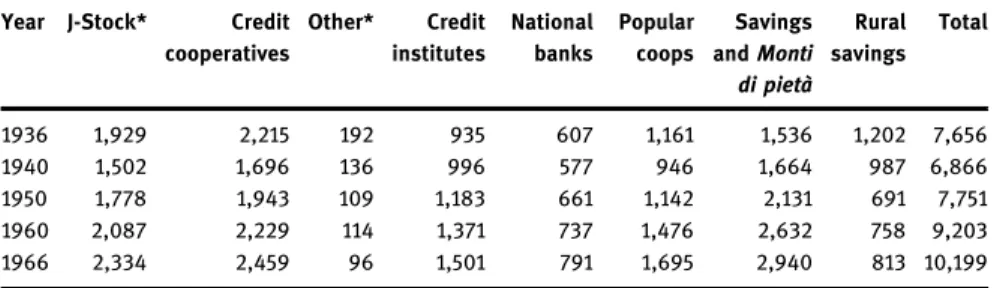
Further data are available for later periods that suggest the importance of branch office networks for alternative banks and relational banking. Table 3 reports the number of branch offices held by different types of banks in Italy from 1936 to 1966. The private bank share of branch office networks declines during this period from 81.8 to 47.9%. In comparison, savings banks and Monti di pietà increased share of branch offices 20.0–28.8%, credit institutes 12.2– 14.7%, popular coops 15.1–16.6%, while rural savings banks lost shares (15.7– 7.9%) and national-interest banks declined slightly (7.9–7.7%). Alternative banks thereby retained competitive advantage over private banks during the post-war period of sustained growth and social economy in Italy.
Table 2: Italian credit institution loans, 1861–1910 (billion euros)
Year Private,
for-profit banks
Savings banks and Monti di pietà
Popular banks and credit coops Govt. special credit institutes Total 1861 38.7 38.7 1.5 79.0 1870 47.1 137.4 20.4 23.3 228.3 1880 213.0 234.0 92.7 144.6 684.2 1890 362.3 391.9 209.1 427.0 1,390.3 1900 331.9 367.4 234.4 349.1 1,282.8 1910 1,029.7 857.7 652.1 379.2 2,918.7
Source: De Bonis, Farabullini, Rocchelli, and Alessandra (2012).
Table 3: Branch offices of types of banks, Italy 1936–1966
Year J-Stock* Credit
cooperatives Other* Credit institutes National banks Popular coops Savings and Monti di pietà Rural savings Total 1936 1,929 2,215 192 935 607 1,161 1,536 1,202 7,656 1940 1,502 1,696 136 996 577 946 1,664 987 6,866 1950 1,778 1,943 109 1,183 661 1,142 2,131 691 7,751 1960 2,087 2,229 114 1,371 737 1,476 2,632 758 9,203 1966 2,334 2,459 96 1,501 791 1,695 2,940 813 10,199
Reforms during the 1990s and 2000s privatized Italian savings banks and reduced direct government credit channels in favor of private banking. However, contrary to expectations about private bank efficiency, popular cooperative banks have kept strong market shares. And, instead of wholesale privatization, savings bank shares were allocated to new foundations designed to continue the social and cultural missions of savings banks. This is just one permutation of bank change across Europe since the 1990s.
3.2 Germany
Since the nineteenth century, studies of banking in Germany use the term“three pillars” to describe the largely equal market shares held by private banks (pillar one), cooperative banks (pillar two), and Sparkasse local and regional govern-ment savings banks (pillar three) (Schmidt, Bülbül, & Schüwer, 2014). The number of Sparkasse savings banks grew from 85 to 1,765 (mostly local govern-ment banks) between 1839 and the onset of World War I. Table 4 reports data from this critical period of rapid development and industrialization in Germany (1839–1913) before world wars, hyperinflation and depression changed the con-text of banking. The average balance of savings accounts, number of accounts per 100 residents, and balances held per capita population suggest that past debates about savings banks in Germany remain relevant for research on finan-cial inclusion and sofinan-cial banking today (Schmidt, 2009). Indeed, in the first
Table 4: German Sparkasse savings banks, 1839–1913
Year Banks (n) Branch Offices (n) Accounts (n) Accounts per 100 residents (marks) Balance (million marks) Average balance (million marks) Balance per million pop./marks 1839 85 18 1.24 1845 157 38 2.37 1850 234 278,147 54 195.4 3.29 1855 323 423,542 97 228.7 5.6 1865 517 919,513 268 291.3 13.8 1875 1,005 2,209,101 8.6 1,112 503.4 43.2 1885 1,318 1,485 4,209,453 14.8 2,261 537.1 79.5 1895 1,493 2,448 6,876,664 21.5 4,345 631.9 136.3 1900 1,490 2,828 8,670,709 25.1 5,746 662.6 166.4 1910 1,711 4,619 12,900,304 32.1 11,107 860.1 276.2 1913 1,765 5,268 14,417,642 34.2 13,111 909.4 311.4 Source: Büschegen (1983, p. 399).
decade of the twentieth century, the“Sparkasse question” turned on whether the growth of savings deposits at these institutions indicated drift from social missions that increased risk (because of more volatile middle class and business deposits), or whether traditional (poorer) clients had instead simply accumu-lated savings over time. The latter position prevailed, while further debate ensued about whether the small savings of the poor in savings banks helped ameliorate, or exacerbate, business cycles (Seidel, 1909).
Until today, German savings banks retain very large market shares in many markets for banking, insurance, finance, and related services. A core competitive advantage of savings banks is their“two-tier” structure composed of indepen-dently owned and operated local banks and a shared wholesale finance group (the Finanzgruppe Deutscher Sparkassen- und Giroverband, FDSG) that offers investment banking, finance, and insurance through 631 independent local and regional savings banks. Wholesale operations of German savings banks emerged in the late nineteenth century to launch many innovations in capital markets and finance throughout the twentieth and into the twenty-first century. In 2010, the balance sheets of German savings banks (reported together as the Sparkasse Finance Group) summed over 3.4 trillion euros (far more than the largest private banks in the world), uniting 6,201 firms with 21,700 branch offices and 366,500 employees (See Table 5). Through their multi-level giro organization, German savings banks cooperate to reduce costs and coordinate to improve monitoring and control over member banks– mechanisms not available to private banks
Table 5: The German Sparkasse Finance Group, 2009
Firms Branch
Offices
Staff Total assets
(in bn euro)
Sparkasse Finance Group 6,201 21,700 366,500 3,410
Sparkasse savings banks 631 15,685 258,737 1,073
Landesbank groups 7 50,476 1,689
DekaBank giro center bank 1 3,667 133
Sparkasse insurance group 1 30,000 17
Regional mortgage savings banks 10 8,896 52
Leasing groups 5 10,595 73
Capital market groups 85 1,447 506 2
Factoring groups 3 213 12
Finance IT division 5,375
LBS real estate 10 455 4
Commune management firms 8
forced to compete by maintaining their own retail networks and wholesale banking and finance operations individually.
The second pillar of alternative banking in Germany is composed of erative banking groups that remit to Raiffeissen and Schultz-Delitz credit coop-eratives founded in the 1840s. Credit coopcoop-eratives also grew rapidly during the nineteenth century; from 133 to 1,245 banks and from 31,603 to 748,058 members 1860–1920. And like savings banks, the trajectory of German cooperative banks reflects traditional business models of deposit-taking and loan-making, with conservative levels of capital reserves and members balances. Table 6 shows this gradual accumulation of savings, assets, (equity) balances for members, and reserves by commercial credit cooperatives in Germany during the critical period of rapid development and industrialization from 1860 to 1920 before hyperinflation and fascism changed banking.
The“three pillars” expression actually underestimates the importance of alter-native banking in Germany because it omits federal and provincial government special purpose banks that hold an additional 10% market share, depending on the sector, product, and service (Schmidt et al., 2014; Krahnen and Schmidt, 2004; Deeg, 1999). Table 7 reports the balance sheet, number of staff and government shareholding structure of the 20 special purpose banks in Germany in 2010. Together, these institutions held 834.4 billion euros in assets with 12,730 employees, serving provincial and federal governments by leading bank consortia and tapping capital markets. German special purpose banks remain especially important in public and home finance, public building con-struction, infrastructure modernization, environmental innovation, the greening of industry, and provision of health and other public services.
Table 6: German commercial credit cooperatives, 1860–1920
Year Coops Members Asset side Liability side Reserves*
Assets* Loans* Savings Member
Deposits* Balances* 1860 133 31,603 7 1 0 1870 740 314,656 187 166 131 40 4 1880 905 460,656 493 438 353 102 16 1890 1,072 518,003 620 538 438 117 28 1900 870 511,061 806 672 586 133 45 1910 939 600,387 1,477 1,202 1,084 216 94 1920 1,245 746,058 7,158 4,026 6,480 391 164
Note: *Million marks.
Tab le 7: Germ an special purpose banks , 2010 Staff Balance sheet * Majorit y shar eholdi ng** Feder al govern ment special purpos e banks KfW Bank Group 4, 600 400.1 80% Fed. 20% State Gov ts. Land wirtschaftliche R entenb ank 218 75.8 Fed. Govt. State g overnmen t spe cial purp ose banks Inves titionsbank Schleswig -Holstein 460 16.7 Schleswig -Hol stein Bre mer Aufb au-Bank 5 5 1.3 Bremen Holding Hambu rg ische Wo hnungsbau kreditanstalt 185 5.1 Hambu rg NBan k Inves t. und Förd erb ank Nie dersac hsen 426 5.7 Nieder sachse n NRW Bank (Nordrhe in-West falen Bank) 1,224 161 98.6% Nordr hein-We stfalen Inves titions-und Strukturban k Rheinlan d-Pfalz 186 8.5 Rhein-P falz LTH, Lan destreuhandban k Rheinlan d-Pfalz 98 1.9 Rhein-P falz SIKB Saarländis che Investitionskr editbank 6 6 1.2 51% Saar L-Ban k, Land eskreditbank Ba den-Württemb erg 1,230 59.7 Baden-W ürttembe rg LfA Förderbank Ba yern 344 19.4 Freistaat Bayern Bay erische Lande sboden kredit anstalt 227 21.2 Bayrisc hen esban k Land esförderinstitut Meckle nburg-V orpom mern 246 2.5 NORD LB Inves titionsbank Berlin 673 20.4 Berlin Inves titions Ba nk des Lan des Brand enburg 505 11.8 50% Brand enburg, 50% NRW Bank Inves tionsban k Sachs en-Anhalt 349 1.3 NORD/ LB Thü ringer Auf bauban k 336 2.5 Freistaat Thüringen Sächs ische Aufbaub ank Förd erbank 9 0 5 8.7 Freistaat Sachs en Wirtschafts -u nd Infrastrukturbank 397 9.6 Lande sbank Hess en-Th üringen Total 12,73 0 834.4 Note: *billio n euros **100% where per centag e not reported. Source: Association of Germ an Public Sector Banks (Bu ndesve rband Öffen tlicher Banke n Deut schla nds, VÖB) .
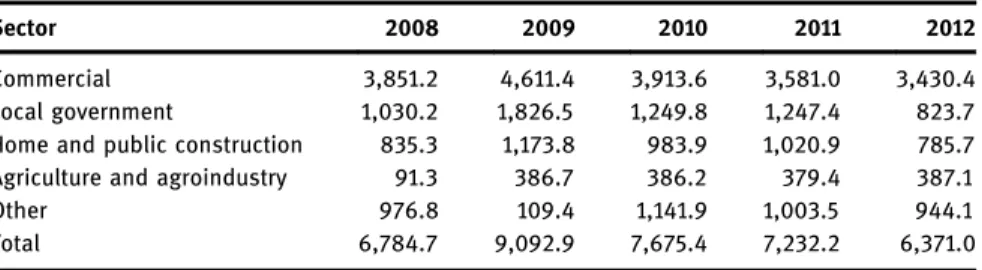
Some regional Landesbanks were caught in the crisis or succumbed to corruption, leading observers of German finance to call for ending links between savings banks and special purpose banks (Hilgert et al., 2011). However, not all German special purpose banks incurred losses and, as a whole, appear to have been important sources of counter-cyclical finance and credit since the 2007– 2008 global financial crisis. Table 8 reports the lending of German special purpose banks from 2008 to 2012; total investments increased from 6.7 to 9.0 billion in 2008–9, just as private banks incurred major losses from exposures in capital markets (Hardie & Howarth, 2013b).
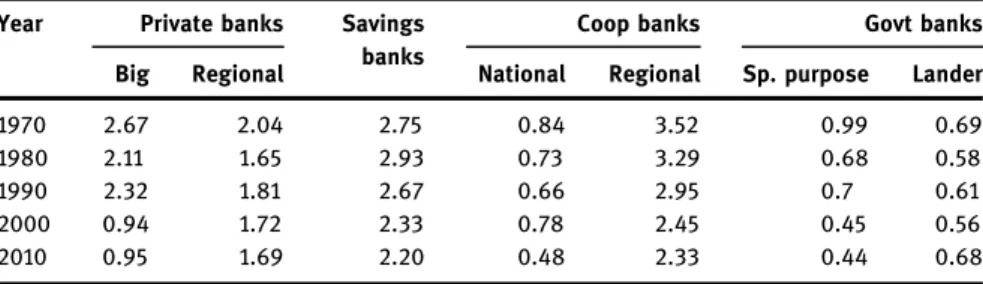
Data on bank performance reported by the German central bank also suggest the competitive advantages of alternative banks (see Table 9 and appendices). One clear advantage of alternative banks is cheaper administrative costs than private banks. Given the lean central offices of special purpose banks, the cost–income ratios6of these institutions declined from 47.9 in 1970 (vs 84.5 at big private banks and 70.0 at Landesbanks) to 32.2 in 2010 (vs 83.1 at big private banks and 57.9 at Landesbanks). And because savings banks and cooperative banks reduce costs by sharing wholesale operations, the latter also report cost–income ratios below large private banks and reduced this crucial indicator of bank perfor-mance from 1970 to 2010 (from 74.3 to 63.0 and 70.4 to 64.5, respectively) (see Table 9).
However, before turning to further evidence of recent performance, a histor-ical introduction to alternative banking would be incomplete without mention of government postal savings banks.
Table 8: German special purpose bank finance and credit, 2008–2012, million euros
Sector 2008 2009 2010 2011 2012
Commercial 3,851.2 4,611.4 3,913.6 3,581.0 3,430.4
Local government 1,030.2 1,826.5 1,249.8 1,247.4 823.7
Home and public construction 835.3 1,173.8 983.9 1,020.9 785.7
Agriculture and agroindustry 91.3 386.7 386.2 379.4 387.1
Other 976.8 109.4 1,141.9 1,003.5 944.1
Total 6,784.7 9,092.9 7,675.4 7,232.2 6,371.0
Source: Bundesverband Öffentlicher Banken Deutschlands (2013, p. 2).
6 The cost–income ratio is calculated as total administrative spending divided by gross
3.3 Postal Savings Banks
After the UK Postal Savings Bank was founded in 1862, governments throughout Europe began to offer savings accounts and other banking services through the vast branch office networks of postal agencies. Postal savings banks rapidly acquired large numbers of depositors and mobilized large quantities of savings. From 1862 to 1908, the UK Postal Savings Bank increased branch offices from 2,535 to 15,239, depositors from 178,495 to over 11 million (over 25% of the population), and deposits from 8.2 to 781.8 billion US dollars7 (Table 10). Postal savings banks experienced similar rapid growth throughout Europe and European colonies before World War I (National Monetary Commission, 1909).
After independence from colonial rule, postal savings banks were often retained by governments in developing countries for their large branch office networks and high ability to mobilize savings and facilitate payments and service provision. Countries that closed postal banks have recently recreated them. The creation of the China Postal Savings Bank in 2007 (with over 40,000 branch offices) and resale of banking concessions inside the 6,000 Brazilian postal offices in 2011 suggest the continued importance of postal banks with profound opportunities (and risks), especially for financial inclusion. In Africa, post-independence governments used postal offices to promote access to pay-ment and banking services toward poverty alleviation (Kamawe-Tsafack, 2002). Indeed, to counter the dramatic increase of financial exclusion in the US, the postal service has, once again, proposed expanding non-bank financial and
7 Data in dollars, facilitating comparison, were calculated according to foreign exchange rates by US consulate officials at that time for the US National Monetary Commission.
Table 9: Cost–income ratios by type of German bank, 1970–2010
Year Private Big Regional Savings Coops Government Sp. Purpose Landes
1970 84.5 76.8 74.3 70.4 47.9 70.0
1980 85.9 80.3 68.7 72.7 50.5 72.5
1990 69.7 77.4 67.9 76.5 71.0 66.0
2000 93.4 76.4 69.0 76.1 30.5 62.7
2010 83.1 69.2 63.0 64.5 32.2 57.9
Note: Cost–income ratio ¼ Total administrative spending/gross earnings (aggregate net interest
and net commissions received).
payment services at branch offices.8Although closed because of opposition by private banks in 1967, the US Postal Service Savings System had provided widespread access to basic savings since its creation in 1911 (Kemmerer, 1917). Postal savings banks remain critical institutions for promoting savings and averting financial exclusion.
In sum, alternative banks have played important roles in a variety of bank-ing and financial systems since the nineteenth century, especially in terms of promoting financial inclusion, mobilizing savings and public finance. Given the long history and wide variety of alternative banks, it is difficult to measure the overall importance of these institutions. Industry associations such as the World Savings Banks Institute and the International Co-operative Banking Association provide information about member banks, but no aggregate data exist for public development banks, despite their size and importance in many advanced and
8 On proposals by the USPS, see: Office of the Inspector General, USPS (2014). On financial exclusion in the US, see FDIC (2012).
Table 10: Postal Savings Banks, UK, France, and Italy, 1862–1908
Year Offices Depositors Deposits (US$)
UK Postal Savings Banks, 1862–1908
1862 2,535 178,495 8,264,392 1870 4,082 1,183,153 73,479,789 1880 6,233 2,184,972 164,218,275 1890 9,681 4,827,314 329,145,788 1900 13,341 8,439,983 659,652,347 1908 15,239 11,018,251 781,794,533
France Postal Savings Bank 1882–1908
1882 6,024 211,580 9,187,116
1890 6,817 1,475,820 79,793,736
1900 7,697 3,565,941 194,980,796
1908 5,291,673 296,964,867
Italy Postal Savings Bank, 1876–1908
1876 1,989 57,354 471,577
1880 3,313 339,845 8,926,802
1890 4,479 2,126,289 59,923,342
1900 5,143 3,990,983 131,652,255
1908 8,735 4,981,920 290,808,886
Note: Dollar values calculated by US consular staff reporting to the National Monetary Commission. Time series ends the year before the Commission report.
developing countries. Moreover, because alternative banks vary widely across sectors, countries, and regions, these institutions may not appear in standard aggregate measures of banking activity. For example, according to the overall market shares of UK bank deposits in the 1990s, mutual building societies appear marginal while, in fact, they remained dominant players on the mortgage lending market.
Differences across world regions also are marked. While local and regional savings banks and cooperative banks predominate across Continental Europe (Groeneveld, 2014; Schmidt et al., 2014); development banks and savings banks or institutes were centralized in developing and emerging countries, often by military or authoritarian governments (Mettenheim, 2014).
It is thus fair to say that given the importance of alternative banks in some segments of banking and many financial systems, these institutions have indeed been historically significant and deserve more attention in research on banks and banking.
4 Alternative banks after liberalization,
deregulation, privatizations, and IT revolution:
a discussion of empirical evidence
Even where alternative banks retained large market shares and critical roles in banking and finance, fundamental changes in the legal, regulatory and competi-tive environment of banking appeared to threaten their survival after 1980. Reforms in many countries radically altered banking through: (a) de-segmentation, in the sense of ending strict separation between segments of banking markets such as short-term money markets and long-term lending; household and corporate lending; and retail and wholesale banking (for example, the 1999 Gramm-Leach-Bliley Act in the US, which repealed core provisions of the Glass-Steagall Act restricting affiliations between deposit banks and trading firms); (b) financial market liberalization that reduced legal and regulatory barriers to entry; (c) liberal-ization of credit markets and prices that sought to reduce or end administered credit in state-centered financial systems such as France or Italy (or abandon informal interest rate controls in countries such as the UK); (d) statutory normal-ization designed to end protection of alternative banks (usually leading to their transformation into or merge with joint-stock banks; for example, the Building Societies Act of 1986 allowed British building societies to demutualize; or the 1990 Amato-Carli law in Italy that transformed savings banks and other public banks
into joint-stock companies); and finally (e) large-scale privatizations of state-owned banks in countries with traditions of state-owned enterprises such as France and Italy in Europe, as well as many developing, emerging, and transition countries.
Liberalization, deregulation, privatizations, and mergers and acquisitions have radically changed banking and finance. Banks and other financial inter-mediaries such as insurance companies and investment funds shifted business away from traditional deposit-taking and loan-making toward a wide variety of products and services traded directly on capital markets. New technologies of information and communication also revolutionized banking with new electro-nic channels such as ATMs, online banking and mobile banking via cellular phones– technologies that bypass traditional branch offices and personal, face-to-face provision of services traditionally associated with relational banking (see below).
These fundamental changes have challenged all banks, but alternative banks most dramatically. Privatizations transformed many alternative banks into joint-stock corporations, often abruptly ending traditional governance struc-tures and practices. For example, building societies, a non-profit pillar of the UK financial system, were largely dismantled after reforms in 1986 allowed the most powerful societies to demutualize. These demutualized building societies formed the backbone of for-profit banking groups that played central roles in exacer-bating the 2007–2008 banking crisis (Northern Rock, Halifax, Bradford, and Bingley). Liberalization of banking and credit markets and waves of consolida-tion through mergers and acquisiconsolida-tions forced many local cooperative banks and savings banks to merge with or be acquired by larger for-profit banks. This process was most marked in the UK and Italy.9Finally, foreign bank entry and
financial market liberalization encouraged all banks to diversify away from traditional business lines and pay more attention to short-term profit margins. Although widely expected to reveal the greater efficiency of private banks, alternative banks appear to have adopted new technologies through moderniza-tion strategies capable of tapping their tradimoderniza-tional competitive advantages.
As a result of these far-reaching changes in their competitive, technological, and regulatory environment, the fate of alternative banks has differed. In the US and UK, traditional savings and cooperative banks have been marginalized, either through collapse of the sector during transition to market-based banking (the US Savings and Loan crisis in the late 1980s) or demutualization (the 1986
9 In the UK, most large building societies choose to demutualize and then merge with large joint-stock commercial banks in the 1990s; in Italy, most large savings banks, once granted a
joint-stock status, merged with former public banks to form the backbone of the country’s
Building Society Act led large UK building societies to demutualize, thus causing the cooperative movement in UK banking to shrink four fifths of its total assets during the 1990s). However, alternative banks kept large market shares in many other countries, both in lending and in retail funding markets, especially in Continental Europe. In France and Germany, cooperative banks and savings banks retain dominant positions. As mentioned above, alternative banks con-stitute two of three pillars in German banking. In Italy, 5 of the largest 10 banking groups (in assets) are cooperative banks (Banche Popolari). In the Netherlands, after declining during the 1990s, the cooperative group Rabobank recovered over the next decade to remain the second largest bank in the country. Alternative banks also retain powerful market positions in many developing countries. In large emerging countries such as Brazil and India, state-owned banks remain the largest and fastest growing banks long after liberalization and privatizations (Mettenheim, 2014).
However, the evidence goes beyond market shares. In the appendix, Table 16 summarizes the findings, research methods and data of 21 empirical studies that compare the performance of alternative banks, mostly in terms of cost-efficiency, profitability, and riskiness. Overall, these studies provide strong evidence from diverse settings that alternative banks can compete with and also outperform private banks, even after liberalization, deregulation, and adop-tion of new technologies. In particular, these studies find cooperative banks and savings banks to be at least as cost-efficient10as their commercial competitors. Ayadi et al. find European savings banks as much cost-efficient as commercial banks (2009). Although German cooperative banks appear slightly less efficient, cooperative banks in France, Italy, and Spain are largely more cost-efficient than their commercial peers (Ayadi et al., 2010). This confirms findings from Iannotta, Nocera, and Sironi (2007) showing that government-owned and cooperative banks are more cost-efficient in 15 European countries (in a sample of 181 large banks). Altunbaş, Carbó Valverde, and Molyneux (2003) also find slightly higher cost-efficiencies with savings and cooperative banks in a sample study of banks in 15 European countries and the US 1990–2000. Savings and cooperative banks were found to be more cost-efficient than private banks in all but three countries. Country studies such as Altunbas, Evans, and Molyneux (2001) on Germany, Giordano and Lopes (2009) on the Italian cooperative sector,
10 Cost-efficiency is defined here as the ability of banks to minimize the cost of inputs for a given output. Of course, this rather narrow view raises a number of questions as to what is the implicit business model underlying these efficiency measures. The theoretical and methodolo-gical biases of bank performance studies are addressed in other sections below.
and Cebenoyan et al. (1993) on the US savings and loans sector obtained similar results.11
Alternative banks also perform well in terms of profitability. Again, this is surprising because they do not focus on profit maximization. Indeed, Berger et al. warn against using measures of profitability to compare government banks with private banks because “the measures of performance and economic con-sequences employed in these studies do not always correspond to the objectives of the state-owned banks” (Berger, Clarke, Cull, Klapper, & Udell, 2005). This caveat applies to studies of savings banks and cooperative banks that emphasize profitability and casts doubt on comparisons between alternative banks and private banks based on measures drawn from joint-stock firms (such as stock returns used by Cole and Mehran (1998) on a sample of US thrift institutions). More appropriate measures for analysis of alternative banks may be found in studies of cooperative institutions or non-profit organizations; while other expla-nations of performance (such as alternative bank specialization in more tradi-tional, safer, and profitable lines of business such as retail and mortgage lending) need to be explored.
Notwithstanding these problems of inappropriate measurement and com-parison, alternative banks still fare well in recent studies of profitability. Dietrich and Wanzenried (2011) find that Swiss government-owned banks performed better than privately owned commercial banks during the crisis years (2007– 2010), while pre-crisis performance was at par.12Millon Cornett, Guo, Khaksari, and Tehranian (2010) present mixed evidence on the comparative performance of government banks. Studying a sample of East Asian banks from 1989 to 2004, the authors find that state-owned banks were less profitable, held less core capital, and had greater credit risk than privately owned banks prior to the 1997 crisis.13 However, East Asian government banks have approached private bank levels of performance since the 1997 financial crisis in Asia. Micco, Panizza, and Yañez (2007) find that state-owned banks in developing countries are less profitable than private-owned banks. However, Bonin, Hasan, and
11 An exception is Mester (1993) who finds, on the contrary, in a sample of more than a 1,000 US savings and loans surveyed in 1988, that joint-stock savings and loans outperform their mutual peers in terms of cost-efficiency.
12 An anonymous referee suggests that this is because state banks were prohibited from international banking.
13 However, it should be said that lower or higher credit risk are affected by risk measurement methods, themselves associated with bank regulations such as core capital requirements under Basle agreements. We thank an anonymous reviewer for raising this point.
Wachtel (2005) find significant differences between state banks and private banks in Eastern Europe in terms of profit efficiency. An earlier comparison of European banks found, on average, that state banks posted higher returns on assets than private banks (Molyneux & Thornton, 1992). Aggregate comparisons of public and private banks after the 2007 crisis also become difficult because nationalizations or public rescue of banks undercut this dichotomy.
Ayadi et al. (2010) find German and Spanish cooperative banks more profit-able than commercial banks in terms of returns on assets and equity. However, this does not hold for cooperative banks in other European countries. After excluding small cooperative banks and savings banks, Iannotta et al. (2007) find that government-owned banks and cooperative banks perform worse than private, commercial banks in terms of profitability and riskiness. Altunbas et al. (2003) also find that European commercial banks are slightly more profitable than their non-profit peers. However, these findings from comparative studies are reversed in several analyses of specific countries: Chakravarty and Williams (2006) on Germany, Crespi, Garcia-Cestona, and Salas (2004) on Spain, Altunbas et al. (2001) on Germany, Valneck (1999) on British building societies, and Cebenoyan, Cooperman, Register, and Hudgins (1993) on the US all find non-profit banks to be more non-profitable than for-non-profit banks.
Results from comparison of risk management in alternative banks and private banks are also mixed. Standard measures of bank risk such as z-scores, which measure default probabilities, or earnings volatility produce mixed results. Studies by La Porta, Lopez-de-Silanes, and Schleifer (2002), Millon Cornett et al. (2010), and Iannotta et al. (2007) find government-owned banks (but not cooperatives in the latter case) to be less stable; while Ayadi et al. (2009, 2010), Beck, De Jonghe, and Schepens (2012), Bongini and Ferri (2008), Garcia-Marco and Robles-Fernandez (2008), Cihak and Hesse (2007), Iannotta et al. (2007), Salas and Saurinas (2002), and Esty (1997) all report higher earn-ings stability for cooperative banks and savearn-ings banks than in private banks. Ayadi et al. (2009), Beck et al. (2012), and Garcia-Marco and Robles-Fernandez (2008) find lower probabilities of default in cooperative banks and savings banks compared to private banks.
Comparisons of credit risk also find cooperative banks and savings banks to have fewer non-performing loans than commercial banks (Beck et al., 2012; Salas & Saurina, 2002). Data from the Central Bank of Brazil suggest that levels of non-performing loans in Brazilian government banks fell from very high levels under military rule and transition governments to well below levels of private banks in the country after transition to democracy during the 2000s (Mettenheim, 2010). Although it is difficult to control for the practice of rolling over bad loans to reduce levels of non-performing loans, data from the Reserve
Bank of India also suggest that the level of non-performing loans at state banks has converged to private bank levels during the 2000s (Mettenheim, 2014).
In sum, comparative statistical analyses bolster the idea that alternative banks have realized competitive advantages over private banks. Despite the profound changes in banking produced by liberalization, deregulation, and new technologies since the 1980s, alternative banks in many countries have not only survived; they have fared well on the basis of standard indicators of performance in empirical comparisons with private banks. Using more adequate measures to assess alternative bank performance (such as counter-cyclical lend-ing or credit rationlend-ing) also produce findlend-ings favorlend-ing these institutions over private banks (Schclarek-Curutchet, 2014). However, most studies still use stan-dard measures of bank profitability, efficiency, and risk management taken directly from the literature on private banking.14This is a tough test suggesting that alternative banks do indeed compare well with private banks.
Before turning to theories of banking and the institutional foundations of competitive advantage to explain why alternative banks perform as well or better than private banks, a note on why alternative banks matter is in order.
5 Why alternative banks matter
Alternative banks matter because they counter the credit rationing of private banks (Bresler, Grossle, & Turner, 2007), help avert capital drain (Hakenes & Schnabel, 2006), and promote financial inclusion by serving poor and geogra-phically isolated citizens that private banks increasingly refuse to retain as clients (Federal Deposit Insurance Corporation, 2012). Alternative banks also provide important institutional resources for social and political forces and policy options for governments. And given the hard realities of fiscal constraints in advanced and emerging economies, it is essential to recognize that govern-ment banks can dramatically increase funding for public policies (banks do create money, after all) and improve policy implementation by monitoring and control public projects (Biondi, 2013; Mettenheim, 2010).
14 Whether this provides tough tests that indicate competitive advantages in alternative bank-ing or, instead, that alternative measures and alternative theories are needed is a question we return to below.
5.1 Alternative banks as institutions for social and
economic development
Two functions of alternative banks stand out in social and economic develop-ment: enlarging access to banking services and funding economic activities. The core mission of credit cooperatives and savings banks (since their emergence in the nineteenth century) is to encourage savings among popular and working classes and meet the financial needs of low- and middle-income members and citizens. Cooperative banks and local and regional government savings banks still specialize in retail lending (to households and small firms) and holding deposits of low- and middle-income households. Despite increased competition for deposits (and low interest rates set by central banks since 2008), cooperative banks and savings banks nonetheless retain large shares of retail bank deposit markets.
Cooperative banks and savings banks have also played a key role in chan-neling savings to public finance through government securities and encouraging home ownership in many European countries since the nineteenth century. In advanced and emerging economies, public development banks retain explicit mandates to finance a broad array of public goods and projects, ranging from funding small and medium enterprises to financing social housing and local and regional economic development.
5.2 Alternative banks as buffer for systemic stability
Alternative banks also improve the overall functioning of financial systems, especially systemic stability. Recent research on diversity in banking develops three arguments relevant for understanding how alternative banks may improve the stability of banking and financial systems (Ayadi et al., 2010, 2009; Haldane and May, 2011). The first argument simply notes the importance of diverse business models within and across banking systems, especially in terms of organizational purpose and risk management. Such arguments can be found in recent studies of alternative banks cited above and official government reports, such as the UK Treasury report on financial regulation (HM Treasury, 2010); or the Liikanen Report for the European Commission that defines six dimensions of diversity in banking (size, ownership, capital and funding, activ-ities revealed by balance sheets and income statements, corporate and legal structure, and geographical scope) (Liikanen, 2012). Michie and Oughton (2013) emphasize bank diversity in terms of ownership (shareholding structure), com-petition (market structure), balance sheet resilience, and geographical spread.
The second argument is that diversity is valuable in itself as a characteristic of the banking sector as a whole. In other words, banking systems composed of heterogeneous organizations do better at mitigating systemic risk than homo-geneous banking systems, whatever the source of heterogeneity. This point is very similar to the view that homogeneous banking systems suffer from a too-many-to-fail problem, whereby an implicit guarantee by governments“induces banks to herd ex-ante in order to increase the likelihood of being bailed out ex-post” (Acharya & Yorulmazer, 2007).
More broadly, diversity helps reduce systemic risk by reducing the collinear-ity of bank portfolios. Indeed, one reason behind the global financial crisis of 2007–8 was that banks invested in the very same asset classes (such as mort-gage assets) because of the high correlation of diversification strategies at banks. In other words, too many banks chose to diversify their revenue in similar ways. As Haldane (2009) famously pointed out, individual diversification by banks may decrease systemic diversity and increase systemic risk. This has been confirmed by Corsi, Marmi, and Lillo (2013) and explained further as phenomena driven by market-based banking in Minskyian cycles of financial instability by Solomon and Golo (2013). Wagner makes related argument that the homogenization of banking systems has reduced the ability of banks to share risk, such that the re-optimization of bank portfolios tends to disrupt liquidity creation in the banking system (Wagner, 2010, 2008; Goodhart & Wagner, 2012). Biondi and Fantacci (2012) further demonstrate how liquidity was designed as a market-based process driven by use of fair value accounting (instead of histor-ical cost accounting) that has culminated in increased market distress and massive injections from monetary authorities to preserve liquidity. These studies go beyond typologies and differences in organizational forms of banks to iden-tify the importance of diversity in the industry.
A third argument suggests that diversity is important for the evolution of banking systems. For Michie (2011, p. 309), “In a situation of uncertainty and unpredictability, we cannot know which model will prove to be superior in all possible future circumstances, so we ought to be rather cautious before destroying any successful model.” Arguments about banking diversity do not imply support for alternative banks per se. However, they do suggest that alternative banks improve banking and financial systems – especially because their lower levels of exposure to markets and smaller size may allow them to better withstand adverse economic conditions (Vallascas & Keasey, 2012; De Jonghe, 2010).
In terms of the “three pillars” description of German banking, banking systems that rely exclusively on one pillar (private, market-based banking) may well be less stable than banking systems that retain two further pillars, i.e. large groups of independent local and regional cooperative banks and savings banks.
6 Explaining competitive advantages of
alternative banks with banking theory
15To go beyond metaphors and explain why alternative banks have outperformed private banks so consistently, one naturally turns to theories of banking. However, contemporary banking theory, as presented, for instance, in the Oxford Handbook of Banking (Berger et al., 2010), or textbooks (Matthews & Thompson, 2008), provides very scant reference to savings banks, cooperative banks, or government banks. None of the 36 chapters of the 2010 Handbook deal with alternative banks or non-profit financial intermediaries. Savings banks and mutual banks are absent from the Handbook index; cooperative banks appear twice (in a chapter on Japan); development banks once (the Development Bank of Japan); thrift institutions twice in a chapter on the US alongside an entry on thrift failures; and state-owned commercial banks four times in a chapter on transition countries. Ignoring alternative banks in a handbook published three years after the 2007 global financial crisis indicates a glaring omission in main-stream banking studies. However, heterodox theories of banking seem to share the same apparent lack of interest in alternative banks (Nasica, 2010; Bertocco, 2006), even when the purpose of analysis is to reassess what banks should do (Wray, 2013; Dymski, 1988). And while economists did pay more attention to non-profit financial intermediaries in the past, research focused almost exclu-sively on governance and ownership issues.16
A closer look at contemporary banking theory helps explain this lack of interest in alternative banking but, ironically, also suggest that core ideas from banking theory may nonetheless clarify certain competitive advantage of alter-native banks. First, modern theories of banking in the 1960s ignored alteralter-native banks because they sought to go over neo-classical theories of fractional reserve banking. The latter were primarily theories of money. Accordingly, banks remained a sideshow to monetary authorities as simple cogs in the money multiplier. Banks were seen as money creating entities with no significant contribution to the economy. The“new view” in banking theory thus emerged as a reaction against this“pure theory of fractional reserve banking” (Towey, 1974). These new approaches (Tobin, 1963; Gurley & Shaw, 1960) made two key arguments. First, they rejected what Tobin called the mystique of money. For Tobin, substitutability (from the borrowers’ point of view) between financial
15 The following sections build on Butzbach and Mettenheim (2014).
16 As Rasmussen put it 25 years ago:“the difference between mutual and stock banks lies in
assets required the rejection of money as special. Second, Tobin and others argued that banks are firms with specific corporate goals:“Bank-created ‘money’ is a liability, which must be matched on the other side of the balance sheet. And banks, as businesses, must earn money from their middleman’s role” (Tobin, 1963, p. 416).17 Modern theories of banking thereafter emphasized that bank assets and liabilities were shaped by the strategies of bank managers to max-imize returns from lending and interest rates on deposits (Tobin, 1982; Santomero, 1984). Lending was thus seen to be determined by the marginal returns of assets over the cost of liabilities (Klein, 1971).
New theories from Tobin, Gurley, and Shaw sought to reinstate a more realistic view of banking within monetary theory; their primary focus was not to offer a better understanding of banks per se. Banking theory developed, therefore, as a secondary endeavor and largely followed two parallel theoretical tracks. First, Tobin was a Keynesian and his monetary theory was neo-Keynesian. However, his, and other, new views of banking applied old assump-tions from neo-classical theories of the firm to banks and financial instituassump-tions (utility maximization and self-interest taken, in turn, of course, from neo-classi-cal assumptions about individuals). Second, banking theory explained banks in terms of their functions in financial systems of money-based economies. Tobin extrapolated from the monetary role of banks with a portfolio approach: “the essential function of financial intermediaries […] is to satisfy simultaneously the portfolio preferences of two types of individuals or firms” (1963, p. 411).
Research in banking theory and financial economics has since retained the assumptions of mainstream firm theory to elaborate specific functions of banks (Fama, 1980a; Diamond & Dybvig, 1983; Baltensperger, 1980; Wray, 2013). This approach to banks as multi-function, profit-maximizing firms has distanced banking theory from institutional and organizational approaches in other dis-ciplines. In their landmark synthesis, Bhattacharya and Thakor (1993) suggest that banks fulfill two key functions in modern financial systems: brokerage services and qualitative asset transformation. By focusing on banks as interme-diaries between investors and capital markets, contemporary banking theory has largely ignored, in peril, traditional views of how banks manage maturity
17 As a reviewer pointed out, Tobin’s ideas reflect a very reductive “balance sheet approach” to
the banking firm, i.e. one that conceives assets and liabilities as marketable securities and sees the banking firm as a mere portfolio of such assets and liabilities. We completely agree with this
critical assessment of the “new view”. But our purpose here is precisely to highlight the
limitations of contemporary banking theory by questioning its core assumptions – while
retaining certain arguments within this overall questionable framework that may usefully
transformation.18In contrast, we return to traditional conceptions of banks (as deposit-taking and loan-making institutions that must balance assets with liabilities) to reject the idea that financial intermediation allows market-based banks to manufacture and manage assets above and beyond traditional capital reserve levels that have long been seen as necessary to cover possible losses from risks.
For contemporary banking theory, market efficiency implies that price sig-nals from capital markets may replace soft information and relationship banking embedded in social and political institutions. An institutional theory of alter-native banking suggests, to the contrary, that competitive advantages arise from traditional balancing of liabilities and assets that permit maturity transformation through size, scale, confidence, organizational reputation, internal monitoring, and supervision (that averts excessive risk-taking and opportunistic marketing and sales) and, in the past, guarantees from mutual arrangements or govern-ment entities. This differs from the core concept of qualitative asset transforma-tion in contemporary theories of banks as financial intermediaries that focus on how bank loans retain different risk profiles than the liabilities issued by banks to make those loans (Diamond & Rajan, 2001). Recent research shifts from relational to transactional views of banking (Boot & Marinč, 2008) and the integration of banks and markets (Boot & Thakor, 2010), but focuses on func-tions of brokerage and asset transformation that assume neo-classical theories of the firm and see banks as intermediaries between investors and capital markets.19
Two significant developments in contemporary banking theory emerged in the 1970s: one emphasizing market failures, another focusing on changes in governance by banks driven by shareholders.20The literature on market failures in banking retains core assumptions about market efficiency. And studies of bank governance retain core assumptions about the virtues of shareholder-based governance in mainstream theories of the firm. However, both nonetheless help identify several competitive advantages of alternative banks, especially if sup-plemented with findings from past research on non-profit banks and credit institutions.
18 The authors thank Yuri Biondi for suggesting this critical point.
19 However, in analyzing this shift in behavior, economists ignore the important role of top-down regulatory reforms and changes in accounting standards. Thanks to an anonymous referee for this useful comment.
20 The authors thank Yuri Biondi for this synthesis of turns in banking theory and their importance for rethinking alternative banks from an institutional perspective.
The turn to market failures in banking theory focused on information asymme-tries (see Leland and Pye, 1977). For Boot (2000, p. 8), the theory of information asymmetries helps distinguish“modern theories of financial intermediation from the earlier transaction costs-based theories”. From this perspective, banks exist because“intermediation is a response to the inability of market-mediated mechan-isms to efficiently resolve informational problems” inherent to financial transac-tions (Bhattacharya & Thakor, 1993, p. 14). The specificity of banks is then in the type of contractual mechanism used to solve information asymmetries. While for Tobin (1963; 1982), banks helped decrease transaction costs through the pooling of risk, modern theories insist on the informational advantages of banks over markets as critical to reduce credit rationing (Stiglitz & Weiss, 1981). Banks were thereby seen as delegated monitors able to reduce the cost of monitoring borrowers incurred by lenders/depositors (Diamond, 1984). From this perspective, banks undertake relationship lending to decrease information asymmetries and avert the conse-quences of information asymmetries on credit relationships: adverse selection and moral hazard (Boot, 2000; Petersen & Rajan, 1994).
These views of market failures, banks as intermediaries, and relationship lending help clarify the competitive advantages and broader importance of alternative banks. Caution is in order here because, despite profound advances in this influential area of contemporary banking theory, one cannot dispel the impression that organizational and institutional aspects of banking remain underestimated or ignored. Contemporary banking studies rely on default the-ories of the modern firm, mostly based on neo-institutional thethe-ories of the firm (agency theory and property rights theory). Since 1970, banking theory has evolved as a sub-discipline of financial economics wedded to conceptions of financial market efficiency, neo-classical economics and models of dynamic stochastic general equilibrium. Meanwhile, traditional conceptions of banking and institutional approaches increasingly appeared anachronistic, as market-based banking came to dominate the industry and lawmakers amidst deregula-tion, privatizations, demutualizaderegula-tion, disintermediaderegula-tion, and financialization. With notable exceptions such as Minskyian theories of financial instability, critical approaches in political economy, and regulation approaches, banking studies focused on a limited set of questions about market failures, the impor-tance of law (basically the protection of creditors) and agency theories of own-ership and governance in joint-stock banks (ironically, just as private equity firms and other forms of ownership grew as alternatives in response to problems with shareholder-based governance).21
21 We thank Yuri Biondi for suggesting this focus on how alternative banks counter market failures.
The following sections mirror the trajectory of contemporary banking theory by first drawing on agency theory, then turning to theories of intermediation and asymmetric information to explain the competitive advantages and systemic importance of alternative banks. These approaches present important flaws and make disputable theoretical assumptions. However, because they have largely shaped debates about bank performance in the academic literature, they provide a necessary point of departure for our analysis. Moreover, ironically (given the bias of contemporary banking theory toward private ownership), both agency theory and intermediation theory nonetheless provide important, if limited, explanations of the competitive advantage of alternative banks found in the empirical evidence discussed above. The limits of these two approaches inform our turn to heterodox views of how firms acquire and maintain institu-tional foundations of competitive advantage, approaches that provide both more compelling explanations of recent empirical findings about alternative banks and greater promise for development of alternative banking theories.
7 Alternative banking and agency theories of
shareholding and market discipline
Most comparisons of bank performance are informed by concepts and measures from agency theory that emphasize shareholders, contractual control, and market discipline of management. From this perspective, the efficiency of banks depends on their ability to mitigate potential agency conflicts. As noted, mainstream theories of the firm have remained the explicit (Fama, 1980a, 1980b) or implicit bases of contemporary theories of banking since the 1960s. Comparative analyses of bank shareholding structures in the 1990s (which set the terms for current debates on government vs private banking) also made extensive use of agency theory (Altunbaş et al., 2003). Indeed, the dichotomy between “stakeholder-oriented” and “shareholder-oriented” banks (Coco & Ferri, 2010) suggests the primacy of governance and shareholding issues in this literature.
While the distinction between stakeholder and shareholder governance in banking is not questionable per se, the following problems remain: (1) the explicit or implicit adherence to mainstream neo-classical theories of the firm in most discussions of the advantages of public or mutual vs private share-holding/control; (2) the implicit assumption that shareholding and governance are the key characteristics that distinguish alternative banks from private banks; this ignores other critical differences emphasized herein.