A WISH LIST OF DRR AND DRM ACTIONS FOR CULTURAL HERITAGE
Xavier Romão a, *, Esmeralda Paupério b
a CONSTRUCT-LESE, Faculty of Engineering of the University of Porto, Portugal - [email protected]
b Construction Institute, CONSTRUCT-LESE, Faculty of Engineering of the University of Porto, Portugal - [email protected]
KEY WORDS: Risk management, risk assessment, preparedness
ABSTRACT:
The implementation of effective actions for disaster risk reduction (DRR) and disaster risk management (DRM) in cultural heritage has been slow, despite the increase in awareness regarding the overall risks to cultural heritage and the several international initiatives recognizing the importance of cultural heritage for society. Although there are numerous reasons for this lack of tangible changes, a few practical topics are addressed herein. The selected topics require further discussion, research and development to achieve the successful implementation of DRR and DRM practices for immovable cultural heritage.
* Corresponding author
1. INTRODUCTION
Numerous international institutions connected to disaster risk reduction (DRR) and disaster risk management (DRM) are increasingly echoing concerns about the protection of cultural heritage from disasters. Existing international frameworks and programmes for DRR emphasizing the need to develop and implement measures to reduce hazard exposure and vulnerability to disasters also recognize the importance of cultural heritage and its irreplaceable value for society. Furthermore, several initiatives have also started to recognize the importance of cultural heritage as a sustainable resource for economic growth and for addressing several societal challenges. Despite this awareness increase regarding the overall risks to cultural heritage, the implementation of effective actions for DRR and DRM in cultural heritage has been slow. Although there are numerous reasons for this lack of tangible changes, the current paper brings some attention to a few practical aspects that require further discussion, research and development to achieve the successful implementation of DRR and DRM practices for immovable cultural heritage. In particular, the paper will focus different elements of the risk management cycle that link with the mitigation and preparedness component of the disaster management cycle.
2. THE DISASTER MANAGEMENT CYCLE AND THE RISK MANAGEMENT CYCLE: A BRIEF REVIEW 2.1 The disaster management cycle
Several terminologies are available to define and describe the disaster management cycle. Even though different fields of disaster-related practice use alternative interpretations of this cycle, most of them are very close and differ in minor details only. Among those, the definition of disaster management cycle that is selected herein is one that is simple, that incorporates all the fundamental steps and provides a clear connection with the risk management cycle. As such, the disaster management cycle is considered to be a three-stage process, as presented in Figure 1, that involves the following stages:
• Mitigation & preparedness • Response
• Recovery
Disaster Management
Cycle
Figure 1. The disaster management cycle
Even though mitigation and preparedness are usually seen as independent activities in several definitions of the disaster management cycle, they are in fact complementary and need to be carried out simultaneously. Therefore, they are considered to be in the same stage in the selected definition of the disaster management cycle. Mitigation involves actions attempting to prevent hazards from developing into disasters altogether or to minimize the damaging effects of disasters. Preparedness, on the other hand, is a continuous cycle of planning, organizing, training, evaluating and improving activities to ensure the enhancement of capacities and an effective coordination to respond to and recover from the effects of a disaster. Mitigation and preparedness are a direct output of the risk management cycle that link with the disaster management cycle.
The response stage includes all the actions taken during or immediately following an emergency, including efforts to save lives and to prevent further property damage. Ideally, disaster response involves putting into practice a pre-established disaster preparedness plan. Finally, the recovery stage involves actions to return the impacted area to its pre-disaster state or better by restoring, rebuilding and/or reshaping it. This stage usually starts after damages have been assessed and adequate response efforts are achieved and ongoing.
2.2 The risk management cycle
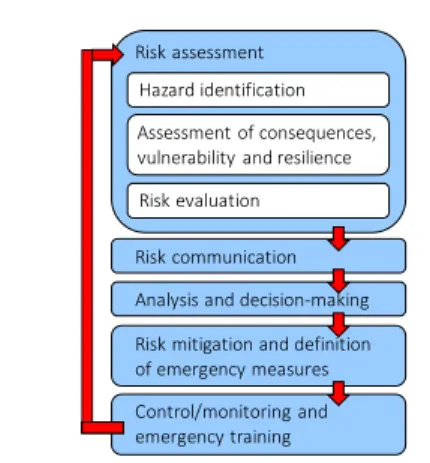
As for the disaster management cycle, several definitions and terminologies are also found to describe the risk management cycle. Although different fields of risk management practice also use alternative interpretations of the several steps involved, the risk management cycle definition that is considered herein incorporates the essential elements. The risk management cycle is considered to be a five-stage process, as represented in Figure 2, that involves the following stages:
• Risk assessment • Risk communication • Analysis and decision-making
• Risk mitigation and definition of emergency measures • Control/monitoring and emergency training
Hazard identification Risk assessment
Assessment of consequences, vulnerability and resilience Risk evaluation Risk communication Analysis and decision-making Risk mitigation and definition of emergency measures Control/monitoring and emergency training
Figure 2. The risk management cycle
As can be seen from Figure 2, the risk assessment component of the risk management cycle comprises three sub-stages. These correspond to hazard identification, assessing consequences, vulnerability and resilience, and risk evaluation. The output of this stage is a risk value or classification that is then conveyed to stakeholders in the risk communication stage. Therefore, efficient risk communication needs to involve risk measures that can be understood clearly by decision-makers. The analysis and decision-making stage is where the need for actions regarding a certain risk level is determined and where the type of action is gauged against potential losses using cost-benefit analyses and other criteria. The following stage has also two components: risk mitigation and definition of emergency measures. The first addresses the implementation of the risk mitigation actions that were selected in the previous stage (if any) and the second involves the development of emergency preparedness measures and processes to enhance the capacity to respond to and recover from a disaster. The final stage of the risk management cycle also comprises two components. The first is the control and monitoring of changes in the condition of the asset, including after the implementation of mitigation actions if such actions were defined. The second component involves the regular implementation of training activities addressing the emergency preparedness measures that were planned in the previous stage. Unlike the disaster management cycle that is only activated by the occurrence of a disastrous event, the risk management cycle needs to be regularly implemented to ensure an up-to-date risk assessment information and an adequate level of emergency preparedness. Furthermore, it also becomes clear that the outputs of the stage that defines risk mitigation actions and emergency measures corresponds to the link between the risk management cycle and the disaster management cycle.
3. DRR AND DRM ACTIONS FOR CULTURAL HERITAGE: A WISH LIST
As referred before, several practical aspects connected to the implementation of DRR and DRM in cultural heritage and that are believed to require further developments are addressed in the following. The various issues are seen as components of a wish list that, in the opinion of the authors, would support DRR and DRM practices in cultural heritage.
3.1 Do we know how much cultural heritage we are losing to disasters?
The availability of robust disaster damage and loss data is known to be essential for developing adequate risk assessment and management processes. Consequently, the development of systems, models and methodologies to collect and handle such data is becoming a worldwide priority. Disaster loss data frameworks such as the EM-DAT/CRED, the SIGMA/SwissRe, the NATCAT/MünichRe or the DesInventar/UNISDR databases are undoubtedly important sources of information in terms of the damages and losses that occurred in worldwide disasters. Recording such data is known to be useful for the purpose of loss accounting, forensic analysis of disasters and disaster risk modelling (De Groeve et al., 2014). For example, this data can provide an objective baseline for vulnerability/risk assessment as well as for mitigation priority setting and decision-making. However, the data recorded by these databases does not include damages and losses to cultural heritage. Therefore, without this important component, current loss estimation procedures are not able to provide a sound and comprehensive quantification of disaster impacts. Currently, there is no systematic collection of data about the impacts of hazardous events on cultural heritage properties. Existing data on damages and losses to cultural heritage is scattered among various agencies (national and international) without any rationality and coordination. Furthermore, no standardized methods and tools have been developed for cultural heritage disaster data collection until now. Therefore, specific approaches and methods are required. To address this issue, the International Committee on Risk Preparedness of the International Council on Monuments and Sites (ICORP/ICOMOS) and the Faculty of Engineering of the University of Porto developed the framework for a database with the objective of collecting worldwide data on immovable cultural heritage disaster losses (Romão and Paupério, 2016). This database would then be able to provide institutions managing and protecting cultural heritage with:
• a systematic and standardized recording of cultural heritage disaster-related data, from both natural and man-made hazards;
• a reliable accounting of cultural heritage losses;
• adequate data to analyse disaster trends and risk mitigation needs in cultural heritage.
One of the key issues of the database development was the definition of a simple system of categories for the type of cultural heritage properties that are considered. Although several classifications and definitions of cultural heritage categories can be found in the literature, no approach was seen to be entirely satisfactory in order to accommodate different types of immovable cultural heritage assets in a simple, general and structured way. Therefore, the following system of Heritage Categories was developed which establishes the importance of a certain immovable cultural heritage item:
• UNESCO World Heritage Sites
• Properties Protected by the Hague Convention • Listed National Heritage
• IUCN Protected Areas
• Properties of Local Significance
Given that some of these categories may overlap (e.g. a UNESCO World Heritage Site can also be a Listed National Heritage), more than one Heritage Category can be assigned to a cultural heritage property. For each category, an additional descriptor is also assigned to define the type of cultural heritage item. This descriptor establishes that a given cultural heritage item belongs to one of the following Unit Identification types:
• Single unit property: an individual monument or a natural landscape
• Multiple unit property: a group of monuments, an historic landscape, an historic town, an urban block of cultural significance
It is noted that within this classification for immovable cultural heritage, a museum building together with its collections is treated as a single unit property.
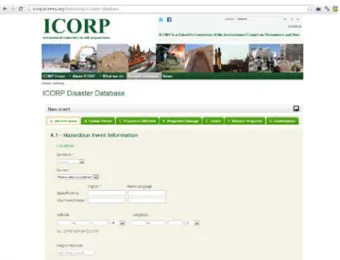
Hazardous events that can be recorded by the database range from small-scale events that only affect a single cultural heritage property to large and widespread ones that affect a larger number of heritage assets. The database is able to record basic identification and information about the main event (and secondary events that may have been triggered by the main event) such as the hazard type/subtype, the GLIDE number, geographical information (country, continent, location, latitude and longitude) and temporal information (start/end date, local time), (Figure 3). For each event, the database is able to record information about the cultural heritage properties that were affected, namely basic descriptions about them before they were damaged and descriptions of the damages and losses they suffered. The damage description can be illustrated using additional media such as photos, videos or reports that can be uploaded into the database. Each cultural heritage property affected by an event is then associated to a Heritage Category and an Identification Type (according to the previously referred classifications), to one or more Property Classes (e.g. religious facility, archaeological site, residential facility, landmark, nature reserve, park, marine zone, rock formation, etc.), to a Value (qualitative) and to one or more Construction Materials (only for built properties). In terms of disaster data, the database records the (qualitative) damage level of each cultural heritage property, a loss of functionality/downtime indicator, available information on economic losses and data regarding emergency procedures that may have been activated following the disaster. Even though the framework for this database was developed, populating the database is still fraught with challenges. Difficulties range from a lack of resources and funding to establish a team of analysts to search and process data and to manage the database, to the unavailability of sources willing to provide adequate data. However, given that the recently adopted indicators to monitor the global targets of the Sendai Framework for Disaster Risk Reduction include the need to report on cultural heritage losses (UN, 2016; UNISDR, 2017a), initiatives targeting the cultural heritage sector are expected in the near future. Moreover, according to a recent UNISDR Data Readiness Review (UNISDR, 2017b), the surveyed countries identified the need for financial resources, technology transfer and capacity building when asked to identify requirements
needed to redress data availability gaps on cultural heritage losses. As such, there is a clear need to address data collection on cultural heritage losses to support in-depth analyses of their impact and the development of efficient DRM strategies.
Figure 3. Main screen of the ICORP Disaster Database 3.2 Do we understand and know the risks to our cultural heritage?
It is believed that numerous cultural heritage assets require the implementation of risk mitigation measures. Still, developing such measures needs to be based on adequate knowledge about the risks these assets are facing. However, for most countries, carrying out multi-hazard risk analyses for a large number of cultural heritage assets requires efforts and budgets that are frequently unavailable. Therefore, assessing the risks for a large number of assets with limited resources is only feasible when based on simple methodologies.
Risk analysis usually requires the probabilistic quantification of hazard and vulnerability. Probabilistic representations of those components require both sufficient/reliable data and adequate analytical/numerical procedures. Probabilistic hazard is usually defined using data from past events. For natural events such as earthquakes, floods, landslides or volcanic eruptions, a probabilistic hazard can usually be defined. However, there are fields for which establishing a probabilistic hazard is still complex mostly due to a lack of adequate data or models. For the case of vulnerability, its definition relies on the availability of procedures capable of forecasting the damaging/negative effects that a particular hazard may have on a certain asset under analysis. Although detailed vulnerability representations can be established in several contexts, for the particular case of cultural heritage assets, their complexity and the lack of knowledge regarding their behaviour in certain situations are often important obstacles to the detailed definition of their vulnerability. Furthermore, when the risk analysis addresses a large amount of assets, those difficulties are amplified due to resource-related restrictions that might also come into play. In such cases, vulnerability analyses often involve methodologies where simplified assumptions are made.
Despite the inherent complexity of modelling the vulnerability of cultural heritage assets, when defining a risk assessment procedure for cultural heritage assets, the availability of human, time and economic resources usually sets the boundaries of the scope and comprehensiveness of the risk analysis. Furthermore, it will also be fundamental for the successful regular update and
monitoring of the risk assessment results over time. Therefore, when dealing with a large number of cultural heritage assets, it is important to have a simple methodology that can be used for the preliminary risk analysis of those assets to establish risk mitigation priorities or to identify assets requiring more detailed and resource-demanding analyses. In light of this, the use of a qualitative risk analysis approach is seen to be more adequate to fulfil these requirements. Even though qualitative analyses still involve analytical and evidence-based characterizations of the risk, they establish descriptive or categorical treatments of information instead of numerical estimates. These methods simplify the risk analysis by reducing the required inputs and calculations to a set of judgments. The simple risk categories that are produced can then be communicated to policymakers and stakeholders in a simpler way. Qualitative analyses are useful in situations where theory, data, time or expertise are limited but they also provide adequate results when decision makers only need a qualitative assessment of the risk. Furthermore, they are also useful for cases where quantitative risk analysis is impractical. For example, the qualitative analysis of a large number of cultural heritage assets (e.g. nationwide) may be a suitable way to identify situations where a more detailed assessment is needed. In many situations, a qualitative risk analysis is able to provide risk managers or stakeholders with enough information for decision-making. For example, the gathered data may include sufficient evidence indicating that a given risk can, in fact, be disregarded. On the contrary, the gathered evidence may also point out to an unacceptably large risk, or to consequences of a given hazard so unacceptable that mitigation measures are needed whatever the level of risk. To address these aspects, a simplified methodology for the risk assessment of cultural heritage assets was recently proposed (Romão et al, 2016). This approach can be used as a screening procedure for the preliminary assessment of a large number of cultural heritage assets with limited resources or for the preliminary identification of assets that require a more detailed and resource demanding risk evaluation. The methodology involves a qualitative risk analysis based on a set of structured assessment flowcharts (Figures 3 and 4) addressing the main components of a risk analysis: the likelihood of the hazard, the consequences of the hazard, the vulnerability and the loss of value of the asset and, finally, the capacity to recover from the event. The methodology was further detailed by developing specific forms and guidelines for the seismic risk assessment of cultural heritage masonry constructions. However, further refinements of the framework need to be developed in the near future to include more types of constructions as well as to define similar guidelines for other types of hazards.
Y N Y N Y N Y N VI VII VIII VIV VV The loss in value is significant? The loss in value is significant? The loss in value is significant? The loss in value is significant? The loss in value is significant? The loss in value is significant? The loss in value is significant? The loss in value is significant? Y N
The function of the CH unit can be easily restored?
Y N
The function of the CH unit can be easily restored?
S N
The function of the CH unit can be easily restored?
Y N
The function of the CH unit can be easily restored?
Y (entirely) Y (partially)
The damages are expected to be repairable?
Y (entirely) Y (partially)
The damages are expected to be repairable? What is the level of damage that the CH unit is expected to suffer?
Heavy Medium
Light
The exposure of the CH unit to the hazard is relevant? Y N R0 Y N Y N Y N Y N N N N The loss in value is significant? Y
Figure 3. Risk assessment methodology for cultural heritage assets: vulnerability analysis
VI VII VIII VIV VV The likelihood of the hazard is Low Medium High RI RII The likelihood of the hazard is Low Medium High RII RIII The likelihood of the hazard is Low Medium High RIII RIV The likelihood of the hazard is Low Medium High RIV RV The likelihood of the hazard is Low Medium High RV
Figure 4. Risk assessment methodology for cultural heritage assets: risk analysis
3.3 Do we know enough about our cultural heritage? Adequate documentation practices and inventories containing relevant data are essential for the sustainable management and preservation of cultural heritage assets, as well as to develop effective risk and disaster management strategies. Still, there are no standards or universally accepted documentation protocols and systems for cultural heritage assets. Even though some attempts to develop such standardized procedures have been made in the past (Kioussi et al, 2011, 2013; Myers et al, 2016), the responsibility for collecting and managing cultural heritage-related data ultimately depends on the administrative structure of each country or region.
Developing such inventories is known to be complex. Among others aspects, difficulties derive from the large variety of data that can or needs to be recorded for multiple purposes due to the multidisciplinary nature of cultural heritage preservation. Still, inventory systems have been evolving to reflect more holistic approaches of cultural heritage data recording. From initial systems that were more focussed on recording historical data, the evolution of heritage assets from an archaeological or architectural point of view, current heritage inventories evolved considerably, embracing digital technologies and including other data features. Other difficulties can also be related to data updating issues and the resources it involves. For inventories to be effective tools for the preservation of cultural heritage assets, the information they contain needs to be up-to-date to reflect the various changes in the state of that heritage over time. These and other concerns have been driving the evolution of the documentation and inventory practices for cultural heritage management. However, the level of evolution varies greatly from case to case and according to the type of data. For example, inventories with relevant technical characteristics (e.g. adequate geometric surveys, data on the construction techniques or material properties) of built cultural heritage assets as well as information about the more recent interventions that have been undertaken on those assets are not so common.
In the context of having to manage intensive and extensive risks in cultural heritage, the existence of specific engineering-related data organized in a standardized format is an advantage since risk assessment and mitigation can then be performed in a more systematic and effective way. Data standardization becomes particularly relevant for managing heritage properties with similar construction processes and architectural characteristics. An example of such type of inventory system was recently developed (Nunes et al, 2017) for churches of the Portuguese Romanesque period and was used to collect data for 44 churches. For each church, the specific data collection form that was developed allows the recording of the geometric characteristics, structural typology, construction process(es),
level of damage, changes and works carried out over time, the existence of heritage assets attached to the building, and its interaction with the surrounding environment. The collected data is a technical database that complements existing inventories and provides information for developing a comprehensive cultural heritage property management system. Potential losses can be estimated by correlating this information with a certain type of intensive or extensive hazard and the urgency of mitigating measures can be determined from the likelihood of the hazard occurrence. For the particular case of frequent or persistent hazards, the possibility of establishing the conservation state of the load-bearing structure of cultural heritage assets and identify the sources of existing damage and/or of ongoing degradation phenomena through systematic surveys provides fundamental data for risk mitigation. Moreover, having adequate knowledge about the materials, geometry and building processes of these cultural heritage assets also allows estimating risk mitigation costs and perform cost-benefit analyses to minimise heritage losses. By extending this type of analyses to a large group of heritage properties with similar architectural characteristics, common issues can be more easily identified. As such, the planning of risk mitigation actions is also facilitated.
Data on the presence and type of decorative cultural heritage assets that are attached to a given heritage construction (e.g. mural paintings, tiles) is another important component that needs to be included in engineering-related data inventories. This type of information is particularly important when estimating potential cultural heritage damage and losses because a certain hazard intensity that is not expected to cause significant damage to the component supporting those assets may in fact cause a substantial loss in value to those assets. Moreover, when defining risk mitigation measures that involve the components supporting those assets, the type of mitigating action and/or solution needs to account for the presence of those assets. A similar line of reasoning needs to be applied when developing emergency measures for those components after a disaster. Surveying data on decorative cultural heritage elements attached to the constructions along with the more technical and engineering-related data, therefore provides a more complete and multidisciplinary view of the immovable heritage asset. Another category of information that should also be included in cultural heritage inventories is related to the type of landscape and environment that surrounds a given heritage construction. Information on the existence of nearby water sources or forest sites, on the type of terrain (material and slope) or other relevant environmental data is essential for risk management procedures related to hazards such as landslides, fire, floods or heavy rains. Given these issues, it can be seen that developing or extending cultural heritage inventory systems to include these types of data should be promoted. Having this additional data allows for a more holistic approach of heritage management, providing support for a realistic analysis of potential losses and of the existing constraints for defining risk mitigation actions. 3.4 Are we efficient when communicating cultural heritage risk?
Risk analysis is expected to provide information for informed decision-making, given the uncertainty one might be faced with and the potential consequences of the uncertain events under analysis. This information about risk can range from qualitative insights on the expected damage to quantitative expressions of performance and losses. Selecting an adequate risk metric to
communicate risk is an essential part of the risk management process. An adequate risk metric reflects the result that must be conveyed from the risk analysis but also needs to be easily interpreted by decision-makers and stakeholders.
Given the large number of existing metrics and the fact that new metrics can be defined for a specific purpose, selecting the most adequate one is often challenging. Johansen and Rausand (2012) propose eleven criteria to evaluate the adequacy of a certain metric. Three of these criteria focus the quality of the risk output received by stakeholders. Communicability refers to the ability of the risk information to be grasped by non-experts, Contextuality refers to the suitability of the risk metric for decision support and Acceptability analyses if the risk information is considered legitimate and informative by the relevant stakeholders. In order to optimize the impact of the risk information on the mindset of stakeholders, a possible strategy is to address first these three criteria when selecting an adequate risk metric to communicate cultural heritage risks. Still, what is the metric and what should it reflect regarding cultural heritage? Cultural heritage is a fundamental resource for enhancing social capital and plays an important role in the smart (education, training, knowledge, new technologies), sustainable (regional attractiveness and competitiveness, greener economy, reuse of resources) and inclusive growth (creating jobs, social cohesion, quality of life) of societies. Global international strategies currently recognize that cultural heritage is an asset in economic growth and in addressing societal challenges. A recent project (CHCFE, 2015) examined the wide range impacts of cultural heritage and acknowledged that clear positive impacts can be found on economy, society, culture and the environment. Still, the project also concludes that further research is needed to measure these impacts and that a holistic approach should be followed to fully understand their wide reach. From the disaster impact and risk management points of view, the ideal risk metric(s) should be able to reproduce the holistic influence of cultural heritage. However, evidence of these impacts will occur distributed in time (some in the short term while others only in the long term). Therefore, selecting the most adequate time range creates an additional challenge for risk communication. Given the intangible nature of cultural heritage value, a risk metric that would measure the direct impact of destroyed or lost cultural heritage is inherently non-quantitative. To determine a quantitative measure, the destruction or loss of cultural heritage needs to be defined based on its indirect effects. Furthermore, to maximise the impact of the risk information on stakeholders, an economic perspective of these effects is usually preferred. The topic of economic valuation of cultural heritage has been the subject of several studies over the past years and several methodologies were developed to elicit monetary expressions of cultural values. Aside from their complexity and the difficulties to scale their results, it is noted that most of these methods were not developed to estimate economic losses due to damaged or destroyed cultural heritage. Therefore, their usefulness to derive an efficient risk metric is limited, especially to represent the wide range scale (i.e. regional or national level) of cultural heritage impacts. Alternatively, global economic indicators such as the gross value added associated to the cultural heritage sector (Romão and Paupério, 2016) are seen to have more potential to capture cultural heritage impacts both on a wider scale and in the short-to-long-term. Nevertheless, there is a clear need for risk metrics defining an equivalent economic value that reflects (even if only partially) indirect losses due to destroyed and damaged cultural heritage, which would then
help communicating these impacts to stakeholders and facilitate their engagement in cultural heritage protection.
3.5 Are we prepared for disasters?
Numerous disasters in the past highlighted the fundamental role of preparedness in DRR and DRM. The readiness of special teams prepared to act in emergency situations is paramount to reduce the impact of disasters. However, unlike sectors that only require civil protection entities and emergency response officials to be ready to act in case of an emergency, other stakeholders need to be involved when dealing with cultural heritage. When addressing preparedness for cultural heritage, two components need to be analysed: movable heritage and immovable heritage.
For movable heritage, preparedness needs to cover two aspects: priority lists to evacuate movable heritage if necessary and training of emergency-response officials to ensure adequate handling, conservation and care during the evacuation. While there have been several initiatives across the world to address the latter (e.g. in England, Italy or Spain, the training initiatives developed by ICROM and the Smithsonian Institute), the former is still challenging. One of the challenges is often related to the reluctance or inability of heritage curators to define pre-disaster priority lists to evacuate movable heritage. If a pre-disaster occurs and such lists are not available, decisions about rescue priorities to determine which items to save and which to sacrifice might have to be made fast, possibly in a chaotic environment which might lead to mistakes. Defining priority lists prior to the occurrence of a disaster allows for clear thinking and adequate planning to minimize the consequences. The two aspects that were addressed for emergency actions in disaster scenarios involving movable heritage are well known. Yet, they are not given enough consideration and priority. The training of emergency-response officials to ensure adequate behaviour during an evacuation should be part of their normal training. Furthermore, institutions responsible for managing movable heritage collections should enforce the development of adequate emergency plans accounting for the evacuation of those collections, including the necessary logistics and human resources that might be required.
4. FINAL REMARKS
International frameworks and programs for DRR and DRM are clear in their objectives of reducing hazard exposure and vulnerability to disasters. Furthermore, the importance of cultural heritage and its irreplaceable value for society is also clearly acknowledged in these objectives. However, the implementation of effective actions for DRR and DRM in cultural heritage has been slow. Some practical aspects connected to this lack of tangible changes were addressed herein given they require further discussion, research and development. The topics that were addressed focus cultural heritage disaster loss data collection, risk assessment methods for cultural heritage, cultural heritage data inventories, efficient risk communication for cultural heritage and planning for emergency response. The importance of each topic was briefly reviewed and the current state of knowledge was discussed within the objectives of existing DRR and DRM international initiatives. Although some research and development needs are identified, the main objective of the paper was to draw some attention on a few fundamentals aspects of DRR/DRM for
cultural heritage in order to foster further in-depth discussions on these topics.
REFERENCES
CHCFE (2015) Cultural Heritage Counts for Europe. Full Report. Cultural Heritage Counts for Europe (CHCFE) Consortium.
De Groeve, T., Corbane, C., Ehrlich, D., Poljansek, K. (2014). Current status and Best Practices for Disaster Loss Data recording in EU Member States: A comprehensive overview of current practice in the EU Member States. Scientific and Technical Research Reports. Report EUR 26879.
Johansen, I., Rausand, M. (2012) Risk metrics: Interpretation and choice. In: IEEE International Conference on Industrial Engineering and Engineering Management, Hong Kong. Kioussi, A., Karoglou, M., Labropoulos, K., Bakolas, A., Moropoulou, A. (2013) Integrated documentation protocols enabling decision making in cultural heritage protection. Journal of Cultural Heritage, 14(3), e141-e146.
Kioussi, A., Labropoulos, K., Karoglou, M., Moropoulou, A., Zarnic, R. (2011) Recommendations and Strategies for the Establishment of a Guideline for Monument Documentation Harmonized with the existing European Standards and Codes. Geoinformatics FCE CTU, 6, 178-184.
Myers, D., Dalgity, A., Avramides, I. (2016) The Arches heritage inventory and management system: a platform for the heritage field. Journal of Cultural Heritage Management and Sustainable Development, 6(2), 213-224.
Nunes, A., Paupério, E., Romão, X., Varum, H. (2017) Risk management potential of technical data inventories on built cultural heritage: a case study for the churches of the Portuguese Route of the Romanesque. CIPA-ICORP-ISCARSAH 2017 Joint Meeting. ICOMOS General Assembly, India.
Romão, X., Paupério, E. (2016) Challenges in recording disaster damage and loss data for cultural heritage. ICUR2016 - International Conference on Urban Risks, Lisbon, Portugal. Romão, X., Paupério, E., Pereira, N. (2016) A framework for the simplified risk analysis of cultural heritage assets. Journal of Cultural Heritage, 20, pp. 696-708.
UN (2016) General Assembly resolution 71/644, Report of the open-ended intergovernmental expert working group on indicators and terminology relating to disaster risk reduction, A/71/644. United Nations.
UNISDR (2017a) Technical Guidance for Monitoring and Reporting on Progress in Achieving the Global Targets of the Sendai Framework for Disaster Risk Reduction. Draft for consultation. United Nations Office for Disaster Risk Reduction.
UNISDR (2017b) Sendai Framework data readiness review 2017 - Global summary report. United Nations Office for Disaster Risk Reduction.