Exact and Technology Sciences Center
Chemical Engineering Graduate Program
Cássia Maria de Oliveira
Energy Integration of Sugarcane Biorefineries with
Multiperiod Operation
FEDERAL UNIVERSITY OF SÃO CARLOS
Exact and Technology Sciences Center
Chemical Engineering Graduate Program
Cássia Maria de Oliveira
Energy Integration of Sugarcane Biorefineries with
Multiperiod Operation
Thesis presented to the Chemical Engineering Graduate Program of the Federal University of São Carlos in partial fulfillment of the requirements for the Degree of Doctor in Chemical Engineering.
Supervisor: Prof. Dr. Antonio José Gonçalves Cruz Co-supervisor: Prof.ª Dr.ª Caliane Bastos Borba Costa
i
A quem se dedicou inteiramente a minha felicidade minha mãe, Wilma
ii
Agradecimentos
Agradeço a Deus, por ter me guiado e protegido ao longo das minhas decisões. Agradeço a Ele também por
manter as pessoas que amo ao meu lado.
À minha mãe e minha irmã Fernanda, pelo apoio, carinho e paciência. Sou infinitamente grata por ter vocês
ao meu lado. Vocês representam o meu porto seguro.
À minha vó Cida, pelo amor e dedicação que sempre teve por mim.
Aos meus tios e tias, pelo incentivo e confiança ao longo de toda a caminhada. Não foi fácil, mas teria sido
ainda mais difícil sem vocês.
Aos meus orientadores, Caliane e Antonio, pelos ensinamentos, sabedoria e dedicação que me ofereceram
durante todo o mestrado e doutorado, assim como a amizade. Obrigada pela paciência que tiveram nos meus
momentos de dificuldades. Sou muito grata pela oportunidade que me ofereceram. Você são exemplos pra
mim e sempre terei um carinho imenso.
Ao Charles, pela oportunidade de aprender e pelos sábios conselhos, mesmo durante anos após o estágio.
Obrigada pelo apoio e por me apresentar, aqueles que seriam após algum tempo, meus orientadores em uma
nova etapa da vida.
Ao professor Alberto, pelos ensinamentos e pela oportunidade de aprender um pouquinho sobre outra área de
trabalho.
Ao professor Mauro da UEM, por compartilhar seus conhecimentos e pela dedicação.
Ao Leandro, também da UEM, por ter me auxiliado com as inúmeras dificuldades que tive na execução do
trabalho.
Aos membros da banca, pela dedicação e contribuição nesse processo de aprendizagem.
Aos meus amigos de infância e adolescência, Daiana, Lidiane, Bruna, Gabriela, Juliane, Mariana, Natália,
Rafael, Luiz e Allan, pelo apoio e amizade, a qual é fundamental na minha vida. Vocês fazem de simples
momentos, os melhores.
Às minha amigas da FZEA, Ivana, Geisa, Priscila e Danielle, que mesmo em distância são pessoas muito
especiais. A cada conversa, percebo o quão bom é ter vocês na minha vida.
iii
por partilharem seus conhecimentos, pela amizade e bons momentos de convivência. Obrigada, vocês
fizeram desses anos de estudo um momento muito especial na minha vida. Um agradecimento especial ao
Felipe, atualmente professor do Departamento, e ao Anderson, pela disponibilidade, dedicação e paciência
em me ajudar em várias etapas do trabalho.
À minha amiga Paula, quem tive a feliz oportunidade de conhecer no primeiro dia de mestrado, pelo carinho,
amizade e incentivo. Obrigada por fazer parte da minha vida e fazê-la mais leve e alegre.
Aos meus amigos do IFSP, pela amizade, paciência e boas risadas. Agradeço também por me ensinaram o
que é ser docente e o que isso representa na vida dos alunos.
Ao Programa de Pós-Graduação de Engenharia Química da UFSCar, pela oportunidade.
Ao Instituto Federal de São Paulo, pela oportunidade em me tornar professora e pelo investimento na minha
carreira.
À FAPESP (Processo 2013/21343-3) e CAPES, pelo suporte financeiro.
A todas as demais pessoas que contribuíram, direta ou indiretamente, para que o presente trabalho fosse
iv
"Quando você conseguir superar graves problemas de relacionamentos, não se detenha na lembrança dos momentos difíceis, mas na alegria de haver atravessado mais essa prova em sua vida. Quando sair de um longo tratamento de saúde, não pense no sofrimento que foi necessário enfrentar, mas na benção de DEUS que permitiu a cura.
Leve na sua memória, para o resto da vida, as coisas boas que surgiram nas dificuldades. Elas serão uma prova de sua capacidade e lhe darão confiança diante de qualquer obstáculo.
Uns queriam um emprego melhor; outros só um emprego. Uns queriam uma refeição mais farta; outros, só uma refeição. Uns queriam uma vida mais amena; outros, apenas viver. Uns queriam pais mais esclarecidos; outros, apenas ter pais. Uns queriam ter olhos claros; outro, enxergar. Uns queriam ter voz bonita; outros, falar. Uns queriam silêncio; outros, ouvir. Uns queriam sapatos novos; outros, ter pés. Uns queriam um carro; outros, andar. Uns queriam o supérfluo, outros, apenas o necessário.”
v
Integração Energética de Biorrefinarias de Cana-de-açúcar
com Operação Multiperiódica
Resumo
O Brasil tem uma grande importância como produtor de biocombustíveis, especialmente na produção de
etanol a partir de cana-de-açúcar. O bagaço, um subproduto das biorrefinarias de cana-de-açúcar, pode ser
usado para gerar energia elétrica e produzir etanol de segunda geração. No entanto, as variações nos preços
da energia elétrica e do etanol podem motivar variações nas condições operacionais do processo integrado da
biorrefinaria, a qual produz etanol de primeira e segunda geração e energia elétrica. A rede de trocador de
calor (RTC) de tal processo deve ser capaz de atender a essas variações. Este trabalho teve como objetivo a
síntese de RTC multiperiódica em biorrefinarias de cana-de-açúcar. Nesta abordagem, cada período indica
uma condição de processo e a RTC sintetizada é capaz de atender a essas diferentes condições de operação.
Três estudos de caso industriais são considerados. O Estudo de Caso 1 (EC1) é uma biorrefinaria que produz
etanol 1G/2G e energia elétrica, descartando a fração de pentoses. Nos Estudos de Caso 2 e 3, EC2 e EC3, o
processo é semelhante, mas a fração de pentoses é usada para produzir etanol (EC2) ou biogás (EC3). Para
cada biorrefinaria, foram considerados três períodos, que diferem na fração do bagaço desviada para a
produção de etanol 2G. Em cada período, um problema de Programação Não Linear Inteira Mista (PNLIM)
foi resolvido para minimizar o Custo Total Anualizado (CTA) e mecanismos de compartilhamento de tempo
foram utilizados para integrar as RTCs de todos os períodos em uma RTC multiperiódica. Os problemas de
otimização foram resolvidos em dois níveis usando três estratégias diferentes. Na primeira estratégia, uma
adaptação do algoritmo Otimização por Enxame de Partículas foi usada em ambos os níveis. No entanto, as
soluções por este método apresentaram pequenas melhorias de CTA em comparação com o processo
comumente encontrado nas plantas brasileiras, onde já existe integração de energia entre algumas correntes
de processo (chamado neste trabalho de processo com integração de projeto). Para lidar com esse problema,
duas estratégias foram empregadas com metaheurísticas híbridas: Recozimento Simulado e Otimização por
Fogos de Artificio; e Busca Tabu e Otimização por Enxame de Partículas. Para os processos com as RTCs
multiperiódicas, estas duas últimas estratégias apresentaram reduções acima de 58% e 54% no CTA e na
demanda de vapor, respectivamente, em comparação com processos sem integração de energia. Além disso,
usando os métodos acima mencionados, as melhorias no CTA e na demanda de vapor para o processo com as
RTCs multiperiódicas atingem valores acima de 44% e 41%, respectivamente, em relação aos processos com
integração de projeto. Tais reduções na demanda de vapor permitem desviar mais bagaço para a produção de
etanol de segunda geração. Além disso, a integração energética em biorrefinarias oferece melhor
gerenciamento da energia e redução nos custos de operação e de capital. Assim, todas essas melhorias
contribuem para o processo de produção de etanol 1G/2G e energia elétrica.
Palavras-chave: Etanol 1G/2G. Síntese de Rede de Trocador de Calor. Otimização por Exame de Partículas.
vi
Energy Integration of Sugarcane Biorefineries with Multiperiod Operation
Abstract
Brazil has a great importance as biofuels producer, especially of ethanol from sugarcane. The bagasse, a by-product of sugarcane biorefineries, can be used to generate electricity and produce second generation ethanol. However, variations in prices of electricity and ethanol may motivate variations in the operating conditions of the integrated biorefinery process, which produces first and second generation ethanol and bioelectricity. The heat exchanger network (HEN) of such a process must be able to meet these variations. This work aimed the synthesis of multiperiod HEN in sugarcane biorefineries. In this approach, each period indicates a process condition and the HEN synthesized is able to meet these different operating conditions. Three industrial case studies are considered. Case Study 1 (CS1) is a biorefinery that produces 1G/2G ethanol and electricity, disposing the pentoses fraction. In Case Studies 2 and 3, CS2 and CS3, the process is similar, but the pentoses fraction is used to produce ethanol (CS2) or biogas (CS3). For each biorefinery, three periods were considered, which differ in the bagasse fraction diverted to 2G ethanol production. In each period, a Mixed Integer Nonlinear Programming (MINLP) problem was solved to minimize the total annualized cost (TAC) and timesharing mechanisms were used to integrate the HENs of all periods into a multiperiod HEN. Optimization problems were solved at two levels using three different strategies. In the first strategy, an adapted Particle Swarm Optimization algorithm was used in both levels. However, the solutions by this method presented small TAC improvements compared to the process commonly found in Brazilian plants, where there is already energy integration among some process streams (called in this work of the process with project integration). To deal with this problem, two strategies were employed with hybrid metaheuristics: Simulated Annealing and Rocket Fireworks Optimization; and Tabu Search and Particle Swarm Optimization. For processes with the multiperiod HENs, these latter two strategies presented reductions above 58% and 54% in TAC and steam demand, respectively, compared to processes without energy integration. Also, using the aforementioned methods, improvements in TAC and steam demand for process with the multiperiod HENs reach values above 44% and 41%, respectively, in relation to processes with project integration. Such reductions in steam demand allow diverting more bagasse to produce second generation ethanol. In addition, energy integration in biorefineries provides improved energy management and reduced operating and capital costs. Thus, all these improvements contribute to 1G/2G ethanol and electricity production process.
vii
Summary
1 Chapter 1 ... 1
Introduction and Justification ... 1
2 Chapter 2 ... 3
Literature Review ... 3
2.1 Introduction ... 3
2.2 Multiperiod HEN ... 5
2.3 Mathematical methods ... 10
2.4 Conclusion... 11
References ... 12
3 Chapter 3 ... 18
Energy Integration of a Sugarcane Biorefinery using Particle Swarm Optimization ... 18
Abstract ... 19
3.1 Introduction ... 19
3.2 Approach for solving the multiperiod HEN problem ... 22
3.2.1 Superstructure ... 22
3.2.2 Model equations ... 23
3.2.3 Particle Swarm Optimization algorithm ... 30
3.2.4 Timesharing mechanisms ... 32
3.2.5 Procedure for solving the multiperiod HEN problem ... 34
3.3 Sugarcane biorefinery ... 36
3.3.1 Process description ... 36
3.3.2 Energy integration case study ... 44
3.4 Results and discussion ... 49
3.5 Conclusion... 60
Nomenclature ... 61
References ... 64
4 Chapter 4 ... 69
Energy Integration of a Sugarcane Biorefinery using Simulated Annealing and Rocket Fireworks Optimization ... 69
References ... 90
5 Chapter 5 ... 91
Energy Integration of a Sugarcane Biorefinery using Tabu Search and Particle Swarm Optimization .... 91
Abstract ... 85
5.1 Introduction ... 86
viii
5.2.1 Mathematical model and assumptions ... 90
5.2.2 Tabu Search and Particle Swarm Optimization ... 91
5.2.2.1 Upper level ... 92
5.2.2.2 Lower level ... 93
5.2.2.3 Algorithm description ... 94
5.2.3 Timesharing strategy ... 97
5.3 Biorefineries ... 97
5.4 Results and discussion ... 101
5.4.1 Case study 1 ... 101
5.4.2 Case study 2 ... 107
5.4.3 Case study 3 ... 112
5.4.4 Remarks ... 116
5.5 Conclusion... 120
Nomenclature ... 121
References ... 124
Appendix 5.A ... 127
Appendix 5.B ... 128
6 Chapter 6 ... 145
Conclusions and Recommendations to Future Work ... 145
Recommendations to future works ... 147
ix
Figures list
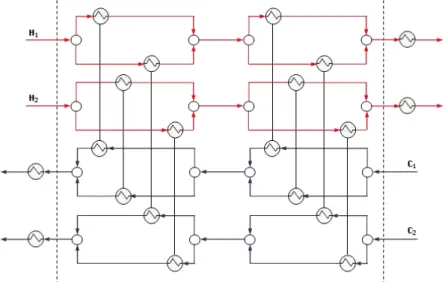
Figure 3.1. Superstructure of Yee and Grossmann (YEE; GROSSMANN, 1990) with two stages, two hot and two cold
streams. ... 23
Figure 3.2. By-pass in heat exchanger. ... 33
Figure 3.3. Diagram of the sugarcane biorefinery. ... 38
Figure 3.4. Diagram of HEN for Period 1 using PSO. ... 50
Figure 3.5. Diagram of HEN for Period 2 using PSO. ... 51
Figure 3.6. Diagram of HEN for Period 3 using PSO. ... 52
Figure 5.1. Steps of 1G/2G ethanol and eletricity production process. ... 100
Figure 5.2. Multiperiod HEN using TS-PSO of Case Study 1. ... 105
Figure 5.3. Multiperiod HEN using TS-PSO for Case Study 2. ... 111
x
Tables list
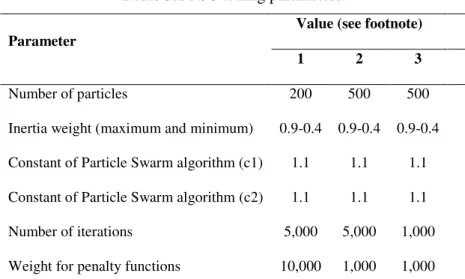
Table 3.1 PSO tuning parameters. ... 35
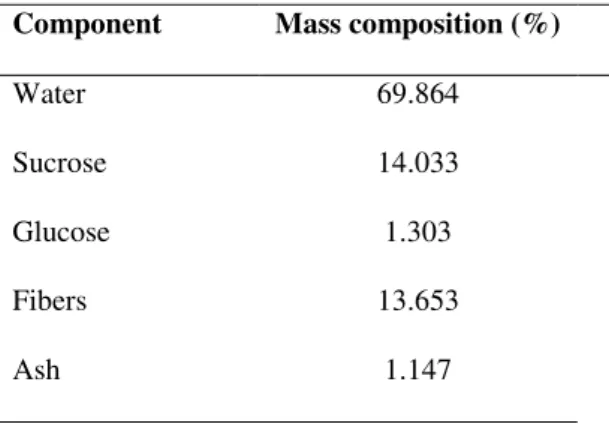
Table 3.2. Composition of sugarcane. ... 37
Table 3.3. Composition of fiber and straw of sugarcane. ... 37
Table 3.4. Main data for 1G ethanol production. ... 39
Table 3.5. Main data for 2G ethanol production. ... 40
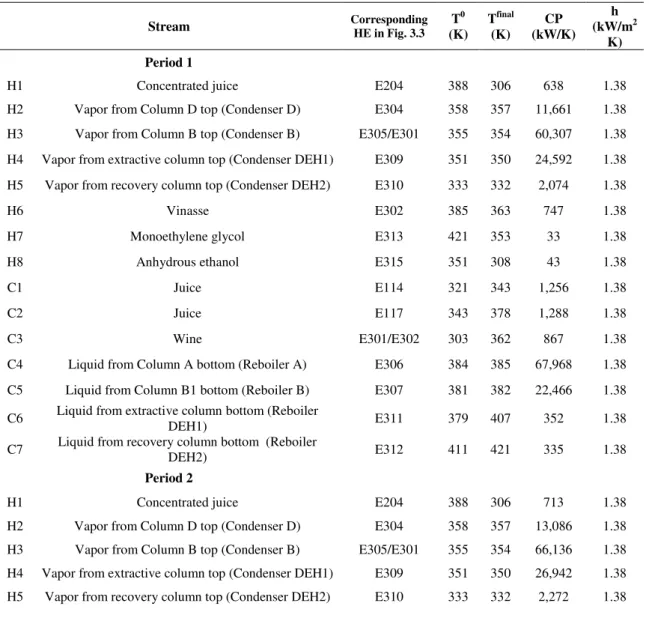
Table 3.6. Input data for energy integration. ... 45
Table 3.7. Parameters for HEN operating calculations. ... 48
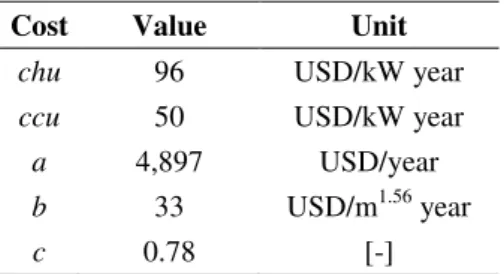
Table 3.8. Costs of utilities and parameters for calculation of annualized cost of heat exchanger. ... 48
Table 3.9. Data for HEN in Periods 1, 2 and 3 using PSO (Part 1). ... 53
Table 3.10. Data for HEN in Periods 1, 2 and 3 using PSO (Part 2). ... 54
Table 3.11. Data for HEN in Periods 1, 2 and 3 using PSO (Part 3). ... 55
Table 3.12. Number of HE, HEN area, capital cost (CC), operating cost (OC), and total annualized cost (TAC) for each period of operation of HEN using PSO. ... 56
Table 3.13. Data for the integrated HEN using PSO. ... 56
Table 3.14. Comparison among the processes without energy integration (S1), with project energy integration (S2), with energy integration proposed in this work (S3) and with the integrated HEN (S4) using PSO for Period 1. ... 57
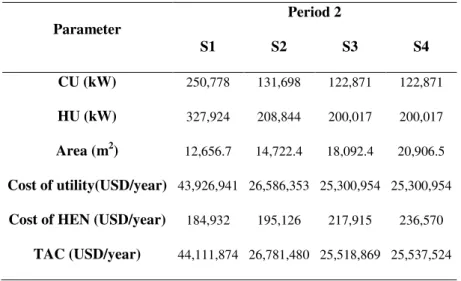
Table 3.15. Comparison among the processes without energy integration (S1), with project energy integration (S2), with energy integration proposed in this work (S3) and with the integrated HEN (S4) using PSO for Period 2. ... 58
Table 3.16. Comparison among the processes without energy integration (S1), with project energy integration (S2), with energy integration proposed in this work (S3) and with the integrated HEN (S4) using PSO for Period 3. ... 58
Table 3.17. Saving of utility cost, hot utility (HU) and total annualized cost (TAC) of processes with energy integration proposed in this study for each period (S3) and with the integrated HEN (S4) using PSO in relation to the processes without energy integration (S1) and with project energy integration (S2). ... 60
Table 3.18. Bypass for cold streams in heat exchangers. ... 60
Table 5.1. Tuning parameters for TS and PSO. ... 96
Table 5.2. Stream data for sugarcane biorefinery of Case Study 1. ... 101
Table 5.3. Number of heat exchange devices, total area, capital cost (CC), operating cost (OC), and total annualized cost (TAC) for the single-period HEN using TS-PSO in Case Study 1. ... 103
Table 5.4. Saving of steam demand and TAC of the processes with the single-period HEN (S3) and with the multiperiod HEN (S4) using TS-PSO in relation to the processes without energy integration (S1) and with project energy integration (S2) in Case Study 1. ... 106
xi
Table 5.6. Number of heat exchange devices, total area, capital cost (CC), operating cost (OC), and total annualized cost (TAC) for single-period HEN using TS-PSO in Case Study 2. ... 109 Table 5.7. Saving of steam demand and TAC of the processes with the single-period HEN (S3) and with the multiperiod HEN (S4) using TS-PSO in relation to the processes without energy integration (S1) and with
1
1
Chapter 1
Introduction and Justification
Concern with better use of energy began during the 1970s-1980s oil crises. During that
period, actions aiming diversification of energy matrix, conservation and better use of natural
resources were performed. Brazil is the second largest producer of ethanol in the world, behind only
the United States of America. In Brazil, ethanol is mostly produced from sugarcane juice, in a process
known as first generation ethanol (1G) production process. In sugarcane plants, the bagasse is used to
produce electricity and steam in order to ensure the energy self-sufficiency of the process and,
sometimes, sell the electricity surplus. Sugarcane bagasse can also be used in second generation
ethanol (2G) production. However, it is not yet a consolidated technology and requires studies to
propose improvements, which allow making the integrated production of 1G/2G ethanol more
sustainable and economical.
In chemical processes, an efficient alternative to save energy is the exchange of thermal
energy among process streams by synthesis of heat exchanger networks (HENs). However, prices of
electricity and ethanol vary according to market demand, which implies changing operating conditions
of the plant, as well as utilities consumption. Thus, the HEN synthesized should be able to meet
different operating conditions. To deal with this problem, a common practice is to synthesize a HEN
with multiple periods. In a multiperiod HEN, each period represents a different process condition and
the HEN synthesized is able to operate in these established conditions. In this sense, Chapter 2
presents a brief literature review about multiperiod HENs and mathematical methods for solving such
problems.
This work includes industrial case studies of energy integration in sugarcane biorefineries
by HEN synthesis with multiple operation periods. The case studies differ in the disposal of pentose
fraction or in the use of this fraction to produce ethanol or biogas. For each biorefinery case study,
three periods were considered. In each period, a different bagasse fraction is diverted to second
2
integration and the flow rates of some streams. A Mixed Integer Nonlinear Programming (MINLP)
problem formulation was solved for each period, separately. To integrate the HENs of all periods into
a single HEN, timesharing mechanisms were employed. This approach suits to requirements of
biorefineries, since it does not require the duration of periods and the number of transitions from one
operating condition to another in order to synthetize the multiperiod HEN, which may be difficult to
specify. MINLP problems were solved at two levels of optimization using meta-heuristic methods.
This approach consists in solving the problem at the upper level for integer variables and at the lower
level for continuous variables. Different strategies were used to solve the optimization problems. In
Chapter 3, an adapted Particle Swarm Optimization (PSO) algorithm was used for integer and
continuous variables in a case study of energy integration in a sugarcane biorefinery. However,
marginal improvements were achieved using that method compared to the process already existing in
Brazilian plants. Two other strategies applying hybrid meta-heuristic methods were employed. In
Chapter 4, a case study of energy integration in a biorefinery was solved by the hybridization of
Simulated Annealing (SA) and Rocket Fireworks Optimization (RFO). The latter combines two
algorithms, SA and PSO. In Chapter 5, three case studies of energy integration in biorefineries using
the hybridization of Tabu Search (TS) and Particle Swarm Optimization (PSO) were presented. The
hybrid approaches, SA-RFO and TS-PSO, are recent strategies that can be used for problems of
large-scale HEN synthesis. Chapters 3, 4 and 5 are chapters structured each as full (i.e., each chapter has
abstract, introduction, methodology, results and discussion and conclusion sections).Finally, in
Chapter 6, the conclusions of this study and the suggestions for future works are presented,
respectively. It is important to highlight that the synthesis of HENs in biorefineries has as one of the
main goals to reduce steam consumption by the process. Thus, less bagasse needs to be burned to
generate steam and the surplus can be diverted to 2G ethanol or electricity production, depending on
the demand. However, other goals associated to energy integration, such as energy security and
reduced consumption of environmental resources and waste generation, are very important. Therefore,
all improvements provided by energy integration contribute to catalyze the viability of second
3
2
Chapter 2
Literature Review
2.1 Introduction
Energy integration is a process integration technique that matches hot and cold streams,
by heat exchanger network (HEN) synthesis. For a given set of hot and cold streams, energy
integration techniques find the best combination among these streams aiming at the lowest cost for the
process. Depending on the method employed for energy integration, the cost includes only operating
cost or operating and capital costs, as well as other costs (e.g., piping costs). For energy integration, it
is necessary to know thermal loads (or heat capacity), the inlet and outlet temperatures and heat
transfer convective coefficients of all streams, cost of heat exchanger units, cost of utilities and their
heat transfer convective coefficients. In the literature, important review papers of the state of the art
for HEN synthesis can be cited, such as Gundersen and Naess (1988), Grossmann, Caballero and
Yeomans (2000), Furman and Sahinidis (2002), Morar and Agachi (2010), Klemeš and Kravanja (2013) and Klemeš, Varbanova and Kravanja (2013), as well as books ‘Chemical Process Design and
Integration’ (SMITH, 2014), ‘Redes de cambiadores de calor’ (RAVAGNANI; CABALLERO SUÁREZ, 2012), ‘Energy Optimization in Process Systems and Fuel Cells’ (SIENIUTYCZ; JEŻOWSKI, 2013) and ‘Handbook of Process Integration (PI)’ (PARDALOS; DU, 1998). In general,
the methods for HEN synthesis can be classified into two groups: sequential and simultaneous.
Sequential techniques subdivide the problem into subproblems to reduce complexity and
include methods that use thermodynamic concepts (e.g., Pinch Analysis) and mathematical
programming methods. Pinch Analysis is a well-known methodology for energy integration, which is
simply and easy to apply. However, HEN should be synthesized manually by the designer or with the
help of some available pieces of software, which can be an advantage or disadvantage, depending on
the knowledge level of the designer. Although the Pinch Analysis is easy to apply, the HEN
4
minimization of the energy demand is not performed simultaneously to the investment cost of HEN.
That technique provides tools that allow verifying the energy flow inside the process and identifying
the more economical way to recover energy by means of concepts such as determination of the
minimum utility demand, Pinch temperature, the minimum number of units for HEN and the minimum
average area of heat transfer. For applying the technique, the minimum temperature difference
between a hot and a cold stream should be specified. It has influence on operating and capital costs. In
other words, for a given minimum temperature difference, a minimum utility demand is achieved and
the HEN synthesized should meet this energy demand.
Sequential techniques for energy integration also include mathematical programming
methods. Papoulias and Grossmann (1983) introduced concepts of the sequential approach for the
HEN synthesis using mathematical programming. The methodology consists in separately solving
three optimization problems: the minimization of operating cost (giving rise to a Linear Programming,
LP, formulation), the minimization of the number of units of heat transfer (formulated as a Mixed
Integer Linear Programming, MILP) and the minimization of the investment cost (formulated as a
Non-Linear Programming, NLP). This strategy decreases the complexity of the problem and relatively
large problems can be solved with minor computational effort. However, since different costs
associated to HEN synthesis are not optimized simultaneously, suboptimal solutions can be obtained.
Studies on sequential techniques have produced great advances for energy integration area.
In simultaneous techniques all variables of the problem are optimized in a single step. For
this approach, the problem is usually formulated using a superstructure that contains different possible
combinations for heat transfer among streams. Thus, a Mixed Integer Nonlinear Programming
(MINLP) problem is solved, where operating and capital costs are minimized simultaneously. Such
strategy makes it possible to find better solutions, but it requires more computational effort given the
nonlinearities and non-convexities present in its mathematical formulation.
This chapter is organized as follows. Section 2.2 provides a literature review on
multiperiod HENs. Section 2.3 presents mathematical methods for solving optimization problems in
HEN synthesis area. It is important to mention that this chapter aims to provide a brief review on
5
simultaneous techniques, as well as advances on these approaches, can be found in the references cited
previously.
2.2 Multiperiod HEN
The synthesis of networks of heat exchanger is an area that has been explored since the
1970s. However, many of the contributions presented do not consider oscillations in the process,
which may occur due to changes in environmental conditions, quality of raw materials or the products,
market demand and disturbances in the process. To circumvent this problem, methodologies for the
flexible HEN synthesis have been developed, which allow changes in some parameters of the process.
One of the more common approaches to deal with variations in the process is to design a multiperiod
HEN, which can operate under various established conditions. These operating conditions are
denominated periods and can present changes in temperature, heat capacity, heat transfer convective
coefficient or/and number of streams. It is important to mention that the flexibility concept is broader,
since this concept involves other approaches for the HEN synthesis under uncertainty, such as
identification of critical values of uncertain parameters (PINTARIČ; KRAVANJA, 2008), sensitivity analysis for identification of uncertain parameters (PINTARIČ; KASAŠ; KRAVANJA, 2013) and measurement of flexibility degree by resilient (SABOO; MORARI; WOODCOCK, 1985) and
flexibility indexes (SWANEY; GROSSMANN, 1985). Sequential or simultaneous techniques can be
used to solve problems of the multiperiod HEN synthesis.
The synthesis of a multiperiod HEN using the Pinch Analysis, a sequential approach, was
performed by Ravagnani and Modenes (1996). In this study, a procedure was proposed to evaluate the
flexibility of HENs that operate with multiple conditions. Silva (1995) also presented a sequential
methodology for the multiperiod HEN synthesis using the Pinch Analysis. In the first step, a HEN is
designed for each period. After, all HENs are analyzed and a new configuration that meets those
established conditions is proposed.
The sequential approach using mathematical programming for the multiperiod HEN
6
the single-period model of Papoulias and Grossmann (1983), aiming to obtain the minimum cost of
utility and the minimum number of heat transfer units in each period. Later, the automatic generation
of the minimum HEN cost for a multiperiod model was developed by Floudas and Grossmann (1987),
based on the single-period NLP model of Floudas, Ciric and Grossmann (1986).
Konukman, Çamurdan and Akman (2002) performed the synthesis of HEN
configurations, which remains viable to changes in inlet temperatures of streams, ensuring a minimum
total utility consumption. The objective function minimizes the total utility cost, which is solved for
different flexibility levels. Thus, for each flexibility level, a total minimum utility demand and one or
more HEN structures are obtained. Since that work is restricted to determining the HEN configuration,
the designer should choose the best HEN according to investment cost, controllability and/or
operability.
In order to reduce costs in the plant, many processes use more than one hot and cold
utility. In this context, a MILP formulation was presented by Marechal and Kalitventzeff (2003) for
solving the multiperiod HEN problem with a utility system. The proposed methodology incorporates
models to select and to guide the choice of the best strategy for the utility system. Later, El-Temtamy
and Gabr (2012) used the MILP model of Floudas and Grossmann (1986) for the multiperiod HEN
synthesis and applied it to a case study of the literature in order to discuss alternatives for the HEN
configuration achieved by random iteration runs.
Recently, Mian, Martelli and Maréchal (2016a) proposed a multiperiod HEN approach
including selection, design and scheduling of multiple utilities. The problem was solved by a
sequential procedure. In the first step the optimal selection of utilities, the installation capacity and the
installed capacity required for each period are established. In the second stage, the number of heat
transfer units is calculated for that given utility demand. In the third step, the investment cost is
minimized. The same authors (2016b) extended that approach to utility systems including storages.
More lately, Miranda et al. (2017) presented a strategy for the multiperiod HEN synthesis
via sequential mathematical programming based on models of Floudas and Grossmann (1986 and
1987). This strategy includes new bypass streams and an improvement in the model, which allowed
7
The multiperiod HEN synthesis can also be treated as an MINLP problem, in which
utility and capital costs for all periods are minimized simultaneously. Aaltola (2002) introduced the
simultaneous approach to the multiperiod HEN problems from extension of single-period MINLP
model of Yee and Grossmann (1990). This model has some simplifications, such as elimination of
bypasses and assumptions of average areas required by the units of all periods and isothermal mixing.
These simplifications reduce the complexity of the optimization problem, but capital costs would be
slightly underestimated. To deal partially with those limitations, a search algorithm involving LP and
NLP models was applied by those authors.
Chen and Hung (2004) proposed a methodology of three stages for HENs under
uncertainty: simultaneous HEN synthesis, flexibility analysis and removal of infeasible HENs. The
approach is based on the model presented by Aaltola (2002). Those authors introduced the concept of
the maximum area from a discontinuous maximization function. Although this approach allows better
solutions, the maximization function added to the problem can result in higher computational cost and
problems of convergence.
Verheyen and Zhang (2006) modified the model of Aaltola (2002) by removing
assumptions of isothermal mixture and average area. In this strategy, the term of average area is
replaced by a term of maximum area (i.e., maximum areas required by heat transfer units that involve
the same streams in more than one period) and nonlinear constraints are enabled. This approach allows
more realistic solutions. However, since nonlinear terms are present in the set of constraints, the
problem is more complex and difficult to solve.
The previous works reported for the multiperiod HEN synthesis via simultaneous
techniques used deterministic algorithms. Recently, stochastic optimization algorithms have been used
in the HEN synthesis with multiple operating conditions. Ma et al. (2008) presented a new strategy in
two steps. In the first step, a diagram of temperature and enthalpy is used for the HEN synthesis of
each operation period. So, a multiperiod HEN that includes all matches among periods found in the
previous step is synthesized. After, a subsequent optimization in the heat transfer area of that HEN is
performed. For the multiperiod HEN synthesis, Genetic Algorithm (GA) and Simulated Annealing
8
multiperiod HEN synthesis. According to the authors, the proposed method allows reducing the size
and the complexity of the problem compared to formulations of Aaltola (2002) and Verheyen and
Zhang (2006). More recently, Ahmad et al. (2012) performed the synthesis of the multiperiod HEN in
an industrial case study using the meta-heuristic Simulated Annealing (SA).
The duration of periods influences the design of the multiperiod HEN, which can be
unviable due to unexpected changes in operating conditions (i.e., the energy demand cannot be met by
the HEN design). However, it is difficult to define the duration of periods. To circumvent the issue of
the unequal durations of periods, Isafiade and Fraser (2010) used the concept of maximum area in the
model and compared a case study for HEN synthesis with equal and unequal duration of periods.
Isafiade et al. (2015) proposed a procedure in two stages to reduce the computational cost
of the multiperiod HEN problems. In the first stage, the best matches of hot and cold streams are
identified varying the minimum temperature approximation in heat exchangers and the number of
stages in the superstructure. In the second stage, a reduced MINLP model is formulated from the
previous matches for a fixed number of stages. This strategy facilitates the search for good solutions.
Recently, Kang, Liu and Wu (2016) presented two approaches for solving the HEN
synthesis problem using the features of periods. In the first approach, the single-period problem that
has the longest duration is solved and the HEN configuration achieved for that problem is used to
solve the multiperiod HEN problem. For cases with similar duration of periods, the devices commonly
found among single-period HENs are used in the multiperiod HEN synthesis.
Isafiade and Short (2016a) presented a procedure to deal with duration of periods and
number of transitions from one operating condition to another. In this procedure, single-period MINLP
problems are solved separately and used to initialize the multiperiod HEN configuration. So, the HEN
provided in the previous step is redesigned and evaluated to meet unexpected changes in operating
conditions and their transitions among periods. After, Pavão et al. (2018a) adapted meta-heuristic
method of Simulated Annealing (SA) and Rocket Fireworks Optimization (RFO) for the HEN
synthesis in single-period problems to deal with multiple periods. The authors included a post-stage of
stochastic optimization to improve the results.
single-9
period HENs (i.e., HENs with fixed process conditions). In this sense, Kang and Liu (2014) presented
a methodology of matching heat transfer areas for the HEN retrofit. This purpose aims to avoid idle
area in existing devices through the reverse order procedure (i.e., procedure for rematching the
existing device areas with the required device areas). Afterwards, based on that method, Kang and Liu
(2015) proposed three correspondence strategies to minimize the investment cost for the retrofit of the
multiperiod HEN. In these strategies, substitution and addition of heat exchangers and addition of heat
transfer area are performed.
Short et al. (2016) approached the synthesis of multiperiod HEN including details of heat
exchangers, based on the model of Verheyen and Zhang (2006). Correction factors are included into the
objective function, which consider features of the real design. However, that approach uses heuristics,
and so it requires experience of the designer to synthesize devices that operate under all periods. When
this is not possible, extra heat exchangers are designed for periods that cannot be satisfied.
Lately, Isafiade and Short (2016b) studied the use of alternative energy sources as
utilities. The authors evaluated renewable and non-renewable sources of utilities, such as biomass,
coal, solar and wind power, for the multiperiod HEN problems evaluating economics and
environmental impacts.
Traditional multiperiod HEN designs can be improved with timesharing schemes (i.e., a
heat exchanger can be used for different pairs of streams among periods). This strategy avoids
overestimating the capital costs, a common problem when the maximum area approach is used in the
objective function. Using this approach, Sadeli and Chang (2012) extended the model of Verheyen and
Zhang (2006) by adding a set of timesharing heuristics. Recently, Jiang and Chang (2013) presented
an approach for the multiperiod HEN, which involves solving the problem for each period separately
and using the timesharing mechanisms to integrate all HENs of individual periods into one. This
strategy allows designing a multiperiod HEN without defining the duration of periods and the number
of transitions from one operating condition to another. Since the problems of each period are solved
individually, the computational cost is reduced. Note that although the capital and investment costs are
minimized simultaneously in the objective function, the approach presented by Jiang and Chang
10
and Chang (2015) compared two strategies for the multiperiod HEN using timesharing scheme, which
allowed saving capital costs. That scheme was also applied by Miranda et al. (2016) in three case
studies. The authors corrected inconsistences of the literature and obtained better results. More
recently, Pavão et al. (2018b) presented an approach to synthesize HENs with multiple operating
cycles using those timesharing mechanisms and a post-stage of stochastic optimization to reduce costs.
In that work, two strategies to achieve solutions for HEN problems were used before applying such
switching mechanisms.
2.3 Mathematical methods
This section is restricted to mathematical methods used to solve HEN problems via
MINLP models, since these problems are often non-convex, nonlinear and complex. Grossmann and
Kravanja (1997), Grossmann (2002), Behera, Sahoo and Pati (2015), and Boukouvala, Misener and
Floudas (2016) presented important reviews on techniques that can be used for these problems.
Many advances have been achieved in the optimization area to deal with large-scale
MINLP problems. The most common deterministic algorithms used in HEN problems are Generalized
Benders Decomposition (GEOFFRION, 1972), Branch and Bound (LAND; DOIG, 1960),
Outer-Approximation/Equality-Relaxation (DURAN; GROSSMANN, 1986) and Extended Cutting Plane
(WESTERLUND; PETTERSSON, 1995). Some of these methods are found in solvers available in
commercial computational pieces of software (e.g., CPLEX, BARON and DICOPT ++ are solvers that
include those methods and are integrated to the commercial program ‘GAMS modelling environment’). However, the computational burden to solve HEN problems by deterministic methods
increases considerably with the size of the problem and the solution can be stuck to local minima.
To attack the problems mentioned, meta-heuristic methods have been widely used for the
HEN synthesis. Examples of meta-heuristic algorithms applied to these problems are Particle Swarm
Optimization (SILVA; RAVAGNANI; BISCAIA, 2008), Genetic Algorithm (BOCHENEK;
JEŻOWSKI, 2006), Simulated Annealing (AHMAD et al., 2012) and Tabu Search (LIN; MILLER,
11
they avoid getting stuck in local minima and obtain better results to complex problems when
compared to purely deterministic methods (RAVAGNANI; CABALLERO SUÁREZ, 2012).
However, meta-heuristic algorithms require a large number of evaluations of the objective function,
and so a long processing time until termination criterion is met. A recent review about meta-heuristic
techniques applied to the HEN synthesis was performed by Toimil and Gómez (2017).
An alternative approach to solve HEN synthesis is using hybrid methods, in which the
problem is divided into two levels. The problem is solved for integer variables at the upper level and
for continuous variables at the lower level. Since the problem is divided in two levels, promising
results can be achieved with less computational effort. Hybrid strategies using the same algorithm to
both levels were employed in the HEN synthesis with Genetic Algorithm (GA) (LEWIN, 1998),
Differential Evolution (DE) (YERRAMSETTY; MURTY, 2008) and Chaotic Ant Swarm (CAS)
(ZHANG; CUI; PENG, 2016) algorithms. The hybridization between a meta-heuristic and a
deterministic method was applied combining Harmonic Search (HS) and Sequential Quadratic
Programming (SQP) (KHORASANY; FESANGHARY, 2009), Tabu Search (TS) and Sequential
Quadratic Programming (SQP) (CHEN et al., 2008), Variable Neighborhood Search (VNS) and
Sequential Quadratic Programming (SQP) (MARTELLI; MIAN; MARÉCHAL, 2015). Hybrid
approaches using meta-heuristic methods in both levels were performed with Genetic Algorithm (GA)
and Particle Swarm Optimization (PSO) (PAVÃO; COSTA; RAVAGNANI, 2016), Simulated
Annealing (SA) and Particle Swarm Optimization (PSO) (PAVÃO; COSTA; RAVAGNANI, 2017)
and Simulated Annealing (SA) and Rocket Fireworks Optimization (RFO) (PAVÃO et al., 2017). It is
important to mention that large-scale HEN synthesis problems are more complex due to number of
variables of the problem, so hybrid meta-heuristic methods are good options for these problems.
2.4 Conclusion
In order to reduce impacts of renewable and non-renewable energy consumption, the
development of process integration techniques that bring economic and environmental benefits is
12
their associated costs. Thus, studies about models and mathematical methods allow advances in
research area and improvements to industrial processes. Regarding multiperiod HEN synthesis, one of
the first approaches was the use of Pinch Analysis. Although Pinch technique allows good results, the
investment costs are not minimized simultaneously. Besides, the procedure for HEN synthesis can be
exhaustive when the number of streams is large, since the HEN is designed manually for each
operation period and, later, for the multiperiod HEN. Sequential techniques via mathematical
programing are an interesting strategy for large problems of multiperiod HEN synthesis, because they
allow obtaining good solutions with minor computational effort. In those techniques, the problems are
solved separately (i.e., the complexity of the problem is reduced), but different costs associated to
HENs are not optimized simultaneously. In simultaneous methods, operating and capital costs of all
operation periods are minimized in a single step. For this reason, the larger the HEN synthesis
problem, the larger is the complexity of the problem. Consequently, robust mathematical methods are
required. Thus, the best option to solve HEN synthesis problems depends on several factors, such as
the purpose of study, the size of the problem and the mathematical methods available. Moreover, few
applications of HEN synthesis in real problems are found in the literature. In most cases,
methodologies are proposed and applied in small-scale benchmark problems, which do not represent
real plants. In addition, the literature demonstrates success in applications of multiperiod HEN
synthesis for small-scale problems, but few applications of multiperiod HEN synthesis for large-scale
problems are known.
References
AALTOLA, J. Simultaneous synthesis of flexible heat exchanger network. Applied Thermal Engineering, v. 22, n. 8, p. 907–918, 2002.
AHMAD, M. I.; ZHANG, N.; JOBSON, M.; CHEN, L. Multi-period design of heat exchanger networks. Chemical Engineering Research and Design, v. 90, n. 11, p. 1883–1895, 2012.
BEHERA, S.; SAHOO, S.; PATI, B. B. A review on optimization algorithms and application to wind energy integration to grid. Renewable and Sustainable Energy Reviews, v. 48, p. 214–227, 2015.
13
BOUKOUVALA, F.; MISENER, R.; FLOUDAS, C. A. Global optimization advances in Mixed-Integer Nonlinear Programming, MINLP, and Constrained Derivative-Free Optimization, CDFO. European Journal of Operational Research, v. 252, n. 3, p. 701–727, 2016.
CHEN, C.-L.; HUNG, P.-S. Simultaneous Synthesis of Flexible Heat-Exchange Networks with Uncertain Source-Stream Temperatures and Flow Rates. 2004.
CHEN, X.; ZHAOHUA, L.; YANG, J.; SHAO, Z.; ZHU, L. Nested Tabu Search (TS) and Sequential Quadratic Programming (SQP) Method, Combined with Adaptive Model Reformulation for Heat Exchanger Network Synthesis (HENS). 2008.
DURAN, M. A.; GROSSMANN, I. E. An outer-approximation algorithm for a class of mixed-integer nonlinear programs. Mathematical Programming, v. 36, n. 3, p. 307–339, 1986.
EL-TEMTAMY, S. A.; GABR, E. M. Design of optimum flexible heat exchanger networks for multiperiod process. Egyptian Journal of Petroleum, v. 21, n. 2, p. 109–117, 2012.
FLOUDAS, C. A.; CIRIC, A. R.; GROSSMANN, I. E. Automatic synthesis of optimum heat exchanger network configurations. AIChE Journal, v. 32, n. 2, p. 276–290, 1986.
FLOUDAS, C. A.; GROSSMANN, I. E. Synthesis of flexible heat exchanger networks for multiperiod operation. Computers & Chemical Engineering, v. 10, n. 2, p. 153–168, 1986.
FLOUDAS, C. A.; GROSSMANN, I. E. Automatic generation of multiperiod heat exchanger network configurations. Computers & Chemical Engineering, v. 11, n. 2, p. 123–142, 1987.
FURMAN, K. C.; SAHINIDIS, N. V. A Critical Review and Annotated Bibliography for Heat Exchanger Network Synthesis in the 20th Century. 2002.
GEOFFRION, A. M. Generalized Benders decomposition. Journal of Optimization Theory and Applications, v. 10, n. 4, p. 237–260, 1972.
GROSSMANN, I. E. Review of Nonlinear Mixed-Integer and Disjunctive Programming Techniques. Optimization and Engineering, v. 3, n. 3, p. 227–252, 2002.
GROSSMANN, I. E.; CABALLERO, J. A.; YEOMANS, H. Advances in mathematical programming for the synthesis of process systems. Latin American Applied Research, v. 30, n. 4, p. 263–284, 2000.
GROSSMANN, I. E.; KRAVANJA, Z. Mixed-Integer Nonlinear Programming: A Survey of Algorithms and Applications. In: [s.l.] Springer New York, 1997. p. 73–100.
GUNDEPSEN, T.; NAESS, L. The synthesis of cost optimal heat exchanger networks: An industrial review of the state of the art. Computers & Chemical Engineering, v. 12, n. 6, p. 503–530, 1988.
14
ISAFIADE, A. J.; FRASER, D. M. Interval based MINLP superstructure synthesis of heat exchanger networks for multi-period operations. Chemical Engineering Research and Design, v. 88, n. 10, p. 1329–1341, 2010.
ISAFIADE, A. J.; SHORT, M. Simultaneous synthesis of flexible heat exchanger networks for unequal multi-period operations. Process Safety and Environmental Protection, v. 103, p. 377–390, 2016a.
ISAFIADE, A. J.; SHORT, M. Multi-Period Heat Exchanger Network Synthesis Involving Multiple Sources of Utilities and Environmental Impact. Computer Aided Chemical Engineering, v. 38, p. 2067–2072, 2016b.
JIANG, D.; CHANG, C.-T. A New Approach to Generate Flexible Multiperiod Heat Exchanger Network Designs with Timesharing Mechanisms. Industrial & Engineering Chemistry Research, v. 52, n. 10, p. 3794–3804, 2013.
JIANG, D.; CHANG, C.-T. An algorithmic approach to generate timesharing schemes for multi-period HEN designs. Chemical Engineering Research and Design, v. 93, p. 402–410, 2015.
KANG, L.; LIU, Y. Retrofit of Heat Exchanger Networks for Multiperiod Operations by Matching Heat Transfer Areas in Reverse Order. Industrial & Engineering Chemistry Research, v. 53, n. 12, p. 4792–4804, 2014.
KANG, L.; LIU, Y. Minimizing investment cost for multi-period heat exchanger network retrofit by matching heat transfer areas with different strategies. Chinese Journal of Chemical Engineering, v. 23, n. 7, p. 1153–1160, 2015.
KANG, L.; LIU, Y.; WU, L. Synthesis of multi-period heat exchanger networks based on features of sub-period durations. Energy, v. 116, p. 1302–1311, 2016.
KHORASANY, R. M.; FESANGHARY, M. A novel approach for synthesis of cost-optimal heat exchanger networks. Computers & Chemical Engineering, v. 33, n. 8, p. 1363–1370, 2009.
KLEMEŠ, J. J.; KRAVANJA, Z. Forty years of Heat Integration: Pinch Analysis (PA) and Mathematical Programming (MP). Current Opinion in Chemical Engineering, v. 2, n. 4, p. 461–474, 2013.
KLEMEŠ, J. J.; VARBANOVA, P. S.; KRAVANJA, Z. Recent developments in Process Integration. Chemical Engineering Research and Design, v. 91, n. 10, p. 2037–2053, 2013.
KONUKMAN, A. E. S.; ÇAMURDAN, M. C.; AKMAN, U. Simultaneous flexibility targeting and synthesis of minimum-utility heat-exchanger networks with superstructure-based MILP formulation. Chemical Engineering and Processing: Process Intensification, v. 41, n. 6, p. 501–518, 2002.
LAND, A. H.; DOIG, A. G. An Automatic Method of Solving Discrete Programming Problems. Econometrica, v. 28, n. 3, p. 497, 1960.
15
LIN, B.; MILLER, D. C. Solving heat exchanger network synthesis problems with Tabu Search. Computers & Chemical Engineering, v. 28, n. 8, p. 1451–1464, 2004.
MA, X.; YAO, P.; LUO, X.; ROETZEL, W. Synthesis of multi-stream heat exchanger network for multi-period operation with genetic/simulated annealing algorithms. Applied Thermal Engineering, v. 28, n. 8, p. 809–823, 2008.
MARECHAL, F.; KALITVENTZEFF, B. Targeting the integration of multi-period utility systems for site scale process integration. Applied Thermal Engineering, v. 23, n. 14, p. 1763–1784, 1 out. 2003.
MARTELLI, E.; MIAN, A.; MARÉCHAL, F. MINLP Model and two-level Algorithm for the Simultaneous Synthesis of Heat Exchanger Networks and Utility Systems. Computer Aided Chemical Engineering, v. 37, p. 1979–1984, 2015.
MIAN, A.; MARTELLI, E.; MARÉCHAL, F. Framework for the Multiperiod Sequential Synthesis of Heat Exchanger Networks with Selection, Design, and Scheduling of Multiple Utilities. Industrial & Engineering Chemistry Research, v. 55, n. 1, p. 168–186, 2016a.
MIAN, A.; MARTELLI, E.; MARÉCHAL, F. Multiperiod Sequential Synthesis of Heat Exchanger Networks and Utility Systems including storages. Computer Aided Process Engineering, v. 38, p. 967–972, 2016b.
MIRANDA, C. B.; COSTA, C. B. B.; CABALLERO, J. A.; RAVAGNANI, .A.S.S. Optimal synthesis of multiperiod heat exchanger networks: A sequential approach. Applied Thermal Engineering, v. 115, p. 1187–1202, 2017.
MIRANDA, C. B.; COSTA, C. B. B.; CABALLERO, J. A.; RAVAGNANI, M. A. S. S. Heat Exchanger Network Optimization for Multiple Period Operations. Industrial & Engineering Chemistry Research, v. 55, n. 39, p. 10301–10315, 2016.
MORAR, M.; AGACHI, P. S. Review: Important contributions in development and improvement of the heat integration techniques. Computers & Chemical Engineering, v. 34, n. 8, p. 1171–1179, 2010.
PAPOULIAS, S. A.; GROSSMANN, I. E. A structural optimization approach in process synthesis— II. Computers & Chemical Engineering, v. 7, n. 6, p. 707–721, 1983.
PARDALOS, P. M.; DU, D.-Z. Handbook of combinatorial optimization. 1. ed. [s.l.] Kluwer Academic Publishers, 1998.
PAVÃO, L. V.; COSTA, C. B. B.; RAVAGNANI, M. A. da S. S. Automated heat exchanger network synthesis by using hybrid natural algorithms and parallel processing. Computers & Chemical Engineering, v. 94, p. 370–386, 2016.
PAVÃO, L. V.; COSTA, C. B. B.; RAVAGNANI, M. A. S. S. Heat Exchanger Network Synthesis without stream splits using parallelized and simplified Simulated Annealing and Particle Swarm Optimization. Chemical Engineering Science, v. 158, p. 96–107, 2017.
16
AIChE Journal, v. 63, n. 5, p. 1582–1601, 2017.
PAVÃO, L. V.; MIRANDA, C. B.; COSTA, C. B. B.; RAVAGNANI, M. A. S. S. Efficient multiperiod heat exchanger network synthesis using a meta-heuristic approach. Energy, v. 142, p. 356–372, 2018a.
PAVÃO, L. V; MIRANDA, C. B.; COSTA, C. B. B.; RAVAGNANI, M. A. S. S. Synthesis of multiperiod heat exchanger networks with timesharing mechanisms using meta-heuristics. Applied Thermal Engineering, v. 128, p. 637–652, 2018b.
PINTARIČ, Z. N.; KASAŠ, M.; KRAVANJA, Z. Sensitivity analyses for scenario reduction in flexible flow sheet design with a large number of uncertain parameters. AIChE Journal, v. 59, n. 8, p. 2862–2871, 2013.
PINTARIČ, Z. N.; KRAVANJA, Z. Identification of critical points for the design and synthesis of flexible processes. Computers & Chemical Engineering, v. 32, n. 7, p. 1603–1624, 2008.
RAVAGNANI, M. A. S. S.; CABALLERO SUÁREZ, J. A. Redes de cambiadores de calor. [s.l.] Publicaciones de la Universidad de Alicante, 2012.
RAVAGNANI, M. A. S. S.; MÓDENES, A. N. Heat exchanger networks with multiple periods of operation. Brazilian Journal of Chemical Engineering, v. 13, n. 2, p. 71–84, 1996.
SABOO, A. K.; MORARI, M.; WOODCOCK, D. C. Design of resilient processing plants—VIII. A resilience index for heat exchanger networks. Chemical Engineering Science, v. 40, n. 8, p. 1553– 1565, 1985.
SADELI, E.; CHANG, C.-T. Heuristic Approach to Incorporate Timesharing Schemes in Multiperiod Heat Exchanger Network Designs. Industrial & Engineering Chemistry Research, v. 51, n. 23, p. 7967–7987, 2012.
SHORT, M.; ISAFIADE, A. J.; FRASER, D. M.; KRAVANJA, Z. Two-step hybrid approach for the synthesis of multi-period heat exchanger networks with detailed exchanger design. Applied Thermal Engineering, v. 105, p. 807–821, 2016.
SIENIUTYCZ, S.; JEŻOWSKI, J. Energy optimization in process systems and fuel cells. [s.l.] Elsevier Science, 2013.
SILVA, A. P.; RAVAGNANI, M. A. S. S.; BISCAIA, E. C. Particle Swarm Optimisation in heat exchanger network synthesis including detailed equipment design. Computer Aided Chemical Engineering, v. 25, p. 713–718, 2008.
SILVA, A. P.; RAVAGNANI, M. A. S. S.; BISCAIA, E. C.; CABALLERO, J. A. Optimal heat exchanger network synthesis using particle swarm optimization. Optimization and Engineering, v. 11, n. 3, p. 459–470, 2010.
17
SMITH, R. Chemical Process: Design and Integration. [s.l.] Wiley, 2014.
SWANEY, R. E.; GROSSMANN, I. E. An index for operational flexibility in chemical process design. Part I: Formulation and theory. AIChE Journal, v. 31, n. 4, p. 621–630, 1985.
TOIMIL, D.; GÓMEZ, A. Review of metaheuristics applied to heat exchanger network design. International Transactions in Operational Research, v. 24, n. 1–2, p. 7–26, 2017.
VERHEYEN, N.; ZHANG, W. Design of flexible heat exchanger network for multi-period operation. Chemical Engineering Science, v. 61, n. 23, p. 7730–7753, 2006.
WESTERLUND, T.; PETTERSSON, F. An extended cutting plane method for solving convex MINLP problems. Computers & Chemical Engineering, v. 19, p. 131–136, 1995.
YEE, T. F.; GROSSMANN, I. E. Simultaneous optimization models for heat integration—II. Heat exchanger network synthesis. Computers & Chemical Engineering, v. 14, n. 10, p. 1165–1184, 1990.
YERRAMSETTY, K. M.; MURTY, C. V. S. Synthesis of cost-optimal heat exchanger networks using differential evolution. Computers & Chemical Engineering, v. 32, n. 8, p. 1861–1876, 2008.
18
3
Chapter 3
Energy Integration of a Sugarcane Biorefinery using Particle Swarm Optimization
This chapter presents the synthesis of heat exchanger network (HEN) for one industrial
case study of biorefinery using an adapted Particle Swarm Optimization (PSO) algorithm. The Particle
Swarm Optimization method has been already used in other works of HEN synthesis and presented
good results (SILVA; RAVAGNANI; BISCAIA, 2008; SILVA et al., 2010). For this reason, the
meta-heuristic method PSO was chosen in this study as the first mathematical approach to solve HEN
problems in the case study of biorefinery. The equations of the model and the mathematical method
were written in C ++ language. Preliminary tests were performed using literature examples for the
validation of this approach. Although those examples have achieved solutions with quality equivalent
to the literature, they are not showed in this thesis, since similar studies have already demonstrated the
success of PSO (SILVA; RAVAGNANI; BISCAIA, 2008; SILVA et al., 2010). The results of this approach are presented in the following text entitled “Energy Integration of a Sugarcane Biorefinery
using Particle Swarm Optimization”. It was structured into five main topics: introduction; approach for
solving the multiperiod HEN problem; biorefinery description and data of case study; results and
discussions; and conclusion.
19
Energy Integration of a Sugarcane Biorefinery using Particle Swarm Optimization
Oliveira, C. M.a; Cruz, A. J. G.a; Costa, C. B. B.b
a Chemical Engineering Department, Federal University of São Carlos, Rodovia Washington Luís, km
235, 13565-905 São Carlos, São Paulo, Brazil
b Chemical Engineering Department, State University of Maringá, Av. Colombo 5790, Bloco D-90,
87020-900 Maringá, Paraná, Brazil
Abstract
Energy integration in a sugarcane biorefinery allows reducing the steam consumption in the plant and,
consequently, more bagasse is available to be processed into second generation ethanol. However,
sugarcane plants can vary the production of ethanol and electricity depending on the demand. This
study presents the energy integration of a sugarcane biorefinery by multiperiod Mixed Integer
Nonlinear Programming (MINLP). The periods indicate different process conditions and differ in the
bagasse fractions diverted to the second generation ethanol section and to the cogeneration system. To
reduce the complexity of heat exchanger network (HEN) synthesis for all periods, an MINLP model
was solved for each period, separately. Later, a timesharing scheme was used for the automatic
integration of heat exchanger networks obtained in each period. For solving the MINLP problem, an
adapted Particle Swarm Optimization (PSO) algorithmwas used. The results demonstrated reductions
in TAC (Total Annualized Cost) of HEN proposed in this work compared to the process without any
energy integration. However, that saving is small when compared to the process with project energy
integration (i.e., process commonly found in Brazilian plants).
Keyword: Sugarcane Biorefinery, Second generation ethanol, Multiperiod Heat Exchanger Network,
Mixed Integer Nonlinear Programming, Particle Swarm Optimization.
3.1 Introduction
Sugarcane plants in Brazil have great importance in world market of ethanol production,
20
decades studies have presented the use of sugarcane bagasse in second generation (2G) ethanol
production, such as evaluation of pretreatments for bagasse (CARDONA; QUINTERO; PAZ, 2010;
ZHOU et al., 2016); bagasse hydrolysis using acid (RODRÍGUEZ-CHONG et al., 2004; KUMAR et al., 2015) and enzymes (SANTOS et al., 2017); fermentation of bagasse hydrolyzed by Mucor e
Fusarium (UENG; GONG, 1982), Pichia stipites (ROBERTO et al., 1991) and Saccharomyces
cerevisiae (MARTÍN et al., 2002; SINGH et al., 2013); simulations of first and second generation ethanol process (DIAS et al., 2013a,b); evaluation of technical configurations for bioenergy
production with sugarcane bagasse (DANTAS; LEGEY; MAZZONE, 2013); and studies about
process flexibility in second generation ethanol and electricity production (FURLAN et al., 2013). In
this context, the sugarcane biorefinery concept is introduced, which refers to the production of
different products and by-products (sugar, 1G/2G ethanol and electricity) from the main raw material
(sugarcane). The current efforts to turn 2G ethanol viable have, among other goals, the increase in
energy security and the decrease in environmental resources consumption, since 2G ethanol turns
possible increasing the production of this biofuel without increasing the cultivated land area. However,
2G ethanol technology is still not consolidated and requires studies to allow the integrated first and
second generation ethanol production to be more sustainable and economic.
Process integration techniques provide increased productivity, improved energy
management and reduced operating and capital costs. Energy integration is one of the process
integration techniques and one of its fundamental tasks is the synthesis of the heat exchanger network
(HEN). In general, the methods for HEN synthesis can be classified into two groups: sequential and
simultaneous.
The first group subdivides the problem into subproblems to reduce complexity and
include methods that use thermodynamic concepts and mathematical programming. The methods that
uses thermodynamic principles and heuristic rules allowed the development of Pinch Analysis in
1970s (FLOWER; LINNHOFF, 1979; CERDA et al., 1983; LINNHOFF; HINDMARSH, 1983).
Pinch Analysis uses thermodynamic concepts to improve energy efficiency through the minimization
of utilities demand to a given minimum temperature difference between a hot and a cold stream. The
21
mathematical programming, three optimization problems are solved separately: minimization of
operating cost (Linear Programming formulation, LP), number of units of heat transfer (Mixed Integer
Linear Programming, MILP) and investment cost (Non-Linear Programming, NLP). This strategy
decreases the complexity of the entire task, so that relatively large problems can be solved with less
effort and good solutions can be achieved. However, since different costs associated to HEN synthesis
are not optimized simultaneously, suboptimal solutions can be obtained. The second group,
simultaneous methods, considers all constraints and costs (both operating and capital costs)
simultaneously through a Mixed Integer Nonlinear Programming (MINLP) problem. This strategy
makes it possible to find better solutions, but it requires more computational effort.
Energy integration in the sugarcane biorefinery has as one of main goals the minimization
the utility consumption. However, in a flexible plant, ethanol and electricity production can vary,
according to variations in the prices of such products. Thus, the HEN synthetized should be able to
meet different operating conditions.
Energy integration studies have been performed with processes of 1G ethanol and sugar
production from sugarcane (PINA et al., 2014, 2015); 1G ethanol production from corn (BRUNET et
al., 2015); 2G ethanol production from the straw (KRAVANJA; MODARRESI; FRIEDL, 2013); and
1G/2G ethanol production from sugarcane (OLIVEIRA; CRUZ; COSTA, 2016). However, these
studies used the sequential technique Pinch Analysis and considered one single-period of operation
(i.e., HEN is rigid and cannot operate under more than one operating condition).
Collaborations under flexible HENs include methodologies to design HENs that operate
in more than one operating condition, which are called the multiperiod HEN. Techniques applied to
HEN synthesis with multiple operations can be sequential or simultaneous. Floudas and Grossmann
(1986) presented an MILP formulation for HEN synthesis with multiperiod operations. Afterwards,
the automatic HEN costs for a multiperiod model was developed by Floudas and Grossmann (1987),
based on the NLP model for single-period of Floudas, Ciric and Grossmann (1986). The simultaneous
approach of the multiperiod HEN synthesis was introduced by Aaltola (2002) from the extension of
the MINLP model of Yee and Grossmann (1990).
22
biorefinery that produces 1G/2G anhydrous ethanol and electricity. The periods differ essentially in the
bagasse fraction diverted to second generation ethanol production. This fraction is responsible for changing
the flow rates of many streams in the integrated process. This paper is organized as follows. Section 3.2
presents the approach for solving the multiperiod HEN problem, including superstructure, HEN model
equations, mathematical algorithm, timesharing mechanisms to integrate the HENs of all periods and
procedure for solving the multiperiod HEN problem. Section 3.3 describes the process of 1G/2G anhydrous
ethanol and electricity production process in the sugarcane biorefinery, as well as the streams data in each
period for the case study and the costs of utilities and of HEN applied to the Brazilian sugarcane industry.
Sections 3.4 and 3.5 present results and discussion and main conclusions of this study, respectively.
3.2 Approach for solving the multiperiod HEN problem
In order to reduce the complexity of HEN synthesis for all periods, an MINLP model is
solved for each period, separately. In addition, the presence of process streams with phase change
makes the HEN synthesis problems even more difficult to solve since it requires extra constraints. A
usual approach in HEN synthesis problems in which latent heat is present is to consider latent heat as
equivalent to a large heat capacity over a small temperature difference (usually equal to 1.0 K). More
assumptions includes constant specific heat capacities, constant heat transfer convective coefficients,
counter-flow heat exchangers, nonisothermal mixing, non-consideration of fouling and pressure drop
effects and non-inclusion of piping costs in the TAC function. These approaches were used in this study to simplify the calculations. In each period, an adapted Particle Swarm Optimization algorithm
is used to solve the MINLP optimization model. To integrate the HENs of all periods into one,
timesharing mechanisms presented by Jiang and Chang (2013) were used.
3.2.1 Superstructure
The superstructure used in this study is based on the superstructure of Yee and