www.ccarevista.ufc.br ISSN 1806-6690
Modified atmosphere together with refrigeration in the conservation
of bananas resistant to black Sigatoka
1Atmosfera modificada associada à refrigeração na conservação de frutos de bananas
resistentes à Sigatoka Negra
Célia Lúcia Siqueira2*, Hilário Junior de Almeida3, Miryan Franciele Pereira Serpa4, Paulo Sérgio Cardoso Batista2
and Gisele Polete Mizobutsi2
ABSTRACT - The aim of this work was to evaluate the chemical, physical and sensory characteristics of the Caipira and Pakovan Ken cultivars of the banana (Musa spp.), resistant to black Sigatoka (Mycosphaerella fijiensis Morelet), both with and without low-density polyethylene wrapping and together with refrigeration during the period of post-harvest storage. The experiment was carried out in 2012, in a randomised block design and an arrangement of lots split over time. A 3 x 2 factorial scheme was used for the lots, consisting of fruit with no wrapping and fruit wrapped in 10 and 16 μm polyethylene film, and two cultivars, Caipira and Pakovan Ken. The sub-lots consisted of evaluations made at intervals of six days (0, 6, 12, 18 and 24) and of two days (0, 2, 4, 6 and 8), for fruit stored at temperatures of 12, 15 and 25 °C respectively. The following variables were evaluated: soluble solids, titratable acidity, ratio of soluble solids to titratable acidity, hydrogen potential, total soluble sugars, fruit colouration and sensory analysis. The polyethylene film together with the refrigeration enabled the fruit to be stored for 24 days, maintaining post-harvest characteristics suitable for consumption. The Pakovan Ken cultivar stood out when compared to the Caipira, with higher values for the fruit attributes under evaluation.
Key words:Musa spp..Mycosphaerella fijiensis Morelet. Post-harvest. Polyethylene wrapping.
RESUMO - O objetivo do trabalho foi avaliar as características químicas, físicas e sensoriais dos frutos de banana (Musa
spp.) cultivar Caipira e Pacovan Ken, resistentes à Sigatoka Negra (Mycosphaerella fijiensis Morelet), com e sem embalagem
de polietileno de baixa densidade, associada à refrigeração durante o período de armazenamento pós-colheita. O experimento foi instalado em 2012, no delineamento de blocos casualizados em esquema de parcelas subdivididas no tempo, tendo nas parcelas um fatorial 3 x 2 referente aos frutos sem embalagem e com embalagem de polietileno de 10 e 16 µm e duas cultivares Caipira e Pakovan Ken, e nas subparcelas as avaliações em intervalos de seis dias (0; 6; 12; 18 e 24) e dois dias (0; 2; 4; 6 e 8), para frutos armazenados nas temperaturas de 12; 15 e 25 ºC, respectivamente. As variáveis avaliadas foram: sólidos solúveis, acidez titulável, relação sólidos solúveis/ acidez titulável, potencial hidrogeniônico, açúcares solúveis totais, coloração do fruto e análise sensorial. A embalagem de polietileno associada à refrigeração manteve os frutos armazenados por 24 dias, mantendo as características pós-colheita adequadas ao consumo. A cultivar Pakovan Ken destacou-se quando comparada à Caipira, apresentando valores superiores nos atributos dos frutos avaliados.
Palavras-chave:Musa spp..Mycosphaerella fijiensis Morelet. Pós-colheita. Embalagem de polietileno.
DOI: 10.5935/1806-6690.20170071 *Autor para correspondência
Recebido para publicação em 04/04/2016; aprovado em 15/12/2016
1Resultado de projeto financiado pela Fundação de Amparo à Pesquisa do Estado de Minas Gerais/FAPEMIG
2Programa de Pós-Graduação em Produção Vegetal no Semiárido/CCET/Unimontes, Av. Reinaldo Viana, 2630, Bico da Pedra, Campus Janaúba,
Janaúba-MG, Brasil, 39.440-000, [email protected], [email protected], [email protected]
3Programa de Pós-Doutorado em Agronomia Produção Vegetal, Unesp/FCAV, Via de acesso Prof. Paulo Donato Castellane s/n - Jaboticabal-SP, Brasil,
14.884-900, [email protected]
4Instituto Federal do Norte de Minas/IFNMG, Fazenda São Geraldo, s/n, Campus Januária, Januária-MG, Brasil, 39480-000, miryanpserpa@yahoo.
INTRODUCTION
The banana is the most produced and appreciated fruit in the world, and Brazil is noteworthy in this scenario, producing 6,949,316 tonnes of fruit in in 2015 (IBGE, 2016). The fruit is of great socioeconomic importance for the north of the State of Minas Gerais. According to data from Epamig (2015), the production of 385.97 thousand tonnes of bananas, marketed for BRL 489.8 million, generated more than 38 thousand direct and indirect jobs. The north of Minas Gerais is the third largest banana-producing region in the country, due to suitable soil and climate conditions together with irrigation for banana farming. Despite this advantage, the main cultivars marketed in the country, and produced in the region, ‘Prata’, ‘Prata Anã’, ‘Pacovan’, ‘Maçã’
and ‘Nanica’, are susceptible to the Mycosphaerella
fijiensis Morelet fungus, which causes black Sigatoka
(RODRIGUES; LEITE, 2008). This is considered globally to be the most serious disease in the banana, and results in severe defoliation, compromising the active photosynthetic area and resulting in reduced plant growth and productivity, as well as compromising fruit quality
due to early maturation (SANTOS et al., 2006). In an
effort to reduce losses in the production and quality of the harvested fruit, one alternative, from an economic point of view and for preserving the environment, would be the strategy of using disease-resistant cultivars to reduce the risks of disease and lower production costs by utilising
different inputs (PIMENTELet al., 2010).
There exists a complete agronomic characterisation for the resistant genotypes, including vigour, productivity, plant height, pseudostem diameter, number of hands per bunch, and fruit weight, among others, but information on the physico-chemical and sensorial characteristics of the fruit are still not common in the literature. The physical and chemical variables, and the quality attributes, contribute to a profile of each variety of banana, and to the selection of less-susceptible genetic material for planting in breeding programs (BEZERRA, 2011).
According to Siqueiraet al. (2010), some cultivars
are already the target of research and analysis, such as ‘Thap Maeo’, ‘Fhia-02’, ‘Tropical’, ‘PV-4285’, ‘Pakovan Ken’ and ‘Caipira’. In view of the above, it is essential to develop post-harvest technologies for new cultivars that are resistant to black Sigatoka, as planting such cultivars will be one of the main control measures to be adopted by producers.
The study of post-harvest techniques for handling the fruit of tolerant cultivars makes it possible to have a longer shelf life without loss of quality to the consumer,
and avoids food waste (HOJOet al., 2007; SCANAVACA
JÚNIOR; FONSECA; PEREIRA, 2007; SERPA et al.,
2014). Among known postharvest techniques, a modified atmosphere, with the use of low-density polyethylene and edible biofilms, whether together with refrigeration or not, has shown positive results. Both the modified atmosphere and refrigeration reduce metabolic activity and the loss of water by the fruit and vegetables, maintaining their attractive
appearance. Santoset al. (2011) reported that combining a
modified atmosphere, and refrigeration with low temperature and high relative humidity, ensures the conservation of fresh fruit during transportation and storage.
The aim of this study therefore, was to evaluate the effects of a modified atmosphere together with refrigeration during fruit storage, with no loss of post-harvest quality, in the banana cultivars Pakovan Ken and Caipira, both resistant to black Sigatoka.
MATERIAL AND METHODS
The fruit was harvested in an experimental area of the town of Jaíba, Minas Gerais (15º05’12.37” S, 44º00’58.35” W) in 2012. The banana cultivars Caipira and Pakovan Ken were used. Hands of bananas from randomly picked bunches were selected when the fruit reached physiological maturity. Colour index 2 (green fruit with traces of yellow) was used, as described in the visual colour scale by Dadzie and Orchard (1997). The hands were later immersed for 5 minutes in 15 L of a suspension of Sportak 450 CE post-harvest fungicide, at
a dose of 0.280 mL L-¹, and the surfactant Iharaguem,
at a concentration of 0.3 mL L-¹. The hands were then
divided into bunches of three fruits, wrapped in either 10
μm or 16μm film, or left unwrapped, placed in expanded
polystyrene trays and stored in cold rooms at temperatures of 12, 15 and 25 ºC, and at 90% relative humidity for all temperatures. The temperature of 12ºC was tested to see whether chilling injury occurred in the bananas; if the fruit suffered no damage from the cold, this temperature would be ideal to prolong the storage period. The temperature of 15 ºC is recommended in the literature, and 25 °C was used to simulate the ambient temperature.
The experiment was carried out in a randomised complete block design in lots split over time, with a 3x2
factorial for the lots (10 and 16μm polyethylene film,
and no film x the cultivars Caipira and Pakovan Ken) and the five evaluation periods for the sub-lots, in six-day intervals for fruit stored at 12 and 15 °C, and two day intervals for fruit stored at 25 °C, with four replications and three fruits per replication.
determined by titration with a 0.1 N NaOH solution and an indicator of 1% phenolphthalein, as per the standards of the Association of Official Analytical Chemists (AOAC, 2005); c) relationship of soluble solids to titratable acidity, obtained from the ratio of the soluble-solid content to the titratable acidity; d) hydrogen potential (pH), using a digital pH meter with a direct reading of the pH value of the extract; e) total soluble sugars (TSS), determined with the methodology described by Somogyi, and adapted by Nelson (1944); f) fruit colouration, determined using the Loesecke scale (1980); g) for the sensory analysis, 30 non-trained tasters were recruited from the State University of Montes Claros, Janaúba campus. The tasters gave their opinion on attributes of aroma, pulp colour, taste and texture, using a hedonic scale of from 1 to 9 (‘dislike extremely’ and ‘’like extremely’), similar to that described by Villanueva and Da Silva (2009). The samples were placed in disposable cups and duly coded; the fruit used was from the final day of storage at 12 ºC.
The data were submitted to analysis of variance by F-test, and when significant for the quantitative factors, regression analysis was carried out. The mean values for the cultivars, when significant, were compared by F-test at 5% significance. The regression equations were adjusted to find the best model to explain the phenomenon using the SISVAR statistical software (FERREIRA, 2011).
RESULTS AND DISCUSSION
Fruit of Pakovan Ken, with no wrapping and stored at 25 ºC, reached 18.5 ºBrix on the 8th day of storage (Figure 1A), a value greater than the 13.7 ºBrix found in the cultivar Caipira (Figure 1B) stored under the same conditions. Both cultivars, stored at 25°C and wrapped in
16μm, film reached values for SS of 14.5 and 12.2 °Brix,
which was less than the unwrapped fruit (Figures 1A and 1B) evaluated at 8 days after harvesting. At a temperature of 12 °C, fruit of the cultivar Pakovan Ken, stored for 24
days wrapped in 10 and 16μm film, achieved lower SS
values than those found at 25 °C, reaching values equal to 9 and 8 °Brix respectively (Figure 1C). While the cultivar Caipira under the same conditions, displayed values of 10.1 and 7.0 ºBrix respectively (Figure 1D). The lower values for SS show the direct effect of the polyethylene film in delaying ripening in response to the decrease in the metabolic activity of the fruit, which is due to the atmospheric changes inside the wrappings, resulting in
lower brix levels (SILVAet al., 2006).
There was a difference for fruit of the banana cultivar Pakovan Ken, wrapped and stored at 15 ºC for 24 days, with the lowest SS content of 7 °Brix being recorded
for the fruit stored in 16μm film (Figure 1E). On the other
hand, fruit of the Caipira cultivar had higher values for SS, 13 ºBrix (Figure 1F), showing that the fruit matured more quickly, having the effect of a lower shelf life compared to the cultivar Pakovan Ken.
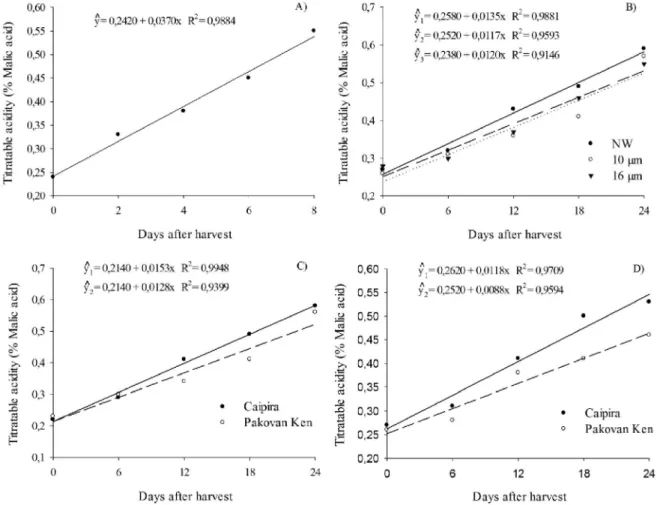
The titratable acidity (TA) of the banana fruit stored at 12, 15 and 25 °C increased for both cultivars (Figures 2A, 2B, 2C and 2D). The fruit stored at 25 °C showed no difference for packaging or cultivar; however, there was an increase in acidity with storage period (Figure 2A). At the end of storage, the unwrapped fruit stored at 12 ºC had a higher recorded value for TA of 0.59%, which is higher than that found for the wrapped fruit (Figure 2B). At 12 and 15 ºC, fruit of the Caipira banana showed higher values for TA than those of the Pacovan Ken banana (Figures 2C and 2D).
In the banana, unlike in most fruits, increases have been recorded in the titratable acidity of the fruit throughout the period of storage and ripening (ALENCAR
et al., 2010). This situation, together with the increase
in soluble-solid content, ensures an improvement of the
appreciable sweet flavour of the fruit (MATSUURAet al.,
2002). Data behaviour agrees with Sarmentoet al. (2015),
who found an increase in titratable acidity in fruit of the Prata Catarina banana during the storage period, covered in cassava starch or wrapped in polyvinyl chloride film (PVC), with lower values for the fruit wrapped in PVC film. For those authors, wrapping the fruit in PVC film slows the metabolism, delays the synthesis of organic acids, and increases the shelf life of the fruit.
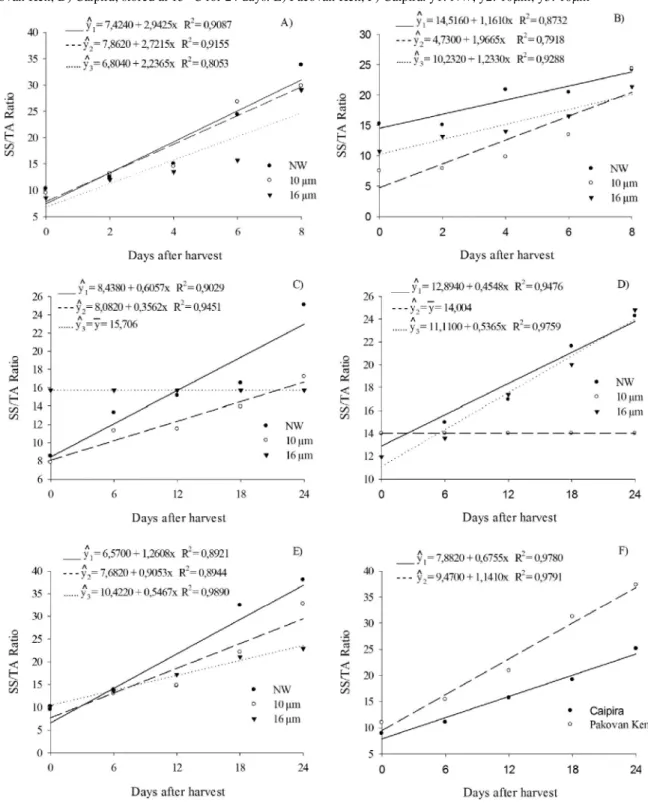
Fruit of Pakovan Ken, stored at 25 °C with no
wrapping, and wrapped in 10 and 16μm film (Figure 3A)
reached greater values for SS/TA than fruit of the Caipira banana under the same conditions (Figure 3B). At the end of the evaluation, the relationship of SS to TA ranged from 22 to 30 and from 19 to 24 for the Caipira and Pacovan Ken cultivars respectively. The results for the SS/TA ratio showed similar behaviour to the soluble-solid content, increasing with the storage period, except for the fruit of Pacovan Ken and Caipira stored at 12ºC with 16 and
10μm film respectively, which recorded constant values
Figure 1 - Soluble-solid content (SS), in the fruit of banana cultivars (Musa spp.) with no wrapping (NW) and wrapped in 10
and 16μm film; stored at 2 ºC for 8 days: A) Pacovan Ken, B) Caipira; stored at 12 °C for 24 days: C) Pacovan Ken, D) Caipira; stored at 15 °C for 24 days: E) Pacovan Ken, F) Caipira. ŷ1: NE; ŷ2: 10μm; ŷ3: 16μm
Most of the flavours presented by fruit are a result of a mixture of scores attributed to the sweet and acidic taste, where the proportion of sugar to acid can be accompanied
Figure 2 - Titratable acidity (TA), in the fruit of banana cultivars (Musa spp.) with no wrapping (NW) and wrapped in 10 and 16μm film. A)
Pacovan Ken and Caipira stored at 25 ºC for 8 days; B) NW, 10 and 16μm film stored at 12 °C for 24 days; C) Pacovan Ken and Caipira stored at 12 °C for 24 days; D) Pacovan Ken and Caipira stored at 15 °C for 24 days. ŷ1: NW; ŷ2: 10μm; ŷ3: 16μm
of 4.90 and 4.84 for the cultivars Pacovan Ken and Caipira respectively (Figures 4C and 4D). These results are similar to those of 4.41 and 5.10 seen in fruit of the
Pacovan Ken and Caipira banana by Ribeiroet al. (2012)
under conventional cultivation in Cruz das Almas, in the State of Bahia.
During the evaluation period, there was an increase in the levels of total soluble sugars (TSS) for all treatments (Figures 5A, 5B, 5C, 5D and 5F). At 25 ºC, the highest values for TSS were recorded in fruit of the Pacovan Ken cultivar in relation to the Caipira cultivar (Figures 5A and 5B). Fruit of the Pakovan Ken cultivar at a temperature of 12 ºC displayed higher levels of TSS, especially the fruit with no wrapping (Figure 5C). At the same temperature (12 °C), fruit of the cultivar Caipira displayed a value for TSS of 17% for fruit with
no wrapping, whereas the wrapping of 10 and 16μm
film gave the lowest values for TSS of 13% and 11% respectively (Figure 5D).
The three types of wrapping had different effects on the fruit that was stored at 15ºC (Figure 3E). Furthermore, at 15 °C, higher values for the SS/TA ratio were seen for fruit of the Caipira banana when compared to Pacovan Ken (Figure 3F). A previous study had shown higher values for SS/TA in the same cultivars stored at 25 °C and a humidity of 80%
(RIBEIRO et al., 2012). According to the scientific
report and to data from the present study, although the percentage of SS to TA of the fruit was different, it
still presented values considered ideal for in natura
consumption.
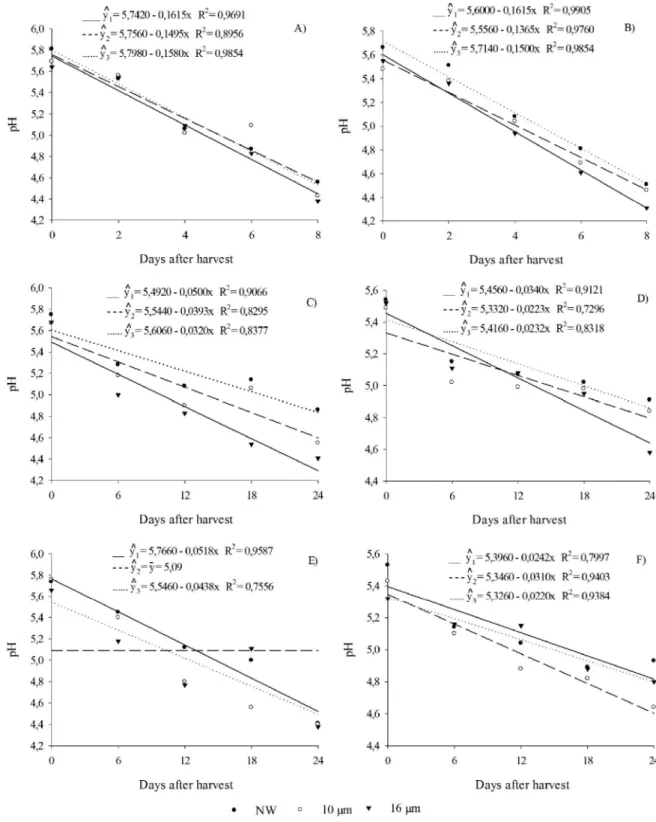
The pH decreased with fruit maturation at all temperatures tested (Figures 4A, 4B, 4C, 4C, 4D, 4E and 4F), except for the fruit of Pacovan Ken stored at 15
°C and wrapped in 10μm film, which remained constant
throughout the period of storage (Figures 4E). In the fruit stored at 12 ºC, the lowest reduction in pH was found for
Figure 3 - Relationship of soluble solids to titratable acidity (SS/TA), in the fruit of banana cultivars (Musa spp.) with no wrapping (NW) and wrapped in 10 and 16μm film; stored at 25 °C for 8 days: A) Pacovan Ken, B) Caipira; stored at 12 °C for 24 days: C) Pacovan Ken, D) Caipira; stored at 15 °C for 24 days: E) Pacovan Ken, F) Caipira. ŷ1: NW; ŷ2: 10μm; ŷ3: 16μm
Fruit of the Pakovan Ken cultivar stored at 15 °C showed a TSS value of 19.68%, with a value of 17.85% in fruit of the Caipira cultivar (Figure 5E). The greatest accumulation of TSS found in the fruit from all
the treatments is related to the conversion of starch into
sugars. To this effect, Carvalho et al. (2011) state that
Figure 4 - pH in the fruit of banana cultivars (Musa spp.) with no wrapping (NW) and wrapped in 10 and 16μm film; stored at 25 ºC for 8
days: A) Pacovan Ken, B) Caipira; stored at 12 °C for 24 days: C) Pacovan Ken, D) Caipira; stored at 15 °C for 24 days: E) Pacovan Ken, F) Caipira. ŷ1: NW; ŷ2: 10μm; ŷ3: 16μm
characterised by the conversion of starch into sugars, with a consequent increase in soluble solids, sugars and titratable acidity in response to the reduction in pH.
et al., 2008). Studies point out that evaluation of the same
characteristics by different authors, who found differing results, may be associated with the soil and climate
Figure 5 - Total soluble sugars (TSS) in the fruit of banana cultivars (Musa spp.) with no wrapping (NW) and wrapped in 10 and 16μm
film; stored at 25 °C for 8 days: A) Pacovan Ken, B) Caipira; stored at 12° C for 24 days: C) Pacovan Ken, D) Caipira; stored at 15 °C for 24 days: E) Pacovan Ken and Caipira. ŷ1: NW; ŷ2: 10μm; ŷ3: 16μm
however under different climatic conditions (RAMOS; SARITA; MISCHAN, 2009).
Fruit stored with no wrapping displayed an increase in the yellowish colour of the skin, indicating the advance of maturation irrespective of cultivar or temperature (Figures
Figure 6 - Colouration in the fruit of banana cultivars (Musa spp.) with no wrapping (NW) and wrapped in 10 and 16μm film; stored
at 25 °C for 8 days: A) Pacovan Ken, B) Caipira; stored at 12 °C for 24 days: C) Pacovan Ken and Caipira; stored at 15 °C for 24 days: D) Pacovan Ken, E) Caipira. ŷ1: NW; ŷ2: 10μm; ŷ3: 16μm
6A, 6B, 6C, 6D and 6E). Under such conditions, chlorophyll degradation by the enzyme chlorophyllase occurs in the pericarp, and carotenoid synthesis is reduced due to an increase in ethylene, increasing the speed of metabolism
Pacovan Ken stored at 25 °C and wrapped in 10 and 16μm film showed a skin colouration of 3.2 and 3.0 (50% green and 50% yellow) respectively at the end of storage (Figure 6A). While the Caipira, cultivar stored under the same conditions had values of 3.2 (50% green and 50% yellow) and 2.8 (light green) respectively (Figure 6B).
Fruit of the Caipira cultivar stored at a temperature of 12 ºC displayed more-advanced skin colouration at the end of 24 days when compared to the Pacovan Ken banana (Figure 6C). The cultivars stored at 15 ºC and wrapped in
10 and 16μm film showed less change in skin colouration
during the evaluation period in relation to fruit with no wrapping under the same conditions. The Pacovan Ken cultivar displayed the least skin colouration at the end of
storage for the 10 and 16μm wrapping (Figure 6D and 6E).
This result is positive, as it presupposes that the technique resulted in the fruit having a longer shelf life, increasing the period of marketing, without losing the
qualities desired for consumption. According to Silvaet al.
(2006), skin colouration is an important factor in evaluating the quality of the banana to be marketed, serving as a reference to establish the maturation stage of the fruit.
The results of the sensory analysis showed a difference between the cultivars Pacovan Ken 5.63 (neither like nor dislike) and Caipira 3.70 (dislike moderately); the former obtaining better results for acceptability from tasters in Janaúba in the north of the State of Minas Gerais (Figure 7). Previous studies under varying climatic conditions had already demonstrated the low acceptance of the cultivar Caipira when compared to other cultivars (CARVALHO
et al., 2011; SOUZAet al., 2013). In sensory analysis,
flavour is one of the main attributes, as it reflects consumer preference for the product. The results of the present study therefore reaffirm previous research, in which the cultivar Caipira was the least accepted by the tasters.
CONCLUSIONS
1. The modified atmosphere together with the temperatures of 15 and 12 °C delayed ripening in the Pacovan Ken and Caipira bananas;
2. The Pacovan Ken cultivar was more responsive to the ripening techniques, and more acceptable to the tasters than the Caipira cultivar.
REFERENCES
ALENCAR, F. M. A. et al. Evolução da maturação e determinação do ponto de colheita de banana nas condições de cultivo da região do submédio do vale do São Francisco.
2010. Disponível em: < http://www.infoteca.cnptia.embrapa.br/ bitstream/CPATSA/34351/1/OPB 1015.pdf >. Acesso em: 5 set. 2016.
ASSOCIATION of OFFICIAL ANALYTICAL CHEMISTS.
Official methods of analysis of AOAC International.
AOAC International, 2005.
BEZERRA, V. S. Características físico-químicas de frutos de bananeiras resistentes à sigatoka-negra. In: DIAS, J. S. A.;
BARRETO, M. C. (Ed.).Aspectos agronômicos, fitopatológicos e socioeconômicos da sigatoka-negra na cultura da bananeira no Estado do Amapá. Macapá: Embrapa Amapá, 2011. 95 p. BEZERRA, V. S.; DIAS, J. S. A. Avaliação físico-química de frutos de bananeiras.Revista Acta Amazônica, v. 39, n. 2, p. 423-428, 2009.
CARVALHO, A. V.et al. Qualidade pós-colheita de cultivares de bananeira do grupo ‘maçã’, na região de Belém-PA.Revista Brasileira de Fruticultura, v. 33, p. 1095-1102, 2011. CHITARRA, M. I. F.; CHITARRA, A. B.Pós-colheita de frutos e hortaliças: fisiologia e manuseio. 2. ed. Lavras: UFLA, 2005. 785 p.
DADZIE, B. K.; ORCHARD, J. E. Post-harvest criteria and methods for routine screening of banana/plantain hybrids.
Rome: IPGRI; Montpellier: INIBAP, 1997.
EMPRESA DE PESQUISA AGROPECUÁRIA DE MINAS GERAIS. 2015. Disponível em: <http://www.epamig.br/ index.php?option=com_content&task=view&id=1969> Acesso em: 08 set. 2016.
FERREIRA, D. F. Sisvar: a computer statistical analysis system.
Revista Ciência e Agrotecnologia, v. 35, p. 1039-1042, 2011. HOJO, E. T. D.et al. Uso de películas de fécula de mandioca
e PVC na conservação pós-colheita de pimentão. Revista Ciência e Agrotecnologia, v. 3, n. 3, p. 184-190, 2007.
INSTITUTO BRASILEIRO DE GEOGRAFIA E ESTATÍSTICA. 2016. Disponível em: <ftp://ftp.ibge.gov. br/Producao_Agricola/Levantamento_Sistematico_da_ Producao_Agricola_[mensal]/Fasciculo/lspa_201607.pdf.> Acesso em: 11 set. 2016.
Figure 7 - Sensory analysis of fruit of the banana cultivars
Pacovan Ken and Caipira
LOESECKE, H. W. V. Banana: chemistry, physiology, technology. 2. ed. New York: Interscience, 1980. 189 p. MATSUURA, F. C. A. U.et al. Qualidade sensorial de frutos de
híbridos de bananeira cultivar Pacovan.Revista Brasileira de Fruticultura, v. 24, n. 1, p. 263-266, 2002.
NASCIMENTO JUNIOR, B. B.et al. Diferenças entre bananas
de cultivares Prata e Nanicão ao longo do amadurecimento: características físico-químicas e compostos voláteis.Revista Ciência e Tecnologia de Alimentos, v. 28, n. 3, p. 649-658, 2008.
NELSON, N. A. Photometric adaptation of the Somogy method for the determination of glucose.Journal Biological Chemistry, v. 153, p. 375-380, 1944.
PIMENTEL, R. M. A. et al. Qualidade pós-colheita dos
cultivares de banana PA42-44 e prata-anã cultivados no norte de Minas Gerais.Revista Brasileira de Fruticultura, v. 32, p.407-413, 2010.
RAMOS, D. P.; SARITA, L.; MISCHAN, M. M. Caracterização físico-química dos frutos de cultivares de bananeira produzidos em Botucatu-SP. Revista Ciência e Agrotecnologia, v.33, p.1765-1770, 2009.
RIBEIRO, L. R.et al. Caracterização física e química de bananas
produzidas em sistemas de cultivo convencional e orgânico.
Revista Brasileira de Fruticultura, v. 34, n. 3, p. 774-782, 2012.
RODRIGUES, M. G.V.; LEITE, M. A. V. Aspectos socioeconômicos da bananicultura. Informe Agropecuário, v.29, n. 245, p. 7-12, 2008.
SANTOS, A. E. O.et al. Utilização de atmosfera modificada na
conservação pós-colheita de mangas ‘Tommy Atkins’.Revista Semiárido De Visu, v. 1, n. 1, p. 10-17, 2011.
SANTOS, S. C. et al . Caracterização morfológica e avaliação de cultivares de bananeiras resistentes a sigatoka negra (Mycosphaerella fijiensis Morelet) no sudoeste goiano.
Revista Brasileira de Fruticultura, v. 28, n. 3, p. 449-453, 2006.
SCANAVACA JÚNIOR, L.; FONSECA, N.; PEREIRA, M.E.C. Uso de fécula de mandioca na pós-colheita de manga ‘surpresa’. Revista Brasileira de Fruticultura, v. 29, n. 1, p. 67-71, 2007.
SERPA, M. F. P.et al. Conservação de manga com uso de fécula
de mandioca preparada com extrato de cravo e canela.Revista Ceres, v. 61, n.6, p. 975-982, 2014.
SILVA, C. S. et al. Amadurecimento da banana-prata
climatizada em diferentes dias após a colheita.Revista Ciência e Agrotecnologia, v.30, n.1, p.103-111, 2006.
SIQUEIRA, C. L.et al. Características físico-químicas, análise
sensorial e conservação de frutos de cultivares de bananeiras resistentes à sigatoca-negra.Revista Ceres, v. 57, p. 673-678, 2010.
SOUZA, M. E.et al. Caracterização físico-química e avaliação
sensorial dos frutos de bananeira. Revista Nativa, v. 1, n. 1,
p. 13-17, 2013.
VILLANUEVA, N. D. M.; DA SILVA, M. A. A. P. Comparative performance of the nine-point hedonic, hybrid and self-adjusting scales in the generation of internal preference maps. Food Quality and Preference, v.20, p.1-12, 2009.