ABSTRACT
Environmental impact assessment is a determining tool for the implementation or not of all types of developments that can cause some imbalance in the surrounding environment. Brazil is known for its strict environmental legislation, requiring detailed projects that provide sustainable development at the site of implantation. Thus, Brazilian hydroelectric power plants are required to issue an Environmental Impact Assessment. In this study, environmental studies related to 30 Brazilian hydroelectric plants, available at the database of the Brazilian Institute of Environment and Renewable Natural Resources (IBAMA), were evaluated in order to temporally assess how many and which hydrological parameters were addressed in the environmental impact assessment. The hydroelectric plants are inserted directly into waterways, interfering or being directly influenced by rainfall, flow and sediment deposits. The results showed a tendency of adopting the same parameters. The creation of legislation that requires studies of certain variables may facilitate future comparison of the environmental impacts generated after the construction of hydroelectric plants.
Keywords: environmental impact assessment; hydroelectric power; hydrological parameters.
1BC2 Engenharia – Bauru (SP), Brazil.
2Universidade Estadual Paulista “Júlio de Mesquita Filho” – Ilha Solteira (SP), Brazil.
*Corresponding author: [email protected]
Received: 09/29/2016 – Accepted: 03/14/2017 – Reg. ABES: 169678
Quantitative analysis of environmental
impact assessments of hydroelectric power
plants on the IBAMA database and evaluation
of the hydrological parameters used
Análise quantitativa dos estudos de impactos ambientais de hidroelétricas existentes
no banco de dados do IBAMA e avaliação dos parâmetros hidrológicos utilizados
Carolina Abreu Mazzei
1, Thaís Tonelli Marangoni
2*, Jefferson Nascimento de Oliveira
2RESUMO
A avaliação de impacto ambiental é um instrumento determinante para a implantação ou não de todos os tipos de empreendimentos que possam causar algum desequilíbrio no meio ambiente circundante. O Brasil é conhecido pela sua rigorosa legislação de proteção ambiental, exigindo projetos minuciosos que proporcionem o desenvolvimento sustentável no local de implantação. Dessa maneira, é exigido das usinas hidroelétricas brasileiras o Estudo de Impacto Ambiental. No presente trabalho foram avaliados os estudos ambientais referentes a 30 usinas hidroelétricas brasileiras, disponíveis no banco de dados do Instituto Brasileiro do Meio Ambiente e dos Recursos Naturais Renováveis (IBAMA), com o objetivo de avaliar temporal e quantitativamente os parâmetros hidrológicos abordados nos estudos de impacto ambiental. As usinas hidroelétricas são inseridas diretamente nos cursos d’água, intervindo ou sendo influenciadas diretamente pela precipitação, vazão e depósito de sedimentos. Os resultados mostraram que há uma tendência de adoção dos parâmetros. A criação de uma legislação que exija estudos de determinadas variáveis pode facilitar a comparação futura dos impactos ambientais gerados após a construção da usina hidroelétrica.
Palavras-chave: estudo de impacto ambiental; hidroelétricas; parâmetros hidrológicos.
INTRODUCTION
The Environmental Impact Assessment (EIA) is an environmental management tool, applied in various activities and countries, with the aim of protecting ecosystems and providing sustainable development (GWIMBI & NHAMO, 2016). Sánchez (2008) defined environmen-tal impact as any and all environmenenvironmen-tal imbalance caused by (direct
or indirect) anthropic activity, be it in the site’s physical, chemical or biological properties.
In developing countries, the adoption of the EIA was imposed by international funding agencies, which applied the same requirements from their places of origin to the applicant states (GAMA, 2016).
According to Sánchez (2008), the first Brazilian EIAs were car-ried out for the dams of Sobradinho (1972) and Tucuruí (1977) as a requirement of the World Bank to finance construction. In Brazil, with the creation of the Resolution of the National Environmental Council (CONAMA) no. 001, in 1986 (BRAZIL, 1986), presentation the EIA and the respective Environmental Impact Report (EIR) became a require-ment for the issuance of a Preliminary Permit (PP) for a Plan, Program or Policy (PPP) that could cause significant environmental impact.
The scope and depth of the EIA are defined in terms of the poten-tial environmental impacts that will be caused by the development. Sousa (2000) stated that one of the most common impacts in the physi-cal environment, in the case of a hydroelectric power plant (HPP), is the reduction of river flow, changing the dynamics of the aquatic envi-ronment and favoring sediment deposition.
According to Águas et al.(2014), hydrological studies are important when their main objective is to understand the dynamics and func-tionality of the environment in question, and in the management and evaluation of areas that will or will not be occupied by a development. This analysis includes the investigation of pluviometry, fluviometry and the survey of the physical characteristics of river basins.
Fonseca and Resende (2016) stated that the websites of Brazilian state licensing agencies are one of the most important sources of infor-mation on the practice of EIA and environmental licensing. The authors further complement that, although limited and outdated, they still allow the identification and comparison of a series of data and give subsidy to the research.
Latini (2016) observed a significant increase in the number of envi-ronmental licenses issued by the Brazilian Institute for the Environment and Renewable Natural Resources (IBAMA). Fonseca and Resende (2016) have highlighted the lack of studies that attempt to analyze the legislation and the controls of EIA and environmental licensing in Brazil.
In this sense, the present study aimed to carry out a survey of the temporal evolution of the study of hydrological parameters (rainfall, flow and sediment deposition) in the records of EIAs and EIRs of HPPs available in the IBAMA database. It sought to identify, in each of the EIAs, the methods of approach and treatment of the data, accounting for how many and which parameters were used, in order to assist in the preparation of studies and future standardizations.
METHODOLOGY
IBAMA is responsible for the issuance of PPs for several developments, and therefore, its database includes studies of different activities. In this study, the focus was given to the analysis of the hydrological parameters
(flow, rainfall and sediment deposition) of the HPPs’ EIAs/EIRs and hydroelectric exploitation (HEE).
Firstly, a survey was made of the number of HPPs registered and their form of use (by run-of-the-river or in a storage basin) according to the technical file attached to the IBAMA database (2014).
It was noted that, due to its construction year or its current situation (in project or initial licensing phase), not all of the HPPs in the data-base presented the EIA/EIR or the Simplified Environmental Report (SER), and only 43 environmental studies were available for download.
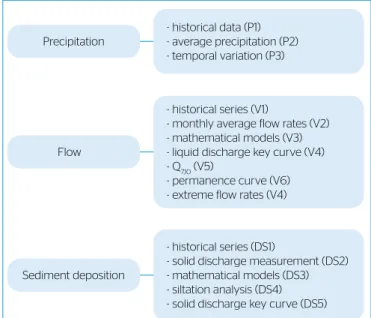
From this, the year of the publication of the EIAs and the types of environmental studies carried out for each development were verified. This analysis allowed the subdivision of the hydrological parameters according to Figure 1.
Finally, a comparative approach was performed on the hydrologi-cal parameters found in the environmental studies evaluated by ana-lyzing them quantitatively and chronologically.
RESULTS AND DISCUSSION
In the IBAMA database, 92 hydroelectric development projects were regis-tered by September 2016, with 23.9% of them using storage basin, 45.7% by run-of-the-water and 30.4% not presenting information on their form of use. IBAMA reports that 52 of the 92 registered processes (56.5%) had EIA/ EIR or SAR, but 9.8% (9 cases) were not available for access or download. Thus, the analysis focused on the 43 cases whose information was obtainable.
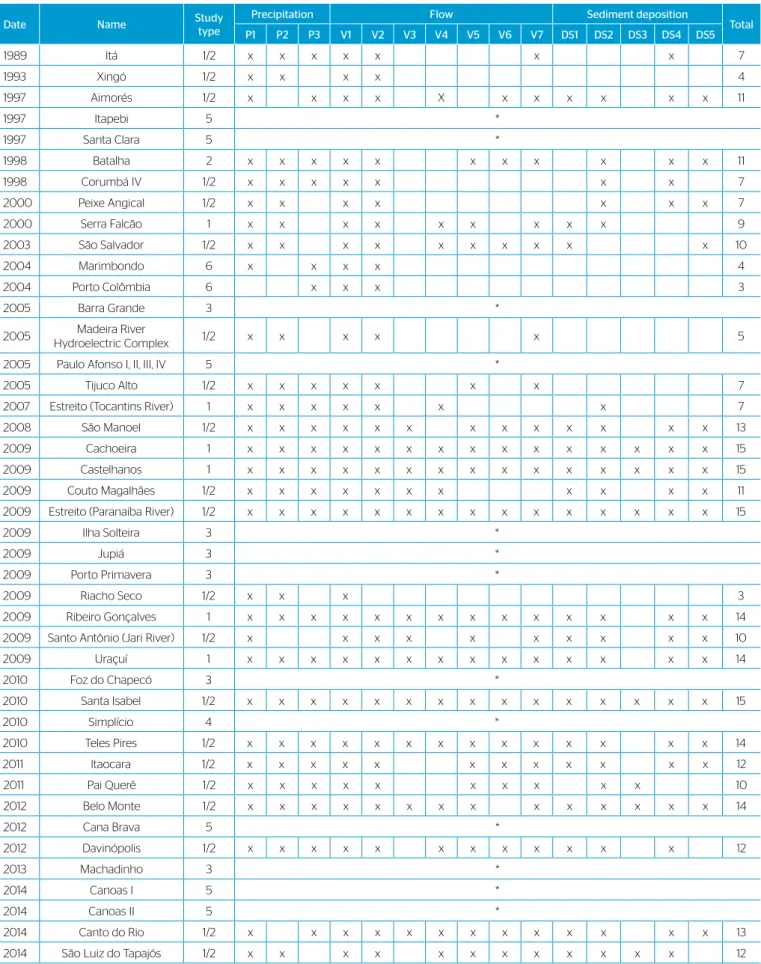
A first evaluation made it possible to verify the types of envi-ronmental studies presented, between 1989 and 2014, organized in Table 1. Six variations were found: EIA; EIR; Plan for Environmental Conservation and Use of Water from the Reservoir Environment (Plano
- historical series (DS1)
- solid discharge measurement (DS2) - mathematical models (DS3) - siltation analysis (DS4) - solid discharge key curve (DS5) Precipitation
Flow
Sediment deposition
- historical data (P1) - average precipitation (P2) - temporal variation (P3)
- historical series (V1)
- monthly average flow rates (V2) - mathematical models (V3) - liquid discharge key curve (V4) - Q7,10 (V5)
- permanence curve (V6) - extreme flow rates (V4)
Q7,10: minimum flow of 7 consecutive days with an occurrence period of 10 years.
Table 1 – Comparison of the parameters discussed in the environmental studies from hydroelectric power plants and type of study presented per each development and its year of publication.
Date Name Study type
Precipitation Flow Sediment deposition
Total P1 P2 P3 V1 V2 V3 V4 V5 V6 V7 DS1 DS2 DS3 DS4 DS5
1989 Itá 1/2 x x x x x x x 7
1993 Xingó 1/2 x x x x 4
1997 Aimorés 1/2 x x x x X x x x x x x 11
1997 Itapebi 5 *
1997 Santa Clara 5 *
1998 Batalha 2 x x x x x x x x x x x 11
1998 Corumbá IV 1/2 x x x x x x x 7
2000 Peixe Angical 1/2 x x x x x x x 7
2000 Serra Falcão 1 x x x x x x x x x 9
2003 São Salvador 1/2 x x x x x x x x x x 10
2004 Marimbondo 6 x x x x 4
2004 Porto Colômbia 6 x x x 3
2005 Barra Grande 3 *
2005 Madeira River
Hydroelectric Complex 1/2 x x x x x 5
2005 Paulo Afonso I, II, III, IV 5 *
2005 Tijuco Alto 1/2 x x x x x x x 7
2007 Estreito (Tocantins River) 1 x x x x x x x 7
2008 São Manoel 1/2 x x x x x x x x x x x x x 13
2009 Cachoeira 1 x x x x x x x x x x x x x x x 15
2009 Castelhanos 1 x x x x x x x x x x x x x x x 15
2009 Couto Magalhães 1/2 x x x x x x x x x x x 11
2009 Estreito (Paranaíba River) 1/2 x x x x x x x x x x x x x x x 15
2009 Ilha Solteira 3 *
2009 Jupiá 3 *
2009 Porto Primavera 3 *
2009 Riacho Seco 1/2 x x x 3
2009 Ribeiro Gonçalves 1 x x x x x x x x x x x x x x 14
2009 Santo Antônio (Jari River) 1/2 x x x x x x x x x x 10
2009 Uraçuí 1 x x x x x x x x x x x x x x 14
2010 Foz do Chapecó 3 *
2010 Santa Isabel 1/2 x x x x x x x x x x x x x x x 15
2010 Simplício 4 *
2010 Teles Pires 1/2 x x x x x x x x x x x x x x 14
2011 Itaocara 1/2 x x x x x x x x x x x x 12
2011 Pai Querê 1/2 x x x x x x x x x x 10
2012 Belo Monte 1/2 x x x x x x x x x x x x x x 14
2012 Cana Brava 5 *
2012 Davinópolis 1/2 x x x x x x x x x x x x 12
2013 Machadinho 3 *
2014 Canoas I 5 *
2014 Canoas II 5 *
2014 Canto do Rio 1/2 x x x x x x x x x x x x x 13
2014 São Luiz do Tapajós 1/2 x x x x x x x x x x x x 12
de Conservação Ambiental e Usos da Água do Entorno do Reservatório – PACUERA); Environmental Assessment (EA); Technical Advice; and Environmental Reporting.
The PACUERA-type environmental study refers only to permanent preservation areas (PPAs) and does not include the evaluation of the hydrological parameters. Thus, the studies on Barra Grande, Foz do Chapecó, Ilha Solteira, Jupiá, Machadinho and Porto Primavera HPPs were excluded from the survey.
The technical opinions regarding the hydroelectric power plants of Cana Brava, Canoas I, Canoas II, Itapebi and Paulo Afonso I, II, III, IV, Usina Piloto and Apolônio Sales (Moxotó) were very superficial, not going into detail about the desired parameters, and were elimi-nated from the study.
The environmental assessment of the Simplício hydroelectric devel-opment, available in the database used, is a complement to the previous environmental study, which was not available and was also rendered useless. Finally, 30 HPPs were analyzed.
Table 1 shows the studies in chronological order and it is possible to observe that, despite the legal requirement of the elaboration of EIA/ EIR for developments built after 1986, there are HPPs that only pres-ent simplified environmpres-ental studies. Such is the case of the Simplício HPP, whose construction began in 2000 and has only one EA. In some cases, the obligation to submit the EIA/EIR for the issuance of the Installation License (IL) is not complied with, as in the Cana Brava HPP, which came into operation in 2002 and only presents a technical opinion, submitted in 2012. In addition, there is no EIR for Serra do Falcão HPP, Estreito HPP, Cachoeira HPP, Castelhanos HPP, Ribeiro Gonçalves HPP and Uraçuí HPP developments.
Table 1 shows that there is no tendency to increase or decrease the number of parameters adopted chronologically. The Xingó HPP, with EIA/EIR carried out in 1993, presents 4 parameters; in 1998, HPPs Aimoré and Batalha analyzed 11, but the Riacho Seco HPP in 2009, presented only 3.
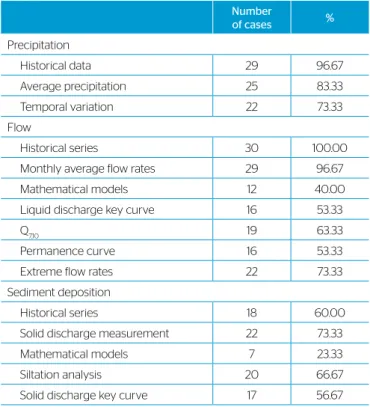
The hydrological parameters of precipitation are the ones most approached in the studies, followed by the ones of flow and sediment deposit. This fact can be explained by the greater number of pluvio-metric stations in the country, increasing the probability of their occur-rence within the studied basin. Sediment data require further in-depth studies, and are often ignored.
Table 2 shows the total occurrence number of the parameters and their survey percentage.
CONCLUSIONS
This study aimed to investigate, together with IBAMA, the available EIAs and the temporal behavior of the hydrological parameters addressed by them. At first, it was verified that the IBAMA website is not up to date, which makes access and analysis of the EIAs/RIMAs of various developments impossible.
It should be noted that the number and type of parameters dis-cussed in the studies over the years occurred in a random manner, influenced perhaps by the lack of a resolution that requires the licensee to strictly adopt the hydrological parameters and their subdivision for the EIA. Nevertheless, the observation of data and the study of norma-tive environmental publications have shown that there is a tendency to adopt the same classifications. This approach facilitates the comparison between the works, according to their size and their respective impact. Therefore, the establishment of obligation in the adoption of the parameters could facilitate the EA, making it more clear and objective, as well as the verification of the changes induced by the construction of HPPs. In addition, it is suggested that the databases of licensing agen-cies be updated constantly.
Table 2 – Number of parameters presented in the studies evaluated.
Number
of cases %
Precipitation
Historical data 29 96.67
Average precipitation 25 83.33
Temporal variation 22 73.33
Flow
Historical series 30 100.00
Monthly average flow rates 29 96.67
Mathematical models 12 40.00
Liquid discharge key curve 16 53.33
Q7,10 19 63.33
Permanence curve 16 53.33
Extreme flow rates 22 73.33
Sediment deposition
Historical series 18 60.00
Solid discharge measurement 22 73.33
Mathematical models 7 23.33
Siltation analysis 20 66.67
Solid discharge key curve 17 56.67
Q7,10: minimum flow of 7 consecutive days with an occurrence period of 10 years.
ÁGUAS, T.A.; BRAZ, A.M.B.; LIMA, S.F.L.; FERREIRA, C.C.F.; MIRANDOLA GARCIA, P.H.M.G. (2014) Panorama Ambiental das Alterações Gerada pela Implantação de Pequenas Centrais Hidrelétricas no Município de Costa Rica/MS. Revista GEONORTE, Edição Especial 4, v. 10, n. 1, p. 335-340.
ALMEIDA, A.N.; RÉQUIA JUNIOR, W.J.; SOARES, P.R.C.; ÂNGELO, H. (2016) Deficiências na Comunicação dos Estudos de Impacto Ambiental (EIA). Acervo On-line de Mídia Regional, ano 16, v. 11, n. 1, p. 29-40.
© 2018 Associação Brasileira de Engenharia Sanitária e Ambiental This is an open access article distributed under the terms of the Creative Commons license. BRASIL. (1981) Conselho Nacional do Meio Ambiente
(CONAMA). Lei nº 6.938, de 31 de agosto de 1981. Diário Oficial da União, Brasília.
FONSECA, A.; RESENDE, L. (2016) Boas Práticas de Transparência, Informatização e Comunicação Social no Licenciamento Ambiental Brasileiro: uma Análise Comparada dos Websites dos Órgãos Licenciadores Estaduais. Revista de Engenharia Sanitária e Ambiental, v. 21, n. 2, p. 295-306. DOI: 10.1590/S1413-41522016146591
GAMA, A.P.S. (2016) Proposta de Alterações da AIA no Brasil: uma Análise Crítica à Luz da Experiência Internacional. 102 f. Dissertação (Mestrado) – Universidade de São Paulo, São Paulo. Disponível em: <http://www.teses.usp.br/teses/ disponiveis/100/100136/tde-02052016-112053/en.php>. Acesso em: 07 jul. 2016.
GWIMBI, P.; NHAMO, G. (2016) Translating mitigation measures proposed in environmental impact statements into planning conditions: Promises and practices by multinational platinum mining firms along the Great Dyke of Zimbabwe. Environmental Science & Policy, v. 57, p. 10-21. https://doi.org/10.1016/j.envsci.2015.12.005
INSTITUTO BRASILEIRO DO MEIO AMBIENTE E DOS RECURSOS NATURAIS RENOVÁVEIS (IBAMA). (2014) Sistema informatizado de licenciamento ambiental federal. Brasília. Disponível em: <https:// servicos.ibama.gov.br/licenciamento/consulta_empreendimentos. php>. Acesso em: 10 ago. 2016.
LATINI, J.R. (2016) A Avaliação de Impacto Ambiental (AIA) Enquanto Instrumento Participativo e Preventivo no Contexto do Neodesenvolvimentismo: O Caso do Complexo Logístico Industrial do Porto do Açu (Clipa). 148 f. Dissertação (Mestrado) – Universidade Estadual do Norte Fluminense, Campos dos Goytacazes. Disponível em: <http://uenf.br/posgraduacao/ecologia- recursosnaturais/wp-content/uploads/sites/7/2013/10/2016-mestrado-UENF-Juliana-Ribeiro-Latini.pdf>. Acesso em: 15 jul. 2016.
SÁNCHEZ, L.H. (2008) Avaliação de impacto ambiental: conceitos e métodos. 2. ed. São Paulo: Oficina de Textos. 584 p.