Short Report
J. Braz. Chem. Soc., Vol. 29, No. 12, 2657-2668, 2018 Printed in Brazil - ©2018 Sociedade Brasileira de Química*e-mail: [email protected]
Potential
Antileishmanial
Activity
of
4-
N
-Acylhydrazone
Pyrazolo[3,4-
d
]pyridazin-7-ones:
Synthesis,
in
vitro
Biological
Evaluations
and
Computational
Studies
AndreyP.Jacomini,aMichaelJ.V.daSilva,aJuliaPoletto,aGessicaM.Ribeiro,a JessicaT.C.Yokoyama,aDanielleL.Bidóia,bFáveroR.Paula,cCelsoV.Nakamura,b
MariaHelenaSarragiottoaandFernandaA.Rosa*,a
aDepartamento de Química, Universidade Estadual de Maringá (UEM),
87020-900 Maringá-PR, Brazil
bPrograma de Pós-Graduação em Ciências Biológicas, Universidade Estadual de Maringá (UEM),
87020-900 Maringá-PR, Brazil
cDepartamento de Farmácia, Universidade Federal do Pampa (UNIPAMPA),
97500-970 Uruguaiana-RS, Brazil
In this work a series of 28 novel pyrazolo[3,4-d]pyridazin-7-ones were synthesized and tested
against Leishmania amazonensis (strain WHOM/BR/75/JOSEFA) in promastigote and axenic
amastigote forms. Five compounds were active against both cellular forms with IC50 (inhibitory
concentration growth of 50%) values of 20.2, 11.7, 16.2, 29.5 and 40.3 µM for promastigote and 17.4, 25.2, 3.84, 21.8 and 22.7 µM for axenic amastigote. All compounds were studied by the
Lipinski rule, cytotoxicity both in silico and in vitro to fibroblast line (L929) and macrophages
(J774A1), and the most active compound showed a selectivity index of 59.9.
Keywords: pyrazolo[3,4-d]pyridazinone, N-acylhydrazone, Leishmania amazonensis
Introduction
Leishmaniasis is a major infection, a neglected disease caused by more than 20 species that belong to family Trypanosomatidae and genus Leishmania. This disease is distributed worldwide and can be found in subtropical and temperate regions in more than 88 countries, mainly affecting poor regions of developing countries. It is estimated that about 12-15 million people are already infected with leishmaniasis; 2 million new cases occur annually and around 350 million people live in risk areas. The parasites may be transferred to humans by bites from 30 species of sand fly and can cause three main clinical types of leishmaniasis: cutaneous, mucocutaneous and visceral.1-7 The drugs used nowadays in the treatment of leishmaniasis have shown highly toxic effects and parasite resistance, demonstrating the necessity of development of novel antileishmanial compounds.8-10
It is known that pyrazoles,11-14 fused pyrazoles15-17 and N-acylhydrazones13,18 show antileishmanial activity. Recently, studies by our research group have shown the
synthesis,19 and antileishmanial activity20 of a series of 1,4,6-trisubstituted pyrazolo[3,4-d ]pyridazin-7-one-N-acylhydrazone-(bi)thiophene hybrids. In continuation
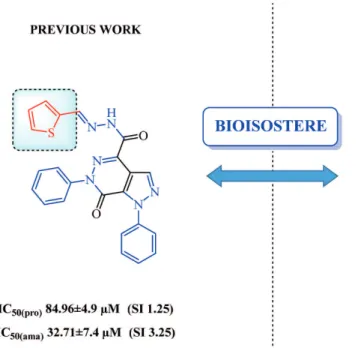
of our studies with pyrazolopyridazinone hybrids, a new series was synthesized using a phenyl substituent in the N-acylhydrazone moiety, which is a bioisostere of
thiophene (Figure 1).
Results and Discussion
The novel pyrazolo[3,4-d]pyridazin-7-ones 5-8 were
obtained from the β-enamino diketone and hydrazines according to highly regioselective methodology reported by our research group,19 as shown in Scheme 1, and characterized by 1H and 13C nuclear magnetic resonance (NMR), heteronuclear single quantum correlation (HSQC) and heteronuclear multiple bond correlation (HMBC) data, high resolution mass spectrometry (HRMS), X-ray diffraction (XRD, CCDC 1576799) and melting point (mp) (see Supplementary Information for full details).
All new compounds synthesized (3b, 4b, 5e-j, 6e-l, 7e-j
and 8e-j) were evaluated against promastigote and axenic
Figure 1. Pyrazolopyridazinones synthesized in previous work20 and in this work.
Scheme1. General methodology for synthesis of new derivatives. (i) R1NHNH
2 (0.9 equiv.), EtOH; (ii) R2NHNH2 (1.1 equiv.), AcOH (4.0 equiv.), EtOH;
(iii) PhNHNH2 (2.2 equiv.), AcOH (4.0 equiv.), EtOH; (iv) NH2NH2.H2O (20 equiv.), EtOH:MeCN (1:1); (v) aldehyde(R3) (1.0 equiv.), HCl(cat.), DMSO. concentration growth of 50% (IC50) was determined for
each compound. Results of IC50 > 100 µM were considered as inactive. As observed for the compounds 3a,c,d and
4a,c,d,20 the ester (3b) and hydrazide (4b) derivatives were
the phenyl-substituted pyrazolo[3,4-d ]pyridazin-7-one-N-acylhydrazone 5-8 led to active compounds 6h, 6l, 7e, 8f, and 8i with IC50 values of 20.2, 11.7, 16.2, 29.5 and 40.3 µM to promastigote forms and 17.4, 25.2, 3.84, 21.8 and 22.7 µM to axenic amastigote forms, respectively (Table 1).
It is notorious that the N-acylhydrazone moiety in
4-position has a great influence on the activity;20 however, the nature of the substituent in 1 and 6-positions of pyrazolo[3,4-d]pyridazinone also has an influence on the
antileishmanial results for those substances (Figure 2), where the presence of a phenyl group in all positions (1, 4 and 6) resulted in substance 7e, which showed the best
results of IC50: 16.2 and 3.84 µM for promastigotes and
amastigotes, respectively. The phenyl substituent can be found in 1-position in two more active compounds 8f and 8i, where there is a 4-chlorophenyl substituent in 6-position;
nevertheless, this combination led to less active compounds. Compounds 6h and 6l, which have not phenyl substituent
in 1 or 6-position, were active with IC50 of 20.2 and 11.7, and 17.4 and 25.2 µM for promastigotes and amastigotes, respectively. Although these results demonstrated that
N-acylhydrazone moiety in 4-position and the nature of
the substituent in 1 and 6-positions of pyrazolo[3,4-d]
pyridazinone play an important role in antileishmanial activity, additional studies are necessary to investigate the action mechanism of these class of compounds in antileishmanial activity.
Table1.In vitro antiproliferative activity in L. amazonensis and cytotoxicity in mammalian cells of new compounds synthesized
Compound IC50(pro)a / µM IC50(ama)b / µM CC50(f)c / µM CC50(m)d / µM SIp-fe SIp-mf SIa-fg SIa-mh
3b > 100 > 100 – > 100 – – – –
4b > 100 > 100 – > 100 – – – –
5e > 100 > 100 – > 100 – – – –
5f > 100 > 100 – > 100 – – – –
5g > 100 > 100 – > 100 – – – –
5h > 100 > 100 – > 100 – – – –
5i > 100 > 100 – > 100 – – – –
5j > 100 > 100 – > 100 – – – –
6e > 100 > 100 – > 100 – – – –
6f > 100 > 100 – > 100 – – – –
6g > 100 > 100 – > 100 – – – –
6h 20.2 ± 0.2 17.4 ± 2.1 228.5 ± 9.1 234.0 ± 5.7 11.3 11.6 13.1 13.4
6i > 100 > 100 – > 100 – – – –
6j > 100 > 100 – > 100 – – – –
6k > 100 > 100 – > 100 – – – –
6l 11.7 ± 1.1 25.2 ± 2.7 301.7 ± 7.4 298.5 ± 8.8 25.8 25.5 12.0 11.8
7e 16.2 ± 2.6 3.84 ± 2.1 145.54 ± 14.45 230.15 ± 10.8 9.0 14.2 37.9 59.9
7f > 100 > 100 – > 100 – – – –
7g > 100 > 100 – > 100 – – – –
7h > 100 > 100 – > 100 – – – –
7i > 100 > 100 – > 100 – – – –
7j > 100 > 100 – > 100 – – – –
8e > 100 > 100 – > 100 – – – –
8f 29.5 ± 3.0 21.8 ± 1.4 245.1 ± 7.8 370.8 ± 9.0 8.3 12.6 11.2 17.0
8g > 100 > 100 – > 100 – – – –
8h > 100 > 100 – > 100 – – – –
8i 40.3 ± 4.4 22.7 ± 0.9 273.2 ± 9.6 318.3 ± 3.6 6.8 7.9 12.0 14.0
8j > 100 > 100 – > 100 – – – –
aIC
50 (inhibitory concentration growth of 50%) values of promastigote form; bIC50 values of axenic amastigote form; ccytotoxic concentration corresponding
to 50% inhibition of fibroblast growth; dcytotoxic concentration corresponding to 50% inhibition of macrophage growth; eselectivity index (CC
50(f)/IC50(pro)); fselectivity index (CC
The cytotoxicity of all compounds was investigated in mammalian fibroblast L929 cells and macrophages J774A1 through the MTT [3-(4,5-dimethylthiazol-2-yl)-2,5-diphenyltetrazolium bromide] method.21 For the active compound the range of cytotoxicity was up to 1000 µM. The most active compound 7e was also the most selective
against both forms of L. amazonensis, with selectivity
index (SI) values of 37.9 and 59.9 to promastigote and amastigote forms, respectively. All the active compounds showed SI values higher than 10 for axenic amastigote forms, and all inactive compounds showed values of cytotoxic concentration corresponding to 50% inhibition (CC50) > 100 µM.
In addition, all compounds were evaluated considering the Lipinski rules,22 aiming to determine the theoretical oral bioavailability using Molinspiration online software.23 Some descriptors, such as nRot (number of rotatable bonds) and PSA (polar surface area) were included in the Lipinski rules, in which is desirable that there are 10 or fewer rotatable bonds and a polar surface area equal to or less than 140 Å2 (Table 2). Five compounds, 5j, 6j, 7j, 8h and 8j showed one or two
violations of Lipinski rules and may present problems in oral bioavailability; however, these did not show antileishmanial activity. All the active derivatives, 6h, 6l, 7e, 8f and 8i showed
no violations of conditions, being able to participate in the drug development process (Table 2).
The calculated electrostatic potential map (MEP) showed no important differences between the compounds studied. Considering compound 8f, regions of negative
electrostatic potential near the nitrogen atom of the pyrazole ring, the oxygen atoms of the carbonyl moieties located on the lateral chain and the pyridazinone group were observed (Figure 3), and the positive electrostatic potentials were found in the lateral chain in all compounds studied.
For in silico toxicological studies, Osiris Property
Explorer software25 was used for calculating the fragment-based toxicity risks, and compared with hydrogen peroxide and meglumine antimoniate (Table 3).
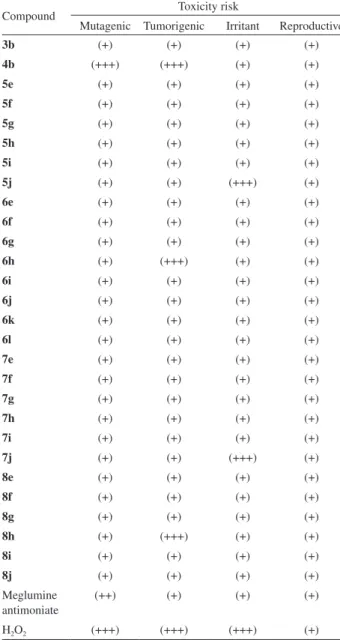
The theoretical toxicity evaluation of the tumorigenic profiles of pyrazolo[3,4-d]pyridazin-7-one derivatives 4b,
6h and 8h showed the same tumorigenic risk as H2O2.
The compound 4b has an hydrazide moiety without
substitution, and 6h and 8h have a dimethylamino
attached to the para-position of the benzene ring, which
Figure 2. Influence of substituent in different positions.
Table2. Physicochemical descriptors calculated for the set of pyrazolo[3,4-d]pyridazinone derivatives
Compound
Molecular weight /
Dalton
nON nOHNH miLogP nRot PSA / Å2
5e 358.36 8 2 2.40 4 105.04
5f 374.36 9 3 1.93 4 125.27
5g 388.39 9 2 2.46 5 114.28
5h 401.43 9 2 2.51 6 108.28
5i 376.35 8 2 2.57 4 105.04
5j 406.36 11 2 2.36 5 150.87
6e 338.37 8 2 2.32 4 105.04
6f 354.37 9 3 1.84 4 125.27
6g 368.40 9 2 2.37 5 114.28
6h 381.44 9 2 2.42 5 140.28
6i 356.36 8 2 2.48 4 102.04
6j 383.37 11 2 2.27 5 150.87
6k 346.42 8 2 1.07 4 98.53
6l 428.53 8 2 2.77 5 98.53
7e 434.46 8 1 3.75 5 94.19
7f 450.46 9 2 3.27 5 114.41
7g 464.49 9 1 3.80 6 103.42
7h 477.53 9 1 3.45 6 97.82
7i 452.45 8 1 3.91 5 94.19
7j 479.46 11 1 3.71 6 140.01
8e 468.90 8 1 4.42 5 94.19
8f 484.90 9 2 3.95 5 114.41
8g 498.93 9 1 4.48 6 103.42
8h 511.97 9 1 4.53 6 97.42
8i 486.89 8 1 4.59 5 94.19
8j 513.90 11 2 4.38 6 140.31
may increase the risk of these molecules to cause a tumorigenic effect. The compound 4b showed a high
risk of mutagenic effect. Compounds 5j and 7j showed
high risk of causing damage to the reproductive system. Other derivatives showed low risk of causing all toxic effects studied. This information is useful since the active compounds 6l, 7e, 8f, and 8i are able to be submitted to
drug design development. All compounds showed lower risk of toxic effects when evaluated in comparison with the antileishmanial drug meglumine antimoniate, which showed a high risk of tumorigenic and mutagenic effects and effects on the reproductive system.
Conclusions
Our results suggest that our synthetic methodology to synthesize fused-ring pyrazolopyridazinone has a wide application, and those rings have potential antileishmanial activity, depending on the substituents that is present in 1, 4 and 6-positions, where the phenyl substituent led to higher-activity compounds in comparison to tert-butyl and
4-chlorophenyl substituents. All compounds synthesized showed low cytotoxicity with good selectivity index for promastigote and amastigote forms of L. amazonensis.
Experimental
General information
Reagents were used as obtained from commercial suppliers without further purification. Solvents were dried and purified according to procedure.261H NMR, 13C NMR, HSQC and HMBC experiments were run on VARIAN Mercury Plus apparatus operating at 1H 300.06 MHz and 13C 75.46 MHz, and Bruker Avance III HD apparatus operating at 1H 500.13 MHz and 13C 125.77 MHz. Chemical shifts are reported in ppm using tetramethylsilane (TMS) as the internal standard for CDCl3 and dimethyl sulfoxide (DMSO-d6). Melting points were determined on Micro-Química apparatus model MQAPF-301. The column chromatography used was silica gel 60, with 230-400 mesh (Merck). Electrospray ionization (ESI)(+)-MS and tandem ESI(+)-MS/MS were acquired using a hybrid high-resolution and high accuracy microTof (Q-TOF, quadrupole time-of-flight) mass spectrometer (Bruker®). For ESI(+)-MS, the energy for the collision induced dissociations (CDI) was optimized for each component. For data acquisition and processing, the Q-TOF-control data analysis software (Bruker Scientific) was used. The error was calculated for all compounds in ppm. Single crystal X-ray diffraction studies: X-ray intensity data measurements
Table3. Theoretical toxicity evaluation values of the active compounds pyrazolo[3,4-d]pyridazin-7-one derivatives compared to H2O2 and
meglumine antimoniate
Compound Toxicity risk
Mutagenic Tumorigenic Irritant Reproductive
3b (+) (+) (+) (+)
4b (+++) (+++) (+) (+)
5e (+) (+) (+) (+)
5f (+) (+) (+) (+)
5g (+) (+) (+) (+)
5h (+) (+) (+) (+)
5i (+) (+) (+) (+)
5j (+) (+) (+++) (+)
6e (+) (+) (+) (+)
6f (+) (+) (+) (+)
6g (+) (+) (+) (+)
6h (+) (+++) (+) (+)
6i (+) (+) (+) (+)
6j (+) (+) (+) (+)
6k (+) (+) (+) (+)
6l (+) (+) (+) (+)
7e (+) (+) (+) (+)
7f (+) (+) (+) (+)
7g (+) (+) (+) (+)
7h (+) (+) (+) (+)
7i (+) (+) (+) (+)
7j (+) (+) (+++) (+)
8e (+) (+) (+) (+)
8f (+) (+) (+) (+)
8g (+) (+) (+) (+)
8h (+) (+++) (+) (+)
8i (+) (+) (+) (+)
8j (+) (+) (+) (+)
Meglumine antimoniate
(++) (+) (+) (+)
H2O2 (+++) (+++) (+++) (+)
The scale of toxicity risk ranges from low (+) to medium (++) and high (+++), calculated using Osiris software.25
Figure3. 3D visualization of the MEP from compound 8f, beyond the Van der Waals surface using Spartan for Window 08.24 Color scheme:
of compounds 8h (CCDC 1576799) were collected with
a Bruker APEX II CCD area-detector diffractometer and graphite-monochromated MoKα radiation. The structure was solved by direct methods using SHELXS.27 Subsequent Fourier-difference map analyses yielded the positions of the non-hydrogen atoms. Refinements were carried out by the SHELXS package.27 All refinements were made by full matrix least squares on F2 with anisotropic displacement parameters for all non-hydrogen atoms. Hydrogen atoms were included in the refinement in calculated positions, but the atoms (of hydrogens) that are performing special bond were located in the Fourier map. The ORTEP diagram were drawn with 50% probability displacement ellipsoids using ORTEP-3 for Windows.28
Parasites and cell culture
Biological activity was determined in promastigotes and axenic amastigotes of L. amazonensis (strain WHOM/
BR/75/JOSEFA). Promastigotes were cultured in Warren (brain heart infusion, hemin, and folic acid; pH 7.0) supplemented with 10% fetal calf serum (FCS) at 25 °C. Axenic amastigotes were cultured in Schneider medium (pH 4.6) supplemented with 20% fetal bovine serum (FBS) at 32 °C.
Cytotoxicity in mammalian cells was determined in a fibroblast line (L929) and macrophages (J774A1). Fibroblasts were cultured in Dulbecco’s modified Eagle’s medium (DMEM, pH 7.2) supplemented with 10% FBS at 37 °C in a 5% CO2 atmosphere. Macrophages were cultured in RPMI-1640 (pH 7.2) medium supplemented with 10% FBS at 37 °C in a 5% CO2 atmosphere.
Dilution of compounds
Stock solutions of the compounds were prepared in DMSO and then diluted in the respective medium. The groups (controls and treated) were tested with DMSO concentrations below 1%, with concentrations that do not affect viability of the protozoa, and mammalian cells.
Anti-proliferative assay
Promastigotes (1 × 10⁶ cells mL-1) were cultured in 24-well plates in the presence and absence of different concentrations of compounds diluted in Warren medium supplemented with 10% FBS and incubated for 72 h. Axenic amastigotes (1 × 10⁶ cells mL-1) were cultured in a 12-well plate in the presence and absence of different concentrations of compounds diluted in Schneider medium supplemented with 20% FBS and incubated for 72 h.
After incubation, the cell count was performed in a Neubauer chamber to determine the 50% inhibitory concentration of protozoa (IC50).
Cytotoxicity assay in mammalian cells
A fibroblast (2.5 × 10⁵ cells mL-1) suspension was prepared in DMEM medium supplemented with 10% FBS and added to 96-well plates. Then, the plates were incubated at 37 °C in a CO2 atmosphere for 24 h to obtain confluent cell growth. After incubation, cells were treated or not with different concentrations of compounds diluted in DMEM for 72 h. A macrophage (5 × 10⁵ cells mL-1) suspension was prepared in RPMI-1640 medium supplemented with 10% FBS and added to 96-well plates. Then, the plates were incubated at 37 °C in a CO2 atmosphere for 24 h to obtain confluent cell growth. After incubation, cells were treated or not with different concentrations of compounds diluted in RPMI-1640 for 48 h.
After treatment, medium was removed and cells were incubated with MTT (2 mg mL-1) for 4 h. Then, DMSO was added for solubilization of the formazan and analyzed with a reading microplate reader (BIO-TEK PowerWave XS spectrophotometer) at 392 nm. The percentage of viable cells was calculated in relation to the control to determine the cytotoxic concentration to 50% of the cells (CC50).
Molecular modeling
Molecular modeling studies were performed on the pyrazolo[3,4-d]pyridazinone derivatives developed using
the physicochemical properties of lipophilic, electronic and structural profiles in order to support the understanding of their antileishmanial mechanism of action and the potential toxicity effects.
The geometry of compounds was fully optimized by applying DFT B3LYP/6-31G* basis in gas phase24 and it was used to calculate the stereoelectronic properties, EHOMO (highest occupied molecular orbital energy), ELUMO (lowest unoccupied molecular orbital energy), gap energy (ELUMO – EHOMO), and surface of electrostatic potential density (MEPs). The three-dimensional isosurfaces of the molecular MEPs at the van der Waals contact surface represented electrostatic potentials superimposed onto a surface of constant electron density (0.002 e au-3). The color-coded isosurface values provide an indication of the overall molecular size and location of negative (red) or positive (blue) electrostatic potentials.
web cheminformatics software Molinspiration,23 where the following values were obtained: polar surface area (PSA), molecular weight, and number of acceptor groups and hydrogen bond donors (nON and nOHNH, respectively).
For the theoretical study of toxicity (through mutagenic effects, tumorigenic, irritant and impacts on their productive system) and the drug score and druglikeness profiles of pyrazolo[3,4-d]pyridazinone derivatives, the online web
free Osiris Property Explorer (Actelion Pharmaceuticals Ltd, Allschwil, Switzerland, CH) computer program was used.
General synthetic procedure and spectra data
Diethyl 3-((dimethylamine)methylene)-2,4-dioxo-pentanedioate (1)
The β-enamino diketone substrate 1 was prepared
according to the literature.19
5-(Ethoxycarbonyl)-4-[ethoxy(oxo)acetyl]-1-phenyl-1H-pyrazole (2a)
Pyrazole 2a was prepared according to the literature.19
1-(tert
-Butyl)-5-(ethoxycarbonyl)-4-[ethoxy(oxo)acetyl]-1H-pyrazole (2b)
Pyrazole 2b was prepared according to the methodology
described in the literature for the preparation of 2a19 with a
little modification. A mixture of the compound 1 (0.271 g,
1 mmol) and tert-butylhydrazine hydrochloride (0.113 g,
0.9 mmol) in ethanol (2 mL) was stirred under reflux for 1 h. After, the solvent was evaporated under reduced pressure and the residue was washed with distilled water (25 mL), extracted with ethyl acetate (3 × 20 mL) and dried with anhydrous sodium sulfate. The solvent was evaporated once again under reduced pressure and the obtained residue was purified on a silica gel chromatography column, utilizing a 95:5 mixture of hexane:ethyl acetate as the eluent, affording the product as a viscous light yellow oil: 79% yield (0.211 g); 1H NMR (300.06 MHz, CDCl
3) d 1.38 (t, 3H, J 7.2 Hz, O–CH2–CH3), 1.39 (t, 3H, J 7.2 Hz, O–CH2–CH3), 1.63 (s, 9H, t-Bu) 4.37 (q, 2H, J 7.2 Hz, O–CH2–CH3), 4.44 (q, 2H, J 7.2 Hz, O–CH2–CH3), 8.18 (s, 1H, H3); 13C NMR (75.46 MHz, CDCl
3) d 13.8, 14.1, 29.7, 62.7, 63.3, 63.5, 119.1, 138.3, 140.5, 161.4, 162.9, 177.0; HRMS (ESI(+)): calcd. for C14H21N2O5+, [M + H]+: 297.1445, found 297.1469.
1,6-Disubstituted 4-(ethoxycarbonyl)-1H-pyrazolo
[3,4-d]pyridazin-7-one (3a,b,d)
The pyrazolopyridazinone derivatives 3a,b,d were
prepared according to the literature.19 A mixture of
compound 2 (2a: 0.158 g; 2b: 0.148 g, 0.50 mmol),
hydrazine (hydrazine hydrate, 80% in water: 0.022 g; 4-chlorophenylhydrazine: 0.078 g, 0.55 mmol) and acetic acid (2 mmol, 0.11 mL), was stirred under reflux in ethanol (5 mL) for 12 h. Then, the mixture was cooled to 0 °C and the solid was filtered, washed with cold ethanol (10 mL) and dried under vacuum.
1-(tert-Butyl)-4-(ethoxycarbonyl)-6,7-dihydro-1H-pyrazolo
[3,4-d]pyridazin-7-one (3b)
White solid; 87% yield (0.115 g); mp 177.3-178.9 °C; 1H NMR (300.06 MHz, DMSO-d
6) d 1.36 (t, 3H, J 7.1 Hz, O–CH2–CH3), 1.76 (s, 9H, t-Bu), 4.39 (q, 2H, J 7.1 Hz, O–CH2–CH3), 8.28 (s, 1H, H3), 13.27 (bs, 1H, NH); 13C NMR (75.46 MHz, DMSO-d
6) d 14.0 (O–CH2–CH3), 29.4 (C(CH3)3), 61.5 (O–CH2–CH3), 62.4 (C(CH3)3), 120.7 (C3a), 131.3 (C7a), 132.3 (C3), 132.4 (C4), 153.4 (C7), 162.2 (COOEt); HRMS (ESI(+)): calcd. for C12H17N4O3+, [M + H]+: 265.1295, found 265.1316.
4 - ( E t h o x y c a r b o n y l ) - 1 , 6 - d i p h e n y l - 1H- p y r a z o l o
[3,4-d]pyridazin-7-one (3c)
The pyrazolopyridazinone derivative 3c was prepared
according to the literature.21
1,6-Disubstituted 4-(hydrazinecarbonyl)-1H-pyrazolo
[3,4-d]pyridazin-7-one (4a-d)
The hydrazides derivatives 4a-c were prepared
according to the literature.22 A mixture of 3 (3a: 0.284 g;
3b: 0.264 g; 3c: 0.360 g; 3d: 0.394 g, 1.0 mmol) and
hydrazine monohydrate (0.84 mL, 20 mmol) was stirred under reflux in ethanol:acetonitrile (1:1, 10 mL) for 24 h. Then, the mixture was cooled to room temperature and the solvent evaporated under vacuum.
1-(tert-Butyl)-4-hydrazinecarbonyl-6,7-dihydro-1H-pyrazolo
[3,4-d]pyridazin-7-one (4b)
White solid; 95% yield (0.238 g); mp 291.4-292.7 °C; 1H NMR (300.06 MHz, DMSO-d
6) d 1.75 (s, 9H, t-Bu), 4.58 (bs, 2H, CONHNH2), 8.30 (s, 1H, H3), 9.74 (bs, 1H, CONHNH2), 13.03 (bs, 1H, NH); 13C NMR (75.46 MHz, DMSO-d6) d 29.5 (C(CH3)3), 62.2 (C(CH3)3), 120.4 (C3a), 131.6 (C7a), 132.5 (C3), 135.4 (C4), 153.5 (C7), 161.4 (CONHNH2); HRMS (ESI(+)): calcd. for C10H15N6O2+, [M + H]+: 251.1251, found 251.1274.
1,6-Disubstituted 4-[(2E)-N
’-(substituted)hydrazine-carbonyl]-1H-pyrazolo[3,4-d]pyridazin-7-one (5, 6, 7, 8e-j,
6l,k)
The N-acylhydrazones derivatives 5e-j, 6e-l, 7 and 8e-j
of compound 4 (4a: 0.081 g; 4b: 0.075 g; 4c: 0.104 g; 4d: 0.114 g, 0.3 mmol), aldehyde (benzaldehyde: 0.032 g;
4-hydroxybenzaldehyde: 0.037 g; p-anisaldehyde:
0.041 g; 4-(dimethylamino)benzaldehyde: 0.045 g; 4-fluorobenzaldehyde: 0.037 g; 4-nitrobenzaldehyde: 0.045 g; 2-thiophenecarboxaldehyde: 0.034 g; 2,2’-bithiophene-5-carboxaldehyde: 0.058 g, 0.3 mmol) and HCl 37% (two drops) in DMSO (3 mL) was stirred at room temperature for 1 h. Then, cold distilled water (20 mL) was added to the mixture and the product was obtained as a white solid. The product was washed with cold water and dried under vacuum.
4-[(2E)-N
’-(Benzylidene)hydrazinecarbonyl]-6,7-dihydro-1-phenyl-1H-pyrazolo[3,4-d]pyridazin-7-one (5e)
White solid; 95% yield (0.102 g); mp > 350 °C; 1H NMR (300.06 MHz, DMSO-d
6) d 7.45-7.60 (m, 6H, PhA and PhB), 7.72-7.76 (m, 4H, PhA and PhB), 8.62 (bs, 1H, H8’), 8.66 (s, 1H, H3), 12.06 (bs, 1H, H6’), 13.33 (bs, 1H, H6); 13C NMR (75.46 MHz, DMSO-d
6) d 119.9 (C3a), 125.5, 127.2, 128.6, 128.6, 128.9, 130.3 (PhA and PhB), 131.9 (C7a), 134.3 (PhB), 134.9 (C4), 136.5 (C3), 138.4 (PhA), 149.2 (C8’), 153.3 (C7), 158.7 (C5’); HRMS (ESI(+)): calcd. for C19H15N6O2+, [M + H]+: 359.1251, found 359.1270.
6,7-Dihydro-4-[(2E)-N
’-(4-hydroxybenzylidene)hydrazine-carbonyl]-1-phenyl-1H-pyrazolo[3,4-d]pyridazin-7-one (5f) White solid; 94% yield (0.105 g); mp 328.4-330.6 °C; 1H NMR (300.06 MHz, DMSO-d
6) d 6.86 (d, 2H, J 8.6 Hz, 4-OHC6H4), 7.48-7.60 (m, 5H, 4-OHC6H4 and Ph), 7.72-7.75 (m, 2H, Ph), 8.49 (bs, 1H, H8’), 8.65 (bs, 1H, H3), 9.98 (bs, 1H, 4-OHC6H4), 11.84 (bs, 1H, H6’), 13.29 (bs, 1H, H6); 13C NMR (75.46 MHz, DMSO-d
6) d 115.8 (4-OHC6H4), 120.0 (C3a), 125.2, 125.5, 128.5, 128.5, 129.0 (Ph and 4-OHC6H4), 131.9 (C7a), 135.1 (C4), 136.6 (C3), 138.5 (Ph), 149.5 (C8’), 153.3 (C7), 158.4 (C5’), 159.6 (4-OHC6H4); HRMS (ESI(+)): calcd. for C19H15N6O3+, [M + H]+: 375.1200, found 375.1220.
6,7-Dihydro-4-[(2E)-N
’-(4-methoxybenzylidene)hydrazine-carbonyl]-1-phenyl-1H-pyrazolo[3,4-d]pyridazin-7-one (5g) White solid; 95% yield (0.111 g); mp > 350 °C; 1H NMR (300.06 MHz, DMSO-d6) d 3.82 (s, 3H, 4-OCH3C6H4), 7.04 (d, 2H, J 8.8 Hz, 4-OCH3C6H4), 7.48-7.60 (m, 3H, Ph), 7.68 (d, 2H, J 8.8 Hz, 4-OCH3C6H4), 7.71-7.76 (m, 2H, Ph), 8.54 (bs, 1H, H8’), 8.65 (s, 1H, H3), 11.92 (bs, 1H, H6’), 13.30 (bs, 1H, H6); 13C NMR (75.46 MHz, DMSO-d
6)
d 55.3 (4-OCH3C6H4), 114.4 (4-OCH3C6H4), 119.9 (C3a), 125.5 (Ph), 126.8 (4-OCH3C6H4), 128.5, 128.5 (Ph), 128.8 (4-OCH3C6H4), 131.9 (C7a), 135.1 (C4), 136.5 (C3),
138.4 (Ph), 149.0 (C8’), 153.3 (C7), 158.5 (C5’), 161.0 (4-OCH3C6H4); HRMS (ESI(+)): calcd. for C20H17N6O3+, [M + H]+: 389.1357, found 389.1374.
6,7-Dihydro-4-[(2E)-N’-(4-(dimethylamino)benzylidene)
hydrazinecarbonyl]-1-phenyl-1H-pyrazolo[3,4-d
]pyridazin-7-one (5h)
Light yellow solid; 95% yield (0.114 g); mp 329.0-330.6 °C; 1H NMR (300.06 MHz, DMSO-d
6)
d 2.99 (s, 6H, 4-N(CH3)2C6H4), 6.77 (d, 2H, J 9.1 Hz, 4-N(CH3)2C6H4), 7.48-7.60 (m, 5H, Ph and 4-N(CH3)2C6H4), 7.71-7.75 (m, 2H, Ph), 8.44 (bs, 1H, H8’), 8.65 (s, 1H, H3), 11.74 (bs, 1H, H6’), 13.27 (bs, 1H, H6); 13C NMR (75.46 MHz, DMSO-d6) d 39.8 (4-N(CH3)2C6H4), 111.8 (4-N(CH3)2C6H4), 120.0 (C3a), 121.5 (4-N(CH3)2C6H4), 125.5, 128.5, 128.5 (Ph), 128.5 (4-N(CH3)2C6H4), 131.9 (C7a), 135.3 (C4), 136.6 (C3), 138.5 (Ph), 149.9 (C8’), 151.6 (4-N(CH3)2C6H4), 153.3 (C7), 158.2 (C5’); HRMS (ESI(+)): calcd. for C21H20N7O2+, [M + H]+: 402.1673, found 402.1686.
6,7-Dihydro-4-[(2E)-N
’-(4-fluorobenzylidene)hydrazine-carbonyl]-1-phenyl-1H-pyrazolo[3,4-d]pyridazin-7-one (5i) White solid; 94% yield (0.106 g); mp > 350 °C; 1H NMR (300.06 MHz, DMSO-d
6) d 7.32 (t, 2H, 3JH-F 8.9 Hz, J 8.9 Hz, 4-FC6H4), 7.48-7.60 (m, 3H, Ph), 7.72-7.76 (m, 2H, Ph), 7.80 (dd, 2H, 4J
H-F 5.6 Hz, J 8.8 Hz, 4-FC6H4), 8.61 (bs, 1H, H8’), 8.66 (s, 1H, H3), 12.07 (bs, 1H, H6’), 13.33 (bs, 1H, H6); 13C NMR (75.46 MHz, DMSO-d6) d 116.0 (d, 2JC-F 22.0 Hz, 4-FC6H4), 119.9 (C3a), 125.5, 128.6, 128.6 (Ph), 129.4 (d, 3J
C-F 8.7 Hz, 4-FC6H4), 130.9 (d, 4JC-F 2.8 Hz, 4-FC6H4), 131.9 (C7a), 134.9 (C4), 136.5 (C3), 138.4 (Ph), 148.0 (C8’), 153.3 (C7), 158.7 (C5’), 163.2 (d, 1J
C-F 248.0 Hz, 4-FC6H4); HRMS (ESI(+)): calcd. for C19H14FN6O2+, [M + H]+: 377.1157, found 377.1166.
6,7-Dihydro-4-[(2E)-N
’-(4-nitrobenzylidene)hydrazine-carbonyl]-1-phenyl-1H-pyrazolo[3,4-d]pyridazin-7-one (5j) Light yellow solid; 94% yield (0.114 g); mp > 350 °C; 1H NMR (300.06 MHz, DMSO-d
6) d 7.48-7.60 (m, 3H, Ph), 7.71-7.74 (m, 2H, Ph), 7.99 (d, 2H, J 9.0 Hz, 4-NO2C6H4), 8.32 (d, 2H, J 8.9 Hz, 4-NO2C6H4), 8.66 (s, 1H, H3), 8.71 (bs, 1H, H8’), 12.38 (bs, 1H, H6’), 13.33 (bs, 1H, H6); 13C NMR (75.46 MHz, DMSO-d
4-[(2E)-N’-(Benzylidene)hydrazinecarbonyl]-1-(tert
-butyl)-6,7-dihydro-1H-pyrazolo[3,4-d]pyridazin-7-one (6e) White solid; 95% yield (0.096 g); mp 304.8-306.9 °C; 1H NMR (300.06 MHz, DMSO-d
6) d 1.79 (s, 9H, t-Bu), 7.43-7.52 (m, 3H, Ph), 7.71-7.75 (m, 2H, Ph), 8.39 (s, 1H, H3), 8.59 (bs, 1H, H8’), 12.00 (bs, 1H, H6’), 13.24 (bs, 1H, H6); 13C NMR (75.46 MHz, DMSO-d
6) d 29.5 (C(CH3)3), 62.4 (C(CH3)3), 120.4 (C3a), 127.1, 128.9, 130.2 (Ph), 131.7 (C7a), 132.6 (C3), 134.3 (Ph), 135.1 (C4), 149.0 (C8’), 153.7 (C7), 158.8 (C5’); HRMS (ESI(+)): calcd. for C17H19N6O2+, [M + H]+: 339.1564, found 339.1568.
1-(tert-Butyl)-6,7-dihydro-4-[(2E)-N’-(4-hydroxybenzylidene)
hydrazinecarbonyl]-1H-pyrazolo[3,4-d]pyridazin-7-one (6f) Light yellow solid; 95% yield (0.101 g); mp 310.4-312.8 °C; 1H NMR (300.06 MHz, DMSO-d
6) d 1.78 (s, 9H, t-Bu), 6.85 (d, 2H, J 8.7 Hz, 4-OHC6H4), 7.56 (d, 2H, J 8.7 Hz, 4-OHC6H4), 8.37 (s, 1H, H3), 8.46 (bs, 1H, H8’), 9.96 (bs, 1H, 4-OHC6H4), 11.78 (bs, 1H, H6’), 13.19 (bs, 1H, H6); 13C NMR (75.46 MHz, DMSO-d
6) d 29.5 (C(CH3)3), 62.3 (C(CH3)3), 115.8 (4-OHC6H4), 120.5 (C3a), 125.2, 128.9 (4-OHC6H4), 131.7 (C7a), 132.6 (C3), 135.3 (C4), 149.3 (C8’), 153.6 (C7), 158.5 (C5’), 159.6 (4-OHC6H4); HRMS (ESI(+)): calcd. for C17H19N6O3+, [M + H]+: 355.1513, found 355.1515.
1-(t e r t-Butyl)-6,7-dihydro-4-[(2E)-N
’-(4-methoxy-b e n z y l i d e n e ) h y d r a z i n e c a r ’-(4-methoxy-b o n y l ] - 1H- p y r a z o l o
[3,4-d]pyridazin-7-one (6g)
White solid; 95% yield (0.105 g); mp 271.5-272.0 °C; 1H NMR (300.06 MHz, DMSO-d
6) d 1.79 (s, 9H, t-Bu), 3.82 (s, 3H, 4-OCH3C6H4), 7.04 (d, 2H, J 8.8 Hz, 4-OCH3C6H4), 7.67 (d, 2H, J 8.9 Hz, 4-OCH3C6H4), 8.38 (s, 1H, H3), 8.52 (bs, 1H, H8’), 11.86 (bs, 1H, H6’), 13.21 (bs, 1H, H6); 13C NMR (75.46 MHz, DMSO-d
6) d 29.5 (C(CH3)3), 55.3 (4-OCH3C6H4), 62.3 (C(CH3)3), 114.4 (4-OCH3C6H4), 120.5 (C3a), 126.8, 128.8 (4-OCH3C6H4), 131.7 (C7a), 132.6 (C3), 135.2 (C4), 148.9 (C8’), 153.7 (C7), 158.6 (C5’), 161.0 (4-OCH3C6H4); HRMS (ESI(+)): calcd. for C18H21N6O3+, [M + H]+: 369.1670, found 369.1674.
1-(tert-Butyl)-6,7-dihydro-4-[(2E)-N’-(4-(dimethylamino)
b e n z y l i d e n e ) h y d r a z i n e c a r b o n y l ] - 1H- p y r a z o l o
[3,4-d]pyridazin-7-one (6h)
Yellow solid; 96% yield (0.110 g); mp 270.4-272.4 °C; 1H NMR (300.06 MHz, DMSO-d
6) d 1.78 (s, 9H, t-Bu), 2.99 (s, 6H, 4-N(CH3)2C6H4), 6.77 (d, 2H, J 8.9 Hz, 4-N(CH3)2C6H4), 7.54 (d, 2H, J 8.9 Hz, 4-N(CH3)2C6H4), 8.37 (s, 1H, H3), 8.41 (bs, 1H, H8’), 11.67 (bs, 1H, H6’),
13.18 (bs, 1H, H6); 13C NMR (75.46 MHz, DMSO-d 6)
d 29.5 (C(CH3)3), 39.8 (4-N(CH3)2C6H4), 62.3 (C(CH3)3), 111.8 (4-N(CH3)2C6H4), 120.5 (C3a), 121.5, 128.5 (4-N(CH3)2C6H4), 131.7 (C7a), 132.6 (C3), 135.4 (C4), 149.8 (C8’), 151.6 (4-N(CH3)2C6H4), 153.6 (C7), 158.3 (C5’); HRMS (ESI(+)): calcd. for C19H24N7O2+, [M + H]+: 382.1986, found 382.1998.
1-(tert-Butyl)-6,7-dihydro-4-[(2E)-N’-(4-fluorobenzylidene)
hydrazinecarbonyl]-1H-pyrazolo[3,4-d]pyridazin-7-one (6i) White solid; 94% yield (0.100 g); mp 314.4-315.4 °C; 1H NMR (300.06 MHz, DMSO-d
6) d 1.79 (s, 9H, t-Bu), 7.32 (t, 2H, 3J
H-F 8.9 Hz, J 8.9 Hz, 4-FC6H4), 7.79 (dd, 2H, 4J
H-F 5.7 Hz, J 8.7 Hz, 4-FC6H4), 8.39 (s, 1H, H3), 8.59 (bs, 1H, H8’), 12.01 (bs, 1H, H6’), 13.24 (bs, 1H, H6); 13C NMR (75.46 MHz, DMSO-d
6) d 29.5 (C(CH3)3), 62.3 (C(CH3)3), 116.0 (d, 2JC-F 22.0 Hz, 4-FC6H4), 120.4 (C3a), 129.3 (d, 3J
C-F 8.6 Hz, 4-FC6H4), 130.9 (d, 4JC-F 3.1 Hz, 4-FC6H4), 131.7 (C7a), 132.5 (C3), 135.1 (C4), 147.9 (C8’), 153.7 (C7), 158.8 (C5’), 163.2 (d, 1J
C-F 247.8 Hz, 4-FC6H4); HRMS (ESI(+)): calcd. for C17H18FN6O2+, [M + H]+: 357.1470, found 357.1473.
1-(tert-Butyl)-6,7-dihydro-4-[(2E)-N’-(4-nitrobenzylidene)
hydrazinecarbonyl]-1H-pyrazolo[3,4-d]pyridazin-7-one (6j) Light yellow solid; 94% yield (0.108 g); mp 317.4-319.5 °C; 1H NMR (300.06 MHz, DMSO-d
6)
d 1.79 (s, 9H, t-Bu), 7.98 (d, 2H, J 8.9 Hz, 4-NO2C6H4), 8.31 (d, 2H, J 8.8 Hz, 4-NO2C6H4), 8.39 (s, 1H, H3), 8.70 (bs, 1H, H8’), 12.30 (bs, 1H, H6’), 13.28 (bs, 1H, H6); 13C NMR (75.46 MHz, DMSO-d
6) d 29.5 (C(CH3)3), 62.4 (C(CH3)3), 120.4 (C3a), 124.1, 128.0 (4-NO2C6H4), 131.7 (C7a), 132.5 (C3), 134.8 (C4), 140.6 (4-NO2C6H4), 146.5 (C8’), 147.9 (4-NO2C6H4), 153.7 (C7), 159.1 (C5’); HRMS (ESI(+)): calcd. for C17H18N7O4+, [M + H]+: 384.1415, found 384.1385.
1-(tert-Butyl)-6,7-dihydro-4-[(2E)-N’-(2-thienylmethylene)
hydrazinecarbonyl]-1H-pyrazolo[3,4-d]pyridazin-7-one (6k) White solid; 95% yield (0.098 g); mp 319.2-322.1 °C; 1H NMR (500.13 MHz, DMSO-d
6) d 1.77 (s, 9H, t-Bu), 7.15 (dd, 1H, J 5.1, 3.6 Hz, 2-thienyl), 7.44 (dd, 1H, J 3.7,
1.1 Hz, 2-thienyl), 7.69 (dd, 1H, J 5.0 Hz, 2-thienyl), 8.36
(s, 1H, H3), 8.76 (bs, 1H, H8’), 11.99 (bs, 1H, H6’), 13.21 (bs, 1H, H6); 13C NMR (125.77 MHz, DMSO-d
4-[(2E)-N
’-(2,2’-Bithienyl-5-methylene)hydrazinecarbonyl]-1-(tert-butyl)-6,7-dihydro-1H-pyrazolo[3,4-d]pyridazin-7-one
(6l)
Yellow solid; 96% yield (0.123 g); mp 223.2-225.3 °C; 1H NMR (500.13 MHz, DMSO-d
6) d 1.77 (s, 9H, t-Bu), 7.13 (dd, 1H, J 5.1, 3.6 Hz, 2,2’-bithienyl), 7.32 (d,
1H, J 3.8 Hz, 2,2’-bithienyl), 7.40 (d, 1H, J 3.9 Hz,
2,2’-bithienyl), 7.44 (dd, 1H, J 3.7, 1.2 Hz, 2,2’-bithienyl),
7.59 (dd, 1H, J 5.1, 1.2 Hz, 2,2’-bithienyl), 8.37 (s, 1H,
H3), 8.71 (bs, 1H, H8’), 12.05 (bs, 1H, H6’), 13.21 (bs, 1H, H6); 13C NMR (125.77 MHz, DMSO-d
6) d 29.5 (C(CH3)3), 62.4 (C(CH3)3), 120.4 (C3a), 124.3, 125.2, 126.6, 128.6 (2,2’-bithienyl), 131.7 (C7a), 132.2 (2,2’-bithienyl), 132.6 (C3), 135.1 (C4), 136.1, 137.8, 138.9 (2,2’-bithienyl), 143.6 (C8’), 153.7 (C7), 158.6 (C5’); HRMS (ESI(+)): calcd. for C19H19N6O2S2+, [M + H]+: 427.1005, found 427.1008.
4-[(2E)-N
’-(Benzylidene)hydrazinecarbonyl]-1,6-diphenyl-1H-pyrazolo[3,4-d]pyridazin-7-one (7e)
Light yellow solid; 94% yield (0.122 g); mp 259.3-260.6 °C; 1H NMR (300.06 MHz, CDCl
3)
d 7.36-7.58 (m, 1H, PhA, B and C), 7.66-7.71 (m, 2H, PhA), 7.75-7.79 (m, 2H, PhC), 8.23 (bs, 1H, H8’), 8.87 (s, 1H, H3), 10.18 (bs, 1H, H6’); 13C NMR (75.46 MHz, CDCl
3)
d 120.0 (C3a), 125.7, 126.5, 127.9, 128.7, 128.9, 128.9, 129.1, 129.1, 130.9, 133.4 (PhA, B and C), 132.1 (C7a), 134.4 (C4), 137.5 (C3), 138.5, 140.8 (PhA and B), 149.4 (C8’), 152.6 (C7), 157.9 (C5’); HRMS (ESI(+)): calcd. for C25H19N6O2+, [M + H]+: 435.1564, found 435.1576.
1,6-Diphenyl-4-[(2E)-N
’-(4-hydroxybenzylidene)hydrazine-carbonyl]-1H-pyrazolo[3,4-d]pyridazin-7-one (7f)
Light yellow solid; 95% yield (0.128 g); mp > 350 °C; 1H NMR (300.06 MHz, DMSO-d
6) d 6.85 (d, 2H, J 8.6 Hz, 4-OHC6H4), 7.43-7.58 (m, 8H, 4-OHC6H4, PhA and B), 7.68-7.75 (m, 4H, PhA and B), 8.47 (bs, 1H, H8’), 8.69 (s, 1H, H3), 9.98 (bs, 1H, 4-OHC6H4), 11.72 (bs, 1H, H6’); 13C NMR (75.46 MHz, DMSO-d6) d 115.8 (4-OHC6H4), 119.6 (C3a), 125.1 (4-OHC6H4), 125.7, 126.8, 128.2, 128.5, 128.6, 128.7 (PhA and B), 129.0 (4-OHC6H4), 132.3 (C7a), 134.6 (C4), 136.5 (C3), 138.4, 140.9 (PhA and B), 149.9 (C8’), 152.0 (C7), 158.1 (C5’), 159.7 (4-OHC6H4); HRMS (ESI(+)): calcd. for C25H19N6O3+, [M + H]+: 451.1513, found 451.1514.
1,6-Diphenyl-4-[(2E)-N
’-(4-methoxybenzylidene)hydrazine-carbonyl]-1H-pyrazolo[3,4-d]pyridazin-7-one (7g)
White solid; 96% yield (0.134 g); mp 247.3-248.6 °C; 1H NMR (300.06 MHz, DMSO-d
6) d 3.81 (s, 3H, 4-OCH3C6H4), 7.04 (d, 2H, J 8.8 Hz, 4-OCH3C6H4), 7.44-7.58 (m, 6H, PhA and B), 7.65-7.76 (m, 6H, 4-OCH3C6H4, PhA and B), 8.52 (bs, 1H, H8’), 8.69 (s, 1H,
H3), 11.79 (bs, 1H, H6’); 13C NMR (75.46 MHz, DMSO-d 6)
d 55.3 (4-OCH3C6H4), 114.4 (4-OCH3C6H4), 119.6 (C3a), 125.7, 126.8, 128.2, 128.5, 128.6, 128.7 (PhA and B), 126.7, 128.9 (4-OCH3C6H4), 132.3 (C7a), 134.5 (C4), 136.5 (C3), 138.4, 140.9 (PhA and B), 149.5 (C8’), 152.0 (C7), 158.2 (C5’), 161.0 (4-OCH3C6H4); HRMS (ESI(+)): calcd. for C26H21N6O3+, [M + H]+: 465.1670, found 465.1678.
4-[(2E)-N
’-(4-(Dimethylamino)benzylidene)hydrazine-carbonyl]-1,6-diphenyl-1H-pyrazolo[3,4-d]pyridazin-7-one
(7h)
Yellow solid; 96% yield (0.137 g); mp 267.5-268.9 °C; 1H NMR (300.06 MHz, DMSO-d
6) d 2.98 (s, 6H, 4-N(CH3)2C6H4), 6.76 (d, 2H, J 9.0 Hz, 4-N(CH3)2C6H4), 7.43-7.58 (m, 8H, 4-N(CH3)2C6H4, PhA and B), 7.68-7.75 (m, 4H, PhA and B), 8.41 (bs, 1H, H8’), 8.68 (s, 1H, H3), 11.62 (bs, 1H, H6’); 13C NMR (75.46 MHz, DMSO-d
6)
d 39.5 (4-N(CH3)2C6H4), 111.8 (4-N(CH3)2C6H4), 119.7 (C3a), 121.3 (4-N(CH3)2C6H4), 125.7, 126.8, 128.2, 128.5, 128.5, 128.6 (PhA and B), 128.6 (4-N(CH3)2C6H4), 132.2 (C7a), 134.8 (C4), 136.5 (C3), 138.4, 140.9 (PhA and B), 150.4 (C8’), 151.7 (4-N(CH3)2C6H4), 152.0 (C7), 157.9 (C5’); HRMS (ESI(+)): calcd. for C27H24N7O2+, [M + H]+: 478.1986, found 478.1985.
1,6-Diphenyl-4-[(2E)-N
’-(4-fluorobenzylidene)hydrazine-carbonyl]-1H-pyrazolo[3,4-d]pyridazin-7-one (7i)
White solid; 95% yield (0.129 g); mp 251.2-252.2 °C; 1H NMR (300.06 MHz, DMSO-d
6) d 7.31 (t, 2H, 3JH-F 8.9 Hz, J 8.9 Hz, 4-FC6H4), 7.43-7.58 (m, 6H, PhA and B), 7.68-7.75 (m, 4H, PhA and B), 7.79 (dd, 2H, 4J
H-F 5.6 Hz, J 8.9 Hz, 4-FC6H4), 8.58 (bs, 1H, H8’), 8.69 (s, 1H, H3), 11.93 (bs, 1H, H6’); 13C NMR (75.46 MHz, DMSO-d
6)
d 116.0 (d, 2J
C-F 22.0 Hz, 4-FC6H4), 119.6 (C3a), 125.7, 126.8, 128.3, 128.5, 128.6, 128.7 (PhA and B), 129.4 (d, 3J
C-F 8.7 Hz, 4-FC6H4), 130.8 (d, 4JC-F 2.9 Hz, 4-FC6H4), 132.2 (C7a), 134.3 (C4), 136.5 (C3), 138.4, 140.9 (PhA and B), 148.5 (C8’), 152.0 (C7), 158.4 (C5’), 163.3 (d, 1J
C-F 248.2 Hz, 4-FC6H4); HRMS (ESI(+)): calcd. for C25H18FN6O2+, [M + H]+: 453.147, found 453.1484.
1,6-Diphenyl-4-[(2E)-N
’-(4-nitrobenzylidene)hydrazine-carbonyl]-1H-pyrazolo[3,4-d]pyridazin-7-one (7j)
White solid; 94% yield (0.135 g); mp 277.6-278.2 °C; 1H NMR (300.06 MHz, DMSO-d
6) d 7.45-7.58 (m, 6H, PhA and B), 7.68-7.76 (m, 4H, PhA and B), 7.98 (d, 2H, J 8.9 Hz,
140.9 (PhA and B), 140.4 (4-NO2C6H4), 147.1 (C8’), 148.0 (4-NO2C6H4), 152.0 (C7), 158.8 (C5’); HRMS (ESI(+)): calcd. for C25H18N7O4+, [M + H]+: 480.1415, found 480.1422.
4-[(2E)-N
’-(Benzylidene)hydrazinecarbonyl]-6-(4-chloro-phenyl)-1-phenyl-1H-pyrazolo[3,4-d]pyridazin-7-one (8e) White solid; 96% yield (0.135 g); mp 255.7-257.5 °C; 1H NMR (500.13 MHz, CDCl
3) d 7.37-7.42 (m, 3H, PhB), 7.44-7.51 (m, 5H, PhA and 4-ClC6H4), 7.54 (d, 2H, J 8.8 Hz, 4-ClC6H4), 7.66-7.68 (m, 2H, PhA), 7.75-7.76 (m, 2H, PhB), 8.26 (bs, 1H, H8’), 8.85 (s, 1H, H3), 10.17 (bs, 1H, H6’); 13C NMR (125.77 MHz, CDCl
3) d 120.0 (C3a), 125.7, 127.8 (PhA and 4-ClC6H4), 127.9 (PhB), 128.8, 128.9, 129.2 (PhA and 4-ClC6H4), 129.2, 131.0 (PhB), 132.0 (C7a), 133.4 (PhB), 134.7 (4-ClC6H4), 134.8 (C4), 137.6 (C3), 138.5, 139.3 (PhA and 4-ClC6H4), 149.6 (C8’), 152.5 (C7), 157.8 (C5’); HRMS (ESI(+)): calcd. for C25H18ClN6O2+, [M + H]+: 469.1174, found 469.1169.
6-(4-Chlorophenyl)-4-[(2E)-N’-(4-hydroxybenzylidene)
hydrazinecarbonyl]-1-phenyl-1H-pyrazolo[3,4-d
]pyridazin-7-one (8f)
Yellow solid; 94% yield (0.137 g); mp > 350 °C; 1H NMR (500.13 MHz, DMSO-d
6) d 6.85 (d, 2H, J 8.6 Hz, 4-OHC6H4), 7.49-7.58 (m, 5H, 4-OHC6H4 and Ph), 7.61 (d, 2H, J 8.7 Hz, 4-ClC6H4), 7.73-7.74 (m, 2H, Ph), 7.77 (d, 2H, J 8.7 Hz, 4-ClC6H4), 8.46 (bs, 1H, H8’), 8.69 (s, 1H, H3), 9.98 (bs, 1H, 4-OHC6H4), 11.73 (bs, 1H, H6’); 13C NMR (125.77 MHz, DMSO-d
6) d 115.8 (4-OHC6H4), 119.6 (C3a), 125.1 (4-OHC6H4), 125.6, 128.5, 128.5, 128.6, 128.7 (Ph and 4-ClC6H4), 129.0 (4-OHC6H4), 132.1 (C7a), 132.6 (4-ClC6H4), 134.8 (C4), 136.5 (C3), 138.4, 139.7 (Ph and 4-ClC6H4), 149.9 (C8’), 151.9 (C7), 158.0 (C5’), 159.7 (4-OHC6H4); HRMS (ESI(+)): calcd. for C25H18ClN6O3+, [M + H]+: 485.1123, found 485.1119.
6-(4-Chlorophenyl)-4-[(2E)-N’-(4-methoxybenzylidene)
hydrazinecarbonyl]-1-phenyl-1H-pyrazolo[3,4-d
]pyridazin-7-one (8g)
White solid; 94% yield (0.140 g); mp 154.6-155.8 °C; 1H NMR (300.06 MHz, CDCl
3) d 3.83 (s, 3H, 4-OCH3C6H4), 6.91 (d, 2H, J 8.8 Hz, 4-OCH3C6H4), 7.44-7.57 (m, 7H, Ph and 4-ClC6H4), 7.65-7.73 (m, 4H, 4-OCH3C6H4 and Ph), 8.18 (bs, 1H, H8’), 8.86 (s, 1H, H3), 10.06 (bs, 1H, H6’); 13C NMR (75.46 MHz, CDCl
3) d 55.5 (4-OCH3C6H4), 114.4 (4-OCH3C6H4), 120.0 (C3a), 125.7, 127.8, 128.8, 129.1, 129.2 (Ph and 4-ClC6H4), 126.0, 129.6 (4-OCH3C6H4), 131.9 (C7a), 134.6 (4-ClC6H4), 134.9 (C4), 137.6 (C3), 138.5, 139.3 (Ph and 4-ClC6H4), 149.4 (C8’), 152.5 (C7), 157.6 (C5’), 162.0 (4-OCH3C6H4); HRMS (ESI(+)): calcd. for C26H20ClN6O3+, [M + H]+: 499.1280, found 499.1280.
6-(4-Chlorophenyl)-4-[(2E)-N’-(4-(dimethylamino)
benzylidene)hydrazine carbonyl]-1-phenyl-1H-pyrazolo
[3,4-d]pyridazin-7-one (8h)
Yellow solid; 96% yield (0.147 g); mp 245.2-246.7 °C; 1H NMR (500.13 MHz, CDCl
3) d 2.99 (s, 6H, 4-N(CH3)2C6H4), 6.63 (d, 2H, J 9.0 Hz, 4-N(CH3)2C6H4), 7.43-7.50 (m, 5H, 4-ClC6H4 and Ph), 7.55 (d, 2H, J 8.8 Hz, 4-ClC6H4), 7.59 (d, 2H, J 8.8 Hz, 4-N(CH3)2C6H4), 7.66-7.68 (m, 2H, Ph), 8.08 (bs, 1H, H8’), 8.85 (s, 1H, H3), 9.99 (bs, 1H, H6’); 13C NMR (125.77 MHz, CDCl
3) d 40.2 (4-N(CH3)2C6H4), 111.7 (4-N(CH3)2C6H4), 120.1 (C3a), 120.8 (4-N(CH3)2C6H4), 125.7, 127.8, 128.7, 129.0, 129.2 (Ph and 4-ClC6H4), 129.5 (4-N(CH3)2C6H4), 132.0 (C7a), 134.5 (4-ClC6H4), 135.2 (C4), 137.7 (C3), 138.6, 139.4 (Ph and 4-ClC6H4), 150.3 (C8’), 152.2 (4-N(CH3)2C6H4), 152.5 (C7), 157.3 (C5’); HRMS (ESI(+)): calcd. for C27H23ClN7O2+, [M + H]+: 512.1596, found 512.1593.
6-(4-Chlorophenyl)-4-[(2E)-N’-(4-fluorobenzylidene)
hydrazine carbonyl]-1-phenyl-1H-pyrazolo[3,4-d
]pyridazin-7-one (8i)
White solid; 95% yield (0.139 g); mp 279.9-280.2 °C; 1H NMR (300.06 MHz, DMSO-d
6) d 7.32 (t, 2H, 3J
H-F 8.9 Hz, J 8.9 Hz, 4-FC6H4), 7.50-7.63 (m, 5H, Ph and 4-ClC6H4), 7.72-7.82 (m, 6H, Ph, 4-ClC6H4 and 4-FC6H4), 8.58 (bs, 1H, H8’), 8.69 (s, 1H, H3), 11.94 (bs, 1H, H6’); 13C NMR (75.46 MHz, DMSO-d
6) d 116.0 (d, 2JC-F 22.0 Hz, 4-FC6H4), 119.6 (C3a), 125.7, 128.5, 128.5, 128.6, 128.7 (Ph and 4-ClC6H4), 129.4 (d, 3JC-F 8.8 Hz, 4-FC6H4), 130.7 (d, 4J
C-F 3.1 Hz, 4-FC6H4), 132.2 (C7a), 134.5 (C4), 136.5 (C3), 132.7, 138.4, 139.7 (Ph and 4-ClC6H4), 148.5 (C8’), 152.0 (C7), 158.3 (C5’), 163.3 (d, 1J
C-F 248.1 Hz, 4-FC6H4); HRMS (ESI(+)): calcd. for C25H17ClFN6O2+, [M + H]+: 487.1080, found 487.1082.
6-(4-Chlorophenyl)-4-[(2E)-N’-(4-nitrobenzylidene)
hydrazine carbonyl]-1-phenyl-1H-pyrazolo[3,4-d
]pyridazin-7-one (8j)
Light yellow solid; 96% yield (0.148 g); mp 303.5-304.3 °C; 1H NMR (300.06 MHz, DMSO-d
6)
Supplementary Information
Crystallographic data for compound 8h in this work
were deposited in the Cambridge Crystallographic Data Centre as supplementary publication number CCDC 1576799. Copies of the data can be obtained, free of charge, via www.ccdc.cam.ac.uk/conts/retrieving.html or from the Cambridge Crystallographic Data Centre, CCDC, 12 Union Road, Cambridge CB2 1EZ, UK; fax: +44 1223 336033. E-mail: [email protected].
Supplementary data are available free of charge at http://jbcs.sbq.org.br as PDF file.
Acknowledgments
The authors are grateful for the financial support from CNPq, Brazil (Universal Process No. 405107/2013-7 and 454920/2014-8) and Fundação Araucária (Brazil). Fellowships from CAPES (Brazil) are also acknowledged.
References
1. Mishra, B. B.; Kale, R. R.; Singh, R. K.; Tiwari, V. K.;
Fitoterapia2008, 80, 81.
2. Singh, N.; Mishra, B. B.; Bajpai, S.; Singh, R. K.; Tiwari, V. K.; Bioorg. Med. Chem. 2014, 22, 18.
3. Srinivas, N.; Palne, S.; Nishi, G. S.; Bhandari, K.; Bioorg. Med. Chem. Lett. 2009, 19, 324.
4. Jain, K.; Jain, N. K.; Drug Discovery Today 2013, 18, 1272. 5. Silva-López, R. E.; Quim. Nova 2010, 33, 1541.
6. World Health Organization (WHO); Working to Overcome the Global Impact of Neglected Tropical Diseases, First WHO Report on Neglected Tropical Diseases; WHO: Geneva, Switzerland, 2010. Available at http://whqlibdoc.who.int/ publications/2010/9789241564090_eng.pdf, accessed in July 2018.
7. Kamhawi, S.; Trends Parasitol. 2006, 22, 439.
8. Croft, S. L.; Sundar, S.; Fairlamb, A. H.; Clin. Microbiol. Rev.
2006, 19, 111.
9. Tiuman, T. S.; Santos, A. O.; Ueda-Nakamura, T.; Filho, B. P. D.; Nakamura, C. V.; Int. J. Infect. Dis. 2011, 15, 525. 10. Walker, J.; Gongora, R.; Vasquez, J.; Drummelsmith, J.;
Burchmore, R.; Roy, G.; Ouellette, M.; Gomez, M. A.; Saravia, N. G.; Mol. Biochem. Parasitol. 2012, 183, 166.
11. dos Santos, M. S.; Gomes, A. O.; Bernardino, A. M. R.; de Souza, M. C.; Khan, M. A.; de Brito, M. A.; Castro, H. C.; Abreu, P. A.; Rodrigues, C. R.; de Léo, R. M. M.; Leon, L. L.; Canto-Cavalheiro, M. M.; J. Braz. Chem. Soc.2011, 22, 352.
12. Santos, M. S.; Oliveira, M. L. V.; Bernardino, A. M. R.; Léo, R. M.; Amaral, V. F.; Carvalho, F. T.; Leon, L. L.; Canto-Cavalheiro, M. M.; Bioorg. Med. Chem. Lett. 2011, 21, 7451. 13. Bernardino, A. M. R.; Gomes, O. A.; Charret, K. S.; Freitas, A.
C. C.; Machado, G. M. C.; Canto-Cavalheiro, M. M.; Leon, L. L.; Amaral, V. F.; Eur. J. Med. Chem.2006, 41, 80.
14. Faria, J. V.; Santos, M. S.; Bernardino, A. M. R.; Becker, L. M.; Machado, G. M. C.; Rodrigues, R. F.; Canto-Cavalheiro, M. M.; Leon, L. L.; Bioorg. Med. Chem. Lett. 2013, 23, 6310. 15. Anand, D.; Yadav, P. K.; Patel, O. P. S.; Parmar, N.; Maurya,
R. K.; Vishwakarma, P.; Raju, K. S. R.; Taneja, I.; Wahajuddin, M.; Kar, S.; Yadav, P. P.; J. Med. Chem.2017, 60, 1041.
16. Jorda, R.; Sacerdoti-Sierra, N.; Voller, J.; Havlíček, L.; Kráčalíková, K.; Nowicki, M. W.; Nasereddin, A.; Kryštof, V.; Strnad, M.; Walkinshaw, M. D.; Jaffe, C. L.; Bioorg. Med. Chem. Lett. 2011, 21, 4233.
17. Mello, H.; Echevarria, A.; Bernardino, A. M.; Canto-Cavalheiro, M.; Leon, L. L.; J. Med. Chem. 2004, 47, 5427.
18. Quiliano, M.; Pabón, A.; Ramirez-Calderon, G.; Barea, C.; Deharo, E.; Galiano, S.; Aldana, I.; Bioorg. Med. Chem. Lett.
2017, 27, 1820.
19. Silva, M. J. V.; Silva, R. G. M.; Melo, U. Z.; Gonçalves, D. S.; Back, D. F.; Moura, S.; Pontes, R. M.; Basso, E. A.; Gauze, G. F.; Rosa, F. A.; RSC Adv.2016, 6, 290.
20. Jacomini, A. P.; Silva, M. J. V.; Silva, R. G. M.; Gonçalves, D. S.; Volpato, H.; Basso, E. A.; Paula, F. R.; Nakamura, C. V.; Sarragiotto, M. H.; Rosa, F. A.; Eur. J. Med. Chem.2016, 124, 340.
21. Volpato, H.; Desoti, V. C.; Cogo, J.; Panice, M. R.; Sarragiotto, M. H.; Silva, S. O.; Ueda-Nakamura, T.; Nakamura, C. V.;
Evidence-Based Complementary Altern. Med.2013, 2013, Article ID 874367.
22. Lipinski, C. A.; Drug Discovery Today: Technol. 2004, 1, 337. 23. Molinspiration Cheminformatics Software (Online); available
at http://www.molinspiration.com/cgi-bin/properties, accessed in July 2018.
24. Spartan’08 for Windows; Wavefunction Inc., Irvine, CA, USA, 2008.
25. Osiris Properties Explorer (Online); available at: http://www. organic-chemistry.org/prog/peo/, accessed in July 2018. 26. Perrin, D. D.; Armarego, L. F.; Purification of Laboratory
Chemicals, 3rd ed.; Pergamon Press: New York, USA, 1996.
27. Sheldrick, G. M.; Acta Crystallogr. 2008, A64, 112. 28. Farrugia, L. J. J.; Appl. Crystallogr. 1997, 30, 565.
Submitted: May 14, 2018 Published online: July 12, 2018

![Table 2. Physicochemical descriptors calculated for the set of pyrazolo[3,4-d]pyridazinone derivatives](https://thumb-eu.123doks.com/thumbv2/123dok_br/16165434.707265/4.892.451.794.389.984/table-physicochemical-descriptors-calculated-set-pyrazolo-pyridazinone-derivatives.webp)