795 Rev Soc Bras Med Trop 50(6):795-804, November-December, 2017 doi: 10.1590/0037-8682-0237-2017
Major Article
Corresponding author: Dra. Grazielle Vilas Bôas Huguenin. e-mail: [email protected]
Received 9 June 2017 Accepted 14 December 2017
Diet Quality of patients with chronic Chagas disease
in a tertiary hospital: a case-control study
Mariana Pereira de Castilhos
[1],Grazielle Vilas Bôas Huguenin
[2],[3], Paulo Rogério Melo
Rodrigues
[4], Emília Matos do Nascimento
[5], Basílio de Bragança Pereira
[1],[5]and Roberto Coury Pedrosa
[1][1]. Hospital Universitario Clementino Fraga Filho, Instituto do Coração Edson Saad, Universidade Federal do Rio de Janeiro, Rio de Janeiro, RJ, Brasil. [2]. Departamento de Nutrição e Dietética, Universidade Federal Fluminense, Niterói, RJ, Brasil.
[3]. Instituto Nacional de Cardiologia, Rio de Janeiro, RJ, Brasil.
[4]. Departamento de Alimentos e Nutrição, Universidade Federal do Mato Grosso, Campo Grande, MT, Brasil. [5]. Departamento de Bioestatistica a Estatistica Aplicada,Instituto Alberto Luiz Coimbra de Pós-Graduação e
Pesquisa de Engenharia, Rio de Janeiro, RJ, Brasil.
Abstract
Introduction: Nutritional status has been implicated in the modulation of the immune response, possibly augmenting the pathogenesis of Chagas disease (Cd). We evaluated diet quality and nutritional status in adults and elderly patients with chronic Cd in a tertiary hospital. Methods: A case-control study of Cd patients was conducted, paired for gender, age, and co-morbidities with non-Cd patients. Anthropometric measurements and food frequency questionnaire was used, and diet quality was assessed by the Brazilian Healthy Eating Index-Revised (BHEI-R). The Estimated Average Requirement cut-off points were used to
determine the dietary micronutrient adequacy. The Cd group was further grouped according to Los Andes classiication. Results: The study participants were 67 ± 10 years old, 73.6% elderly and 63% female. The prevalence of overweight/obesity and abdominal fat was high in both groups; however, Cd group showed a lower prevalence of obesity and increased risk of disease
according to waist circumference classiication. There was no difference in BHEI-R score between groups (p=0.145). The Cd
group had sodium and saturated fat intake above recommendations and low intake of unsaturated fat, vitamin D, E, selenium,
magnesium, and dairy products; but higher intake of iron. According to Los Andes classiication, group III presented lower intake of whole fruit and dietary iber. Conclusions: Patients with Cd were overweight and the quality of their diet was unsatisfactory based on the recommended diet components for age and sex.
Keywords: Food consumption. Food habits. Nutritional status. Chagas disease. Brazilian Healthy Eating Index-Revised.
INTRODUCTION
Chagas disease (Cd) is caused by the parasite Trypanosoma (T.) cruzi, and is the third most important tropical infection in the world. Despite a substantial reduction in the number of T. cruzi infected individuals worldwide, Cd remains neglected by the media and politicians both nationally and internationally1. Cd is associated with poverty, marginalization, and social vulnerability. It has a major adverse impact on health, quality of life, and social economic development, particularly in low-income and developing countries2,3.
The chronic phase of Cd has a variety of clinical presentations, usually beginning with the indeterminate form. About 30-40% of patients will develop lesions 10-30 years after
infection on different organs; mainly the heart, the digestive system, or both; leading to the cardiac, digestive, and cardio-digestive forms of the chronic disease, according to former studies (contemporary natural history information is scarce)4,5.
Digestive lesions involving the esophagus and colon, or both occur in about 10-15% of chronically infected patients6. These abnormalities usually do not lead to a reduction in life expectancy and patients have a favorable prognosis, low morbidity, the same mortality as the general population, and they are capable of doing any type of activity7. Despite a good prognosis in patients with gastrointestinal dysfunction, epidemiological studies in endemic areas have shown that malnutrition can occur with the progression of the disease8. The effect of Cd in the digestive tract of affected individuals influences the dynamics of swallowing and can lead to changes in nutritional status9,10. Adequate nutrition can reduce the risk of colon infection, especially foods with antioxidant compounds11. However, nutritional imbalances affect the
de Castilhos MP et al. - Diet quality of patients with Chagas disease
cell-mediated immunity, and complement system, secretion of antibodies, cytokines production and function. Low levels of body antioxidant nutrients promote cell immunosuppression and may intensify the severity of infection and worsen its evolution13. As such, there is a synergistic interaction between worsening nutritional status which contributes negatively to the development and evolution of infection, and the infection; leading to a worsening nutritional status14. Nevertheless, the investigation of Cd and food intake in human populations are rare. The evaluation of food and nutrients intake in Cd is important for the understanding of infection and for the formulation of strategies for prevention and control of Cd. The purpose of this study was to assess the diet quality and nutritional status in adults and elderly patients with chronic Cd in a tertiary hospital.
METHODS
The study was conducted between July 2015 and February 2016 at the Clementino Fraga Filho University Hospital (HUCFF/UFRJ), Rio de Janeiro, Brazil. A case-control approach was used. The Cd group was composed of patients that were out of the endemic area for over 20 years and, with an etiologic diagnosis of Cd (two different serological tests with the positive reaction to T. cruzi). The selection of patients for the non-infected group was performed from among the outpatients of HUCFF/UFRJ Cardiology Service matched by sex, age, and co-morbidities (hypertension, diabetes mellitus type 2, cerebrovascular accident, and dyslipidemia). Exclusion criteria were unable to accept meals orally, clinical suspicion or diagnosis of liver disease, oncology patients, those with neurological problems, or in the immediate postoperative period (up to 30 days post-surgery).
Ethical considerations
The study protocol was approved by the Research Ethics Committee of the Clementino Fraga Filho Hospital of the Federal University of Rio de Janeiro (CEP-HUCFF-UFRJ), under the protocol number CAAE 46502615.1.0000.5257, and all patients who agreed to participate signed a consent form.
Both the case and control groups underwent clinical assessment, anthropometric measurement [weight (kg), height (m)15 and waist circumference (cm)16], calculation of body mass index (BMI)17,18, and assessment of food intake and diet quality. Weight, height, and waist circumference were measured
three times by a trained nutritionist. The classiication of BMI considered a BMI ≤18.5 as underweight, BMI ≥18.5 and <25.0 as normal, BMI ≥25.0 and <30 as overweight, and ≥30.0 as
obesity17. We used the recommended sex-speciic cut-off points for waist circumference: 94cm (men) and 80cm (women) for increased risk, and 102cm (men) and 88 cm (women) for substantially increased risk. The waist circumference was considered as an indicator of disease risk for type 2 diabetes, hypertension, and CVD using cut off points determined by the World Health Organization (WHO)16. The assessment of food intake was carried out by the Food Consumption Frequency Questionnaire (FFQ)19 previously validated for an adult population. A trained nutritionist applied the FFQ with a support
instrument help (photographic material)20. The data was entered once by a researcher and reviewed by a second researcher. The calculation of the diet nutritional value was conducted by analyzing FFQ with Food Processor® program.
The diet quality was assessed by the revised Brazilian Healthy Eating Index (BHEI-R)21. This index is composed of 12 items that feature distinct aspects of a healthy diet. They are: Total fruit; Whole fruit; Total vegetables and legumes; Dark green and orange vegetables and legumes; Total grain; Whole grains; Milk; Meats, eggs and legumes; Oils; Saturated fat; Sodium; Solid fat, added sugar and alcohol. Each component was scored at 0, 5, 10 or 20 points, with intermediate values calculated in proportion to the foods or nutrients consumed. The maximum score of BHEI-R is 100 points and the higher the score the better the quality of the diet. The item Whole grains of BHEI-R was not used in this study as the FFQ does not distinguish between the types of grains consumed. Instead, ten points were awarded to three servings of grains to 1.000kcal as a criterion for the highest score in Total grains. Consequently, the BHEI-R in this study consisted of eleven component scores. Information on the energy value, saturated fat, monounsaturated fat (MUFA), polyunsaturated fat (PUFA), trans fat, sodium, and addition of sugar to each food consumed to calculate the BHEI-R were collected from the Brazilian Institute of Geography and Statistics tables22; and for other foods, the Food Processor Plus® software (ESHA Research, USA), which consists of a complete food composition table developed by the US Department of Agriculture (United States Department of Agriculture) was used23.
The Estimated Average Requirement (EAR) cut-off points according to sex and age were used to determine the dietary micronutrient adequacy24.
Participants with Cd were divided into four groups according
to the Los Andes classiication: I-A, I-B, II, and III. Group I-A
had normal electrocardiogram and echocardiogram – no heart involvement, group I-B included patients at an early stage of cardiac involvement, group II patients were at an advanced stage of cardiac involvement without heart failure (HF), and group III patients were at an advanced stage of cardiac involvement with HF25.
Quantitative variables were expressed as means and standard deviation or 95% confidence interval (CI) for continuous variables with normal distribution, and percentages for categorical variables. McNemar test was used to compare categorical variables by pairing non-Cd and Cd groups. The comparison of the continuous variables was done using paired Student t test. ANOVA test and Bonferroni post-test were used for comparing the Los Andes groups categorized into Cd group, while the Pearson’s chi-square test was used for comparison of frequencies among Los Andes groups. Statistical Package for the Social Sciences (SPSS, version 20.0) software was used
for analyses and p values <0.05 were considered signiicant.
RESULTS
797
Rev Soc Bras Med Trop 50(6):795-804, November-December, 2017
an incompatible work day (31), patient's (10), and family (15) decisions; while 21 were excluded because they had one or
more exclusion criteria. A inal sample of 81 each of infected
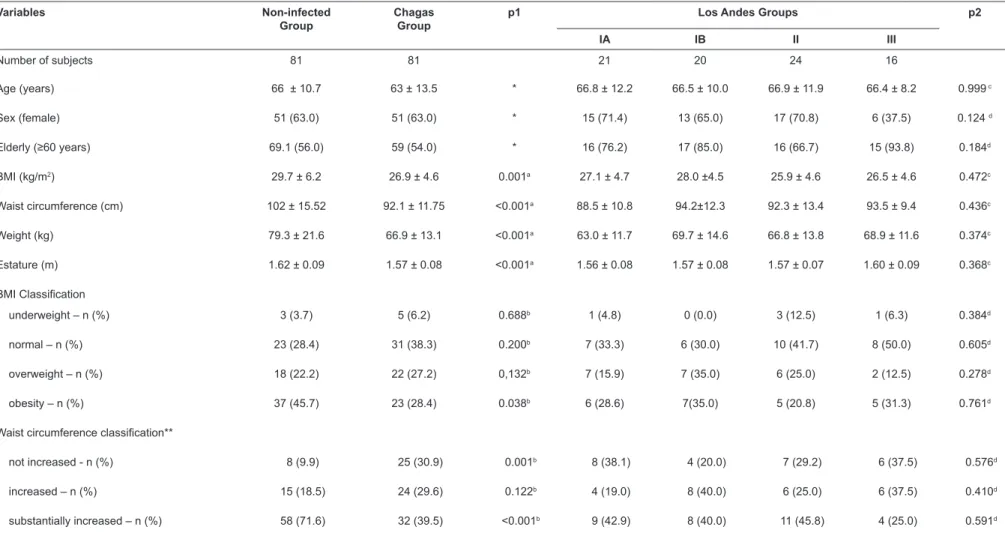
(with an etiological diagnosis of Cd) and non-infected (controls) from the HUCFF Cardiology Service agreed to participate in the study Table 1 presents the general characteristics of individuals. The mean age was 67 ± 10 years (range, 38 to 89 years), 63.0% of participants were female and 73.6% were elderly. There was a low prevalence of hypertension (24.7%), dyslipidemia (7.4%), diabetes (6.2%), and stroke (12.3%) as documented in medical records. Most of the participants were overweight in both groups, but the prevalence of obesity was
lower in Cd group (p= 0.038). Waist circumference showed
different distribution between Cd and non-infected groups. The substantially increased risk for diseases was lower in Cd group
(p<0.001) (Table 1). There was no difference between the Los
Andes groups in the general characteristics, BMI classiication, and waist circumference classiication.
The mean educational level in Cd group was 3.4 (± 3.2)
years and family’s income level was low (<2 salary/months).
Most of the Cd patients migrated from Bahia in 24.5% of cases, followed by 22.5%, 14.3%, and 12.0% from Minas Gerais, Paraíba, and Pernambuco, respectively. All the patients had nutrition counselling.
The estimated energy intake was lower in Cd group (BHEI-R average score; 80.8±5.3 points) compared to the non-infected
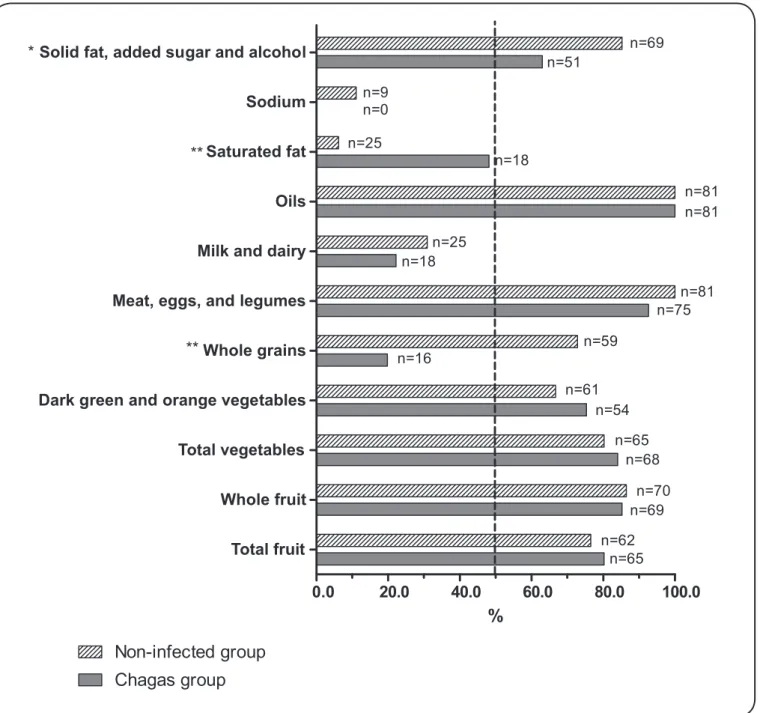
group (82.1±6.1 points) (p=0.154) (Table 2). Regarding BHEI-R components, Cd group showed a higher consumption of vegetables and sodium, and lower consumption of cereals, milk and dairy products, meat and saturated fats than the non-infected group. The Los Andes groups’ analysis showed lower intake of whole fruit by patients at an advanced stage with HF compared to the groups with early cardiac involvement. Less than 50% of the groups presented with adequate intake of milk and dairy, saturated fat, and sodium, see Figure 1.
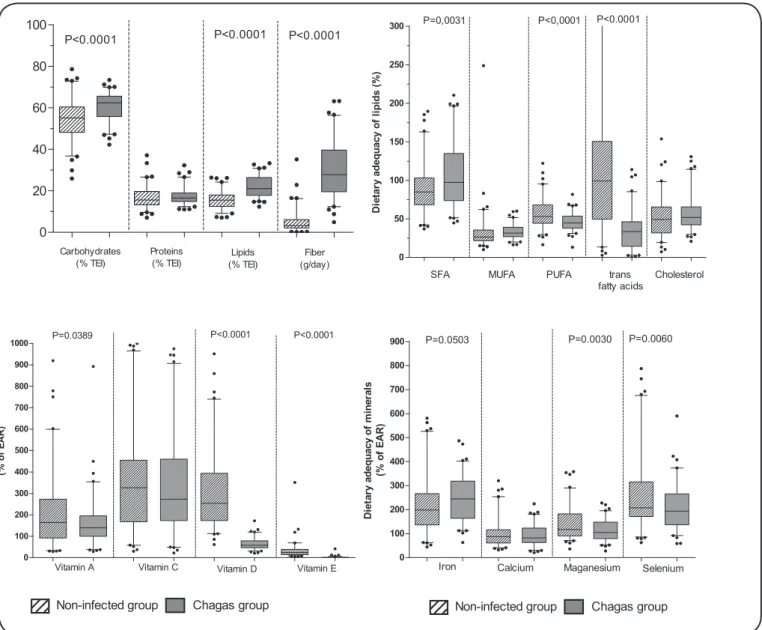
The intake of carbohydrates, lipids, and ibers were higher in the Cd group compared to the non-infected group (p<0.001)
(Figure 2). It is noteworthy that there was a lower intake of trans
fatty acids by the Cd group (p<0.0001) and low intake of MUFA
and PUFA. There was a greater variation in the distribution of the dietary variables in the non-infected group. The dietary intake of vitamins showed lower intake of vitamins A, D, E, magnesium, and selenium in the Cd group. Although, vitamin E intake was less than the recommendation in both groups, values were even lower in the Cd group. A greater variation in the distribution of vitamins and minerals variables was evident in the non-infected group (Figure 2).
Table 3 shows the intake of macronutrients, dietary iber, vitamins, and minerals according to Los Andes groups. There
was a decrease in the dietary iber intake of Los Andes groups
II and III compared to IA and IB groups.
DISCUSSION
The present work evaluated the diet quality of Cd and non-infected groups by BHEI-R, as well as the intake of
macronutrients, dietary iber, and adequacy of micronutrients.
It is the irst to date to evaluate food intake of patients with Cd,
using a method that measures not only the energy and nutrients
intake but also the quality of diet. The food intake proile of
patients with Cd was different from non-infected patients. The Cd group showed a lower intake of energy, vitamins A, D, and E, magnesium, and selenium, lower BHEI-R score for total grain, milk, meats and sodium, and a higher BHEI-R score for saturated fat. Los Andes group III presented a lower intake of
whole fruit and dietary iber. Another important inding of this
study was the high prevalence of overweight and abdominal fat in both groups, although Cd group showed a lower prevalence of obesity and increased risk of disease for type 2 diabetes, hypertension, and CVD according to waist circumference
classiication.
We observed the cohort effect when considering the mean age of patients. Similarly, Viotti et al26 found Cd patients to be around 66 years, similar to our study. In studies carried out in the 1960s and 1970s27-29 the mean age of patients with Cd
was ≤25 years. The progressive increase in the mean age of
patients over the years is referred to as the cohort effect30.In
turn, studies from the 1990s tend to include adults ≥40 years
and older (adult-elderly). Knowledge of the natural history of Cd anticipates impairment of organs with increasing age, due to the slowly progressing nature of Cd. However, in this study and in other urban series26,31, progression may already have occurred in study participants by virtue of their age and may explain the fewer co-morbidities reported by medical records in the Cd group.
The digestive form of Cd occurs in about 10-15% of chronically infected patients. Contemporary natural history information is scarce in relation to the digestive form. The HUCFF at Federal University of Rio de Janeiro/Brazil is a reference center dedicated to treatment and research of esophagopathy and colopathy in Cd, hence, a high esophagus and colon diseases are expected. The Cd and the cohort at HUCFF include patients with early involvement of the esophagus/colon according to Cabral et al.32 However, this study was limited in that it was not possible to evaluate esophagus/colon disease in all patients in this study, because the most accurate diagnostic test uses the application of radioisotope and is not performed routinely. Digestive disease can affect the BMI and patients with digestive form of Cd receive nutritional counselling that can affect their diet quality.
This study showed that Cd patients had increased risk of disease considering the high BMI and high waist circumference.
Similar indings were shown by Geraix33 in 66 adult patients with positive serology for Cd, showing a high frequency of obesity (62%), as measured by BMI and increased risk of metabolic disease (55%), assessed by waist circumference. It is important to note that the cardiac form is the most severe and frequent manifestation of chronic Cd34, and the presence
of obesity signiicantly increases morbidity and mortality from
other diseases, such as hypertension, dyslipidemia, coronary artery disease, diseases biliary tract, osteoarticular diseases, type 2 diabetes mellitus, and some cancers29,34,35. Also, it is
798
Variables Non-infected
Group
Chagas Group
p1 Los Andes Groups p2
IA IB II III
Number of subjects 81 81 21 20 24 16
Age (years) 66 ± 10.7 63 ± 13.5 * 66.8 ± 12.2 66.5 ± 10.0 66.9 ± 11.9 66.4 ± 8.2 0.999 c
Sex (female) 51 (63.0) 51 (63.0) * 15 (71.4) 13 (65.0) 17 (70.8) 6 (37.5) 0.124 d
Elderly (≥60 years) 69.1 (56.0) 59 (54.0) * 16 (76.2) 17 (85.0) 16 (66.7) 15 (93.8) 0.184d
BMI (kg/m2) 29.7 ± 6.2 26.9 ± 4.6 0.001a 27.1 ± 4.7 28.0 ±4.5 25.9 ± 4.6 26.5 ± 4.6 0.472c
Waist circumference (cm) 102 ± 15.52 92.1 ± 11.75 <0.001a 88.5 ± 10.8 94.2±12.3 92.3 ± 13.4 93.5 ± 9.4 0.436c
Weight (kg) 79.3 ± 21.6 66.9 ± 13.1 <0.001a 63.0 ± 11.7 69.7 ± 14.6 66.8 ± 13.8 68.9 ± 11.6 0.374c
Estature (m) 1.62 ± 0.09 1.57 ± 0.08 <0.001a 1.56 ± 0.08 1.57 ± 0.08 1.57 ± 0.07 1.60 ± 0.09 0.368c
BMI Classiication
underweight – n (%) 3 (3.7) 5 (6.2) 0.688b 1 (4.8) 0 (0.0) 3 (12.5) 1 (6.3) 0.384d
normal – n (%) 23 (28.4) 31 (38.3) 0.200b 7 (33.3) 6 (30.0) 10 (41.7) 8 (50.0) 0.605d
overweight – n (%) 18 (22.2) 22 (27.2) 0,132b 7 (15.9) 7 (35.0) 6 (25.0) 2 (12.5) 0.278d
obesity – n (%) 37 (45.7) 23 (28.4) 0.038b 6 (28.6) 7(35.0) 5 (20.8) 5 (31.3) 0.761d
Waist circumference classiication**
not increased - n (%) 8 (9.9) 25 (30.9) 0.001b 8 (38.1) 4 (20.0) 7 (29.2) 6 (37.5) 0.576d
increased – n (%) 15 (18.5) 24 (29.6) 0.122b 4 (19.0) 8 (40.0) 6 (25.0) 6 (37.5) 0.410d
substantially increased – n (%) 58 (71.6) 32 (39.5) <0.001b 9 (42.9) 8 (40.0) 11 (45.8) 4 (25.0) 0.591d
IA: normal electrocardiogram and echocardiogram – no heart involvement; IB: early stage of cardiac involvement; II: advanced stage of cardiac involvement without heart failure; III: advanced stage of cardiac involvement with heart failure; BMI: body mass index. *Study matching variables. **The waist circumference cut off points: increased >94cm for men and >80cm for women; substantially increased >102 cm for men and >88cm for women16. p1: p value for comparison between non-infected and Chagas disease (Cd) groups; p2: p value for comparison between Los Andes Groups. a Paired Student t Test
for means comparison of non-infected and Cd groups. b McNemar test for frequency comparison for paired non-infected and Cd groups. c ANOVA test and Bonferroni post-test for comparison Los Andres
groups. d Pearson’s chi-square test for comparison frequencies between Los Andes groups. n (%) or mean ± standard deviation.
TABLE 1: General characteristics, body mass index and waist circumference classiications between non-infected and Chagas disease groups, and Los Andes groups.
de Castilhos MP
et al.
799 Maximum Score Non-infected Group Chagas Group p1
Los Andes Groups
p2
IA IB II III
Number --- 81 81 --- 21 20 24 16
Energy intake (kcal) --- 2,655
(2,322-2,988) 2,142 (1,976-2,308) 0.005 2,160 (1,895-2,425) 2,104 (1,813-2,396) 1,920 (1,557-2,282) 2,499 (2,053-2945) 0.119
BHEI-R 100 82.1
(80.8-83.4) 80.8 (79.6-82) 0.154 81.7 (79.8-83.6) 81.8 (79.6-83.9) 79.6 (76.7-82.6) 80.1 (77.8-82.3) 0.430
Total fruit 5 4.4
(4.2-4.7) 4.7 (4.5-4.8) 0.203 4.9 (4.9-5.0) 4.6 (4.3-4.9) 4.5 (4.0-5.0) 4.6 (4.2-5.1) 0.329
Whole fruit 5 4.6
(4.3-4.8)
4.7
(4.5-4.9) 0.403
4.9a (4.9-5.0)
4.9 a (4.9-5.0) 4.5 (4.1-4.9) 4.2a (3.5-4.9) 0.011
Total vegetables and legumes 5 4.5
(4.2-4.7) 4.8 (4.6-4.9) 0.036 4.9 (4.8-5.0) 4.7 (4.4-5.0) 4.7 (4.4-5.0) 4.7 (4.4-5.1) 0.738
Dark green and orange vegetables and legumes 5 4.2 (3.8-4.5) 4.1 (3.7-4.4) 0.636 4.1 (3.4-4.8) 4.0 (3.3-4.7) 3.9 (3.2-4.6) 4.3 (3.7-5.0) 0.831
Total grain 10 9.5
(9.2-9.8) 7.3 (6.8-7.8) <0.001 7.0 (5.7-8.2) 7.8 (6.9-8.7) 6.8 (5.9-7.7) 7.7 (6.7-8.7) 0.401
Milk 10 7.6
(7.1-8.1) 5.4 (4.7-6.1) <0.001 4.8 (3.3-6.3) 5.8 (4.5-7.2) 6.1 (4.6-7.6) 4.7 (3.0-6.3) 0.416
Meats, eggs and legumes 10 10
(10-10) 9.7 (9.4-9.9) 0.044 9.3 (8.3-10.3) 9.8 (9.4-10.1) 9.7 (9.3-10.1) 9.9 (9.8-10.0) 0.541
Saturated fat 10 3.5
(2.7-4.4) 8.9 (8.5-9.3) <0.001 9.2 (8.4-10.0) 8.9 (8.0-9.7) 8.5 (7.6-9.3) 9.2 (8.3-10.1) 0.542
Sodium 10 4.5
(3.8-5.1) 2.3 (1.9-2.8) <0.001 2.9 (1.7-4.1) 2.0 (1.2-2.7) 2.4 (1.6-3.2) 1.7 (0.9-2.6) 0.286
Solid fat, added sugar and alcohol 20 19.1 (18.5-19.7) 18.7 (18.1-19.3) 0.328 19.3 (18.6-19.9) 18.9 (17.9-19.9) 18.1 (16.6-19.5) 18.5 (16.7-20.3) 0.535
IA: normal electrocardiogram and echocardiogram – no heart involvement; IB: early stage of cardiac involvement; II: advanced stage of cardiac involvement without heart failure; III: advanced stage of cardiac involvement with heart failure; ANOVA: analysis of variance; 95% CI: conidence interval 95%; Mean (95% CI). p1: Paired Student t-test for comparison of means. p2: ANOVA test and Bonferroni
post-test for comparison Los Andres Groups. a Represent the differences between Los Andes IA and IB vs. III for whole fruit (p<0,05).
TABLE 2: Energy intake, Brazilian Healthy Eating Index-Revised total score and component scores between non-infected and Chagas disease groups, and Los Andes groups.
Rev Soc Br
FIGURE 1 - Relative frequency of individuals who achieved the recommended intake in the different components of the BHEI-R. The McNemar test was performed. BHEI-R: Brazilian Healthy Eating Index-Revised. *p <0.001 and **p<0.01.
promotes the secretion of cytokines, leads to the initiation of
pro-inlammatory events, and oxidative stress36. As Cd is an
inlammatory disease, obesity could aggravate the evolution
of the disease. According to some studies, adipocytes are an important target for infection by T. cruzi, functioning as host cell and reservoir in chronic Cd37. The Cd group presented a high prevalence of overweight/obesity, and it could worsen the course of the disease in these patients.
In the Cd group, it was possible to observe a smaller variation of consumption of BHEI-R components, this fact was a constant in the study. Possibly, the lower variation in food
consumption in patients with Cd relected the complications of
these patients, such as dysphagia, leading to the impairment of the quality and amount of food. Other complications arising in these patients are impairment of the gastrointestinal tract, which
affects food motility, and permanent relux of partially digested
food material. According to Torres38 77% of Cd patients in their study reported discomfort during feeding. Possibly, this may explain why the Cd group obtained a better score for the fruit and vegetable groups, and a lower score for the cereals group because of adaptation by patients in their diet, resulting from
dificulty in swallowing food, especially solid foods.
The results showed that the total score of BHEI-R did not differ among the groups. However, when evaluating the food
de Castilhos MP et al. - Diet quality of patients with Chagas disease
0.0 20.0 40.0 60.0 80.0 100.0
Total fruit Whole fruit Total vegetables Dark green and orange vegetables Whole grains Meat, eggs, and legumes Milk and dairy Oils Saturated fat Sodium Solid fat, added sugar and alcohol
Chagas group
Non-infected group
n=69 n=51
n=9 n=0
n=25
n=18
n=81 n=81
n=25 n=18
n=81 n=75
n=59 n=16
n=61 n=54
n=65 n=68
n=70 n=69
n=62 n=65
*
** **
801
0 20 40 60 80 100
Carbohydrates (% TEI)
Proteins (% TEI)
Lipids (% TEI)
Fiber (g/day)
P<0.0001 P<0.0001 P<0.0001
0 100 200 300 400 500 600 700 800 900 1000
Vitamin A Vitamin C Vitamin D Vitamin E P<0.0001 P<0.0001 P=0.0389
(%
o
f
E
A
R
)
0 100 200 300 400 500 600 700 800 900
Iron Calcium Maganesium Selenium
P=0.0503 P=0.0030 P=0.0060
D
ie
ta
ry
a
d
e
q
u
a
c
y
o
f
min
e
ra
ls
(%
o
f
E
A
R
)
Chagas group
Non-infected group Non-infected group Chagas group
0 50 100 150 200 250 300
SFA MUFA PUFA trans
fatty acids
Cholesterol P=0,0031 P<0,0001 P<0.0001
Di
e
ta
ry
a
d
e
q
u
a
c
y
o
f
li
p
id
s
(
%
)
FIGURE 2 - Box plots representing macronutrients and micronutrients intake. The values in the boxes represent the median and interquartile intervals, the whiskers represent the 5th and 95th percentiles, and the outliers are plotted as individual values. Paired Student t test was performed.
components, signiicant differences were observed among the
groups. As there was no study that evaluated dietary intake in
Cd patients, we compared our indings to general studies that
evaluated dietary intake and diet quality by BHEI-R. Since most patients in this study were older, a population-based study of 1,509 elderly39 aimed at assessing quality diet of the elderly according to sociodemographic variables, behaviors related to health and morbidities was considered. Assumpção et al.39 showed similar population characteristics that were found in the present study, a higher proportion of women (57%) and elderly (53.8%) and an average of BHEI-R score 62.4. In the Assumpção’s study, a different method of dietary assessment, using a 24-hour recall, was used, while in this study, FFQ was used. According to the literature, other BHEI scores tend to be overestimated when the FFQ is used40. Also, Cd patients have clinical follow-up of many years, and are likely to have already received nutritional advise. The results of this study indicate
worse scores on cereals, milk and dairy, meats and saturated fat in the Cd group. The consumption of fruits and vegetables in their usual diet can lead to lower cereal intake.
The percentage of macronutrients intake showed that Cd group presented higher lipid consumption in diet, and the
proile of this consumption was high in saturated fat, and lower
in PUFA. Considering a population with low socioeconomic
level, this proile of fat consumption could be related to the
consumption of products rich in saturated fat and at a more affordable price, such as sausages, ultra-processed biscuits, and cakes and lower consumption of foods rich in unsaturated fat, such as oilseeds, vegetable and olive oils which are more expensive. Considering the cardiovascular impairment of these
patients, the lipid proile is a concern for the dietary advise.
The deleterious role of saturated fatty acid intake in glycolipid metabolism is well-established. Metabolic and epidemiological studies41 have shown that saturated fatty acid raises the plasma
concentration of total and low-density lipoprotein cholesterol (LDL-C), compared to PUFA. Margioris42 reviewed the impact
of consumption of saturated fats on inlammatory proile and showed that saturated fats increased inlammatory markers
in the postprandial period, which does not occur with MUFA and PUFA. Fnu Nagajyoth43 analyzed in vitro, the effect of the high-fat diet in the regulation of acute myocarditis caused by T. cruzi, and the effect on lipid metabolism in adipose tissue
Los Andes Groups
p
IA IB II III
Total energy (kcal/day) 2,160
(1,895-2,425) 2,104 (1,813-2,396) 1,920 (1,557-2,282) 2,499 (2,053-2,945) 0.119
Carbohydrate (% TEI) 61.3
(58.9-63.6) 61.3 (58.4-64.3) 60.5 (57.3-63.6 59.1 (54.6-63.6) 0.751
Protein (% TEI) 17.6
(15.8-19.4) 17.1 (15.2-18.9) 16.5 (15.0-18.1) 18.5 (16.2-20.7) 0.472
Lipids (% TEI) 21.0
(19.0-23.0) 21.5 (19.4-23.6) 22.9 (20.4-25.4) 22.3 (19.4-25.1) 0.618
Saturated fatty acid (% TEI) 6.8
(5.3-8.3) 8.0 (6.7-9.3) 8.1 (6.7-9.4) 6.8 (5.6-7.9) 0.288
Monounsaturated fatty acid (% TEI) 6.0
(5.4-6.7) 7.2 (6.2-8.2) 6.7 (5.9-7.5) 6.7 (5.6-7.8) 0.247
Polyunsaturated fatty acid (% TEI) 4.3
(3.8-4.8) 4.8 (4.3-5.3) 4.6 (4.1-5.1) 4.6 (4.1-5.1) 0.587
Trans fatty acid (% TEI) 0.25
(0.18-0.32) 0.33 (0.21-0.45) 0.34 (0.24-0.43) 0.31 (0.17-0.44) 0.601
Cholesterol (mg/day) 268.4
(199.6-337.2) 255.5 (218.6-292.3) 270.1 (191.2-349.0) 273.3 (215.5-331.0) 0.981
Dietary iber (g/day) 34.3a
(27.5-41.2) 26.6b (21.6-31.6) 8.6ª.b (7.2-10.1) 1.4ª.b (1.1-1.7) <0.0001
Vitamin A (% EAR) 183.6
(136.6-230.6) 147.4 (120.0-174.8) 166.6 (97.6-235.5) 136.1 (83.6-188.5) 0.618
Vitamin C (% EAR) 406.3
(296.2-516.4) 303.4 (216.8-390.1) 295.6 (191.6-399.7) 307.9 (190.6-425.1) 0.345
Vitamin D (% EAR) 44.5
(39.3-49.8) 45.3 (37.9-52.8) 39.0 (29.7-48.4) 45.0 (33.4-56.6) 0.621
Vitamin E (% EAR) 4.0
(-2.0-10.1) 2.8 (1.3-4.3) 1.6 (0.14-3.05) 2.2 (-0.10-4.57) 0.740
Calcium (% EAR) 99.93
(81.6-118.2) 100.4 (76.8-123.9) 93.01 (73.1-112.9) 79.19 (62.2-96.2) 0.450
Iron (% EAR) 267,7
(227,2-308,2) 236,5 (195,9-277,2) 239,7 (197,2-282,1) 270,7 (215,1-326,3) 0.551
Magnesium (% EAR) 124,4
(104,0-144,8) 112,1 (93,4-130,9) 105,1 (86,5-123,6) 121,8 (93,3-150,4) 0.476
Selenium (% EAR) 238,5
(198,7-278,2) 197,6 (144,4-250,9) 186,9 (149,9-224,0) 206,8 (164,9-248,7) 0.302
Data are expressed in mean [95% conidence interval (CI 95%)]. IA: normal electrocardiogram and echocardiogram – no heart involvement; IB: early stage of cardiac involvement; II: advanced stage of cardiac involvement without heart failure; III: advanced stage of cardiac involvement with heart failure; TEI: total energy intake; EAR: estimated average requirement. p: ANOVA test and Bonferroni post-test for comparison Los Andres Groups. TABLE 3: Intake of macronutrients, dietary iber, vitamins and minerals according to Los Andes groups.
and heart. They showed that persistence of the inlammatory iniltrate contributes to the chronic pathology in the heart43.
Dietary iber intake was apparently satisfactory in Cd group, but
there was a lower intake in the advanced stage of cardiac involvement. This could be associated with the lower intake of whole fruit.
It is important to point out that parasitic infection and
micronutrient deiciencies coexist in developed countries, and
usually have complex interactions that promote deleterious
803
clinical effects, and which are mutually reinforcing44. Consumption below the EAR for vitamin D, E may be related
to lower consumption of fatty ish and oilseeds by the Cd group.
In 2007, Maçao et al45 carried out a study where patients used antioxidant therapy and showed that this intervention was able to neutralize the progressive oxidative stress associated with the Cd. Pitz46 has shown that low levels of vitamin D are associated with a higher prevalence of myocardial dysfunction and death due to cardiovascular failure and sudden death.
The average consumption of the minerals magnesium, iron, and selenium were adequate. However, when comparing the consumption among the groups, the Cd group presented lower consumption of magnesium and selenium. The fact that this group had lower consumption of grains, milk, and dairy probably explains the lower consumption of these minerals. The low consumption of selenium has been indicated as a contributory factor in some cases of congestive cardiomyopathy and increased cardiovascular complications, including myocardial infarction47. Rivera48
conirmed the hypothesis that cardiomyopathy in Cd is
associated with a decrease of selenium, and this association arose from the result of low concentrations of selenium in cases of more severe Cd. Additionally, calcium intake was below the recommendation in both groups. Observational
studies conirm that the diet rich in potassium, magnesium,
and calcium is associated with lower incidence and mortality due to cardiovascular diseases49 making calcium one of the most important minerals for individuals with cardiovascular complications like Cd patients.
This study had limitations, including the possibility of under- and over-reported energy intake assessed by FFQ that may have under or overestimated the food consumption data
analyzed, but the use of simpler criteria (<500 and >3,500kcal/
day) is still controversial in the literature. The BHEI-R results were already adjusted for energy intake because BHEI-R method attributes the scores considering the servings consumed for 1000 kcal. Andrade et al.50 evaluated the validity of the construct, and observed that BHEI-R was reliable and structurally valid to estimate the quality of the Brazilians’ diet. In addition, the authors point out that an additional advantage in working with an index such as BHEI-R is due to the fact that its calculation is based on energy density (portion/1,000kcal), which attenuates the effect of total energy intake on the index. Another limitation is that FFQ does not address questions about the intake of whole grains, so this component was absent in the analysis. However, the scores of whole grains were attributed to total grains. Despite its limitations, FFQ can estimate the usual food consumption over a period of time, is a recommended method for epidemiological studies, due to its easy applicability and low cost51.
In conclusion, this study showed that the patients with Cd were overweight and the quality of the diet was unsatisfactory, as regards the recommendations of the diet components for age
and sex. The diet appears to be compatible with an inlammatory
diet (high intake of sodium and saturated fat, and low intake of PUFA, vitamins D and E).
Conlict of interest
The authors declare that they have no competing interests.
Financial support
Scholarship of Conselho Nacional de Desenvolvimento Cientíico e
Tecnológico (CNPq).
REFERENCES
1. World Health Organization (WHO). Working to overcome the global impact of neglected tropical diseases. First WHO report on neglected tropical diseases [Internet]. WHO; 2010. 184p Available from: http://apps.who.int/iris/bitstream/10665/44440/1/9789241564090_ eng.pdf
2. Hotez PJ, Molyneux DH, Fenwick A, Ottesen E, Ehrlich Sachs S, Sachs JD. Incorporating a rapid-impact package for neglected tropical diseases with programs for HIV/AIDS, tuberculosis and malaria. PLoS Med. 2006;3(5):e-102.
3. Coura JR. Chagas’ disease: what is known and what’s needed – A background article. Mem Inst Oswaldo Cruz. 2007;102 (Suppl 1):113-22.
4. Andrade JP, Marin-Neto JA, Paola AAV de, Vilas-Boas F, Oliveira GMM, Bacal F, et al. I Latin American guidelines for the diagnosis and treatment of Chagas' heart disease: executive summary. Arq Bras Cardiol. 2011;96(6):434-42.
5. Rassi AJr., Rassi A, Marin-Neto JA. Chagas disease. Lancet. 2010;375:1388-402.
6. Chaimowicz F. A saúde dos idosos brasileiros às vésperas do século XXI: problemas, projeções e alternativas. Rev Saúde Pública. 1997;31:184-200.
7. RochaMO, CorreiaPC, Barros MV, TorresRM, Ribeiro AL, Teixeira MM. Cardiovascular function in elderly patients with chronic chagasic cardiopathy. Rev Soc Bras Med Trop. 2003;36(5):545-50. 8. Oliveira FA, Teixeira VP, Lino RSJr, Vinaud MC, Reis MA.
Macroscopic aspects of chronic Chagas heart disease in aging. Arq Bras Cardiol. 2007;88(4):486-90.
9. Yamada EK, Siqueira KO, Xerez DK, Koch HA, Costa MMB.
A inluência das fases oral e faríngea na dinâmica da deglutição.
Arquivos de Gastroenterologia. 2004;41(1):18-23.
10. Santos C, Cassiani RA, Dantas RO. Avaliação clínica da deglutição na doença de Chagas.Rev. soc. bras. fonoaudiol. 2011;16(2 ):215-20. 11. Jelicks LA, Souza AP, Araújo-jorge TC, Tanowitz HB. Would
selenium supplementation aid in therapy for Chagas Disease? Trends in Parasitology. 2011;27(3):102-5.
12. Capík I. Periodontal health vs. various preventive means in toy dog breeds. Acta Veterinária Brunensis, Košice. 2010;79(4):637-45. 13. Moynihan P, Petersen PE. Diet, nutrition and the prevention of
dental diseases. Public Health Nutricion. 2006;7(1A):201-26.
14. Brunetto MA, Gomes MOS, Jeremias JT, Oliveira LD, Carcioi AC.
Imunonutrição: o papel da dieta no restabelecimento das defesas naturais. Acta Scientiae Veterinariae. 2007;35(2):230S-32.
15. BRASIL. Ministério da Saúde. Orientações para coleta e análise de dados antropométricos em serviços de saúde: norma técnica do
sistema de Vigilância Alimentar e Nutricional - SISVAN. Brasília:
Ministério da Saúde, 2011. (Série G. Estatística e Informação em Saúde).
16. World Health Organization. Waist circumference and waist-hip ratio: report of a WHO expert consultation. Geneve:
WHO. 2008. Available from: http://apps.who.int/iris/ bitstream/10665/44583/1/9789241501491_eng.pdf
17. World Health Organization. Obesity: preventing and managing the global epidemic: report of a WHO Consultation. Geneve: WHO. 2000.
18. Organização Pan-Americana. XXXVI Reunión del Comitê Asesor
de investigaciones em Salud – Encuestra Multicêntrica – Salud
Beinestar y Envejecimeiento (SABE) em América Latina e el Caribe – Informe preliminar. OPAS. 2002.
19. Sichieri R, Everhart J E. Validity of a Brazilian Food Frequency Questionnaire against dietary recalls and estimated energy intake. Nutrition Research, 1998;18(10):16494-59.
20. Zabotto CB, Vianna RPT, Gil MF. Registro fotográico para inquéritos
dietéticos: utensílios e porções. Rio de Janeiro/ Goiânia; 1996.1-74.
21. Previdelli AN, Andrade SC, Pires MM, Ferreira SRG, Fisberg RM, Marchioni DM. Índice de qualidade da dieta revisado para população brasileira. Rev Saúde Pública. 2011;45(4):794-8.
22. Instituto Brasileiro de Geograia e Estatística (IBGE). Pesquisa
de Orçamentos Familiares 2008/2009: Tabelas de Composição Nutricional dos Alimentos Consumidos no Brasil. Rio de Janeiro: IBGE; 2011.
23. United States Departament of Agriculture, Agricultural Research Service (USDA). Department of Agriculture, Agricultural Research Service. USDA Nutrient Database for Standard Reference, 2011. 24. Food and Nutrition Board, Institute of Medicine, National
Academies of Sciences. Dietary Reference Intakes: EAR, RDA, AI, Acceptable Macronutrient Distribution Ranges, and UL [internet]. Washington, DC: National Academy of Sciences; 2017. [updated 2017 Jan 28; cited 2017 Dec 14].Available from: http:// www.nationalacademies.org/hmd/~/media/Files/Activity%20Files/
Nutrition/DRI-Tables/5Summary%20TableTables%2014.pdf?la=en
25. Bern C, Montgomery SP, Herwaldt BL, Rassi Jr A, Marin-Neto JA, Dantas RO, et al. Evaluation and treatment of chagas disease in the United States: a systematic review. JAMA, v. 298, n. 18, p. 2171-2181, 2007.
26. Viotti R, Vigliano C, Armenti H, Segura E. Treatment of chronic Chagas’ disease with benznidazole: Clinical and serologic evolution of patients with long-term follow-up. Am Heart J. 1994;127(1):151-62. 27. Puigbó JJ, Rhode JR, Barrios H, Yepez C. Cuatro años de estudio
longitudinal de una comunidad rural com endemicidad chagasica.
Boletín de la Oicina Sanitaria Panamericana. 1969;66:112-20.
28. Moleiro F, Pifano F, Anselmi A, Ruesta V. La dinámica epidemiológica de La enfermedad de Chagas em el Valle de los Naranjos, Estado Carabobo, Venezuela: II, La infección chagásica em La población rural del área. Arch Venez Med Trop Parasit Méd. 1973;5:31-45.
29. Macedo VO. Inluência da exposição à reinfecção na evolução da
doença de Chagas. Rev Patol Trop. 1976;5:33-116.
30. Dias JCP. Doença de Chagas: sucessos e desaios. Cad. Saúde
Pública. 2006;22(10):2020-21.
31. Rassi AJr, Rassi A, Little WC, Xavier SS, Rassi SG, Rassi AG, et al. Development and validation of a risk score for predicting death in Chagas' heart disease. N Engl J Med. 2006;355(8):799-808.
32. Cabral DMG, Abrahão Júnior LJ, Marques CHD, Pereira BB, Pedrosa RC. Oropharingeal dysphagia in patients with chronic
Chagas disease: phonoaudiological, videoluoroscopic, and
manometric evaluations. Acta Fisiatr. 2015;22(1):24-29.
33. Geraix J, Ardisson LP, Marcondes-Machado J, Pereira PCM.
Clinical and nutritional proile of individuals with Chagas disease.
BJID. 2007;11(4):411-14.
34. Organización Mundial de la Salud. Reporte del grupo de trabajo
cietiico sobre la enfermedad de Chagas [Internet]. Buenos Aires:
Organización Mundial de la Salud; 2005. 104p. [Actualizado en julio de 2007, cited 2016 Jul 28]. Available in: http://apps.who.int/ iris/bitstream/10665/69724/1/TDR_SWG_09_spa.pdf
35. Bouchard C. Atividade física e obesidade. São Paulo: Manole, 2003. 36. Murano I, Barbatelli G, Parisani V, Latini C, Muzzonigro G,
Castellucci M, et al. Dead adipocytes, detected as crown-like structures, are prevalent in visceral fat depots of genetically obese mice. Journal of lipid research. 2008;49:1562-68.
37. Combs TP, Nagajyothi, Mukherjee S, Almeida CJG, Jelicks LA, Schubert W, et al. The Adipocyte as an Important Target Cell for
Trypanosoma cruzi Infection. J Biol Chem. 2005;280(25):24085-94. 38. Torres, Ana Catarina Moura. Nutrição e deglutição no paciente com
megaesôfago chagásico. Dissertação (Mestrado) – Universidade Federal da Bahia. Escola de Nutrição, 2011. Disponível em: https://repositorio. uf ba.br/ri/bitstream/ri/11540/1/Disserta%C3%A7%C3%A3o_ Nut_%20Ana%20Catarina%20%20Torres.pdf.
39. Assumpcao D, Domene SMA, Fisberg RM, Barros MBA. Qualidade da dieta e fatores associados entre idosos: estudo de base populacional em Campinas, São Paulo, Brasil. Cad. Saúde Pública. 2014;30(8):1680-94
40. Huybrechts I, Vereecken C, Bacquer DD, Vandevijvere S, Oyen HV, Maes L, et al. Reproducibility and validity of a diet quality index for children assessed using a FFQ. Br J Nutr. 2010;104(1):135-44. 41. Nicolosi RJ, Stucchi AF, Kowala MC, Hennessy LK, Hegsted DM,
Schaeffer E. Effect of dietary fat saturation and cholesterol on LDL composition and metabolism. Arteri-osclerosis. 1990;10(1):119-28
42. Margioris NA. Fatty acids and postprandial inlammation. Curr
Opin Nutr Metab Care. 2009;12(2):129-37.
43. Nagajyothi F, Weiss LM, Silver DL, Desruisseaux MS, Scherer PE, Herz J, et al. Trypanosoma cruzi utilizes the host low density lipoprotein receptor in invasion. PLoS Negl Trop Dis. 2011;5(2):e-953. 44. Rivera M, Souza A, Araujo-Jorge, T., et al. (2005). Trace Elements,
Innate Immune Response and Parasites. Clinical Chemistry and Laboratory Medicine, 41(8), pp. 1020-1025.
45. Maçao LB, Wilhelm Filho, Pedrosa RC, Pereira A, Backes P, Torres MA, Fröde TS. Antioxidant therapy attenuates oxidative stress in chronic cardiopathy associated with Chagas' disease. Int J Cardiol. 2007;123(1):43-9.
46. Pitz S, März W, Wellnitz B, Seelhorst U, Fahrleitner Pammer A.
Association of vitamin D deiciency with heart failure and sudden
cardiac death in a large cross-sectional study of patients referred for coronary angiography. J Clin Endocrinol Metab. 2008;93(10):3927-35. 47. Nève J. Selenium as a risk factor for cardiovascular diseases. J
Cardiovasc Risk. 1996;3:42-47.
48. Rivera MT, Souza AP, Moreno AH, Xavier SS, Gomes JA, Rocha MO, et al. Progressive Chagas’ Cardiomyopathy is associated with low selenium levels. Am J Trop Med Hyg. 2002;66(6):706-12. 49. He K, Liu K, Daviglus ML, Morris SJ, Loria CM, Van Horn L, et
al. Magnesium intake and incidence of metabolic syndrome among young adults. Circulatian. 2006;113(13):1675-82.
50. Andrade SC, Previdelli AN, Marchioni DML, Fisberg RM.
Avaliação da coniabilidade e validade do Índice de Qualidade da
Dieta Revisado. Rev Saúde Pública. 2013;47(4):675-83.
51. Ribeiro AC, Sávio KEO, Rodrigues MLCF, Costa THM, Schmitz
BAS. Validação de um questionário de freqüência de consumo
alimentar para população adulta. Rev Nutr. 2006;19(5):553-62.