Nanoleakage Evaluation of Resin Luting Systems to Dental
Enamel and Leucite-Reinforced Ceramic
LU´ CIA TRAZZI PRIETO,1EDUARDO JOSE´ SOUZA-JU´NIOR,2CI´NTIA TEREZA PIMENTA ARAU´ JO,1,4
ADRIANO FONSECA LIMA,1CARLOS TADEU DIAS,3ANDLUI´S ALEXANDRE MAFFEI SARTINI PAULILLO1*
1Department of Restorative Dentistry, Piracicaba Dental School, State University of Campinas, SP-Brazil, Avenida Limeira, 901, Areia˜o, 13414-903, Piracicaba, SP, Brazil
2Department of Restorative Dentistry, Dental Materials Division, Piracicaba Dental School, State University of Campinas, SP-Brazil Avenida Limeira, 901, Areia˜o, 13414-903, Piracicaba, SP, Brazil
3Department of Statistical Mathematics, Luiz de Queiroz Higher School of Agriculture of the University of Sa˜o Paulo (Esalq/USP), Avenida Pa´dua Dias, 11—Piracicaba, SP, Brazi
4Department of Dentistry, Faculty of Sciences of Health, Federal University of Jequitinhonha and Mucuri Valley -UFVJM, Diamantina, Minas Gerais, Brazil
KEY WORDS ceramic; adhesive system; enamel; nanoleakage; resin cement
ABSTRACT Purpose: The aim of this study was to evaluate the nanoleakage patterns between dental enamel and reinforced leucite ceramic, bonded with resin luting systems and a flowable composite resin.Materials and Methods:Twelve crowns of bovine incisors were randomly divided into four groups (n53) according to the luting procedure: Excite/Variolink II, Clearfil SE Bond/ Panavia F, Scotchbond Multi-Purpose Plus/RelyX ARC, and Single Bond 2/Filtek Z350 Flow. To evaluate the nanoleakage patterns, IPS Empress Esthetic disks (5 mm Ø and 1.2-mm thick) were bonded to enamel, and, after 24 h, the specimens were immersed in a 50% (w/v) solution of silver nitrate (24 h), fixed, dehydrated, and processed scanning electron microscopy (SEM).Results:None nanoleakage on interface of the groups that Single Bond 2 followed by the flowable composite were used. The highest percentage of nanoleakage was shown by the Excite/Variolink II protocol. Also, in all conditions tested, none silver nitrate uptake was observed between the leucite-reinforced ce-ramic and the resin luting cement. Conclusions: The use of a two-step etch-and-rinse adhesive with flowable composite was able to promote an adequate seal of the bond interface at the enamel. Moreover, the conventional dual-cured resin cements associated with simplified and dual-cured adhesives tested are also indicated to bond thin ceramics to enamel, since all presented low silver nitrate uptake.Microsc. Res. Tech. 00:000–000, 2011. VVC2011 Wiley Periodicals, Inc.
INTRODUCTION
With the development of the adhesive dentistry, resin luting strategies have been widely used to bond indirect restorations to tooth structures. In this way, the dual-cured resin system aims to improve the poly-merization through the indirect restorations, since the light attenuation caused by the ceramic can jeopardize the degree of conversion of the luting materials. How-ever, the dual resin cements may have the original color changed, due to oxidation of the amine compo-nent. This fact can compromise the final esthetic appearance of the restoration, especially in cases of thin ceramic veneers (Karaagaclioglu and Yilmaz, 2008). To avoid this, some authors have suggested lut-ing thin ceramic veneers with flowable resin compo-sites (Moon et al., 2002). Flowable compocompo-sites are light-cured materials, with a lower amount of amine coini-tiators, which may not affect the final esthetic appear-ance of the ceramic restoration over time.
The resinous luting approach traditionally requires the use of adhesive agents, which can be either total-etching or self-total-etching systems. The bond systems pre-senting a hydrophobic resin layer, such as the three-step etch-and-rinse and two-step self-etch, can decrease the adhesive film permeability, favoring bond stability over time (Carrilho et al., 2009; Reis et al.,
2008) Also, solvated bonding systems can compromise the quality of the hybrid layers, due to the inferior polymer matrix formed, decreasing the bonding per-formance to dental substrate (Carrilho et al., 2009; Tay et al., 2003).
To evaluate the sealing ability of restoration by adhe-sive material and the quality of the polymer formed, nanoleakage is an important indicator (Sano et al., 1995). Based mainly on this technique, many studies evaluating nanoleakage patterns for several bonding systems (and their influence on bonding parameters) have been performed (Makishi et al., 2010; Reis et al., 2007, 2010). Silver nitrate has been accepted as a suit-able method for measuring interfacial leakage (Mala-carne-Zanon et al., 2010; Reis et al., 2007; Sano et al., 1995) due to the size of the silver ion dyes (0.059-nm di-ameter) compared to the size of a typical bacterium (0.5–1.0 nm). The small size of particles and the high, binding tightly to any exposed collagen fibrils not
*Correspondence to: Prof. Dr. Luı´s Alexandre Maffei Sartini Paulillo, Depart-ment of Restorative Dentistry, Piracicaba School of Dentistry, State University of Campinas—UNICAMP, Av: Limeira—Areia˜o. CEP: 13414-903, Piracicaba, SP, Brazil. E-mail: [email protected]
Received 29 May 2011; accepted in revised form 26 September 2011 DOI 10.1002/jemt.21110
enveloped by the adhesive resin, makes silver nitrate the most appropriate agent to detect the nanoporosities within the hybrid layer (Carrilho et al., 2007).
As there is no ideal material to bond indirect restora-tions to enamel, appropriate selection of these resin luting systems, according to the different clinical situa-tions, is required. Thus, the aim of this study was to evaluate the nanoleakage patterns of resin luting sys-tems, bonded to dental enamel and leucite-reinforced ceramic. The hypothesis tested was that the flowable composite would provide an effective seal for veneer ce-ramic cementation compared to the dual-cured resin cements.
MATERIALS AND METHODS Specimen Preparation
Twelve bovine incisors were selected, cleaned, and stored in 0.01% thymol solution at 378C for 2 weeks. The root was sectioned using a low-speed, double-faced diamond saw (Isomet 1000, Buehler, Lake Bluff, IL). The buccal surface was ground flat with 400-, 600-, and 1,200-grit aluminum oxide papers (Carborundum, Saint-Gobain Abrasives, Guarulhos, SP, Brazil), under constant water-cooling. Next, the specimens were ran-domly distributed in experimental groups according to the luting procedures (adhesive systems/resin cement): G1—Excite /Variolink II (EX/VR—Ivoclar-Vivadent, Schaan, Lietschestein); G2—Clearfil SE Bond/Panavia
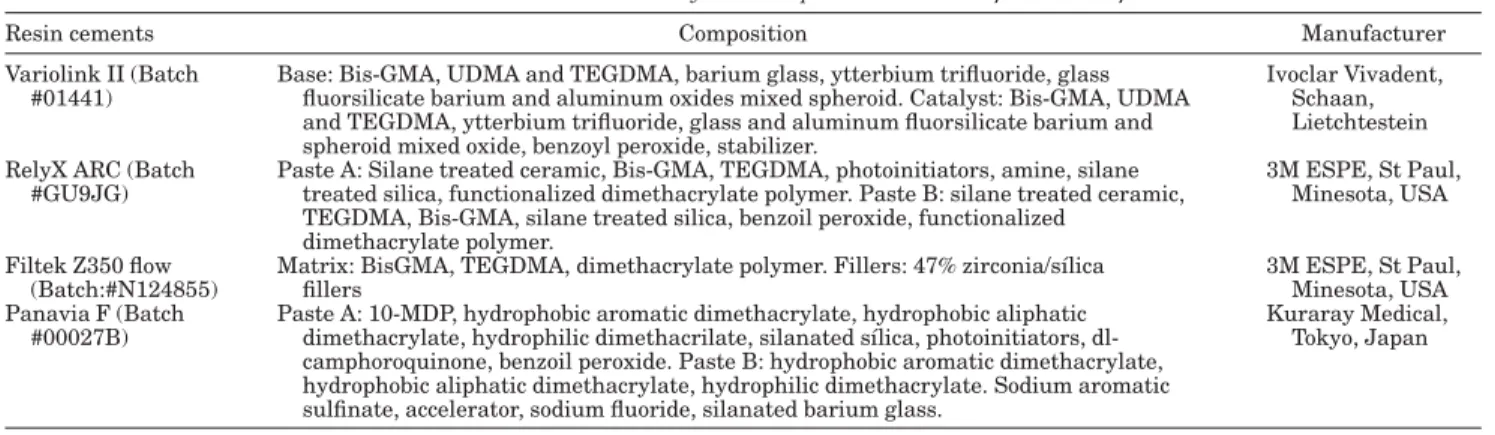
F (CSE/PN—Kuraray, Tokyo, Japan); G3—Adper Scotchbond Multi-Purpose Plus/RelyX ARC (SBMP/ RX—3M/ESPE, St Paul, MN); G4—Adper Single Bond 2/Filtek Z350 Flow (SB/FL—3M/ESPE). The composi-tion of the resin cements and adhesive systems are listed in Tables 1 and 2. The adhesive systems and resin cements were applied following manufacturer’s instructions, and are described in Table 3.
Ceramic disks (5-mm diameter, 0.6-mm-thick leu-cite-reinforced ceramic, and 0.6-mm-thick feldspar ce-ramic, totaling a ceramic specimen 1.2-mm thick) were etched for 60 s using a 10% hydrofluoridric acid (Dentsply Caulk, Midford, DE), followed by silane (Monobond S, Ivoclar Vivadent, Schaan, Lietschestein) application for 60 s. The specimens were bonded to enamel surface, according to the manufacturer’s instructions.
Nanoleakage Evaluation
After 24 h of the luting procedure, specimens were longitudinally sectioned using a diamond saw. Next, each specimen was immersed in a 50% ammoniac sil-ver nitrate solution for 24 h in the dark at 378C (Tay et al., 2002). Afterward, the specimens were thor-oughly rinsed in distilled water for 2 min and immersed in a photo-developing solution for 8 h (Kodak Developer D--76-Kodak Brasileira Ind. e Com Ltda., Sao Jose dos Campos, SP, Brazil) under fluorescent
TABLE 2. Adhesive systems used in the study with composition and manufacturer’s information
Adhesive systems Composition Manufacturer
ED Primer (Batch #01441) Primer A (Batch #00272A): 2-hydroxyethyl methacrylate (HEMA), MDP,
NM-aminosalicylic acid, diethanol-p-toluidine, water. Primer B (Batch
#00147A): NM-aminosalicylic acid, T-isopropilic benzenic sodium sulfinate,
diethanol-p-toluidine, water
Kuraray Medical, Tokyo, Japan
Excite (Batch #1177) Phosphonic acid acrylate, HEMA, Bis-GMA, methacrylates, silicon dioxide,
ethanol, catalysts and stabilizers
Ivoclar Vivadent, Schaan, Lietchtestein Adper Single Bond 2
(Batch #9XB)
Dimethacrylates, HEMA, Polyalkenoid acid copolymer, 5-nm silane-treated colloidal silica, ethanol, water, photoinitiator
3M ESPE, St Paul, Minesota, USA
Clearfil SE Bond Primer (Batch #00896A): water, MDP, HEMA, camphorquinone, hydrophilic
dimethacrylate. Adhesive (Batch #01320A): MDP, bis-GMA, HEMA,
camphorquinone, hydrophobic dimathacrylate,N,N-diethanolp-toluidine bond,
colloidal silica.
Kuraray Medical Inc., Tokyo, Japan
Adper Scotchbond Multi Purpose (Batch #356B)
Primer:HEMA, water, copolymer of polycarboxilic acid. Adhesive: Bis-GMA, HEMA, polyalkenoic acid copolymer, CQ, EDMAB, DHEPT.
3M ESPE, St Paul, Minesota, USA
TABLE 1. Resin cements used in the study with composition and manufacturer’s information
Resin cements Composition Manufacturer
Variolink II (Batch #01441)
Base: Bis-GMA, UDMA and TEGDMA, barium glass, ytterbium trifluoride, glass fluorsilicate barium and aluminum oxides mixed spheroid. Catalyst: Bis-GMA, UDMA and TEGDMA, ytterbium trifluoride, glass and aluminum fluorsilicate barium and spheroid mixed oxide, benzoyl peroxide, stabilizer.
Ivoclar Vivadent, Schaan, Lietchtestein
RelyX ARC (Batch #GU9JG)
Paste A: Silane treated ceramic, Bis-GMA, TEGDMA, photoinitiators, amine, silane treated silica, functionalized dimethacrylate polymer. Paste B: silane treated ceramic, TEGDMA, Bis-GMA, silane treated silica, benzoil peroxide, functionalized
dimethacrylate polymer.
3M ESPE, St Paul, Minesota, USA
Filtek Z350 flow (Batch:#N124855)
Matrix: BisGMA, TEGDMA, dimethacrylate polymer. Fillers: 47% zirconia/sı´lica fillers
3M ESPE, St Paul, Minesota, USA Panavia F (Batch
#00027B)
Paste A: 10-MDP, hydrophobic aromatic dimethacrylate, hydrophobic aliphatic dimethacrylate, hydrophilic dimethacrilate, silanated sı´lica, photoinitiators, dl-camphoroquinone, benzoil peroxide. Paste B: hydrophobic aromatic dimethacrylate, hydrophobic aliphatic dimethacrylate, hydrophilic dimethacrylate. Sodium aromatic sulfinate, accelerator, sodium fluoride, silanated barium glass.
light, to reduce silver ions to metallic silver grains along bonded interface, adhesive resin, and cement polymeric structure. Then, the stained specimens were embedded in a polystyrene resin, and were
wet-pol-ished sequentially with aluminum oxide papers (600-, 1,200-, and 2,000-grit) and felt disc with diamond paste of decreasing grain (3.1 and 0.25lm) using a
metallo-graphic polisher (PL02, Arotec Equip, SP, Brazil). The specimens were immersed in distilled water and placed in ultrasonic baths (Ultrasone D 1440—Odontobra´s Ind. E Com Med Odont. Ltda., Rio Preto, Brazil) for 10 min, after each step of the polishing procedure.
Next, the specimens were dried with absorbent papers and immersed in a solution of 50% phosphoric acid for 10 s, followed by rinsing in distilled water. For deproteinization, a 10% solution of sodium hypochlo-rite was used for 10 min. After this, the specimens were rinsed and dried at room temperature (2 h) and dehydrated with ethanol at increasing concentrations of 25, 50, 75, 90, and 100%, for 10-min each. The speci-mens were carbon coated (Bal-Tec SCD-050—Sputter-Coater) and analyzed in a scanning electron micro-scope (SEM—JEOL JSM—V 5600 LV, Tokyo, Japan), at 15 kV. The images of silver-infiltrated specimens were taken to calculate the marked area using com-puter software Image Tool 3.0 (University of Texas, Health Science Center at San Antonio, TX). The inter-face length between enamel/adhesive and ceramic/ resin cement was measured, and the percentage of the infiltrated area calculated.
RESULTS Nanoleakage Patterns
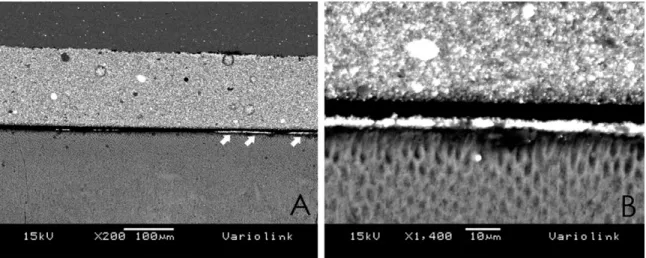
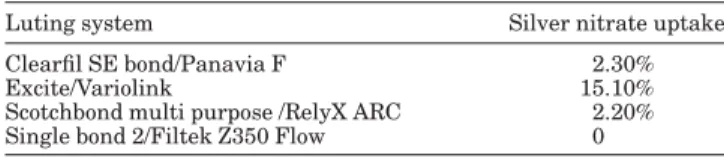
Descriptive analysis of the nanoleakage patterns was performed, as SEM evaluation showed a low per-centage of silver nitrate uptake; in most situations it was 0%, excluding the statistical analysis. After analy-sis of the bonding interface between ceramic and resin cement, none nanoleakage was observed in any speci-mens. Figures 1–4 show the bonded interface with sil-ver nitrate uptake (magnification 3200 and 31,400). Table 4 shows the percent values of nanoleakage at the enamel/adhesive interface. The association of Excite/ Variolink showed higher silver nitrate uptake under the adhesive layer (Fig. 1), followed by Clearfil SE
TABLE 3. Procedures for cementing systems adhesion
Luting systems Procedures for cementing
Adhesive system 1) Acid etching of enamel with 35%
phosphoric acid (15 s) and washing with distilled water for 15 s
Excite 2) Application of the adhesive system on
enamel
Resin cement 3) Mild air stream
Variolink 4) Light curing for 20 s
(Ivoclar-Vivadent) 5) Mix of resin cement pastes (base1
catalyst for 15 s) 6) Light curing for 40 s.
Adhesive system 1) Primer application on enamel surface
(Clearfil SE Bond) for 30 s
Clearfil SE bond 2) Bond application (Clearfil SE Bond) and
light curing for 10 s
ED primer 3) Application of the primer (Clearfil SE
Bond)1Porcelain Bond Activator mix for
1 minute on ceramic surface for 1 min.
Resin cement 4) Mix of ED Primer A e B, and application
on the adhesive layer on enamel
Panavia F 5) Mix of resin cement (20 s)
(Kuraray) 6) Light curing for 40 s
Adhesive system 1) Acid etching with 35% phosphoric acid
(15 s), and washing with distilled water (15 s)
Scotchbond multi-uso Plus
2) Application of Activador Scotchbond and mild air stream (5 s)
Resin cement 3) Application of primer agent and air spray
(5 s)
RelyX ARC 4) Catalyst application in ceramic surface
and enamel
(3M/ESPE) 5) Mix of the resin cement (10 s)
6) Light curing for 40 s.
Adhesive system 1) Acid etching with 35% phosphoric acid
(15 s), and washing with distilled water for 15 s
Single bond 2) Application of two consecutives layer of
adhesive system
Resin Filtek Flow 3) Light curing for 10 s
(3M/ESPE). 4) Application of the flowable resin
5) Light curing for 40 s.
Fig. 1. SEM photomicrography showing nanoleakage for the luting system Excite/Variolink II. (A)
Can be noted as a silver deposition between the enamel and adhesive layer (arrows—3200). (B) Region
Fig. 2. (A) Few points of silver deposition can be observed in the interface of Clearfil SE/Panavia
(arrows—3200). (B) Region with the silver infiltrated points in the adhesive layer (arrows—31,400).
Fig. 3. (A) Interface Scotchbond MP Plus/ RelyX ARC showing silver deposition in few regions
(arrows—3200). (B) The silver infiltrated can be noted in increased magnification (arrows—31,400).
Fig. 4. (A and B) Absence of silver deposition in the interface of flowable resin even in high
Bond/Panavia F and Scotchbond Multi-Purpose Plus/ RelyX ARC, which show few points of silver nitrate penetration in the adhesive layer (Figs. 2 and 3). The flowable composite did not present nanoleakage pat-terns on the bond interface (tooth/adhesive; Fig. 4).
DISCUSSION
The luting systems selected for this study are suita-ble for fixing ceramic with different compositions. How-ever, the dual-cure resin cements can cause color alter-ation, due to the oxidation of the tertiary amine, lead-ing to color change of the prosthetic restorations (especially thin ceramic veneers), compromising the es-thetic appearance (Ghavam et al., 2010). Moreover, some manufacturers of flowable composite resin recom-mend this resin for luting thin indirect restorations. In light of these facts, the objective of the present study was to compare the adhesive/flowable composite resin efficacy, a color-stable material, with different dual-cure luting systems, used for indirect restorations.
When the nanoleakage patterns between the leucite-reinforced ceramic and the resinous cements were eval-uated, no silver-tracing solution was found. This might be explained by the fact that some ceramic surface treatments, such as fluoridric acid etch, silanization, (Fabianelli et al., 2010) and, the application of a hydro-phobic resin layer (Naves et al., 2010) after the silani-zation approach, can guarantee adequate bonding and sealing ability, preventing the infiltration of silver ions inside this interface.
Concerning nanoleakage evaluation, images obtained by SEM shown little or none penetration of silver nitrate at the bonding interfaces between enamel-luting systems, in most of the samples eval-uated. In this sense, the results of this study showed that the hypothesis tested (that the flowable composite resin could promote effective sealing when used for lut-ing ceramic veneers) was validated, as the interface bonding agent/flowable resin presented no silver uptake along the interface with enamel.
It should be observed that the silver nitrate penetra-tion was observed in the interface enamel-bonding agent in nearly all specimens analyzed, but not between the adhesive system and resin cements. This fact demonstrated the reliable compatibility between the systems regardless of the bonding protocol tested.
Although the SB adhesive is more susceptible to water sorption compared to the EX (Malacarne et al., 2006), the first adhesive presented lower silver nitrate uptake. One possible explanation for these results is the amount of solvent content present in the SB. The solvent facilitates the diffusion of the agent into the micromechanical retention on enamel created by the acid etching, promoting better sealing of the interface enamel-adhesive.
The high concentration of hydrophobic monomers (BisGMA and UDMA) in EX, viscous monomers with high molecular weight (Van Landuyt et al., 2007), com-bined with the low concentration of diluents (HEMA) and solvent (ethanol), increase the viscosity of this ad-hesive, which can reduce the diffusion of the adhesive to the microretention, decreasing the quality of adhe-sive interlocking, and, consequently, compromises the sealing ability of the adhesive.
The three-step etch-and-rinse and the two-step self-etch adhesives tested present a high amount of hydro-phobic monomers on the bond agent, which could com-promise sealing as with the EX. However, the primer application improves the bond penetration into the etched surface, which might explain the results obtained for the SBMP and CSE adhesives.
The present study showed that the flowable compos-ite resin associated with a simplified two-step etch-and-rinse bond system promotes better sealing of the ceramic–tooth interface, an important factor for the longevity of tooth veneers. In light of these facts, the use of flowable resins to bond ceramic laminates should be considered, as this material can provide both adequate sealing and color stability.
CONCLUSIONS
The luting agents associated with the adhesive sys-tems showed high quality of the bonding to enamel and few points of silver nitrate infiltration on the adhesive interface. The flowable resin is an alternative to luting thin ceramic veneers to enamel, promoting adequate sealing between ceramic and tooth substrate.
REFERENCES
Carrilho MR, Carvalho RM, de Goes MF, di Hipolito V, Geraldeli S, Tay FR, Pashley DH, Tjaderhane L. 2007. Chlorhexidine preserves dentin bond in vitro. J Dent Res 86:90–94.
Carrilho MR, Tay FR, Donnelly AM, Agee KA, Carvalho RM, Hosaka K, Reis A, Loguercio AD, Pashley DH. 2009. Membrane permeabil-ity properties of dental adhesive films. J Biomed Mater Res B Appl Biomater 88:312–320.
Fabianelli A, Pollington S, Papacchini F, Goracci C, Cantoro A, Fer-rari M, van Noort R. 2010. The effect of different surface treatments on bond strength between leucite reinforced feldspathic ceramic and composite resin. J Dent 38:39–43.
Ghavam M, Amani-Tehran M, Saffarpour M. 2010. Effect of acceler-ated aging on the color and opacity of resin cements. Oper Dent 35:605–609.
Karaagaclioglu L, Yilmaz B. 2008. Influence of cement shade and water storage on the final color of leucite-reinforced ceramics. Oper Dent 33:386–391.
Makishi P, Shimada Y, Sadr A, Wei S, Ichinose S, Tagami J. 2010. Nanoleakage expression and microshear bond strength in the resin cement/dentin interface. J Adhes Dent 12:393–401.
Malacarne J, Carvalho RM, de Goes MF, Svizero N, Pashley DH, Tay FR, Yiu CK, Carrilho MR. 2006. Water sorption/solubility of dental adhesive resins. Dent Mater.
Malacarne-Zanon J, de Andrade ESSM, Wang L, de Goes MF, Martins AL, Narvaes-Romani EO, Anido-Anido A, Carrilho MR. 2010. Per-meability of dental adhesives—A SEM assessment. Eur J Dent 4:429–439.
Moon PC, Tabassian MS, Culbreath TE. 2002. Flow characteristics and film thickness of flowable resin composites. Oper Dent 27:248– 253.
Naves LZ, Soares CJ, Moraes RR, Goncalves LS, Sinhoreti MA, Cor-rer-Sobrinho L. 2010. Surface/interface morphology and bond strength to glass ceramic etched for different periods. Oper Dent 35:420–427.
Reis AF, Giannini M, Pereira PN. 2007. Long-term TEM analysis of the nanoleakage patterns in resin-dentin interfaces produced by different bonding strategies. Dent Mater 23:1164–1172.
TABLE 4. Percentual of silver nitrate uptake at the tested groups
Luting system Silver nitrate uptake
Clearfil SE bond/Panavia F 2.30%
Excite/Variolink 15.10%
Scotchbond multi purpose /RelyX ARC 2.20%
Reis AF, Albuquerque M, Pegoraro M, Mattei G, Bauer JR, Grande RH, Klein-Junior CA, Baumhardt-Neto R, Loguercio AD. 2008. Can the durability of one-step self-etch adhesives be improved by double appli-cation or by an extra layer of hydrophobic resin? J Dent 36:309–315. Reis AF, Carrilho MR, Ghaname E, Pereira PN, Giannini M, Nikaido
T, Tagami J. 2010. Effects of water-storage on the physical and ultramorphological features of adhesives and primer/adhesive mix-tures. Dent Mater J 29:697–705.
Sano H, Takatsu T, Ciucchi B, Horner JA, Matthews WG, Pashley DH. 1995. Nanoleakage: Leakage within the hybrid layer. Oper Dent 20:18–25.
Tay FR, King NM, Chan KM, Pashley DH. 2002. How can nanoleak-age occur in self-etching adhesive systems that demineralize and infiltrate simultaneously? J Adhes Dent 4:255–269.
Tay FR, Pashley DH, Yiu CK, Sanares AM, Wei SH. 2003. Factors contributing to the incompatibility between simplified-step adhe-sives and chemically-cured or dual-cured composites. Part I. Single-step self-etching adhesive. J Adhes Dent 5:27–40.