Reliability of the bRazilian veRsion
of the CambRidge Cognitive
examination Revised CamCog-R
Emylucy Martins Paiva Paradela
1, Claudia de Souza Lopes
2, Roberto Alves Lourenço
1,3abstract – The study’s goal was to evaluate the reliability of the Cambridge Cognitive Examination Revised-Brazilian version (Br-CAMCOG-R), a neuropsychological battery measuring the global cognitive function. It was applied on 123 elders and retested at a mean interval of 30.7 days; 60 were evaluated by two raters at the same time. The intraclass coefficient for the set of items and for the subscales varied from 0.93 to 0.98. In the retests the agreement was nearly perfect for the set of items. There was no expressive range in the stability of the instrument for sex, age, schooling, or for the presence of dementia. The Cronbach’s alpha of the set of items of the test was high (0.89). The Br-CAMCOG-R has obtained a high level of stability with time, agreement among raters, and optimum internal consistency; it can be useful for epidemiological studies and in specialized clinics to evaluate cognitive functions in elders.
KEy wORds: cognition, reliability, reproducibility of results, aged, dementia.
Confiabilidade da versão brasileira do Cambridge Cognitive Examination Revised – CAMCOG-R
Resumo – O objetivo deste estudo foi avaliar a confiabilidade da versão brasileira do Cambridge Cognitive Examination Revised (Br-CAMCOG-R), uma bateria neuropsicológica que mede a função cognitiva global. Ele foi aplicado em 123 idosos e reaplicado no intervalo médio de 30,7 dias; 60 destes idosos foram avaliados por dois aferidores ao mesmo tempo. O coeficiente de correlação intraclasse para o conjunto dos itens do teste assim como das subescalas variou de 0,93 a 0,98. No reteste a concordância foi quase perfeita para o conjunto dos itens. Não houve variação significativa na estabilidade do instrumento entre os sexos, idade, escolaridade ou presença de demência. O alfa de Cronbach para o conjunto dos itens do teste foi alta (0,89). O Br-CAMCOG-R teve altos níveis de estabilidade no tempo, entre os examinadores e ótima consistência interna; pode ser útil em estudos epidemiológicos assim como em clínicas especializadas na avaliação das funções cognitivas dos idosos.
PALAVRAs-CHAVE: cognição, confiabilidade, reprodutibilidade dos testes, idoso, demência.
1Geriatrician, service of Geriatrics, Public outpatient clinic Piquet Carneiro, Rio de Janeiro RJ, Brazil; 2Epidemiologist, Professor of the department of
Epidemiology, social Medicine Institute of Rio de Janeiro state University, Rio de Janeiro RJ, Brazil (UERJ); 3Geriatrician, Professor of the department
of Internal Medicine, Faculty of Medical sciences, UERJ. Received 16 december 2008. Accepted 24 March 2009.
Dr. Emylucy Martins Paiva Paradela – Cuidado Integral à Pessoa Idosa / Policlínica Piquet Carneiro - Rua Marechal Rondon 381 / 2º andar - 20950-000 Rio de Janeiro RJ - Brasil. E-mail: [email protected]
The use of reliable and valid instruments to evaluate cognition of the elderly with memory complaints pro-vides more accurate and reproductive diagnosis, making it possible for the health professional to be able to trace therapeutic goals based on objective results. It also al-lows comparisons between different populations, there-fore helping to standardize procedures in clinical and ep-idemiological studies1. Although there is no standard
neu-ropsychological test for the diagnosis of dementia, exists several instruments used for this purpose.
Neuropsycho-logical batteries of tests are widely used to evaluate sub-jects who tested positive in the screening examinations. The lack of a speciic biological marker for the diagnosis of dementia in the clinical practice ampliies the vitali-ty of this evaluation2. Among the brief
The Cambridge Cognitive Examination-Revised (CAM-COG-R) is the section B of the revised version of the Cam-bridge Examination for Mental disorders of the Elderly (CAMdEX-R) which was developed at Cambridge Univer-sity, in England5.It has incorporated a few screening
instru-ments for cognitive disturbances widely used in epidemi-ological research, such as the Mini-Mental state Exami-nation (MMsE)6, and 8 of the 10 items of the Hodgkinson
Abbreviated Mental Test7. The CAMCOG-R is
subdivid-ed into 8 subscales, namely: orientation (time and place), language (comprehension and expression), memory (inci-dental, remote, recent, and new learning), attention, cal-culation, praxis, perception, and executive functions (ab-stract thinking, ideational luency, and visual reasoning). The instrument is composed of 69 items with a maximum score of 105 points; the higher the total score, the better the performance in the test. The complexity of the in-strument demands training for the raters and the copy-right is reserved by the Cambridge University Press. sever-al reliability and vsever-alidity studies ansever-alysing the irst version of the instrument (CAMCOG) have been published3, 8-10,
the same being true of the revised version (CAMCOG-R)11-15.In Brazil, the only study found by the authors which
validates instruments from this country’s perspective was the one written by Bottino et al.16,who made a translation
and an adaptation into Portuguese of CAMdEX, and stud-ied the reliability of this Brazilian version using 40 elder-ly subjects. The interrater reliability, which was evaluated using the ICC, proved to be high, varying from 0.79 to 0.99 for a pair of psychiatrists who applied the instrument, and from 0.67 to 1.0 for another pair (p<0.001).
The objective of the present study is to evaluate the interrater reliability and test-retest as well as the inter-nal consistency of the Br-CAMCOG-R, as one of the vital steps in the evaluation process of the psychometric prop-erties of this instrument.
method
Design and population
This study took place in a public geriatric outpatient clinic in Rio de Janeiro, Brazil. The source population was composed of 1,200 elders who attended the clinic between May 2nd and december 28th, 2006. A research team examined the records of the subjects who would be treated and selected those who ful-illed the eligibility criteria. On the appointment day, the select-ed subjects were invitselect-ed to participate in the study. In all, 196 subjects agreed to participate, gave their informed consent, and took the Br-CAMCOG-R. The irst 60 subjects tested were also used to assess the interrater reliability of the instrument. On re-test invitation 123 out of 196 subjects returned.
The inclusion criteria were: to be over 60 years of age, to be able to hear and to understand the survey’s objectives, and to have obtained ≥14 points in the MMsE taken in the previous 11
months, since an averagely maintained cognition is required for wider neuropsychological testing. The exclusion criteria were:
delirium, sensorial deiciency causing sight or hearing
impair-ment, motor deiciency or tremor in the dominant hand which impaired tasks such as writing and copying, or any severe illness.
As for the evaluation of the interrater reliability, two rat-ers applied the test and both of them wrote down the answrat-ers separately. The raters were not allowed to discuss their doubts, which were answered later by the coordinator of the survey. The test-retest reliability was evaluated with a mean interval of 30.7 days between the two ratings by the same rater.
Instrument application and the evaluated variables The test application was done by one of the ive trained ex-aminers for the study: an occupational therapist, three psychol-ogists, and a geriatrician. The testing took place in a reserved room, well lit, with little external noise, and with no visible cal-endars or clocks. Each subject submitted to the test sat on a chair at a table used as a surface upon which to write or draw, and in case he or she wore eyeglasses, was asked to wear them.
The patient’s schooling was deined as completed years of school in the formal educational system as informed by the sub-ject (failed school years were not taken into consideration). They were then divided in the following categories: no formal school-ing/illiterate, low schooling (1 to 4 years of schooling), medi-um schooling (5 to 8 years of schooling), and high schooling (≥9 years of schooling).
The age taken into consideration was based on any identi-ication document presented, and it was divided into: 60 to 64, 65 to 74, and ≥75 years old.
All subjects underwent a comprehensive geriatric assess-ment consisting of a functional and a cognitive evaluation, as well as of an interview with an informant. The functional evalua-tion consisted of applying both the evaluaevalua-tion scale of the daily life basic activities17 and of the daily life instrumental activities18, both in the subject as well as in the informant, with divergencies in the information written down and commented by the rater. The cognitive evaluation consisted of applying the MMsE6, the Clock drawing Test19, and the Verbal Fluency Test20 – animal cate-gory.The Brazilian version of the Questionnaire on Cognitive de-cline in the Elderly – IQCOdE21 was applied during the interview with the informant.The diagnosis of dementia was given by the geriatrician who assisted the subject based on dsM-IV criteria. The ICC was used to evaluate reliability, and Cronbach’s al-pha (α) to evaluate the test items’ internal consistency, as well as the items of their subscales separately.
As the “attention” and the “calculation” subscales are very small (each having only two items), they were analyzed togeth-er with a maximum value of 9 points.
by Landis and Kock22 were taken into consideration: nearly perfect (>80), substantial (from 0.61 to 0.80), moderate (from 0.41 to 0.60), regular (from 0.21 to 0.40), weak (from 0.01 to 0.20), and poor (≤0). The data was typed and analyzed using sPss 12.0 for windows.
The study was approved by the Research Ethics Committee of the social Medicine Institute of Rio de Janeiro state Univer-sity, and all participants signed an Informed Consent.
Results
One hundred and twenty-three subjects took part in the test-retest study, while 60 of them participated in the interrater reliability study as well. The internal consisten-cy of the set of items of the test was high: the Cronbach’s alpha was 0.89.
Interrater reliability
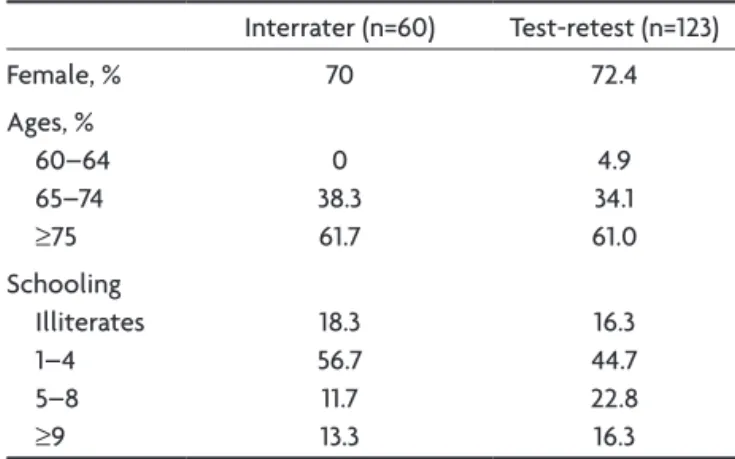
In the interrater reliability study, 70% of the subjects were female; the mean±sd value of schooling was 4.5±3.9 years; mean±sd value of age was 77.2±6.9 years (Table 1). ICC was high for the set of items of the test, as well as for the items of the subscales separately and the MMsE items (≥0.93). As shown in Table 2, the mean±sd value for the total score in the test, as well as for the subscales scores, was similar between the two raters. The ICC for the set of items in the Br-CAMCOG-R was high: 0.93 (0.89–0.95) and the ICC scores for the set of items of the test as well as for the items of the subscales separately and the MMsE items were excellent (>0.92), with narrow reliability intervals.
Test-retest reliability
In the test-retest reliability study, 72.4% of the sub-jects were female; the mean±sd value of schooling was 4.1±4.8 years; the mean±sd value of age was 76.1±7.1 years (Table 1). In the irst testing, the mean time spent was 43±9.4, range 23–90 minutes; the overall mean was
of 68.3±12.9, range 36–96 points. In the retest, the mean time was 40.5±8.9, range 24–90 minutes; the overall mean was 71.8±12.6, range 42–99 points (Table 3).
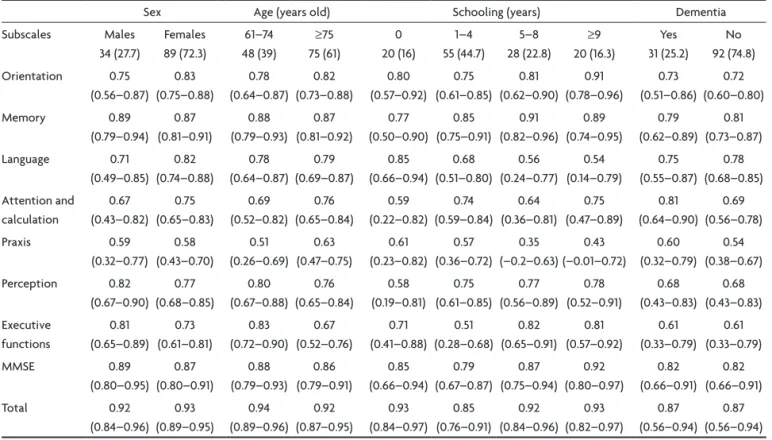
The stability of the instrument with time did not vary between males and females and or with or without de-mentia. However, a small difference was found for sub-jects with low schooling (Table 4).
discreet differences were noticed in the ICC values for the subscale items after sex, age, and schooling strat-iication. According to the dementia diagnosis, the “per-ception” and “executive functions” subscales obtained a higher ICC among the non-cases, while in the “attention and calculation” subscale, the ICC was higher among the cases (Table 4).
The subscale means were similar in the two testings; a discreet difference was noticed in the “executive func-tions” subscale and in the MMsE. The ICC score was ex-cellent for the set of items of the test and for the items
Table 1. Reliability study of the Br-CAMCOG-R: characteristics of subjects.
Interrater (n=60) Test-retest (n=123)
Female, % 70 72.4
Ages, % 60–64 65–74
≥75
0 38.3 61.7
4.9 34.1 61.0 schooling
Illiterates 1–4 5–8
≥9
18.3 56.7 11.7 13.3
16.3 44.7 22.8 16.3 Br-CAMCOG-R: Brazilian version of the Cambridge Cognitive Examina-tion Revised.
Table 2. Interrater reliability study of the Br-CAMCOG-R: mean±SD value and range of the ICC for the set of the items of the test, of
the subscales separately and the MMSE (n=60).
subscales / Total of possible points
Rater 1 Rater 2
ICC (95% CI) Mean±sd (Range) Mean±sd (Range)
Orientation / 10 8.4±1.7 (02–10) 8.5±1.7 (03–10) 0.97 (0.94–0.98)
Memory / 27 14.6±4.8 (03–22) 15.1±4.8 (03–23) 0.97 (0.96–0.98)
Language / 30 23.6±3.1 (16–29) 23.6±3.2 (15–28) 0.96 (0.94–0.98)
Attention and calculation / 09 5.2±2.2 (01–09) 5.3±2.3 (01–09) 0.98 (0.97–0.99)
Praxis / 12 7.8±1.8 (04–12) 8.2±1.8 (04–12) 0.95 (0.92–0.97)
Perception / 09 4.3±1.4 (01–08) 4.5±1.4 (01–08) 0.93 (0.89–0.96)
Executive functions / 28 9.6±3.4 (04–17) 9.9±3.5 (04–17) 0.97 (0.96–0.98)
MMsE / 30 21.9±4.1 (13–29) 22.1±4.1 (14–30) 0.98 (0.96–0.99)
Total / 105 64.7±11.4 (44–90) 65.9±11.7 (44–91) 0.98 (0.97–0.99)
Table 3. Test-retest reliability study of the Br-CAMCOG-R: means±SD value and range of the ICC, and Cronbach’s alpha for the set of items of the test, for the items of their subscales separately and the MMSE (n=123 ).
subscales
Test Retest ICC (95% CI) Cronbach’s alpha
Mean±sd (Range) Mean±sd (Range)
Orientation 8.7±1.6 (02–10) 8.8±1.6 (02–10) 0.80 (0.73–0.86) 0.57
Memory 15.8±4.8 (02–26) 15.8±4.8 (02–26) 0.89 (0.83–0.91) 0.69
Language 22.2±3.5 (12–30) 22.8±3.2 (14–30) 0.79 (0.72–0.85) 0.69
Attention and calculation 5.5±2.2 (01–09) 5.7±2.1 (01–09) 0.74 (0.65–0.81) 0.47
Praxis 8.2±1.7 (04–12) 8.2±1.8 (04–12) 0.59 (0.46–0.69) 0.51
Perception 4.7±1.5 (02–09) 4.9±1.6 (01–09) 0.79 (0.71–0.85) 0.44
Executive functions 10.9±3.9 (03–23) 11.7±4.2 (03–25) 0.75 (0.66–0.82) 0.72
MMsE 22.5±4.2 (13–30) 23.1±4.2 (13–30) 0.87 (0.82–0.91) 0.72
Total 68.3±12.9 (36–96) 71.8±12.6 (42–99) 0.93 (0.89–0.95) 0.89
Br-CAMCOG-R: Brazilian version of the Cambridge Cognitive Examination Revised; sd: standard deviation; ICC: intraclass correlation coeficient; MMsE: Mini-Mental state Examination.
Table 4. Test-retest reliability study of the Br-CAMCOG-R: ICC (95% CI), according to sex, age, schooling, and dementia (n=123).
sex Age (years old) schooling (years) dementia
subscales Males 34 (27.7) Females 89 (72.3) 61–74 48 (39) ≥75 75 (61) 0 20 (16) 1–4 55 (44.7) 5–8 28 (22.8) ≥9 20 (16.3) yes 31 (25.2) No 92 (74.8) Orientation 0.75 (0.56–0.87) 0.83 (0.75–0.88) 0.78 (0.64–0.87) 0.82 (0.73–0.88) 0.80 (0.57–0.92) 0.75 (0.61–0.85) 0.81 (0.62–0.90) 0.91 (0.78–0.96) 0.73 (0.51–0.86) 0.72 (0.60–0.80) Memory 0.89 (0.79–0.94) 0.87 (0.81–0.91) 0.88 (0.79–0.93) 0.87 (0.81–0.92) 0.77 (0.50–0.90) 0.85 (0.75–0.91) 0.91 (0.82–0.96) 0.89 (0.74–0.95) 0.79 (0.62–0.89) 0.81 (0.73–0.87) Language 0.71 (0.49–0.85) 0.82 (0.74–0.88) 0.78 (0.64–0.87) 0.79 (0.69–0.87) 0.85 (0.66–0.94) 0.68 (0.51–0.80) 0.56 (0.24–0.77) 0.54 (0.14–0.79) 0.75 (0.55–0.87) 0.78 (0.68–0.85) Attention and calculation 0.67 (0.43–0.82) 0.75 (0.65–0.83) 0.69 (0.52–0.82) 0.76 (0.65–0.84) 0.59 (0.22–0.82) 0.74 (0.59–0.84) 0.64 (0.36–0.81) 0.75 (0.47–0.89) 0.81 (0.64–0.90) 0.69 (0.56–0.78) Praxis 0.59 (0.32–0.77) 0.58 (0.43–0.70) 0.51 (0.26–0.69) 0.63 (0.47–0.75) 0.61 (0.23–0.82) 0.57 (0.36–0.72) 0.35 (–0.2–0.63) 0.43 (–0.01–0.72) 0.60 (0.32–0.79) 0.54 (0.38–0.67) Perception 0.82 (0.67–0.90) 0.77 (0.68–0.85) 0.80 (0.67–0.88) 0.76 (0.65–0.84) 0.58 (0.19–0.81) 0.75 (0.61–0.85) 0.77 (0.56–0.89) 0.78 (0.52–0.91) 0.68 (0.43–0.83) 0.68 (0.43–0.83) Executive functions 0.81 (0.65–0.89) 0.73 (0.61–0.81) 0.83 (0.72–0.90) 0.67 (0.52–0.76) 0.71 (0.41–0.88) 0.51 (0.28–0.68) 0.82 (0.65–0.91) 0.81 (0.57–0.92) 0.61 (0.33–0.79) 0.61 (0.33–0.79) MMsE 0.89 (0.80–0.95) 0.87 (0.80–0.91) 0.88 (0.79–0.93) 0.86 (0.79–0.91) 0.85 (0.66–0.94) 0.79 (0.67–0.87) 0.87 (0.75–0.94) 0.92 (0.80–0.97) 0.82 (0.66–0.91) 0.82 (0.66–0.91) Total 0.92 (0.84–0.96) 0.93 (0.89–0.95) 0.94 (0.89–0.96) 0.92 (0.87–0.95) 0.93 (0.84–0.97) 0.85 (0.76–0.91) 0.92 (0.84–0.96) 0.93 (0.82–0.97) 0.87 (0.56–0.94) 0.87 (0.56–0.94) Br-CAMCOG-R: Brazilian version of the Cambridge Cognitive Examination Revised; CI: conidence interval; ICC: intraclass correlation coeficient.
of the subscales; it varied from “moderate” (0.59, “prax-is” subscale) up to “nearly perfect” (0.89, “memory” sub-scale). There was no signiicant range in the stability of the instrument in sex, age, schooling, or the presence of dementia. The internal consistency for the set of items in the test was 0.89 (Table 4).
disCussion
different comprehensive evaluation instruments have been developed to assess cognitive dysfunctions in the
ield of neuropsychology, as it is the case with the CAM-COG-R; neuropsychological test batteries are made up of instruments utilized to evaluate several cognitive func-tions. when a subject answers one item correctly, it is ex-pected that he or she would also be able to answer other items related to it correctly as well, because split cogni-tion into cognitive domains is more didactical than ana-tomical, since the brain operates in a network where one area is intimately connected with the other23.
con-struct named cognition, the internal consistency of the instruments used to evaluate it should relect the agree-ment (or not) of each item with the test as a whole.
The high score of Cronbach’s alpha found in this study for the instrument’s set of items suggests that the Br-CAMCOG-R evaluates one same construct. The internal consistency score of the test’s items of the subscales re-lected the differences of the number of items in each one of them; the subscale containing the smallest number of items obtained the lowest alpha score (attention and calculation=0.47), and those with a higher number of items obtained a higher score (memory and language=0.69). Heinik et al.16, who developed the Hebrew version of the
CAMCOG and studied the internal consistency of the ver-sion in 55 subjects in a psychiatric clinic, obtained inter-nal consistency scores varying from 0.32 (calculation sub-scale) to 0.93 (memory subsub-scale); the calculation subscale has only 2 items, and perhaps, for this reason, it obtained the lowest score for internal consistency, due to the fact that it was evaluated separately, differently from our sam-ple, where the items of the calculation subscale were add-ed to the attention subscale.
when evaluating the stability of an instrument, it is fundamental to guarantee that the variability of the re-sults is not signiicantly determined by the range associ-ated to the rater, which can occur due to the precarious standardization while applying it. The high interrater re-liability found in the present study suggests that, despite its complexity and the dependence on the raters’ evalua-tion of some items, the variability associated to the rater did not jeopardize the instrument’s reliability.
The operational dificulties during the interrater reli-ability study, which demanded the presence of two rat-ers in the interview room at the same time, caused the studied sample to be smaller than that of the test-retest. However, it does not seem to us that this fact jeopardized the quality of the results, since similar studies were made with samples containing 40 to 55 subjects8,10.
Another source of variability which may risk the stabil-ity of an instrument is the change of the studied phenom-enon. The high reliability of the test-retest found in the present study suggests that the instrument has an excel-lent level of stability with time, for both the set of items in the test and for the majority of the items in the sub-scales. The data suggest that the studied phenomenon – cognition – was kept stable during the period of time in which it was studied. Tombach et al.24 evaluated the
test-retest reliability of the MMsE at a 90-day interval, and considered that there had not been signiicant changes in the subjects’ cognition during that time.
The praxis subscale demonstrated the smallest stability in time (Table 4). This inding can be partially explained by the fact that the punctuation of the items which constitute the
subscale depends on the raters’ interpretation. It is made up of items which require the copying of drawings and the pro-ducing of a freehand drawing of a clock (without copying). The stability of the total score of the instrument in time was adequate, even after the stratiication by sex, age, schooling, and the presence of dementia; the difference in the ICC scores for the test’s set of items and for most sub-scales was discreet, suggesting the instrument maintains its stability in time even in subjects with cognition im-pairment. These indings corroborate those of Lindeboom et al.9 which evaluated the CAMCOG’s stability in
elder-ly subjects with dementia at a 21-day interval. The stabil-ity of the instrument among those with mild, moderate and severe dementia was 0.97, 0.97, and 0.96, respectively. The overall mean in the retest was discreetly higher than in the test, which showed a possible learning effect, already noticed in similar studies with different cogni-tive instruments25.
A few general methodological aspects deserve com-ments when examining the reliability of a rating process, principally of the interrater type. One aspect has to do with the raters who, aware of the evaluation process in course, tend to proceed more rigorously than in every-day circumstances, which may provide for an overestima-tion of the reliability results. The other aspect is the rat-ers’ tendency to alter their approach with time, in such a way as to improve the way they ask the questions and re-late to the respondents, in case the application of an in-strument takes a long time26.
In the interrater reliability study, the minimum age of the subjects was 65 years; for this reason, it was not possi-ble to test the items of the remote memory subscale sug-gested for subjects who were born after 1940. Other study limitations were that most of the subjects had low school-ing, were under 85 years old, and attended a public health clinic, making the sample a homogeneous one, but not rep-resentative of the Brazilian elderly population as a whole. Ongoing additional criteria validity studies should complete the measurement equivalence of the Brazilian version of the test. However, we suggest reapplying this study in different operational settings to learn about the stability of the instrument in other circumstances. we reach the conclusion that the Br-CAMCOG-R has high lev-els of stability with time, agreement among raters, and very good internal consistency and, as such, it can be use-ful in epidemiological studies and in specialized clinics to evaluate cognitive functions in elders.
RefeRenCes
2. Russel EW, Russel SLK, Hill BD. The fundamental psychomet-ric status of neuropsychological batteries. Arch Clin Neurop-sychol 2005;20:785-794.
3. Huppert FA, Jorm A, Brayme C, et al. Psychometric properties
of the CAMCOG and its eficacy in the diagnosis of dementia.
Ageing Neuropsychol Cognition 1996;3:201-214.
4. Williams JG, Huppert FA, Matthews FE, Nickson J. The MRC Cognitive Function and Ageing Study (MRC CFAS). Perfor-mance and normative values of a concise neuropsychological test (CAMCOG) in an elderly population sample. Int J Geria-tr PsychiaGeria-try 2003;18:631-644.
5. Roth M, Huppert F, Mountjou CQ, Tym E. CAMDEX-R: The Cambridge examination for mental disorders of the elderly. Cambridge University Press, 1998.
6. Folstein MF, Folstein SE, Mc Hugh PR. Mini-mental State: a practical method for grading the cognitive state of patients for the clinician. J Psychiatr Res 1975;12:189-198.
7. Hodkinson M, Qureshi K. Evaluation of a 10 question mental test of the institutionalized elderly. Age Ageing 1974;3:152-157. 8. Roth M, Tym E, Mountjoy CO, Huppert FA, Hendrie H, Ver-ma S, Goddard R. CAMDEX: a standardized instrument for the diagnosis of mental disorders in the elderly with special reference to the early detection of dementia. Br J Psychiatry 1986;149:698-709.
9. Lindeboom J, Horst RT, Hooyer C, Dinkgreve M, Jonker C. Some psychometric properties of the CAMCOG. Psychol Med 1993;23:213-219.
10. Heinik J, Werner P, Mendel A, Raikher B, Bleich A. The Cam-bridge Cognitive Examination (CAMCOG): validation of the Hebrew version in elderly demented patients. Int J Geriatr Psychiatry 1999;14:1006-1013.
11. Verhey FRJ, Huppert FA, Korten ECCM, et al. Cross – Nation-al Comparisons of the Cambridge Cognitive Examination- Re-vised: The CAMCOG-R. Results from the European Harmoni-zation Project for instruments in dementia. Age Ageing 2003; 32:534-540.
12. Athey RJ, Porter RW, Walker RW. Cognitive assessment of a representative community population with Parkinson’s dis-ease (PD) using the Cambridge Cognitive Assessment-Revised (CAMCOG-R). Age Ageing 2005;34:268-273.
13. Athey RJ, Walker RW. Demonstration of cognitive decline in Parkinson’s disease using the Cambridge Cognitive Assess-ment (Revised) (CAMCOG-R). Int J Geriatr Psychiatry 2006; 21:977-982.
14. Lautenschlager NT, Dunn JC, Bonney K, Flicker L, Almeida OP. Latent Semantic Analysis: an improved method to mea-sure cognitive performance in subjects of Non-English-Speak-ing-Background. J Clin Exp Neuropsychol 2006;28:1381-1387. 15. Heinik J, Solomesh I. Validity of the Cambridge Cognitive Ex-amination-Revised new Executive Function Scores in the
di-agnosis of dementia: some early indings. J Geriatr Psychiatry
Neurol 2007;20:22-28.
16. Bottino CMC, Stoppe AJr, Scalco AZ, Ferreira RCR, Hototian
SR, Scalco MZ. Validade e coniabilidade da versão brasileira
do CAMDEX. Arq Neuropsiquiatr 2001;59(Suppl 3):S20.
17. Lino VTS. Adaptação transcultural da Escala de Independên -cia em Atividades da Vida Diária (Escala de Katz). Cad Saúde Pública 2008;24:103-112.
18. Lawton MP, Brody EM. Assessment of older people: self main-taining and instrumental activities of daily living. Gerontolo-gist 1969;9:179-186.
19. Manos PJ, Wu R. The ten point clock test: a quick screen and grading method for cognitive impairment in medical and sur-gical patients. Int J Psychiatry Med 1994;24:229-244. 20. Bertolucci PHF, Okamoto IH, Brucki SMD, Siviero MO,
To-niolo J Neto, Ramos LR. Applicability of the CERAD Neurop-sychological Battery to Brazilian Elderly. Arq Neuropsiquiatr 2001;59:532-536.
21. Sanchez MAS. Questionário baseado no relato do
informan-te para deinforman-tecção de declínio cognitivo em idosos: tradução, adaptação transcultural e estudo da coniabilidade. Disserta
-ção. Rio de Janeiro, 2007.
22. Landis J, Koch G. The measurement of observer agreement for categorical data. Biometrics 1977;33:159-174.
23. Mungas D, Reed BR, Farias ST, Decarli C. Criterion-referenced validity of a neuropsychological test battery: equivalent per-formance in elderly Hispanics and Non-Hispanic whites. J In-tern Neuropsychol Soc 2005;11:620-630.
24. Tombaugh TN Test-retest reliable coefficients and 5-year change scores for the MMSE and 3MS. Arch Clin Neuropsy-chol 2005;20:485-503.
25. De Yebenes MJ, Otero A, Zunzunegui MV, Rodriguez-Laso A, Sanchez-Sanchez F, Del Ser T. Validation of a short cognitive tool for the screening of dementia in elderly people with low educational level. Int J Geriatr Psychiatry 2003;18:925-936.
26. Hasselmann MH, Lopes CS, Reichenheim ME. Coniabilidade das aferições de estudo sobre violência familiar e desnutrição