www.drink-water-eng-sci.net/3/21/2010/
©Author(s) 2010. This work is distributed under the Creative Commons Attribution 3.0 License.
Engineering and Science
Open Access
Online modelling of water distribution systems:
a UK case study
J. Machell, S. R. Mounce, and J. B. Boxall
Pennine Water Group, Department of Civil and Structural Engineering, University of Sheffield, Sheffield, UK
Received: 11 December 2009 – Published in Drink. Water Eng. Sci. Discuss.: 23 December 2009 Revised: 12 March 2010 – Accepted: 24 March 2010 – Published: 30 March 2010
Abstract. Hydraulic simulation models of water distribution networks are routinely used for operational in-vestigations and network design purposes. However, their full potential is often never realised because, in the majority of cases, they have been calibrated with data collected manually from the field during a single historic time period and, as such, reflect the network operational conditions that were prevalent at that time, and they are then applied as part of a reactive, desktop investigation. In order to use a hydraulic model to assist proac-tive distribution network management its element asset information must be up to date and it should be able to access current network information to drive simulations. Historically this advance has been restricted by the high cost of collecting and transferring the necessary field measurements. However, recent innovation and cost reductions associated with data transfer is resulting in collection of data from increasing numbers of sensors in water supply systems, and automatic transfer of the data to point of use. This means engineers potentially have access to a constant stream of current network data that enables a new era of “on-line” modelling that can be used to continually assess standards of service compliance for pressure and reduce the impact of network events, such as mains bursts, on customers. A case study is presented here that shows how an online modelling system can give timely warning of changes from normal network operation, providing capacity to minimise customer impact.
1 Introduction
The day to day operation of a water supply system is man-aged by skilled staff that use their experience and expert judgement to adjust control elements such as pumps and valves to ensure customer demands on the systems are met (regulatory compliance), and to minimise energy costs. As water use tends to follow repeatable patterns the operators understand what is required for normal operation but, when an unplanned event such as a burst main occurs, they often have to respond in a reactive manner, usually with scant in-formation provided by contact from customers already im-pacted by the event. Because water companies are constantly striving to improve standards of service delivery and increase customer satisfaction, there is a need to shift from this reac-tive approach to a more proacreac-tive management strategy. One of the tools that can be used to help accomplish this shift is an online hydraulic network simulation model.
Correspondence to:S. R. Mounce ([email protected])
Hydraulic simulation software is in widespread use within the water industry for strategic supply analysis, design of control strategies, network extensions, and maintenance planning. A number of off the shelf packages are avail-able that allow tailor made simulation models to be con-structed for a water companies specific requirements. Pop-ular packages include EPANET (US Environmental Protec-tion Agency), AQUIS (7T), Infoworks (Wallingford ware), and SynerGEE (Advantica). These simulation soft-ware packages enable the implementation of mathematical models of a water distribution networks that combine the physical laws governing the networks with the equations that relate pressure and flow for each operational element.
The design of distribution networks using these software packages has developed from trial and error to, more re-cently, the use of various forms of optimization, including genetic algorithms (e.g. Dandy et al., 1996). Tools of this type are offline in nature as, although very efficient, the com-putational burden is often large. Real time, near optimal con-trol using hydraulic modelling is still somewhat impractical for large water distribution networks because of the compu-tational burden such optimization imposes, and alternative approaches are being developed. Bhattacharya et al. (2003) proposed an ANN (Artificial Neural Network) with rein-forcement learning which could learn to replicate the optimal control strategy (based on capturing operator experience). Rao and Salomons (2007) developed a GA (Genetic Algo-rithm) and an ANN model for capturing the knowledge base of an EPANET model and consequently producing a near op-timal solution for control settings under dynamic conditions (with 1 h SCADA updates).
For any hydraulic model to be useful to operators it should contain accurate element physical characteristic information and be calibrated, by adjusting the model variable parame-ters until field measurement and model simulation results are in reasonable agreement, so that it accurately reflects the true operational characteristics of the network. This process gen-erally requires a considerable amount of data, for example, around 14 days of measured flow and pressure from the net-work, which has traditionally been collected manually, and manipulation of model variables. Kapelan et al. (2000) re-views calibration models. Koppel and Vassiljev (2008) illus-trate the calibration problem with a case study.
Some preliminary efforts have been made to link hydraulic simulation models with on-line data from telemetry systems for operational purposes (Skipworth et al., 1999; Orr et al., 1999). The idea was to associate a well calibrated network hydraulic model with a SCADA (Supervisory Control and Data Acquisition) system that populated a database with near real time measurements of flow and pressure from strategic points in the network that could be accessed by a simula-tion model. However, data was transmitted via telephone lines and wired modems which frequently could not con-nect to some of the data loggers in the network. The system was slow and suffered data corruption problems. Also,
be-cause every data logger had to be contacted individually via a telephone call to obtain a single, current reading, the time required to gather data from all the loggers was significant thereby introducing data “skew” that could affect simulation results.
This paper describes an online hydraulic simulation model and demonstrates its potential by showing details of a flow event detected in one case study network DMA (Distribution Management Areas). It is shown that a sufficiently accurate on-line model may be used to detect hydraulic events such as bursts and if correctly configured, such a model can also detect illegal hydrant or valve operations, and monitor stan-dards of service levels for pressure.
2 Conventional modelling of distribution networks
A conventional distribution network simulation model is comprised of static asset information including pipe lengths, diameters, connectivity, and network topography; and infor-mation about dynamic parameters, for example, the distribu-tion of demand, and elements such as pumps, reservoirs and valves. Most contemporary modelling packages in current use utilise models that include every main down to the level of, but not including, customer service pipes. Standard daily time-varying demand relationships are estimated for different customer types, and these are summed and allocated at pipe junctions (nodes) according to the distribution of customers. The models are normally used to simulate flows and pres-sures over a fixed (normalised data from a specific date) 24 h period which provides enough information to be suitable for purpose. Since their advent, these complex calibrated models have predominantly been used for leakage management and control, specifically for splitting distribution networks into discrete DMAs, the design of pressure reduction schemes, and the location of substantial leaks during model calibration exercises.
3 On-line modelling of distribution networks
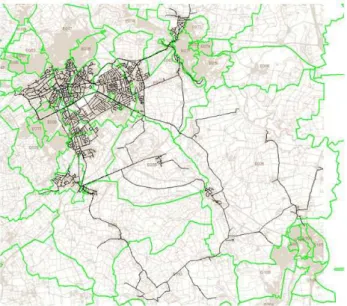
Figure 1. Online model geographical extent showing all pipes, background map and DMA boundaries.
is measured in the real network. In order to simulate the cur-rent hydraulic state of a network, demand constraints within the model are relaxed and their adjustment allows for a so-lution to be calculated that matches the measured hydraulic conditions.
4 The On-line model
This paper presents an online model using the Aquis 1.47 (7T) software. Aquis is a water network simulation plat-form used in daily operation in 1500 cities worldwide, and is an industry standard modelling package in the UK (http: //www.7t.dk/aquis/). The model is driven by near real-time flow and pressure data gathered using GPRS communication technologies that downloaded data with a 15 min sample in-terval every 30 min. This GPRS technology includes accu-rate time stamping, irrespective of any intermittent commu-nication errors, that ensures no data skewing occurs across measurement sites. The online model can run every 30 min on 15 min sampled data and takes only a minute or two to run one real-time cycle on an average spec desktop PC. Even when scaling up to the larger 16 DMA model this frequency of recalculation described is feasible. The full area covered by the online hydraulic model includes a large area of a town of 160 000 people (approximately 25 500 properties) and is supplied with 77 near real time measurements. It comprises 16 DMAs, 4 service reservoirs, 2 pumping stations, 9081 pipes and 8571 nodes. Figure 1 shows the geographical ex-tent of the model.
4.1 Model construction and calibration
A conventional network simulation model calculates a hy-draulic solution under a set of constraints which correspond to an estimated distribution of demand for an idealized 24 h period. Calibration of such models is usually to averaged pressure data from a relatively short period and with limited coverage. It is possible for idealised 24 h models to provide apparently sensible, but not wholly accurate, solutions for non-representative model constraints. For an on-line simu-lation, with numerous hydraulic flow and pressure bound-ary conditions imposed, these constraints are relaxed, lead-ing to the requirement for a higher degree of accuracy both in the model calibration procedure and the on-line flow and pressure measurements. Hence, the first requirement for an on-line model is for an accurate representation of the net-work and a well calibrated conventional hydraulic model. For the work reported here the calibrated conventional off-line model was built by consultants on behalf of the water company. Once a suitable conventional hydraulic model has been produced, it is necessary to connect it for on-line op-eration. This is achieved by a SCADA system to provide the flow and pressure data for simulation of boundary condi-tions, and a data management system that checks data status and pre-processes it in preparation for use in the model.
4.2 Data route and interfacing
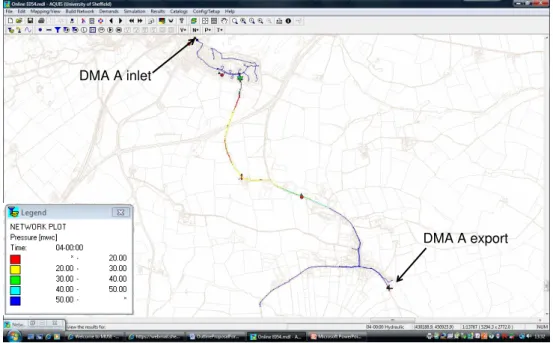
DMA A export DMA A inlet
Figure 2.Example DMA network plot with normal pressure overlay.
4.3 Example event
As stated above an online model has been successfully cre-ated for a significant network area. In order to tangibly demonstrate the capabilities of the online model attention is focused on a single DMA where an unusual event is known to have occurred.
The DMA used for the selected example is a semi rural DMA with customers concentrated at the north end. The DMA selected consists of 269 domestic and 18 commercial properties. It has pipes made of asbestos, cement, cast and ductile iron and polyethylene, diameters from 50 to 300 mm. For the purposes of the results reported here, a single DMA model was extracted from the full online model with real time data for the DMA inlet and export flows streamed into the model and imposed as simulation boundary conditions using DataManager. The model was then checked to confirm that under “normal” conditions the online simulation results were comparable to those produced by the conventional hy-draulic model, at the time of calibration. This confirmed that under normal operational flow conditions the online model produced output that accurately reflected the actual pressure conditions found in the real network. Figure 2 shows a net-work plot with pressure overlay, and the locations of the im-posed flows under normal operational conditions.
During a period of operations a fire hydrant was opened producing a flow to waste of approximately 3 l/s, this was confirmed by an Artificial Intelligence based alert system running concurrently (Mounce and Boxall, 2009). Figure 3 illustrates the flow and pressure changes (for the DMA ex-port) that occurred during the event and some details of the timings.
Figure 3. Details of event as reported by Artificial Intelligence based alert system.
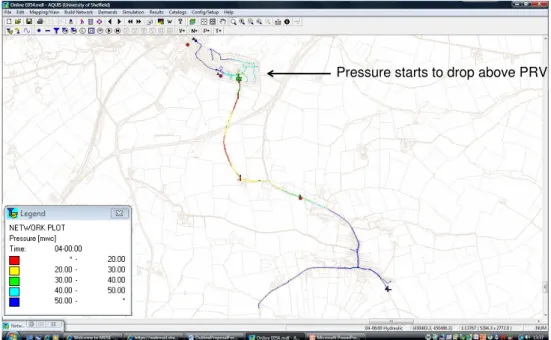
Pressure starts to drop above PRV
Figure 4.Pressure effect of event at 06:00.
Pressure drop starts to spread to rest of DMA
Figure 5.Pressure effect of event at 08:00.
data and not simulated data in which various events in the live distribution system, often unknown to the utility com-pany, will manifest in recorded data.
Following the identification and characterization of the event the online hydraulic model was used in historic mode to test its capability to detect the event by “replaying” the time series data gathered at the time to predict the flow and pressure changes throughout the selected DMA. The online
model effectively simulated the flow increases into and out of the DMA from 06:00 and simulated the pressure effect of the event within the DMA. Figures 4 to 6 show the effects of the event propagating through the DMA as simulated by the model.
Pressure drop affects entire DMA Pressure drop at DG2s
Figure 6.Pressure effect of event at 11:00.
generated using SCADA data specific to the times shown on the slides i.e. Fig. 6 is generated by the model using SCADA data measured at 11:00 imposed as simulation boundary ditions. With the SCADA and modelling system current con-figuration, the operator would have seen these screen views (operator screens) about an hour after the event. It is per-fectly feasible however to gather and transfer data, and carry out the simulation, inside a 15 min window. As the effects last several hours this would allow sufficient time to warn customers or, if possible, make network changes to limit or even protect customers from the effects. These effects are hydraulic i.e. pressure and flow effects within pipes and even flow reversals. Checks against alarm levels if setup can pro-vide early warning on certain changes for the online model.
The example given in this paper was of a single DMA drawn from a larger network model. Resources would in-crease proportionately if the model was extended to a wider area, particularly in terms of the instrumentation, communi-cations and computational infrastructure needed. But as this type of modelling moves from the R&D realm to a “busi-ness as usual”, the resources required are expected to become more manageable as such technologies continue to improve.
5 Conclusions
On-line simulation models require a continuous feed of flow and pressure data from the real network being simulated. Ad-vances in communications technologies have made it viable to transfer such data directly from network instrumentation to the point of use at a frequency suitable to be of practi-cal use. Simulation results presented here have demonstrated
that such an on-line model can provide early warning of the magnitude of effect in each pipe in a network and hence on customer service. This capability enables models to simu-late and report current network hydraulic state which can be monitored to detect network events such as burst mains and respond to events in a proactive and timely manner.
On-line simulation of a water distribution network pro-vides a tool that can offer tangible and significant operational benefits for system managers. It allows network operators to progress beyond the reactive and develop a more proac-tive approach to network management. The early effects of a network event such as a burst main can be detected at an early stage which, in turn, can allow network operators to minimize the later effects and sometimes pre-empt and avoid many standards of service failures by manipulating valves, providing an alternative supply or making other appropriate operational change. Pressure effects on every pipe in a net-work can be captured to gather knowledge about which cus-tomers were affected by an event and for how long.
Acknowledgements. This work is part of the NEPTUNE
project supported by the UK Science and Engineering Research Council, grant EP/E003192/1, and Industrial Collaborators. The authors would like to particularly acknowledge the assistance of Ridwan Patel from Yorkshire Water Services.
References
Andersen, J. H. and Powell, R. S.: Simulation of water networking containing controlling elements, J. Water Res. Pl.-ASCE, 125(3), 162–169, 1999.
Bhattacharya, B., Lobbrecht, A. H., and Solomatine, D. P.: Neural networks and reinforcement learning in control of water systems, J. Water Res. Pl.-ASCE, 129(6), 458–465, 2003.
Dandy, G. A., Simpson, A. R., and Murphy, L. J.: An improved ge-netic algorithm for pipe network optimisation, Water Res., 32(2), 449–458, 1996.
Kapelan, Z., Savic, D. A., and Walters, G. A.: Inverse transient analysis in pipe networks for leakage detection and roughness calibration. Proceedings of Water Network Modelling for Opti-mal Design and Management CWS 2000, Exeter, UK, 2000. Koppel, T. and Vassiljev, A.: Calibration of the Model of an
Opera-tional Water Distribution System, Proceedings of the IWA World Water Congress (WWC), Vienna, 2008.
Mounce, S. R. and Boxall, J. B.: Implementation of an on-line Ar-tificial Intelligence District Meter Area flow meter data analysis system for abnormality detection: a case study, Proceedings of the 10th IWA conference in instrumentation, control and automa-tion, Cairns, Australia, 2009.
Orr, C., Bouulos, P., Stern, C., and Liu, P.: Developing real-time models of water distribution systems. Modeling and optimisation applications, in: Water Engineering and Management Series, 3– 4, edited by: Savic, D. and Walters, G., Vol. 1, Research Studies Pr., 1999.
Powell, R. S., Irving, M. R., Sterling, M. J. H., and Usman, A.: A comparison of three real-time state estimation methods for on-line monitoring of water distribution systems, in: Computer Ap-plications in Water Supply, Vol. 1, Systems Analysis and Simula-tion, edited by: Coulbeck, B. and Orr, C. H., 333–348, Research Studies Press Ltd., 1988.
Rao, Z. and Salomons, E.: Development of a real-time, near-optimal control process for water distribution networks, J. Hy-droinform., IWA Publishing, 9(1), 25–37, 2007.
Skipworth, P. J., Saul, A., and Machell, J.: Practical applications of real time hydraulic modelling of water distribution networks, Int. J. COMADEM, 2, 1, 15–21, 1999.