USE OF DRUGS AMONG STUDENTS IN A UNIVERSITY IN EL
SALVADOR AND ITS RELATIONSHIP TO CHILDREN MALTREATMENT
Cristina de Amaya1, Robert Mann2, Hayley Hamilton3, Pat Erickson4, Bruna Brands5, Norman Giesbrecht6,
Maria da Gloria Miotto Wright 7, Francisco Cumsille8, Jaime Sapag9, Akwatu Khenti10
1 M.Sc. Vice Academic Rector da Universidad Evangélica de El Salvador. San Salvador, El Salvador. E-mail: cristina.amaya@ uees.edu.sv
2 Ph.D. Investigator Centre for Addiction and Mental Health, CAMH, University of Toronto. Toronto, Canada. E-mail: robert. [email protected]
3 Ph.D. Investigator CAMH, University of Toronto. Toronto, Canada. E-mail: [email protected] 4 Ph.D. Investigator CAMH, University of Toronto. Toronto, Canada. E-mail: [email protected]
5 Ph.D. Senior Scientist. Ofice of Research and Surveillance, Drug Strategy and Controlled Substances Programme, Health Canada and Public Health and Regulatory Policies, CAMH, University of Toronto. Toronto, Canada. E-mail: [email protected] 6 Ph.D. Investigator, CAMH, University of Toronto. Toronto, Canada. E-mail: [email protected]
7 Ph.D. Former Coordinator Educational Development Program Inter-American Drug Abuse Control Commission (CICAD), Secretariat for Multidimensional Security. Washington, USA. E-mail: [email protected]
8 Ph.D. Director Interamerican Drug Observatory, CICAD, Secretariat for Multidimensional Security at Organization of American States. Washington, USA. E-mail: [email protected]
9 Ph.D. MD, MPH, CAMH. Toronto, Canada. E-mail: [email protected]
10 Doctoral Student. Director Transformative Global Health Ofice, CAMH. Toronto, Canada. E-mail: [email protected] ABSTRACT: The goal of the study was to examine the relationship between drug use and abuse and maltreatment during childhood among university students in San Salvador, El Salvador. This research was an exploratory study, with a cross-sectional design using a sample of 272 students. The results indicated that 43% (118) of students reported having used drugs sometime in their life; the most frequently used drugs in the past 12 months were alcohol, cannabis and tobacco, with prevalence of 14% (38), 9.3% (26) and 7% (19) respectively. Physical and verbal abuses were the two most common types of maltreatment, and sexual abuse was less frequent, but
still present. Having friends who use drugs was a risk factor for drug use and abuse. Additionally there was a direct signiicant (<0.005)
relationship between the use and abuse of drugs and physical abuse during childhood. DESCRIPTORS: Child Abuse. Substance-related disorders. Students.
USO DE DROGAS ENTRE ESTUDANTES DE UMA UNIVERSIDADE EN EL
SALVADOR E SUA RELAÇÃO COM MAUS-TRATOS NA INFÂNCIA
RESUMO: O objetivo do estudo foi examinar a relação entre o uso e o abuso de drogas e maus-tratos durante a infância em estudantes universitários na cidade de San Salvador, El Salvador. Trata-se de estudo exploratório, de corte transversal, com uma amostra de 272 estudantes. Os resultados indicaram que 43% (118) dos alunos relataram ter consumido drogas em algum momento da vida; as drogas mais utilizadas nos últimos 12 meses foram álcool (14%), maconha (9,3%) e tabaco (7%). Os abusos físico e verbal foram os tipos mais comuns de abuso e, menos frequente, porém existente, foi o abuso sexual. Ter amigos que usam drogas foi um fator de risco para o uso e abuso de drogas. Existe uma relação direta entre o uso/abuso de drogas e o abuso físico na infância, sendo essa associação
estatisticamente signiicantiva (<0.005).
DESCRITORES: Maus-tratos infantis. Transtornos relacionados ao uso de substâncias. Estudantes.
USO DE DROGAS EN ESTUDIANTES DE UNA UNIVERSIDAD DE EL
SALVADOR Y SU RELACIÓN CON EL MALTRATO DURANTE LA NIÑEZ
RESUMEN: El objetivo del estudio fue examinar la relación entre el uso y abuso de drogas y maltrato durante la niñez en estudiantes de una universidad de la ciudad de San Salvador, El Salvador. La investigación fue exploratoria, con un diseño transversal, siendo la
muestra de 272 estudiantes. Como resultado se obtuvo que el 43% (118) de los estudiantes airmaron haber consumido drogas alguna
vez en su vida; las drogas de mayor consumo en los últimos 12 meses fueron el alcohol, el cannabis y el tabaco, con prevalencias del 14% (38), 9.3% (26) y 7% (19) respectivamente. El abuso físico y el abuso verbal fueron los dos tipos de maltrato más frecuentes; el
tener amigos que consuman drogas es un factor de riesgo. Adicionalmente existe una relación directa y signiicativa (< 0.005) entre el
uso y abuso de drogas y maltrato físico durante la niñez.
INTRODUCTION
El maltrato durante la niñez está cultural-mentMaltreatment during childhood is culturally ingrained in El Salvador. Although it has been proved that maltreatment during childhood is a risk factor associated with the use of drugs,1-3 the topic has not been treated in depth and with an evidence-based scientiic approach in many Latin American and Caribbean countries, among them El Salvador.
Salvadoran society is characterized as being traditionally sexist, with its coercive and authori-tarian features, in which children are considered as the property of adults, and in which abusing minors as a means of education, discipline, and punishment is considered normal.4
Drug use in the country tends to be asso-ciated more with men rather than women.5
Ac-cording to the irst study on drug use and other issues among the student population from ive universities in El Salvador (2010), 70.8% of uni-versity students reported having used some kind of substance at some time in their lives, and 45.1% of students have used an illicit or licit substance during the past year. If we exclude alcohol and tobacco, the most used substances in 2009 were: cannabis (3.3%); solvents (0.7%); cocaine (0.6%); and hashish (a little over 0.5%). As for tranquili-zers, stimulants, and painkillers, 7.8% of university students reported having used tranquilizers at some time in their life.6
Over the period 2004-2007, reported cases of maltreatment during childhood increased from 1,818 cases in 2004 to 4,403 cases in 2007.7 Four types of maltreatment during childhood are listed and legally recognized in El Salvador: physical abuse; psychological/emotional abuse; sexual abuse; and neglect or abandonment of children. The most frequent types of child maltreatment are physical abuse and psychological/emotional abuse. Many cases of child abuse go unreported, and only serious or extreme cases tend to be for-mally reported. Children are particularly more vulnerable to maltreatment by family members, relatives, or close friends.8-9
The purpose of this investigation was to determine the relationship between drug use among university students and maltreatment du-ring childhood. The results of this work provide valuable information for prevention, treatment, and rehabilitation programs, for both the use of drugs and for maltreatment during childhood, as
the study provides a comprehensive overview that may have a positive impact on quality of life, on dignity, and on the health of children, adolescents, and the young adult population of El Salvador.
This study considers the following cate-gories for classiication of maltreatment: sexual abuse; physical abuse; psychological abuse; and neglect (physical and emotional). In this context, the research question was: Is there a relationship between the use and abuse of drugs and maltreat-ment during childhood among university students in El Salvador?
METHOD
EThis investigation is part of a multi-cente-red study of cross-sectional design. The sample used in this investigation consisted of university students (men and women) aged over 18 years, who attended the selected university.
El Salvador is located in Central America, with a total area of 20,000 km, and its capital is San Salvador. The country has a population of six million inhabitants and the oficial langua -ge is Spanish.10 The study was carried out at a university in San Salvador. A non-probabilistic sampling technique was used. A questionnaire was applied, which was composed of 60 questions to be completed in approximately 35 minutes. The questionnaire consisted of four instruments that aimed to assess the relationship between the use and abuse of drugs and maltreatment during childhood. These instruments were: the Adverse Childhood Experience questionnaire (ACE);11 the Kessler Psychological Distress Scale (K10)12 to as-sess psychological distress; a selection of questions from the CICAD-OAS questionnaire on the use of drugs; and a socio-demographic questionnaire. Two questions were related to the use of mental health services as the result either of maltreatment during childhood or of treatment for substance abuse. This questionnaire was translated into Spa-nish in order to facilitate its management.
Participation in this study was on a volun-tary basis. Each participant signed a free and informed consent form prior to the survey. The study was previously approved by the Research Ethics Committee of the studied university in El Salvador and by the Research Ethics Board of the Centre for Addiction and Mental Health (CAMH), under number 141-2010. Students completed the questionnaire in approximately 35 minutes.
main investigator after the project was presented to the respective authorities of the university (President, Scientiic Investigation Committee of the selected faculty) in order to obtain the permit. For data collection, purposive sampling was used. The sampling frame was limited to one faculty, of which six courses were randomly selected. The sample was composed of 272 students. A sampling error of 5% was found and considered acceptable, and it was used for sample size calculation. The inclusion criterion was to be aged over 18 years.
Participants were included in the study after: 1) they met the speciic inclusion and exclusion criteria; 2) they agreed to participate in the study, after they were given a verbal description of the study objectives and a free and informed consent form to be signed so that conidentiality was en -sured; 3) they were provided with answers to any questions they had about the study and data co-llection; and 4) they signed the free and informed consent form. Data were collected during classes, and their management was conducted by the main researcher. The questionnaire and the informed consent form were explained by the main resear-cher in 10 minutes and they were distributed to participants for completion. After the papers were completed, they were put inside two different boxes that were made available for this purpose.
An electronic database was created with the help of the software Statistical Package for the Social Sciences (SPSS), version 15.0 for Windows. Data entry was performed by the main researcher. This database was tested with preliminary data ob-tained from 10 questionnaires collected from other students who were not participating in the study.
This test was performed to assess the effectiveness of the electronic database and the functionality of the questionnaire.
A descriptive statistical analysis was carried out; absolute and relative frequencies and mea-sures of central tendency (mean, median) were found; and dispersion (standard deviation) was calculated for numeric variables. Contingency tables and a chi-squared test were done to assess the association between maltreatment during childhood and drug use and abuse; a binomial test was also applied to determine the accuracy of opinions. The relationship between variables was considered statistically signiicant where p<0.05.
RESULTS
Sociodemographic characteristics of the
sample
The sample consisted of 272 students from a university in El Salvador. Only students from the university’s school of medicine were selected.
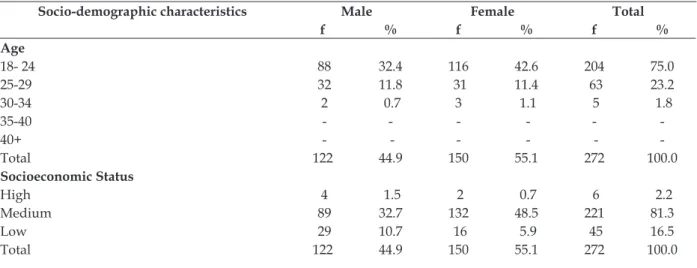
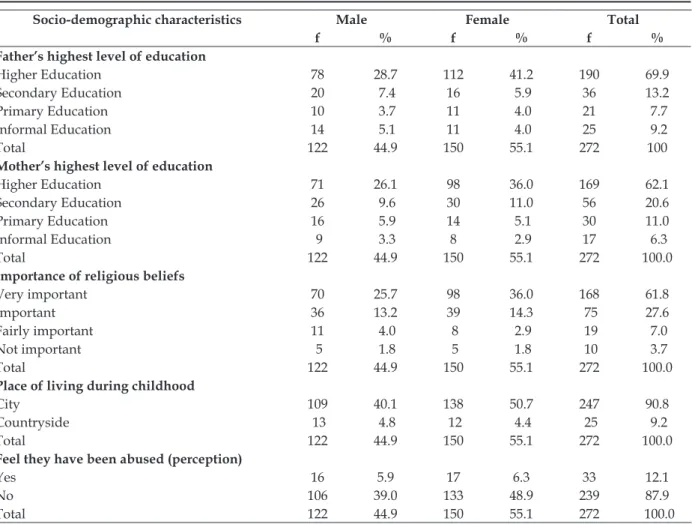
Table 1 shows that, out of the surveyed stu-dents, 55.1% (150) were women and 44.9% (122) were men; 75% (204) were aged between 18 and 24 years old; 81% (221) had a medium socioeconomic status; 69% (190) had parents who had completed higher education; 62.1% (169) had mothers who had completed higher education; for 68.8% (168), religious belief was considered very important; 90.8% (247) came from the city. Regarding the per-ception of maltreatment during childhood, only 12.1% (33) considered that they had been abused, while the others, 87.9% (239), did not think so.
Table 1 - Socio-demographic characteristics of university students. San Salvador, El Salvador, 2011
Socio-demographic characteristics Male Female Total
f % f % f %
Age
18- 24 88 32.4 116 42.6 204 75.0
25-29 32 11.8 31 11.4 63 23.2
30-34 2 0.7 3 1.1 5 1.8
35-40 - - - - -
-40+ - - - - -
-Total 122 44.9 150 55.1 272 100.0
Socioeconomic Status
High 4 1.5 2 0.7 6 2.2
Medium 89 32.7 132 48.5 221 81.3
Low 29 10.7 16 5.9 45 16.5
Socio-demographic characteristics Male Female Total
f % f % f %
Father’s highest level of education
Higher Education 78 28.7 112 41.2 190 69.9
Secondary Education 20 7.4 16 5.9 36 13.2
Primary Education 10 3.7 11 4.0 21 7.7
Informal Education 14 5.1 11 4.0 25 9.2
Total 122 44.9 150 55.1 272 100
Mother’s highest level of education
Higher Education 71 26.1 98 36.0 169 62.1
Secondary Education 26 9.6 30 11.0 56 20.6
Primary Education 16 5.9 14 5.1 30 11.0
Informal Education 9 3.3 8 2.9 17 6.3
Total 122 44.9 150 55.1 272 100.0
Importance of religious beliefs
Very important 70 25.7 98 36.0 168 61.8
Important 36 13.2 39 14.3 75 27.6
Fairly important 11 4.0 8 2.9 19 7.0
Not important 5 1.8 5 1.8 10 3.7
Total 122 44.9 150 55.1 272 100.0
Place of living during childhood
City 109 40.1 138 50.7 247 90.8
Countryside 13 4.8 12 4.4 25 9.2
Total 122 44.9 150 55.1 272 100.0
Feel they have been abused (perception)
Yes 16 5.9 17 6.3 33 12.1
No 106 39.0 133 48.9 239 87.9
Total 122 44.9 150 55.1 272 100.0
Maltreatment during childhood
DOf the 272 surveyed students, 6.6% (18) stated that they were sexually abused, 24.6% (67) that they were physically abused, 24.6% (67) that they had suffered verbal abuse, and 12.9% (35) that they had suffered emotional or physical neglect. Physical maltreatment had a slight prevalence among men, and verbal maltreatment had a slight prevalence among women.
Table 2 indicates that 18.4% (50) of students reported that their mother, caregiver, or guardian was physically abused. Eighty-seven students (32%) reported that their parents were divorced or separated; 22.4% (61) of students stated that they lived with someone who suffered from depression or other mental illness; and 36.1% (98) lived with a consumer of illicit or licit drugs.
According to the Kessler scale, 55.1% (150) of students reported suffering from minimal psy-chological distress, 22.4% (61) from slight distress, 12.1% (33) from moderate distress, and only 10.3% (28) from severe distress.
Table 2 - Report of adverse experiences during childhood among university students. San Salvador, El Salvador, 2012 (n=272)
Family experiences f %
Mother, caregiver, or guardian was physi-cally abused
50 18.4
Divorced or separated parents 87 32.0 Lived with someone who suffered from
depression or other mental illness 61 22.4 Family member who had attempted
suicide
26 9.6
Lived with an alcoholic 66 24.3 Lived with a drug user 32 11.8 Had a family member who had been to
prison
24 8.8
Use of psychoactive drugs
tobacco, and cannabis, with a prevalence of 16.9% (46), 11.0% (30), and 4.4% (12) respectively. The least used drugs over the last 12-month and 30-day periods were heroin and inhalants, respectively.
As for the frequency of use of psychoactive drugs, it was found that alcohol was the most used drug, with a monthly frequency of 13.2% (36), tobacco was the most used drug on a weekly basis at 3% (9), and over-the-counter drugs were the most used drugs on a daily basis at 4.1% (11).
In Table 3, we show that, according to the DSM-IV classiication criteria, of the total number students who reported having used drugs, 41.5% (49) met the criteria for psychoactive drug abuse, while 58.5% (69) were in the “use” category.
Tabla 3 - RReport of cases of psychoactive drug abuse based on DSM-IV criteria. San Salvador, El Salvador, 2011 (n=118)
DSM – IV Male Female Total
f % f % f %
Abuse 36 30.5 13 11.0 49 41.5
Use 33 28.0 36 30.5 69 58.5
Total 69 58.5 49 41.5 118 100.0
Of the total number students who reported having used drugs, only 2.5% (3) stated that they have received therapy or professional psychologi-cal support due to drug use and, according to the results of the chi-squared table, this can be con-irmed with an error probability lower than 0.05. One hundred and ifty-nine students surve -yed (58.45%) had friends who use psychoactive drugs, whereas 53.24% (82) of students who repor-ted not using drugs (n=154) had friends who use drugs. This proportion is greater when we analyze the group of students who reported use and abuse of drugs (n=118), where 65.25% (77) had friends who also use drugs.
Of the students who reported having used drugs at some time in their lives, 67.8% (80) stated that their irst time was with a friend who had
already used drugs, and 55.9% (66) stated that they tend to use drugs with friends. Alcohol and tobacco were the most used drugs by friends over the last 12 months with a prevalence of 79% (93) and 75% (89) respectively, which puts cannabis behind at 36% (42), and inally cocaine at 17% (20).
Relationship between maltreatment during
childhood and the use of psychoactive drugs
In terms of relationships or associations between child maltreatment and the use of psy-choactive drugs, according to the results of the chi-squared test, of the students who use drugs (69), 70% (48) had suffered some kind of mal-treatment during childhood; of the students who reported drug abuse (49), 84% (41) had suffered some kind of maltreatment during childhood; and of the students who do not use drugs, 64% (98) had suffered some kind of maltreatment during childhood.
After the application of the chi-squared test, it was found that the probability of error regarding the relationship between use, abuse, or no use of psychoactive drugs and sexual abuse is 42.9%, which is not statistically signiicant, thus showing that there is no relationship with use and abuse of drugs for this type of maltreatment.
As for the relationship between use, abuse, and no use of psychoactive drugs and physical abuse, Table 4 shows, with a probability of error below 0.05, that 30.43% of students who use drugs had suffered physical abuse during childhood. Of the students who used drugs, 34.69% had suffered physical abuse during childhood, and only 18.83% of students who do not use drugs had suffered physical abuse during childhood.
After the application of the chi-squared test, a high probability of error was found regarding the relationship between the use of psychoactive drugs and verbal abuse, and between the use of psychoactive drugs and emotional or physical neglect. For this reason, this association cannot be made.
Tabla 4 - Use of psychoactive drugs and physical abuse: chi-squared test
Ítems Value gl Asymptotic sig.
(bilateral) Exact sig. (bilateral)
Exact sig. (unilat-eral)
Pearson’s chi-squared test 12.378a 1 .000 Correction for continuity 11.133 1 .001
Fischer’s Exact test .001 .001 Linear by linear association 12.332 1 .000
N of valid cases 272
DISCUSSION
En El Salvador la tendencia creciente en el consuIn El Salvador, the increased tendency toward the use of psychoactive drugs among university students is considered a public health issue.13 According to the sociodemographic cha-racteristics of the university population surveyed, there is no gender dominance and they belong mainly to the age group 18-24, because academic life takes place during this young adult stage. Most people surveyed belong to a medium socioecono-mic status and both parents had completed higher education. These are the expected characteristics, according to the proile of people in El Salvador who have Access to higher education.14
Religious beliefs were stated as very impor-tant to them and this is a protective factor; in fact some researchers have deined “non-religiosity”15 as a risk factor for drug consumption. Nearly all university students lived in the city during their childhood. Eighty-seven point nine percent of stu-dents believed that they were not abused during childhood, which is in line with the region’s cultu-ral aspects, where the majority of adults consider physical maltreatment to be a tolerated means of educating and socializing.4-16
According to the results of the Adverse Childhood Experience questionnaire (ACE), and in contrast with the perception of maltreatment expressed by university students, 70% of students suffered some kind of maltreatment during child-hood, in similar proportions for both genders, and this is a valuable piece of information to take into account, because many authors have found that experiencing maltreatment during childhood is a risk factor associated with drug use.1-3,15,17-20
Regarding the types of maltreatment repor-ted by university students, physical abuse and verbal abuse were the two most frequent types, and although sexual abuse was the least frequent, it was also present. The results are in line with those of other studies that showed that most mi-nors in Latin America and the Caribbean undergo physical and psychological maltreatment, with an incidence between 40-82%.4
Thirty-two percent of students stated that their parents were separated or divorced, and
one-fourth stated that they lived either with so-meone who suffered from depression or another mental illness or with an alcoholic. A lower pro-portion of 20% stated that their mother, caregiver, or guardian had been physically abused, that they had lived with a drug addict, and/or that they had a family member who had tried to commit suicide or gone to prison. These results coincide with other studies that highlighted the violence that affects women and that has alcohol intake and the use of drugs as the main triggering elements of the abuser’s violent attitude.21-22
In addition, according to the studies carried out with young adults in the rehabilitation process at Hogares CREA, Fundación Desafío Juvenil, FUNDASALVA, and Fundación Alma in El Salva-dor throughout 2006,23-24 among the family factors
that most inluence the use of licit and illicit drugs the following can be mentioned: lack of commu-nication between parents and children, followed by poor control of parents over their children’s activities, and a lack of commitment by parents regarding their children’s education. All of these contribute to family instability, parental rejection, separations or divorce, and conlicts that are the result of too much or too little discipline.
According to the parameters of measurement of psychological distress (Kessler scale) used in this study, most students had minimum to mo-derate levels of psychological distress, which is in line with other studies that showed that impulsi-veness,1-2,17 emotional suffering,20 and physiological and genetic predisposition25 are important factors in drug use.
Forty-three point three percent of students reported having used drugs at some time in their lives, with alcohol, cannabis, and tobacco being the most used within the last 12 months, and alcohol, tobacco, and cannabis within the last 30 days. As for the frequency of use, alcohol was the most used drug on a monthly basis, tobacco the most used on a weekly basis, and over-the-counter drugs on a daily basis. These results conirm those of other studies carried out in the country,13,23-24 while some studies have shown that the pattern of drug consumption among adolescents is currently “poly-drug use.”13,26
and other issues with student populations at ive universities in El Salvador,6 70.8% of university students stated that they had used some kind of licit or illicit drug over the course of their lives, and 45.1% of students had used some kind of licit or illicit drug over the past year. Except for alcohol and tobacco, the results of this study conducted in 2009 show that the most used drugs were: can-nabis, with 3.3%; solvents with 0.7%; cocaine with 0.6%; and hashish with a little more than 0.5%. As for tranquilizers, stimulants, and painkillers, 7.8% of university students reported having used tranquilizers at some time in their lives.13
According to DSM-IV classiication, of all the students who stated that they used drugs, 41.5% are drug abusers, with a prevalence of the male gender, which is similar to other studies conducted with a young population in which drug use in El Salvador is reported to be more associated with men than women.5,23-24 The other 58.5% use drugs
according to the DSM-IV classiication and the pattern is similar for both genders.
Of students who use drugs, most have not received any kind of treatment, and this is true for more than 97% of the students surveyed. It is worth mentioning that the areas of treatment and rehabilitation must be strengthened in El Salvador.27 It has been stated that there are serious limitations in El Salvador’s national mental health system, especially in primary care, and there is also a lack of skilled human resources and a national record of services as well as treatment programs.28
As for peers, the inluence of friends regar -ding drug consumption is clear, as most students who use and abuse drugs have friends who use drugs. This inluence can be clearly seen among students who abuse drugs, of whom 65.25% have friends who use drugs. However, this study also revealed that 53.24% of students who do not use drugs have friends who do, and 46.76% have no friends who do. Moreover, we can see that more than 50% of the population that reports using drugs also state that their irst time was with friends, and when they consume they tend to do it with friends. Studies carried out with a student population have shown that peer pressure, as well as the pressure and inluence of media regarding psychoactive drugs, represented by alcohol and tobacco, are risk factors that favor simultaneous use.29-31
Previous studies with the university popu-lation in El Salvador have shown similar results
in regard to the inluence of peers as a risk factor for drug consumption.13,22 The drugs most used by friends over the last 12 months were alcohol, tobacco, and cannabis.
There is a direct relationship between the use and abuse of psychoactive drugs and physical abu-se during childhood, which shows that this asso-ciation does exist. Of the students who use drugs, 30.43% suffered physical abuse during childhood. Of the students who abuse drugs, 34.69% suffered physical abuse during childhood, and 18.83% of students who do not use drugs were maltreated during childhood. This relationship does not exist in the other three types of abuse: verbal abuse; sexual abuse; and neglect. These igures cannot be contrasted because there are no previous studies in El Salvador that investigate the use of drugs among university students and its relationship with maltreatment during childhood.
CONCLUSIONS
The students surveyed had suffered some kind of maltreatment during childhood to a similar extent in both genders. Physical abuse and verbal abuse were the two most frequent types of mal-treatment, and sexual abuse was less frequent, but still present. The most used drugs were, in order of consumption, alcohol, cannabis, and tobacco. Having friends who use drugs was a risk factor for drug use and abuse by university students. There is a greater history of physical abuse during childhood among university students who have used and abused drugs than among those who do not. There is a direct relationship between the use and abuse of drugs and physical abuse during childhood.
Limitations
The sampling technique was a limitation, since it does not allow for the generalization of the results of this study to the whole university nor to the country’s general population. Students were asked to provide retrospective data on the events that might have occurred during their childhood and adolescence. These reports might have been affected by a loss of memory. It is worth mentio-ning that maltreatment and use or abuse of drugs might have been over-reported or under-reported, according to each student’s perceptions.
To all universities in El Salvador, we recom-mend the inclusion of drug and violence issues in their institutional research policy as one of the main lines of university scientiic research, because both have been listed as social issues with serious impacts on the country. Prevention programs for drug consumption within univer-sity premises, and involvement of student bodies coordinating with competent bodies are essential. Research studies can gain new perspectives on maltreatment during childhood and its relations-hip with individual factors (personality-tempe-rament), social inluence (media, the country’s historical context), the legal framework, and socioeconomic conditions, among others.
ACKNOWLEDGMENTS
To the Government of Canada/DFAIT; the Organization of American States; the Inter-Ame-rican Drug Abuse Control Commission (CICAD); the Centre for Addiction and Mental Health, CAMH-Toronto/Canada. Additionally, we would like to thank all students who participated in this study and who contributed directly or indirectly to its implementation.
REFERENCES
1. Hartzler B, Fromme K. Cognitive–behavioral proiles of college risk-takers with type II and psychopathic
personality traits. Addict Behav. 2003; 28(2):315-26.
2. Moeller FG, Dougherty DM. Impulsivity and substance abuse: what is the connection? Addict Disord Their Treat. 2002; 1(1):3-10.
3. Gilbert R, Cathy SWC, Browne K, Fergusson D, Webb E, Janson S. Child maltreatment 1: burden and consequence of child maltreatment in high-income
countries. Lancet. 2009 Jan; 373(3):68-81.
4. Arriaga I. Políticas y programas de salud en América Latina. Problemas y propuestas, Chile: CEPAL,ONU; 2005 [access 2012 Feb 1]. Available at http://www.eclac.cl/publicaciones/xml/7/23777/ sps114_lcl2450.pdf
5. Rivas I. Factores que incidieron en el consumo de drogas lícitas e ilícitas. Estudio realizado en instituciones de rehabilitación en el año 2006. Rev Cientíica Crea Ciencia [online]. 2006 [access 2012 May 18]; 4(6). Available at http://www.uees.edu. sv/crea6/1_factores.htm
6. Comisión Nacional Antidrogas.. Primer estudio sobre consumo de drogas y de otras problemáticas en población estudiantil de cinco universidades de El Salvador [online]. El Salvador: CNA; 2010 [access 2014 May 08]. Available at: http://www.seguridad.
gob.sv/observatorio
7. Comité de América Latina y el Caribe para la defensa de los derechos de la mujer - CLADEM. Resumen ejecutivo aplicación de la convención sobre los derechos del niño(a) en El Salvador [online]. El Salvador: CLADEM; 2009 [access 2014 May 08]. Available at: http://www.cladem.org/ monitoreo/informes-alternativos/ElSalvador/ Comite_DDnino/informe-alternativo-2009.pdf 8. Observatorio Centroamericano sobre la Violencia
[online]. Costa Rica: OCAVI; 2009. [access 2010 Jul 21]. Available at: http://www.ocavi.com/ docs_iles/ile_700.pdf
9. Observatorio Centroamericano sobre Violencia - 2009 [online]. Costa Rica: OCAVI; 2010 [ access 2010 Jun 21]. Available at: http://www.ocavi.com/ docs_iles/ile_715.pdf
10. Organización de los Estados Americanos y Comisión Interamericana para el Control del Abuso de Drogas. El Salvador: evaluación del progreso de control de drogas, Mecanismo de Evaluación Multilateral (MEM). Washington (US): OEA; 2006.
11. Rothman EF, Edwards EM, Heeren T, Hingson RW. Adverse childhood experiences predict earlier age of drinking onset: results from a representative US sample of current or former drinkers. Pediatrics. 2008 Aug; 122(2):e298-304.
12. Kessler R, Barker PR, Colpe LJ, Epstein JF, Gfroerer JC, Hiripi E. Screening for serious mental illness in the general population. Arch Gen Psychiatry. 2003; 60(2):184-9.
13. Bautista Pérez F, Simich L, Strike C, Bradns B, Giesbrecht N, Khenti A. Policonsumo simultáneo de drogas en estudiantes de pregrado del área de la salud de una universidad, San Salvador - El Salvador. Texto Contexto Enferm [online]. 2012 [access 2014 Jun 20]; 21(spe):56-62. Available at: http://www. scielo.br/scielo.php?script=sci_arttext&pid=S0104-07072012000500007&lng=en
14. Dirección General de Estadísticas y Censos (DIGESTYC). VI Censo de población y V de vivienda 2007 [online]. El Salvador: Ministerio de Economia; 2007 [access 2014 Jun 11]. Available at: http://www. digestyc.gob.sv/index.php/temas/des/poblacion- y-estadisticas-demograicas/censo-de-poblacion-y-vivienda/poblacion-censos.html
15. Adlaf EM, Samart RG. Drug use and religious afiliation, feelings and behaviour. Br J Addict. 1985 Jun; 80(2):163-71.
16. Morrison A, Maróa LB. El costo del silencio: violencia doméstica en las Américas [online]. New York: Banco Interamericano de Desarrollo; 1999 [access 2011 May 20]. Available at http://issuu. com/idb_publications/docs/book_es_51518 17. McCarthy DM, Kroll LS, Smith GT. Integrating
Clin Psychopharmacol. 2001 Nov; 9(4):389-98. 18. Gantiva Díaz CA, Bello Arévalo J, Vanegas Angarita
E, Sastoque Ruiz Y. Historia de maltrato físico en la infancia y esquemas de maladaptativos tempranos en estudiantes universitarios. Acta Colomb. P sicol. 2009 Jun; 12(2):127-34.
19. Gallego Gómez CL, Medina Bernal MT, Montoya Vélez LP. Historia de abuso sexual y su relación con depresión, autoestima y consumo de sustancias psicoactivas en estudiantes de media vocacional del municipio de Caldas Antioquia, Colombia - 2007. CES Med. 2008; 22(1):17-27.
20. Félix-Ortiz M, Newcomb MD. Vulnerability for drug use among Latino adolescents. J Community
Psychol. 1999; 27(3):257-80.
21. Vaiz R, Spanó A. La violencia intrafamiliar, el uso de drogas en la pareja, desde la perspectiva de la mujer maltratada. Rev Latino-Am Enferm [online]. 2004 Mar-Abr [access 2013 Nov 20]; 12(esp):433-8. Available at: http://www.scielo.br/scielo. php?pid=S0104-11692004000700020&script=sci_ arttext
22. Rivera A. Factores de riesgo y protección del consumo de drogas entre estudiantes universitarios salvadoreños. Rev Cientíica Crea Ciencia [online].
2007 [access 2013 Nov 20]; 7: 12.Available at: http://
www.uees.edu.sv/crea2.2/1_factores.htm
23. Fundación Antidrogas de El Salvador. Observatorio Salvadoreño sobre drogas: informe ejecutivo [online]. San Salvador: Fundación Antidrogas de El Salvador; 2004 [Access 2010 jul 18].. Available at http://www.seguridad.gob.sv/observatorio 24. Fundación Antidrogas de El Salvador [online]. San
Salvador: FUNDASALVA; 2009 [access 2013 Nov 20]. Available at: http://www.fundasalva.org.sv/ home/investigacion.aspx
25. Schuckit MA. A clinical model of genetic inluences
in alcohol dependence. J Stud Alcohol.1994;
55(1):5-17.
26. Muñoz-Rivas M, Graña Lopes JL. Factores familiares de riesgo y de protección para el consumo de drogas en adolescentes. Psicothema. 2001; 13(1):87-94. 27. Rodríguez JJ, Barrett T, Narváez S, Caldas JM,
Levav I, Saxena S. Sistemas de salud mental en El Salvador, Guatemala y Nicaragua: resultados de una evaluación mediante el WHO-AIMS. Rev Panam Salud Pública 2007; 22(5):348-57.
28. Juárez C, García M, Marquina M. Percepción del personal de salud sobre la calidad de la atención a adolescentes que abusan de drogas. Rev Análisis. 2011; 8:101-11.
29. Veloza Gómez M, Simich L, Strike C, Brands B, Giesbrecht N, Khenti A. (2012). Medio social y uso simultáneo de alcohol y tabaco en estudiantes universitarios de pregrado de carreras de ciencias de la salud de una universidad, Cundinamarca - Colombia. Texto Contexto Enferm [online]. 2012 [access 2014
Jun 11]; 21(spe):41-8. Available at: http://www. scielo.br/scielo.php?script=sci_arttext&pid=S0104-07072012000500005&lng=en&tlng=es
30. Riofrío Guillén R, Nascimento LC. Consumo de drogas en los jóvenes de la ciudad de Guayaquil, Ecuador. Rev Latino-Am Enfermagem [online]. 2010 [access 2014 Jun 11]; 18(spe):598-605. Available at http://www.scielo.br/scielo.php?script=sci_ arttext&pid=S0104-11692010000700016&lng=en& tlng=es
31. Bermúdez-Herrera A, Silva MAI, Priotto EMT, Sampaio JMC (2011). Percepción de los estudiantes de una escuela de enfermería acerca del consumo de drogas lícitas e ilícitas. Rev Latino-Am Enfermagem [online]. 2011 [Access 2014 Jun 11]; 19(spe): 684-90. Available at http://www.scielo. br/scielo.php?script=sci_arttext&pid=S0104-11692011000700004&lng=en&tlng=es
Correspondence: Cristina Juárez de Amaya Universidad Evangélica de El Salvador