DRUG USE AMONG UNIVERSITY STUDENTS AND ITS RELATIONSHIP
WITH MALTREATMENT DURING CHILDHOOD IN ONE UNIVERSITY IN
SAN SALVADOR, EL SALVADOR
Eduardo Alfredo Martínez Díaz1, Robert Mann2, Hayley Hamilton3, Pat Erickson4, Bruna Brands5, Norman Giesbrecht6, Maria da Gloria Miotto Wright 7, Francisco Cumsille8, Jaime Sapag9, Akwatu Khenti10
1 M.Sc. MEd, Investigator, Facultad de Medicina. Universidad Evangélica de El Salvador. El Salvador, San Salvador. E-mail: [email protected]
2 Ph.D. Investigator Centre for Addiction and Mental Health, CAMH, University of Toronto. Toronto, Canada. E-mail: robert. [email protected]
3 Ph.D. Investigator, CAMH, University of Toronto. Toronto, Canadá. E-mail: [email protected] 4 Ph.D. Investigator, CAMH, University of Toronto. Toronto, Canadá. E-mail: [email protected]
5 Ph.D. Senior Scientist. Ofice of Research and Surveillance, Drug Strategy and Controlled Substances Programme, Health Canada
and Public Health and Regulatory Policies, CAMH, University of Toronto. Toronto, Canada. E-mail: [email protected] 6 Ph.D. Investigator, CAMH, University of Toronto. Toronto, Canada. E-mail: [email protected]
7 Ph.D. Former Coordinator Educational Development Program Inter-American Drug Abuse Control Commission (CICAD), Secretariat for Multidimensional Security. Washington, USA. E-mail: [email protected]
8 Ph.D. Director Interamerican Drug Observatory, CICAD, Secretariat for Multidimensional Security at Organization of American States. Washington, USA. E-mail: [email protected]
9 Ph.D. MD, MPH, CAMH, University de Toronto. Toronto, Canadá. E-mail: [email protected]
10 Doctoral Student. Director Transformative Global Health Ofice, CAMH. Toronto, Canada. E-mail: [email protected]
ABSTRACT: The objective of the study was to examine the relationship between drug use and maltreatment during childhood among students from one university in San Salvador. This is a cross-sectional study, on a sample size of 272 students with a sampling error of 5%. The results showed prevalence of drug use sometime in life of 43.0%, 6.6% of students reported had been sexually abused, 24.6% reported physical abuse, 24.6% reported verbal abuse, and 12.9% declared being emotionally or physically neglected. 55.1% reported a minimum level of psychological distress. 58.5% have friends who use drugs. Alcohol, cannabis and tobacco are the most used drugs. At least 70% of students who use drugs suffered some kind of abuse. In terms of partnerships, only physical abuse was
found signiicantly associated with a probability of error less than 0.05. These data shouldn’t be generalized to university students of
San Salvador, El Salvador.
DESCRIPTORS: Child abuse. Substance-related disorders. Students. Universities
USO DE DROGAS E SUA RELAÇÃO COM MAUS-TRATOS NA INFÂNCIA
EM ESTUDANTES UNIVERSITÁRIOS DE UMA UNIVERSIDADE EM SAN
SALVADOR, EL SALVADOR
RESUMO: O objetivo do estudo foi analisar a relação entre o uso de drogas com os maus-tratos na infância entre estudantes universitários de uma universidade em San Salvador. Este é um estudo é transversal, com uma amostra de 272 alunos, e com erro amostral de 5%. Os resultados mais importantes foram que 6,6% dos alunos referem ter sofrido abuso sexual, 24,6% abuso físico e 24,6% abuso
verbal, e 12,9% referiram ter sido isica ou emocionalmente negligenciados. Dentre os estudantes, 55,1% relataram mínimo sofrimento
psicológico. Os 43% usaram drogas uma vez em sua vida. Os 58,45% tinham amigos que usam drogas. álcool, maconha e tabaco são as drogas mais comumente usadas. 70% dos alunos que usam drogas sofreram algum tipo de abuso. Somente o abuso físico apresentou
associação estatisticamente signiicativa, com probabilidade de erro < 0.05. Os resultados deste estudo não devem ser generalizado
para a população de estudantes universitários de San Salvador, El Salvador.
USO DE DROGAS EN ESTUDIANTES UNIVERSITARIOS Y SU RELACIÓN
CON EL MALTRATO DURANTE LA NIÑEZ EN UNA UNIVERSIDAD DE
SAN SALVADOR, EL SALVADOR
RESUMEN: El objetivo del estudio fue examinar la relación entre el uso de drogas en estudiantes universitarios de una universidad en San Salvador y su relación con el maltrato durante la niñez. Este estudio fue de corte transversal, siendo el tamaño de la muestra de 272 estudiantes, con un error muestral del 5%. Los resultados más importantes fueron: el 6.6% de los estudiantes manifestó haber sufrido abuso sexual, el 24.6% abuso físico y el mismo porcentaje fue reportado para el abuso verbal mientras que el 12.9% reportó negligencia emocional o física. El 55.1% reportó distress psicológico mínimo. El 43% ha consumido drogas alguna vez en su vida. El 58.45% tiene amigos que usan drogas. El alcohol, el cannabis y el tabaco son las drogas más usadas. El 70% de los estudiantes que usan drogas sufrieron algún tipo de maltrato. En cuanto a las asociaciones, sólo en el abuso físico se encontró una asociación estadísticamente
signiicativa con una probabilidad de error menor al 0.05. Los datos no pueden ser generalizados a los estudiantes universitarios de
San Salvador, El Salvador.
DESCRIPTORES: Maltrato a los niños. Trastornos relacionados con substancia. Estudiantes. Universidades.
INTRODUCTION
Se reconoce ampliamente que el consumo de alcohoIt is widely known that the abuse of al-cohol and other legal and illegal drugs is a global public health issue that can be approached under different yet complementary perspectives. One of these perspectives is to reduce drug availability, while the other is to reduce demand. Regarding the latter, evidence-based strategies to reduce demand intend to increasingly expose the population at lar-ge, mainly children and youngsters, to identiied protective factors, and to reduce the exposure of populations to recognized risk factors.
Many authors have found that exposure to maltreatment in childhood is a risk factor associa-ted with drug abuse.1-7 However, in many Latin American and Caribbean countries—such as El Salvador—this topic has not been investigated based on scientiic evidence.
In 2008, the Intelligence Center of the Natio-nal Civil Police (PNC) reported 128 cases of child maltreatment, of which 46% of the victims were male and 54% were female. The age group of 10–12 years was found to be most vulnerable, as 22% of the cases belong to that group.8-9 In 2007, the Salvadoran Institute for Women’s Development (ISDEMU) identiied 2,607 cases of maltreatment in childhood within the previous eight months. Therefore, child maltreatment is an important problem in El Salvador, and its impact should be deeply reviewed.8-9
Drug abuse among university students and their friends, notably alcohol abuse, is at concerning levels among the university popula-tion.10 The gradual transition from adolescence to adulthood is a period marked by conlicts and changes, many of which increase the risk of
emo-tional distress and abuse of alcohol, tobacco, and illegal drugs.11
Psychological factors such as psychological distress are associated to drug abuse. Anxiety and symptoms of depression are associated with the use of tobacco;12 and depression has been associa-ted with the use of drugs in general,13-14 leading to pathological behavior.
Physical abuse is related to drug abuse and problematic behavior. Individuals who have su-ffered physical abuse also start doing drugs earlier than those who have not suffered physical abuse.
This study aims at establishing the relations-hip between drug abuse among university stu-dents and maltreatment in childhood. The results of this paper provide valuable information for programs on prevention, treatment, and rehabili-tation regarding the consumption of psychoactive substances and the correlation with maltreatment in childhood, as it facilitates a mainstreaming focus that could have a positive impact on the quality of life, dignity, and health of children, adolescents, and young adults in Salvadoran society.
Maltreatment was classiied as follows: se -xual abuse; physical abuse; psychological abuse; and neglect (physical and emotional). The research question was: “Is there any correlation between drug use and abuse and maltreatment in child-hood among university students in El Salvador?
METHOD
information about the student population.
The survey employed a non-probabilistic sampling technique to facilitate sampling selec-tion. It selected 272 students from a university in San Salvador, El Salvador, speciically from the College of Medicine. A 5% sampling error was selected and used to calculate sampling sizes. Participation in the study was voluntary. The inclusion criteria were as follows: 18 years of age or older (which is considered to be the legal age in El Salvador) and an active student at the parti-cipating university.
The survey employed a 60-question ques-tionnaire comprising four instruments to explore the correlation between drug use and abuse and maltreatment in childhood. The instruments were as follows: the Questionnaire on Adverse Childhood Experiences (ACE),15 the Kessler Scale of Psychological Disorders (K10)16 to evaluate the Psychological Distress; questions selected from the CICAD-OEA17 questionnaire on drug use; and a questionnaire consisting of socio-demographic questions. Two questions addressed the use of mental health care as a result of child maltreatment or abuse of substances. The questionnaire was translated into Spanish to facilitate the application.
The survey was approved by the Ethics in Research Board (ERB) of the Addiction and Mental Health Center (CAMH) and of the Ethics Commi-ttee of the participating university.
The Statistical Package for the Social Sciences (SPSS) software, version 15 for Windows, was used to design the database and further data analysis. The database was tested with preliminary data from 10 questionnaires answered by non-parti-cipating students to establish the effectiveness of the electronic database and of the questionnaire.
A descriptive statistical analysis was perfor-med, with absolute and relative frequencies of ca-tegorical variables and central tendency measures (average and median); and dispersion measures (standard deviation) were calculated for numerical variables. Contingency tables and a chi-square test were used to analyze the association between mal-treatment in childhood and drug use and abuse, and a binomial test was performed to determine the certainty of opinions. The relations between variables were considered to be statistically sig-niicant at p<0.05.
RESULTS
Overview of results
Of the students participating in the survey, 55.1% (150) were female and 44.9% (122) were male, and 75% of the university students in the sampling were in the age group between 18 to 24 years old. Regarding socio-economic status, 81% (221) of the students belonged to the middle class, according to the El Salvador scale. Concerning the perception of having been maltreated in child-hood, only 12.1% (33) of the students considered themselves to have suffered maltreatment.
Adverse experiences in childhood
According to the results presented in Table 1, 18.4% (50) of the students in the sampling stated that their mother, female caregiver, or guardian had been physically abused, indicating the pre-sence of intra-familiar violence. Of the students in the sampling, 32% (87) said their parents were divorced or separated; 22.4% (61) reported having lived with someone suffering from depression or other mental disorder; and 36.1% (98) lived with someone who used legal and/or illegal drugs.
Table 1 - Report on adverse childhood experiences among university students from a university in San SalvadorEl Salvador, 2012 (n=272)
Family experiences F %
Mother, female caregiver, or guardian was
physically abused 50 18.4
Parents separated or divorced 87 32.0 Lived with someone suffering from
depres-sion or other mental disorder 61 22.4 Family member had attempted to commit
sui-cide 26 9.6
Lived with an alcoholic individual 66 24.3
Lived with a drug user 32 11.8
A family member had been arrested 24 8.8
Use of psychoactive substances
Table 2 - Chi-square tests for use and no use of drugs among students from a university in San SalvadorEl Salvador, 2012
Items Value gl
Asymptotic signiicance (bilateral)
Exact signiicance (bilateral)
Exact signii -cance
(unilat-eral)
Pearson’s chi-square 49.112* 1 .000
Correction by continuity † 47.386 1 .000
Likelihood rate 51.883 1 .000
Fisher’s exact statistic .000 .000
Linear association by linear 48.931 1 .000
# of valid cases 271
* 0 squares (0%) have an expected frequency lower than 5. The minimum expected frequency is 49.20; †calculated only for a 2 x 2 table.
Correlation between maltreatment in
childhood and use of psychoactive substances
According to Table 3, of the 69 students in the sampling who are drug users, 48 (70%) stated that they had suffered some kind of maltreatment. Of the 49 students abusing drugs, 41 (84%) stated that they had suffered some kind of maltreatment and, of the 154 students that do not use psychoactive substances, 98 (64%) had suffered some kind of maltreatment.
Table 3 - Correlation between maltreatment in childhood and the use and abuse of psychoactive substances among students from a university in San Salvador, El Salvador, 2012 (n=272)
Child mal-treatment
Use of psy-choactive substances
Abuse of psychoactive
substances
# of use of
psychoac-tive sub-stances
f f f
Sexual abuse 4 2 12
Physical abuse 21 17 29
Verbal abuse 15 14 38
Negligence (emotional and physical)
8 8 19
Total 48 41 98
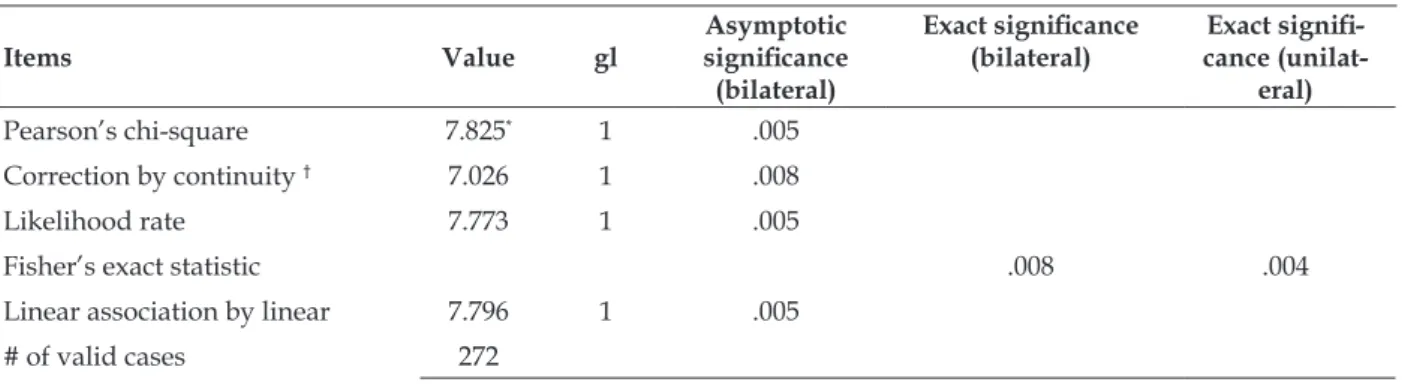
Table 4 - Chi-square tests on the use of psychoactive substances and physical abuse among students from a university in San Salvador El Salvador, 2012
Items Value gl
Asymptotic signiicance (bilateral)
Exact signiicance (bilateral)
Exact signii -cance
(unilat-eral)
Pearson’s chi-square 7.825* 1 .005
Correction by continuity † 7.026 1 .008
Likelihood rate 7.773 1 .005
Fisher’s exact statistic .008 .004
Linear association by linear 7.796 1 .005
# of valid cases 272
* 0 squares (0%) have an expected frequency lower than 5. The minimum expected frequency is 26.46; †calculated only for a 2 x 2 table.
DISCUSSION
The use of drugs, notably alcohol, among university students and their peers is at concerning levels in the university population in the region.10 In El Salvador the increasing tendency towards the use of psychoactive substances among university students is also considered to be a public health issue.18-19
The socio-demographic features of the sampling were designed to have no predominant gender, and the average age range was from 18 to 24 years old, that is, the young adult stage when university students typically experience their academic lives.
The Kessler scale showed that most of the students in the sampling presented minimum to mild degrees of psychological distress, which corroborates other studies according to which impulsivity,4,6,20 emotional suffering,2 and physio-logical and genetic predispositions7 are important
data that inluence drug consumption. Moreover, psychological distress is supplemented by adverse childhood experiences, where the mother or fema-le caregiver has been physically abused, or where parents were divorced, thus creating dysfunctional families.
In the sampling, 87.9% of the students stated that they were not maltreated during childhood, which relects the cultural aspects of a region where most adults consider physical maltreatment an acceptable method of education and socializa-tion.21-22
In opposition to the perception of mal-treatment expressed by students in the sampling through the Questionnaire on Adverse Childhood Experiences (ACE), 70% had suffered some kind
of maltreatment in childhood, with no signiicant difference by gender. This is an important fact, as many authorities have identiied exposure to maltreatment in childhood as a risk factor asso-ciated with drug use.1-7,20,23-24 Regarding the types of maltreatment reported by students in the sam-pling, physical abuse and verbal abuse were the most frequent, although to a lesser extent sexual abuse was also mentioned. This result is coherent with other studies that have shown that most minor-aged individuals in Latin America and the Caribbean have suffered physical and psycholo-gical maltreatment, in percentages ranging from 40% to 82%.21
Among the students sampled, 43.3% stated that they had used drugs at least once in their lives, and 100% of these students have friends who use psychoactive substances. The drugs most widely used in the last 12 months were alcohol, cannabis, and tobacco, whereas for the last 30 days these were alcohol, tobacco, and cannabis. Alcohol is the most widely used drug on a monthly basis and tobacco on a weekly basis, whereas prescrip-tion medicines are the most used on a daily basis. These results corroborate other studies previously performed in the country.25-27 Some studies, in turn, have disclosed that the standard consumption of drugs among adolescents today is that of “multiple consumption”.18,28
reported having been pushed, grasped, beaten, or thrown by a parent or other adult in the household at some point in their lives. For the sampling of drug abusers, 34.69% had suffered physical mal-treatment in childhood, whereas 18.83% of the students of the sampling that did not use drugs had suffered physical maltreatment in childhood. This correlation was not evidenced for the other three types of maltreatment: verbal abuse, sexual abuse, and neglect. These data cannot be compared as there are no previous studies in San Salvador/ El Salvador on the use of drugs among university students or on the correlation between drug use and maltreatment in childhood. It is also worth mentioning that 64% (98 of 154) of the students that were part of the sampling and reported using no psychoactive substances had suffered some kind of maltreatment.
CONCLUSIONS
Only 12.1% of the students in the sampling recalled having suffered maltreatment in child-hood, although the ACE data display a higher percentage (68.75%) of students who effectively suffered some kind of maltreatment in childhood. They show that maltreatment in childhood is a component that is culturally tolerated and ac-cepted in San Salvador/El Salvador. Moreover, no gender prevalence was found regarding mal-treatment in childhood. Physical and verbal abuse were the most frequent forms of abuse reported in the sampling surveyed, although to a lesser extent sexual abuse was also found. The university students who were part of the sampling and sta-ted that they use or abuse drugs reporsta-ted greater incidences of abuse during childhood than those who do not use drugs, and this association is sta-tistically signiicant (error lower than 0.01). When it comes to sexual abuse, verbal abuse, and neglect, university students who were part of the sampling and that use or abuse drugs did not report greater incidences of abuse during childhood than those who do not use or abuse drugs. There was a direct correlation between use and abuse of drugs and physical maltreatment in childhood among uni-versity students in this sampling. However, the results of this study cannot be generalized to the all university students in San Salvador/El Salvador.
Limitations
As the sampling was limited to one college of the university, it does not allow for
generali-zing the results to the university as a whole, nor to the population of El Salvador at large.
Data are retrospective, about events that could have taken place in childhood and ado-lescence. These recollections may be affected by the interference and deterioration of memory, as well as by the family’s concept or perception of maltreatment. There could also be a tendency towards over-reporting or underreporting mal-treatment and use and abuse of drugs, according to the perception of each student.
Recommendations
Other universities in El Salvador should con-duct similar surveys to obtain a better perspective on maltreatment in childhood and the use and abuse of drugs. Such an institutional survey would incorporate the topics of drugs and violence as the main line of university scientiic research, because these are public health issues in our country. Mo-reover, programs involving student associations in the prevention and treatment of drug abuse in universities could be developed and coordinated with the appropriate authorities in the university.
ACKNOWLEDGMENT
To the Canada Government/DFAIT; the Inter-American Drug Abuse Control Commission (CICAD) of the Multidimensional Safety Secreta-riat (MSS) of the Organization of American States (OAS); and to the Center of Addictions and Mental Health (CAMH) of Canada for the opportunity they gave us. To the authorities and undergradua-te students who have participaundergradua-ted in the study; and to the professors, advisors, and colleagues who participate in the CICAD-CAMH-IRCBP program for their collaboration.
REFERENCES
1. Adlaf EM, Samart RG. Drug use and religious
afiliation, feelings and behaviour. Br J Addict. 1985 Jun;80(2):163-71.
2. Félix-Ortiz M, Newcomb MD. Vulnerability for
drug use among Latino adolescents. J Community
Psychol. 1999; 27(3):257-80.
3. Gilbert R, Cathy SWC, Browne K, Fergusson D,
Webb E, Janson S. Child Maltreatment 1: burden and
consequence of child maltreatment in high-income
countries. Lancet. 2009 Jan; 373(3):68-81.
profiles of college risk-takers with Type II and
psychopathic personality traits. Addict Behav. 2003
Mar; 28(2):315-26.
5. Kilpatrick DG, Acierno R, Saunders B, Resnick H,
Best CL, Schnurr PP. Risk factors for adolescent
substance abuse and dependence: data from a
national sample. 68(1). J Consult Clin Psychol. 2000;
68(1):19-30.
6. McCarthy DM, Kroll LS, Smith GT. Integrating disinhibition and learning risk for alcohol use. Exp Clin Psychopharmacol. 2001 Nov;9(4):389-98. 7. Schuckit MA. A clinical model of genetic inluences
in alcohol dependence. J Stud Alcohol. 1994 Jan;
55(1):5-17.
8. Observatorio Centroamericano sobre la Violencia [online]. San Salvador: Gobierno de San Salvador;
2009 [access 2010 Jul 21] Available at: http://www. ocavi.com/docs_iles/ile_700.pdf
9. Instituto Salvadoreño para el Desarrollo de la Mujer. Primer Informe Nacional sobre la Situación de Violencia contra las Mujeres en El Salvador [online]. San Salvador: Gobierno de San Salvador; 2009 [access 2014 Nov 20]. Available at: http:// www.isdemu.gob.sv/index.php?option=com_pho cadownload&view=category&id=19%3Ainforme-violencia&Itemid=227&lang=es
10. Webb E, Ashton CH, Kelly P, Kamali F. Alcohol and drug use in UK university students. Lancet. 1996 Oct 5; 348(9032):922-5.
11. Fonte L. Child abuse and culture. Working with diverse families. New York (US): The Guilford Press; 2005.
12. Hagman BT, Delnevo CD, Hrywna M, Williams JM. Tobacco use among those with serious psychological distress: results from the national survey of drug
use and health 2002. Addict Behav. 2008 Apr;
33(4):582-92.
13. González-Sánchez JD, García Aurrecoechea VR, Córdova Alcaráz A. Uso de sustancias entre adolescentes y su asociación con síntomas de depresión y percepción de sus relaciones familiares.
Centros de Integración Juvenil, Dirección de
Investigación y Enseñanza, Subdirección de Investigación, Informe de Investigación 04-03,
México, 2004.
14. Mora MEM, Cravioto P, Villatoro J, Fleiz C, Galván
F, Tapia R. Consumo de drogas entre adolescentes. Resultados de la encuesta nacional de adicciones 1998. Salud Pública Méx. 2003; 45(supl1):16-25. 15. Rothman EF, Edwards EM, Heeren T, Hingson
RW.Adverse childhood experiences predict earlier
age of drinking onset: results from a representative US sample of current or former drinkers. Pediatrics. 2008 Aug; 122(2):e298-304.
16. Kessler R, Barker PR, Colpe LJ, Epstein JF, Gfroerer
JC, Hiripi E. Screening for serious mental illness in
the general population. Arch Gen Psychiatry. 2003 Feb; 60(2):184-9.
17. Comisión Interamericana para el Control del Abuso de Drogas. Primer estudio Nacional sobre consumo de drogas en población general de El Salvador. San Salvador: CICAD/OEA; 2006.
18. Bautista Pérez F, Simich L, Strike C, Bradns B, Giesbrecht N, Khenti A. Policonsumo simultáneo de drogas en estudiantes de pregrado del área de la salud de una universidad, San Salvador - El Salvador. Texto Contexto Enferm [online]. 2012 [access 2014
Jun 20]; 21(spe):56-62. Available at: http://www.
scielo.br/scielo.php?script=sci_arttext&pid=S0104-07072012000500007&lng=en
19. Comisión Nacional Antidrogas de El Salvador. Primer estudio sobre consumo de drogas y de otras problemáticas en población estudiantil de cinco universidades de El Salvador 2010. San Salvador:
CNA; 2011 [access 2014 Jun 20]. Available at:
http://www.seguridad.gob.sv/observatorio/ demanda/Estudios/Primer%20Estudio%20 Universitarios2010.pdf
20. Moeller FG, Dougherty DM. Impulsivity and substance abuse: what is the connection? Addict Disord Their Treat. 2002; 1(1):3-10.
21. Comisión Económica para América Latina y el Caribe. Maltrato infantil: una dolorosa realidad puertas adentro. Desafíos [online]. 2009 [access
2010 Jun 21]; 9. Available at: http://www.unicef. org/lac/Boletin-Desaios9-CEPAL-UNICEF(2).pdf
22. Morrison A, Maróa LB. El costo del silencio: violencia doméstica en las Américas [online]. New
York: Banco Interamericano de Desarrollo; 1999
[access 2011 May 20]. Available at http://issuu. com/idb_publications/docs/book_es_51518 23. Gallego Gómez CL, Medina Bernal MT, Montoya
Vélez LP. Historia de abuso sexual y su relación con depresión, autoestima y consumo de sustancias psicoactivas en estudiantes de media vocacional del municipio de Caldas Antioquia, Colombia - 2007. CES Med. 2008; 22(1):17-27.
24. Gantiva Díaz CA, Bello Arévalo J, Vanegas Angarita
E, Sastoque Ruiz Y. Historia de maltrato físico en la
infancia y esquemas de maladaptativos tempranos en estudiantes universitarios. Acta Colomb. Psicol.
2009 Jun; 12(2):127-34.
25. Comisión Nacional Antidrogas. Estudio de prevalencia y patrones de Consumo de sustancias licitas e ilícitas en salvadoreños entre las edades de 12 a 71años. San Salvador (SV); 2005.
26. Fundación Antidrogas de El Salvador [online]. San
Salvador: FUNDASALVA; 2004 [access 2010 Jul
20]. Available at: http://www.fundasalva.org.sv/ home/DIAGNOSTICO%20NACIONAL%20-%20
RED%20DE%20TRATAMIENTO%20REHAB.pdf
consumo de drogas entre estudiantes universitarios
salvadoreños. Rev Cientíica Crea Ciencia [online].
2007 [access 2013 Nov 20]; 7: 12.Available at: http://
www.uees.edu.sv/crea2.2/1_factores.htm
28. Muñoz-Rivas M, Graña Lopes JL. Factores familiares
de riesgo y de protección para el consumo de drogas en adolescentes. Psicothema. 2001; 13(1):87-94.
Correspondence: Eduardo Alfredo Martínez Díaz Universidad Evangélica de El Salvador
Alameda Juan Pablo II,
San Salvador, El Salvador