THE RELATION BETWEEN SEXUAL ABUSE IN CHILDHOOD AND
USE OF ILLICIT DRUGS: IN STUDENTS OF A PUBLIC UNIVERSITY IN
NICARAGUA
Marlon Osman Meléndez Rodríguez1, Robert Mann2, Hayley Hamilton3, Pat Erickson4, Bruna Brands5, Norman Giesbrecht6, Ever Téllez Castillo7, Luis Zambrana Gutiérrez 8, Maria da Gloria Miotto Wright9,
Francisco Cumsille10, Jaime Sapag11, Akwatu Khenti12
1 M.Sc. Investigador, Universidad Nacional Autónoma de Nicaragua-León, León, Nicaragua. E-mail: marlonmelendezrodriguez@ gmail.com
2 Ph.D. Investigator, Centro para la Adicción y Salud Mental (CAMH), Universidad de Toronto. Toronto, Canada. E-mail: [email protected]
3 Ph.D. Investigator, CAMH, Universidad de Toronto. Toronto, Canada. E-mail: [email protected] 4 Ph.D., Investigator, CAMH, Universidad de Toronto., Toronto, Canada. E-mail: [email protected]
5 Ph.D. Senior Scientist. Ofice of Research and Surveillance, Drug Strategy and Controlled Substances Programme, Health Canada and Public Health and Regulatory Policies, CAMH, University of Toronto. Toronto, Canada. E-mail: [email protected] 6 Ph.D. Investigator, CAMH, Universidad de Toronto. Toronto, Canada. E-mail: [email protected]
7 M.Sc. Investigator, Universidad Nacional Autónoma de Nicaragua-León. León, Nicaragua. E-mail: [email protected] 8 M.Sc. Investigator, Universidad Nacional Autónoma de Nicaragua-León. León, Nicaragua. E-mail: [email protected] 9 Ph.D. Former Coordinator Educational Development Program Inter-American Drug Abuse Control Commission (CICAD),
Secretariat for Multidimensional Security. Washington, USA. E-mail: [email protected]
10 Ph.D. Director Interamerican Drug Observatory, CICAD, Secretariat for Multidimensional Security at Organization of American States. Washington, USA. E-mail: [email protected]
11 Ph.D. MD, MPH, CAMH, Toronto, Canada. E-mail: [email protected]
12 Doctoral Student. CAMH, Director de la Oicina de Salud Global Transformadora. Toronto, Canada. E-mail: akwatu_kenthi@ camh.net
ABSTRACT: Illicit drugs with sexual abuse during childhood are responsible for considerable morbidity in the world. The results show that sexual abuse was reported by 8.9% [95% CI (6.1%, 11.8%)] of respondents. The prevalence of illicit drugs (Cannabis, Cocaine, Heroin or Ecstasy) in the last year was 15.5 % [95% CI (11.8%, 19.2%)]. After controlloling for sex, age and origin of the students, the
Generalized Linear Models determined that female students who were sexually abused during childhood are 2.3 [p=0.01, 95% (1.21,
4.55)] more likely to using illicit drugs compared to women who did not suffer from this kind of abuse. These results highlight the extent of sexual abuse in childhood and its relationship, long-term consumption of illicit drugs, and develop preventive actions that aim to minimize these problems.
DESCRIPTORS: Child abuse, sexual. Street drug. students
A RELAÇÃO ENTRE O ABUSO SEXUAL DURANTE A INFANCIA E O USO
DE DROGAS ILÍCITAS EM ESTUDANTES DE UMA UNIVERSIDADE
PÚBLICA DA NICARAGUA
RESUMO: As drogas ilícitas com abuso sexual durante a infância são responsáveis por considerável morbidade no mundo. Os resultados deste estudo mostram que o abuso sexual foi relatado por 8,9% [IC 95% (6,1%, 11,8%)]. A prevalência de drogas ilícitas
(maconha, cocaína , heroína ou ecstasy) no último ano foi de 15,5% [IC 95% (11,8%, 19,2%)]. Depois de veriicar os Modelos Lineares Generalizados por sexo, idade e origem dos estudantes, foi determinado que os estudantes que foram abusados sexualmente durante a infância tinham 2,3 [p=0,01, 95% (1,21, 4,55) mais chances de uso de drogas ilícitas em comparação com mulheres que não sofreram esse tipo de abuso. Estes resultados destacam a extensão do abuso sexual na infância e sua relação com o consumo, a longo prazo, de drogas ilícitas, e desenvolver ações preventivas que visam minimizar esses problemas.
RELACIÓN ENTRE EL ABUSO SEXUAL EN LA INFANCIA Y EL USO DE
DROGAS ILÍCITAS EN ESTUDIANTES DE UNA UNIVERSIDAD PÚBLICA
EN NICARAGUA
RESUMEN: Las drogas ilícitas junto con el abuso sexual durante la infancia son responsables de una considerable morbilidad en el mundo. Los resultados del presente estudio muestran que el abuso sexual fue reportada por el 8.9% [IC95% (6.1%, 11.8%)] de los encuestados. La prevalencia del consumo de drogas ilícitas (Cannabis, Cocaína, Éxtasis ó Heroína) en el último año fue del 15.5% [IC95%
(11.8%, 19.2%)]. Después de haber ajustado los Modelos Lineales Generalizados por sexo, edad y procedencia de los estudiantes, se determinó que estudiantes del sexo femenino que fueron víctima de abuso sexual durante la infancia tienen 2.3 [p=0.01; IC95%; (1.2,
4.5)] más posibilidades de consumir drogas ilícitas en comparación con estudiantes del sexo femenino que no sufrieron de este tipo
de abusos. Estos resultados ponen de maniiesto la magnitud del abuso sexual durante la infancia y su relación, a largo plazo, en el
consumo de drogas ilícitas.
DESCRIPTORS: Child abuse, sexual. Street drug. students.
INTRODUCTION
Illicit drugs are the cause of a considerable number of diseases and morbidities in the world.
It is also known that the use of illicit drugs fulills
the needs of users not to be despised, to escape from problems, or to avoid feared situations.1-3 On the other hand, it is assumed that there is a loss in the number of years of life during childhood and adolescence due to disability, representing a
signiicant number of diseases in some countries,
where the main causes are alcohol abuse and drug addiction.2 In this context, and according to the
results of other studies, a signiicant relationship
has been found between drug use and people who were sexually abused by adults during childhood or adolescence.4-7
In 2006 in Nicaragua, according to sub-national data, it was found that the prevalence of consumption of cannabis, cocaine, and opioids in the last 12 months was 1.1%, 0.5%, and 0.02%respectively.8 In a population-based study carried out in the county of León, Nicaragua, it was found that 20% of men and 26% of women had suffered some sexual abuse during childhood. This same study mentioned that 33% of sexual abuse of men and 66% of women was perpetrated by a family member.9 According to the Legal Medicine Institute of Nicaragua, sexual abusers are mostly fathers, stepfathers, neighbors, uncles, or brothers. Only 10% of perpetrators are unknown to the victims.8
Because most studies on licit or illicit drugs are restricted to estimates of prevalence of consumption of these substances, and because studies that attempt to demonstrate the relationship between sexual abuse in childhood and the use of illicit drugs
in adolescence are rare, our study aims to ill this
gap by studying the relationship between sexual
abuse during childhood and the use of the following illicit drugs: cannabis; cocaine; ecstasy; and heroin.
METHOD
This is a cross-sectional study that employed a questionnaire about experiences of sexual abuse during childhood. For sample size calculation, we considered the total population of students enro-lled in a public university in Nicaragua (17,700 students), with a prevalence of psychoactive drug
consumption of 42.6%, a conidence level of 95%,
and precision of 5%. The sample size found for this investigation was 368 students. The sample unit was university students selected using a non-pro-babilistic sampling technique. For students to be eligible for interviews, they had to be over 18 years old and therefore legally adults, and active students in a public university in Nicaragua.
The instrument validated for this study was designed with a total of 60 questions, among which was a test to determine whether the student was sexually abused during childhood. These ques-tions considered three different forms of abusive behavior: penetration; touching of genitals; and
other nonspeciic acts of sexual abuse. Penetration
includes oral, anal, or other types. Sexual pene-tration was considered as a severe form of sexual abuse.10 Data collection took place in March 2011.
Questions from CICAD/OEA questionnaires were applied to record responses from students to questions related to the use of illicit drugs. A
team of ive interviewers was trained to manage
validation rules were created in order to minimize typing errors.
The software used for data analysis was Stata v11.2. For the descriptive analysis, we used measu-res of central tendency and dispersion (mean, me-dian, and standard deviation), absolute and relative frequencies, and contingency tables through which a chi-square test10 was applied in order to assess the relationship between sexual abuse during child-hood and the use of illicit drugs. Comparison of proportions tests was performed in order to verify
the existence of signiicant differences in the preva -lence of use of illicit drugs and sexual abuse during childhood among male and female students.11 A Mann-Whitney U-test12 was performed to verify
the existence of signiicant differences between the
averages of male and female students’ age. This test was performed when the Kolgomorov-Smirnov13
test had no statistical signiicance.
The risk of consuming any illicit drug in stu-dents who were sexually abused during childhood
was estimated using Generalized Linear Models (GLM) for binomial distributions related to the
logit function.14 These models had their respective
p-values and a conidence interval of 95%. To va
-lidate the GLMs, the Akaike information criterion
was used.14
The protocol was submitted to the Research
Ethics Board of the Centre for Addiction and Mental Health (CAMH) for approval, under number
141-2010, and to the Ethics Committee of the public university in Nicaragua under number 75. Students participated in the study on a voluntary basis. Befo-re the interviews, they weBefo-re asked to sign a FBefo-ree and Informed Consent form. Interviews were conducted in a private location. Students had the possibility of interrupting the interview at any time or not answering questions they felt were inappropriate.
RESULTS
A total of 368 students aged over 18 years old were interviewed; 48.4% (178) were male, and 51.6% (190) were female. Eighty-two point nine percent of participants came from rural areas; 63.3% stated that they had a medium socioeconomic status; and 82.6% considered that religion was important to them. Thirty-six point one percent of these students’ fathers had completed higher education, whereas 38.6% of mothers had done so. No differences were observed in sociodemographic characteristics among male and female students. Therefore, pre-vious results indicate that the studied population was composed of young students with a medium socioeconomic status, who came mainly from ur-ban areas, who considered, at the moment of the interview, that religious beliefs were important, and stated that their parents had a high level of education (see Table 1).
Table 1 - Sociodemographic characteristics, parents’ education, and importance of religious beliefs, divided by students’ gender. León, Nicaragua 2011
Variables Total
n=368
Geder
p-value propor-tion test Male
n=178
Female n=190
Average age 20 [2.2]* 20 [2.4] 19 [2.0] 0.09‡
Socioeconomic status
High 47 (12.8)† 24 (13.5) 23 (12.11) 0.88
Medium 233 (63.3) 104 (58.4) 129 (67.9) 0.13
Low 88 (23.9) 50 (28.1) 38 (20.0) 0.38
Origin
Rural 63 (17.1) 25 (14.0) 38 (20.0) 0.54
Urban 305 (82.9) 153 (85.9) 152 (80.0) 0.16
Religious beliefs
Important 304 (82.6) 137 (76.9) 167 (87.9) 0.01
Fairly important 47 (12.8) 33 (18.5) 14 (7.4) 0.32
Not important 17 (4.6) 8 (4.5) 9 (4.5) 0.98
Education level of the father
Primary school 116 (31.5) 46 (25.8) 70 (36.8) 0.21
Secondary school 119 (32.3) 59 (33.2) 60 (31.6) 0.85
Higher education 133 (36.1) 73 (41.0) 60 (31.2) 0.26
Education level of the mother
Variables Total n=368
Geder
p-value propor-tion test Male
n=178
Female n=190
Secondary school 134 (36.4) 62 (34.8) 72 (37.9) 0.71
Higher education 142 (38.6) 77 (43.3) 653 (4.2) 0.27
* Standard Deviation; †Percentages; ‡Mann-Whitney test
The prevalence of sexual abuse was estima-ted at 8.9% [CI95% (6.1%, 11.8%)]. This prevalence was lower among male students (5.6%) [CI95% (2.2%, 9.0%)] than among female students (12.1%)
[CI95% (7.5%, 16.7)]. Signiicant differences were
found between the respective prevalence of male
and female students [p=0.02; CI95% (0.7%, 12.2%)],
that is, 6.5 percentage points higher among female
students. A signiicant association was found be -tween gender and sexual abuse during childhood
[p=0.03].
The most prevalent type of sexual abuse was offensive touching (6.8%), followed by sexual ca-ress (6.5%) and the attempt to have sexual contact
(6.3%). Three point ive percent of students [CI95%
(1.7%, 5.4%)] stated that they had had some sexual contact with their parents or another adult who lived in the household. An association was found between students’ gender and offensive touching
(p=0.01) and the attempt to have sexual contact (p=0.02) (see Table 2).
Among all students interviewed, the
preva-lence of use of illicit drugs (cannabis, cocaine, he-roin, or ecstasy) in the last year was 15.5% [CI 95% (11.8%, 19.2%)]. The distribution per type of drug was: cannabis 13.9% [CI95% (10.3%, 17.4%)], co-caine 8.4% [CI95% (5.6, 11.3)], heroin 2.7% [CI95% (1.1, 4.4)], and ecstasy 2.2% [CI95% (0.7, 3.7)].
The prevalence of any drug among male students was 24.7% [CI95% (18.4%, 31.5)] and 6.8% [CI95% (3.3%, 10.4%)] among female students,
with signiicant differences between the respective prevalence of male and female students [p=0.00;
CI95% (10.6, 25.2)], that is, 17.9 percentage points higher for men. The prevalence of cannabis (21.8%) and cocaine (6.8%) was higher for men than for women.
No signiicant differences were found be -tween men and women for the prevalence of use of heroin or ecstasy. However, a relationship was found between gender and the use of any drug,
that is, cannabis and cocaine (p=0.00), but not for heroin (p=0.45) or ecstasy (p=0.92) (see Table 2).
Table 2 - Types of sexual abuse, diagnosis of sexual abuse according to DECQ, prevalence of use
of illicit drugs in the last 12 months, and chi-square test to ind relationships, divided by students’
gender. León, Nicaragua, 2011
Total n=368
Geder
p-value for the chi-square test Male
n=178
Female n=190
Sexual abuse according to DECQ 33 (8.9)† 10 (5.6) 23 (12.1) 0.03‡
Type of sexual abuse*
Offensive touching 25 (6.8) 6 (3.4) 19 (10.0) 0.01‡
Sexual caress 24 (6.5) 8 (4.5) 16 (8.4) 0.12
Attempt to have sexual contact 23 (6.3) 6 (3.4) 17 (8.9) 0.02‡
Actual sexual contact 13 (3.5) 6 (3.4) 7 (3.7) 0.87
Use of illicit drugs per type
Any illicit drug 57 (15.5) 44 (24.7) 13 (6.8) 0.00‡
Cannabis 51 (13.9) 38 (21.4) 13 (6.8) 0.00‡
Cocaine 31 (8.4) 24 (13.5) 7 (3.7) 0.00‡
Heroin 10 (2.7) 6 (3.4) 4 (2.1) 0.45
Ecstasy 8 (2.2) 4 (2.3) 4 (2.1) 0.92
* Multiple answer; †Percentages; ‡Signiicant to 0.0 level
Of the 33 students (8.9%) who were sexually abused during childhood, 18.2% stated that they had used at least one of the four types of drug (cannabis, cocaine, ecstasy, or heroin) in the last
12 months. There was no signiicant difference in
the percentages of use of drugs between students who were sexually abused (18.2%) and those who
In this same group of students, 18.2% used can-nabis, 15.2% cocaine, and 9.1% heroin or ecstasy (see Table 3).
Signiicant differences were found in percen
-tages of use of heroin (p=0.01) and ecstasy (p=0.00)
among students who were sexually abused during
childhood and students who were not. A signii -cant relationship was also found between sexual abuse during childhood and the use of heroin
(p=0.01) (see Table 3).
Table 3 - Prevalence of use of illicit drugs per type in the last 12 months and chi-square test to assess relationships. León, Nicaragua, 2011
Illicit drug use Total n=368
Sexual abuse according to
DECQ p-value for the chi-square test No
n=335
Yes n=33
Use of any illicit drug 57 (15.5)† 51 (15.2) 6 (18.2) 0.65
Type of drugs*
Cannabis 51 (13.9) 45 (13.4) 6 (18.2) 0.45
Cocaine 31 (8.4) 26 (7.8) 5 (15.2) 0.14
Heroin 10 (2.7) 7 (2.1) 3 (9.1) 0.01‡
Ecstasy 8 (2.2) 6 (1.5) 3 (9.1) 0.00‡
* Multiple answer; †Percentages; ‡Signiicant to 0.05 level
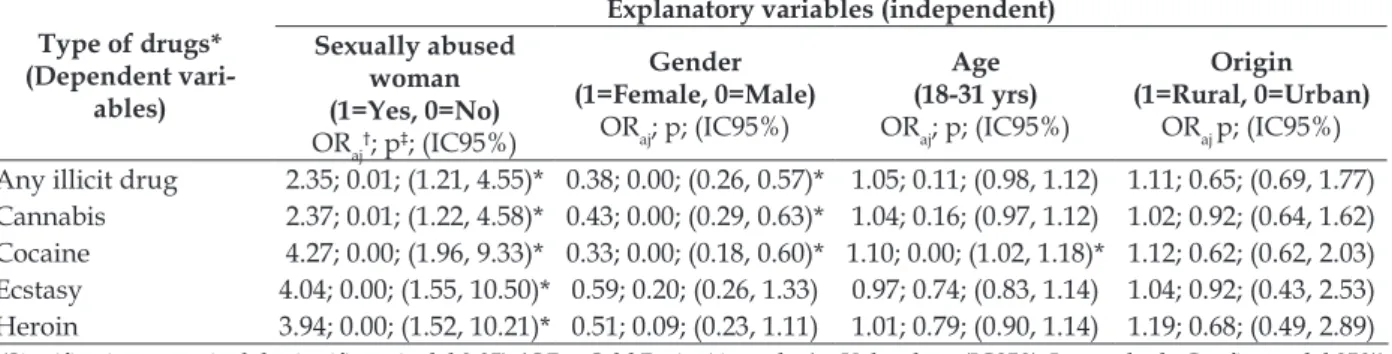
Tables 4 and 5 show the Generalized Linear Models (GLM) after controlling for gender, age, and origin of students. The GLM presented in
Table 4 shows that the possibility of students using any of the four illicit drugs (cannabis, cocaine,
ecstasy, or heroin) in the last year was ORaj=1.42 [p=0.20; CI95% (0.83, 2.44)]. The risks for using cocaine, ecstasy, or heroin were ORaj=1.98 [p=0.02; CI95% (1.10, 3.57)], ORaj=2.45 [p=0.01; CI95%(1.18, 5.08)], and ORaj=2.22 [p=0.02; CI95% (1.09, 4.52)] respectively, which allows us to afirm that the risk
for consuming one of these illicit drugs in the last 12 months was higher among students who were sexually abused during childhood when compared to those who were not (see Table 4). Table 5
pre-sents GLMs and the relationship between having
been sexually abused during childhood and being female. The results show that the risk of using any illicit drug is greater among female students who were sexually abused during childhood than
among female students who were not, ORaj=2.35 [p=0.01; CI95% (1.21, 4.55)]. Female students who
were sexually abused during childhood presented
the following risks: cocaine [ORaj=4.27; p=0.00; CI95%(1.96, 9.33)], ecstasy [ORaj=4.04; p=0.00; (1.55, 10.50)], heroin [ORaj=3.94; p=0.00; (1.52, 10.21)], and cannabis [ORaj=2.35; p=0.01; (1.21,
4.55)], compared to female students who were not abused during childhood (see Table 5).
Table 4 - Generalized linear models: factors associated with the use of any illicit drug in the last 12 months regardless of gender after controlling for gender, age, and origin of students. León, Nicaragua, 2011
Type of drugs* (Dependent
vari-ables)
Explanatory variables (independent) Sexual abuse
(1=Yes, 0=No)
ORaj†; p‡; (IC95%)
Gender (1=Female, 0=Male)
ORaj; p; (IC95%)
Age (18-31 yrs)
ORaj; p; (IC95%)
Origin (1=Rural, 0=Urban)
ORaj p; (IC95%) Any illicit drug 1.42; 0.20; (0.83, 2.44) 0.44; 0.00; (0.31, 0.62)* 1.05; 0.10; (0.98, 1.13) 1.11; 0.64; (0.70, 1.77) Cannabis 1.50; 0.13; (0.87, 2.59) 0.49; 0.00; (0.34, 0.69)* 1.05; 0.14; (0.98, 1.12) 1.02; 0.92; (0.64, 1.62) Cocaine 1.98; 0.02; (1.10, 3.57)* 0.47; 0.00; (0.30, 0.73)* 1.10; 0.00; (1.02, 1.18)* 1.13; 0.67; (0.63, 2.01) Ecstasy 2.45; 0.01; (1.18, 5.08)* 0.81; 0.51; (0.41, 1.52) 0.98; 0.82; (0.84, 1.14) 1.02; 0.94; (0.43, 2.44) Heroin 2.22; 0.02; (1.09, 4.52)* 0.70; 0.24; (0.38, 1.27) 1.02; 0.71; (0.91, 1.14) 1.18; 0.70; (0.50, 2.78) * (Signiicativo a un nivel de signiicancia del 0.05); †OR
aj ; Odd Ratio Ajustado;
‡p: Valor de p; (IC95%: Intervalo de Conianza del 95%)
* OR
Table 5 - Generalized linear models: factors associated with the use of illicit drugs in the last 12 months, with a relationship between female gender and having been abused during childhood after controlling for gender, age, and origin of students. León, Nicaragua, 2011
Type of drugs* (Dependent
vari-ables)
Explanatory variables (independent) Sexually abused
woman (1=Yes, 0=No)
ORaj†; p‡; (IC95%)
Gender (1=Female, 0=Male)
ORaj; p; (IC95%)
Age (18-31 yrs)
ORaj; p; (IC95%)
Origin (1=Rural, 0=Urban)
ORaj p; (IC95%)
Any illicit drug 2.35; 0.01; (1.21, 4.55)* 0.38; 0.00; (0.26, 0.57)* 1.05; 0.11; (0.98, 1.12) 1.11; 0.65; (0.69, 1.77) Cannabis 2.37; 0.01; (1.22, 4.58)* 0.43; 0.00; (0.29, 0.63)* 1.04; 0.16; (0.97, 1.12) 1.02; 0.92; (0.64, 1.62) Cocaine 4.27; 0.00; (1.96, 9.33)* 0.33; 0.00; (0.18, 0.60)* 1.10; 0.00; (1.02, 1.18)* 1.12; 0.62; (0.62, 2.03) Ecstasy 4.04; 0.00; (1.55, 10.50)* 0.59; 0.20; (0.26, 1.33) 0.97; 0.74; (0.83, 1.14) 1.04; 0.92; (0.43, 2.53) Heroin 3.94; 0.00; (1.52, 10.21)* 0.51; 0.09; (0.23, 1.11) 1.01; 0.79; (0.90, 1.14) 1.19; 0.68; (0.49, 2.89) * (Signiicativo a un nivel de signiicancia del 0.05); †OR
aj ; Odd Ratio Ajustado;
‡p: Valor de p; (IC95%: Intervalo de Conianza del 95%)
DISCUSSION
This study analyzed the inluence of sexual
abuse during childhood on the risk of using illicit drugs (cannabis, cocaine, ecstasy, and heroin) in the last 12 months among young students at a
public university in Nicaragua. The GLM results
show an association between sexual abuse during childhood and the use of cocaine, ecstasy, and he-roin, regardless of gender, and after controlling for gender, age, and origin of students. On the other
hand, GLM results show a signiicant increase in
the risk of using cannabis, cocaine, ecstasy, and heroin when the abused student is female. Iden-tifying the consequences of sexual abuse during childhood is essential, especially in populations for whom sexual violence is considered a public health issue, although substantial progress has been made in Nicaragua in order to address this matter.15-17
Prevalence found for the use of ecstasy (9.1%) in the last 12 months among participants in this study is consistent with the results found in the report Monitoring the Future, by the University of
Michigan’s Institute for Social Research, although
the prevalence of use of cannabis, cocaine, and he-roin is lower in our student population than in the population studied in the aforementioned report.18
After an unstratiied analysis of results, we
can see a relationship between students’ gender and sexual abuse during childhood, as well as the use of cannabis, cocaine, heroin, and ecstasy. On the other hand, an association was found between sexual abuse and the use of heroin and ecstasy, but not with the use of any other type of illicit drug.
GLMs without any relationship show that,
regardless of gender, sexual abuse during
child-hood poses a signiicant risk for using drugs in
the following order: ecstasy (ORaj:2.4); heroin (ORaj:2.3); cocaine (ORaj:1.98); and cannabis (ORaj:1.50). On the other hand, in GLMs with any
relationship, for which being a woman and having been sexually abused during childhood are taken into consideration, it is possible to observe a
signi-icant increase in the risk of using these substances, and the order of these risks is: cocaine (ORaj:4.2); ecstasy (ORaj:4.0); heroin (ORaj:3.9); and cannabis (ORaj:2.3), which is in line with recent studies on
the topic that highlight the association between se-xual abuse during childhood and the risk of using illicit drugs during adolescence and adulthood.19-21
CONCLUSIONS
The results of the present study reveal the extent of sexual abuse during childhood and the long-term effects on health, especially on female students, regarding the use of illicit drugs such as ecstasy, heroin, cocaine, or cannabis. Quantifying
the problem and identifying relationships justiies
the creation of public policies against violence, especially towards children, and the
implemen-tation of speciic programs aimed to reduce the
consumption of these types of psychoactive drugs.
Limitations
of sexual abuse during childhood and the use of illicit drugs in this population. On the other hand, the study design was cross-sectional, so we were not able to identify a causal relationship between sexual abuse during childhood and the use of illicit drugs such as cannabis, cocaine, ecstasy, or heroin.
Recommendations
Given the association found between women
who were sexually abused during childhood and the use of psychoactive drugs, we suggest that professionals and teachers who are engaged in this issue be provided with comprehensive
informa-tion about how to address sexual abuse. Regarding
the general population and especially parents or caregivers, we share the view of some researchers who suggest that the prevention of sexual abuse during childhood can be achieved through educa-tion and training of family members in the early detection of this type of child abuse.16, 20- 21
ACKNOWLEDGMENTSS
To the Government of Canada/DFAIT,
the Organization of American States (OEA), the Centre for Addiction and Mental Health (CAMH, Toronto, Canada), and to the students who kindly agreed to answer all of our questions.
REFERENCES
1. Ferrán Catalá-López, Ricardo Gènova-Maleras, Elan Álvaarez-Martín, Neran Fernández de Larrea-Baz, Consuelo Morant-Ginestar. Carga de Enfermedad en Adolescentes y Jóvenes en España. Rev Psiquiatr Salud Ment. 2013 Apr-Jun;6(2):80-5.
2. Pérez del Rio F, Martín Martín I. Nuevas adicciones: ¿Adicciones nuevas? Guadalajara: Intermedio Ediciones; 2007.
3. Fiestas F. Reduciendo la carga de enfermedad generada por el consumo de alcohol en el Perú: propuestas basadas en evidencias. Rev Peru Med Exp Salud Publica. 2012; 29(1):112-8.
4. Pérez del Rio F, Lara F, González Gutiérrez M. Abuso sexual, prostitución y dependencia efectiva en drogodepedientes. Rev Española Drogodependencia. 2010; 35(3):365-78.
5. Day A, Thurlow K, Woolliscroft J. Working with childhood sexual abuse: a survey of mental health professionals. Child Abuse Negl. 2003 Feb; 27(2):191-8. 6. Paolucci EO, Genuis ML, Violato C. A meta-analysis
of the published research on the effects of child sexual abuse. J Psychol. 2001 Jan;135(1):17-36. 7. Scott E. Hadland, Dan Werb, Thomas Kerr, Eric Fu,
Hong Wang, et al. Childhood sexual abuse and risk for initiating injection drug use: a prospective cohort study. Prev Med. 2012 Nov;55(5):500-4.
8. Degenhardt L, Bucello C, Calabria B, Nelson P, Roberts A, Hall W, et al. What data are available on the extent of illicit drug use and dependence globally? Results of four systematic reviews. Drug Alcohol Depend. 2011 Sep 1;117(2-3):85-101. 9. Olsson A, Ellsberg M, Berglund S, Herrera A, Zelaya
E, Peña R, et al. Sexual abuse during childhood and adolescence among Nicaraguan men and women: a population-based anonymous survey. Child Abuse Negl. 2000 Dec;24(12):1579-89.
10. Righthand S, Kerr B, Drach K. Child maltreatment risk assessments: an evaluation guide. New York: The Haworth Maltreatment and Trauma Press; 2003. 11. Murray J. Fisher, Andrea P. Marshall, Marion
Mitchel L. Testing differences in proportions. Aust Crit Care. 2011 May;24(2):133-8.
12. H e r r m a n n D . M a n n - W h i t n e y - T e s t . I n : Wahrscheinlichkeitsrechnung und Statistik - 30
BASIC-Programme. Germany: Vieweg+Teubner
Verlag; 1984.p. 48-50.
13. Smirnov NV. Estimate of deviation between empirical distribution functions in two independent samples. Bull Moscow University. 1933;2:3-16. 14. Akaike H. Information theory and an extension of
the maximum likelihood principle. In: Petrov BN, Csaki F, editors. Second international symposium on information theory. Budapest: Akadémiai Kiadó; 1973.p. 267-81.
15. Instituto Nicaraguense de la Mujer. Plan Nacional para la prevención de la violencia intrafamiliar y sexual. Nicaragua 2001-2006. Nicaragua: Instituto Nicaraguense de la Mujer; 2006.
16. López Sánchez F, Del Campo Sánchez A. Prevención de abusos sexuales a menores: guía para padres y educadores. Salamanca (ES): Amarú; 2002.
17. Zollner H, Fuchs KA, Fegert JM. Prevention of sexual abuse: improved information is crucial. Child Adolesc Psychiatry Ment Health. 2014 Feb 12;8(1):5. 18. Lloyd D. Johnston, Patrick M. O’Malley, Bachman
JG, Schulenberg JE. Monitoring the future national survey results on drug use, 1975–2012: secondary school students. Ann Arbor: Institute for Social Research, The University of Michigan; 2013. 19. Draucker CB, Mazurczyk J. Relationships between
childhood sexual abuse and substance use and sexual risk behaviors during adolescence: An integrative review. Nurs Outlook. 2013 Sep-Oct;61(5):291-310. 20. Putnam FW. Ten-year research update reviw: child
sexual abuse. J Am Acad Child Adolesc Psychiatry. 2003 Mar;42(3):269-78.
Correspondencia: Marlon Osman Meléndez Rodríguez Ediicio Central, Contiguo a la Iglesia La Merced,
Apartado Postal 68 - León, Nicaragua